





































Which Polish NIS 2 Regulator Governs You – and Why Does It Matter Now?
Navigating NIS 2 in Poland is not a theoretical exercise or a box-ticking formality. Your business’s resilience and reputation hinge on getting the seemingly “basic” step right: knowing, documenting, and operationalising which Polish authority governs your cyber compliance. Inaction or ambiguity here is more than a technical foul-it becomes a catalyst for investigation, escalated audits, and lost customer trust.
The fastest way to build confidence is to cut confusion at the source.
Knowing Your “Competent Authority”
For every Polish entity-whether you run a SaaS operation, logistics firm, diagnostics lab, or essential infrastructure-the assignment of a competent authority is not optional. It’s the foundation for every other compliance routine. The official registry, managed through the Cyberbezpieczenstwo portal, provides sector-by-sector mappings. These define, unequivocally, whether you answer to NASK, the Ministry of Digital Affairs, CSIRT GOV, or CSIRT MON (for military suppliers), and which incident response team holds your reporting line.
Waiting for an incident-then scrambling to cross-reference or guess-is not just inefficient. Poland’s regulators are explicit: failing to follow notification protocol is a stand-alone breach. Register now, clarify your reporting path, and avoid the panic that infects unprepared incident responses and audit narratives.
Registry, Routines, and the Audit Trail
NASK and CERT Polska operate around the clock. Their channels serve not just for emergencies but for proactive compliance touches: registering, updating, and clarifying sector boundaries. Early onboarding, handled through standardised forms and verified contact points, becomes a defensive “reasonable step” in the eyes of auditors and regulators. Even routine updates (e.g., new business lines or supply chain partners) create a digital audit trail that strengthens your stance if controls are challenged.
Reporting Timelines and Enforcement
Poland’s NIS 2 enforcement is built on minutes, not days. Once you detect a significant incident, you have 24 hours to submit first notification to the right CSIRT and to the Ministry registry. If you report to the wrong regulator or fail to provide clear cross-border mappings (e.g., GOV vs NASK for mixed operations), that’s a violation-not a formality.
Scope: Who Must Register?
Poland’s broadened NIS 2 net pulls in:
- Energy, transport, utilities
- Healthcare, pharma, critical manufacturing
- Digital B2B, SaaS, hosting platforms-including many firms above 50 employees or €10M turnover
If your entity grows or changes scope (new products, acquisition, expansion), re-register promptly. Many cross-border businesses will find themselves under dual (or even triple) authority in supply, cloud, or infrastructure chains.
Evidence: The Practical Defence
“Best effort” is not enough. NASK and CERT Polska have published model audit templates, incident response blueprints, and digital reporting protocols. Using these is not just suggested-it’s expected. Failure to produce digital confirmation logs, template-based reporting, or acknowledgment receipts weakens legal defence and procurement credibility.
Local Vocabulary Equals Competitive Edge
Major Polish buyers and government partners already circulate NIS 2 questionnaires referencing precise authority and CSIRT conventions. Get these wrong, and doors close. Precision isnt paranoia-its the new trust language.
-
Book a demoWho Falls in Scope? Polish Entity Types, Timelines, and Risks
Classifying your entity is no longer a box to tick but a process with real management, operational, and legal consequences. Polish NIS 2 compliance isn’t binary but a sliding scale that defines your enforcement risk, reporting cadence, and board-level liability.
The Compliance Scope Web
The Ministry’s scoping guide factors in more than size; it weighs sector, digital dependencies, and network links. Being “essential” or “important” is not a status you declare-it’s assigned following a thorough registry process and can shift if your business evolves.
- Essential entities: Core sectors (energy, finance, transport), direct public or economic impact, tighter reporting windows, and higher penalty ceilings.
- Important entities: Supporting digital infrastructure, SaaS, cloud, healthcare, logistics, food supply-frequently audited, mandatory registry, but with different fine structures.
- New “critical” designations are added regularly, often sweeping in cloud/email/SaaS providers serving in-scope operators.
Operational Timelines and Gateways
Registration is not optional. The clock is ticking from the moment NIS 2 transposes into Polish national law: you have 3 months to register in the official registry, identify responsible contacts, and onboard to sector-appropriate notification mechanisms. Miss the window and you face immediate compliance risk-even before an incident occurs.
Random audits and registry checks are a certainty, not a threat. Prepare a master compliance calendar (who, when, what evidence, sign-off), and ensure clear ownership, not just process documentation.
Bold risk: Letting compliance float across divisions or downplaying scope invites business suspension, infrastructure access loss, and commercial exclusion-not just fines.
International Operations and Dual Compliance
Companies straddling Polish and other EU markets must maintain dual records-one for each relevant competent authority. This often requires duplicate notification workflows, with harmonised but clearly distinct logs-failure to do this can lead to multi-jurisdictional audits and simultaneous scrutiny by more than one regulator.
Scope Creep and Audit Realities
With frequent, criteria-based expansions by NASK (especially for SaaS and data-centric services), many previously “non-critical” businesses will find their scope status shifting. A proactive, recurring check of the registry and regular dialogue with sector authorities is essential.
Polish NIS 2 Sector Mapping Table
A pragmatic tool for compliance lead and board:
| Sector/Type | Min. Thresholds | Regulator & CSIRT Contact | Registration Deadline | Key Evidence Needed |
|---|---|---|---|---|
| Energy | 50 FTE, €10M+ turnover | NASK; CSIRT GOV | 3 months | Registered ID, evidence log |
| Healthcare | As above | Ministry; CSIRT NASK | 3 months | Audit template, incident plan |
| SaaS Provider | Any size, digital B2B client | NASK; CSIRT NASK | 3 months | Supplier review, SoA |
| Transport/Logistics | 50 FTE, €10M+ | Gov/CERT GOV | 3 months | Incident log, registered evidence |
| Food Supply | Any | Ministry; CSIRT GOV | 3 months | Supplier contract, registry cert |
| Finance | 50 FTE, €10M+ | NASK; sectoral CSIRT | 3 months | Audit proof, supplier log |
This snapshot aligns every compliance event owner with their specific evidence duty, closing the gap between registry and action.
–

Master NIS 2 without spreadsheet chaos
Centralise risk, incidents, suppliers, and evidence in one clean platform.
Who Are the Polish Authorities and CSIRTs? Getting Incident Handling Right
Assigning a competent authority is not just about paperwork-it’s about survival in a crisis or under a regulator’s microscope. Incident misreporting has direct, audit-traceable consequences. Every step, from hotline call to audit proof, is part of your compliance file.
Polish Cyber Authority Map
- Ministry of Digital Affairs: Maintains central registry, sets policy, holds enforcement remit on compliance and audit failures.
- NASK / CERT Polska: 24/7 hotline and digital incident reporting for critical infrastructure, cloud/DSPs, and any digital business over scope thresholds.
- CSIRT GOV: Frontline for core governmental and utility incidents, often in parallel with NASK for shared infrastructure.
- CSIRT MON: Dedicated team for military, defence suppliers, and classified operators.
Always reference the latest mapping table and double-confirm your current sector assignment before a real incident-roles can shift as the registry updates.
CSIRT: Authority and Evidence
Every CSIRT in Poland has the power to:
- Issue binding incident response notifications
- Provide real-time guidance in major events
- Confirm (or challenge) incident closure
All logs, tickets, emails, and call receipts must flow directly into your ISMS or compliance archive. This is the core of your “reasonable effort” defence-a completed feedback cycle, not just a one-sided ticket.
Mini-table: Incident Confirmation Tracking
| Ticket ID | Incident Type | Date-time | Confirmation Status |
|---|---|---|---|
| 2024521-A | Ransomware | 2025-04-10 17:29 | Confirmed, CSIRT NASK #38721 |
| 2024521-B | Data Leakage | 2025-04-12 07:12 | Confirmed, CSIRT GOV #48192 |
Immediate logging-every contact, ticket, and response-turns incident panic into audit capital.
Escalation: When Incidents Jump Sectors
If a disturbance cuts across digital, physical, or public sector lines, the Ministry will become involved-ensuring a rapid, centralised escalation, especially for attacks impacting critical infrastructure, data or public order.
Polish Incident Reporting Checklist
- Open unique incident ticket, assign incident document ID
- Report to correct CSIRT (official email/phone, save confirmation/receipt)
- Retain acknowledgement (digital signature or logged reply)
- Trace all steps within internal ISMS or audit tool
Late or ambiguous reporting faces a near-zero leniency regime. These are legal obligations, not best-practise recommendations.
–
Building Your Polish NIS 2 Compliance File: Documentation, Evidence, and Routines
For real operational resilience, avoid relying on policy papers or “intentions.” Compliance in Poland is now measured by digital evidence and traceable documentation-not just frameworks or intent statements.
Core Compliance File Foundations
- Central registry documentation and asset/risk map: Use gov.pl for forms, process, and evidence type checklists.
- Explicit role assignments: Appoint compliance owner, evidence custodians, and backup contacts. Prove assignment via platforms or signed docs.
- Contract and supply chain discipline: Audit supplier contracts, use digital sign-off, and log third-party compliance attestations.
- Board/management sign-off for all major compliance docs.:
- Structured staff training, digitally acknowledged: Rely on e-signatures or photo records; bulk “attendance” records will not pass audit muster.
Sample Training Record Table
| Name | Title | Date | Digital Signature |
|---|---|---|---|
| Anna Kowalska | NIS 2 Intro | 02/04/2025 | AK-20250402-1 |
| Paweł Nowak | Incident Handling | 04/04/2025 | PN-20250404-3 |
Quarterly evidence refreshes and test audits are audit insurance: each milestone lessens risk exposure and boosts procurement traction.
Platformizing Your Evidence
Use a platform (ISMS.online or equivalent) to link controls, evidence logs, and submission receipts. Store digital “proof of sign-off” for every compliance event, especially where board or regulator input is required.
–
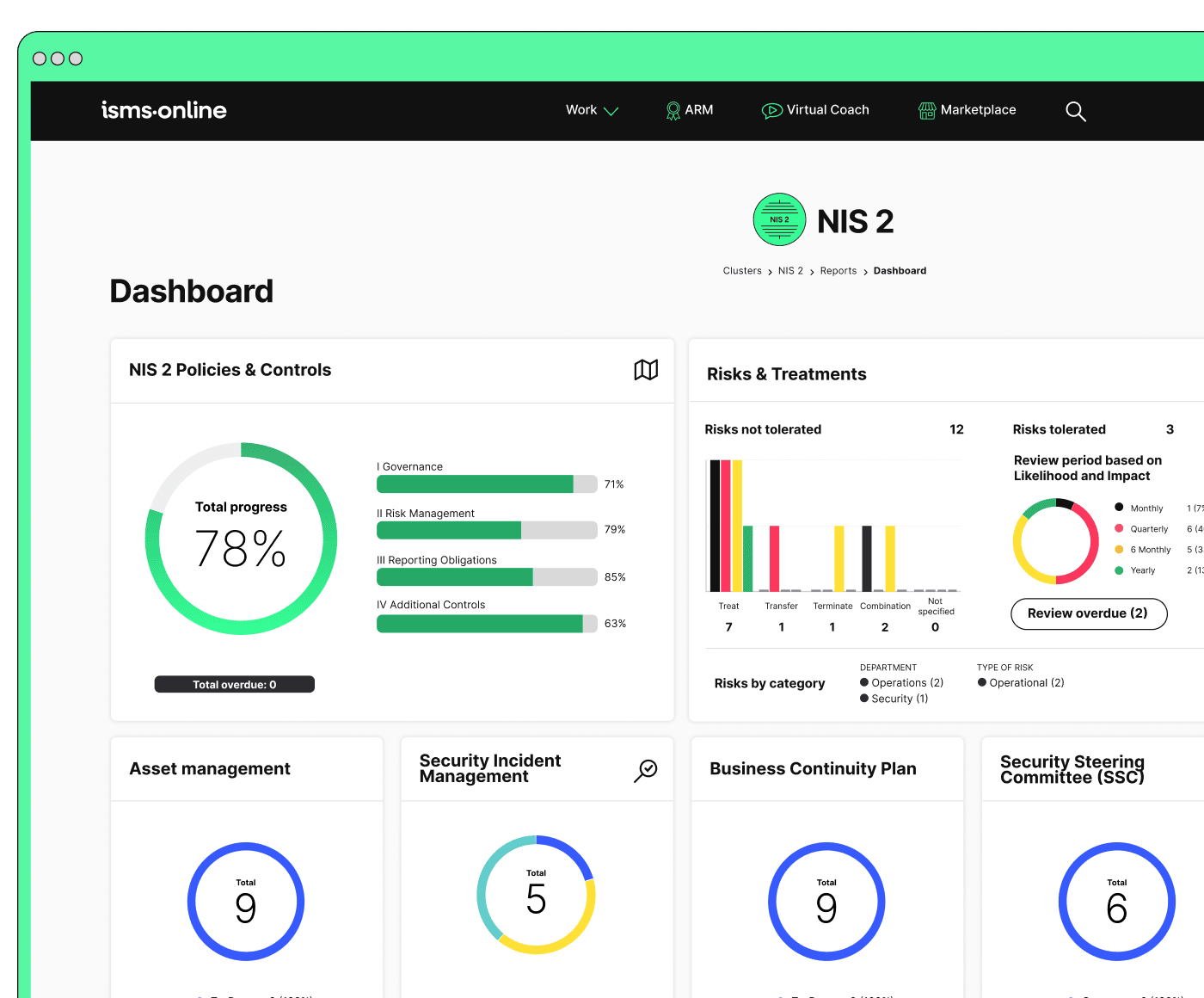
Be NIS 2-ready from day one
Launch with a proven workspace and templates – just tailor, assign, and go.
Incident Handling, Timelines, and Enforcement – The Polish Way
Timelines define Polish incident management. From detection to final report, every step is time-bound, logged, and regulator-auditable. Board members: personal liability attaches to each compliance break.
Polish NIS 2 Incident Reporting Timeline
| Step | Action | Deadline |
|---|---|---|
| Detection | Internal log of incident | Immediate |
| Notification | CSIRT & Ministry registry | ≤ 24 hours |
| Technical Details | Preliminary (short-form) technical details | ≤ 72 hours |
| Incident Remediation | Final log of event and remedial action | ≤ 30 days |
Personal accountability now extends to the boardroom: failing to report, or reporting late, can mean direct personal penalties-even operational suspension.
Documentation Stack for Incidents
- Detection log entry (internal, timestamped)
- Notification proof (email/call record, CSIRT/registry receipt)
- Signed acknowledgement of advice or escalation
- All incident communication evidence (including correction/closure logs)
- Retained 5+ years, longer if sector or contract requires
Enforcement
Penalties in Poland are significant-not only as fines but as practical disruptions:
- Essential entities: up to €10M or 2% of global turnover
- Important entities: up to €7M or 1.4% of turnover
Repeat breaches or deliberate non-compliance can see operations suspended and management barred from future roles.
–
Sector Overlap and “Grey Zones”: Solving Polish Compliance Headaches
When your business cuts across sectors-say, energy supply and SaaS hosting-you face one of the toughest NIS 2 realities: grey zone jurisdiction. Poland’s answer is unambiguous: rely on central registry records and written confirmation from the controlling authority. If uncertain, request a written opinion-this becomes hard evidence in an audit, insulating your management from charge of inaction.
A written ruling about sector assignment is audit platinum: referenced by auditors, procurement, and insurance reviewers alike.
Evolving Requirements for Digital and Supply Chain Operators
Cloud, SaaS, and supply chain entities face not only primary rules but layered requirements: supplier audits, data transfer evidence, routine external validation, and participation in NASK-run sector drills. Documenting scenario participation is proactive audit capital.
Up-to-Date Compliance is a Moving Target
Evidence packs must reflect the most recent quarterly guidance-you will be assessed not against the law’s intent but against its present, local operationalization.
–
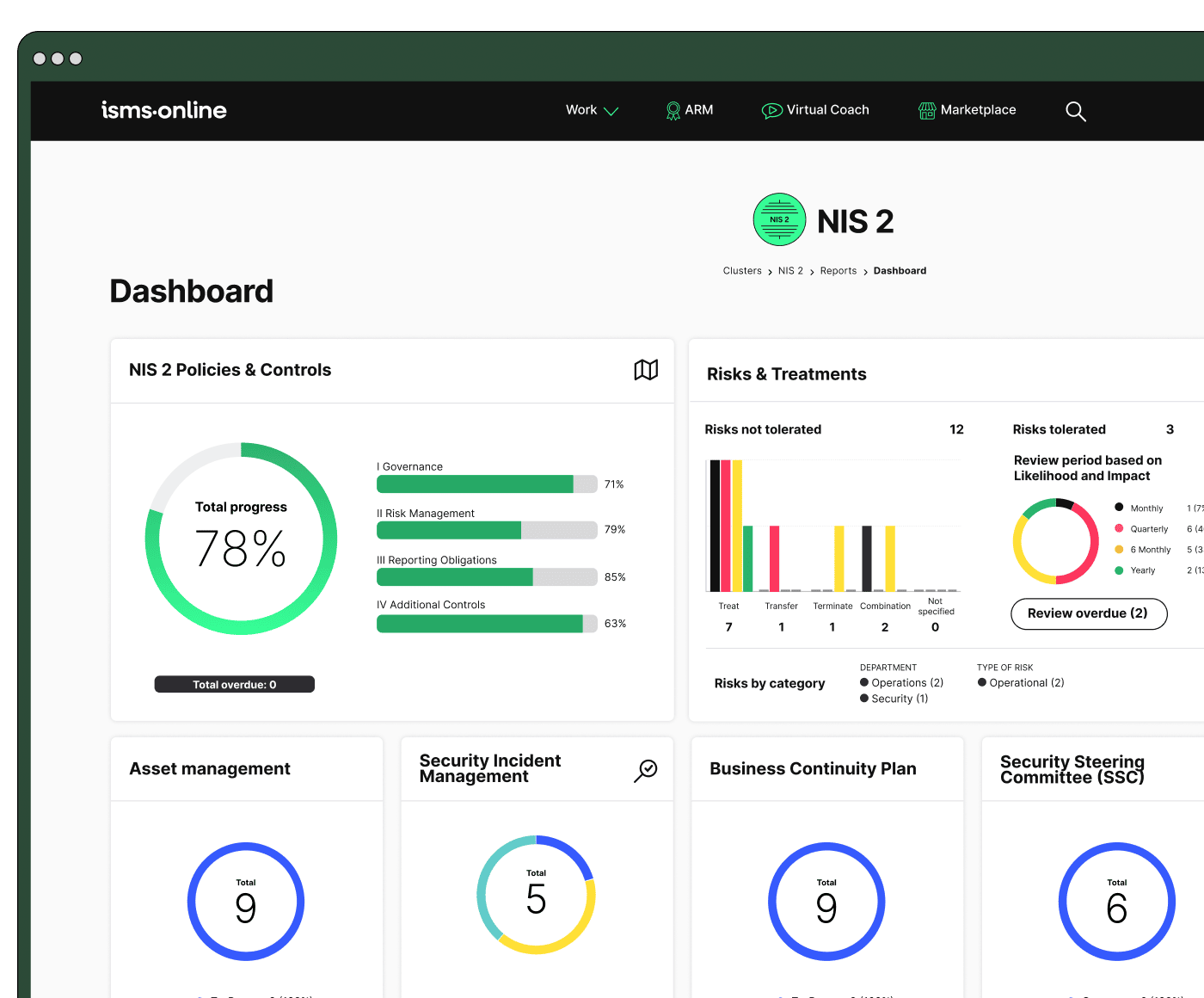
All your NIS 2, all in one place
From Articles 20–23 to audit plans – run and prove compliance, end-to-end.
Crosswalking Polish NIS 2 and ISO 27001 – Fast Tracking Audit Readiness
Bridging NIS 2 and ISO 27001 in Poland isn’t optional: it’s the best pathway to audit speed, trust, and commercial advantage. Both ISMS.online and Polish authorities supply mapping templates for every requirement-to-control linkage.
Polish–ISO 27001 Mapping Table
| Expectation | Operationalisation | ISO 27001 Reference |
|---|---|---|
| 24h Incident Reporting | CSIRT ticketing, hotline, logs | A.5.24–A.5.25 |
| Supply Chain Assurance | Third-party audits, logs, reviews | A.5.19, A.5.20 |
| Management Sign-off | Signing, approval workflows | 5.2, 5.3, A.5.1 |
| Policy Mapping | Cross-domain mapping, SoA | SoA, A.5.34 |
| Staff Training | Digital logs, evidence tracking | 7.2, 7.3 |
Traceability Mini-Table
| Trigger | Risk Update | Control/SoA Link | Evidence Logged |
|---|---|---|---|
| CSIRT call | Incident registered | A.5.26, SoA | Ticket, CSIRT confirmation |
| New Supplier | Due diligence logged | A.5.19–A.5.21 | Supplier review, contract |
| Training Event | Skills update | 7.3, A.6.3 | Digital log, acknowledgement |
Auditor review, contract negotiation, or procurement review is vastly simplified when every event in your compliance log is already mapped.
–
Accelerating Polish NIS 2: From Boardroom Wins to Everyday Resilience
Compliance isn’t a tax-it’s business capital. In Poland, NIS 2 is now a board-level, procurement-ready asset: the quality and currency of your evidence signals trust not just to regulators but to banks, partners, and even potential acquirers.
Turning Compliance into Operational Advantage
Take compliance from “project” to “daily advantage” with live dashboards that track:
- Audit readiness: at-a-glance boards for executives, auditors, buyers
- Real-time reporting: incident queues, deadlines, open/closed flagging
- Policy status: % acknowledged, overdue renewals, sign-off logs
- Evidence gaps: reminders for missing or ageing controls
Proactive compliance routines, visible to decision-makers, unlock smoother audits, faster procurement, and less day-to-day firefighting.
A live question today means minutes saved tomorrow. Don’t wait until the notice arrives-build your compliance advantage now.
Organisational Value: From Defensive to Decisive
Entities that surface compliance routines proactively secure reputation, unlock financing, and create margin with regulators. Teams that treat evidence as “active capital” consistently outperform laggards stuck in fire-drill mode. This is how you set a compliance benchmark-before the market forces you to catch up.
–
ISMS.online Today: Your Polish-Ready Compliance Solution
Your compliance team’s greatest value lies in turning regulatory demand into procurement and reputational advantage. ISMS.online offers a platform, natively aligned with Polish NIS 2 mandates, that brings together registry requirements, sector assignments, policy packs, audit routines, and sector- and regulation-specific evidence logs. Staff engagement and sign-off, routine monitoring, and up-to-date sector templates accelerate compliance, close procurement gaps, and surface risk issues before they become bottlenecks for board or buyer.
When scope, sector, or regulatory advice changes, ISMS.online pushes new sector modules, updates audit maps, and ensures your evidence trails stay ahead of audit and incident review cycles. This is compliance as capital-measurable, visible, and ready to be showcased when it matters.
You set the compliance benchmark. Make resilience your competitive metric-while others chase checklists.
Frequently Asked Questions
Who supervises NIS 2 compliance in Poland, and why does sector mapping require immediate focus?
Poland’s NIS 2 compliance is supervised by a distributed network: the Ministry of Digital Affairs (Ministerstwo Cyfryzacji) is the national cornerstone for official registration, but each sector-like energy, health, finance, and digital services-assigns its own “competent authority” (NCA) with tailored requirements and communication channels. Overlaying this, three national CSIRTs (NASK, GOV, MON) oversee incident response by company type. Recent expansions mean any organisation with more than 50 staff or €10M turnover, including SaaS vendors and logistics providers, faces direct obligations. Immediate and accurate sector mapping is essential because a misstep here-like registering with the wrong body or neglecting a required notification-can result in penalties, missed tenders, or audit failures.
Compliance in Poland isn’t about following a single checklist-you must trace and document exactly which authority governs each of your core obligations before a regulator or customer requests proof.
The Ministry’s cyber-security portal publishes up-to-date sector assignments. Best practises include requesting written sectoral assignment confirmation from the registry and retaining it in your audit trail-this letter is often your strongest evidence in regulatory disputes or cross-border contract bids.
Why is urgency so high now?
Since 2024, NIS 2’s expanded coverage has brought formerly unregulated organisations-SaaS, MSPs, manufacturers-into direct regulatory oversight for the first time. Sector mapping mistakes have already triggered “grey zone” legal disputes and unplanned audits. Timely documented mapping gives you not only regulatory protection but also a critical edge in supply chain eligibility and high-value tenders, ensuring your compliance credentials never fall behind or become a barrier to growth.
How can you pinpoint the correct Polish CSIRT, and what incident notification timelines are law?
Each company must assign its CSIRT pathway and document this in its security policy-this is a foundational compliance anchor in Poland. The three core CSIRTs are:
- CSIRT NASK: For most private sector firms, IT and cloud providers, and academia. Reach at info@cert.pl or +48 22 380 82 74.
- CSIRT GOV: For government and critical state infrastructure. Contact csirt@csirt.gov.pl or +48 22 58 59 373.
- CSIRT MON: For military and defence organisations. Contact csirt-mon@ron.mil.pl or +48 261 871 641.
NIS 2 mandates a strict, three-stage incident escalation for notifiable events:
- Initial notification: Within 24 hours of detection (requires a log or call record).
- Detailed report: Within 72 hours (includes scope, impact, and response).
- Final report: Within 30 days (“lessons learned,” root cause, mitigations). See.
Assign a named staff member or small response team to own this process, and create digital, timestamped records for all notifications. Auditors increasingly request not just proof of notification, but evidence that the correct CSIRT was selected and involved under time constraints-a simple error here can trigger extended investigation.
How to bulletproof your reporting rhythm
Document each notification with a scanned email, helpdesk ticket, or call log, and seek written confirmation from your CSIRT after each incident. Building this workflow into your ISMS or compliance dashboard is a proven defence, and it markedly raises your audit readiness.
What are Poland’s key NIS 2 compliance deadlines, audit timelines, and documentary requirements?
Your core deadlines and evidence practises:
- Register with the national NIS registry: Within 3 months of entering scope (from law enactment or organisational change).
- Implement an ISMS (including risk, business continuity, policies): Within 6 months of applicability.
- First compliance audit: Within 24 months under scope, repeating every 3 years.
Evidence requirements:
- Full asset and risk registers: (include IT, physical, digital, supply chain).
- Incident logs: Retain all tickets, emails, and direct CSIRT communications.
- Board approvals and authority signoffs: Digital signatures or signed meeting minutes.
- Supplier due diligence files: Completed checklists, risk reviews, and sector assignments.
- Staff training records: Digitally signed logs, refreshed annually.
| Milestone/Event | Audit Evidence | ISO 27001 / Annex A |
|---|---|---|
| 24h incident reporting | CSIRT email, call log | A.5.24, A.5.25 |
| Executive signoff | Board minutes, e-approval log | 5.2, 5.3, A.5.1 |
| Supply chain check | DD worksheet, SoA sheet | A.5.19–A.5.21 |
| Policy/status mapping | SoA and policy doc | A.5.34, SoA |
Auditors expect evidence to be real-time and rolling-not backfilled before audit. Every log or approval should map to both the NIS registry and your ISO 27001 Statement of Applicability.
How do “grey zone” sector assignments and dual obligations affect your NIS 2 duties in Poland?
NIS 2 compliance in Poland is sector-driven: your official sector (or sectors) determines your authority, audit scope, and notification chain. Grey zones arise when your activities (e.g., SaaS with both healthcare and finance clients) fall into multiple categories, requiring dual assignment and multiple register entries. The risk: missing an assignment or failing to maintain confirmatory evidence can mean non-compliance even for diligent organisations.
To safeguard your compliance:
- Always request and archive a written assignment confirmation from either the registry (Ministry of Digital Affairs or NASK) or your sector’s NCA.
- If you join sectoral incident exercises, file attendance proofs-this practical evidence strengthens your compliance posture and is viewed positively by auditors.
- Recognise that “digital providers” now includes most SaaS, MSP, and IaaS companies, while “energy” assignments reach deep into industrial and extraction supply chains.
A single email from the registry, naming your sector, is the line between a routine audit and a drawn-out regulatory query-always get confirmation.
Why do Polish authorities demand ISO 27001 mapping for every NIS 2 process, document, and incident?
ISO 27001 is the gold standard for documenting, verifying, and communicating NIS 2 compliance in Poland. Increasingly, auditors, boards, and procurement teams want to see explicit mapping: every control, risk, incident response, and policy tied directly to both the relevant ISO 27001 clause and legal/NIS registry requirement.
Bridging compliance-how to do it:
- Your *Statement of Applicability* (SoA) should cite the exact NIS 2 clause and Polish law provision for each applied control, supported by links to real artefacts and change logs.
- Every major compliance artefact-incident log, contract, training certificate-should be mapped within your ISMS, cross-referencing both the ISO control and national requirements.
| NIS 2 / Polish Provision | Evidence Link | ISO 27001 / Annex A |
|---|---|---|
| 24h CSIRT notification | Notification record | A.5.24, A.5.25 |
| Board/management approval | Signed minutes, SoA page | 5.2, 5.3, A.5.1 |
| Supplier vetting | Due diligence worksheet | A.5.19–A.5.21 |
| Training completion | Digital log, signature | A.6.3, A.8.7 |
ISMS.online aligns Polish and ISO requirements via mapping flows, templated policy packs, and artefact crosswalks-ensuring that your next audit or procurement review passes at first attempt and registration updates occur seamlessly.
What are the real consequences in Poland for NIS 2 non-compliance or poor documentation?
Penalties for NIS 2 breaches are now prompt and uncompromising:
- Financial: Up to €10 million or 2% of global turnover for “essential” companies; €7 million / 1.4% for “important” entities.
- Operational: Persistent non-compliance triggers audits, business licence suspensions, or executive blacklists.
- Procurement: If you cannot produce documented evidence (registrations, logs, authority letters, incidents) instantly, you risk being barred from public tenders and dropped from supply chains.
Organisations that maintain clear, dynamic sector assignments, log all authority and CSIRT communications, and digitise evidence (not just archive paperwork) consistently avoid fines, win audits, and stay in the eligibility pool for regulated procurement projects.
How does ISMS.online unify Polish NIS 2, ISO 27001, and ongoing compliance management?
ISMS.online delivers a platform tailored to Poland’s NIS 2 and ISO 27001 landscape-from registration through each audit cycle, evidence update, and notification event:
- Sector assignment and CSIRT mapping assistant: Rapidly confirm sector, NCA, and CSIRT; auto-log all correspondence; and generate documentation suitable for audit.
- Evidence artefact engine: Drag-and-drop policy, SoA, incident, or training record linking directly to Polish and ISO references for seamless reporting.
- Automated reminders and sign-off logs: Trace board or NCA decisions, incident reporting, and staff training in one dashboard to maintain a ready audit trail at all times.
- Grey zone defence: Archive sector assignment documents, participation in incident readiness drills, and handle dual sector notifications effortlessly.
In Poland, regulatory readiness is a living workflow. By mapping sector logic, incident timelines, and authority communications into your daily ISMS routine, you transform compliance from a paper chase into a habit-and stand out when the auditors come calling.






