





































Who’s at Risk Under NIS 2-And Why “Not My Problem” Ends Up on Your Desk
NIS 2 is not just another bureaucratic curveball. If your organisation provides, supports, or relies on critical infrastructure, technology, or digital services, you can’t assume the new Directive is “above your pay grade” or someone else’s headache. A single supply chain link-or a single client-brings liability to your boardroom before you even receive a formal letter. The reality is stark: in the world of NIS 2, accountability trickles down and upstream simultaneously, cutting across business lines and exposing new points of legal and operational risk with every new contract.
When accountability is fragmented, risk quietly multiplies in forgotten corners.
The Lateral Spread: Are You Actually In-Scope?
By late 2024, the NIS 2 coverage net sweeps broad: energy, digital infrastructure, health, finance, transport, manufacturing, ICT, cloud provision, data centres, research, and regulated digital platforms. In practise, even if you believe you’re an “ancillary player,” supply chain proximity drags compliance onto your agenda. Many businesses only realise they’re caught when a customer demands NIS 2-aligned assurance, not when an authority knocks first.
| Organisation Type | Commonly in Scope? | Direct Board Duties | Supply Chain Risk Duties |
|---|---|---|---|
| SaaS (B2B) Vendor | Yes | Yes | Mandatory flowdown clauses |
| MSP / IT Service Provider | Often | Yes / Maybe | Diligence, rapid reporting |
| Hospital/Finance Operator | Always | Yes | Downstream contract review |
| Software Integrator | By proximity | No (unless critical) | Incident report relay |
If your team means to “wait and see,” a contract revision may force an urgent rethink-too late for a strategic approach, and risky for your executive team. Map your dependencies and obligations now, before an incident tests your assumptions.
ISO 27001: Foundation, Not a Pass Card
ISO 27001 certification remains a strong compliance bedrock, but NIS 2 introduces new expectations that go beyond best practise checklists. The Directive mandates direct board involvement in oversight, rapid, regulated breach notification, rigorous supply chain evidence, and demonstrable proof of ongoing control effectiveness. Legal protection now requires active, living evidence-not just a certificate.
Boardroom Heat: Personal Liability Is In
Directorial and management responsibility sits at Article 20’s core. If you sit-or deputise-on the board, you’re personally on the line for missing policies, late incident reporting, or lack of control visibility. Executive “blind spots” are now a reputational and financial exposure, not a technical footnote.
Hidden Spread: Supply Chain Osmosis
Contract and supplier risk is fatal when left to bounce between teams. Studies show nearly 40% of supplier-side non-compliance emerges from customer-driven contract updates-even before formal regulatory action lands. If you havent updated your supplier mapping or reviewed upstream dependencies, a cascading incident could place both your contracts and your regulator standing on the line.
Pause-and-act prompt: Has your senior leadership mapped the latest NIS 2 impact-across business units, supplier agreements, and critical services? If you depend on someone else to own it, youll pay for it, consciously or not.
Book a demoWhat Are the Real NIS 2 Deadlines-and Why Delay Puts You at Immediate Risk
By autumn 2024, NIS 2 ceases to be an abstract compliance goal-the clock is already ticking if you expect to win business or avoid sanctions. The most common compliance pitfall? Teams assume the law applies only after overt notifications or sector alerts. In truth, the law’s “immediacy” clause means audit, breach, and evidence requirements hit the day you are in scope.
Compliance leadership is earned in the months before a crisis, not during the audit post-mortem.
First 30 Days: What Leaders Do Differently
Red flags wave for companies that stall the appointment of a compliance sponsor or fail to identify their precise operational boundaries. Teams who appoint executive sponsorship and cross-functional steering committees immediately achieve twice the compliance rate.
Immediate-action checklist:
- Map organisational structure (include all subsidiaries, critical suppliers, cloud dependencies).
- Assign board or executive-level NIS 2 sponsorship (not just “compliance delegate”).
- Stand up a steering committee (IT, risk, legal, procurement, business ops).
Reactive teams are left in a lurch-waiting for guidance, only to run remediation in a haze of late nights, missed deadlines, and cost overruns.
The No-Slack Countdown: Breach Notification and Legal Ticks
The headline NIS 2 timer: 24 to 72 hours for incident notification. There’s no grace period for half-formed plans or ongoing projects. All evidence, contracts, and escalation points must be in place before the breach, not after.
Mini-case: A regional logistics IT provider realised too late it had a key pharmaceutical chain as a client. Ransomware hit the chain, contractually binding upstream notification, but the incident register was blank-no plan, no owner, no defined reporting. Contract penalties and customer loss began long before regulators stepped in.
Procurement & Legal: The Drag No One Volunteered For
Contrary to myth, most NIS 2 failures trace to contractual and legal process backups. 70% of missed notifications are due to slow supplier responses or procurement/contract teams lagging on review. Compliance excellence is as much about smoothing contract amends and legal sign-offs as patching networks.
Practical Enablement: How ISMS.online Shrinks Lag and Error
Platforms like ISMS.online deliver pre-mapped policy packs, live reminders, and role-based onboarding workflows-reducing “missed” actions and documentation gaps by up to 40% (isms.online). For leaders, this means less consultant spend and more accountability clarity-non-specialists can step through compliance without waiting for outside help, turning slow review cycles into actionable, time-locked reminders.
Are your department-level and supply chain owners genuinely clear on their responsibilities? Is there a missing notification triggered by legal waiting for procurement or vice versa? Map your accountability, activate reminders, and commit to visible deadlines or pay in stress and lost business later.
The margin between compliance and exposure is daily, not annual.

Master NIS 2 without spreadsheet chaos
Centralise risk, incidents, suppliers, and evidence in one clean platform.
How Do NIS 2, ISO 27001, and NIST Actually Map-And What’s Vulnerable During an Audit?
“Does our ISO 27001 certificate mean we’re automatically compliant?” Teams unsurprisingly find themselves split-legal satisfied, tech anxious, auditors unimpressed. The gap isn’t just one of framework alignment-it’s about productive traceability and real-time proof.
The Bridge: Expectations to Living Evidence
NIS 2 auditors require end-to-end links-from policy to person, action to timestamp, evidence to board sign-off. A compliance plan on paper, locked in a spreadsheet, or delivered via annual review is no longer sufficient.
| NIS 2 Expectation | Action in Practise | ISO 27001 / Annex A Reference |
|---|---|---|
| Continuous supply chain risk oversight | Vendor registry, annual contract & evidence check | Ann. A.5.19, 5.20, 5.21 |
| Board-level risk management and oversight | Quarterly management review minutes, role matrix | Cl. 9.3, Ann. A.5.4, 5.36 |
| Incident notification (24/72 hr) | Rehearsed incident playbooks with live contacts | Ann. A.5.24, 5.25, 5.26 |
| Live risk management (not static) | Up-to-date risk register, periodic review logs | Cl. 8.2/8.3, Ann. A.5.7 |
| Control testing with attached evidence | Automated reports, audit logs, live approvals | Ann. A.5.31, 5.35, 5.36 |
Auditors want to see the path. Who owns it? When was it last tested? Where’s the proof today, not last year?
Mini-case: Mapping Mismatch
An ISO 27001-certified German SME assumed “pass-through” for NIS 2. The audit trailed a live ransomware incident at a supplier. When asked for start-to-finish evidence-from event to resolution-they could not produce linked logs or review sign-offs. The result: flagged non-continuity, a much longer audit, and a scramble to correct both process and documentation.
Traceability Chain: Trigger to Action to Evidence
Modern audits follow a linear thread. For every incident, policy review, or supplier event:
| Trigger Event | Risk Update | Control / SoA Link | Audit Evidence Example |
|---|---|---|---|
| Supplier breach | Add supplier event | Ann. A.5.19, 5.21 | Incident log, contract |
| Phishing failure in training | Add user action | Ann. A.6.3, 6.4 | Training record, test log |
| Policy triggers new risk | Update register | Ann. A.5.7, Cl. 6.1 | Board minutes, risk entry |
| Anomalous login in SIEM | Raise incident | Ann. A.5.24, 8.16 | SIEM alert, response log |
| Regulators request supplier check | Review vendor certs | Ann. A.5.20, 5.35 | Certification, audit log |
Any break in this chain-missing sign-off, absent link, out-of-date document-triggers audit findings, mitigation cycles, and reputational dents.
The connectedness of your compliance evidence is now as important as its completeness.
Sector-specific Caution: One Size Does Not Fit All
Banking, health, energy, and other sectors overlay NIS 2 with DORA, GDPR, and national carve-outs. Always check the latest regulator/association interpretation. “Close enough” control claims quickly become audit gaps as sector codes evolve.
Ask now: When did your organisation last perform an all-sectors, all-standards control and policy update?
Prove Your ISMS is “Living”-The Shelfware Trap and What Audit-Ready Means
The NIS 2 era isn’t impressed with shelfware or “set-and-forget” compliance. A living ISMS marks progress, role ownership, activity, and evidence-all as real-time data points, not archived artefacts.
A living ISMS is built on transparency-proof of every step, every owner, every result.
Evidence Logging and Traceability
- Live logs: Timestamped incidents, risk, and evidence with clear role owners.
- Dashboards: Real-time gap and closure monitoring, not just annual summary graphs.
- Reminders: Automated (and role-based) prompts for overdue policy review, testing, and evidence collection.
- Evidence attachments: Documents, contracts, training logs, and incident records directly linked to controls and policies.
- Improvement cycles: Every management review, audit, or policy test creates new logs-with visible status and assigned next actions.
Persona in Practise: Practitioner or Compliance Lead
If you’re charged with compliance delivery, the right platform automates reminders, flags overdue action, and tracks everything by owner-not by CC chain or lost email. Managers gain peace of mind seeing task status, while IT and legal build a credible audit trail with minimal admin.
The difference between compliance and non-compliance is now measured in reminders sent and logs completed.
From Siloed Duties to Shared Ownership
A living ISMS requires co-ownership across roles and departments. Evidencing a breach, control update, or contract review always puts an owner’s name and timestamp in the log, visible to managers and auditors alike.
| Triggered Action | Assigned Role | Automated Reminder? | Tracked in ISMS? |
|---|---|---|---|
| Supplier review | Procurement | Yes | Registry, contract |
| Policy annual review | Compliance | Yes | Review log, SoA link |
| Drill/test remediation | Security lead | Yes | Test log, lessons |
| Audit gap closure | Business/IT leader | Yes | Issue tracker, log |
This interconnected visibility forms the essential evidence web for board, audit, and regulator reporting-erasing ambiguity and collapse in accountability.
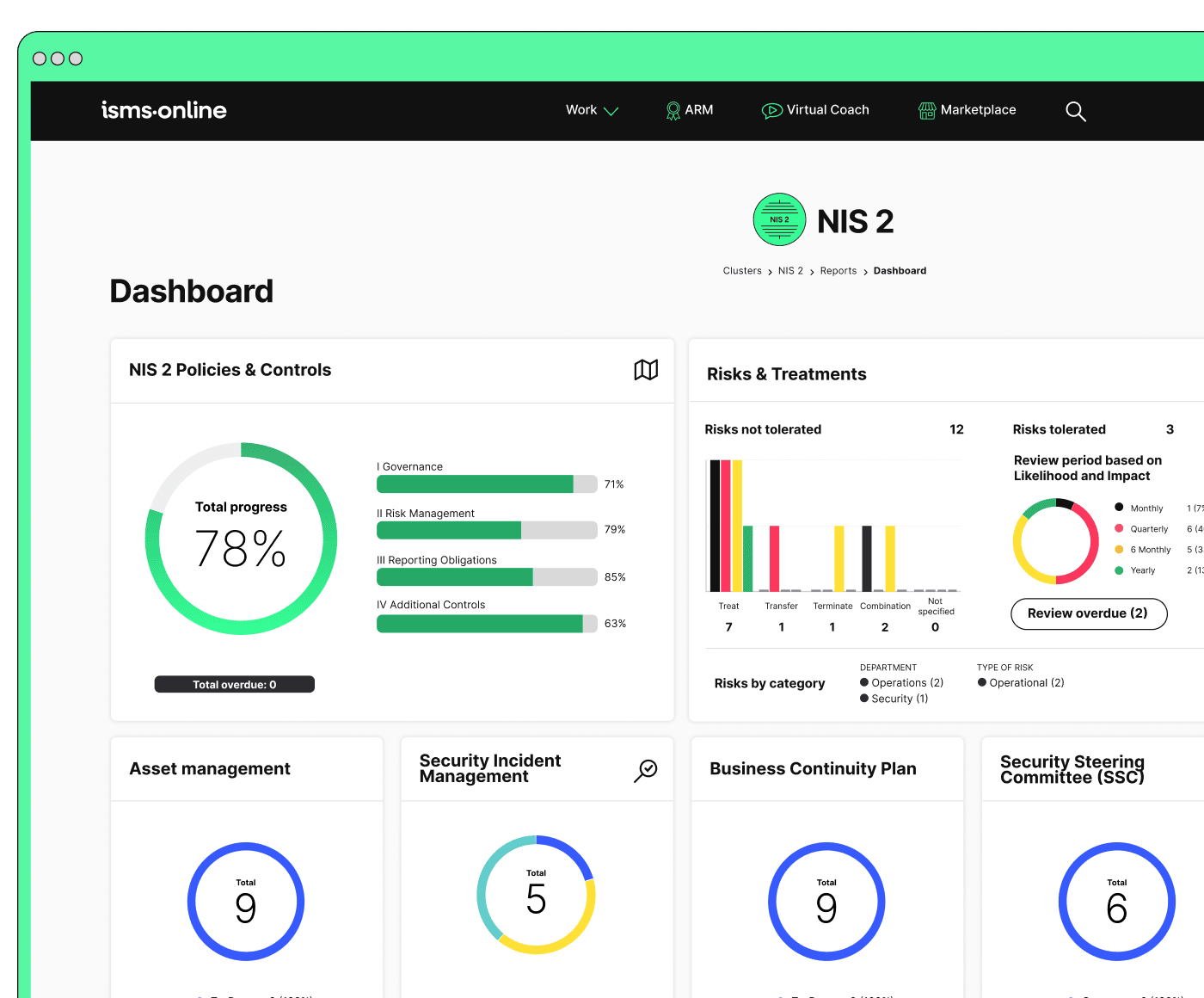
Be NIS 2-ready from day one
Launch with a proven workspace and templates – just tailor, assign, and go.
Can You Really Prove Supply Chain Compliance-Or Are You Hoping for the Best?
Under NIS 2, supply chain exposure is both your biggest risk and your hardest gap to close. You bear new upstream and downstream responsibilities. If your suppliers breach, you may pay the penalty; if you ignore evidence collection or contract clauses, you can lose regulator trust and customer business overnight.
Compliance risk is now collective-a single weak link can unravel your whole chain.
Mini-Case: The Supply Chain Wake-up Call
A SaaS healthcare provider, secure internally, overlooked a third-party HIPAA processor with incomplete reporting agreements. An external breach occurred, the vendor failed to report within regulatory windows, and the provider took the PR and financial hit-not because of a technical weakness, but a contractual and process oversight.
The Wheel of Supply Chain Evidence
| Process Step | Required Action | ISO / NIS 2 Reference | Evidence Logged |
|---|---|---|---|
| Map suppliers | Update registry annually | Ann. A.5.19, NIS 2 Art 21 | Supplier log, review |
| Vet and screen | Document contract, scan risk | Ann. A.5.20, 5.21, Art 25 | Contract, audit cert |
| Add contract clauses | Insert incident/audit terms | Ann. A.5.20, 5.26, Art 25 | Signed contract |
| Ongoing review | Run vendor questionnaires | Ann. A.5.21, Art 21 | Compliance emails, log |
| Audit/close gaps | Demand evidence, log | Ann. A.5.35, Art 32 | Audit closure log |
For CISOs and practitioners, audit priorities shift from internal dashboards to supply chain diligence, accelerating the transition from a trust-based to a proof-based ecosystem.
Automated Cycle: From Chasing to Tracking
Using platforms like ISMS.online, periodic supplier reviews, recertification reminders, and contract gap logs move out of email and into the compliance operating system. Dashboards flag overdue actions, and rapid evidence collection can intercept failures before they cascade. Teams who automate these cycles reduce audit findings, avoid chronic rework, and position themselves as trusted supply chain partners.
Visibility isn’t a wish-it’s the mechanism for closing risk before it materialises.
Why Regular Incident Drills and Evidence Loops Decide Compliance Survival
NIS 2 resilience lives and dies by rehearsal and readiness. Boards and auditors no longer accept static plans; evidence of tested, adaptive response separates robust ISMS implementations from paper programmes.
A playbook untested is a risk unacknowledged.
The Cycle of Preparedness
- Tabletop exercises are scheduled, logged, and reviewed-with learning points carried into audit evidence.
- Actions and gaps from drills are entered into issue trackers-status, ownership, and timelines always visible.
- Anti-phishing, incident response, and continuity are practised and reported as living cycles.
- Missed or overdue drills trigger at-risk flags in system dashboards, prompting leadership accountability.
- Peer assessment follows each test-driving organisational learning and compliance improvements.
| Activity | Recommended Frequency | Evidence Example | Audit-Ready? |
|---|---|---|---|
| Tabletop drill | Annual | Drill log, lessons review | Yes |
| Phishing test | Quarterly | Results log, retraining notes | Yes |
| Contact roster | Six-monthly | Updated roster, test messages | Yes |
| Audit closure | After finding | Closure tracker, sign-off | Yes |
Security leaders must think in cycles, not sprints. The best teams treat every test as a dress rehearsal for the real thing-building documented assurance, not anxiety. Practitioners who automate these cycles and surface evidence to leadership gain recognition and establish a resilient brand.
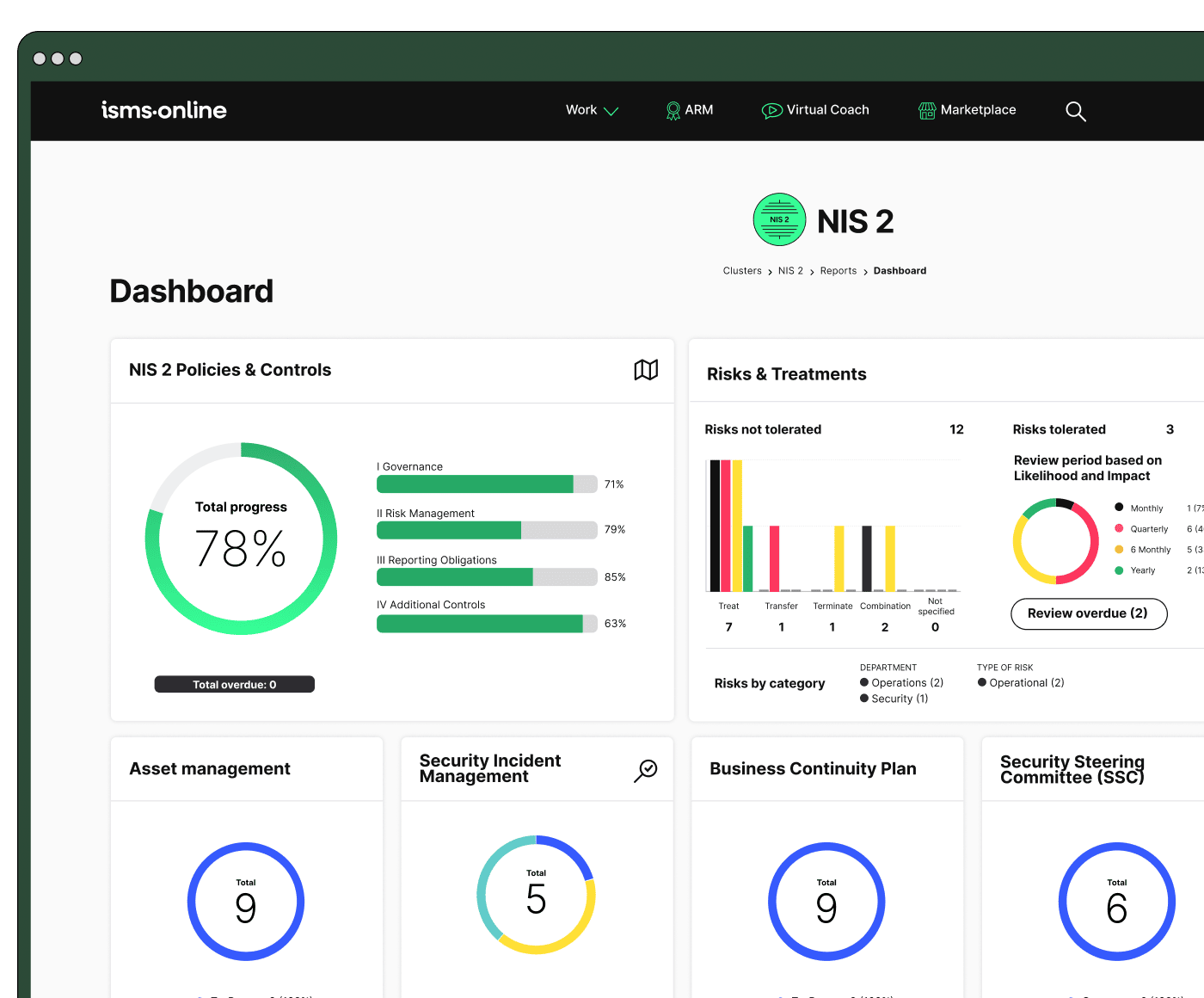
All your NIS 2, all in one place
From Articles 20–23 to audit plans – run and prove compliance, end-to-end.
Continuous Compliance-How Do You Prove “It’s Alive”?
Today’s compliance is not a year-end party-trick-NIS 2 teams are judged on daily mastery. Risk status, audit points, and open gaps are dynamically visible, always a click away from being shown to an auditor, client, or board.
Continuous compliance is a culture, not a one-off achievement.
Digital Flow, Evidence, and Board Confidence
- Dashboards show live status of every control, overdue evidence action, and policy cycle.
- Every risk is traceable: completion rate, action status, test coverage.
- Board and audit committee requests go from agenda to evidence-entirely inside the ISMS, not scattered over email or spreadsheets.
- Regulatory shifts, new threats, and audit findings are system-logged, actioned, and closed transparently.
| Event | Tracker Output | Control Reference | Audit Evidence Example |
|---|---|---|---|
| Vendor cyber incident | Automated trigger log | Ann. A.5.19, 5.21 | Vendor breach log |
| Law change | Gap assessment entry | Cl. 6.1, 9.3, A.5.7 | Board review, register |
| Audit finding | Remediation action log | Ann. A.5.35, 5.36 | Issue closure, sign-off |
| Board request for risks | Dashboard export | Ann. A.5.7, SoA | Risk register, SoA file |
Practitioners become operators of the compliance day-to-day-directing reminders, closing actions, updating logs. CISOs present confidence to board and investors. Legal and privacy teams show defensible evidence to regulators.
Every evidence trail is a thread in your wider system of trust-when it’s visible, risk is manageable.
Identity CTA: Build with ISMS.online-The System that Proves Itself
Instead of chasing policies, let your system chase you. Leverage ISMS.online for persistent reminders, visible ownership, and always-on audit readiness. Resilience is not a checkbox, nor is it one persons responsibility. Its a system of transparent, collective action, looping through every owner and every day.
Ready to make compliance a living part of your culture? Lets put your system to the test, today.
Book a demoFrequently Asked Questions
Who must comply with NIS 2, and how does “in scope” change what’s required of your organisation?
If you operate in the EU or deliver essential services-think energy, finance, healthcare, water, transport, or digital infrastructure-or act as a key supplier, platform, or SaaS vendor serving those sectors, NIS 2 almost certainly applies to you. The “in scope” net is now cast much wider than it was under the original NIS Directive. Not just large enterprises, but also managed service providers and smaller vendors, are required to comply if their failure would ripple upstream. Critically, in 2024 and beyond, NIS 2 compliance is as likely to appear in contracts and procurement RFPs as it is in regulatory documents, with many organisations already inserting “NIS 2 ready” as a prerequisite for doing business.
This expansion raises the consequences: board-level accountability, prescribed incident timelines (24-hour initial notice, 72-hour follow-up), documented risk cycles, and real supply chain controls. The penalties for missing the mark are high-up to €10 million or 2% of turnover, with additional reputational fallout from being tagged as a liability by customers or partners. But the upside is growing too: embedding compliance not as fire-fighting, but as proof of trust-making your ISMS an operational asset that accelerates deals.
What does “in scope” require you to do immediately?
- Check for direct and indirect obligations: Review NIS 2 Annex I & II; do you, your subsidiaries, or your critical suppliers appear?
- Map supply chain exposure: Scope isn’t just about your firewall-supplier, partner, and outsourcing relationships are now scrutinised.
- Appoint a board-level sponsor: NIS 2 requires a named, executive-level owner for compliance and evidence.
- Anticipate customer-driven deadlines: Begin “NIS 2 readiness” planning now, as clients often impose earlier contractually enforced timeframes than regulators.
NIS 2 has shifted from a compliance afterthought to a front-line business philtre-your ability to prove readiness shapes whether partners see you as a risk or a safe bet.
When does NIS 2 enforcement begin, and why are some organisations missing hidden urgent deadlines?
Enforcement rolls out EU-wide in April 2025, but waiting until the official date can already put your organisation behind the curve. Why? Many key deadlines are triggered the moment you’re declared “in scope”-including requirements to acknowledge incidents within 24 hours, report updates within 72 hours, and begin logging risk treatment and board review evidence immediately (ENISA, 2024). Simultaneously, sector regulators, clients, and procurement teams are moving faster, writing “NIS 2” expectations into live contracts and due diligence reviews long before national deadlines.
Teams get tripped up when:
- Executive ownership is delayed: -making cross-functional progress grind to a halt.
- Gap assessments stay tactical: -leaving board sign-off, supply chain, or organisational training outside IT’s initial scope.
- Gaps surface under pressure: -typically during a first customer audit, procurement review, or after an “in scope” incident, not on your own schedule.
How can you get-and stay-ahead?
- Lock in an executive sponsor with board-level authority.
- Launch a comprehensive gap analysis that includes suppliers and business units, not just IT.
- Adapt and test your incident response plan and notification reporting-don’t wait for a regulator to issue instructions after an event.
Most damaging failures aren’t about delayed dates-they come from discovering gaps under the spotlight, not before.
How does NIS 2 stack up to ISO 27001 and NIST CSF-and where do most teams find they lack real audit-proof evidence?
ISO 27001:2022 and the NIST CSF remain the backbone for cyber governance. However, matching their clauses alone doesn’t ensure NIS 2 compliance. NIS 2 raises the bar: live risk tracking, instantly accessible audit trails, and board-level involvement are all non-negotiable. Compliance is audited “in motion,” not as a static checklist at year-end.
| NIS 2 Requirement | How you operationalise it | ISO 27001 / Annex A Ref |
|---|---|---|
| Board-level accountability | Management reviews, KPI dashboards, closure logs | Cl. 5, 9.3, A.5.36 |
| Active supply chain security | Vendor registry, risk assessments, onboarding/offboarding logs | A.5.19–5.21, A.5.35 |
| Instant incident readiness | Playbooks, rapid reporting, logs | A.5.24–A.5.26 |
| Evidence that’s living, not shelfware | Continuous role assignments, live SoA, policy/incident logs | A.5.7, A.5.31–A.5.35 |
Teams stumble most often when:
- Risk, incident, and vendor logs go stale.: Annual, spreadsheet-based updates won’t cut it-auditors look for recent, timestamped, trackable changes.
- Ownership is unclear or generic.: Group or “department” control of risks, without an accountable owner, fails the named executive requirement.
- No end-to-end traceability.: Each risk or regulatory trigger must generate a tangible action, with closure and evidence attached-not just “policy updated” notes.
An ISMS only proves value if it can show live activity, assignments, and closure-when you’re asked, not just during audit season.
What does a “living” ISMS look like under NIS 2-and why do checklists and shelfware fail the reality test?
A “living” ISMS operates as a digital ecosystem: every risk, incident, policy, and supply chain event is logged, assigned, actioned, and closed within a unified platform. Time-stamped logs, role-based ownership, and evidence for every update are essential (ISMS.online, 2024). Annual reviews or one-off “compliance days” are no longer defensible. Under NIS 2 and modern audit regimes, you must show that the ISMS is active and adjusting as risks, assets, people, or regulations change-not just when forced.
What are the hallmarks of a “living” system?
- Every control, risk, or supplier has a uniquely named owner linked to an ongoing review cycle.
- Change logs and evidence are attached to policy edits, risk assessment, and incident reports as soon as they occur.
- Scheduled board and management reviews end with documented actions and closure logs, not just meeting minutes.
- Supplier onboarding, assessment, and exit are all traceable, enabling readiness for unplanned audits or regulator spot checks.
Static compliance is now a liability-the ISMS must move at the pace of change, not just audit cadence.
How do you build-and evidence-supply chain controls that satisfy NIS 2 and ISO 27001 together?
NIS 2 brings supply chain risk into direct regulatory focus: every critical supplier, MSP, or vendor must be risk-assessed, contractually bound by security clauses, and reviewable on demand (Deloitte, 2025). Leading organisations:
- Keep a current, indexed supplier registry, flagged for risk, renewal, and assigned ownership.
- Require contracts to include clear cyber security, audit, and notification clauses-with template language periodically reviewed.
- Document onboarding, assessment, annual review, incident response, and offboarding actions for each supplier, with role-based electronic evidence.
- Log all communications and remediation actions, tied to risks or incidents.
- Automate reminders and status checks so no supplier or contract falls through the cracks.
| Supply Chain Stage | Proof Required | NIS 2 / ISO 27001 Ref |
|---|---|---|
| Onboarding | Security clauses, owner assignment | A.5.19, A.5.20, Art. 25 |
| Annual Review | Risk log, evidence of status | A.5.21, A.5.35 |
| Incident | Notification logs, action tracking | A.5.26, Art. 23 |
| Offboarding | Exit procedure, contract closed | A.5.35 |
Regulators-and clients-rightly ask: can you prove every supplier is assessed, controlled, and traceable, all the way from onboarding to offboarding?
Why are drills, continuous improvement, and “lessons learned” critical-not just suggested-in NIS 2 compliance?
Drills and reviews are now essential to compliance, not optional extras. NIS 2 and leading frameworks expect annual (or more frequent) cyber incident simulations, scenario testing, and rigorous post-incident reviews-with every gap or learning triggered as a tracked, assignable action (ENISA, 2024). The evidence chain is only as strong as its weakest link:
- Tabletop drills, red team exercises, and lessons-learned meetings must be scheduled, logged, and improved upon.
- Every finding or incident becomes an actionable item-assigned, closed, and attached to the right risk, control, or policy.
- Supplier and staff participation is tracked through sign-offs, attendance logs, or digital confirmations.
Resilient organisations plan for chaos-then show how it made them stronger, not just compliant.
How does ISMS.online accelerate NIS 2 audit readiness and unlock competitive advantage?
Platforms such as ISMS.online transform scattered spreadsheets, emails, and manual logs into a single, living ISMS. You get:
- Automated evidence capture-policy edits, incident logs, supplier assessments-each linked to roles and timestamped.
- Live dashboards for board and regulator reporting, with closure status and overdue items flagged in real-time.
- Supplier, training, and contract management all tracked in one platform, ensuring nothing is forgotten or “hidden” off-system.
- Exportable audit packs and regulator-facing exports generated on demand-reducing audit prep time by 40% and closing findings sooner (arXiv, 2024).
- Drill modules and risk maps pre-built for NIS 2, supporting both SMEs and the largest enterprises in turning audit readiness into sales, trust, and growth.
| NIS 2 Expectation | ISMS.online Practise | ISO 27001 / Annex A Ref |
|---|---|---|
| Board accountability & reporting | Reviews, dashboard, logs | Cl. 5, 9.3, A.5.36 |
| Supply chain security | Vendor registry, automation | A.5.19–A.5.21, A.5.35 |
| Incident response | Playbooks, evidence logs | A.5.24–A.5.26 |
| Living evidence | Tasks, assignments, exports | A.5.7, A.5.31–A.5.35 |
Change Traceability Table
| Trigger/Event | Risk/Action | Control/SoA Ref | Evidence Logged |
|---|---|---|---|
| New supplier | Supplier review | A.5.21, SoA | Risk entry, contract |
| Scheduled board review | Risk/owner update | 9.3, 5.36 | Minutes, closure log |
| Incident | Action assigned | A.5.24–A.5.26 | Log, closure evidence |
| Regulatory change | Policy update | A.5.35 | Policy doc, role update |
Every one of these events should generate a living record-owner assigned, action logged, evidence attached, and traceability back to source.
In 2025, compliance is won by the organisations that turn audit fear into operational muscle. Show up audit ready, and you become the partner others trust.
If you’re ready to shift from audit panic to competitive readiness, discover how ISMS.online enables you to automate NIS 2 compliance, prove your live evidence at any moment, and seize advantage where most only see risk.






