





































Why Do Most NIS 2 Admin Setups Fail the First Audit-and How Does ISO 27001 Mapping Solve It?
If your organisation can relate to that “deja vu” moment when documentation looks watertight, but audits expose invisible gaps, you’re not alone. No matter how meticulously teams document access or procedures, systems buckle because the invisible thread joining real admin actions, business risk, and formal approval is missing. Boards and auditors have outgrown tolerance for policies that live only as PDFs or mapped flowcharts-today, success is measured by living, linked evidence that can survive forensic-level scrutiny at any stage, in any system.
Policies exist on paper; resilience lives in what you can prove, not just what you intend.
The first true audit cliff appears where daily admin routines split from higher-level oversight. ENISA’s 2024 Implementing Act review identifies the leading root cause: gaps not in “what’s documented,” but in “what’s evidenced and tracked in real time” (ENISA, 2024). When admin systems aren’t mapped directly to risk-when approvals never reach accountable leaders-the audit is lost before it starts. This subtle evidence chain gap delays onboarding, triggers regressions in security posture, and undermines the confidence boards need to back your digital agenda.
The pain doesn’t end in IT. Boardroom-level liability grows each time approvals or privilege reviews remain locked in technical silos. Shadow risks accumulate: privileged access, new admin accounts, or “emergency” superuser privileges, all invisible to those who own the downstream business impact. Under NIS 2, this is no longer just a technical failing; directors shoulder personal accountability for these operational blind spots (Eur-Lex, Dir/2022/2555), and legacy logs offer little comfort when proof of control is demanded.
Regulators, auditors, and insurers are drawing a line: confirmation by IT alone, or privileges floating in side-systems, will fail the real evidence test. Modern best practise now mandates shared responsibility-compliance, IT, and operational leaders each co-signing every privilege cycle, with mapped, role-responsible evidence instead of retrospective explanations (ISMS.online Policy Management).
A policy without mapped evidence is just a promise. The moment you can show a digital thread from privilege to risk to approval, audit pain evaporates.
Visualise: Orphaned admin accounts and unchecked privilege sprawl can’t be papered over with last-minute Excel work. In the next section, you’ll see what’s really hiding in your admin environment-and why living, evidence-centric platforms purpose-built for NIS 2 and ISO 27001 make this risk vanish in real time.
What Are the Privilege and Orphan Account Risks Hiding in Your Admin Setup?
Audit failures don’t stem from one missing change log or a forgotten review checkbox. Instead, auditors surface what you can’t see: leftover admin accounts after personnel change, privileges handed out “just once” that never return, or sprawl when SaaS adoption leaves access drift unchecked month after month.
Audit findings are symptoms; the root cause is always the unreviewed privilege or forgotten account hiding in a process blind spot.
“Zombie” administrator accounts-credentials leftover after restructuring, offboarding, or shadow IT provisioning-lurk as high-impact risks long after they drift from memory. National Cyber Security Centre (NCSC) case studies repeatedly link public breaches to precisely these latent, forgotten admin keys (NCSC Supply Chain Guidance). Security research repeatedly shows “orphaned” admin accounts at the top of critical audit findings lists (SecurityWeek, ENISA, ISACA). These dormant accounts or uncontrolled privilege escalations rarely survive manual worksheet checks-no spreadsheet audit can keep up with real-world change cycles or cloud migrations.
Modern privilege sprawl compounds the problem. With every new SaaS product or supplier, administration rights multiply. ISO 27001 controls (A.8.2 and A.8.9), and NIS 2 section 11.4, are explicit: every admin account must be linked to a current role, asset, and risk, and must be reviewable by platform-not just in theory, but in click-to-evidence reality (Advisera). The failure point? When admin assignments move so fast across cloud, on-prem, and hybrid platforms that no single owner can evidence control-even when logged changes exist in a siloed application, they don’t link to management oversight, policy, or risk.
Here’s where audit resilience genuinely evolves: systems like ISMS.online move privilege review from reactive, one-off tasks to continuous, scheduled loops. These platforms schedule reviewers, nudge workflow sign-offs, and auto-link every privilege assignment to both business and IT accountability (ISMS.online User Access Management). Evidence becomes a living chain, not a quarterly DIY sprint. Orphan privileges are exposed; reviewers are nudged; logs are versioned, timestamped, and exportable at audit.
Visualise: A dashboard, at a glance, summarises privilege assignments, overdue reviews, and evidence health across your systems. Privilege drift and orphan accounts are surfaced before the next audit, not after.
Transitioning, we’ll see how unified standards mapping across NIS 2, ISO 27001, and sector overlays creates audit-proof accountability-so privilege gaps and one-off findings never recur.

Master NIS 2 without spreadsheet chaos
Centralise risk, incidents, suppliers, and evidence in one clean platform.
How Do You Map NIS 2, ISO 27001, and Sector Standards to One Unified Admin Workflow?
Compliance isn’t about collecting certificates-it’s about keeping the evidence chain alive and visible for every admin and business owner, day in and day out. Passing your next audit means operating a living admin map that satisfies NIS 2 Article 21, ISO 27001:2022 (A.5.18, A.8.2, A.8.9), and any sector overlays-finance, health, or supply chain-all in a single system of record.
Fragmented workflows guarantee future audit pain. Only unified mapping builds resilience you can prove.
Auditors judge on three axes: Is the privilege chain regular and multi-signed, not just IT’s memory? Are all admin assets and privileges mapped to real business risks? Can each access, change, or review be instantly exported and tied to a live control, not a theoretical process?
Here’s a working model:
| Expectation | Operationalisation | ISO 27001 / NIS 2 Ref. |
|---|---|---|
| Routine, cross-team privilege review | Automated reminders, co-sign review (IT & ops) | ISO 27001 A.8.2, NIS 2 11.4, A.5.18, Cl. 6.1.2 |
| Admin assets mapped to risks | Real-time asset / privilege registry, live role map | A.8.9, A.5.18 |
| Access changes trigger review loop | Linked Work opens “accountability check” trigger | ISMS.online, A.5.18, NIS 2 S21 |
| Every config change auditable | Changelog + evidence snapshot / quarterly frozen log | A.8.2, NIS 2 11.4, ISMS.online |
| Multi-framework sector overlays | Sector mapping imported; evidence overlays mapped | ISMS.online, ENISA, ISO 27001 + NIS2/NERC/EBA |
Each evidence field must be live, not an administrative afterthought.
ISMS.online automates these linkages-every quarterly review, privilege workflow, config change, or sector requirement is mapped, logged, and exportable. You don’t “prove” only during audits; you’re always mapped and audit-ready (ISMS.online Asset Management).
Traceability Mini-Table
| Trigger | Risk Update | Control / SoA Link | **Evidence Logged** |
|---|---|---|---|
| New admin on SaaS | Privilege map changed | SoA A.8.2 | Timestamped approval, sign-off |
| Quarterly review due | Reviewer prompted | A.5.18 | Dashboard co-sign, exportable log |
| Major process shift | Asset/risk register up | A.8.9 | Control update, audit log archived |
With sector overlays, ISMS.online simply attaches the regulatory import. No more drag-and-drop file hunts-every asset, privilege, and review is always evidence-ready.
To explain to your board: Every trigger (event) links directly to risk, lands in the control library, and the evidence is logged-audit teams need only click export.
What’s the Stepwise Order for Rapid, Resilient Admin Hardening?
Resilient admin hardening depends on sequencing-get a step out of order, and privilege sprawl or evidence panic follows. Get it right, and the dashboard finishes the proof before the auditor gets started.
Evidence trumps excuses-every time. Sequencing is your invisible safety net.
Step 1: Admin Privilege & Owner Assignment
Assign every admin credential directly to both a system and a business owner within your asset register. This closes the game of “Who owns this?”-no more orphaned privileges left untracked or misattributed during audits.
Step 2: Policy–Config–Control Linkage
Tie every admin tool directly to its governing policy and live control object. In ISMS.online, every tool is linked to its ISO 27001 control (A.5.18, A.8.2), risk, and responsible reviewer.
Step 3: Automated Evidence Review Loops
Schedule (and log) quarterly-or risk/event-driven-reviews. ISMS.online automates reviewer nudges, tracks dual sign-offs, and instantly exports all evidence packs. Business co-signs are baked in-both IT and operations sign-off on critical access changes (ISMS.online Evidence Management).
Step 4: Change Log, Rollback, and Audit Export
Every change, approval, or rollback gets an immutable timestamp, owner, and export log. Permission changes are audit-linked to recovery logs. Nothing gets lost, all evidence is “frozen” in the audit trail, exactly as NIS 2 11.4 and ISO 27001:2022 expect (ISMS.online Change Management).
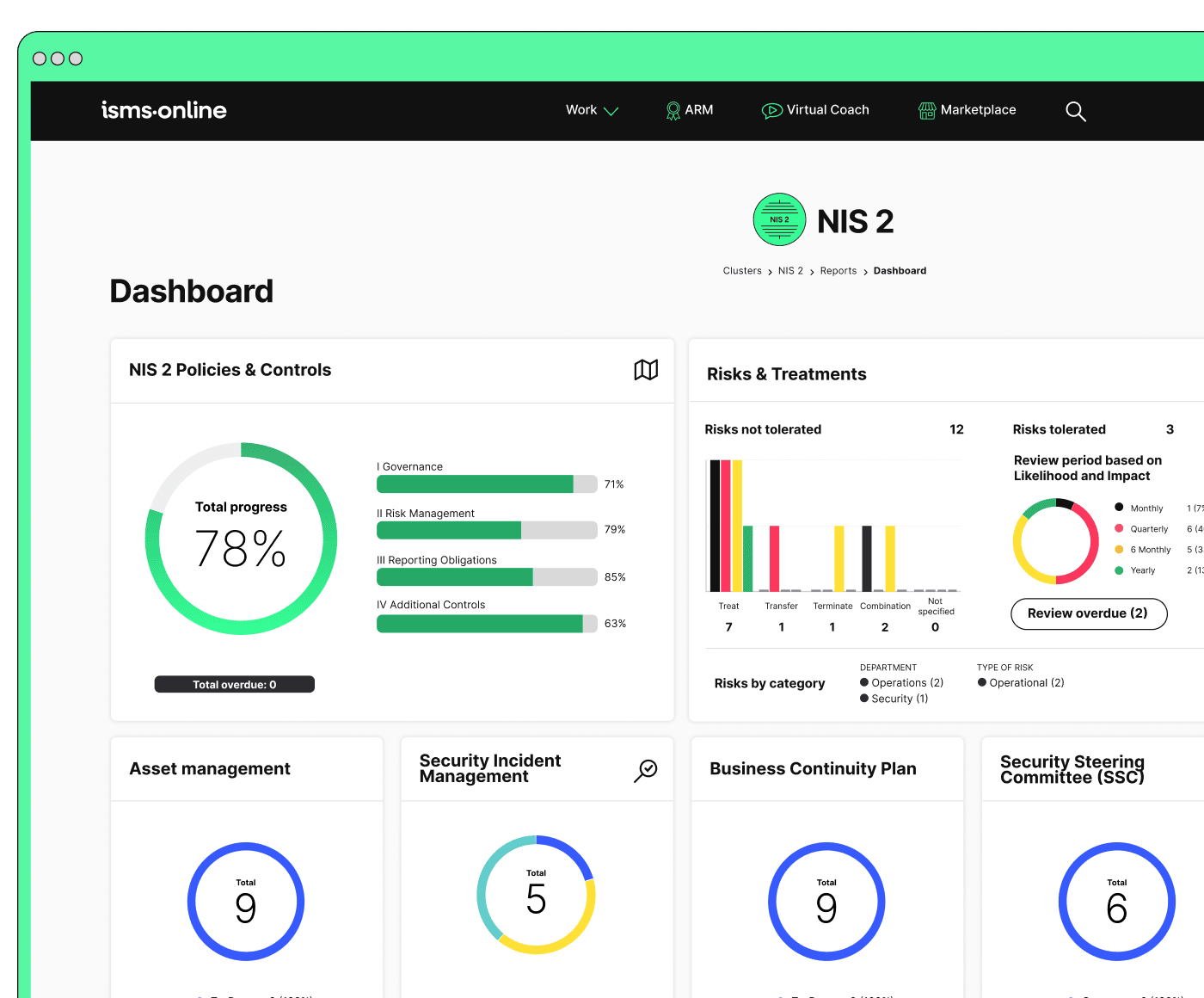
Be NIS 2-ready from day one
Launch with a proven workspace and templates – just tailor, assign, and go.
How Can Automation and Accountability Defeat Review Fatigue?
Human memory is fragile; audits are not. This is the real killer behind most admin setups: manual reminders, harried admins, and gaps appearing at every handoff. No matter how sophisticated the documented process, if real-time, in-system nudging and accountability don’t keep pace with change-you’ll burn out your admin team and get cited for drift.
Boards want proof, not intent. - ENISA 2024
Automated Scheduling and Reminders: With ISMS.online, admins and reviewers are continually scheduled; reminders land before reviews are late; workflow glass-boxes nudge even the busiest co-signers to act (ISMS.online Audit Management). Audit deadlines are caught, not missed.
Dashboards That Pulse, Not Just Display: Instead of “set-and-forget” dashboards, you get a real window into compliance health. The moment any review falls overdue, your dashboard alerts everyone-compliance, IT, business-turning “potential non-compliance” into prompt, corrective action (Forrester TEI of ISMS.online).
Immutable Review and Evidence Logs: Role-based logs, timestamped for every review and privilege event, remove all ambiguity. Quarterly export features “freeze” the evidence at the end of the cycle. Boards and auditors don’t chase answers-they see unbroken, co-signed trails (ISMS.online Evidence Trails).
What Closes the Evidence Chain for NIS 2/ISO 27001 Section 11.4: Audit Chains Without Excuses
Audit readiness isn’t a document, it’s a question: Can you show-instantly-a digital, owner-signed, timestamped chain from privilege assignment to evidence-packed review?
Excuses end where immutable approvals and audit exports begin.
Top-Tier Audit Evidence: Every log, approval, or review is mapped to its policy and owner-no more chasing signatures after the fact (Advisera Audit Log Guidance). Quarterly review cycles push automatic export of all chain-linked evidence, ready to present in your Statement of Applicability (SoA) and audit file.
Typical Chain Example:
- Privilege is assigned (e.g. new admin on cloud SaaS).
- Reviewer is nudged pre-deadline; sign-off is timestamped, logged, and exported.
- Any change or rollback is coded to the relevant control (A.8.2 in the SoA), showing who approved, when, and why-full audit trace.
- Revisions are forbidden unless all signatures are in and evidence is locked.
Glossary:
- Privilege sprawl: Proliferation of admin access/rights without proper review or removal.
- SoA (Statement of Applicability): The formal ISO 27001 document tracing which controls the organisation selects, and why.
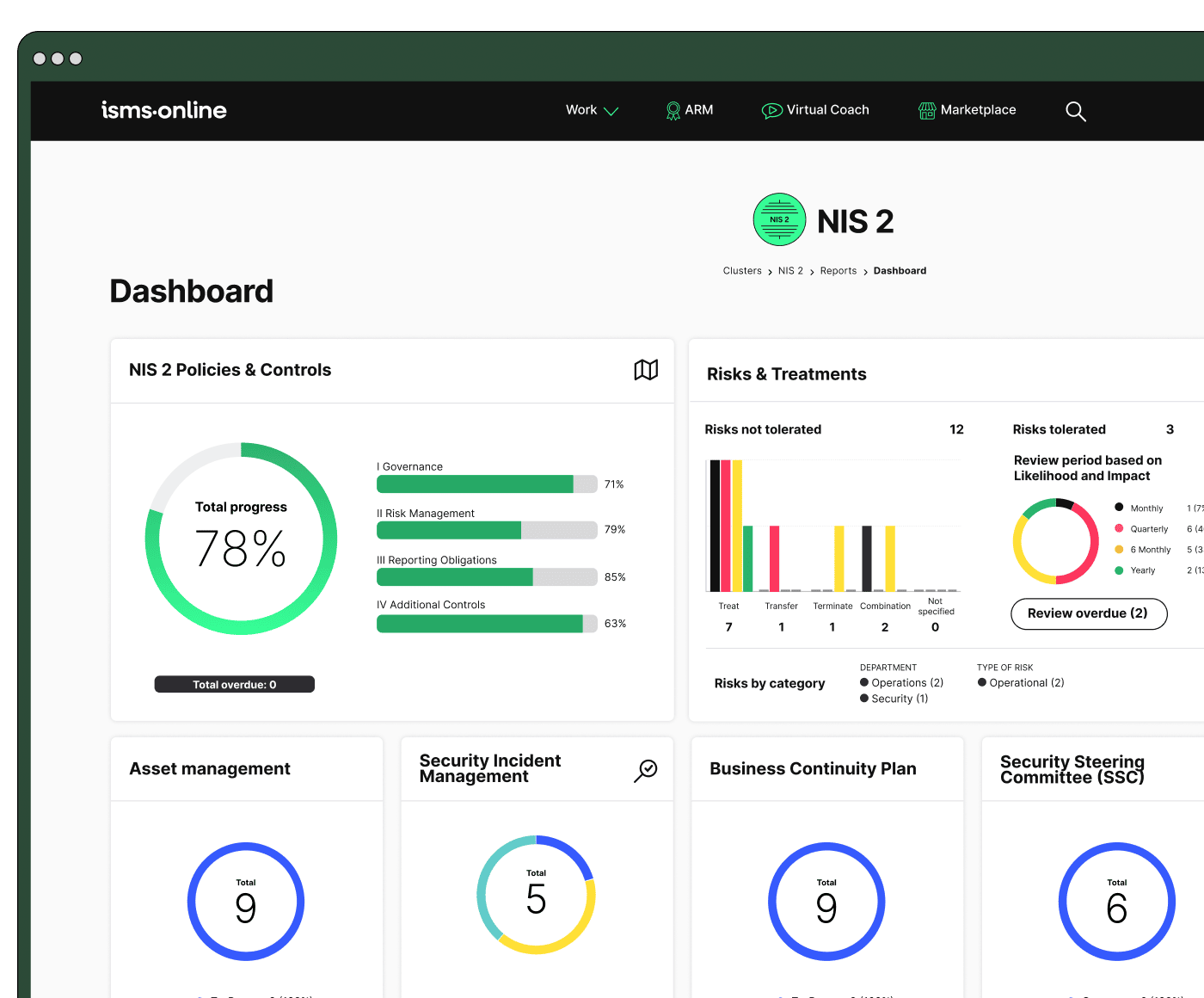
All your NIS 2, all in one place
From Articles 20–23 to audit plans – run and prove compliance, end-to-end.
How Does ISMS.online “Lock In” Admin Config by Default?
An administrative system that is compliance-proof is not one with perfect theoretical controls, but one where every step-assignment, review, change, rollback-leaves unbroken audit evidence, automatically linked to business goals, technical risks, and regulatory requirements.
Compliance that’s audit-ready is always-available proof-where evidence, workflow, and controls are inseparable.
From Asset Registry to Audit-Ready Export:
- Every admin credential is assigned to a named, accountable owner with role and asset documented.
- Every admin tool links to live control objects, relevant policies, risks, and responsible reviewers.
- Live queues for reviews, coupled with nudges and sign-offs, ensure nothing is missed or delayed.
- Every change or rollback is logged, versioned, and mapped to the event, with all relevant sign-offs.
- Audit-ready exports are available quarterly (or on-demand), mapped to ISO 27001 and NIS 2 requirements.
Sector and Framework Overlay Harmony: ISMS.online is pre-mapped for ISO 27001 A.5.18, A.8.2, A.8.9, and NIS 2 overlays across the admin workflow. As sector overlays (EBA, NERC, NHS, etc.) change, updates are mapped at the evidence and workflow level, not in surface documentation (ISO 27001:2022). Audit findings drop and trust-in management, from boards to auditors-rises. Forrester’s TEI reports up to 50% fewer findings and sharp reductions in compliance effort (Forrester TEI of ISMS.online).
Compliance proof is worth more than any intention; automated controls are your board’s defence and your audit edge.
Step Into Audit-Ready Resilience: Own Your Evidence Path Today
The barrier between documentation and live proof has never been clearer-or more critical. With evidence mapped to every privilege, review, and change, you’re not chasing signatures the day before the auditor arrives. You’re driving a living, always-on, always audit-ready system that earns confidence from boards, executives, and frontline teams.
Every documented action today is one less risk tomorrow - and a reason for leadership, board, and auditors to trust your ISMS for the long haul.
Start with a mapped admin checklist that fulfils NIS 2 and ISO 27001 standards, not just on paper, but embedded into every privileged action and sign-off. Align policies, controls, ownership, and evidence so that your workflow becomes your living memory. Let your proof-exported in real time, signed by the right stakeholders-answer every regulator, auditor, and board member without scramble, stress, or uncertainty.
No more spreadsheet chases, no more hidden admin gaps. You lead with facts, backed by a system, team, and dashboard that is genuinely audit-ready and built for trust.
Frequently Asked Questions
Who actually needs to sign off on privileged admin reviews-why do so many fail first audits?
Privileged admin reviews must be co-signed by the IT or system owner and a business or GRC (governance, risk, compliance) lead, not just IT alone. Most NIS 2 audit failures happen because approvals are limited to IT or are retroactively “tidied up,” leading to lost oversight and blurred accountability. Audit teams and regulators flag these single-point sign-off habits as the primary cause of missing logs, blame loops, and unchecked privilege drift-especially when offboarding or handovers lag.
Audit resilience is never a solo act-privilege controls only stand up when business and IT jointly own them.
A 2024 ENISA survey found nearly one in three initial NIS 2 failures traced back to generic or untracked admin rights-a direct result of unsegregated approvals and policy delegation. ISO 27001:2022 (A.8.2, A.8.9) and NIS 2 both require visible business/technical co-signature. ISMS.online enforces this standard by default, running every workflow through structured policy chains and review logs.
Audit-Ready Dual Sign-Off Flow
- IT or system owner initiates every privileged review.
- Business or GRC lead reviews justification and provides independent co-signature.
- ISMS logs preserve owner, rationale, outcome, and freeze immutable quarterly evidence-all mapped for audit.
This co-ownership transforms a technical checklist into a control system your organisation-and your auditors-can trust.
What invisible risks and orphaned accounts still threaten admin compliance in your stack?
The hidden danger lies in orphaned admin accounts, left-behind “root” logins, and SaaS admin privileges disconnected from any real owner-each remaining unseen until an audit or breach reveals them. More than 40% of major breaches in 2024–25 were linked to unrevoked, generic, or ownerless privileged credentials,.
- Orphaned users left after staff exits or reorgs.
- Generic accounts (“admin”, “service”, “root”) still active from migrations, mergers, or SaaS expansions.
- Temporary or project-based privileges not reviewed or expired on time.
- SaaS admins for “trial” tools that outlast deployments and responsible staff.
ISO 27001 (A.8.2, A.8.9) and NIS 2 (Art. 11.4) require every privileged right to be mapped to a named owner and current asset, flagged immediately if overdue or unlinked. The ISMS.online registry crosslinks each credential to real owners, role context, and review cycles-exposing overdue or generic accounts instantly.
Breaches rarely begin with hacking-they start the day a privilege loses its owner, and no one notices.
Orphan Account Close-Out Made Routine
- A living registry flags overdue, orphaned, or generic administrator accounts.
- Scheduled, auto-reminded dual-role reviews keep all rights up-to-date.
- Dashboards show every privilege-asset-owner status in real time.
How does unified ISO 27001 and NIS 2 mapping make admin workflows audit-ready?
Unified mapping between ISO 27001 controls and NIS 2 requirements guarantees that every privileged account is traceable to explicit controls, assets, and evidence logs-instead of static policy PDFs or disparate tracker files. Auditors increasingly demand to see live “evidence chains,” not just sign-off tick-boxes (ISO 27001:2022;.
ISMS.online automates this by crosslinking every admin event-create, change, remove, review-to a mapped control, sign-off, and asset. Logs, signatures, and rationale are versioned and export-ready for audits. No matter your sector, the same workflow satisfies ISO 27001 and NIS 2 without multiplying admin burden.
ISO 27001 and NIS 2 Mapping Table
| Expectation | Evidence Practise | Standard Reference |
|---|---|---|
| Privilege assigned | Owner, asset, and renewal in registry | ISO 27001 A.8.2, NIS 2 Art.11.4 |
| Co-sign required | Business/GRC must approve each privilege | ISO 27001 A.8.18, NIS 2 Art.21 |
| Exportable logs | Full audit chain, on demand | ISO 27001 A.8.9, 5.18, NIS 2 Art.21 |
Cross-framework mapping means you never face double jeopardy audits-one mapped chain, all requirements ticked.
Which sequence hardens admin controls and guarantees audit survival under ISO 27001 and NIS 2?
A hardened, audit-proof admin system prioritises traceability and resilience, not just checklists. The proven sequence:
1. Map all privileges and assets to named owners-no generics.
2. Crosslink each privilege to SoA and NIS 2 controls, automating review cycles with dual approvals.
3. Make co-signature a workflow default-no change or renewal closes without both IT and business input.
4. Log every assignment, review, and deprovision event as a versioned record.
5. Freeze/export immutable audit evidence quarterly or after any major incident.
ISMS.online’s workflow engine ties privileges, assets, controls, and sign-offs together-every stage, signed and monitored ((https://www.isms.online/features/evidence-management/)).
Traceability Mini-Table
| Trigger | Risk Update | Control/SoA Link | Evidence Logged |
|---|---|---|---|
| Admin created | Scope and expiry assigned | ISO 27001 A.8.2 | Owner, asset mapped; review queued |
| Quarterly review | Overdue/ownerless flagged | NIS 2 Art.11.4 | Reminder, dual sign-off stored |
| Staff exit | Rapid deprovision/removal | ISO 27001 A.8.9 | Revocation entry, rationale saved |
Every missed handoff is a potential audit failure-lock the chain at every step.
How does automation prevent admin review drift and break the audit-failure cycle?
Manual privilege reviews-trackers, email reminders, delegated paperwork-break down with scale, staff turnover, or deadline rushes. Regulators and auditors directly tie failure to these missed cycles, as most organisations only discover drift during a scramble before audit or after a breach. Studies show over half of organisations miss a quarterly admin review in any given year, with most issues surfacing too late (Forrester TEI, 2024).
Automating reviews with ISMS.online turns reminders, escalation, sign-offs, and overdue status into system defaults. No more relying on memory; every privileged right is always in scope, every review date met, and every export version-controlled for evidence.
The most resilient teams don’t rely on heroics or hope-automation ensures compliance is provable even when roles change or workloads spike.
What digital evidence and exports do auditors and regulators demand without exception?
Your audit standing rests on end-to-end traceability for every privileged administration event. Non-negotiable records include:
- Assigned privilege logs linking name, asset, tool, owner, and timestamp.
- Dual-role (IT + business) sign-off logs, quarterly and event-triggered.
- Versioned change, renewal, rollback, and removal logs directly mapped to SoA/NIS 2 controls.
- Immutable evidence exports ready for spot-audit or board/regulator review.
Missed links-no co-sign, absent owner, unmapped event-are now flagged as immediate findings (Advisera: Audit Logs; (https://www.isms.online/features/evidence-management/)).
Auditors aren’t chasing best intentions; they want to see robust, digital evidence chains that hold up under scrutiny.
How does ISMS.online enforce audit resilience and evidence by default-raising your compliance baseline?
Resilience lives in the chain: mapped privileges, dual sign-offs, active review cycles, and exportable records-all auto-enforced, all audit-ready. ISMS.online’s system-forced workflows mean no admin event is “invisible,” all reviews are signed, deadlines met, and evidence snapshots available for any audience at any time.
- Automated sign-off and reminder system for every privilege lifecycle phase.
- Version history for every event, never relying on post-hoc patching.
- Dashboards for current and past state-every privilege, every owner, every approval.
- One-click export of full digital audit chain for board sampling or regulator requests.
Modern compliance sets the bar higher: workflows prove and preserve your assurance, so every stakeholder can trust in your controls-today and a year from now.
Don’t wait: Build an audit-proof, resilience-first admin review and evidence chain
Move now from ad hoc compliance to an audit-ready, mapped, and signed privilege regime. Download a complete NIS 2/ISO 27001 admin review workflow, export a sample evidence chain, or see ISMS.online live. Never get blindsided by last-minute review gaps or orphaned privileges again-build the assurance your board and regulators actually want to see, every day.






