





































What Makes Identification the Boardroom’s Cyber Frontier in the Age of NIS 2?
The cyber-security perimeter has collapsed. Identification-the systematic, evidence-backed validation of every workforce member, third party, and supplier-now sits squarely on your board’s agenda, not just your IT desk. NIS 2’s Section 11.5 has transformed from “hygiene” to headline risk: directors face personal liability, and auditors increasingly ask for operational proof, not theoretical policy. Europe’s post-pandemic surge in remote, hybrid, and contingent work forced this evolution. Regulators and insurers concede: the majority of breaches in regulated sectors can be traced to lapses in identification and authentication, not esoteric malware.
When you walk into your next audit, the question won’t be whether you have an identification process, but whether you can prove its real-world execution, gap closure, and board-level oversight. “Trust, but verify” isn’t just philosophy-it’s tomorrow’s audit template. Compliance teams that treat Section 11.5 as a “documentation” task versus a living system risk costly exposure. The value has shifted; the board’s reputation and future depend on a system where identity is audited, not just catalogued, and weaknesses trigger live response-not afterthought reviews.
When you connect every identification event with live evidence, compliance transforms from anxiety to assurance.
Why Proving Onboarding and Offboarding Matters More Than Any Policy
Anyone on your payroll-employee, vendor, contractor, M&A addition-becomes a compliance risk if identification isn’t both automated and audited. Years of EU incident analysis reveal a repeating theme: temp accounts left active past their project, supplier credentials never revoked, and “good enough” identity logs lost in regional fog. These soft spots aren’t accidental: they’re the result of processes too reliant on “just enough” oversight, and risk maps focused on abstract policy instead of daily operational proof.
Regulators want to see every identity’s journey: who approved access, when was it granted, how was it revalidated, and-crucially-when and how was it revoked? Insurers now explicitly demand this before pricing policies. The modern audit discovers shadow access not on paper, but in workflow gaps: delayed onboarding approvals, local IT ad hoc processes, or failed offboarding in supplier systems.
A major audit pitfall: technical teams believe a signed policy is enough, while regulators demand living logs: onboarding timestamp, evidence of identity validation, sign-off tracked against a SoA reference. Offboarding, especially for remote and hybrid workers, must generate a hard artefact-revocation shown on a dashboard, immediately available if challenged.
Evidence is what happens when a regulator can trace a credential’s life from creation to revocation with no missing links.

Master NIS 2 without spreadsheet chaos
Centralise risk, incidents, suppliers, and evidence in one clean platform.
Connecting the Dots: How ISO 27001 and NIS 2 Section 11.5 Actually Converge
It’s easy to imagine ISO 27001 “covers” NIS 2-until your SoA and live controls are compared against the new evidence bar. Regulators and ENISA have made this leap explicit: every unique user must be digitally anchored at onboarding (A.5.16), be authenticated per access risk (A.5.17), monitored for anomalies, and offboarded with proof (A.8.5). Where organisations lose points isn’t technical config, but in evidence that bridges the policy–risk–action loop.
The following ISO 27001–NIS 2 mapping brings clarity to what natively aligns-and what must be upgraded in practise:
| Expectation | Operationalisation | ISO 27001 / Annex A Reference |
|---|---|---|
| Unique identification for each user | Enforced user IDs, no shared accounts | A.5.16 Identity management |
| Authentication for remote access | MFA, event monitoring, conditional access | A.5.17 Authentication information |
| Secure authentication in practise | Automated re-validations, sign-offs | A.8.5 Secure authentication |
But regulatory audits now check the pulse-not the paper. Each onboarding or offboarding event must write a live log, link to a control or risk register, and reflect real-world process. When a staff member leaves, can you show, in one dashboard or export, the timestamped evidence of offboarding and revocation? Did a policy/process change trigger a new risk review, SoA notation, and evidence capture?
| Trigger (change/offboard) | Risk Update | Control / SoA Link | Evidence Logged |
|---|---|---|---|
| Staff/contractor leaves | Revocation | A.5.16/A.5.17 | Offboarding log, access revoked |
| Policy/process change | Risk review | A.8.5 | New SoA entry, signed approval |
If any of these links are missing or outdated, your compliance is already fragile in the eyes of ENISA and national authorities. Your ISMS must be a living ecosystem, not a document silo.
Why “Paper Compliance” Is Every Regulator’s Red Flag
The fastest way to lose compliance credibility is to present a “paper control”-an asserted process unsupported by living logs. Regulators, like ENISA, have shifted from asking “Do you have a policy?” to “Show me evidence of its last real-world execution. Show me the exceptions, remediations, and responsible owner by timestamp.”.
Automated log capture (from onboarding through to offboarding) is now a minimum standard. The best-run programmes conduct scenario testing: What happens if an offboarding is delayed? Does the system alert, log, and resolve with owner/closure evidence? Weakest-link thinking is not theoretical-failures in onboarding, or missed supplier account terminations, are what produce headlines and regulatory actions.
Live operationalisation means every access change-privileged roles, temporary projects, resets-auto logs to a SoA reference and triggers evidence review protocols. Incidents, exceptions, and failed processes are not swept aside-they’re logged, trended, and owned by named managers. This arms your board with proof, and makes the difference between easy audits and crisis meetings.
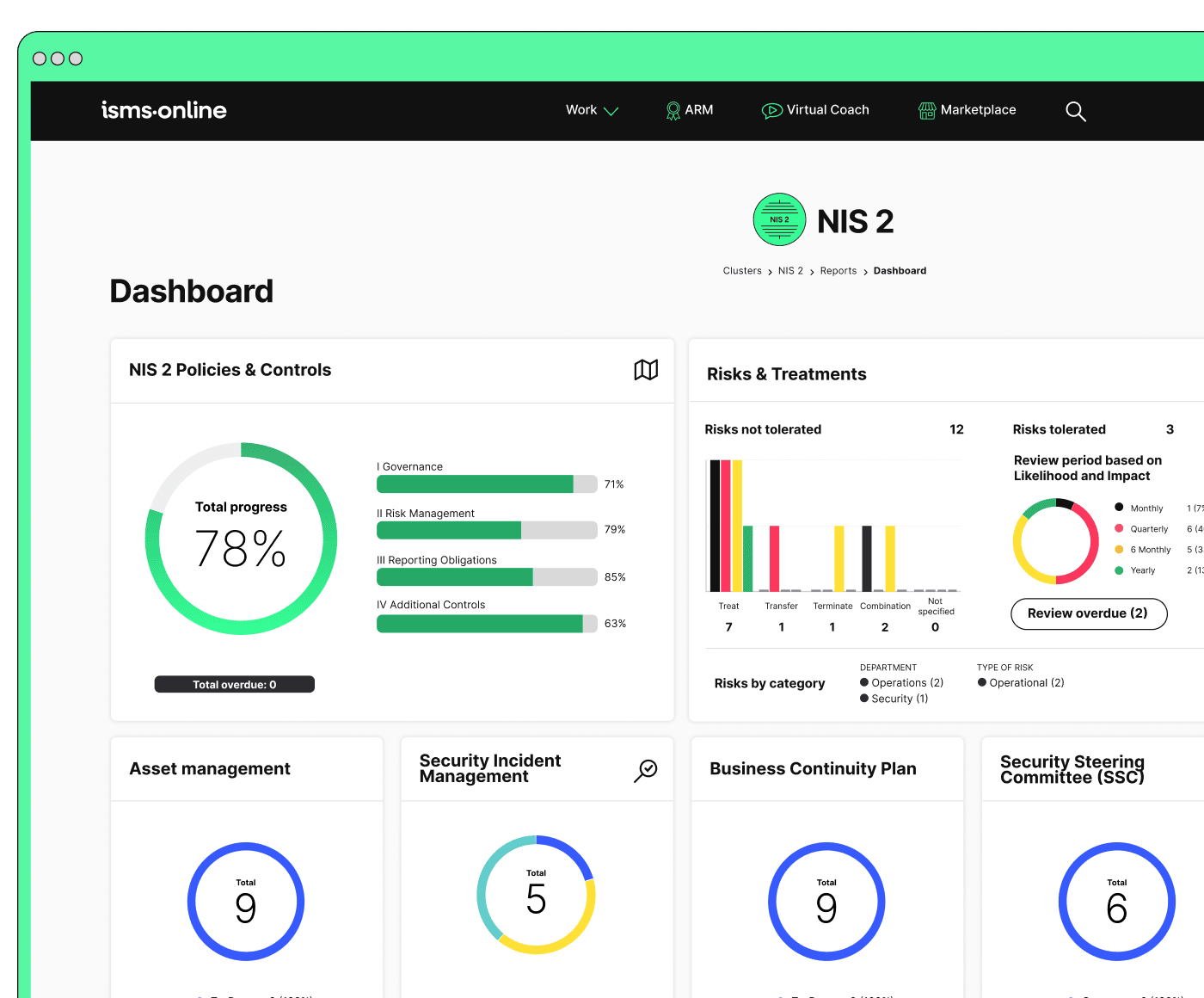
Be NIS 2-ready from day one
Launch with a proven workspace and templates – just tailor, assign, and go.
Boardroom Accountability: The New Reality for Identification Compliance
Directors, C-suites, and audit chairs can no longer treat identification as “IT’s problem.” NIS 2 mandates board and top management responsibility, including explicit risk register sign-off and active evidence review (irms.org.uk; dlapiper.com). Real-world compliance now means your board receives dashboards-trendlines of onboarding and offboarding speed, open exceptions, and live SoA updates-to inform decision-making and fulfil fiduciary duty.
Incidents and exceptions must not only be logged but traced to remediation, with all board members able to see what happened, when, and what changed as a result. Modern ISMS platforms translate these events-onboarding, revocations, escalations-into board-ready summaries. Every action must have a documented owner and evidence trail: change logs, completion timestamps, and improvement actions directly mapped to controls.
Quarterly board packs should no longer just “note progress”-they visually connect identification evidence with operational, legal, and regulatory responsibilities. Directors sleep better when their minutes and evidence are mapped, complete, and resilient. This is no longer a “nice to have”-it’s the new currency of stakeholder trust and insurance confidence.
How Continuous Audit Loops Power Identification Resilience
Static ISMS programmes are now a compliance risk. Regulatory and insurance best practise is continuous readiness, where scheduled reviews and scenario tests surface weak identification links before they are exploited.
“43% of identity breaches involve weak credentials” -but the causes are frequently process drift, not tools. Top-performing organisations test identification journeys monthly: onboarding, exceptions, temp accounts, supplier integrations. Failures or gaps should not just be flagged, but tracked to closure-enforced by automated reminders, evidence snapshots, and clear communication back to the control owner and the board.
The loop closes only when: the risk register is updated, SoA notated, evidence stored, and staff retrained if necessary. ISMS.online’s evidence and dashboard tools automate this loop, ensuring continuous improvement is not a buzzword but a measured, repeatable reality. Over time, this process insulates your compliance from “audit fatigue,” while creating living proof for every stakeholder-internal and external.
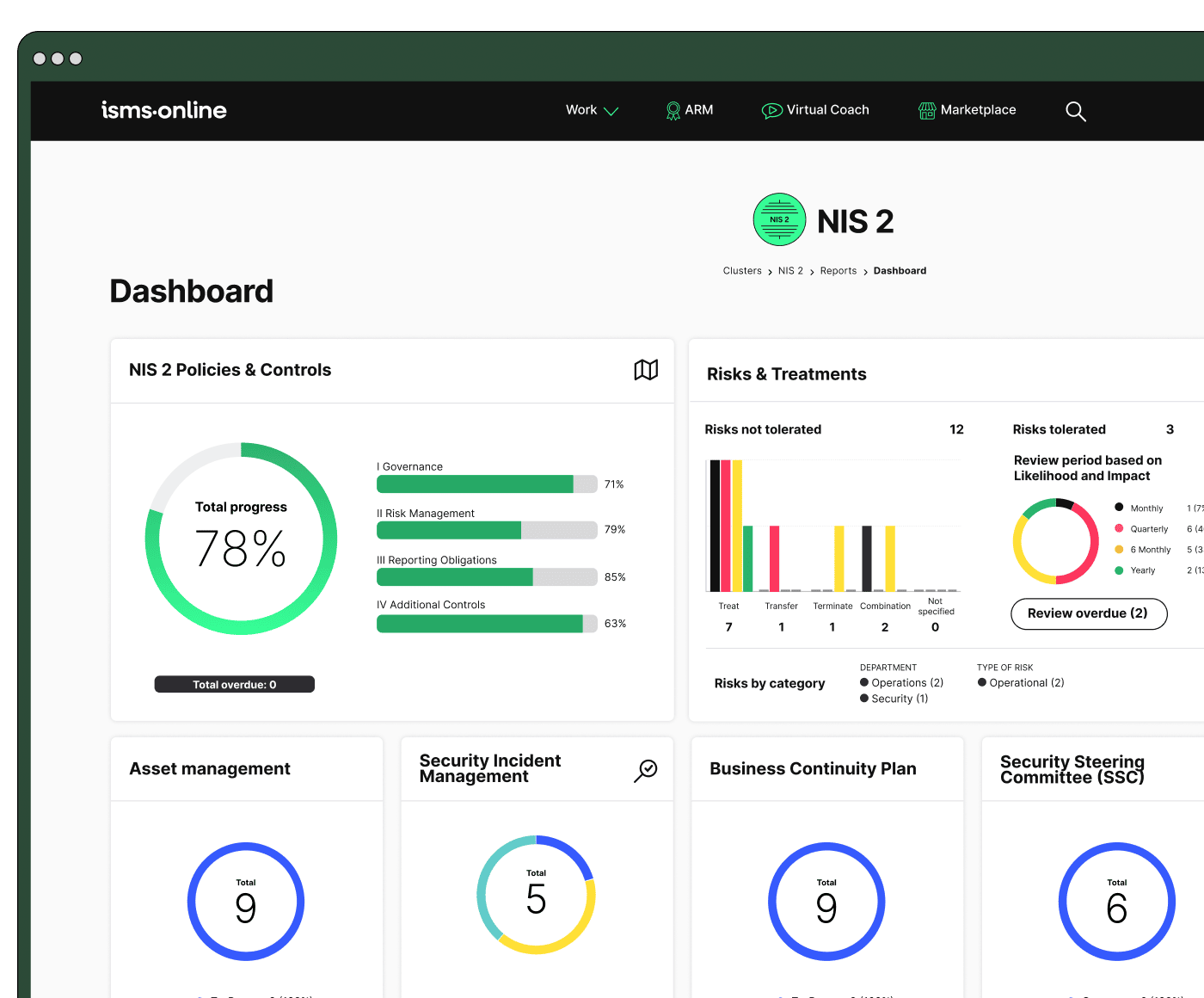
All your NIS 2, all in one place
From Articles 20–23 to audit plans – run and prove compliance, end-to-end.
Can Your Identification Controls Adapt Across Borders and the Entire Supply Chain?
Compliance risk does not stop at the office door. Multinational supply chains, remote workforces, and shadow IT demand identification controls are harmonised, logged, and instantly auditable-regardless of geography or role. NIS 2, especially for critical infrastructure, expects sector-level control harmonisation, weekly log review, and mapped evidence flows (privacy.org; healthitsecurity.com).
Auditors start with supply chain and M&A risk: was every account set up, maintained, and terminated per policy-across all contractors, vendors, and inherited staff? ISMS.online brings region and supply chain management under a unified pane, with real-time dashboards and SoA linkages tailored to sector, role, and local requirements.
The most robust compliance programmes produce a record of every supplier onboarding and termination, with alerts tied to missing or overdue events. Stakeholder dashboards surface exceptions, open items, and completed actions – instantly reportable to supervisors, regulators, and boards without manual trawling.
You earn your regulator’s trust when identity conformance and closure are trendable across the map-not just inside HQ.
Spot and Close the Gaps: Checklist for Compliance and ISMS.online Mapping
The path to robust NIS 2 Section 11.5 alignment is paved with real-life detail. Closing long-standing audit gaps depends on moving from analogue reality to live, unified operational control. Compare your current process to these risk-reduction benchmarks-each specifically negated by a function of ISMS.online:
| Non-compliance Pitfall | ISMS.online Unified Control Feature |
|---|---|
| Manual onboarding/offboarding, missed revocations | Automated, end-to-end user lifecycle with live logs |
| Inconsistent third-party or regional onboarding | Policy Packs-harmonised, cross-entity workflows |
| No central audit evidence-policy docs only | Real-time dashboards, SoA-linked evidence bank |
| IT and board speak different languages | Automated escalation, board-level dashboards |
| Static SoA, not reflecting incident or improvement | Dynamic SoA linkage, audit workflow triggers |
Most transformation happens when a compliance team eliminates “show me the document” requests and answers, live: “Here’s the log, the evidence, the closure, and the lessons trended through the next cycle.” ISMS.online makes this practical-a single platform where non-compliance triggers remediation, not just reporting.
Convert Identification from Weak Point to Boardroom Proof
Organisations that turn NIS 2 identification compliance from paperwork into live accountability turn stress into a competitive advantage. ISMS.online is engineered to automate identity lifecycles at every level-from onboarding through to revocation-linking every credential to real-time logs, role-based dashboards, and SoA trigger points.
Say goodbye to waffle at the audit table. In its place: an operating model where IT, security, compliance, and the board share live proof of every identification event-from internal teams to suppliers across borders-with trends, exceptions, and corrective action visible at a glance.
When the board and operations leader checks the dashboard, they see not only who was given access, but also when, by whom, and when it was taken away-instantly audit-ready.
Your strongest future is one where every identification gap closes faster than any threat emerges. Make identification more than compliance-make it a living asset for resilience, trust, and leadership. Switch to ISMS.online today and turn your identity controls into evidence-backed capital.
Frequently Asked Questions
Why has NIS 2 Section 11.5 made identification and authentication a boardroom issue, not just an IT checklist?
NIS 2 Section 11.5 elevates identification and authentication controls from a technical afterthought to a central obligation for executives, making boards directly responsible for demonstrable access governance and resilient incident response across all digital business lines-including remote work and the supply chain. Simply having policies in place no longer suffices; regulators and auditors now demand operational proof via audit-ready evidence and verifiable workflow records (ENISA, 2021; BSI, 2024).
When identification controls become a living boardroom topic, every audit becomes a test of trust, not just compliance.
A spike in ransomware and supply chain breaches has made brittle ID controls a reputational and financial risk. Incidents now carry the real prospect of fines, lost business, or criminal exposure for executives unable to produce fast, defensible audit trails (Forbes, 2023). The compliance game has shifted: evidence must span onboarding/offboarding logs, real-time KPIs, and documented board oversight. Those trading in paper policies alone are now offside-mature organisations must automate traceability and be ready to surface proof on demand (ZDNet, 2022).
ISO 27001 Bridge Table
| Expectation (NIS 2) | Operationalisation | ISO 27001 Ref. |
|---|---|---|
| Board-reviewed identification policy & evidence | Management review, live logs | Cl. 9.3, A.5.16 |
| Traceable onboarding/offboarding & revocation | SoA sign-offs, automated ID logs | A.5.16, A.8.5 |
How do you guarantee identification traceability-no matter the user, context, or border?
To satisfy NIS 2, every user-whether direct employee, remote contractor, service provider, or third party-must be subject to a unified, evidence-rich access workflow, regardless of geography or access mechanism. Gaps once tolerated for outside vendors, temp workers, or legacy accounts are now a liability: onboarding, changes, and revocation must be explicitly approved, timestamped, and linked back to contracts or authority-no exceptions (HelpNetSecurity, 2023; UK Gov, 2023).
When operational and legal records integrate, compliance becomes measurable. Effective ISMS solutions now surface dashboards covering access approvals, exceptions, and timed events, making this data visible in audits and internal reviews (Dark Reading, 2023). Consistency is paramount: harmonise workflows and legal standards across every unit and supplier to avoid last-minute audit fails or hidden risks (see.
Traceability Table
| Trigger | Risk Update | Control / SoA Link | Evidence Logged |
|---|---|---|---|
| Contractor onboarding | Third-party entry | A.5.16, A.8.5 | Approval log, SoA reference |
| Offboard event | Orphaned account | A.8.5, SoA update | Revoked credential record |
In what critical ways do ISO 27001 and NIS 2 Section 11.5 diverge-and what are the operational gaps?
ISO 27001:2022 lays the technical groundwork for identity and access controls (A.5.16–A.8.5), but NIS 2 explicitly layers in board accountability-requiring evidence that management not only defined, but reviewed, tested, and improved ID controls in practise (ISO, 2022; AuditBoard, 2023). Four typical shortfalls emerge:
- Board sign-off: ISO may stop at documentation; NIS 2 demands records of board engagement, decisions, and actual review (CPA Journal, 2022).
- Risk/event linkage: Under ISO, incident logs and risk registers can be siloed; NIS 2 expects every ID incident to trigger an explicit risk update and evidence of closure (CNBC, 2023).
- Exception handling: ISO treats exceptions as policy; NIS 2 requires they be escalated, documented, and monitored at the management layer (AuditBoard, 2023).
- Cross-jurisdiction consistency: ISO projects may localise; NIS 2 calls for pan-EU standardisation and centralised evidence.
Smart organisations now bridge these gaps by scheduling drills, mapping actual workflows against both ISO and NIS 2, and driving continuous improvement cycles inside their ISMS (Legal500, 2022).
What operational evidence meets NIS 2 expectations-and what’s the audit-ready cycle?
NIS 2 requires more than box-ticking: auditors expect to see automated event logs for every user action (onboarding, revocation, anomaly response), tested escalation paths, regular SoA and risk log updates, and full traceability from incident to closure, with all major evidence retrievable within 24 hours (EU Monitoring, 2024; TechRepublic, 2023).
A high-performing ISMS operationalizes this by:
- Auto-logging all identity actions, including remote and privileged events.
- Escalating exceptions to named owners, documenting resolution times.
- Integrating every identification event with SoA and risk register updates.
- Linking closure of incidents directly to management reviews and improvement logs (CIO.com, 2023).
Platforms like ISMS.online automate and centralise not just documentation, but the evidence retrieval and audit cycle itself-shrinking the distance from incident to provable compliance while arming you with case-ready data whenever needed ((https://www.isms.online/platform/)).
Real compliance is earned in the speed, clarity, and completeness of your evidence response-not in the number of policy pages.
How can you embed real board governance and accountability into ID control-beyond paper policies?
Leading organisations now establish a quarterly rhythm of presenting ID control dashboards, trends, exceptions, and improvement actions to boards/executives, with full minutes, scenario drill logs, and risk acceptance evidence (IRMS, 2023; Bloomberg Law, 2023). This loop closes the gap from frontline event to boardroom decision and regulatory trust.
- Build a reporting cadence that aligns regulatory expectations (NIS 2, GDPR) with real incident evidence and trend data.
- Maintain live minutes and improvement logs for every material discussion-auditors now expect to see board awareness, not just “sign-off.”
- Capture scenario drills, stress tests, and escalation casenotes, linking them to risk and SoA updates (CPA Journal, 2022; Lawfare, 2023).
- Review and log outcomes-regulatory expectations and commercial trust both now rely on demonstrating this end-to-end traceability (Harvard Law Review, 2022).
Why is continuous improvement-and a live evidence/audit loop-the new gold standard for identification compliance?
Modern compliance is not static; it’s a constant audit loop. Every incident, gap, or failed control must trigger assignment of a named owner, documented corrective action, and closure logged in an up-to-date register, with trends surfaced in real-time metrics (SANS, 2024; Verizon DBIR, 2024). Organisations that build this cadence make audit-readiness and management engagement automatic, not an annual grind.
Evidence Traceability Table
| Trigger | Risk/Exception | Control / SoA Link | Evidence Logged |
|---|---|---|---|
| Vendor access request | Supply chain risk | A.5.16, A.8.5 | Approval, logs, SoA reference |
| Remote account breach | Incident, recovery | A.5.17, process record | Incident log, correction proof |
| Policy/process change | Improvement loop | A.5.16, 9.3 | Meeting minutes, sign-off log |
Automated ISMS platforms can validate every loop, giving you-and auditors-confidence that every failure, correction, and trend is visible and closed (SecurityWeek, 2023).
How do you future-proof ID controls for global operations and supply-chain risk?
Identification compliance increasingly needs pan-jurisdiction, pan-industry harmonisation. Assign clear RASCI roles for monitoring law changes, escalate workflow and control updates in real time, and record each change in your ISMS (Privacy.org, 2022; Law.com, 2023). The leaders run cross-border drills and supplier incident simulations, ensuring dashboards and logs stay aligned for regulator and boardroom alike (ITPro, 2024; GovInfoSecurity, 2024).
For a complete walkthrough-mapping NIS 2 and ISO 27001, with live evidence and improvement cycles-see the ISMS.online evidence showcase. The future belongs to organisations able to rapidly surface, defend, and improve their identification controls at scale-transforming compliance from a checkbox into an asset that earns trust.
In future audits, success will be defined by how quickly and defensibly your identification evidence can be surfaced, summarised for a board, and tested by a regulator-across any border or sector.






