





































How Audit-Proof Is Your Authentication? Board and Owner Questions Answered
In the current era of NIS 2 and ISO 27001:2022, authentication isn’t simply a technical hurdle; it’s a direct test of your board’s credibility and operational fitness. Article 20 of NIS 2 delivers an unmistakable message: board members, directors, and organisational owners must prove-not just promise-that authentication controls are effective, evidence-based, and actively monitored (ENISA | DLA Piper). Passive signatures or “tick-box” policy approvals can no longer shield executives from scrutiny-recent legal actions show that without a robust, living chain of digital evidence, not even a director’s signature is defensible.
A signed policy won’t protect you if your evidence chain is ambiguous at audit.
This is the new climate of evidence-centric compliance. It’s no longer sufficient for boards to approve an authentication policy and move on. Regulators and third-party auditors demand a digital audit fabric: immutable logs, linked workflow approvals, and time-stamped records connecting board sign-off all the way to each authentication event-even those involving suppliers and outsourced providers. Legacy evidence trails (emails, scattered documents, spreadsheet audit logs) are now seen as weak signals-a liability flag in both regulatory and legal contexts (ENISA, dlapiper.com).
System-generated workflows-such as those provided by ISMS.online-enable a direct line from the boardroom to operational action. These digital records are demand-driven by both ISO and NIS 2, and are critical at moments of regulator challenge: every admin login, supplier account grant, and exception must be tied to tracked, board-supervised authorizations-not just abstract policies.
What Evidence Do Boards and Auditors Actually Expect?
Modern examiners are evidence maximalists. They look for granular, tamper-evident, and chronologically precise records: who approved each control, what changed, when, and why. Audit-prepared systems generate digital approval trails, capture and timestamp every update and exception, and produce regulator-ready reports. Only platforms like ISMS.online-with their linked evidentiary workflows-close both the NIS 2 and ISO 27001 expectation gaps, putting leadership in auditable command.
What Operational Gaps Expose Companies Most Often?
The most common failure? Board-signed policies that are decoupled from lived reality. Forbes and industry commentators track a surge in boardroom-level findings triggered by outdated password policies, incomplete MFA coverage, or authentication policies left to “rot” after organisational change (Forbes). In the age of regulation, it’s no longer plausible to argue that “approved” equals “effective.” Every policy must be demonstrably kept up to date in light of new threats, changing suppliers, or regulatory triggers.
How Should Boards Future-Proof Their Evidence?
Digital, regulation-linked workflow records are the solution. An ISMS like ISMS.online creates a persistent, workflow-linked suite of approvals, exceptions, and log histories; this not only satisfies current NIS 2 and ISO 27001 demands, it also creates lasting, portable evidence for evolving audits-regardless of staff turnover or market changes. If a director cannot trace a control from policy to practise, confidence-and compliance-is an illusion.
If your evidence isn’t mapped to a regulation and a board approval, it probably won’t survive a multi-jurisdictional audit.
Why Supplier Authentication Is Now a Boardroom Issue
Auditors no longer view supplier accounts as nice to have in MFA or authentication coverage. ENISAs breach intelligence reports affirm: third-party access is now the number one contributor to breaches and failed MFA evidence (ENISA). Boards must verify that every vendor, every supplier, and every access grant or exception is evidence-tracked, appropriately reviewed, and tied to ongoing status dashboards. Anything less creates a fresh audit finding.
Whether youre a compliance initiator, a CISO, a legal officer, or a hands-on IT leader, your authentication processes must be audit-proof, evidence-driven, and mapped to both regulatory and operational needs. Stay with us-the practitioners lens is next: where routine pass rates collapse, and only evidence-linked action closes the gaps that keep boards and businesses safe.
Book a demoPassword Pitfalls: Real-World Gaps Practitioners Can’t Ignore
Even a recent “pass” at audit is a fragile assurance. Cybercriminals, regulatory changes, and the pace of authentication innovation now move many times faster than most compliance cycles. Practitioners cannot hide behind “best effort” or “check the box” compliance. NIS 2 and ISO 27001:2022 expect and enforce a new regime: every control, privileged login, supplier account, and exception must be evidenced, tracked, and defensible in real-world time (The Hacker News | CSO Online).
Attackers don’t care about your aspirations-they exploit the gaps left by process drift.
Why Do Credential Attacks Continue?
Credential attacks flourish where policy intentions are not lived practise-attackers don’t need advanced tactics when exceptions and “edge” cases abound. In the wake of new NIS 2 enforcement, the industry has seen a 40% increase in password-related breaches, with root causes traced back to uneven MFA deployment, untracked exceptions, and fragmented workflow controls (The Hacker News). Attackers leap on VPN admin accounts, remote support platforms, and legacy integrations-exactly where formal authentication coverage lapses.
Where Do MFA Deployments Fail in Practise?
ISO 27001:2022 (A.5.17 and A.8.5) now covers end-to-end authentication: onboarding through supplier management, privilege escalation, exceptions, and closure (BSI). Yet, reviews routinely show partial MFA rollouts: “core” systems and users inside the net, but legacy, external, or vendor-connected systems left exposed. Each of these uncontrolled endpoints becomes the path of least resistance-not just for attackers, but for rigorous auditors.
Who Delays or Fragments Authentication Upgrades?
Authentication gaps are not an IT problem alone. When HR, supplier managers, operations, and legal all take proactive roles in rollout, SANS Institute finds organisations close authentication gaps three times more quickly (SANS). Siloed initiatives, where IT “owns” policy but lacks sight of onboarding or supplier integration, create “grey zones” where attackers and audits alike find holes.
Supplier Portals-the Audit Blindspot
Vendor, supplier, and partner portals remain a frequent origin of breaches-and a routine audit embarrassment. Mandiant’s forensics point to third-party remote access as the root cause in a meaningful share of high-profile attacks (Mandiant). Without evidence linking supplier onboarding and authentication status, policies quickly become outdated-leaving a silent risk in your compliance stack.
The unavoidable fact: every exception not closed is a live liability. The next step? Mastering exception management-not as paperwork, but as living, auditable risk control.

Master NIS 2 without spreadsheet chaos
Centralise risk, incidents, suppliers, and evidence in one clean platform.
Handling Exceptions Like an Auditor: Risks, Gaps, and Compensations
Exceptions-temporary or structural-are inevitable where real-world systems, deadlines, and supplier urgencies collide. But unmanaged exceptions are the number one cause of regulatory fines, material audit findings, and lasting reputational harm. Every exception not actively tracked, justified, and timed becomes a liability for owner, board, and practitioner alike (Bird & Bird | Palo Alto Networks).
Each lingering exception can open the door for audit findings and regulatory fines.
Can Rigorous Exception Management Shield Your Organisation?
Yes-if and only if exceptions are logged, time-bounded, owner-tagged, and routinely reviewed. Modern regulators want to see more than a register: every exception should have its owner, a documented business justification, a set expiry date, and a scheduled review. Tools like ISMS.online enforce this lifecycle-ensuring that exceptions don’t quietly persist and grow.
What Controls Qualify as Acceptable Compensation?
Where MFA is unavailable (often for legacy or operational reasons), auditors now demand layered compensating controls-network isolation, session limitations, real-time logging, and enforced least-privilege. Manual reminders or unlogged exceptions are now explicitly called out as “soft controls”-weak and often non-compliant. Control needs to be evidenced-linked to system logs and workflow approvals (Palo Alto Networks).
Scheduling and Evidencing Exception Reviews
High-risk exceptions now demand quarterly scheduled review cycles, not annual “revisit” rituals (Information Security Forum). Automated reminders, live dashboards, and rapid evidence export are best practise-if your platform requires staff to chase exceptions by hand or track in email, you’re already outpaced by modern audit standards.
| Trigger | Risk Update | Control/SoA Link | Evidence Logged |
|---|---|---|---|
| New supplier onboarded | MFA not available | A.8.5, A.5.17 | Exception, supplier onboarding log |
| Exception expiry | Risk trigger to review | A.9, risk register | Review notification, status update |
| Regulatory change | Policy needs updating | A.6, board sign-off | Policy update log, board approval |
| Remediation complete | Retire exception | A.8.5, SoA | Closure log, updated controls register |
A living practitioner’s trail: visible triggers, mapped risk, control, and logged evidence at every turn.
Supplier Onboarding-Auditable By Default
Supplier onboarding should always trigger authentication control validation and logged evidence. ISMS.online can automate both the scheduling and documentation of such events, easing the burden on practitioners and meeting audit demands (Norton Rose Fulbright).
Exception Sprawl and Detection
Many failed audits trace directly to unmanaged, expired, or “ownerless” exceptions. Dashboards tying exceptions, owners, expiry, and compensating controls into a single view are now a baseline. Tools with automated reminders and closure routing, such as ISMS.online, keep these exceptions visible-and actionable (Help Net Security).
This is the tipping point where operational workflows, pre-mapped to controls and risk registers, deliver both audit defence and real-world resilience.
Boardroom-Grade Mapping: NIS 2 11.6 Versus ISO 27001-Evidence, Gaps, and Cross-Reference
The new benchmark in compliance is not just passing an audit, but doing so efficiently: with lasting, cross-framework evidence that strengthens board confidence. The key? Precise mapping-showing clearly which record or action meets each requirement under both ISO 27001 and NIS 2 (ISACA, KPMG, Deloitte, OCEG).
| Requirement | Operationalisation | ISO 27001 / Annex A Ref | NIS 2 Art. 11.6/20 |
|---|---|---|---|
| MFA/password policy, board signoff | Signed + time-stamped renewal log | Cl.5.2, A.5.17 | Board evidence, annual cycle |
| End-to-end MFA coverage | Platform-enforced, periodic review, workflow log | A.8.5, A.7.2, A.8.3 | “Appropriate, proportional” |
| Exception register & controls | Auto exception register, review logs | A.9, risk register | Owned, documented, reviewed |
| Supplier approvals/evidence | Onboarding logs, digital approvals | A.5.19, A.5.21, A.7.1 | Board, partner documentation |
| Review cadence (continuous) | Automated/scheduled triggers for reviews & updates | Cl.9.2, A.5.36 | “Continuous adaptation” |
A concise mapping bridge-streamline audits, anticipate regulator questions, and strengthen operational traceability.
A mapping table is your audit secret weapon: one record, many requirements matched.
The Practical Value of Mapping
Integrated mapping is what high-performing organisations use to defend against audit overload-accepting one digital record to serve multiple obligations. ISMS.online digitises this mapping: every approval, exception, or workflow update is tied to its respective clause and article-saving you from duplication, confusion, and missed renewals (ISACA).
Why Mappings Fail
Firms get in trouble when governance records live with HR, logs with IT, and exceptions in inboxes. Siloed evidence is invisible at audit time and weak at board review (KPMG). Only platforms with unified governance and technical workflow-ISMS.online’s digital audit pack is a model-deliver both compliance and efficiency.
Governance + Technical Integration
The strongest defence? Combine digital governance (board approvals, policy version logs) with technical evidence (MFA logs, session audits) so every compliance question ties directly to an accountable owner on both sides (OCEG).
For practitioners and compliance leads, the next step is automation-integrating record-keeping into lived process so that resilience is not an accident, but a continuous, auditable asset.
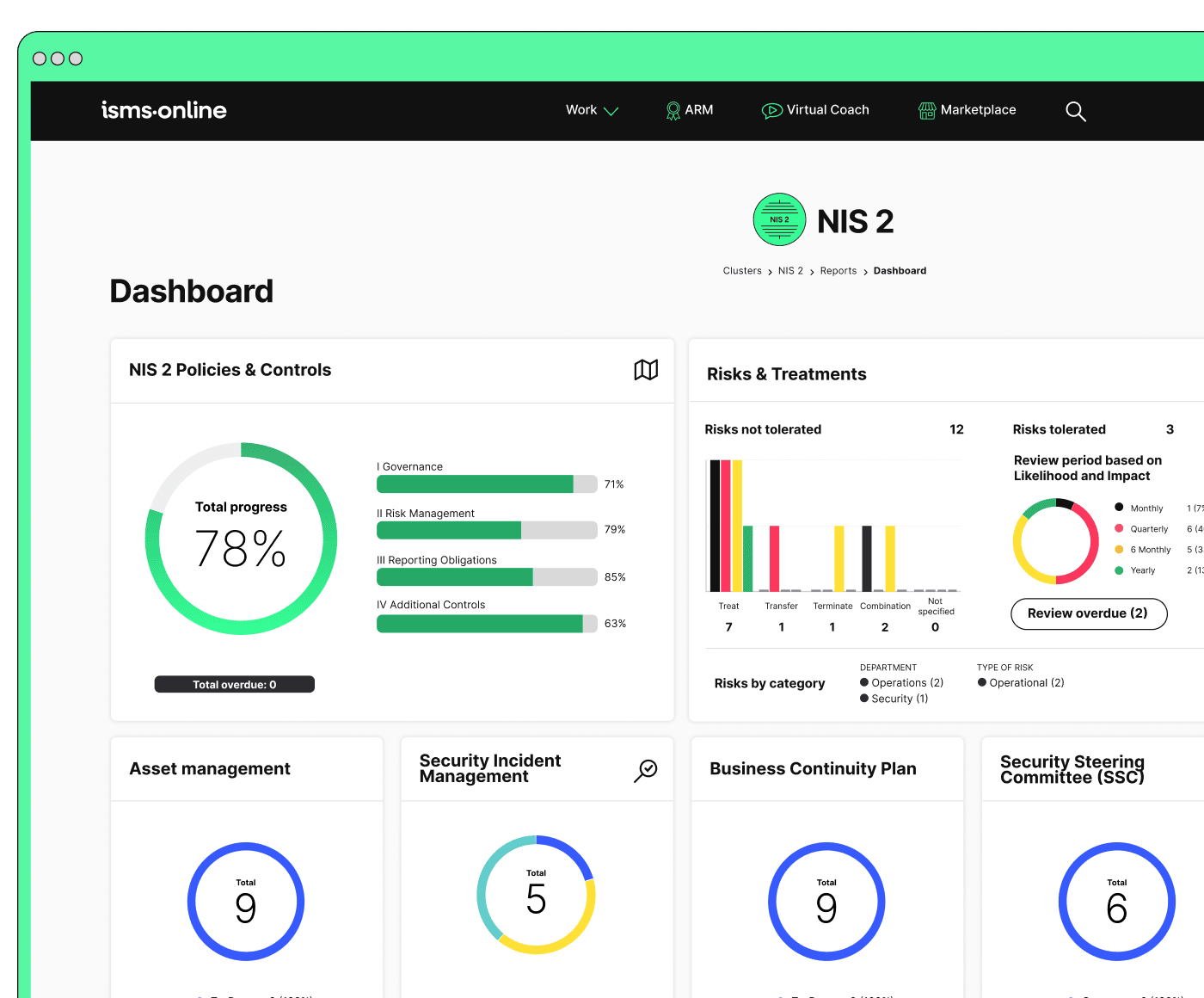
Be NIS 2-ready from day one
Launch with a proven workspace and templates – just tailor, assign, and go.
Proof-Driven Automation: How ISMS.online Delivers End-to-End MFA Evidence
Organisations that thrive in audit and resist regulatory risk aren’t doing more admin-they’re building workflow-linked evidence, where every approval, control, exception, and supplier action is logged, mapped, and instantly export-ready (TechRepublic, SC Media).
Automation isn’t about saving clicks-it’s about chaining every approval and exception to a living evidence log.
How Does Automation Link and Track Every Action?
Workflow automation in ISMS.online means that every policy update, approval, exception closure, and supplier event is not just a ticked box-but a live, time-stamped, and ownership-linked entry. This digital chain means you can always answer “who approved what, when, and why”-and deliver that instantly on audit demand.
Integrated Logs, Supplier Approvals, and Export Chains
Updating authentication policies, onboarding suppliers, and closing exceptions are all stitched together inside ISMS.online; every action builds on the last, with exportable evidence chains meeting both auditor and board oversight (SC Media). No more chasing disparate departments. One log, one workflow, one evidence trail.
Visualising an Audit-Ready Workflow
- Policy Update: MFA/password change reviewed, signed digitally.
- Approval: Owner signs, linked to workflow.
- Exception: Logged with owner, expiry, and compensating controls.
- Supplier: Onboarding triggers authentication check, approval log, escalation path if incomplete.
- Review: Automated reminders for upcoming reviews; closure tracked.
- Export: All evidence-policy, approval, exceptions, supplier logs-packaged for auditor or board.
Supplier Onboarding-Evidenced by Default
Every supplier becomes its own evidence stream in ISMS.online: onboarding checklists, digital approvals, triggered notifications, and escalations if onboarding falls out of compliance (ComputerWeekly).
Tracking and Benchmarking
Where once evidence meant a filing cabinet, now it’s a live dashboard. ISMS.online delivers real KPIs: review cadence, exception closure, supplier onboarding speed-enabling compliance leaders and boards to see, measure, and improve in real time (AICPA).
Next, explore how this automation, when built into your review rhythm, becomes operational resilience-and understand what happens when you let scheduled reviews lapse.
Building Resilience: The New Cadence for Authentication Reviews
True resilience is not a date on a policy review calendar, but a continuous, dynamic cycle of live reviews, event-driven actions, and linked evidence (Legal IT Insider, EU CyberDirect).
Resilience is built-one routine review, one rapid incident response at a time.
What Defines a Modern Review Cadence?
The strongest compliance programmes operate on two channels: a backbone of scheduled reviews (quarterly, annual, defined by risk), complemented by real-time triggers from workflow, threat intelligence, or regulatory change. ISMS.online lets you schedule, trigger, and escalate reviews automatically, logging each step for the board and auditors (Legal IT Insider).
Integrating Threat and Law into Review Cycles
Modern threat, supplier, and regulatory watching is built into ISMS.online-when a new NIS scope or cyber threat is detected, automated reminders and required review cycles are fired, integrating external risk into internal practise (EU CyberDirect).
Supplier Risk-More Than an Annual Tick
Best practise for high-risk suppliers isn’t annual review. DataGuidance and IAPP both find quarterly, even monthly cycles may be required-especially if supplier risk score, privileged access, or regulatory flags are high (DataGuidance, IAPP).
The Price of Missed Reviews
The largest regulatory fines arise not from initial mistakes, but from missed follow-up reviews after emerging risks or audit triggers (Lawfare). ISMS.online reduces this exposure by driving both reminders and closures, with digital evidence to prove it happened.
| Expectation | Operationalisation | ISO 27001 / Annex A Ref |
|---|---|---|
| Live cadence, all staff/suppliers | Automated reminders, audit logs, export chain | Cl.9.2, A.5.36 |
| Event-driven review | Workflow triggers for breach/supplier/incident | A.5.17, A.8.5, A.9 |
| Closure of exceptions | Automated expiry, owner notification, board log | A.9, risk register |
Each row in this table brings you closer to audit security and board trust.
Why Exportable Evidence Chains Are Essential
As supply chains disperse and audits cross borders, your compliance evidence must be not only 360°, but also instantly portable. ISMS.online produces export-ready, cross-framework audit packs-ready for any and every regulator (IAPP).
The final step: connecting your evidence chain from frontline control to board-level trust-making audit and resilience one and the same.
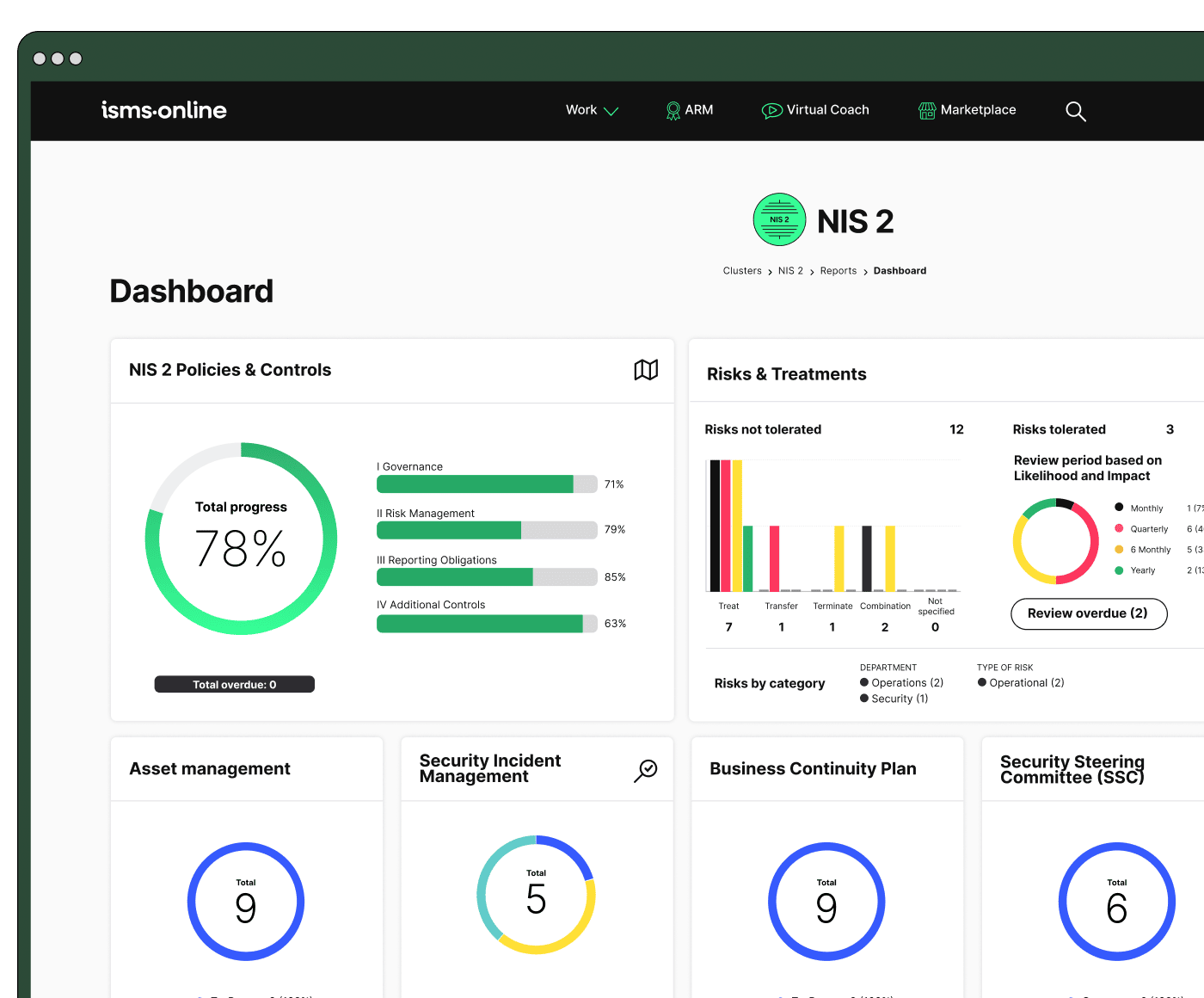
All your NIS 2, all in one place
From Articles 20–23 to audit plans – run and prove compliance, end-to-end.
The Complete Evidence Chain: Win the Audit, Build Trust
Resilient compliance and sustainable trust aren’t achieved with sporadic successes-they’re built on a living evidence chain (Lexology, Gartner, S&P Global, Baker McKenzie).
Trust isn’t static; it’s a living chain, proven by evidence at every step.
How Do Evidence Chains Secure the Enterprise?
A healthy chain connects policy updates, exception reviews, supplier onboarding, and triggered remediation-giving boards and auditors daily, not just yearly, visibility. Every action is time-stamped, owner-tagged, and escalation-linked. Weak links (untracked exceptions, lapsed reviews) are flagged by dashboards before they threaten resilience (S&P Global).
- Digital workflow: sign-off, owner review, exception/closure, supplier onboarding-all logged and traceable.
- Integrated governance: internal and supplier-side activities mapped in one platform, not scattered silos.
Boardroom Accountability
Board members and compliance owners use digital workflows-named sign-offs, date logs, and export chains-to certify their role from approval to operational action. This closes the gap from the conference table to the frontlines (PwC).
Setting the Next Readiness Benchmark
Leading organisations are measured by their time-to-close for each evidence chain: the gold standard is 24 hours from policy change, exception, or supplier event to logged board acknowledgment (S&P Global). This isn’t about perfection-it’s about formalising agility and audit-proofing every move.
From Risk Notification to Preemptive Remediation
A robust evidence chain captures risk triggers, updates the register, maps controls, and logs new evidence-before an auditor ever asks. Outdated approvals or unreviewed exceptions become visible gaps, not hidden risks.
For every compliance lead racing the next audit, and for every board wary of regulator challenge, the difference between good and great is the chain linking action and evidence, daily.
Adopt ISMS.online Today
Resilience-regulatory, operational, reputational-is not an entitlement but an earned asset. ISMS.online is the platform proven to deliver a living compliance chain: mapped evidence, digital templates, workflow-driven automation, and review mechanisms that collectively make your audit process a business differentiator.
| Expectation | Operationalisation | ISO 27001 / Annex A Ref |
|---|---|---|
| Board sign-off on auth | Digital approval, renewal logs | Cl.5.2, A.5.17 |
| MFA/password full coverage | Platform-enforced, triggered surveillance | A.8.5, A.7.2, A.8.3 |
| Supplier proof + onboarding | Automated approval chain, audit logs | A.5.19, A.5.21, A.7.1 |
| Managed exception lifecycle | Automated register, expiry, periodic review | A.9, risk register |
| Live review cadence | Workflow reminders, chain-of-approval exports | Cl.9.2, A.5.36 |
This mapping table is your operational guide: transform good intentions into audit-ready assurance, every day.
Your Next Steps
- Use ISMS.online to standardise every authentication approval, exception, and supplier process-linking actions to digital evidence automatically.
- Automate audit readiness: from MFA rollout to exception review, chain approvals and logs so youre always ready, never scrambling.
- Benchmark and improve: live dashboards show your posture, closing weak links before regulators or attackers exploit them.
- Export with confidence: when auditors, clients, or regulators ask for proof, deliver it-complete, mapped, and regulator-ready.
- Build trust as a lasting asset: every logged action, review, and remediation is another proof point for your organisations integrity.
Resilient compliance isnt a finish line; its a living contract. With ISMS.online, your compliance isnt just built for now-its ready for every next challenge your business will face.
Book a demoFrequently Asked Questions
How Should Boards Prove Their Authentication Practises Meet NIS 2 and ISO 27001 Standards?
Board-level authentication oversight now demands continuous, audit-grade evidence that extends far beyond traditional one-off sign-offs. Under NIS 2 Article 20 and ISO 27001:2022 A.5.17 and A.8.5, your directors must be able to supply live, time-stamped records showing who approved controls, when MFA or authentication policies were reviewed, and how exceptions were signed off and monitored. Static intent statements or annual reviews are no longer defensible when a regulator, auditor, or major customer requests proof of oversight or “continual improvement.”
Modern ISMS platforms-like ISMS.online-create a single system of record by logging policy edits, approvals, boardroom reviews, exception handling, supplier onboarding, and workflow updates. Such real-time evidencing assures external parties that your leadership understands their legal exposure and takes proactive responsibility for authentication risk.
A director’s signature is only as secure as the chain of documented decisions behind it.
Table: Board Authentication Proofs Mapped to Controls
| Evidence Required | Operational Context | ISO 27001 / NIS 2 Reference |
|---|---|---|
| MFA policy sign-off trail | Board-signed, versioned policy | A.5.17, A.8.5, NIS 2 Art. 20 |
| Exceptions w/ owner logs | Owner, expiry, compensations | A.5.18, NIS 2 Art. 20 |
| Supplier auth record | Onboarding, supplier registry | A.5.21, A.8.5 |
What Are the Common Authentication Gaps That Result in Audit Pain-and How Do You Close Them?
Audit reports consistently highlight gaps between declared and actual control, especially when authentication policies look robust on paper but reveal cracks in day-to-day operation. The most frequently cited issues include privileged accounts left out of MFA coverage, outdated password standards, supplier or third-party accounts granted access without SSO or sufficient evidence, and exceptions that remain ownerless or unreviewed.
To close these audit exposure points, your ISMS (Information Security Management System) must treat every privileged credential, authentication policy, and supplier connection as an auditable asset. Automated reminders, proactive asset reviews, and event-driven onboarding workflows ensure that no credential is overlooked and no exception sprawled across systems. Evidence should map granularly-by account, supplier, and exception owner-so your board and practitioners can spot, remediate, and document issues before they become findings.
Lax coverage on one admin account can undermine a year’s worth of compliance effort.
Table: Patch the Pain Points
| Audit Gap | Preventive Action in ISMS.online | Control Mapped |
|---|---|---|
| Admin account lacks MFA | Asset register with MFA flags | A.8.5 |
| Password policy not current | Automated reminders, sign-off requests | A.5.17 |
| Supplier SSO/MFA missing | Onboarding triggers, evidence capture | A.5.21, A.8.5 |
How Can You Manage MFA Exceptions Without Creating Regulatory Risk?
Under NIS 2 and ISO 27001, an exception is not simply a temporary permission-it’s a live risk that must be owned, time-limited, formally reviewed, and mitigated with controls if MFA cannot be enforced. Leaving exceptions open-ended or missing periodic review dates will not just trip audit alerts, but may trigger regulatory penalties.
Best practise is to log every exception as part of a controlled, board-visible process. This includes owner assignment, expiry (or at least quarterly review), and compensating controls (like session or network restrictions). Exception registers, real-time notifications, and review workflows should be central features-not “bolt-ons”-in your ISMS. Automated reminders for review cycles and actionable dashboards help ensure no exception lingers outside board visibility.
The gap between an exception and a breach is only the length of an unmanaged expiry date.
Table: Exception Management Lifecycle
| Use Case | Control Applied | Evidence Captured | Review Schedule |
|---|---|---|---|
| Legacy app/no MFA | Segmentation/logging | Owner, expiry, log trail | Quarterly/incidents |
| Supplier not ready | Temporary register | Supplier sign-off, expiry | Onboarding/renewal |
Where Does Audit Mapping Between NIS 2 Article 11.6 and ISO 27001 Go Wrong-and How Do You Create Audit Synergy?
The overlap between NIS 2 Article 11.6 and ISO 27001 clauses (A.5.17, A.8.5, A.5.21) is intentional: both demand directors prove not only the existence of technical controls but their ongoing governance. Most audit gaps emerge when organisations maintain fragmented records-separate logs for regulatory, ISO, and customer audits-or when technical logs can’t be directly linked to policies or board decisions.
A convergent ISMS enables re-use of evidence across frameworks. Instead of duplicating logs for every standard, integrated workflows mean one control decision (like MFA enforcement or a supplier onboarding event) produces policy-linked, audit-ready proof for all requirements. The real risk lies in siloed evidence: if your technical team can’t easily trace an access event to a policy and a board-approved exception, you’ll fail at least one audit-possibly three.
Audit synergy is achieved when one decision leaves three audit paths-secure and ready for every inquiry.
Table: NIS 2 and ISO 27001 Evidence Mapping
| NIS 2 Demand | ISO 27001 Clause(s) | Platform Evidence |
|---|---|---|
| Board-reviewed MFA | A.5.17, A.8.5 | Sign-off & change log |
| Supplier auth chain | A.5.21, A.7.10 | Supplier registry, logs |
| Exception governance | A.5.18 | Owner, expiry, review logs |
What Does ISMS.online Automate to Turn Authentication into a “Living” Chain of Proof?
ISMS.online automates every decision and event in the authentication lifecycle-policy edits, exception approvals, asset onboarding, supplier reviews, and scheduled reminders-into a live, tamper-resistant chain of evidence. Each authentication action is time-stamped, owner-attributed, and mapped to relevant controls and framework clauses. With policy and exception workflows linked to scheduled board reviews, directors can visualise real progress-not just intent-on an interactive dashboard.
Instant reports are available for audits, regulatory disclosures, or market tenders-no last-minute scrambling for PDF exports or scattered approval emails. Supplier onboarding and terminations are equipped with MFA enforcement triggers and exception logs, connecting every access change to a board-approved, audit-friendly record.
Your audit story is only as strong as its weakest evidence link-build it daily, automate it everywhere.
Checklist: Automation Features for Audit-Ready Authentication
- Events mapped to NIS 2 & ISO 27001 controls
- Onboarding (suppliers, staff) linked to authentication evidence
- Exception register with owner, expiry, compensating controls
- Scheduled reminders for policy and asset review
- Board dashboard scanning evidence chain in real time
How Does Authentication Compliance Become a Boardroom Asset and Source of Trust Capital?
When authentication oversight is no longer a paper exercise but a demonstrable, living discipline, it becomes central to market trust, investor signals, and board confidence. Directors who can show real proof of timely exception reviews, direct sign-off on authentication policies, and agile closure of audit points can turn compliance from a stressor into a strategic advantage. RFP win rates, investor comfort, and even insurance terms can shift when evidence is available on demand and audit queries are resolved with speed and precision.
ISMS.online benchmarks your authentication workflow against industry leaders and automates exception surfacing, closing, and evidence export. The result is a proactive, resilient organisation whose reputation is built on authentic proof, not just promises.
Trust is evidenced on demand-by directors, for directors, with every policy signed, and every risk reviewed.
Table: From Compliance Proof to Resilient Boardroom Capital
| Desired Outcome | Metric/Signal | ISMS.online Feature |
|---|---|---|
| Audit prep time <50% | Hours saved per audit cycle | Automated control/evidence mapping |
| Faster RFP & investor wins | Cycle time, board confidence | Exportable, dashboard-first records |
| Continual improvement | % completed reviews/triggers | Reminders & scheduled review logs |
| Regulatory closure speed | Days to resolve query | Audit/exportable chain, board view |
| Trust capital in reputation | Board/investor feedback, peer ranking | Industry benchmarking, dashboard metrics |
Ready to make board-level authentication compliance a lever for resilience, trust, and business growth? Book a walkthrough and see how living, mapped evidence can secure your leadership standing and protect your enterprise day by day.






