





































Why Removable Media Remain the Silent Breach Risk in Boardrooms
In a world dominated by cloud platforms, the humble USB stick or portable drive is often dismissed as a relic-until one sparks an embarrassing breach or triggers a compliance audit failure. Despite policies and awareness training, most organisations cannot produce a simple, unimpeachable answer to a board-level question: “Can you trace every removable device from assignment to destruction, and prove it?” The evidence tells a sobering story. ENISA’s 2024 report highlights that over 54% of organisations cannot reliably track the current or last location of their removable media assets, and removable media remains the top driver of clear desk policy breaches and costly incident response actions (ENISA, 2024; Iron Mountain, 2023; cyber.gov.au).
A device you can’t locate or evidence is a device you can’t defend-removable media is compliance risk made manifest.
This gap isn’t the result of ignorance. It’s born from the changing complexity of asset management, fragmented process ownership, and inadequate escalation flows. Often, well-meaning teams believe their policies are enough-until a failed audit or data loss incident exposes blind spots. Removable media incidents, by their nature, are easily missed in digital oversight and can go unreported until it’s too late. Digital tools catch much, but the pathway from “lost device” to “documented response” often fails at the first link: unlabelled drives, inconsistent sign-out sheets, and no living chain-of-custody record.
Is Your Board Prepared to Attest to Removable Media Controls? NIS 2 Makes It Mandatory
With the arrival of NIS 2 (Art. 21, Sec. 12.3), the conversation about removable media security has shifted to boardrooms. Gone are the days when a static IT policy in written form sufficed. Now, executives are held directly responsible-not only for the existence of mapped controls but for demonstrating continuous, active compliance across every deployment: employee, contractor, and supplier.
Boards must require and evidence:
- Asset lifecycle management: Every device’s assignment, movement, incident, and disposal must flow through a live-logged chain-of-custody, not a spreadsheet lost to history.
- Real-time incident workflows: A lost, stolen, or suspicious device isn’t a “review later” event. It’s a trigger for instant, documented board escalation.
- Signed policy exceptions: Permissions for legacy, unencrypted, or nonstandard scenarios must be authorised at the board level, mapped to corrective actions, and reviewed on a scheduled basis.
- Staff attestation to policy updates: Digital sign-off-every user, every update, not just annual e-learning tick-boxes.
Recent ENISA NIS 2 Toolbox guidance places strong emphasis on continuous evidence chains, stating that “ad hoc policy or exception handling, with no central audit trail, has become the top non-conformity resulting in material regulatory censure” (ENISA, 2024). Ask yourself honestly: If a regulator stood in your server room today, could you demonstrate end-to-end evidence for the lifecycle of even one USB key?
Boards are no longer shielded by plausible deniability-removable media compliance is a lived, logged responsibility.

Master NIS 2 without spreadsheet chaos
Centralise risk, incidents, suppliers, and evidence in one clean platform.
ISO 27001:2022 and NIS 2-Building an Evidence Bridge, Not Another Paper Trail
If you operate within ISO 27001:2022 controls, you’ll recognise most NIS 2 requirements for media management are conceptually “old news.” The leap, however, is from documentation to systemised, always-on operationalisation. Gone are the days when pasted policy snippets suffice for audit. What counts is actionable, timestamped evidence visible to external and internal stakeholders.
Here’s a concise mapping for conversion:
| Expectation | Operationalisation | ISO 27001:2022 Control |
|---|---|---|
| All media issued/returned is logged | Asset register; live assignment updates | A.7.10, A.5.9 |
| Encryption enforced for confidential | Device encryption policy; audit logs at register | A.8.10, A.8.7 |
| Staff acknowledge policy changes | Digital sign-off plus scenario-based quizzes | A.6.3, A.5.10 |
| Lost/stolen media are escalated | Workflow tickets, escalation procedures | A.5.24, A.7.14 |
| Reviewers have real-time access | Automated evidence packs, SIEM export | A.8.15, A.8.14 |
This bridge is only functional if what happens in IT and operations is visible, provable, and mapped into a live evidence trail.
Sample Audit Traceability Table
| Trigger | Risk Update | Control / SoA link | Evidence Logged (Sample) |
|---|---|---|---|
| Staff receives USB | Data exfiltration risk ↑ | A.7.10 Asset register | Assignment, encryption, user sign-off |
| Policy updated | Outdated controls exposed | A.6.3 Awareness | Versioned sign-offs, quiz logs |
| Device loss | Loss/theft incident risk | A.5.24, A.7.14 | Incident report, root cause, action |
The bridge from trigger to evidence is your shield: break any link, and audit confidence is lost.
From Static Policy to Dynamic Assurance: How ISMS.online Closes the Loop
A compliant removable media policy is necessary, but not sufficient. True assurance comes from workflows enforced by technology-where assignment, exception, and user engagement are system events, not paper trails waiting to fail. ISMS.online provides a full-stack control environment:
- Dynamic policy deployment: Out-of-the-box, regulator-reviewed templates for ISO 27001:2022 and NIS 2, pre-built for adaptation to your own workflows.
- Version-driven acknowledgement: Every policy change requires e-signature; every signature logs the user, actioned device, timestamp, and policy version-no gaps, no ambiguity.
- Asset lifecycle register: A living record, not a static sheet; tracks assignment, movement, secure wipe, destruction, with assigned owner, purpose, and risk linkage.
- Incident triggers and escalation logic: Any lost, missing, or noncompliant device generates a workflow ticket, enforced with role-based assignment and tracked to closure.
With ISMS.online, the dreaded audit request for “evidence of your last ten device assignments and disposals” is a thirty-second philtre, not a week of email chases.
Practise isn’t proven unless evidence is ready-and living-every hour, every audit.
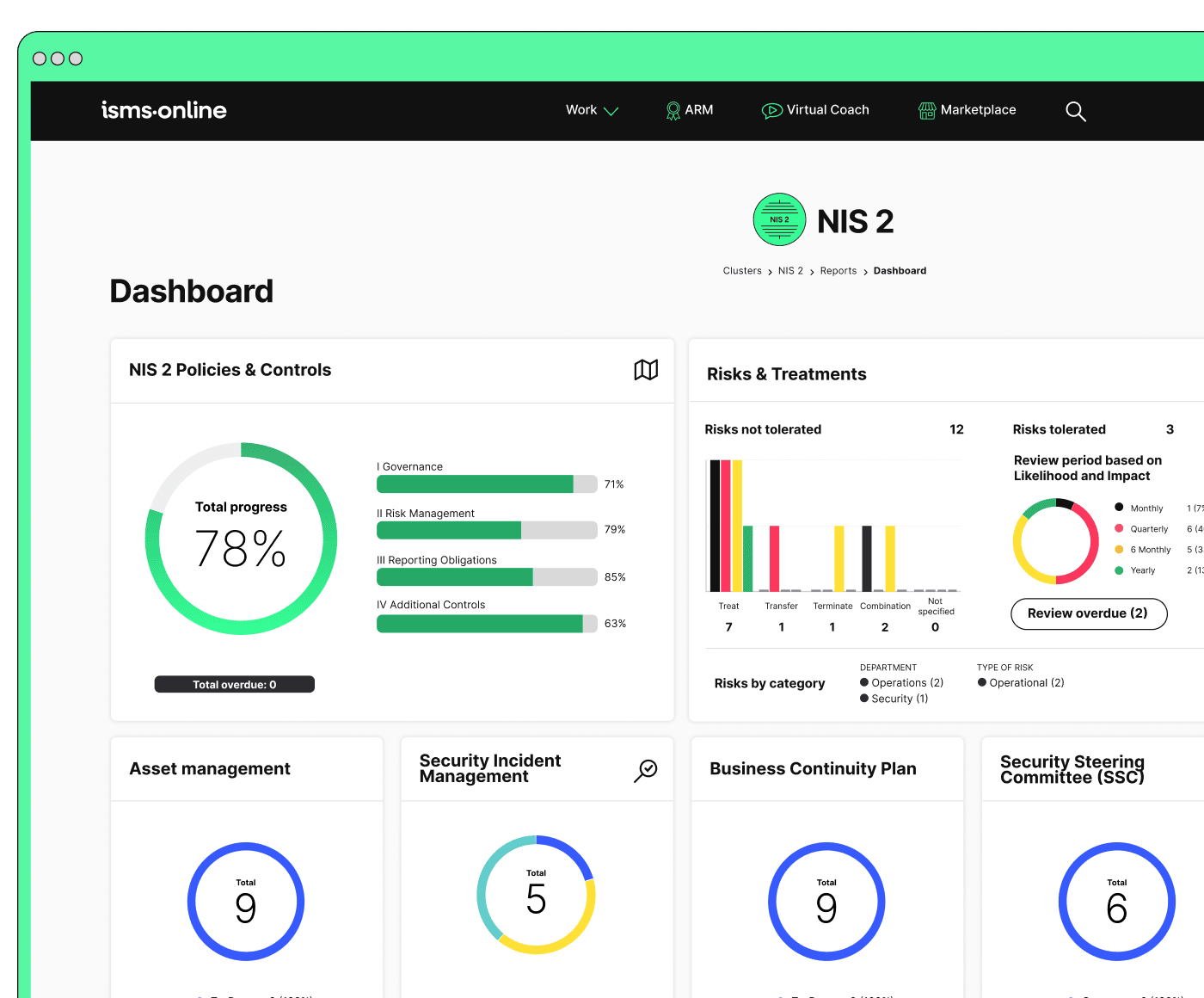
Be NIS 2-ready from day one
Launch with a proven workspace and templates – just tailor, assign, and go.
Technical Controls: Encryption, Blocking, and SIEM Integration Made Real
It’s impossible to achieve true removable media compliance by process alone. ISMS.online ensures that the entire technical control suite-from device encryption to conditional port access and SIEM/EDR integrations-is woven directly into your compliance fabric.
- Mandatory encryption enforcement: blocks the assignment of unencrypted drives, or triggers an exception route for board-signed approval plus risk assessment (per NIS2 and ISO A.8.7/A.8.10).
- Port blocking/conditional access: Integrate with device control solutions like Microsoft Purview or CrowdStrike; only pre-approved assets are assignable, with all exceptions tracked and reported.
- SIEM/EDR workflow: All violations, suspicious events, and attempted port accesses are sent into your compliance asset register-fully timestamped and mapped to the relevant incident and control.
- Evidence linkage: Each technical event is mapped to Statement of Applicability (SoA) controls, making every alert a compliance record, not just a security event.
A technical control is only as strong as its chain to user, asset, and evidence. ISMS.online knits this chain tight, framing every device state change as an auditable event.
Behavioural Controls: Training, Monitoring, Acknowledgement
Technical controls set the baseline, but human behaviour is where audits are lost-or passed with flying colours. ISMS.online embeds living user engagement in every stage:
- Scenario-based training: Users, contractors, and suppliers undertake real-world threat scenario modules, pass/fail rates are logged and mapped to roles and issued assets.
- Policy revision sign-off: E-signature workflows drive version control. Missed acknowledgements are instantly visible to management, eliminating “I didn’t see the update” loopholes.
- At-a-glance compliance dashboards: Units or staff lagging on training or acknowledgements are flagged; compliance is proven before an audit, not as a hasty afterthought.
- Real-case localization: Replace generic awareness videos with tailored modules-incidents are tracked to specific staff and roles, with feedback feeding into continuous improvement.
Your defence is immune to excuses when every behavioural event is logged, evidenced, and retrievable at will.
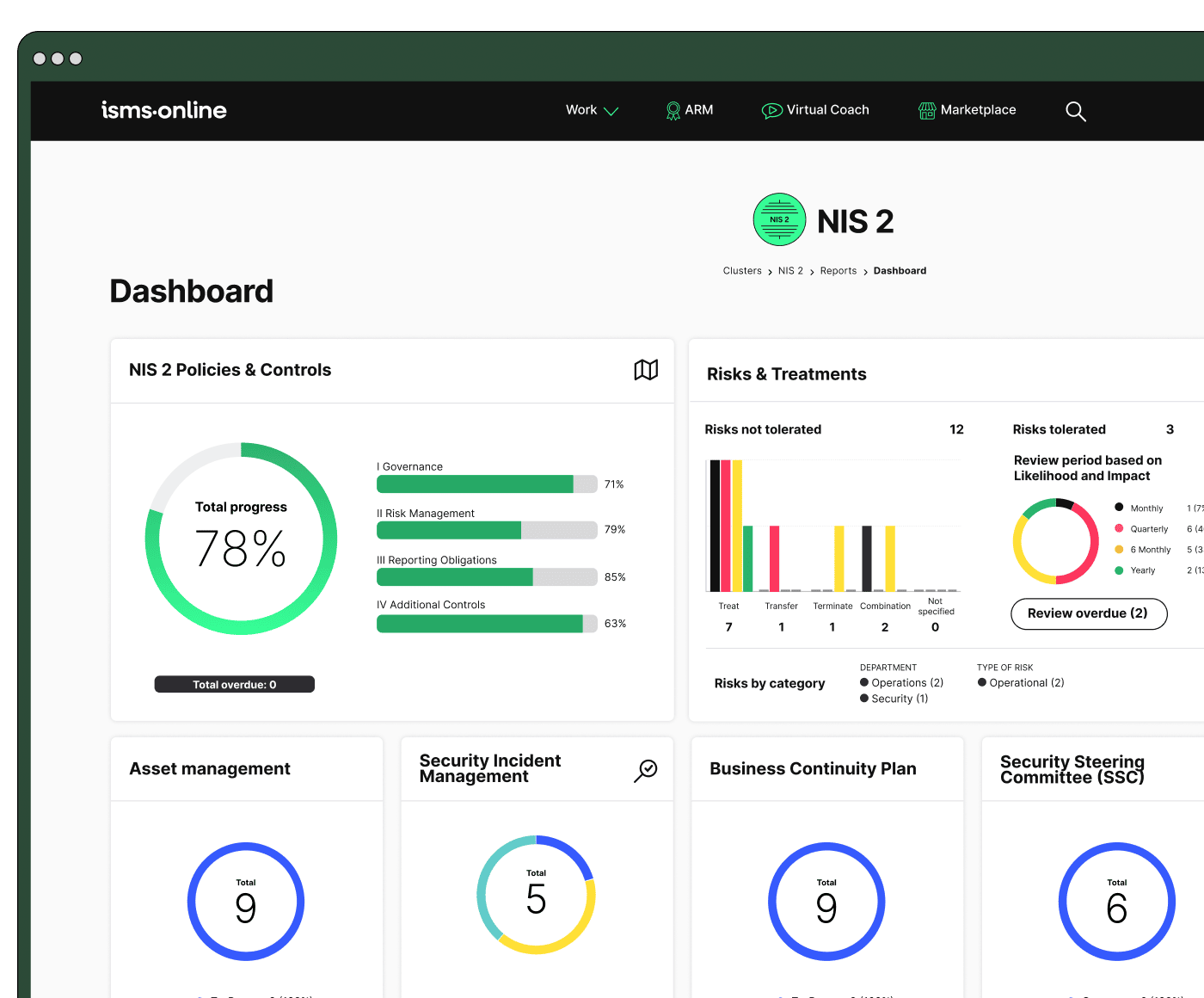
All your NIS 2, all in one place
From Articles 20–23 to audit plans – run and prove compliance, end-to-end.
Automated Evidence: Live Logging and Board Reporting
Continuous, automated evidence collection is the cornerstone of a modern compliance posture. ISMS.online locks this in with:
- Live event logging: Every device assignment, return, loss, policy update, and relevant training step is timestamped, tied to a staff member and asset, and permanently fixed to the evidence record.
- Actionable dashboards and audit exports: Board- and regulator-ready reports are drawn directly from live system logs, eliminating delay and lost evidence.
- Audit success rates: Customers have reported near-perfect pass rates as a result of real-time evidence systems-no late-stage document chasing, no unsourced claims.
- Root-cause closure: Every incident includes logged action, follow-up, and closure assurance; unresolved tickets remain flagged until full documentation is complete.
Compliance is a living process. Evidence shouldn’t be a last-minute rescue operation.
With ISMS.online, you are always ready to answer the call from auditors or boards-wherever, whenever-armed with the transparent, up-to-the-moment story of your compliance.
Why Your Evidence Must Travel: Sector, Supply Chain and International Reach
Compliance is never local. Devices cross borders, staff shift across contracts, and sectoral standards add layers of complexity. ISMS.online ensures:
- Cross-standard traceability: Controls and records are structured to satisfy ISO 27001:2022, NIS 2, and GDPR Article 32 (“state of the art”), meeting both technical and organisational expectations.
- Third-party and supply chain integration: Issued devices under supplier management or contract conditions are registered in your evidence stack, so hand-offs are never a weak link.
- Automated proof generation: Whether for a regulator, board, or client, generate role-focused evidence packs that combine asset histories, risk mappings, and incident trails-instantly.
- Global audit readiness: Logs and evidence are formatted for multi-jurisdictional use, including EU (NIS 2, GDPR), US (SOC 2, CCPA), UK (DPA 2018), and more.
Your compliance system is only as strong as the weakest asset journey-sector, client, supplier, geography, all covered.
From Policy to Resilience: Position Removable Media as an Asset, Not a Liability
With ISMS.online, the managed risk of removable media becomes a board-level success metric. Achieve-and evidence-compliance in the only way that counts: through living policy, automatic traceability, and audit-validated controls.
- Bridge every gap: -from static policy, to live asset register, to instant incident logging.
- See and act on risk: in real time; spotlight gaps before auditors do.
- Push transparency up the chain: -satisfy board, clients, partners, and regulators in minutes, not months.
- Activate automation wherever possible: , so every staff action and device event is captured and defensible.
Risk is only unacceptable when evidence is missing-make every device an asset, not a silent threat.
Ready to transform removable media from risk vector to resilience asset? ISMS.online delivers a living system-linking boardroom policy, technical enforcement, and everyday staff action. Audit-ready, always.
Frequently Asked Questions
Who ultimately bears responsibility for removable media compliance under NIS 2 and ISO 27001, and what are the board-level stakes for lapses?
Responsibility for removable media security and compliance under NIS 2 and ISO 27001 sits squarely with your organisation’s senior management-board members, directors, and executive officers-who now carry explicit legal and regulatory accountability for lapses. NIS 2 (Articles 20–21) moves accountability from “IT’s problem” to a leadership mandate: if controls for tracking, handling, or disposing of removable media (like USB drives) fail or are poorly documented, directors can face regulatory penalties, public disclosures, and business-impacting sanctions. ISO 27001 reinforces this through Clauses 5.1 and 5.3, requiring leadership to drive information security policies and allocate clear responsibilities (see also A.7.10 for removable media).
Day-to-day, ISMS/IT leads orchestrate compliance: they formalise policies, maintain asset registers (A.5.9), require evidence of user understanding (A.6.3), and respond rapidly to incidents. But every employee, supplier, or contractor who touches these devices must be enrolled and acknowledge policies in writing. Lapses-like missing device logs or unsigned policies-become not just audit findings but direct board-level failures, triggering investigation or enforcement.
Board assurance isn’t about blaming staff, but proving oversight. When every move is logged and every user is accountable, leaders can stand confidently in front of regulators and customers alike.
Removable Media Responsibility Matrix
| Step | Accountable Roles | ISO/NIS 2 Reference |
|---|---|---|
| Policy Approval | Board, Executives | Clause 5.1/5.3; NIS 2 Art.20 |
| Asset Register | ISMS Lead, IT, Security, Owners | A.5.9, A.7.10 |
| User Acknowledgement | Staff, Contractors, Suppliers | A.6.3, A.7.10 |
| Oversight/Audit | Compliance, Board, External Auditors | A.9, A.5.35; NIS 2 Art.31 |
What automated technical controls for removable media are required by NIS 2 and ISO 27001-and how can you ensure enforcement?
Both NIS 2 and ISO 27001 demand that organisations implement automated technical controls to govern every interaction with removable media-not just paperwork policies.
- Encryption enforcement: Endpoints must automatically reject unencrypted drives for regulated or sensitive data (A.8.10, NIS 2 Art. 12.3).
- Mandatory malware scanning: Devices are scanned before use, enforced by endpoint protection with logs saved as audit evidence (A.8.7).
- Port and device controls: All endpoints restrict or log use of USB/SD ports, only allowing whitelisted media. Idle ports should be disabled by default (A.7.10, NIS 2 Art. 21).
- Data Loss Prevention (DLP): Systems must block or log attempts to move unapproved data to or from these devices (A.8.12, NIS 2 Art. 12.3).
- Centralised activity logging: Every action-plug-in, file transfer, incident-is logged automatically in a unified register (A.8.15).
Platforms such as ISMS.online integrate with DLP, EDR (endpoint detection/response), and asset management tools like Microsoft Purview for seamless, evidence-backed enforcement-giving you a defensible audit trail and real-time control.
Technical Controls & Enforcement Table
| Control | Enforcement Action | ISO/NIS Ref. |
|---|---|---|
| Encryption | Block unencrypted devices | A.8.10, NIS 2 12.3 |
| Malware Scanning | Require up-to-date AV/EDR scan before use | A.8.7 |
| Port Control | Disable unless media is whitelisted | A.7.10, NIS 2 21 |
| DLP | Block or log suspicious transfers | A.8.12, NIS 2 12.3 |
| Logging | All actions recorded in central register | A.8.15 |
How is audit evidence for removable media captured, mapped, and made audit-ready across the enterprise?
Audit-ready compliance means you track and document the full life cycle of every device: from issuance to handover, use, incident, and final disposal. ISMS.online records time-stamped logs at each stage, links user acknowledgments to specific policy versions, and embeds e-signatures for every asset interaction.
If a device is lost, stolen, or otherwise implicated in an incident, a structured workflow is launched: every assessment, action, and closure step is mapped and logged-no invisible gaps or missing documentation. Integrations pull asset and movement data from IT, supply chain management, or vendor platforms to ensure even cross-border or multi-site usage is provable.
The regulator’s question is always ‘who, when, why, and what proof?’ Your audit trail is your best line of board defence.
Evidence Mapping Table
| Event | Evidence Captured | Control Link | Example/Usage |
|---|---|---|---|
| Device issued | Asset log, user e-sign | A.7.10, NIS 2 12.3 | Staff given encrypted USB, policy signed |
| Policy update | Versioned ack log | A.6.3, A.7.10 | Everyone re-acknowledges after update |
| Device lost | Incident workflow log | A.5.24, A.7.14 | Root cause documented, board notified |
| Device retired | Destruction log | A.7.14, NIS 2 12.3 | Vendor certificate stored |
What corrective action workflow should be followed for removable media incidents, and how does ISMS.online ensure visibility and closure?
When a removable media incident (loss, breach, device malfunction) is detected, ISMS.online triggers a multi-step corrective action workflow:
- Instant incident registration: Key details (device ID, user, date/time/location) linked to asset register and incident response module.
- Assignment and investigation: IT or compliance leads are tasked with root cause analysis, required actions (quarantine, supplier notification, secure deletion), and immediate escalation for critical issues.
- Escalation logic: If regulatory thresholds are met or risks to PII exist, an alert is sent automatically to senior management or the board, mandating documented approval and oversight.
- Proof-of-remediation: Closure is only permitted once all required actions are completed, logged, and verified; persistent gaps or recurrences are highlighted in dashboards.
This ensures a transparent, defensible process that not only prevents regulatory fallout but also demonstrates governance maturity to all stakeholders.
A defensible response is the only true insurance against small mistakes turning into regulatory or reputational crises.
Do cloud-only or MDM-managed companies still require removable media controls under NIS 2 and ISO 27001?
Yes-having a cloud-first or MDM (mobile device management) environment does not eliminate your removable media duties. Both NIS 2 and ISO 27001 require explicit policies, controls, and evidence for every potential or actual use of physical media, regardless of how rare.
If your organisation sometimes needs portable drives-for field operations, legacy migrations, supply chain requests, or regulated customer proofs-even a single such case must go through formal approval and logging (board or CISO sign-off, device registration, monitored usage, documented secure disposal).
Auditors and regulators will not accept “we don’t use them” as an excuse; even zero events must be proven with policy evidence and negative logs.
Exception Approval Flow Table
| Legacy Need? | Approval | Registration | Use Control | Destruction Proof |
|---|---|---|---|---|
| Yes | Board/CISO | Asset log | Monitoring | Disposal cert |
| Never | Not needed | / | / | / |
How do leading organisations embed removable media compliance in training, culture, and the supply chain across sites and borders?
Resilient organisations operationalise removable media controls by weaving them into training, culture, and third-party engagement:
- Scenario-based training: at onboarding and annually-customised for each role and location, referencing jurisdictional nuances (e.g., GDPR, HIPAA).
- Mandatory digital acknowledgements: for all users (internal and supply chain), with training completion and policy sign-offs traceable per person/device.
- Integrated supply chain onboarding: Suppliers, contractors, and remote teams are included in the same compliance workflows and tracked in dashboards.
- Live dashboarding: of compliance gaps-proactive alerts when acknowledgements, training, or policy updates go overdue or are missing.
- Real-world incident studies: reinforce vigilance, responsibility, and concrete “what to do if X happens” guidance for every setting.
Your organisation’s security culture stands or falls on the weakest user, vendor, or forgotten storage device-evidence of engagement is your real standard.
How does ISMS.online move removable media compliance from tick-box exercise to verifiable resilience and board-level assurance?
ISMS.online consolidates all controls, evidence, and oversight for removable media security in one system:
- Deploy mapped controls: for NIS 2 and ISO 27001 quickly.
- Log every device, user action, and incident: with traceable stages from assignment through retirement.
- Synchronise approvals and exception management: even in cloud-only/rare-use environments-ensuring “rare” does not become “untracked.”
- Unify staff and third-party engagement: into a real-time compliance dashboard, alerting leadership to risks before audits uncover them.
- Export audit-ready proof packs: , showing regulators and customers not just compliance, but structural maturity and defensible governance.
Identity CTA:
Step above the “tick box”-let ISMS.online give you the continuous evidence and leadership assurance needed to prove security and resilience, not just compliance, to the people that matter.
ISO 27001 / Annex A Compliance Table
| Expectation | Operationalisation | Ref. |
|---|---|---|
| Devices tracked/logged | Asset register, usage logs, dashboards | A.5.9, A.7.10 |
| Policy/ack sign-off | Workflow + alerts, person-by-person | A.6.3, A.7.10 |
| Encryption enforced | Endpoint settings, EDR, logs | A.8.10, NIS 2 Art 12.3 |
| Antimalware scan/logging | Automated prior-to-use workflows | A.8.7, A.7.10 |
| Root cause for incidents | Investigation, escalation, closure logs | A.5.24, A.7.14 |
| Supply chain engagement | Onboarding and workflow integration | A.7.10, NIS 2 Art 21 |
Traceability Table
| Trigger/Event | Risk | Control Ref. | Logged Evidence |
|---|---|---|---|
| Device assigned | Data exfil risk | A.7.10 | Asset + policy ack log |
| Policy updated | Control drift | A.6.3, A.7.10 | Re-sign, completion log |
| Incident reported | Breach/audit risk | A.5.24, A.7.14 | Workflow + closure log |
| Supplier onboarded | Supply chain gap | A.7.10 | Training + evid. pack |






