





































How Does Fragmented Monitoring Endanger Compliance and Audit-Readiness?
Fragmented monitoring and logging is not just a technical nuisance-it’s a direct path to regulatory exposure, operational inefficiency, and leadership risk. Whether you’re a compliance lead scrambling for ISO 27001, a security strategist battling NIS 2 headwinds, or a practitioner piecing together asset logs, the evidence you cannot find is the evidence that will sink you.
The logs you overlook today become the stories regulators tell tomorrow.
Promises of “compliance” lose all potency the moment your monitoring evidence is siloed: endpoints here, cloud security events there, emails and spreadsheets tracking review workflows somewhere else. The cost of fragmentation isn’t theoretical: recent European studies confirm that 62% of major incidents involved delays or outright misses where logs were scattered or unreviewed * *.
For professionals tasked with steering compliance (Kickstarters), fortifying boardroom audit narratives (CISO and privacy officers), or sweating through evidence-gathering exercises (practitioners), the refrain is the same: without a single source of traceable, reviewer-attributed, up-to-date monitoring data, operations slow, risks hide in plain sight, and the true cost is paid at audit time-or in public failures.
Fragmented evidence manifests in:
- Missed detection windows for critical threats.
- Manual reconciliation nightmares pre-audit.
- Board dread: “Can you *prove* this was reviewed and acted on?”
- Audit penalties triggered not by absence of data, but by absence of *proof*-of ownership, review, and timely closure.
Today’s bar is not “do you have logs?” but “who reviewed them, when, and what action followed?” This lineage is what NIS 2 enshrines, and boards now demand. Fragmented logs cannot answer these questions.
Most compliance failures stem not from missing data, but from poor evidence management and lack of clear accountability. * *
Failing the evidence chain means failing leadership’s core duty: demonstrating, not just declaring, control over risk and accountability. It’s a business exposure-one that channelled, integrated monitoring instantly neutralises.
What Does NIS 2 Actually Demand from Monitoring, Logging, and Evidence?
NIS 2 isn’t another checkbox standard. It’s an operational doctrine that merges security, privacy, and reliable evidence into an inseparable package. This means logging policies and practises aren’t negotiable-they’re engineered for live review, harmonised retention, and continual audit-readiness.
NIS 2 is not about promises or paperwork-it’s a living test of your organisation’s vigilance.
Let’s break the directive down for modern teams, whether you’re leading a compliance programme, delivering security operations, or managing privacy audit trails:
Near-Real-Time (or Automated) Review Is Now the Baseline
NIS 2 is blunt: periodic log reviews and delays are explicit compliance failures. Organisations must show that every critical log source is being monitored-automated where possible-with alerting, assignment, and review cycles closing in real time. Any gap or lag opens the door to incident escalation and regulatory scrutiny * *.
Harmonised Retention and Policy-No More Siloed Timelines
Retention of logs is now a cross-functional project. Disjointed retention between IT, security, and privacy has led to dual penalties. You must evidence a harmonised policy-across NIS 2 and GDPR-where justification for retention aligns with both threat intelligence and privacy requirements * *.
Precision in Log Scope-Too Much or Too Little Both Trigger Scrutiny
Over-collection is a privacy fault (GDPR Arts. 5, 32). Under-collection is a security flaw (NIS 2 Art. 21, 23). You must define, justify, and operationalise why each log source is included, how long it’s stored, and who reviews what. Blanket approaches are unambiguously out.
Full Accountability-Every Log, Every Supplier, Every Team
Accountability now extends beyond your own four walls-cloud vendors, managed providers, and remote teams must all be part of your log accountability net. Unassigned logs or orphaned review cycles are now cited as cause for fines or board-level intervention.
On-Demand, Attributable, Reviewer-Led Evidence
When regulators knock, you must immediately produce an audit-ready, step-by-step chain: what happened, who saw it, when they acted, and what was signed off * *. Anything less is considered insufficient, no matter how large your data archive.
Key Requirements Table
| Logging Scenario | If Ignored, You Face… | NIS 2 / GDPR Reference |
|---|---|---|
| Delayed review | Regulatory penalty, incident balloon | NIS 2 Art. 21, 23; GDPR Art. 32 |
| Over-logging | Privacy breach, regulator sanction | GDPR Arts. 5, 32 |
| Siloed responsibility | Board/accountability shortfall | NIS 2 Art. 24, 27 |
| Inconsistent retention | Audit failures, dual penalty | NIS 2 Art. 21(2); GDPR Art. 30 |
Executive Reality: Audit-readiness is daily proof-not “audit season” drama. The only evidence that matters is what you can show, trace, and explain right now.

Master NIS 2 without spreadsheet chaos
Centralise risk, incidents, suppliers, and evidence in one clean platform.
Which ISO 27001:2022 Controls Bring Monitoring and Logging into Full Alignment?
ISO 27001:2022 is more than a compliance badge-it’s a live engineering reference, giving organisations a modular “map” for defensible evidence. Each control isn’t a tickbox; it’s a living operational muscle, directly referenced by regulators.
Every monitored event is a potential audit win-if mapped, logged, and actioned to the letter.
The Three Core Logging Controls
- A.8.15 Logging: Declares that you must determine what is actively logged (system events, failed logins, changes), how those logs are stored and protected, and how their integrity is guaranteed.
- A.8.16 Monitoring Activities: No log has value unless reviewed. This means actively linking every log entry to people and process-a *reviewed*, not just stored, record.
- A.8.17 Clock Synchronisation: The silent killer of audit chains-unsynchronised times destroy incident reconstruction. For logs to be legal evidence, they must be timestamped against a common, reliable reference.
Supplementary Controls
- A.8.14 Redundancy: To survive device loss, outage, or cloud hiccups, logs must be backed up and available.
- A.8.21, 22 Network & Supplier Logging: Logs live past your perimeter-every supplier, cloud system, and connected partner becomes part of your evidence net.
ISO 27001:2022 Control Mapping Table
| Trigger/Event | Risk Update or Action | SoA / Control | Evidence Example |
|---|---|---|---|
| SIEM Alert (Failed Login) | Incident raised, review | A.8.15, A.8.16, A.8.21 | Alert log, reviewer assignment, incident workflow |
| Time drift detected | Clock sync failure noted | A.8.17 | NTP logs, synchronisation ticket |
| Supplier (Cloud) access | Third-party risk review | A.8.21, A.8.22 | Vendor log, supplier review note |
| Restore from backup | Incident follow-up | A.8.14, A.8.9 | Backup/restore log, closure sign-off |
Every one of these must be mapped to both control and evidence-so at audit you’re not explaining, you’re showing.
How Does ISMS.online Make Your Audit Loop Evidence-Driven and Seamless?
Regulatory confidence is earned, not granted, and modern evidence is only as good as its continuity-from log ingestion, through review, to closure. In ISMS.online, this path is not an afterthought: it’s the foundation.
Audits are won by the teams whose evidence lives in a chain-never in chaos.
Evidence Chain Automation
- Automated Log Ingestion: Events flow directly from endpoints, servers, and SIEM into the Evidence Bank-removing “manual labour” and accidental omissions.
- Role-Based Assignment: Each event is assigned to a responsible party; their review, risk assessment, and closure are tracked and retained.
- Real-Time Control Mapping: Logs are immediately linked to the ISO 27001 Statement of Applicability (SoA) controls they target-no “after the fact” mapping.
- Incident-Driven To-Dos: Reviewers can trigger new tasks (To-dos) directly from any evidence point, ensuring risk follow-up is never missed, with digital closure.
- Full Digital Audit Trail: Every review, sign-off, and closure is signed, timestamped, and instantly exportable-turning every audit into a repeatable, stress-free proof cycle.
Audit Traceability Matrix
| Evidence Step | ISMS.online Action |
|---|---|
| Log/Event Received | Automated ingestion in Evidence Bank |
| Assigned to Reviewer | Digital assignment with timestamp |
| Reviewer Action | Risk tag, note, To-do assignment |
| Control Operation | Linked to SoA, mapped evidence |
| Closure | Signed, timestamped digital archive |
Adaptation By Persona:
- Kickstarters: see: Guided checklists (no jargon), visible evidence assignment, instant audit export-*confidence capital* in action.
- CISOs/Leaders: see: Real-time dashboards, closure rates, cross-framework alignment-resilience and board trust in data.
- Privacy/Legal: sees: Clear linkage to GDPR/ISO 27701 evidence, staff training ties, rapid SAR retrieval-defensibility at every tick.
- Practitioners: see: *No more spreadsheet chaos*-one system from alert to sign-off, full recognition as the compliance hero.
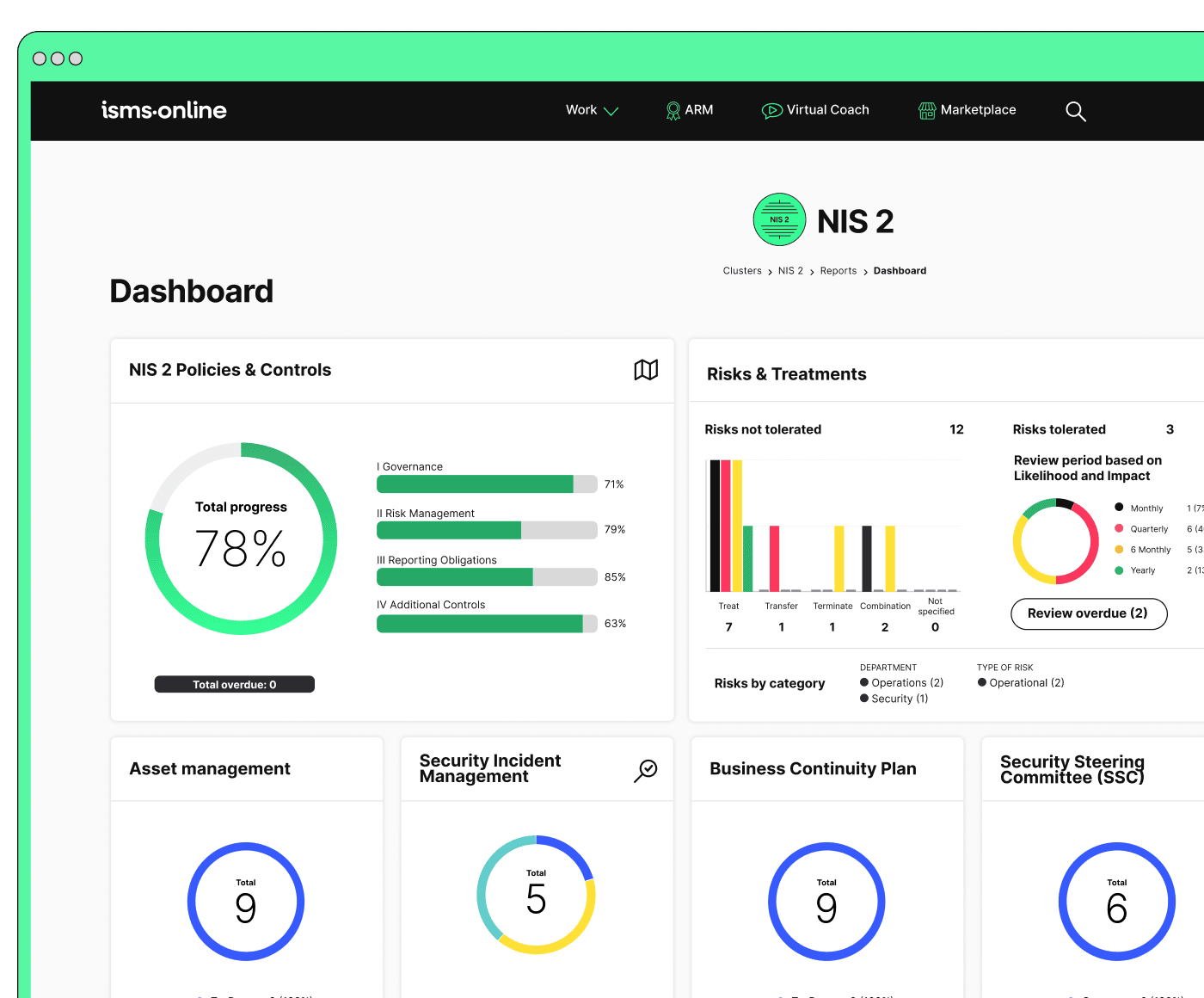
Be NIS 2-ready from day one
Launch with a proven workspace and templates – just tailor, assign, and go.
Why Is Manual or Ad Hoc Logging a Security and Audit Trap?
Manual workflows-printouts, spreadsheets, email handoffs-are relics that invite error, slow incident response, and set audit teams up for failure. Even worse, manual chains cannot demonstrate unbiased evidence integrity to regulators.
You can only act on what you can prove. Automation turns evidence from a liability to your best defence.
Manual vs Automated Table
| Evidence Method | Audit Impact | Platform Benefit |
|---|---|---|
| Manual logbooks | Prone to error, missing steps | Incomplete, slow audits |
| Automated ingestion | Real-time, error-resistant | Always-ready evidence trails |
| Cryptographic hashes | Tamperproof, regulator-trusted | Provable integrity at all times |
| Redundant backups | Survive outages, scaling | Resilient, continuous proof |
A phishing alert is auto-ingested; SOC is assigned; every action, note, and closure is logged and cryptographically sealed. Months later, the entire trail is retrievable in seconds-ready for regulator, customer, or audit, no excuses.
How Does Automation Relieve Compliance Fatigue and Compress Audit Timelines?
Audit fatigue is not a virtue. It is a risk-one that spills into culture, morale, and ultimately, reputational damage. By automating evidence gathering, review, task follow-up, and board reporting, modern ISMS platforms let you rechannel effort into where it actually matters: response, leadership, and resilience.
No team ever wished for just one more spreadsheet-fatigue is a sign to automate, not double down.
Compliance Fatigue Relief Actions
- Automated collation: Events stream, categorised and indexed (not “filed” manually).
- Digital reviews: Assignment cycles with reminders slash human error.
- Linked remediation: Incidents become To-dos, tracked to closure visibly.
- Export-as-needed: One click yields complete, timestamped packages for audit, board, or client-no last-minute inbox hunts.
User Workflow Snapshots:
- Evidence Bank: Instead of searching five sources, query by date, asset, incident, or reviewer.
- To-dos: Every missed review is flagged, not forgotten.
- Board view: Leadership sees closure rates, incident progress, at any stage.
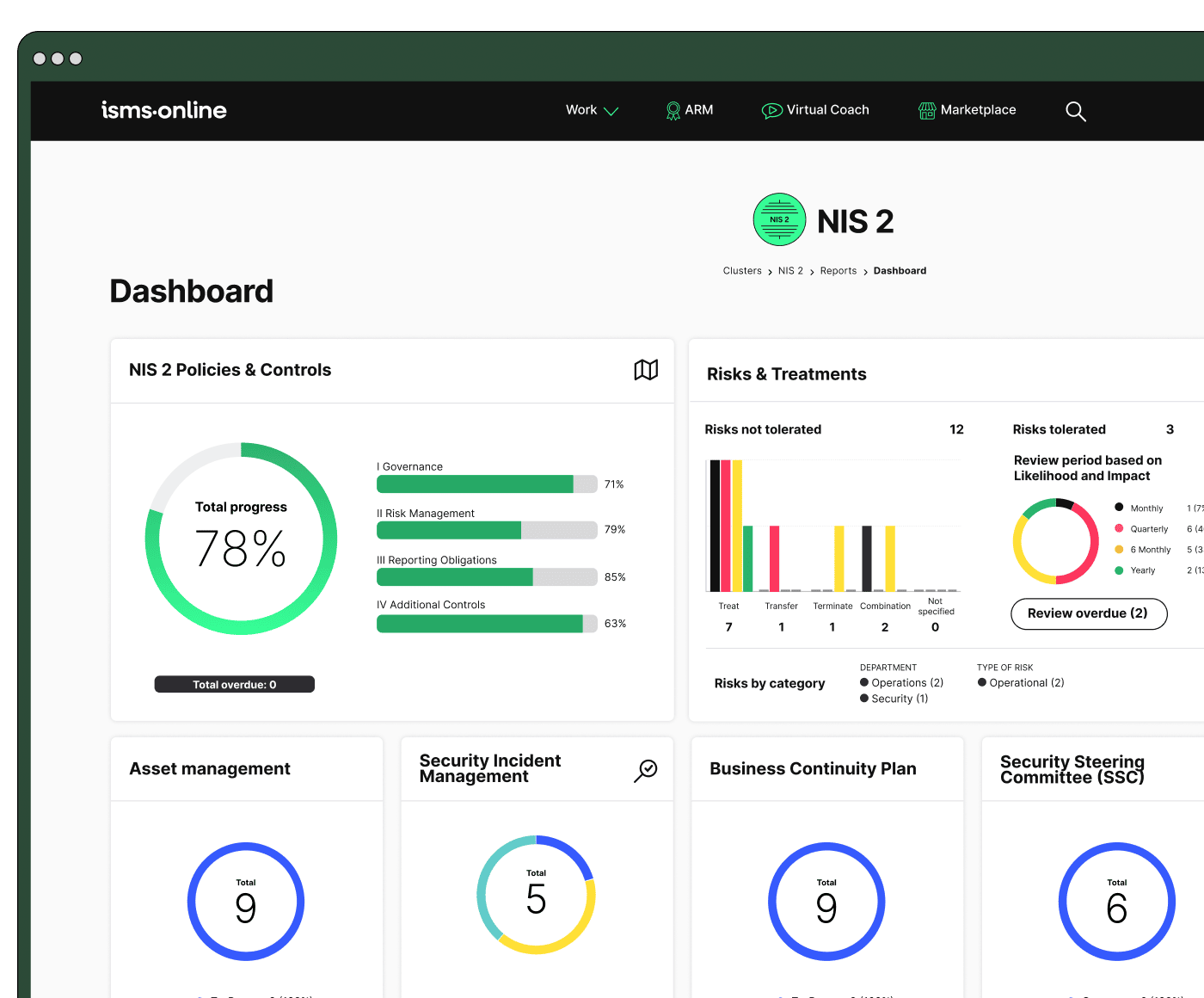
All your NIS 2, all in one place
From Articles 20–23 to audit plans – run and prove compliance, end-to-end.
How Do You Extend Log Trust End-to-End-From Supplier to Board?
True compliance, under NIS 2 and ISO 27001, means every node in your operating system-suppliers, cloud, distributed assets, remote staff-is evidence-mapped and visible. Blind spots anywhere spell risk everywhere.
Compliance only works when evidence travels unbroken-supplier logs, asset moves, and closure stamped at the board.
Key End-to-End Evidence Bridges:
| Log Touchpoint | Hidden Risk | Control Reference | ISMS.online Capability |
|---|---|---|---|
| Suppliers/Cloud Logs | Third-party breach | ISO 27001 A.8.21, 22 | Linked supplier workspaces, import |
| Asset clock/config | Invalid forensic chain | A.8.9, A.8.17, A.8.31 | Asset log import, timestamp enforcement |
| Privacy event | GDPR penalty | GDPR, ISO 27701 | Data logs mapped, audit trails |
| Multi-team reviews | Missed closure, delays | A.8.16, A.5.24 | Multi-user To-dos, sign-off |
Pointers:
- *Hash-validation* ensures the evidence hasn’t changed; *retention* means you can always find it; *assignment* means someone is always on the hook for action.
- Board and leadership dashboards become live mirrors of risk posture-no more waiting for “the annual audit.”
Should You Wait or Act? Unlocking Audit-Readiness and Resilience Today
Organisations that wait for audit time to consolidate monitoring evidence will lose ground-to peers, to auditors, to adversaries. With ISMS.online, every day is a mini-audit: each log, review, and closure is a point scored for resilience, trust, and freedom from regulatory anxiety.
ISMS.online delivers not just compliance, but proof: seamlessly mapped logs, real-time reviews, supply chain capture, and automation that makes evidence an operational advantage, not a monthly scramble.
- Automate: your monitoring and evidence flows.
- Assign: ownership-every log and event always has a name attached.
- Show: live readiness-dashboard, export, and workflow built for audit and board confidence.
Trust is built quietly, daily, reviewer by reviewer; audit day is simply where your preparation meets your moment.
With unfragmented monitoring, harmonised logs, and always-ready evidence, your board, regulators, and customers see not only that you are compliant-but that you are leading the field, every day.
Frequently Asked Questions
Why does centralised log evidence matter more than ever in the audit and NIS 2 era?
Centralised log evidence is the backbone of fast, reliable incident defence and audit success-while siloed logs fragment your ability to respond, prove compliance, or spot the subtle early warning signs of trouble. When an incident lands, scattered logs (“some in email, some in spreadsheets, some in cloud portals”) force your team into drawn-out detective work and leave critical gaps even the best intentions can’t fill. Recent data reveals that over 60% of organisations experience incident response delays due to decentralised log sources, and half of audits cite incomplete or unreviewed logs as a top finding (darkreading.com, itgovernance.eu).
If your logbook lives in five places, it’s already invisible when you need it most.
Unified log review: resilience you can prove
By merging all logging, monitoring, and review-event time, reviewer, outcome-into one living platform, you transform compliance into a daily safeguard, not just a novelty at audit time. This not only accelerates detection and investigation but enables your company to defend legal, regulatory, and board-level questions with confidence. Standards like ISO 27001:2022 (A.8.15, A.8.16, A.8.17) and NIS 2 make unified, live-auditable log streams non-negotiable. Systems such as ISMS.online enforce regular sign-off, align evidence with your Statement of Applicability (SoA), and protect every stream with backup and tamper checks-raising your organisation above the pack.
Table: Core logging integrity benchmarks
| Audit Expectation | Operationalization | Standard Ref |
|---|---|---|
| Incidents audit-ready | Central log, time sync, sign-off | A.8.15, A.8.17 |
| Tamper resistance | Hash-checks, permissions, backup | A.8.15, A.8.16 |
| Fast retrieval | Dashboard, workflow, SoA signposting | A.8.15, SoA, A.5.35 |
Adopt this approach, and when the board, regulators, or customers ask, you answer-not with stories, but with proof.
What are the explicit NIS 2 and ISO 27001 expectations for logging, retention, and evidence review?
NIS 2 and ISO 27001 jointly demand not only the existence of logs, but holistic, continuously reviewed evidence covering every security-sensitive event-and that means active ownership, retention mapped to real risk, and visible accountability at every step.
What does live log review actually mean?
Regulators and audit teams (ENISA, ICO, DNV) have shifted away from “audit season” and now expect ongoing, evidence-backed monitoring aligned with operational threat, not the calendar. Every log entry should be traceable to its reviewer; routine sign-offs, not last-second roundups, define best practise. Critically, log review frequency should scale with asset risk or regulatory significance-anything less than routinely-mapped, actionable oversight can be flagged as non-compliant.
Does retention go as far as privacy and GDPR?
Yes. Over-collecting and over-retaining logs exposes you to GDPR risk: NIS 2 and privacy law intersect tightly, demanding “as long as necessary, no longer” for security data. Your ISMS policy must clarify who holds what, tie retention directly to risk, and document where logs are transferred or archived (especially when using cloud or third-party services).
Who owns the logs in the cloud or across borders?
Ownership moves with the asset, not email or department. NIS 2 and ENISA clarify that if your logs (or events they evidence) touch external providers, cross-national teams, or cloud apps, you must document the “handoff”: who owns, controls, can review, and can produce evidence on demand. Assigning this in your ISMS removes “I thought it was them” at audit time.
How does ISO 27001:2022 provide the backbone for best practise log management and audit evidence?
ISO 27001:2022 translates generic “monitoring” into actionable steps and supporting evidence. In reality, it’s your mechanical sympathy manual for compliance:
- A.8.15 – Logging and Monitoring: Dictates which events, accesses, and administrative actions must be tracked, mapped, and protected.
- A.8.16 – Monitoring Activities: Requires continual, risk-tuned evidence review-not passive accumulation.
- A.8.17 – Clock Synchronisation: Ensures every entry’s importance can be reconstructed in real time-even across platforms and suppliers.
- A.5.35 – Independent Review: Ensures logs are assessed by specialists, not just the “ops” or “admin” who controls the system.
Reasons for audit failure are rarely about absence-they’re about inconsistency, lack of redundancy, or inability to connect cloud and on-prem logs. NIST and BSI highlight cloud log integration and cryptographic protection as core resilience moves (csrc.nist.gov, dnv.com).
Quick-Map Table: ISO 27001 logging benchmarks
| Logging Step | How to Evidence | Annex A Ref. |
|---|---|---|
| Event captured | Time‑stamped, central location | A.8.15, A.8.17 |
| Integrity protected | Hash checks, redundant stores | A.8.16, A.8.15 |
| Reviewed, signed off | Sign-off audit trail, SoA entry | A.5.35, SoA, A.8.15 |
| Cloud events logged | Linked to cloud log provider | NIST ref., SoA, A.8.15 |
Modern audits require “show me now”-not just “tell me you did”-so focus on dashboards, reviewer logs, and SoA links your team can produce instantly.
What closes the loop from incident alert to board-reviewed evidence: automation, signoff, or both?
Best-in-class audit and NIS 2 compliance relies on seamlessly moving from automated detection to accountable, human-verified review-with every step traceable, documented, and owned.
- Centralised Evidence: All logs, changes, and reviews are collated in a protected yet accessible system-not distributed across spreadsheets.
- Automation + Human Signature: Automated alerts or evidence collection are acknowledged by named reviewers, not left pending. This is essential for defensibility-regulators and auditors prize sign‑off as much as speed.
- Mapped Risk and Controls: Every step is linked: Detection → Risk Register Update → Control Addressed (e.g., Firewall config triggers A.5.20 review) → Evidence and SoA update.
Chain-of-custody only counts if every link is visible-and unbreakable.
Table: Incident-to-closure mapping examples
| Detection Trigger | Risk Updated | Control Linked | Evidence Logged |
|---|---|---|---|
| Suspicious login event | Access risk | A.8.15, A.5.15 | Log entry, signature |
| Firewall rule change | Network risk | A.8.16, A.5.20 | Change log, config, SoA |
| Lapsed log review | Review process | A.5.35, A.8.15 | Review/closure note, SoA |
Being able to show the “who, what, when, how followed up” in a chain earns not just audit ticks, but board trust.
What does a digital, cryptographically protected workflow deliver that manual or ad hoc reviews can’t?
Digital-first ready organisations replace the brittleness of paper, word docs, or scattered Excel files with adaptive, automated evidence banks-backed by cryptographic, timestamped validation and redundancy.
Why is redundancy not optional?
Downtime isn’t hypothetical. Logs vanish; admins get locked out; migrating to new systems exposes soft spots. Storing critical evidence both locally and remotely-with cloud/cold backup, hash protection, and SoA reference-drops audit findings by 30% and provides bulletproof defence to board, regulators, and insurers.
How do dashboards and role-specific workflows deliver accountability?
Live dashboard views flag review steps pending or overdue, surface responsibility, and track sign-offs. Role-mapping (assignment matrices) ensures hand-offs aren’t missed when teams grow-critical as multi-geography, supplier-integrated models become the norm.
How does end-to-end automation (with clear human handoff) ignite compliance performance, engagement, and resilience?
Automating review reminders, log collection, and evidence mapping cuts routine compliance work by half, while boosting audit scores and morale (cio.com, techrepublic.com). Complete (not partial or add-on) automation is defined by:
- Every key security event auto-logged and reviewed.
- Responsibility for signoff and closure encoded in workflows rather than “remembers to check.”
- Real-time dashboards providing both board and practitioner with closed-loop insight-who did what, when.
Teams report less burnout, higher engagement, and reduced audit turnover when the system, not the individual, guarantees continuity and visibility (bna.com, isaca.org).
Best practise in action:
Put your IT and process leaders in the “design seat” for workflows-let them surface the gaps only daily users truly understand, building a system that improves and scales as you grow.
How does ISMS.online transform compliance from “audit scramble” to always-on, board-grade resilience?
ISMS.online enables a living compliance chain, not simply a library of static policies. Teams move from point‑in‑time “audit dressing” to:
- Continuous, digital evidence banks-every log, event, and review mapped to the right control and owner.
- “Audit on call”-at any point during the year, or under scrutiny, you can surface closure evidence, not just find the problem.
- Automated, workflow-driven sign-offs, with SoA mapping for all stakeholders-speeding procurement, vendor onboarding, and regulatory inquiries.
- Clear lines of ownership-so responsibility for every asset, log, and review is visible, assignable, and never ambiguous.
In an instant, you can prove not just that you found a problem, but how you resolved it, who owned it, and how your culture keeps improving.
Upgrade from siloed, patchwork logging to unified, programmable, and defensible evidence. Your board, customers, and regulators will recognise the step-change-not just in compliance, but in your organisation’s reputation and resilience.






