





































Are You Audit-Proof or Just Paper-Ready?
Every security or compliance leader, whether in a fast-growing SaaS or a multinational enterprise, faces a crucial test: would your security policy stand up to a regulator’s inspection, or is it just a nicely bound PDF gathering digital dust? The difference between paper-ready and audit-proof is the gap between intention and evidence.
A policy unread is a risk undiscovered.
Most organisations tick off the “policy approved” box and move on, but NIS 2 and ISO 27001:2022 demand that security policy is not just a document-it must be an engine of real engagement and continuous improvement (ENISA, 2023; BSI, 2024). Auditors and boards have shifted their mindset: a signed policy is not enough unless it is operational, reviewed, and acknowledged across teams and supply chains.
The Danger of Paper-Ready Compliance
You might have best-in-class content, but when regulators or customers ask who saw and signed this, and when?, you cannot afford shrugs or well check our email archives. Audit trails cannot be an afterthought. Proper compliance demands:
- Evidence of every staff and supplier acknowledgment.
- Clear records of policy updates, version history, exceptions, and reviews.
- Digital, time-stamped logs showing active engagement.
ISMS.online, for example, supports policy tracking, digital signoffs, and automated reminders to embed policy into workflows and demonstrate real commitment (ISMS.online Solutions). In this era, aiming for good enough exposes you to silent drift-stakeholders working from old copies, missed updates, or untracked exceptions.
If tomorrows regulator or customer requests real engagement evidence, will your workflows deliver-instantly and completely-or will they find only a static policy file? This is where your platforms operationalisation makes all the difference.
Book a demoWhat Happens When Incidents Demand Real Evidence, Not Just a PDF?
When a security incident hits, timing and visibility are everything. Incidents arrive unscheduled, and regulators, customers, or boards will demand incontrovertible evidence that policies weren’t just created, but actually read, acknowledged, and applied-well before the crisis.
Evidence is not just a file. It’s proof of behaviour and intent.
Audit and incident response requests are no longer “Can you show us your policy?” but “Who saw policy version 7 before the breach? Was everyone trained on the update? Where’s the signoff log?” This is codified in NIS 2 Article 21 and ISO 27001:2022 Clause 5.2. The era of searching email or SharePoint folders for last-minute signoff evidence is over.
The Fatal Flaw in Disjointed Evidence
When your evidence is scattered across email, spreadsheets, PDFs, and folders, you are one incident away from failing forensic or regulatory review. A modern ISMS centralises:
- Every signoff (who, what, when).
- Policy version history connected to incident logs.
- Exception approvals, review cycles, and escalation chains.
- Instant exports for auditors or regulators.
Policy Traceability Table
| Trigger | Risk Update | Policy Control | Evidence Example |
|---|---|---|---|
| Change of law | Review and reissue required | Annual review, Board signoff | Board minutes, signoff logs, new version upload |
| Customer audit | Proof of staff acknowledgment | Policy communication | Read receipts, e-learning certifications |
| Security incident | Exception approved | Exception handling | Digital exception log, review closure |
This connected evidence model allows you to prove engagement-auditors and regulators want to see actions, not just intentions. If your system cannot instantly show the journey from policy creation through training, exception, review, and incident, your compliance is vulnerable.

Master NIS 2 without spreadsheet chaos
Centralise risk, incidents, suppliers, and evidence in one clean platform.
Are Policy Versions Floating in the Wild? Why Fragmentation Threatens Everything
A policy is only as strong as its latest version in the hands of every employee and supplier. When outdated copies circulate across business units or partners, exposure spreads silently-resulting in inconsistent response, non-compliance, or even regulatory sanctions.
The real risk is the silent spread of outdated instructions.
The Anatomy of Fragmentation
Policy drift-a scenario where old versions linger in mailboxes or third-party portals-breaks the chain of control. NIS 2 Article 22 and ISO 27001 Annex A:5.1 / A:5.36 make organisations responsible for the full supply network, not just their internal house.
How to Close Policy Gaps
- Secure digital acknowledgement from everyone-staff and suppliers.
- Push the current version to every endpoint, portal, and workflow.
- Centrally manage exceptions and require immediate re-acknowledgment anytime a policy is updated.
ISMS.online provides robust version control, notification, and acknowledgement tracking, so you always know who’s in-sync or requires intervention. This pre-empts risk-outdated or ignored policies become visible risks you can fix, rather than silent liabilities.
Policy Alignment Bridge Table
| NIS 2 Expectation | ISO/ISMS.online Operationalisation | ISO 27001 / Annex A Ref |
|---|---|---|
| Single policy version | Version control & register, tracking | Annex A:5.1, A:5.36 |
| Supplier acknowledgment | Supplier onboarding, signoff logs | Annex A:5.19, A:5.20 |
| Exception management | Exception workflow, escalation logs | Annex A:5.4, A:5.21 |
By letting policy drift persist, you gamble with unseen exposures. Alignment requires daily discipline, not just annual reviews.
How to Escape Box-Ticking: Run a Living Policy Cycle
Passing a one-time audit is easy; surviving continuous scrutiny is not. NIS 2 and ISO 27001:2022 expect proof of an active, iterative policy cycle-not relic “annual reviews,” but an always-on system that tracks, triggers, and records every change.
Continuous improvement isn’t an audit fantasy-it’s a proof loop, live and on demand.
Blueprint for a Living Policy Cycle
- Communicate at every key point: New joiners, contract updates, critical incidents.
- Enforce digital signoff: Tied to policy version, enforced on all users.
- Review and renew continually: Use workflow reminders-automate, not delegate.
- Log and resolve exceptions: Escalate when needed; document every outcome.
In ISMS.online, this means every new starter must digitally acknowledge all active policies before system access. Policy updates trigger “click-to-confirm” notifications. Exception requests auto-assign to reviewers, logs update in real time, and no one is left untracked.
Living Cycle Baseline
- [ ] Triggers (dates/incidents/law changes) fire reviews and exceptions.
- [ ] Reminders/alerts sent to responsible parties.
- [ ] Exceptions logged and tracked per policy.
- [ ] All events timestamped for audit-readiness.
- [ ] Evidence and logs exportable on demand.
Belief inversion: “Set and forget” is now proven risk. Continuous, managed engagement is the only credible stance.
Be NIS 2-ready from day one
Launch with a proven workspace and templates – just tailor, assign, and go.
Can You Prove Policy Engagement to Both Board and Auditor?
Boards demand more than surface compliance; they expect visible, traceable improvement. Auditors require live, granular records to identify not just what has been done, but whether it’s been done right, on time, and at scale.
What Boards and Auditors Expect
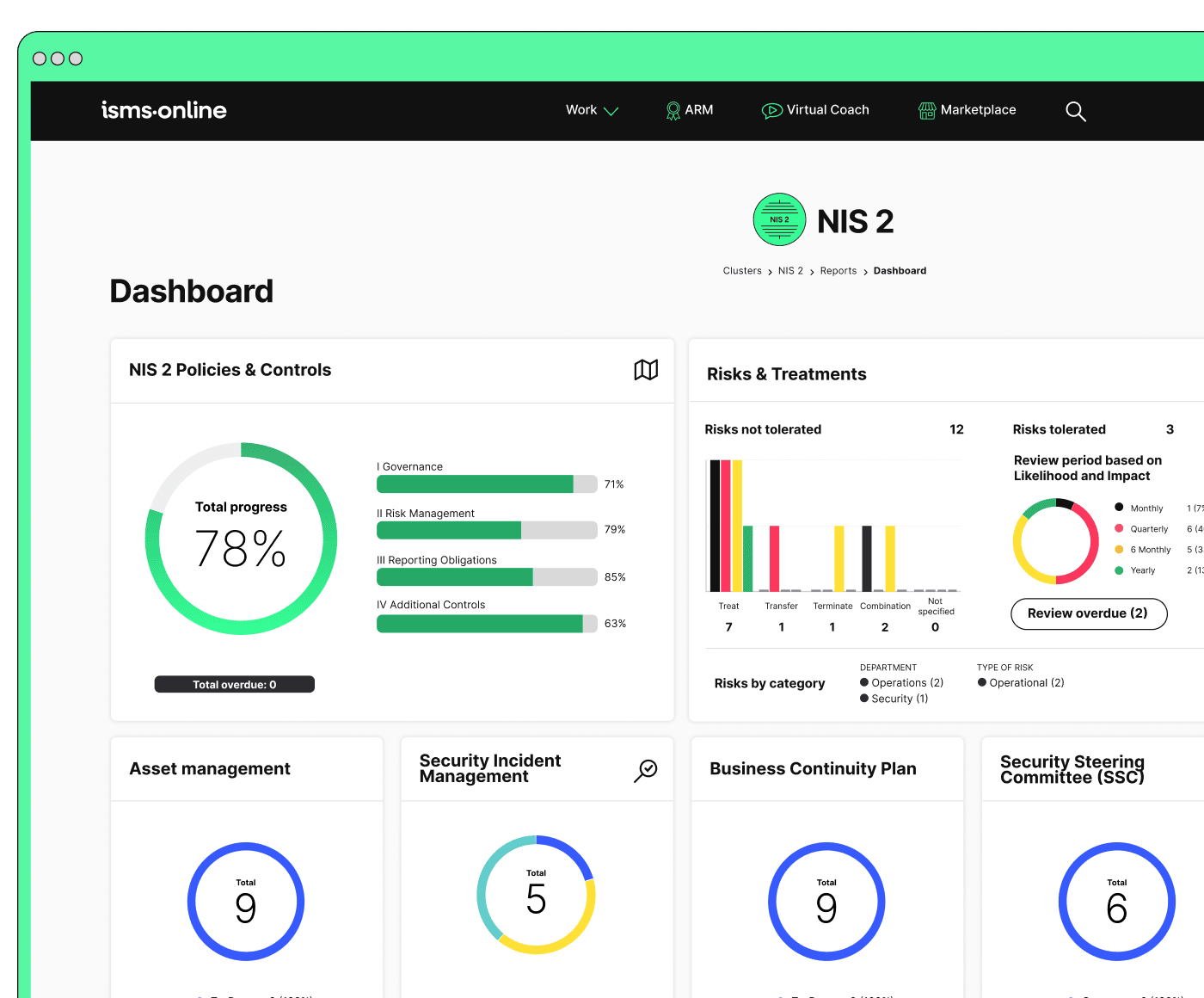
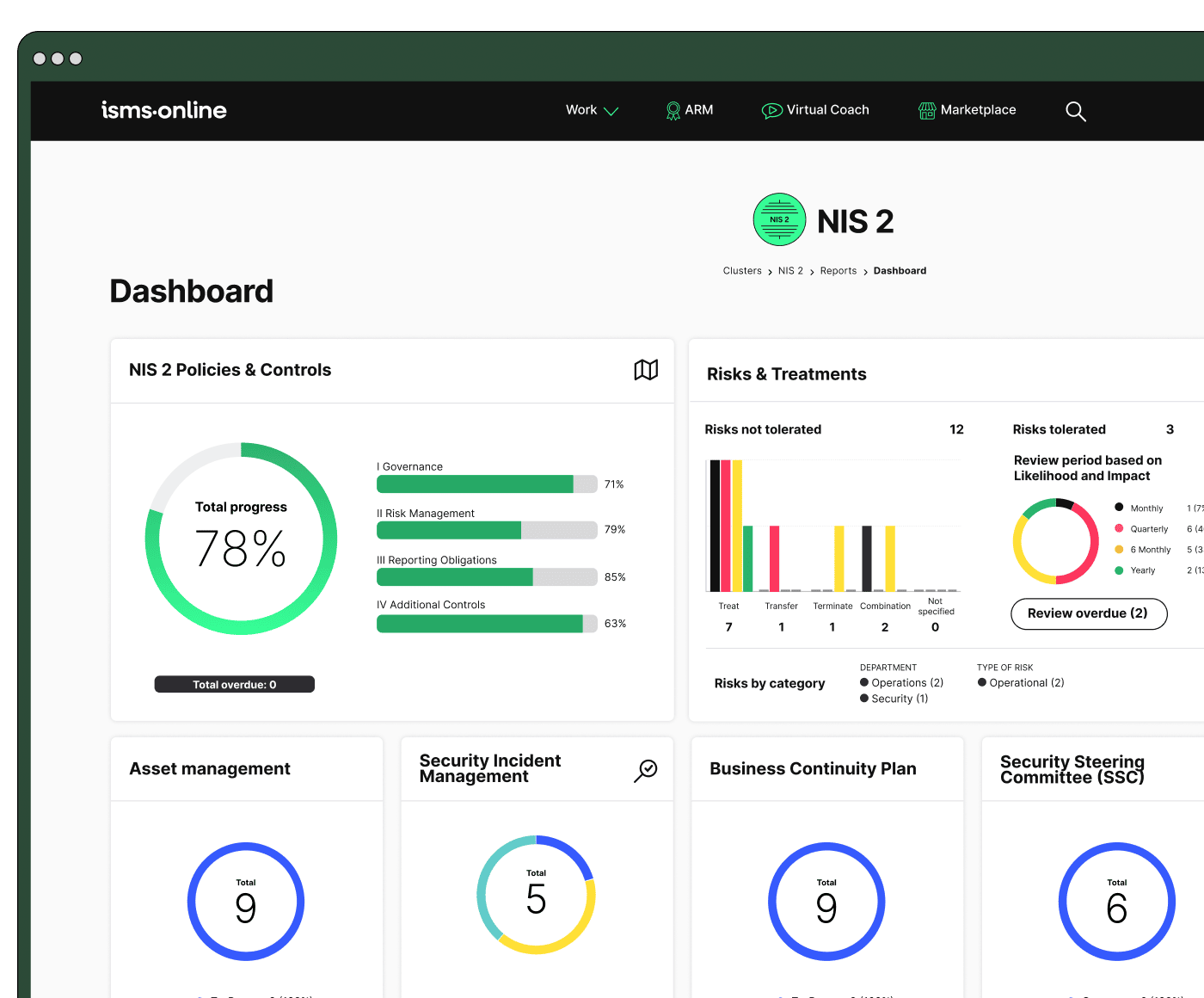
- Dashboarded evidence: Leadership signatures, timestamped approvals, unresolved exceptions spotlighted (“ISMS.online NIS2 Dashboard”).
- Trends and KPIs: Not just current status but how engagement, acknowledgment, and review cycle performance change over time.
- Drill-down proofs: From summary to individual staff/supplier acknowledgements.
Auditors trust numbers, not intent. Boards trust visible progress, not vague compliance.
Integrated Policy Workflow
- Board-triggered changes launch workflows for downstream acknowledgements.
- Exceptions and reviews tracked to closure, not hidden in inboxes.
- Dashboard visualisation lays out: open issues, trends, and full evidence chain.
If you cannot prepare a complete policy engagement report in under two minutes, your system is holding you back, not moving you forward.
Are Your Review Cycles and Exceptions Chasing You-Or Automated?
Manual review reminders, calendar tasks, and ad hoc escalations breed risk, not resilience. A robust ISMS ensures the system-not staff-tracks when actions are due, what’s unresolved, and where exceptions linger.
- Multiple triggers-annual, regulatory update, or incident-activate reviews.
- Exception requests escalate automatically, never “dropping through the cracks.”
- Supplier acknowledgements, not just internal user signoffs, are incorporated for supply chain resilience.
- All logs and reports are exportable in real time, ready for audit or regulator at a moment’s notice.
Reactive compliance slows your organisation; automation gives you command of your risk.
Automation is your frontline defence-without it, compliance will always be a step behind emerging threats and regulatory demands.
All your NIS 2, all in one place
From Articles 20–23 to audit plans – run and prove compliance, end-to-end.
How to Measure Progress: Policy KPIs and Maturity Proof in the Dashboard
It’s easy to confuse the absence of incidents with the presence of real compliance. The defining test: can you produce dashboards showing real-time engagement, review cycle status, exception closure rates, and positive trends?
Healthy dashboards are living evidence. Compliance isn’t a pulse-it’s a heartbeat.
From Documents to Outcomes
Modern ISMS systems like ISMS.online provide:
- Signoff rates: Who has read and acknowledged policies, sliced by business unit or geography.
- Review cycle timeliness: What % of policies were reviewed on or before deadline.
- Exception resolution: How quickly do issues close-and how many remain in limbo.
- Engagement scores: How well are users interacting with notifications and updates.
Policy KPI Table
| KPI Name | Description | Evidence Artefact |
|---|---|---|
| % Policy Acknowledged | Staff/supplier signoff by role/region | Digital logs, dashboard data |
| Review Cycle Timeliness | % reviewed before deadline | Review cycle logs, exports |
| Exception Closure Rate | % exceptions closed within SLA | Exception logs, dashboard trend |
| Engagement Score | Policy reach/user action blend | Engagement dashboard |
If audit and leadership requests are not answered instantly by metrics and logs, you’re at risk for invisible drift-and avoidable findings.
Create Living Compliance: The Next Step with ISMS.online
To meet, and stay ahead of, the expectations set by NIS 2 and ISO 27001:2022, an organisation’s compliance engine must be alive-dynamic, user-engaged, and always ready to demonstrate action, not just intention.
Living compliance isn’t a goal; it’s your new operating system.
Platforms like ISMS.online make the difference between struggle and command: policies not only authored but digitally signed, exceptions routed and resolved automatically, KPIs and dashboards surfaced for board, auditor, and regulator alike.
Trading “signoff and forget” for a culture of living engagement, you transform compliance from a last-minute scramble to a shared asset-protecting your business, reputation, and future growth.
Take your next step: empower your teams and suppliers, move beyond static policies, and build compliance that thrives in uncertainty and stands strong under any scrutiny. That’s the promise-and the proof-of embedding living compliance at the core of your operations.
Frequently Asked Questions
Who is truly accountable for NIS 2 and ISO 27001 security policy approval and ongoing review-and why does it matter so much?
The ultimate responsibility for approving and owning your NIS 2 or ISO 27001 security policy sits squarely with top management-namely, the board, chief executive, or formally appointed legal authority. NIS 2 makes this non-negotiable: every core information security policy must be signed and time-stamped by accountable leadership, not delegated to middle management or IT. ISO 27001:2022 reinforces this (Clauses 5.1–5.3), linking policy approval to visible, ongoing leadership engagement. This isn’t just paperwork; it’s a direct signal to auditors-and your staff-that leadership stands behind your policies and the risks they address.
Policy reviews shouldn’t be treated as annual box-ticking. Both NIS 2 and ISO 27001 demand at least yearly review (ISO 9.3, NIS 2 Art. 21), but also immediate updates following any significant incident, regulatory change, merger, or technological overhaul. Every approval and review must leave a digital trail-meeting minutes, version logs, tracked exceptions-so you’re never caught unprepared if scrutiny comes. Reliance on leadership for these actions is a foundation for real resilience.
Every effective ISMS begins and ends with board-level accountability-no shadow ownership, no ambiguous sign-offs.
Policy Governance Table
| Expectation | Operationalisation | Reference |
|---|---|---|
| Senior execs approve/sign | Named, time-stamped digital signatures | ISO 5.1–5.3; NIS 2 Art.20 |
| Annual + triggered reviews | Logged cycle & event-based updates | ISO 9.3, 10.2; NIS 2 21 |
| Review traceability | Archive logs, SoA version, approval minutes | ISO 7.5.2, 8.3 |
What audit-proof evidence demonstrates real policy engagement-and how do you avoid “tick-box” failure?
Auditors demand more than “signed-off” policies-they want a complete, exportable record showing not only that every required person has received and acknowledged the right version, but also a transparent history of who’s overdue, who’s excused, and what’s done to address lapses. NIS 2 and ISO 27001 expect exactly that: full traceability for every recipient, policy version, date/time, and role-including employees, board members, contractors, and key suppliers.
You’ll need to provide evidence that missed acknowledgments are tracked, exceptions are logged (with an owner and compensating control), and historic versions are accessible. For suppliers, regulators look for contractual inclusion and logged acceptances. Leading ISMS platforms like ISMS.online deliver these natively, automating the register so every audit question is answered without manual artefact-hunting. If you’re on spreadsheets, be ready for more sample checks and a heavier evidence burden.
A living ISMS is one where every sign-off, exception, and update is proactively tracked-never a fire drill at audit time.
How does ISMS.online transform policy review, change alerts, and exception management for NIS 2 Section 1.1?
ISMS.online automates the full governance cycle: it schedules annual and incident-driven reviews, routes policies to owners and reviewers, triggers digital reminders, and logs every step. Approvals and exceptions are automatically captured with timestamps and assigned risk owners. If a regulation or standard changes, the right people are alerted instantly and tasks are tracked until resolved. All actions-reviews, approval flows, exception closures-are captured in logs and export-ready dashboards, so you can evidence every review or rectification, however triggered.
This means you’ll never miss a scheduled review or change alert, never have unassigned exceptions, and can surface all evidence instantly during board meetings or audits-no last-minute chasing or memory lapses.
Review & Exception Workflow Example
| Trigger | Risk/Action Logged | Clause / Control | Audit Evidence |
|---|---|---|---|
| Regulatory update | Immediate review scheduled | NIS 2 21(3), ISO 5 | Task, log, SoA notes |
| Overdue sign-off | Exception + owner – compensating control | 7.5.2, A:5.21 | Exception file, risk |
| Staff turnover | Audit trail audit, policy access closed | ISO 9.2, 7.2 | Access log, closure |
Automated policy workflows mean no gap is ever hidden-every event is mapped, acted upon, and easily proven.
Why does version control and supplier acknowledgment prevent compliance drift-and what specific risks does ISMS.online neutralise?
Policy drift is the silent killer of compliance-outdated policies, unsynchronized supplier agreements, and “shadow” old versions create gaps that auditors routinely flag. NIS 2 and ISO 27001 (Annex A 5.1, 5.19–5.21, 5.36) require you to prove every participant has acted on the active version, all prior versions are archived, and outdated content is formally deprecated.
ISMS.online ties every update to controlled roll-out, requiring everyone-internal and external-to sign the latest policy, exporting exceptions and supplier acknowledgments on demand. Any gap is flagged, any old version is traced to source, and supplier/partner acceptance becomes a logged, not implied, event. That means less risk of audit failures, regulatory inquiries, or supplier confusion, and fewer compliance surprises.
Your compliance is only as strong as your slowest update-system-level version control and third-party logging closes the loop.
What key KPIs guarantee that your policy process supports audit, board, and regulator expectations?
You can’t manage what you can’t measure-so policy KPIs must be live, transparent, and mapped to key outcomes:
- Acknowledge coverage: -% policy sign-off rate (target 99%, split by team/supplier)
- Review on time: -Annual and event-driven reviews (100% compliance)
- Exception closure rate/lag: -% resolved within SLA (95%+ closed promptly)
- Time-to-completion: -Average days from policy update to 100% coverage
- Supplier acknowledgment: -Tracked per renewal window/quarter
ISMS.online provides at-a-glance dashboards for these, surfacing overdue actions, lagging exceptions, and supplier gaps. Manual setups demand more admin and vigilance-plus, board and regulator interest in “policy health” is only rising.
Traceability Table: From trigger to audit-ready evidence
| Event Trigger | Risk Update | Control/SoA Link | Log Evidence Output |
|---|---|---|---|
| Supplier launch/renewal | Mandatory new sign-off | A:5.21 | Supplier sign log & review |
| Incident or breach | Emergency review flagged | 8.16 | Audit note, updated policy |
| Role/staff change | Review, access closure, audit | 7.2, 9.2 | Acknowledgement, closure |
Are manual processes fit for NIS 2/ISO 27001 policy management-or what risks should you expect without automation?
If you forgo ISMS.online, you’ll need to manually systematise owner assignment, review scheduling, acknowledgment logging, and exception management-usually with a combination of spreadsheets, SharePoint, document signing tools, and email reminders. Every action must be linked to a named responsible person, tracked for timeliness, and logged for every version. Missed steps can mean lost approvals, missed exceptions, and unprovable compliance-all high-risk when regulators or auditors inspect.
Manual setups increase administrative overhead, ambiguity, and error risk. You’ll spend more time chasing evidence, less time building resilience, and be exposed to more audit findings-especially if reviewer roles, supplier contracts, or incident triggers are not centrally controlled.
Without automation, compliance becomes a race against time and human error-auditors expect digital evidence, not just good intentions.
How do you activate a living, audit-resilient policy process and instil a compliance culture-starting now?
Here’s your activation checklist to develop a dynamic, audit-ready policy cycle:
- Assign and log top-level owners/reviewers for every policy and version.:
- Schedule and enforce annual and event-triggered policy reviews with digital reminders.:
- Centralise all evidence-acknowledgements, reviews, approval logs, and exceptions-in an export-ready repository.:
- Automate push notifications to all impacted staff, board members, and suppliers with each change, review, or new version.:
- Track and regularly review key KPIs to surface gaps and close them before an audit or regulator does.:
The advantage isn’t just passing one audit but building a reputation for ongoing resilience and leadership-every change and engagement mapped, every risk controlled, every board and audit question answered on demand.
You set the new standard for compliance maturity by turning policies into active leadership, not just locked documents. Adopt these practises now and you’re not just passing audits-you’re making policy a platform for your next business breakthrough.






