





































Are Your Cyber-Security KPIs Truly Proven-Or Are You Just Staging “Audit Theatre”?
Your NIS 2 obligations aren’t impressed by dashboards that dazzle but don’t document. Auditors now expect every cyber-security KPI-especially Mean Time to Detect (MTTD), Mean Time to Respond (MTTR), and supplier diligence-to be more than reportable. They must be provable with a living evidence trail, not just when audit season approaches, but every day your business is at risk.
Your KPIs earn trust only when they leave a transparent trail that anyone can follow.
This shift doesn’t discriminate by job title. Compliance leads-often stretched thin-must document readiness for the board and regulator at a moment’s notice. CISOs and security leadership face increased pressure as boards demand live risk metrics, not static quarterly snapshots. Legal and privacy officers must maintain records robust enough for real regulators. Practitioners on the ground are now custodians of end-to-end evidence-the difference between trust earned and audit confidence lost.
Whats Changed: The Death of Dashboard-Only Assurance
Traditional audits tolerated quarterly summaries and neat PDF exports. But NIS 2, insurers, and enterprise buyers now look for evidence that can be sampled any time, showing remediation, not just declaration. They trace each KPI to underlying incidents, managed risks, and executive action-requiring connected, timestamped documentation, not prettified charts. If an auditor challenges you-can you demonstrate a years worth of risk evidence, mapped to board sign-off, in minutes?
Book a demoWhat Lies Beneath: Turning MTTD, MTTR, and Supplier Coverage Into “Audit-Real” Evidence
Numbers that glow on the dashboard rarely survive a modern audit on their own. MTTD and MTTR KPIs-critical under NIS 2 and also under ISO 27001-are now scrutinised for underlying logs, incident investigations, and recovery sign-off, not just statistical averages. Supplier coverage is a similar flashpoint: regulators want to see ongoing risk evaluation, flags, exceptions, and board-noted follow-ups-not just a rolling vendor list[^1].
Cyber metrics only have integrity when they’re inseparable from the incidents and decisions they represent.
The Drill-Down: How Auditors Examine Evidence
Incidents & Detection (MTTD)
- Is every incident-from alert to resolution-fully tracked and timestamped? True auditability means auditors can follow the thread from SIEM or endpoint detection, through triage, escalation, and all the way to management review and root cause documentation.
- Sample scenario: A phishing alert emerges Wednesday. Was it escalated, when, and how? Where’s the follow-up, and who signed off on the final lessons learned?
Response & Recovery (MTTR)
- Do incident logs demonstrate adherence to NIS 2’s 24-hour and 72-hour notification windows? Documentation should capture not just event times, but the human reasoning-what was tried, when, why delays happened, and how final closure was reached[^2].
- Sample scenario: A ransomware incident emerges Friday. MTTR isn’t just how fast the system rebounds, but how clearly management saw the cause, approved the response, and tracked the downstream risk.
Supplier Coverage
- Are third-party and supplier risks a living process, with risk reviews and escalations? Or does evidence end at a simple vendor list?
- Sample scenario: A vendor fails an IT security check. Was the risk flagged, reviewed, and remediated? Where is the documentation, sign-off, and evidence submitted for executive oversight[^3]?
The New Standard: Drill-Through (Click-Through) Audit Trails
Evidence isn’t just paperwork anymore; it’s the ability to click from a KPI through attached investigation logs, dashboards, meeting notes, corrective actions-each backed by timestamps, user signatures, and real workflow progression[^4]. If you can’t reconstruct a metric’s journey, its trust collapses under inspection.
[^1]: ENISA, NIS2 Guidance
[^2]: Protiviti, NIS 2 Compliance Whitepaper
[^3]: FortifyData, Supply Chain Audit Challenges
[^4]: ISMS.online, NIS2 Solution

Master NIS 2 without spreadsheet chaos
Centralise risk, incidents, suppliers, and evidence in one clean platform.
Where KPIs Snap Under Pressure: Common Evidence Pitfalls
It takes a single break in your evidence thread-like an unreviewed incident or a missing supplier follow-up-to undermine your entire compliance case. No software dashboard or spreadsheet can backfill a missing timestamp, escalate a supplier risk after the fact, or simulate board minutes for a review that never happened.
A single missing log or unreviewed exception is enough to trigger a deeper, risk-focused audit.
Hidden Risks That Undermine Audit Confidence
- Missing logs and incomplete evidence: If even one event can’t be traced from detection to close, the entire metric’s reliability wobbles.
- Delays without explanations: KPIs that don’t embed cause analysis for slow detection or response are seen as post-hoc surface numbers.
- Vendor due diligence gaps: Supplier lists mean little if ongoing risk evaluation and remediation aren’t evidenced[^5].
- Skipped board or management reviews: Gaps in oversight signal process immaturity and can invite more regulatory scrutiny.
- Fragmented tooling: When internal dashboards, log repositories, and approval chains are disconnected, audit friction rises, and errors multiply[^6].
Regular peer- or management-level reviews, especially when layered across ISO 27001 governance, are now the difference between “audit assumed” and “audit earned.”
[^5]: Sharp Europe, Supply Chain Security
[^6]: ISACA, Auditing Cyber-Security KPIs 2025
Turning KPI Blind Spots Into Enterprise Risk: Boardroom & Business Impact
Today, KPIs are currency for trust. When evidence fails under audit, the consequences are bigger than a corrective action-they ripple into board confidence, deal cycles, and even insurance premiums. When a management review is skipped or a supplier issue not documented, those details can damage stakeholder relationships and create new liabilities.
Every unproven KPI is a risk that moves beyond IT-impacting contracts, customers, and the board.
Boardroom Expectations: How Audit Gaps Hurt Now
- Boards expect real-time, actionable metrics: It’s expected that MTTD, MTTR, and supply chain KPIs can be sampled, sliced by sector, and benchmarked-referencing ENISA, ISACA, or sector-wide statistics[^7].
- Proactive review beats reactive auditing: Evidence that is “stress tested” in quarterly simulations reveals and closes gaps proactively, instead of risking exposure in a live audit.
- Siloed compliance efforts are visible: When teams operate distinct toolsets for NIS 2, GDPR, and ISO 27001, audit pain increases; unified dashboards and workflows are now standard.
- Metrics must explain action as well as outcomes: Boards and auditors want to see not just what happened in numbers, but *why*, and *what changed after*.
- Third-party risks are highest-stakes: As supply chain incidents are increasingly linked to fines, supplier assessment KPIs are board-level requirements.
Board-level scrutiny means that failing to substantiate a KPI with living evidence is no longer just an audit risk-it can cost you trust and business.
[^7]: GT Law, NIS2 Boardroom Impact
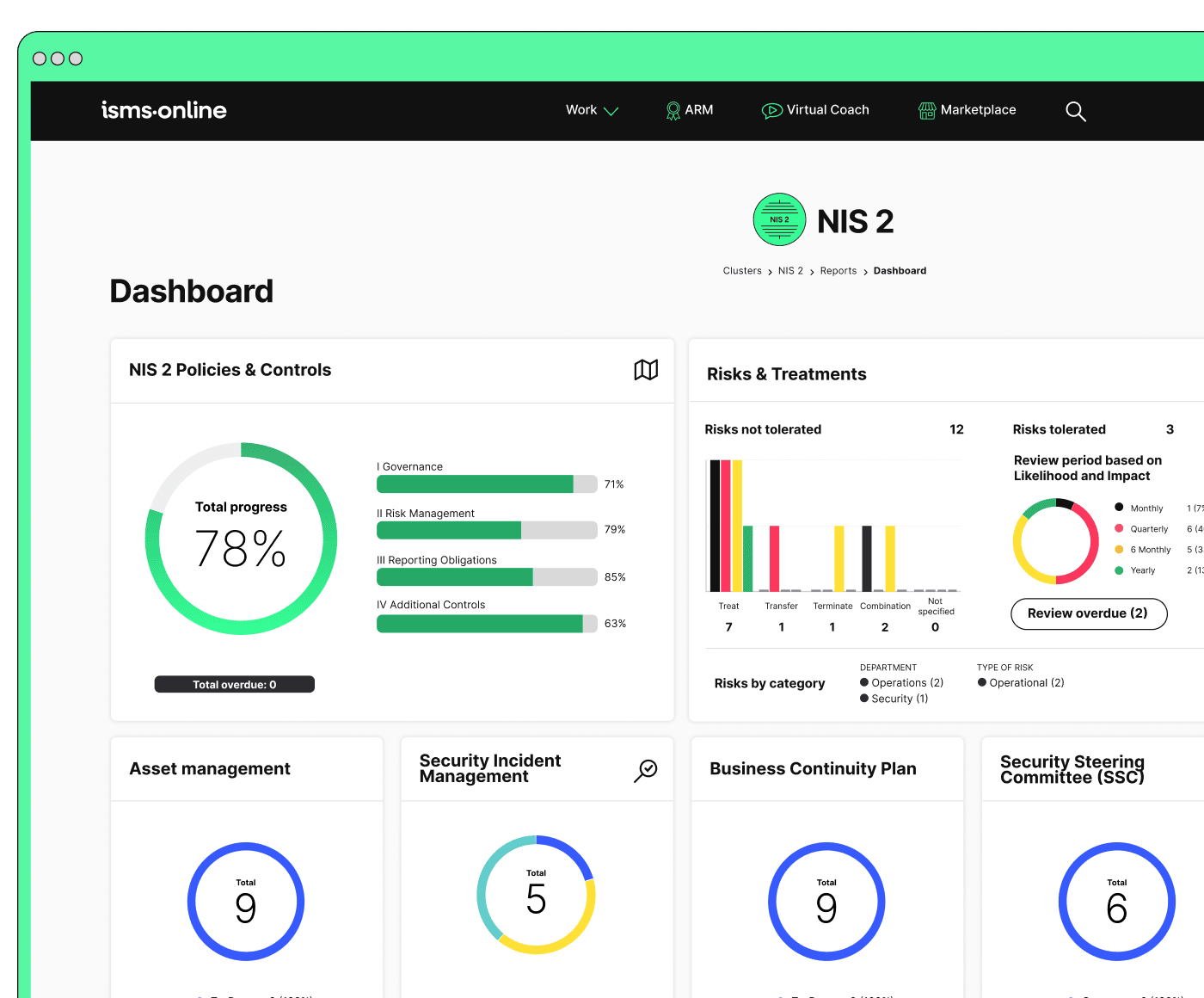
Be NIS 2-ready from day one
Launch with a proven workspace and templates – just tailor, assign, and go.
How to Link NIS 2, ISO 27001, and GDPR: Audit-Ready Bridge Tables That Deliver Evidence “On Click”
Connecting regulatory mandates has become a non-negotiable. The most audit-ready teams “map in real time” with bridge tables and traceability diagrams to demonstrate how incidents and metrics flow through to controls, action, and oversight.
ISO 27001/NIS 2 Audit Bridge Table
Every authority expects cross-referenced proof. Here’s how you can operationalise your KPIs for fast audit pass-through:
| Expectation | Operationalisation (Evidence) | Reference |
|---|---|---|
| Incident Detection (MTTD) | Timestamped SIEM logs, alert-to-close records | ISO 27001 A 8.7; NIS 2 Art. 23 |
| Response/Recovery (MTTR) | IR logs, management review, notification trails | ISO 27001 A 8.13; NIS 2 Art. 23 |
| Supplier Coverage | Vendor due diligence, risk flags, exec sign-off | ISO 27001 A 5.19–21; NIS 2 Art. 21 |
| Privacy Incident Tracking | SAR logs, DPIA audit trails, management review | ISO 27001 A 5.34; NIS 2 Art. 21 |
| KPI Review & Oversight | Board-meeting notes, dashboards, escalation trails | ISO 27001 Cl 9.3; NIS 2 Art. 20 |
| Evidence Traceability | Click-export logs, sign-offs, audit pack structure | ISO 27001 A 8.15; NIS 2 Art. 21/25 |
Visualise the Layer
Picture a compliance dashboard: the headline KPI is a doorway, opening to detailed, timestamped events, incident files, and management action logs-all mapped to ISO 27001 and NIS 2. Each trace is answerable, always ready on demand.
Traceability Table: “Trigger-to-Evidence” Map
Making this practical for your team and audit reviewers:
| Trigger | Risk Update | Control / SoA Link | Evidence Logged |
|---|---|---|---|
| Malware detection | Risk flagged, incident reviewed | ISO 27001 A 8.7 | SIEM alert, response memo |
| Vendor audit failure | Supplier risk flagged | ISO 27001 A 5.21; NIS2 Art. 21 | Review record, exec sign-off |
| Privacy incident | Data breach process triggered | ISO 27001 A 5.34 | SAR logs, notification file |
| Missed RTO/RPO | Escalation to board, impact logged | ISO 27001 A 8.13, Cl 9.3 | Incident report, minutes |
| KPI review warning | Executive review, escalation | ISO 27001 A 5.4 | Board minutes, action log |
This table makes root cause, response, and oversight visible for every stakeholder, onboarding new team members and demystifying audit for those with limited compliance experience.
Are Your Dashboards Audit-Ready-Or Just Aesthetic?
Today’s compliance dashboards are judged not just by how they look, but by whether a third party can “walk the audit chain” from metric to detail, right through to board review and evidence export. If your dashboards are mere presentation layers, expect protracted audits, repeat evidence requests, and delayed deals.
Audit wins are earned in real time: every dashboard metric must lead to actionable, checkable evidence.
Audit-Ready Dashboard Essentials
- Direct linkage: Every KPI is clickable straight through to event logs, incident files, and oversight records-not just snapshots[^8].
- Versioned history: Audit trails should show metric changes, board reviews, and all relevant decisions.
- Unified control environment: Disconnected dashboards feed audit scepticism. Integration across supply chain, privacy, incident, and risk controls is now standard.
- Executive sign-off, not just process notes: Meeting minutes and sign-offs from C-level or board members serve as “costly signals,” raising trust in every KPI.
[^8]: ENISA, Audit-Ready Guidance
If your current systems require days of manual collation to prepare for audit-or can’t produce documentation on demand-it’s time to rethink your control environment.
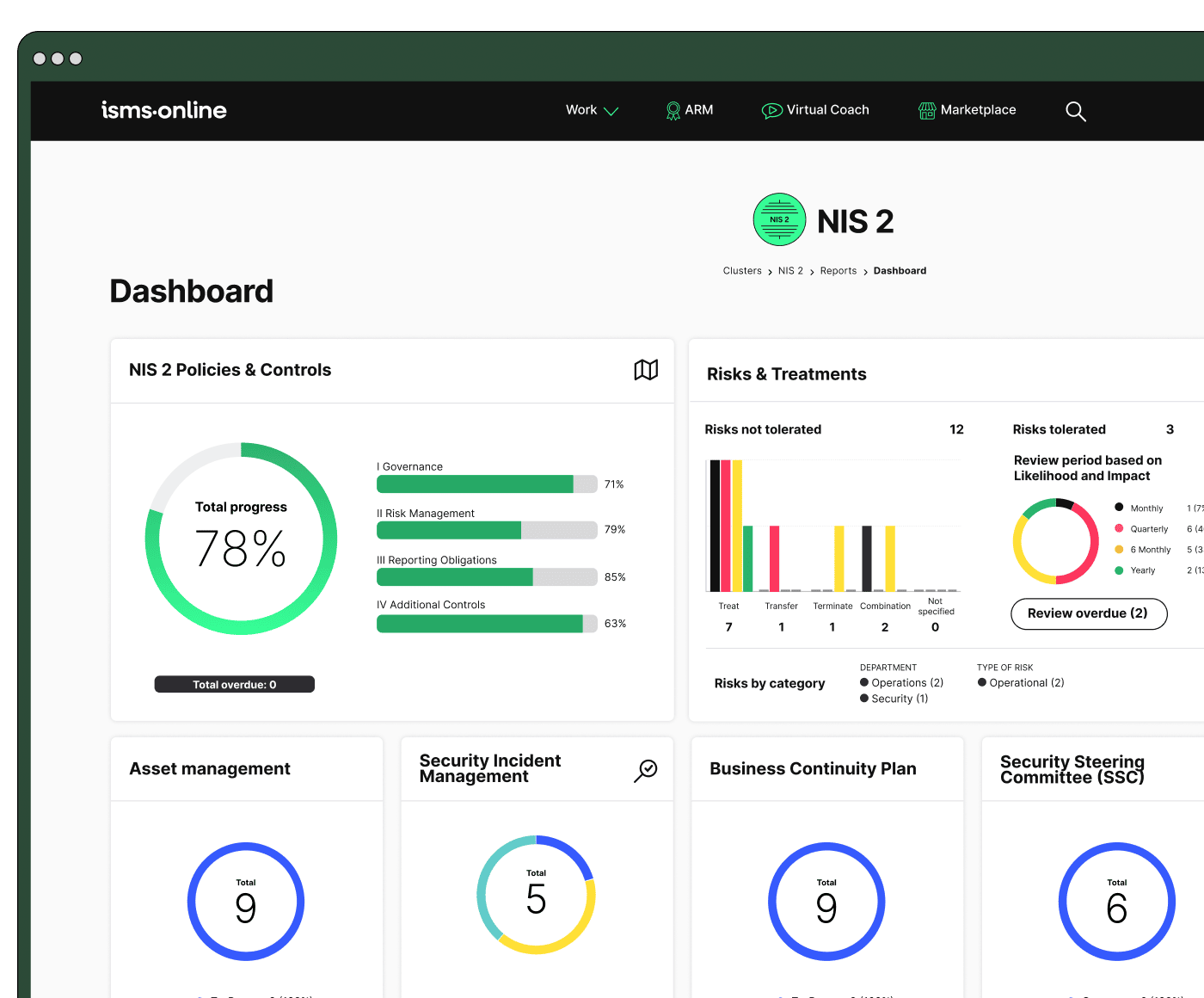
All your NIS 2, all in one place
From Articles 20–23 to audit plans – run and prove compliance, end-to-end.
How to Build Resilient Multi-Framework Evidence-And Prevent Compliance Fatigue
Evidence today is “always on.” Audit evidence must live across frameworks and roles: IT must prove incident response, privacy must substantiate subject access request logs, and third-party owners must show ongoing supplier checks. All evidence must be versioned, role-attributed, exportable, and-most importantly-testable daily, not just reviewed annually.
Real resilience comes from demonstrating live evidence flow, not last-minute paperwork.
Surviving the Evidence Explosion
- Consolidate evidence banks: One repository, mapped to both security and privacy. This is not just smart; it’s an operational requirement for NIS 2 and ISO 27001 alignment[^9].
- Automate reminders and peer reviews: Task-completion logs and regular “mini audits” reveal weak points before regulators do.
- Engage the business: Policy Pack acknowledgments, supplier questionnaires, and KPI reviews pull in HR, procurement, and operational teams.
- Link every audit trigger to evidence: Ensure every exception, RCA, or overdue KPI flows through the same evidence chain and is accessible for spot-checks.
- Quarterly simulation: Practise “mini-audits” quarterly, not just at certification deadlines. Audit fatigue is a symptom of readiness being crammed into annual projects, not daily routines.
[^9]: IT Governance, Unifying NIS2/ISO 27001/GDPR
Can Automation Transform Compliance Anxiety Into Confidence-And Spot the Next Big Gap Before It Hits?
Automation is no longer about speed alone; it’s now the spine of audit defensibility. When your SIEM and ISMS naturally connect detection with risk logs, incident management, supplier reviews, board meetings, and privacy events, your metrics are no longer just numbers-they become audit-ready assets.
Automation you don’t trust doesn’t reduce risk; it only hides it.
The Automation Reality Check
- Audit pack generation: SIEM/ISMS systems like ISMS.online can output all required evidence “on click”-ready for review at any drill-down level.
- Traffic light dashboards: Real risks (red), urgent tasks (amber), and done (green). No surprises at audit time.
- Human in the loop: Automated signals (alerts, overdue reviews, escalations) flagged; humans explain, sign off, and improve. Boards want automation they can interrogate, not just statistics that can’t be explained.
- 80% manual lift eliminated: Teams that automate evidence chains and integrate policy engagement cut prep time, improve morale, and dedicate more energy to risk management-rather than paperwork[^10].
- Regular calibration: Peer and benchmark reviews, sector comparators (ENISA/PwC), and correction during onboarding and new regulatory phases.
[^10]: Nomios, SIEM in NIS2
Key takeaway: Automation, used wisely, is what pulls your audit story together before the pressure is on-not after something slips through the cracks.
What’s the Quiet Advantage? Daily-Ready, Evidence-Led Compliance With ISMS.online
When you move from scattered documentation to a unified ISMS, compliance stops being noise and audit panic turns into quiet confidence. With ISMS.online:
- Frictionless control: Dashboards, logs, policy engagement, and supplier audits-*all linked* and ready for export.
- Unified team engagement: IT, compliance, privacy, and executives all see responsibilities, review cycles, and evidence in one place.
- Maturity that shows: Boards and buyers verify trust in real time; trust in the system reduces repetitive questions and last-minute firefighting.
- Continuous readiness: Readiness for regulators, buyers, and business partners-evidence trails always up to date, with never a “crunch” before certification.
The organisations that turn trust into business advantage are those whose evidence is real-visible, living, and ready at any moment of challenge.
Ready to strip away compliance anxiety and move confidently into audits, procurement, and daily business growth? Let’s make every KPI a building block of trust, resilience, and calm progress. With ISMS.online, audit passes become everyday events-never high-stakes theatre.
Frequently Asked Questions
Who actually sets the KPI audit bar for NIS 2-regulators, auditors, or peer performance?
You won’t find hard numbers for Mean Time To Detect (MTTD), Mean Time To Respond/Recover (MTTR), or supplier risk coverage ratios in NIS 2 law, but these thresholds aren’t set in a vacuum. National regulators issue broad guidance on “appropriate” measures, while it’s auditors-leaning on ENISA technical guidance, sector best practise, and performance benchmarking-who draw the real lines in the sand during assessment.
Typical audit-pass marks now include <24 hours incident detection, 1–3 business days to resolution, and documented risk due diligence for at least 85% of key suppliers. Peer-driven best practise, ENISA reports, and platforms like ISMS.online all reinforce these as minimum expectations. If your sector demands stricter targets (e.g., finance, health, cloud), auditors mandate evidence your KPIs are set and met accordingly. Ultimately, your team’s job is to select, track, and present KPIs that match or beat both cross-industry and audit community standards at any moment in time.
NIS 2 KPI Audit Thresholds: Who Shapes the Bar?
| KPI | Driver(s) | Typical Audit Pass Mark |
|---|---|---|
| MTTD | Regulator, auditor, sector, ENISA | <24 hours |
| MTTR | Auditor, sector, internal reviews | <1–3 days for closure |
| Supplier Coverage | Regulator, sector, peer benchmarks | >85% of key suppliers |
What is “audit-ready” evidence for MTTD, MTTR, and supplier risk under NIS 2?
Auditors want evidence trails that tell a clean, end-to-end story for every NIS 2 KPI-every step logged, signed, and sample-verifiable.
For MTTD/MTTR, that means SIEM, SOAR, or incident logging tools must record every event with a timestamp chain: initial detection, escalation times, management handover, closure, and lessons learned. Management review minutes with clear sign-off are key.
For supplier risk coverage, a live vendor register is essential-listing every critical supplier, current risk assessment, review logs, exception notes, and sign-off history ((https://www.isms.online/features/);.
External auditors typically “walk the chain” for a sample: from KPI dashboard → raw event log → documented escalation → review minutes → corrective action proof. If one link is missing, unsigned, or inconsistent, it’s an audit risk-remediation required.
Proof is not just having logs-it’s showing every KPI is audit-walkable from origin to executive closure.
Which common evidence or process gaps most often derail NIS 2 KPI audits?
Four avoidable evidence pitfalls appear time and again in failed or deferred audits:
- Logs in disparate systems/spreadsheets: Version control, access history, or completeness can’t be proved.
- Unaligned times or gaps across logs/reviews: KPIs in dashboards don’t agree with SIEM or review minutes.
- Supplier register below 85% or missing coverage/risk scores: Aggregations that can’t be sample-verified.
- No evidence of executive/board review or improvement cycle: Management’s sign-off chain is missing or incomplete.
A single incident that can’t be “walked” to closure, or a supplier risk gap that can’t be explained, carries more audit weight than the most challenging security event.
Table: Most-Flagged Audit Gaps for NIS 2 KPIs
| Audit Breakpoint | Typical Impact |
|---|---|
| Broken log chain | Major finding / remediation |
| Timing mismatch across evidence | Data reconciliation, audit pause |
| Supplier < 85% risk coverage | Immediate remedial action |
| No working exec/board closure | Delayed/failed certification |
Where do NIS 2, GDPR, and ISO 27001 actually align (and where do they diverge) on KPI and audit proof?
There’s more overlap than most teams realise-timing evidence and management review are core across all three, but triggers and scope differ:
- NIS 2: Enforces 24h alert/72h major incident reporting and requires robust, risk-based supplier oversight. All must be evidenced for any incident-not only for personal data.
- GDPR: Narrows focus to breaches of personal data; requires proof of prompt 72-hour notification, but only if risk to data subjects is “likely.” Evidence must show why you did or didn’t notify.
- ISO 27001: Requires performance and evidence for detection, response, supplier assurance, and improvement as a living loop-KPIs, logs, and reviews-no incident is required to trigger scrutiny.
| KPI | NIS 2 | GDPR | ISO 27001 |
|---|---|---|---|
| Detect | <24–48h, all events | Only if breach | Yes, 9.1, A.5.25 |
| Respond | 24–72h, all events | 72h breach | Yes, A.5.25, 9.1 |
| Supplier | Risk-driven %, all | Only if data | Yes, A.5.19, 9.1 |
When in doubt, apply the most demanding element (NIS 2 for timing, ISO for evidence depth) and map logs/evidence to all frameworks in a single repository.
Can automation-dashboards, SIEM, and evidence exports-really drive audit success?
Yes-when paired with routine review, sampling, and board engagement.
Real-time dashboards and SIEM logs can shrink evidence pack prep time and error rates by up to 80%;; (https://www.isms.online/features/)). Audit teams increasingly treat click-to-export, versioned records, and live KPI dashboards as signals of maturity-plus clear evidence you can sustain performance at scale.
But “fire-and-forget” automation never works. Audit leaders expect manual review, quarterly sign-off, and live “evidence walks” over random samples. True resilience comes from pairing automation with management’s active engagement and prompt action when issues are surfaced.
The best-run teams let automation accelerate evidence-but never replace regular, eyes-on review and continuous improvement.
What concrete steps ensure your NIS 2 KPI audit passes today-and builds year-on-year resilience?
- Centralise every log, KPI, and supplier risk record in a version-controlled, audit-exportable environment: (ISMS.online is purpose-built for this).
- Set and document quarterly management reviews: each review should analyse KPIs, document sign-off, and track improvement.
- Maintain explicit mapping from incidents and KPIs: to NIS 2, GDPR, and ISO 27001 requirements-ready to show the crosswalk defensibly at audit.
- Automate dashboard-to-log linkages: wherever possible but always run spot checks before and after each audit/review to validate data integrity.
- Benchmark your KPIs against ENISA, sector peer reports, and prior-year audits: to keep performance in line with the market-and demonstrate progress.
- Assign “champion” functions for each area: compliance, IT, privacy, and procurement should co-own audit success, regularly reviewing all mapped evidence.
- Preview and “walk” your evidence pack end-to-end: (incident, log, review, closure) prior to every audit. Ask for a live export demonstration or mock audit from your ISMS provider if needed.
Teams who treat KPI review and evidence management as a living process-embedded in quarterly routines, not rushed before audits-are the ones who consistently pass and improve.
KPI Audit Traceability Table
Given incident or risk trigger, know where your controls and evidence align:
| Trigger | Risk Updated | Control/SoA Link | Evidence Example |
|---|---|---|---|
| Ransomware alert | Medium→High risk | A.5.25 (Incident response) | SIEM log, review minute, closure |
| Supplier breach | Supplier risk status ↑ | A.5.19 (Supplier) | Register, due diligence log |
| Audit finding | KPI gap closure | 9.1 (Performance review) | KPI trend, corrective log |
Ready to raise your audit game? Start by reviewing your NIS 2 KPI process with ISMS.online’s live audit-export features or booking a peer benchmarking session-because passing once isn’t enough; resilience must be proven year after year.






