





































Why Does Your Supplier Register Decide Audit Survival – Not Just Box-Ticking Compliance?
A static supplier list is no longer enough—what stands between your organisation and NIS 2 audit failure is whether your supplier register is a living, review-ready tool that proves ownership, risk assessment, and real-time control. Under today’s NIS 2 regime, simply listing vendor names and numbers is a liability, not reassurance. Auditors, as well as boards, expect each supplier to have a named owner, regularly updated documentation, and unambiguous records of ongoing review actions (ENISA). Every time a register can’t link a change, risk assessment, or incident back to a real decision-maker, you risk audit findings that hit the credibility of your entire compliance programme.
Auditors don’t want lists. They want registers with owners, continuous risk logic, and a traceable proof chain.
Regulatory expectations—driven by NIS 2 Art. 28 and ISO 27001:2022 Annex A.5.22—now separate survivors from non-conformers. For every critical or strategic supplier, you are accountable for maintaining classification, risk scoring, owner assignment, contract linkages, and an incident record. Letting your register stagnate—no matter the reason—is more than an administrative error; it disrupts trust at board level and triggers unwanted scrutiny (KPMG). ISMS.online was built to eliminate these grey zones: every supplier relationship, change, contract, and review gets time-stamped, assigned, and evidenced in one continuous loop—no more lost updates, no more blame on inboxes or spreadsheets.
What Distinguishes a NIS 2-Compliant Register from a Vendor List?
A vendor spreadsheet with names and emails might help your team, but it leaves auditors cold. Today’s ENISA and ISO 27001 prescriptions go far further: a proper supplier directory must evidence risk status, GDPR exposure, contract or DPA links, explicit ownership (with reviewer), and a history of what changed and why. The absence of cross-border data mapping, or unassigned roles and review records, is an immediate flashpoint for audit findings (BSI).
If you can't show how roles and reviews are managed, your register unravels under questioning.
A living, defensible register will always:
- Assign precise owners and reviewers: for each third-party entry, not generic “IT”/“Admin” labels.
- Log GDPR scope, contracts, risk level, role assignment, and every change: —not just annual snapshots.
- Track who made each change, the rationale, and the approval date: , all instantly exportable as audit evidence (ENISA Guidance 2024).
With ISMS.online, register management means every overwritten field, contract upload, or incident association receives a new immutable audit-log entry. Subcontractors, cloud partners, and any service provider handling regulated or sensitive data are recorded with the same evidential discipline. Any attempt to mask, abstract, or ignore ‘routine’ suppliers risks exposing your supply chain to scrutiny, fines, or reputational loss.
The NIS 2-Compliant “Living Register” Checklist
- Name and assign owners and reviewers for each entry (not “shared” responsibility).
- Record GDPR roles, contract files, data residency, and incidents in each supplier profile.
- Maintain a log of all changes including rationale and approval dates, not just a ‘last updated’ timestamp.
Audit-ready teams treat registers as workbenches, not tick-box artefacts.

Master NIS 2 without spreadsheet chaos
Centralise risk, incidents, suppliers, and evidence in one clean platform.
How Can You Prioritise Risk, Structure Reviews, and Demonstrate Continuous Control?
Audit resilience stands or falls on recognising that not all suppliers are equal. Modern cyber, privacy, and resilience regulations demand precise risk tiering: your data centre provider, cloud CRM, or payroll processor do not deserve the same review cadence as office supply vendors. Both NIS 2 and ISO 27001:2022 specify that critical, strategic, and routine third parties be risk-rated, mapped to owners, and reviewed in alignment with actual risk (ENISA Supply Chain Guidance).
Biggest failure isn’t a hostile actor—it’s a supplier nobody checked in 18 months.
ISMS.online automates role assignment, review reminders, risk escalation, and log evidence at every step. If your register’s review cycle, tiering, or rationale is ambiguous or missing, boards and auditors log it as process failure. With our platform, every overdue review, ownership shift, or breach leads to real-time logging, not an afterthought.
Optimal practise means reviewing:
- Critical suppliers: Every quarter (and after incidents or major contract updates).
- Strategic suppliers: Annually, at a minimum; after contract/relationship changes.
- Routine suppliers: Annually; or on incident/ownership changes.
Automated reminders and forced review sign-offs help close your weakest link before your audit clock runs out (ISMS.online help).
Efficient, Auditable Review Cadences
| Tier | Minimum Review Cycle | Trigger for Extra Review | Evidence Required |
|---|---|---|---|
| Critical | Quarterly | Incident, contract update | Owner sign-off, log, updated risk score |
| Strategic | Annually | Contract or service change | Review sign-off, rationale, updated documentation |
| Routine | Annually | Ownership or criticality bump | Reviewer log, rationale, contract updated |
Missing any trigger or rationale from your review log is a direct NIS 2 and ISO 27001 process gap.
How to Map Every Supplier Register Field to NIS 2, ISO 27001, and GDPR Minimums
Audit-proof registers are only as good as their completeness and clarity. Each primary field must visibly map to a standard—NIS 2 Art. 28 (supplier register), ISO 27001:2022 Annex A.5.20, A.5.22 (supplier relationships and monitoring), GDPR (processor records, cross-border flows)—making every entry justifiable.
| Field | Example | Standard Reference |
|---|---|---|
| Supplier / ID | Acme Cloud, #101 | ISO 27001 A.5.22; NIS 2 Art. 28 |
| Jurisdiction | UK; EU | ISO 27701; GDPR Art. 30 |
| GDPR Scope | Processor; Data Export: No | ISO 27001 A.5.34; NIS 2; GDPR Art. 28 |
| Owner / Reviewer | CISO, Jane Roe | ISO 27001 A.5.22, 7.2 |
| Criticality | Critical / Strategic / Routine | ISO 27001 A.5.20; NIS 2 |
| Last Review Date | 30 Sep 2024 | ISO 27001 A.5.22 |
| Contract / DPA | Uploaded, 09/2024 | GDPR Art. 28; ISO 27701 |
| Risk Statement | “Hosts payroll personal info” | ISO 27001 A.5.19, A.5.20; ISO 31000 |
| Incident Links | Incident #2023-02-14 | ISO 27001 A.8.34; NIS 2 |
| Change / Audit Log | Immutable, auto-gen | ISO 27001 A.5.22, 10.1 |
Always flag DPA status for GDPR, map cross-border flows, and record Non-EU rep as applicable (EDPB).
If any column can’t be tied to a control or evidence log, prepare to defend it—standards now expect field-to-proof linkage.
ISMS.online’s register enables teams to instantly export or drill-down on every field, supporting audit and board deep-dives (ISMS.online Documentation).
Traceability-in-Action Table
| Trigger | Risk Update | Control / SoA Link | Evidence Logged |
|---|---|---|---|
| New supplier onboarded | Tier = Critical | ISO 27001 A.5.20, A.5.22 | Owner assigned, log updated |
| Supplier data incident | Review, re-risk | NIS 2 Art. 28, ISO 27001 A.8.34 | Incident file and sign-off |
| Quarterly review | “No change” filed | ISO 27001 A.5.22 | Reviewer sign-off, timestamp |
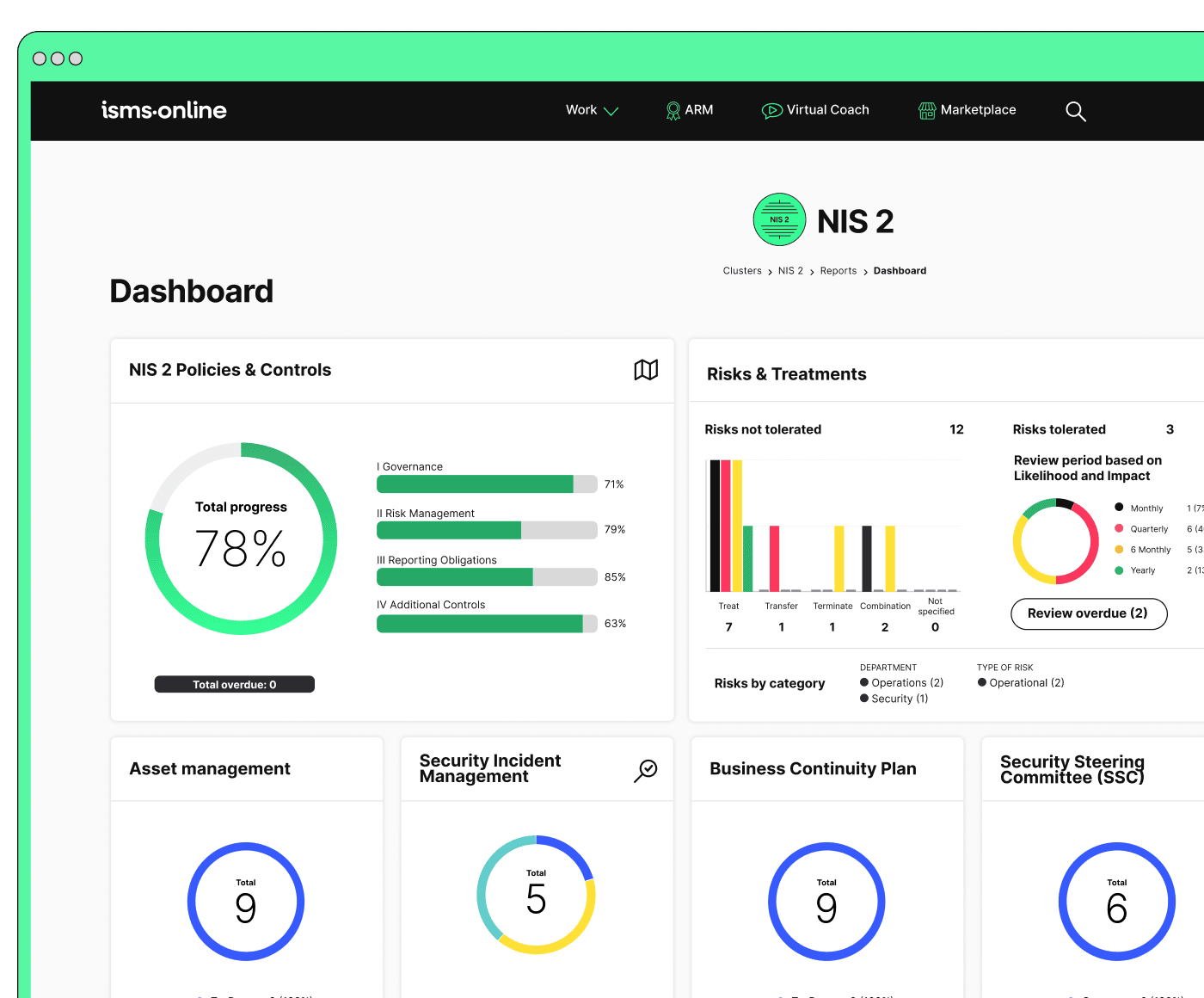
Be NIS 2-ready from day one
Launch with a proven workspace and templates – just tailor, assign, and go.
Do Sector, Size And Geography Really Matter? The Register Must Prove It
Supplier registers that ignore sector, geography, and business type invite compliance drift. Healthcare and public sectors have heavier FOI and residency requirements (data location, public note fields), while banks face extra DORA resilience tracing (EU TED). SMEs might stretch review cycles, but never ignore fields like owner, criticality, or GDPR role (KPMG). For multinational teams, local-language templates and regional mapping help close the gap.
Failing to map regulation to register fields is the shortcut to audit pain.
| Sector | Law/Regulation | Example Extra Fields |
|---|---|---|
| Healthcare | NIS 2, GDPR | Data residency, DPA |
| Financial Services | DORA, NIS 2 | Resilience contract link |
| Public Sector | FOI, Procurement | Owner, review date, note |
| Multi-jurisdiction | GDPR, NIS 2 | Locale, Non-EU rep |
Customise templates, dual-language fields by country, and document your rationale for every field—regulators may request it. ISMS.online supports register configuration by sector and geography, making compliance practical for small or distributed teams.
How Does Automation Replace Static Registers—and What Evidence Do Auditors Really Want?
Modern audit survivability means every action—assignment, review, contract attach, incident, or re-tiering—is logged automatically and time-stamped. Static lists and scheduled emails can’t provide this level of resilience (Gartner). ISMS.online empowers you to schedule and enforce reviews, auto-log incidents, attach contracts, and instantly philtre/export. Boards and auditors expect more than a snapshot; they want to see live dashboards, one-click reports, and logically connected evidence trails.
The next audit is won or lost by your ability to prove every assignment, change, and review—without loopholes.
| Automation Feature | Compliance Outcome | Example Audit Signal |
|---|---|---|
| Automated reminders | No missed critical reviews | Owner sign-offs up-to-date |
| Immutable event logging | End-to-end evidence, no backfill | Change log shows assignment histories |
| Instant exports | Audit/board-ready in seconds | PDF, Excel, dashboard with all fields |
| Security scoring feeds | Real-time supplier status | Incidents/ratings viewable in register |
With ISMS.online, incidents trigger workflows and become audit entries. Security scoring feeds from API partners surface changes before they become findings (SecurityScorecard), and every field is ready for instantaneous reporting and drill-down. Don’t let a spreadsheet gap cost months of progress—automate to guarantee no gaps.
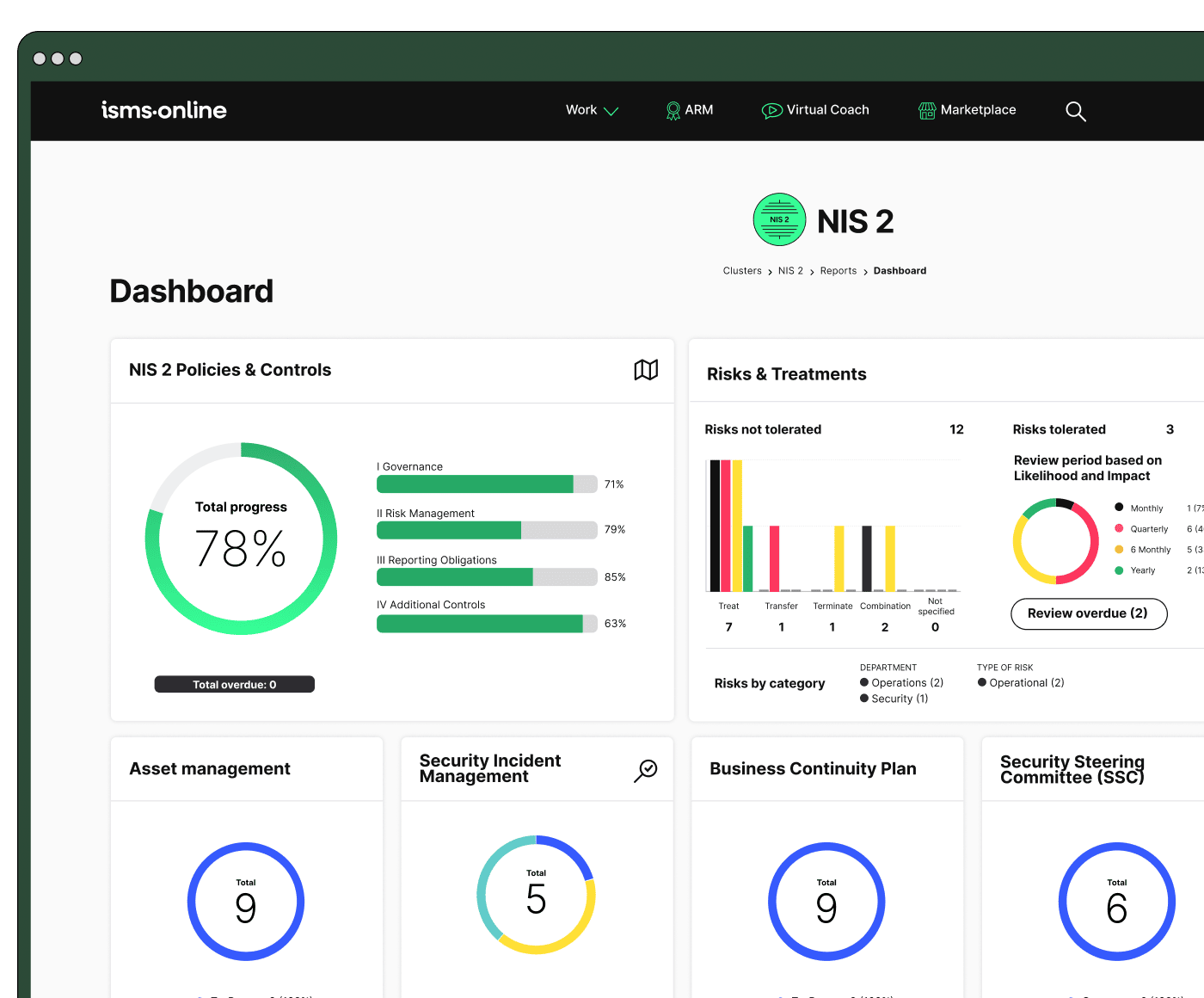
All your NIS 2, all in one place
From Articles 20–23 to audit plans – run and prove compliance, end-to-end.
What Does an Audit-Proof, Board-Trusted Supplier Register Actually Look Like?
Today’s minimum bar is never a static list—it’s live, board-ready dashboards, time-stamped logs, and field-level completeness for every supplier (ISO Controls). ISMS.online brings this to life: every supplier, contract, DPA, incident, or owner change shows up instantly for the right reviewer, the board, or the auditor. From the CEO to the InfoSec lead, anyone can philtre suppliers by risk, owner, or compliance status—and export proof on demand (ISMS.online Documentation).
When you track everything—reviewers, contracts, incidents, changes—you build audit trust before the deadline.
| Field | Why It Matters | Board/Audit Reference |
|---|---|---|
| Supplier/Entity | Full visibility | ISO 27001 A.5.22; NIS 2 Art. 28 |
| Owner/Reviewer | Clear accountability | ISO 27001 A.5.22; A.7.2 |
| Criticality Tier | Focus on risk, not noise | ISO 27001 A.5.20; NIS 2 |
| Review Date | Tracks continuous oversight | ISO 27001 A.5.22 |
| Contract/DPA | Enforces legal responsibility | GDPR Art. 28; ISO 27701 |
| GDPR Cross-Border | Flags compliance risk upfront | ISO 27701 |
| Incident Link | Surfaces real risk events | ISO 31000, ANNEX A |
| Change Log | Immutable chain of proof | ISO 27001 Clauses 9/10, Annex A |
When every column is linked to an actionable control, owner, and evidence log, regulatory trust and board confidence grow side by side.
Why Wait? Build—and Own—Your Next Audit-Proof, Board-Ready Supplier Register Now
The era of checkbox compliance is over. Leading organisations prove resilience every day—not just at audit time—by making supplier registers central, dynamic, and automation-driven. ISMS.online maps every field to NIS 2, ISO 27001, and GDPR mandates, ensuring clarity, ownership, and proof at a click (ENISA Guidance). Critical roles are assigned, reviews triggered, contracts and incidents attached and logged—every piece ready for audit or board scrutiny.
If you’re still relying on quarterly refreshes, emails, and spreadsheet silos, you’re risking avoidable findings and delayed deals. ISMS.online automates your supplier oversight—with every review, risk tier, contract, and incident tied to a named owner, live evidence, and an exportable log. Don’t let the weakest register be your undoing—upgrade to a platform that treats audit readiness as a continuous advantage.
Ready for resilient, futureproof supplier oversight? Claim full ownership—before your next audit asks the hard questions.
Frequently Asked Questions
What transforms a supplier register from a checklist into a true audit-ready asset under NIS 2 and ISO 27001?
A genuine audit-ready supplier register is not just a list of names—it’s an always-current system of ownership, risk, and action, meticulously mapped to controls in NIS 2 and ISO 27001. Each supplier entry needs a named owner, criticality tag, scheduled review, contract and DPA attachment, GDPR/cross-border field, incident log, and a time-stamped, user-stamped change history. Your register must be capable of answering, instantly and with evidence: Who is responsible for this supplier? What is their risk tier? Are contracts and privacy agreements current? When was this record last reviewed or updated? Auditors and authorities no longer accept static spreadsheets; they expect system-driven traceability, living records, and evidence that oversight is ongoing.
Your real assurance isn’t the list—it’s proving real-time vigilance and actionable control, line by line.
Key Audit-Ready Register Components
| Field / Feature | Static List | Audit-Ready Register (NIS 2/ISO 27001) |
|---|---|---|
| Named Owner | – | ✓ |
| Criticality/Risk | – | ✓ |
| Review Cadence | – | ✓ |
| Contract/DPA Link | – | ✓ |
| GDPR Tag/Status | – | ✓ |
| Incident Record | – | ✓ |
| Immutable Log | – | ✓ |
How is supplier ownership assigned and actioned to meet audit requirements and NIS 2 mandates?
In a compliant environment, every supplier is tied to an accountable person—never “Admin,” never a shared mailbox. A platform like ISMS.online enforces this at onboarding, assigning a named reviewer and setting a review cadence tailored to the supplier’s risk: quarterly for critical, annual for routine. All reviews, contract uploads, incidents, and updates are recorded with a tamper-proof, user-specific timestamp. When reviews or contracts approach expiry, and when incidents are added to a supplier, automated notifications ensure the right person takes action—no silent lapses. Board and compliance leads get real-time dashboard visibility into overdue reviews, missing files, or ownership gaps, so risks surface internally before becoming audit findings.
Ownership in supplier management is about accountability made visible—not just doing the work, but proving it, every step.
Proactive Ownership Steps
- Assign a specific owner and backup reviewer at onboarding—never leave fields blank.
- Set review frequency by supplier tier; automate reminders for each period and contract status.
- Capture every action (who, what, when) in a tamper-evident audit log.
- Attach live contracts/DPAs and flag expiry well ahead of deadlines.
- Give leaders dashboard visibility of missing or overdue actions.
Why are criticality tags, risk tiers, and immutable logs non-negotiable for compliance today?
Auditors, insurers, and regulators require evidence of proactive supply chain risk management. Each supplier needs to be classified by risk—“critical,” “strategic,” or “routine”—with this directly affecting how often reviews, contract checks, and risk assessments occur. Every assignment, edit, approval, and incident must be locked in an audit log that’s user- and date-stamped—no overwriting. If a security incident, contract breach, or GDPR challenge surfaces, you must show, within minutes, a chain of diligence: who was responsible, when they acted, what changed. Organisations relying on spreadsheets or unsystematic logs face significant risks: failed audits, insurance denials, loss of public contracts, or regulatory sanctions. Automated platforms like ISMS.online make this living evidence chain standard, not a scramble.
Your audit log is your story of vigilance—proving, not just asserting, that risks are measured and managed.
ISO 27001 & NIS 2 Bridge: Key Links
| Requirement | Operational Action | Reference(s) |
|---|---|---|
| Supplier risk tier | Register field + review freq. | ISO 27001 A.5.22 / NIS 2 Art 28 |
| Owner assignment + review | Named owner + notifications | ISO 27001 A.5.18/5.22 / NIS 2 Art 20 |
| Contract/DPA status | File attach + expiry alert | ISO 27001 A.5.20/5.22, GDPR Art. 28–32 |
| Incident logging | Immutable event record | ISO 27001 A.7.11, DORA |
| GDPR/cross-border status | Field/tag and audit export | ISO 27001 A.5.34, NIS 2 |
How does ISMS.online unify NIS 2, GDPR, DORA, and sector regulations for supplier registers?
ISMS.online anchors every supplier to designated owners, risk tier, and role (processor/controller/third-country) and schedules all reviews and contract renewals according to sectoral rules (even financial/DORA or critical infrastructure overlays). Privacy-sensitive fields (GDPR, cross-border transfers) are filterable and export-ready. Any incident or significant change triggers required risk review, auto-logged and mapped to relevant controls and policies. For public procurement or regulatory review, you can produce a full record—with all logs, assignments, owner actions, contract status, and incident history—in mandated formats within minutes. This isn’t just compliance—it’s resilience, ensuring your register is an actionable evidence source, not an afterthought.
Traceability Table: From Trigger to Evidence
| Trigger/Event | Register Update | Control Link | Evidence Output |
|---|---|---|---|
| Contract expiry | Auto reminder, DPA update | ISO 27001 A.5.22, NIS 2 Art 28 | Audit export, file log |
| Data transfer shift | GDPR status review, tagging | ISO 27001 A.5.34, GDPR Art. 44 | Change log, evidence |
| New incident | Risk/urgency review | NIS 2 Art 28, DORA | Incident entry, log |
What automations separate “box-ticking” from genuine audit defence in supplier management?
Genuine audit defence requires automated reminders for overdue reviews, contract expiries, DPA renewal, and the logging of incidents. ISMS.online goes beyond reminders: every action (or inaction) by every owner is recorded and monitored. Gaps—like missing files, overdue actions, or ownership lapses—are flagged on dashboards for compliance and leadership teams to resolve instantly. Integration with live risk scoring (SecurityScorecard, BitSight) can trigger review workflows the moment a supplier’s risk level changes. One-click export produces a complete log of all actions, contracts, and reviews mapped to controls and roles—providing the evidence required for any audit or regulatory inquiry, whenever needed.
Automated vigilance is proof that supply chain risk isn’t just managed—it’s visible, defensible, and always ready for inspection.
Visual Snapshot: What Audit-Ready Looks Like
- Every supplier mapped to owner, tier, review, contract/DPA, incidents, and GDPR field
- Dashboards surface any overdue or missing item
- Exports generate a full, signed evidentiary trail for instant audit or board review
How does a team transform their supplier register into a resilience engine (and not just a compliance chore)?
The transformation starts by ensuring every register entry is complete: owner, criticality, risk tier, review schedule, up-to-date contract/DPA, GDPR tagging, incident log, and immutable change record. Automation ensures every review and renewal is scheduled—and every action is documented with who, what, and when. Dashboards put unresolved issues in front of leaders, not just owners. Once or twice a year, run a “dry audit”: export your whole register, walk through gaps, and validate every field and log against external standards. ISMS.online’s supplier management feature automates and templates these steps—turning what used to be paperwork into board-level assurance of control, risk, and resilience.
Resilience is demonstrated not by policies, but by daily vigilance—proven in every field, every owner, and every evidence chain your register holds.
ISO 27001: Register Expectation & Traceability Table
| Audit Expectation | Operational Practise | Reference |
|---|---|---|
| Supplier risk tier + owner linked | Owner designation + risk field in register | A.5.22, NIS 2 Art 28 |
| Review schedule + notification | Automated review cycles/reminders by risk tier | A.5.18/5.22, NIS 2 Art 20 |
| Contract/DPA always current/attached | File attachments + expiry monitoring | A.5.20/5.22, GDPR 28–32 |
| Incident and contract changes logged | Tamper-evident, exportable user logs | A.7.11, DORA |
| GDPR/data transfer status surfaced | Field tagging, evidence export | A.5.34, GDPR 44, NIS 2 |
Example: Trigger-to-Evidence
| Trigger | Risk Update | Control/SoA | Evidence Logged |
|---|---|---|---|
| Contract expiry | Supplier risk ↑ | ISO 27001 A.5.22 | Expiry log + DPA file |
| Data transfer change | GDPR tag, review triggered | ISO 27001 A.5.34 | Field update, log |
| Incident | Risk review, owner action | NIS 2, DORA | Incident entry, log |
Your organisation’s resilience is visible in every owner-assigned, action-logged, evidence-linked supplier record you hold.
If it only exists on a spreadsheet, it’s not compliance—it’s a risk. Bring your register to life with ISMS.online, and stand audit-ready, every day.






