





































Are You Structured for Article 10’s 24/72-Hour Supplier Incident Pressure?
Every MSP and MSSP operating in Europe now sits under the unblinking gaze of NIS 2 regulators. Article 10 of the Directive imposes a clear demand: notify within 24 hours for any relevant supplier incident, and deliver a full report within 72 hours (ENISA, 2023). There’s no wiggle room-timezone differences, spreadsheet scrawl, or overnight confusion are excuses that regulators simply won’t entertain. Now that supply chains span borders and involve ever more third parties, the most common compliance failure isn’t technical-it’s an incident that slips quietly through the cracks unseen, unrecorded, or unreported until it’s too late.
Everything you forget at 2 a.m. becomes evidence at 2 p.m.
Clients and auditors will not care if missing notification was a result of confusion or omission-they’re reviewing the lived audit trail, not your best intentions. ENISA and the Commission are explicit: They require living notification protocols, not legacy “policies on a shelf.” Every named supplier, their escalation arrangement, and their midnight contact route-right down to the smallest cloud sub-processor-must be demonstrable and easily accessed. If your team can’t answer, “Who owns this supplier’s escalation and where do we find them right now?” you’re exposed.
Testing Your Real-World Readiness
Does your team regularly rehearse supplier escalations, or do you rely on “we’d know who to email if something happened”? If incident contact info lives in static spreadsheets or buried inbox chains, you’re a risk magnet. Manual, ad hoc reviews and sporadic updates simply aren’t compatible with Article 10’s demand for always-on, instantly actionable assurance. Search-and-hope is a dangerous audit defence.
Does Your Supply Chain Empower Incident Reporting-Or Is It an Evolving Blind Spot?
NIS 2’s incident escalation regime has decisively ended the era of supply chain ambiguity. Supplier risk is now your risk: if one of your managed suppliers delays in flagging a breach, the regulatory clock still ticks on you. Article 10 and Article 21 force the issue further, making it clear your supply chain’s weakness can endanger your own organisation’s compliance status (European Commission, NIS2). One late update, one lost escalation, and you inherit exposure-and potentially regulatory sanction.
Gaps in supplier reporting are no longer just their vulnerability-they directly threaten your compliance standing.
In a world where informal workarounds once filled the gaps (“just WhatsApp me”), NIS 2 demands auditable, systemised, routine: every notification, acknowledgment, and escalation point needs a real digital footprint. If your post-mortem begins with piecing together old Slack threads, your risk exposure has already materialised.
The Real Cost: Regulation by Post-Incident Panic
Imagine a breach at a key vendor at 3 a.m. You miss the 24-hour deadline because you’re still trying to identify who to notify, how, and when escalation was last rehearsed. The next external audit doesn’t ask what you wished had happened-they ask for instant notification trails, source-of-truth sign-offs, and verifiable accountabilities at every supplier touchpoint. Late, vague, or incomplete records open the door to fines, repeat audits, and client trust loss.
Accessible, Accountable-Supplier Incident Visualisation
ISMS.online’s supplier escalation dashboard was built precisely for this new era. Moving beyond colours for accessibility, it combines state icons and status labels for full cognitive and assistive clarity: ✔️ means “all clear,” ⏳ signals escalation pending, ⚠️ flags risk or missed deadlines. This reduces user error, supports team members and auditors with disabilities, and removes all ambiguity during the heat of an incident.
Fast-moving teams need supplier role maps and incident status updates they can trust-even under stress, even at night.

Master NIS 2 without spreadsheet chaos
Centralise risk, incidents, suppliers, and evidence in one clean platform.
Are Manual Logs Jeopardising Your Ability to Instantly Prove a Supplier Incident Response?
When a real supplier incident surfaces, can your team produce every escalation, contact, and update on demand for an auditor-or does the proof trail start with “let me check my files”? Article 10 has moved the finish line-real compliance means automatic, real-time, and instantly retrievable incident logging, not post-fact excavation (ENISA, 2023).
The ISMS.online Supplier DB effectively eradicates the error-prone, time-lagged approach that dogs spreadsheet-only tracking. Every single supplier contact, escalation contract, and incident SLA now lives in one environment, with tamper-evident logs, audit trails, and instantly searchable records. Manual work is now the risk, not the benefit.
A missing escalation record is not just a gap-it’s an open door for fines, lost trust, and board queries.
Usability: Incident Status at a Glance
A live, intuitive dashboard shows:
- ✔️ (green): Supplier incident acknowledged, within SLA
- ⏳ (yellow): Escalation in progress, supplier confirmation pending
- ⚠️ (red): Deadline at risk or breach-trigger immediate escalation
All status labels are text-accessible and logged for audit export, ensuring accountability for every team member.
Example: Supplier Escalation Under Audit
Picture a ransomware hit at 3:21 a.m. in your cloud provider. ISMS.online auto-logs the incident, notifies both your and the supplier’s duty contacts, and starts a compliance timer. If there’s no response by 5:00 p.m., the platform triggers a management alert and updates the compliance dashboard. During your next audit, every touchpoint-alerts, follow-ups, escalations-are ready for export with a single click.
Mini Table: Escalation Chain Traceability
| Trigger | Risk Update | Control / SoA Link | Evidence Logged |
|---|---|---|---|
| Supplier breach | Incident auto-logged | ISO A.5.24, A.5.28 | Notification, escalation log |
| SLA not met | Escalation triggered | ISO A.5.5, A.5.19 | Automated alerts, escalation file |
| Audit/external req | Export/archive | ISO A.5.35 | Tamper-proof PDF, signed evidence |
With ISMS.online, record-keeping is as live as the incident, not an anxious afterthought.
Are Your Audit Trails Fully Chronological and Digitally Signed for Every Supplier Notification and Handoff?
Auditors and regulators now insist that every step of your supplier incident response-notification, escalation, handoff, closure-is digitally signed, time-stamped, and exportable across years, not just weeks or months (ISO 27001:2022; ENISA Notification Guide). This applies whether your operation is MSP, MSSP, or you oversee multiple third-party suppliers: the chain of custody needs to be airtight from the first alert to the last resolution.
If a single audit trail is incomplete, every part of your operational credibility is open to question.
UK NCSC’s guidance is unequivocal: missing supplier logs are ranked as a primary risk for investigation and sanction (NCSC Incident Reporting). When logs are dispersed or ambiguous-across contracts, contact lists, cloud shares-the chance of an audit finding or fine grows exponentially.
Automating Digital Assurance: Complete Traceability
ISMS.online delivers on digital assurance expectations by locking each incident record to a unique identifier and signed approval trail. During review, teams can instantly export a fully chronological record-complete with every action, approval, and document touch-backed by digital sign-offs and immutable logs. Board and regulator confidence follow naturally when every record is both live and demonstrably tamper-evident.
Show me all notifications, sign-offs, and root cause analyses for every material supplier incident in the last year.
With the right tooling, that’s a philtre, not a fire drill.
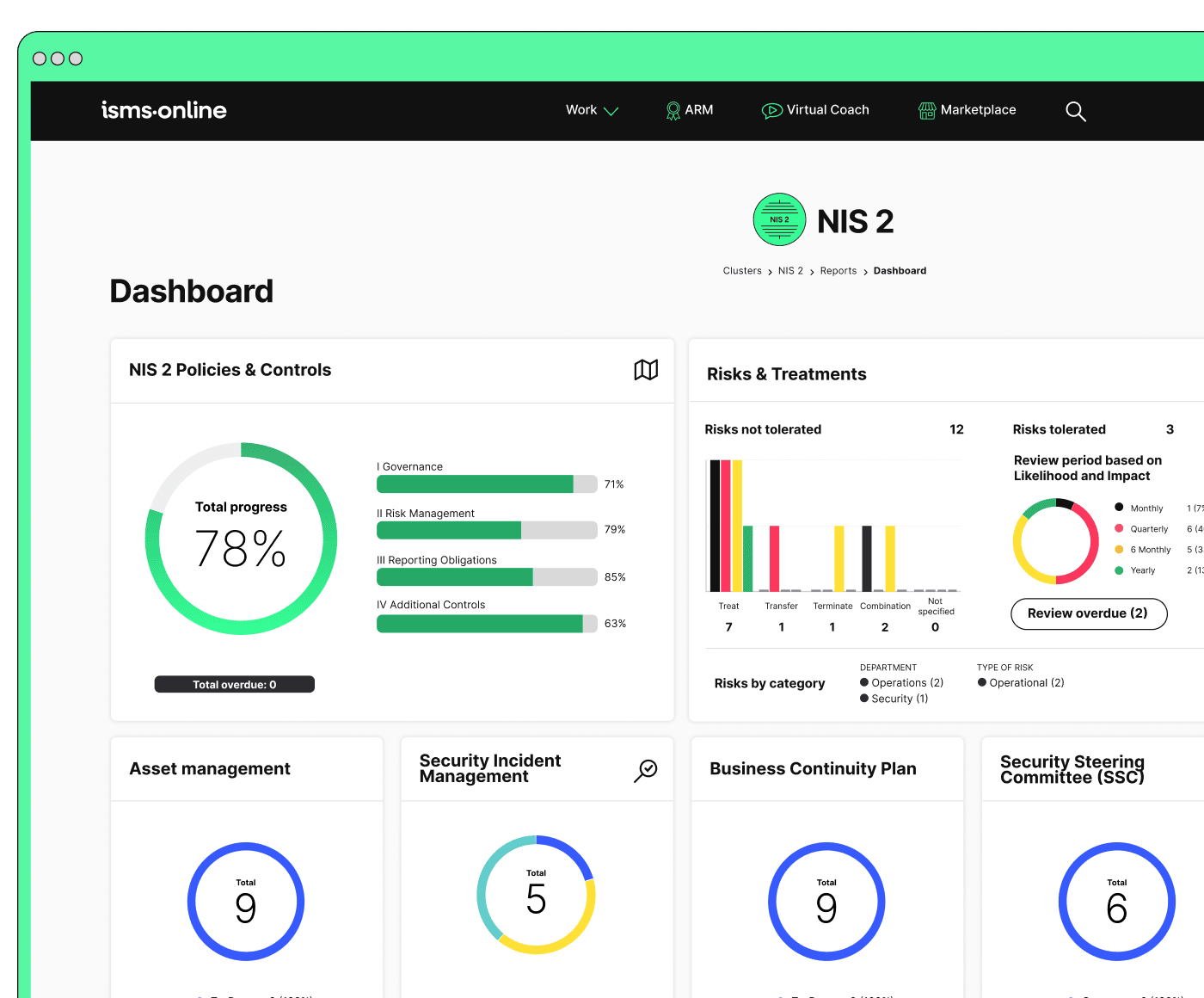
Be NIS 2-ready from day one
Launch with a proven workspace and templates – just tailor, assign, and go.
Can You Instantly Demonstrate Article 10 Compliance-Or Are You Still Trying to Assemble Evidence After an Incident?
Both boards and compliance leads know the question that matters is, “Could you supply, right now, the live, system-logged evidence for every step of your Article 10 playbook?” Regulators require tamper-proof, time-stamped exportability for every notification, escalation, and CSIRT engagement-immediately, not retroactively (ISMS.online-Incident Management; ENISA Toolkit).
Proof that is built post-incident is often proof of what went wrong, not what worked.
ISMS.online provides auto-logged, chronologically sequenced, and evidentially linked records for every incident. Manual or spreadsheet-driven workflows simply can’t satisfy these real-time regulatory demands, nor can “good stories” written post-incident. Your evidence is always a live, operational asset-never a patchwork, never a scramble.
Instantly Exportable: Complete Evidence in Clicks
| Event | Timestamp | Responsible | Linked Evidence File |
|---|---|---|---|
| Incident detected | 2025-07-02 01:20 | Supplier IT Lead | ISMS.online Log Export #12554 |
| Notification sent | 2025-07-02 01:27 | Compliance Manager | ISMS.online Notification Log |
| Escalation closed | 2025-07-02 08:44 | CSIRT Analyst | ISMS.online Case File Export |
A system this tight converts review pressure into resilience-and removes the late-night panic from audit week.
Have You Pressure-Checked Every Supplier and CSIRT Escalation Against Real-World Scrutiny?
Under NIS 2 and ENISA, no compliance programme is credible unless it is tested under real, unpredictable conditions-not just checked off in a policy manual. Stakeholders, from the board to regulators, now expect not only a theoretical plan but a living record of execution: evidence that your notification process worked at 3 AM as well as 3 PM (ENISA Supply Chain Good Practises).
A resilient programme is one where every flaw becomes fuel for improvement, not a cause for regret.
During a simulated or real-life incident-such as a ransomware attack-the ISMS.online platform logs every contact, assignment, and escalation: from the first supplier alert to each actioned step by a CSIRT analyst, with time-stamped, role-assigned, accessible evidence. Not only are notifications and hand-offs tracked, but every follow-up, lesson learned, and root cause file is centrally linked and exportable for audit.
Stepwise: Simulation to Assurance
- Incident detected: Auto-logged in system, supplier notified.
- Escalation triggered: Role owner pinged, response logged via email/SMS.
- CSIRT engagement: All actions and documents attached.
- Closure: Remediation, lessons, approvals all archived.
| Drill Stage | ISMS.online System Log | Audit-Ready Evidence |
|---|---|---|
| Alert | ✔️ Supplier auto-notified | Email/SMS, role log |
| CSIRT in process | ⏳ Assignment, timed steps | Exportable incident file |
| Lessons/close | ⚠️ Root cause, lessons log | Signed PDF, full chain |
This makes “what happened?” questions easy to answer-with operational proof, every time.
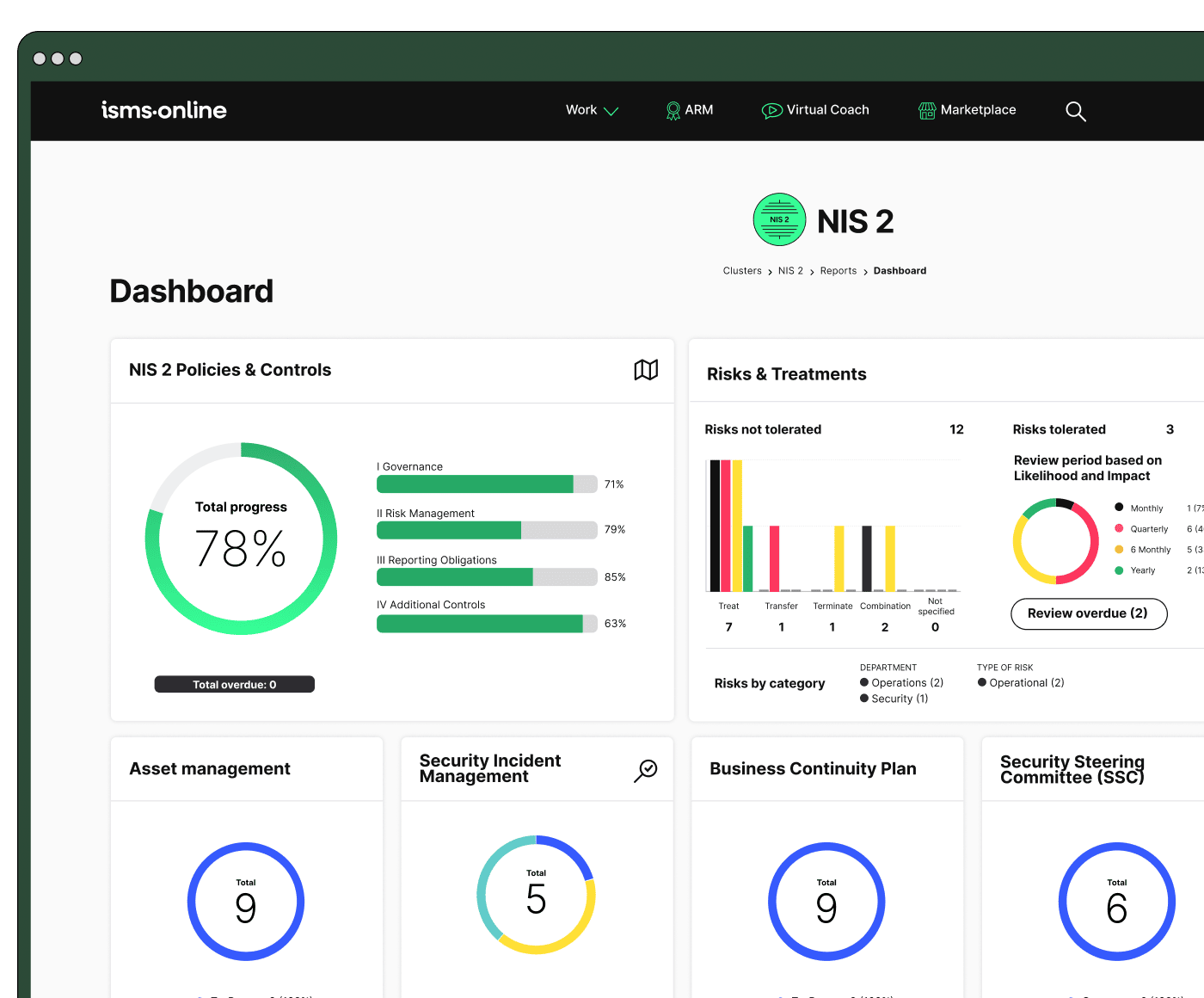
All your NIS 2, all in one place
From Articles 20–23 to audit plans – run and prove compliance, end-to-end.
Is Your Audit Playbook Driven by Genuine Resilience-Or a Checklist Chasing Exercise?
NIS 2 and ISO 27001 are explicit: resilience is built and measured between audits, not just on audit day. Management review (Clause 9.3) and ENISA best practise expect organisations to log trendlines, closure times, improvement actions, and supplier performance over months-not just at project close (ISO 27001:2022; ENISA Good Practises).
Every incremental improvement is a signal to your clients and regulators-real maturity is measured by what you fix, not what you promise.
ISMS.online hardcodes this mindset. Not only does the platform track every incident’s timeline and closure, but it also links supplier responses, performance reviews, trend charts, and action archives in a unified interface. Monthly reviews become evidence-building events; lessons logged today become the audit proof (and improved security) of tomorrow.
Mini Table: Audit Trail as Living Capital
| KPI | Evidence Logged | Board/Regulator Use |
|---|---|---|
| Response SLA met | Trend line, monthly review file | Board and regulator exports |
| Post-mortem filed | Lessons archive, audit log | Management review packet |
| SLA improvement | Signed timestamp, trend file | Risk/compliance dashboards |
Resilience becomes more than a statement-it becomes a living, auditable asset that signals your credibility to customers and supervisors alike.
Can Your Evidence Trail Unify NIS 2, ISO 27001, and Client SLAs-In a Single Export?
The new regulatory reality expects a compliance posture that links every incident to each relevant standard, every time-with nothing lost in translation. ENISA makes it clear: evidence must cross-link seamlessly between NIS 2 notification, ISO 27001 Clause, and contractual SLA records (ENISA NIS 2 Toolkit).
Your system should answer tough questions-before an auditor or client has to ask.
ISMS.online orchestrates this unification: Each incident entry maps directly to both NIS 2 and ISO controls, while dashboard roles tie each event to relevant contract SLAs and management responsibilities. Every incident trace, notification, escalation, and closure is cross-referenced for real-time review and export-empowering board, compliance, and operations teams.
Table: One Incident-Three Standards Met
| Standard | Trigger | Evidence Location | Who Validates |
|---|---|---|---|
| NIS 2 | Supplier incident | Incident log/export | Regulator |
| ISO 27001 | Notification/closure | Audit archive, SoA | Auditor |
| Client SLA | SLA response tracked | Dashboard/export | Board/Client |
This chain of traceable clarity equips you not for “basic” compliance, but for demonstrable operational excellence-even under the sharpest scrutiny.
Resilience Now Looks Like This-Automated, Role-Ready, and Audit-Strong with ISMS.online
The best compliance outcomes no longer go to the companies with the longest checklists-they go to the organisations with the sharpest evidence, tightest playbooks, and strongest feedback cycles. ISMS.online, recognised within ENISA’s current toolkit, equips your team with platform mechanics tailored for Article 10, ISO 27001, and supply chain resilience.
With ISMS.online you move beyond static policy to deliver:
- Live, role-granular supplier incident dashboards: -so every escalation, notification, and handoff is mapped, tracked, and evidenced for both internal leaders and auditors.
- On-demand audit exports: -from single click to complete incident, escalation, and supplier SLA records.
- Continuous improvement metrics: -embedding lessons, trendlines, closure times, and action logs directly into your compliance archive.
The moment for last-minute audit sprints and spreadsheet hunts has passed-now, resilience is lived daily and proven in minutes.
With ISMS.online, your assurance story is no longer paper-thin-it’s live, logical, and locked. Board, auditor, and customer trust are earned by readiness, demonstrated every day.
Frequently Asked Questions
Who is responsible under NIS 2 Article 10, and what does it mean for MSPs and MSSPs?
If you lead a Managed Service Provider (MSP) or Managed Security Service Provider (MSSP) that qualifies as an “essential entity” under NIS 2, Article 10 puts you at the centre of Europe’s toughest supply chain oversight requirements. You are legally accountable not just for your own cyber-security incidents, but also for the detection, notification, and full documentary trail of any serious incident anywhere in your critical supplier ecosystem. The law compels you to notify your national CSIRT or competent authority of any “significant” incident (internal or down your supply chain) within 24 hours, then provide a detailed update within 72 hours-regardless of when or where the trigger occurs;.
One outdated contact or an unlogged escalation in your supplier response map could expose your business to multi-million-Euro fines or contract default at a moment’s notice.
NIS 2 Article 10 at a glance for MSPs/MSSPs:
- Mandatory 24h/72h incident reporting: covers your organisation and key suppliers.
- All events, notifications, and handoffs must be logged, timestamped, and role-assigned: -no exceptions.
- Evidence of current supplier contacts and escalation roles: must be available on demand for three years-regulators will audit this.
- Missed notification or unclear escalation flow: counts as a compliance failure (not a warning).
| Responsible Entity | Detect & Notify | 24/72 Hour Mandate | Escalation to CSIRT | Evidence Retention |
|---|---|---|---|---|
| MSP/MSSP (Essential) | Yes | Yes | Yes | 3 Years |
| Supplier (Critical) | If Critical | Via Prime | Yes | Trace (Supplier Mgmt) |
How does ISMS.online automate evidence, contacts, and notifications for NIS 2 Article 10 audits?
ISMS.online replaces manual tracking and patchwork spreadsheets with a digital backbone purpose-built for Article 10 readiness. When an incident emerges, the platform springs into action: role-based incident tracks are activated, every step is timestamped, and automated notifications fire both internally and across your mapped supplier escalation chain-by email, SMS, or in-app alert, even after hours. The incident clock starts, regulators or CSIRT get instant early warning, and escalation pathways are triggered if deadlines loom or no response occurs.
Every alert, response, handover, and sign-off is auditable in real time. The entire chain of evidence-from incident detection to closure, contact verification to post-incident lessons-lives as an immutable digital record directly accessible for board, management, or regulators ((https://www.isms.online/platform/features/incident-management/)). Scheduled reminders and recurring timeline reviews keep you ahead of NIS 2’s unforgiving notification deadlines.
Resilience is built on visibility; a single missed handoff should be impossible-not just unlikely.
Automated Escalation and Evidence Flow (ISMS.online schematic)
Incident triggers → Automated notifications to staff/suppliers → Timed escalation if pending → Revision-controlled audit log (board ready) → Exportable evidence on demand.
Which audit artefacts and proofs do regulators actually require for Article 10 compliance?
Regulators and auditors don’t want scattered files-they require end-to-end, digital audit trails for every serious incident. For real-world compliance, your organisation must be able to hand over:
- Incident logs: Every action, owner, role assignment, and escalation, captured with timestamps and revision history.
- Notification & escalation records: Proof of on-time alerts (24h/72h) and confirmed receipt by every relevant supplier or authority.
- Digital approvals: Step-by-step sign-off for each task, remediation, and communication-no reliance on email trails.
- Supplier map and contacts: Continuously updated escalation trees proving clear points of responsibility.
- Training records: Evidence that your staff (and suppliers, if required) are familiar with NIS 2 duties and timelines.
- Lessons learned documentation: Each incident must have linked root-cause reviews and a record of improvements.
| Proof Artefact | Captured Where | ISMS.online Output |
|---|---|---|
| Incident & notification logs | Incident dashboard / notification engine | Exportable timeline, PDF, contacts |
| Supplier handoff evidence | Supplier notification module | Fully logged escalation trail |
| Digital sign-offs | Approval workflows | Timestamps and signatures |
| Training & review records | Training tracker | Completion certificates, audit logs |
| Lessons learned/closure | Post-incident review module | Root cause/action log |
Instant export for auditors, board, or contracted clients-no spreadsheet combing required.
Why does real-time, automated escalation protect you from contract and regulatory fines?
Manual tracking is brittle-spreadsheets break, emails go unread off-hours, and “human memory” isn’t accepted by auditors. Under real-world incident loads, a single lapse in the escalation path can render all prior compliance effort worthless. The financial and reputational cost of even one missed alert can be catastrophic (NCSC: Incident Reporting Lessons).
ISMS.online’s Notification Engine gives you a living overview: incident dashboard icons change in real time, status alerts flag overdue actions, and every supplier or stakeholder receives escalation pings until resolved-automatically. Every contact in the chain is checked for validity; any broken escalation triggers visible board and auditor alerts and creates an improvement cycle, not just a hidden failure.
When regulatory risk and contract loss are on the line, automated evidence is the only safety net that holds.
Which improvement cycles and controls transform basic compliance into genuine resilience?
Compliance with Article 10 gets you through an audit; operational resilience and trust come from continuous improvement-and ISMS.online operationalizes both in one loop. Supply chain-related incidents are never “one and done”: ENISA, ISO 27001 Clauses 9.2–10.2, and the Directive all require evidence-based reviews, tracked lessons, and systemized risk reduction (ENISA Good Practises Supply Chain Cyber-Security).
Resilience controls in practise (delivered by ISMS.online):
- Regular supplier and escalation contact reviews: Time-triggered tasks and evidence logs with version history.
- Mandatory lessons learned: Embedded feedback workflow after every incident closure, tracking accountability.
- Ongoing automated improvement logs: Trends, closure rates, and risk patterns visualised in the dashboard and exportable for the board.
- End-to-end traceability: Evidence mapped by clause, SLA, and contract-simplifying SoA and audit proofs.
| Expectation | ISMS.online Delivery | ISO 27001 / Annex Ref |
|---|---|---|
| Notify in 24/72 hours | Automated timestamped reminders | A.5.24, A.5.25, A.5.26 |
| Supplier reviews | Trend/evidence dashboards, logs | 9.2, 9.3, A.5.19, A.5.20 |
| Continuous improvement | Tracked, scheduled improvement logs | 10.1, 10.2, A.5.27 |
You’re not just “passing”-you’re proving active risk reduction and operational maturity to clients and auditors alike.
How do integrations with Jira, Zapier, and Teams support compliance at scale and speed?
Plugging ISMS.online into tools like Jira, Zapier, or Teams means incidents move at the speed of your business-not the speed of email chains. A critical alert in your SIEM can create a Jira ticket, start the incident timer, auto-notify relevant staff and suppliers via Zapier-synced Teams or SMS, and ensure every assignment and fix is attached to the audit timeline-never missed, always mapped.
Automated evidence flow means you can scale compliance activity without scaling manual admin-evidence is centralised, always up to date, and any loss or delay in the handoff generates real-time management prompts to fix the gap. Ultimately, this makes your organisation faster, more robust, and audit-ready every day.
Are “lessons learned” reviews mandatory-and how does ISMS.online ensure they’re seen and evidenced?
“Lessons learned” are the non-negotiable engine of improvement in both NIS 2 and ISO 27001:2022. Every serious incident requires a review in ISMS.online’s workflow: all stakeholders (internal and suppliers) must contribute root cause insights, assign improvement actions (with status and deadlines), and feed findings into recurring review cycles. No incident can be closed without a tracked, timestamped lessons learned cycle-with each action and re-assignment feeding into executive dashboards and exportable compliance trails.
An audit trail without improvement is just expensive shelfware-lived ‘lessons learned’ are the currency clients and auditors value.
What strategic business value does continuous digital compliance deliver beyond audits?
Having a live, digital, always-audit-ready compliance trail is now a top RFP differentiator and a contract-winning asset-not just a regulatory box to tick.
- Export evidence for regulators, clients, or internal reviews in minutes-not days-showing your compliance backbone is living, not theoretical.
- Tighten audit cycles by reducing evidence hunting and duplicate work; centralise every notification, escalation, and root-cause log.
- Accelerate trust: Boards and regulators see exactly who did what, when, and how lessons were embedded into future operations.
- Use your compliance backbone in competitive bids-the ability to prove contractually robust, regulator-grade supply chain oversight is now “table stakes” for major deals.
- ENISA’s research confirms: “Continuous audit evidence and improvement cycles are directly linked to resilience and client trust”.
If you want to lead as a resilient, trusted supplier, unify incident, notification, and improvement evidence across NIS 2, ISO 27001, and critical supplier contacts. With ISMS.online, your audit defence is always up to date-and your business value grows with every logged action.






