





































Why Is Accurate Incident Classification the Linchpin of NIS 2 Compliance-And What Happens When You Get It Wrong?
Every moment you delay, mislabel, or second-guess an incident’s significance under NIS 2, your exposure multiplies. A wrongly classified incident is not a technicality-it’s regulatory risk, lost business, and headline stress waiting to happen. Enforcement bodies make clear that ambiguity is not a defence. When classification falters, you’re left explaining why missed alerts snowballed into business interruption and why your audit trail reads more like a memory game than a compliance log.
Every delay in classifying an incident weakens both your compliance and your reputation.
Modern scrutiny spins small cracks in your reporting into cascading trust issues: deals paused, regulatory scrutiny increased, costs rising as teams play catch-up. In the absence of a robust system, bottlenecks-sometimes just a single stakeholder with unanswered questions-put your audit readiness and board confidence at risk. The pain compounds further: one ambiguous case creates a precedent, multiplying the impact of the next minor event and eroding trust within and beyond your organisation.
Resilient organisations now treat incident classification as a frontline discipline-not an afterthought. That means giving teams the context to close every reporting gap as it opens, enforcing clarity under pressure, and removing the subjective guesswork that so often clouds regulatory obligations. This discipline is especially vital as the NIS 2 Directive deepens its requirements. The truth is, the only way to reliably survive both audit and boardroom scrutiny is with a workflow that codifies classification at every step.
When the steps are visible, repeatable, and auditable-your organisation’s confidence grows as quickly as the regulator’s trust.
How Do You Find Your “Significant” Incident-And Avoid Guesswork Under NIS 2 Article 3?
NIS 2 transforms incident reporting from a hunch to a testable framework. Gone are the days when a “gut feeling” about what matters is enough to satisfy a regulator or an auditor. Article 3 details what is “significant”-service interruption, societal impact, confidentiality breach, ripple effects that cross your sector’s risk threshold. But the lived reality is messier: in a fast-moving incident, even seasoned professionals can slip into over-reporting (flooding the register with noise) or, worse, missing the real harm as incidents cascade or aggregate.
Context determines significance-today’s minor system hiccup may accumulate into tomorrow’s regulatory failure.
Avoiding both “false fires” and critical blind spots is a moving target. Each NIS 2 sector overlays its own operational triggers:
| Sector | “Significant” Trigger Example | Authority/Reference |
|---|---|---|
| Finance | Outage >30 min; transaction disruption | ec.europa.eu |
| Health | Patient care delay; system data loss | cms.law |
| IT/Digital | Cloud platform breach; 1-hour outage | twobirds.com |
| Utilities/Energy | Regional blackout; supply chain disruption | bakerlaw.com |
| Transport | Booking systems unavailable >15 min | kpmg.com |
And significance isn’t only about immediate blast radius: frequent warnings, small outages, or “near-misses” can aggregate into a reportable event.
Small alarms become tomorrow’s big findings-consistent classification discipline is your only safe bet.
That means your workflows and templates should draw on official sector guidance and be embedded into digital routines-reviewed frequently to keep pace with regulatory and threat evolution. Reporting standards change; your classification rules must not ossify.

Master NIS 2 without spreadsheet chaos
Centralise risk, incidents, suppliers, and evidence in one clean platform.
Can You Turn Alert Streams Into Regulatory Decisions-Without Drowning in Process or Overload?
It’s not enough to spot potential incidents-you need a system that turns scattered alerts into defensible, stepwise decisions. Without a structured engine, chaos rules: time is wasted, levels of review are unclear, and every escalation becomes an exercise in subjective memory and lost context. The challenge? Building operational logic that makes every decision explainable-no matter how long after the event.
If you can’t track why a decision was made, you can’t defend it in the eyes of a regulator.
A rigorous process asks:
- Reconstructability: Can your team, three months later, show why you called an incident “significant” (or not), with supporting rationale at each review step?
- Traceable Handoff: Are all reviewer inputs and hand-offs time-stamped and tied to the incident’s unique record?
- Root Cause: Are system and human factors captured at each classification, or are they retrofitted under pressure before a board pack is due?
Within ISMS.online, every stage is made visible so that reviews, handoffs, and rationales aggregate into audit-ready logs. Each workflow state (alert, initial review, classification, escalation, risk log, root cause, management review, close/export) is enshrined with clear decision logic and role accountability.
Example: ISMS.online Incident Classification Flow
| Step | Who / System | Evidence & Outcome |
|---|---|---|
| Alert Triggered | Monitoring / Staff | Event timestamp, origin, signatory |
| Initial Review | SOC/First Responder | Basic details, flagged as possible “significant” |
| Classification Checkpoint | IT/Risk Committee | Decision matrix documented, risk escalated/closed |
| Escalation | Stakeholder Review | Multidisciplinary consensus/lone dissent tracked |
| Risk Register Update | Platform Automation | Change log, asset/control linkage |
| Root Cause Entry | Investigator | Remediation started, preliminary cause logged |
| Management Review | CISO/Board | Policy updated, learning points extracted |
| Audit Export | ISMS.online platform | Full evidence pack, reviewer chain, logs ready |
No step-no matter how small-should escape audit readiness. Routine trumps improvisation under pressure.
How Does ISMS.online Replace Guesswork with End-to-End Audit Trails and Reviewer Rationale?
Keeping a tamper-evident, reviewer-complete chain is non-negotiable. An incident log that only captures summaries, or leaves reviews offline in emails, fails the test if called before a regulator. ISMS.online addresses this by chaining every handoff, escalation, edit, and rationale-and preserving even reviewer disagreements in the record.
Only a complete audit chain satisfies both board scrutiny and regulatory pressure.
Each change is time-stamped and attributed, every escalated review or minority opinion linked, and nothing is left in hidden side-documents. For example, unresolved consensus is explicitly logged, not erased through version overwrite. This focus ensures that every artefact is as defensible in a year as it is moments after the incident closes.
| Audit Evidence Element | Data Captured |
|---|---|
| Reviewer inputs | Name/role, time, stage, rationale |
| Escalation history | Each reviewer/role, time, status, dissent |
| Change logs | Who edited what, when, why |
| Path to closure | Timeline, delays, sign-offs, linked policies |
| Export artefact | Single bundle, full chain-of-custody |
Automated audit trails become living proof-no more chasing documents, no space for uncertainty.
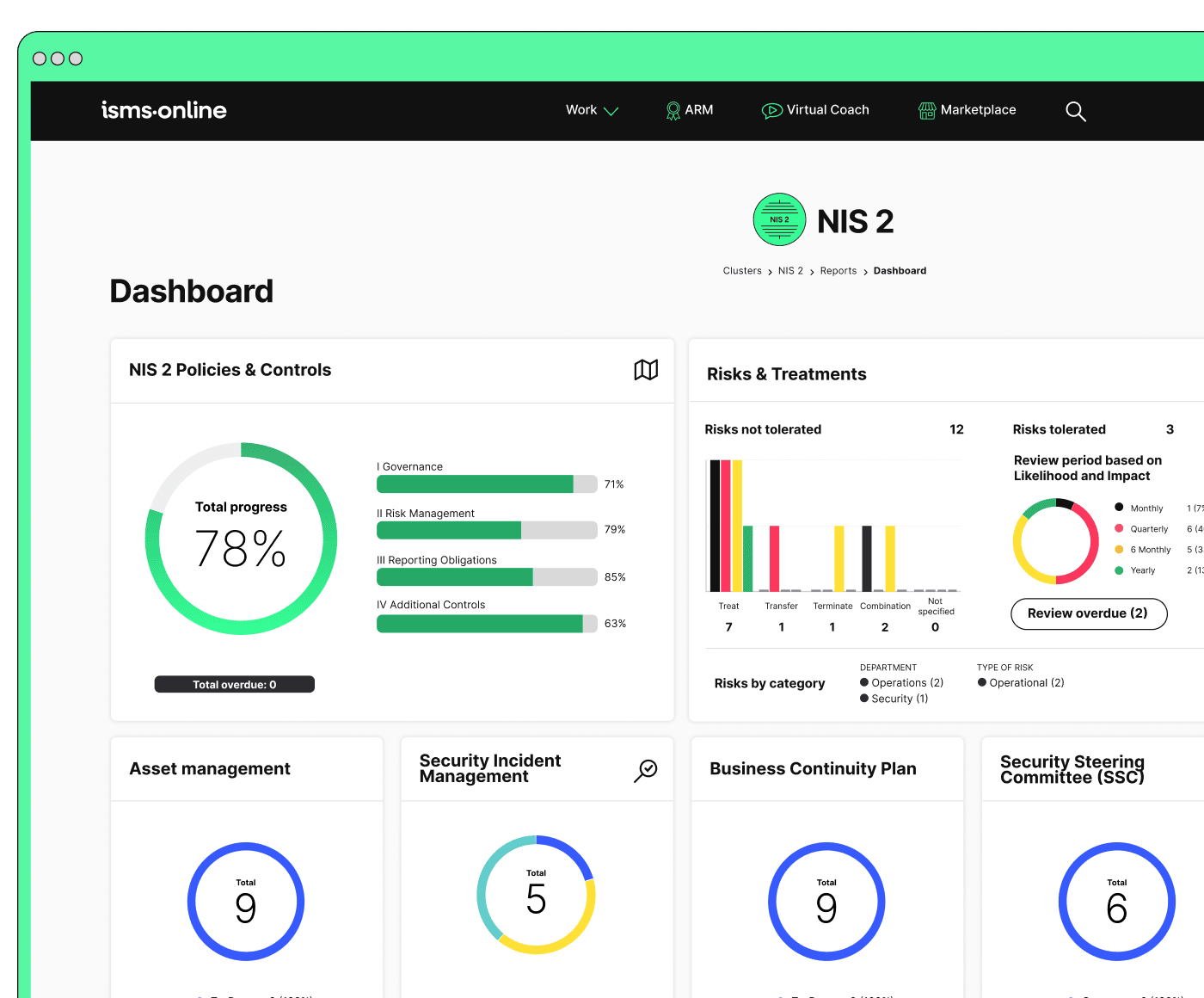
Be NIS 2-ready from day one
Launch with a proven workspace and templates – just tailor, assign, and go.
Are You Closing the Evidence Loop-So Every Incident Triggers Risk Register, Controls, and SoA Revisions?
NIS 2 expects more than simple reporting-it anticipates that every “significant” event triggers an ecosystem update, linking evidence, risk registers, control frameworks, and the Statement of Applicability (SoA). ISMS.online operationalises this by ensuring every incident, once classified, is woven directly back to your policy and risk landscape.
| Trigger | Risk Register Update | Control / SoA Action | Evidence Artefact |
|---|---|---|---|
| Malware outbreak | Increase supply chain risk score | Update A.8.7 controls, test supplier policies | Linked risk event, SoA item |
| Supplier breach | Create new supplier risk | Review A.5.19, A.5.21 supply chain controls | Activity revision, logs |
| Data corruption | Mark confidentiality risk | Check/update A.8.25 secure disposal protocols | Change log, SoA entry |
| Service interruption | Raise availability exposure | Patch A.8.13 backup/continuity procedures | Recovery report, audit log |
In a mature system, every incident improves your posture-by design, not by chance.
With every classification, ISMS.online pushes necessary lessons into the fabric of your controls. Lessons are never lost; every SoA entry is traceable from the incident, ensuring complete traceability for both ongoing operations and external review (isms.online; sophos.com).
Can You Turn Every Classification into a Board/Regulator-Ready Mini-Audit, On Demand?
Your incident log should never feel like a data graveyard. What ISMS.online makes possible is the rapid export and presentation of every investigator decision, reviewer sign-off, change log, and linked SLA-sliced and permissioned for exactly the right audience. This transforms not just audit readiness but real board and regulator assurance.
| Exported Data | Access Level | Purpose |
|---|---|---|
| Incident log + rationale | Regulator, audit | Evidence of process and defensible logic |
| Reviewer sign-off chain | Board, audit lead | Transparency & executive confidence |
| Control/risk mapping | Practitioner | Traceability of lessons, impact, and linkage |
| Change/access logs | Regulator | Assurance of separation and chain-of-custody |
Role-based dashboards and real-time reporting mean every audit pack is both evidence and narrative-demonstrating not just compliance but active, empowered, and continuously improving governance.
Audit readiness is the power to show-not just hope for-the decisions behind every metric.
—
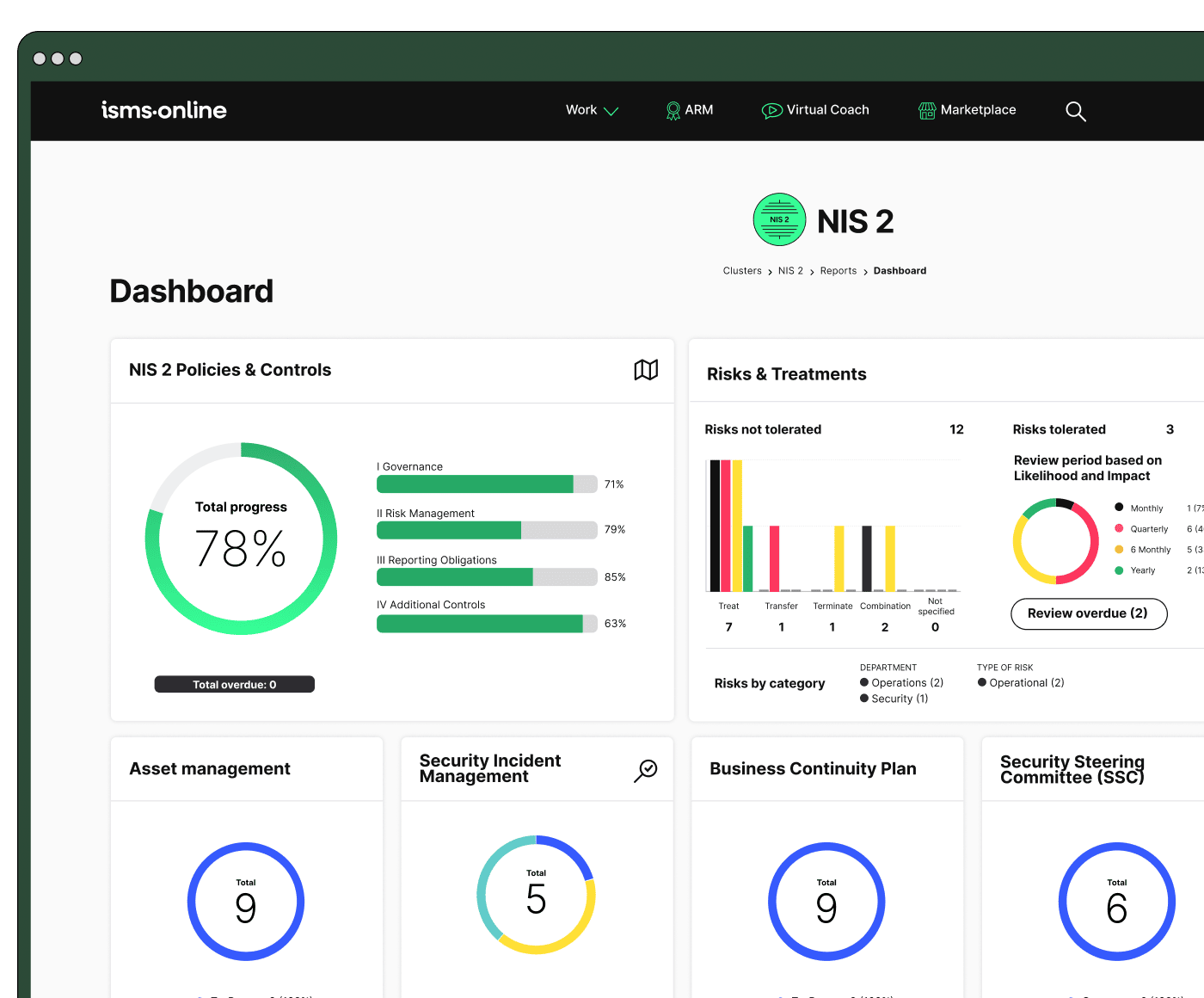
All your NIS 2, all in one place
From Articles 20–23 to audit plans – run and prove compliance, end-to-end.
Does Your Management Review Loop Harvest Real Learning-or Leave Improvement up to Luck?
Management review is where compliance shifts from checkbox to continuous learning. The strongest systems ensure all classifications, root causes, and escalation lessons feed directly into management reviews-turning “near miss” events into improvements, not just boxes ticked or forgotten after the crisis has passed.
An audit-ready culture means every slip, not just every crisis, is an opportunity for improvement.
ISMS.online links each review directly to evidence logs, training records, and policy updates. Common patterns-like repeated classification delays or surge in phishing attempts-become dashboards, not anecdote. Corrective actions can be triggered from any event, automatically, and their downstream effect chain tracked to closure.
| Reviewed Event | Frequency | Outcome | Audit Evidence |
|---|---|---|---|
| Critical incident occurred | 2× last quarter | New policy/control | Mgmt review notes |
| “Near-miss” phish detected | 1× this month | Training update | Training completion |
| Escalation delays > SLA | 3× last 90 days | SLA/policy update | Review docs, SLA logs |
By recording every discussion, decision, and action, your management review forms a continuous resilience ring around all incident classification. This loop prevents small cracks from becoming full breaches tomorrow.
How Do ISMS.online Reports & Sign-Off Features Give You Boardroom and Regulator Confidence-Effortlessly?
Scrambling for evidence under pressure is yesterday’s standard; today’s is real-time, role-aware, permissioned access to every record, with clear sign-off, reviewer logic, and historical change links. ISMS.online’s dashboards and exports link not just the result but the reasoning and sign-off lineage, with full chain-of-custody, ready for any audit window.
When your audit pack shows the why alongside the what, you turn risk into trust.
When regulators or the board demand explanation-or merely assurance-you export the reviews, sign-offs, controls updated, and rationale at speed. This closes the communication loop, keeping all eyes-board, legal reviewers, auditors, practitioners-aligned and confident.
A recent debrief summarises what most aspire to but seldom achieve:
ISMS.online’s incident export features took us from weeks of historical chasing to real-time, regulator-ready board packs. (ISMS.online case study)
Audit readiness becomes everyday certainty-not hopeful coordination.
Move From Hoping to Knowing-Classify, Learn, and Report With Confidence Using ISMS.online
The line between audit success and regulatory pain is drawn by classification insight, not luck. Let your next incident be the proof point-walk your team through ISMS.online’s live workflow. Every classification, escalation, and lesson leaves a digital fingerprint across your incident log, risk landscape, controls, SoA, and board reporting.
Each stakeholder-Kickstarter, CISO, Privacy Officer, Practitioner-operates with newfound confidence: no ambiguity, no guesswork, no last-minute scrambles. Defensibility becomes a byproduct of disciplined workflows and continuous improvement-not an aspiration, but a feature you trust.
With ISMS.online, compliance isn’t a scramble-audits, board reviews, and regulatory checks become proof of your system’s resilience, not its luck.
Frequently Asked Questions
Why does the precision of NIS 2 incident classification dictate your compliance risk-and your reputation in the market?
Accurate incident classification under NIS 2 isn’t about pleasing regulators-it’s the mechanism that shields your organisation from audit dread, spiralling costs, and public scars. When teams hesitate or get tangled in “what counts as significant,” every wasted hour widens the gap for fines, board doubt, and lost customer confidence. European authorities now benchmark leadership credibility on one thing: can you defend, not just declare, how you judge incidents (European Commission, 2024). Recent enforcement trends reveal a sharp rise in penalties for fuzzy logic-where classifications aren’t justified by law-centric criteria, board trust cracks, and revenue-impacting deals stall (BDO, 2024). Any organisation depending on “consensus after the fact” routinely faces costly rework and extra scrutiny. ISMS.online abolishes ad hoc guesswork by embedding regulatory triggers and team rationale into every workflow step-each classification is automatically tracked, justified, and export-ready. Move past the debate cycle, and both compliance risk and reputation costs recede from headlines to footnotes.
Ambiguous incident calls do more than invite auditors-they slow decisions, erode confidence, and give competitors room to cast doubt.
What business risks does misclassification amplify?
- Procurement friction with clients demanding instant clarity.
- Board “audit shock” when documentation is patchy or debatable.
- Regulatory probes that grow from a missed deadline or unclear incident chain.
What specific triggers actually define a “significant incident” under NIS 2-and how do sector benchmarks shift the line?
Under NIS 2, a “significant incident” is drawn not by intuition, but by a matrix of sector thresholds and legal signals. Across the EU, regulators mandate clear decision lines: was a core service disrupted, did confidential or sensitive data leak, did the incident endanger public trust or safety, and were enough users affected to warrant scrutiny. For finance, health, or digital infrastructure, triggers fuse technical, monetary, and reputational markers: for example, an outage affecting €1M transactions or 10,000 users-regardless of whether the initial impact felt “minor” (BakerHostetler, 2024). Crucially, “aggregation” has teeth: a string of lesser incidents, recurrent enough, can tip the scale. ISMS.online operationalizes these parameters-your team sets tailored thresholds per unit, with escalation rules capturing “minor” events that snowball into a major risk (KPMG Cyber, 2024). This eliminates the trap of “we didn’t realise until it was too late,” and keeps every call defensible in the eyes of client, board, and regulator.
NIS 2 Trigger Matrix Example
| Sector | Incident Trigger | Regulatory/Custom Threshold |
|---|---|---|
| Digital Infra | Multi-country user disruption | >10,000 or cross-border outage |
| Healthcare | Patient data unavailable | >72 hours downtime or >5,000 records |
| Finance | Service or transaction interruption | >€1M at risk or >4-hour outage |
True resilience means these criteria are coded into your daily workflow-not left in policy binders for the audit scramble.
How does transforming incident alerts into formal NIS 2 classification protect against both over-reporting and hidden risks?
Operationalising alerts under NIS 2 isn’t just about catching what’s big-it’s about not drowning in noise or missing the quiet disasters. ISMS.online routes technical alerts through sector-tuned logic: every potential incident is auto-tagged, escalated for role-based reviewer chains, and given a documented rationale at each step (SANS, 2024). That means “maybe” incidents don’t get stuck in inboxes, and no critical ones dismiss as “routine.” Reviewer decisions, overrides, and root cause notes are timestamped, preserved, and ready for audit-no shortcutting permitted (BCLP Law, 2024; Delachaux, 2024). Both over-reporters (risking resource waste and regulatory overload) and under-reporters (risking fines and loss of trust) are shielded: ISMS.online flags anomalies, prevents silence, and requires every final status to be justified.
Embedded Steps for Robust Classification
- Philtre by sector and technical relevance.
- Route candidates for collaborative, logged review.
- Lock rationale and closure notes at all stages.
- Demand root cause lessons for every “significant” declaration.
- Instantly export review chains for board or audit queries.
How does ISMS.online keep every override, escalation, and correction secure and tamper-evident for audits and the board?
Defensibility under NIS 2 is about traceability over time-not just logging who did what, but capturing “why” at every decision. ISMS.online creates an immutable, user-linked audit trail for every reviewer action-classification, override, challenge, or correction (Risk.net, 2024). Objections aren’t erased; they’re stored as evidence, preventing “compliance washing” after the fact. This approach ensures your organisation can rapidly produce the full decision and rationale chain for any incident, no matter how far back regulators or the board look (Digital Guardian, 2024; Splunk, 2024). Role-based integrity-where only authorised users make changes, and all escalations are logged-stops “role creep” or tampering, and helps turn audit reviews from a stress event into a reputational win.
A traceable audit chain puts your organisation ahead-trusted by the board, respected by regulators, and unfazed by third-party challenge.
ISMS.online Audit-Chain Strengths
- Immutable, timestamped logs across every reviewer and action.
- Embedded objections, dispute logs, and correction trails by design.
- Export-ready at any moment-auditable and board-proven within minutes.
How does incident-to-control integration with Statement of Applicability (SoA) in ISMS.online future-proof compliance and audit readiness?
ISMS.online links every significant incident directly to your live control and risk registers-removing the risk of “reported, but not reflected.” Each new classification triggers a synchronised update: the SoA, risk register, and control documentation all receive the relevant context, versioned rationale, and timestamp (Risk Ledger, 2024; (https://www.isms.online/features/statement-of-applicability-benefits-for-incident-driven-control-updates/)). No waiting for quarterly review or dealing with stale, static spreadsheets: everything updates as the risk landscape shifts. When auditors or the board demand proof, you can instantly provide a unified chain-classification logic, responsible parties, management review, and control log-fused into a single, exportable evidence pack (Sophos, 2024). This secures not just legal compliance but business trust-demonstrating that each lesson learned reshapes your risk posture in real time.
ISO 27001 / Annex A Operational Mapping
| Incident Trigger | ISMS.online Response | ISO 27001 / Annex A Clause |
|---|---|---|
| NIS 2–classified event | Update control/risk register live | 6.1.2, A.5.24–A.5.26 |
| Evidence to SoA | Triggers versioned SoA and log update | A.5.29, A.5.31 |
| Full chain auditable | Exportable evidence for board/audit | A.5.35, 9.2, 9.3 |
This real-time linkage is what auditors and boards increasingly expect-turning compliance from a one-off to a living, breathing advantage.
How does ISMS.online deliver instant, defensible reporting-so your compliance chain drives trust (not just ticks boxes)?
With ISMS.online, “compliance” becomes immediate business action. All incidents, sign-offs, and control changes atomically link from detection through to evidence export, with oversight for both internal managers and external parties (BrightHR, 2024; CyberSaint, 2024; Mayer Brown, 2024). Dashboards turn data into actionable trust signals: timed decision logs, cross-team escalations, and rationale for each move are surfaced for real-time review (ISMS.online, 2024; BoardEffect, 2024). Executive and regulator queries are answered within minutes, not months, so leadership can drive strategies based on live evidence and external partners see reliability, not delay. The result is swifter audits, unblocked revenue cycles, and a reputation for proactive credibility-turning compliance from a drain into a source of market trust.
See the ISMS.online difference in action
Unlock instant incident-to-audit evidence with ISMS.online. Explore a live NIS 2 workflow-trace any classification, review sign-off, and control update from start to export, and show your board and auditors readiness is built in, not backfilled.






