





































Are You Really in Scope? Who the NIS 2 Directive Applies to in 2024–2025
Most organisations now operate in a world of expanded cyber-security accountability-often before they realise it. The NIS 2 Directive (2022/2555/EU) is not just an IT regulation: it redraws the boundaries of where compliance, liability, and operational gravity sit. It’s a mirror on how modern business, technology, and trust are intertwined. If you’re unsure whether your company is in scope, or worry you might be on the wrong side of readiness, this is where to start.
Assuming exemption is now the rare case-European contracts and supply chains make you responsible even if the regulator hasn’t called.
Which Sectors and Entities Are Caught in the Net?
NIS 2 categorises both “essential” (e.g., energy, financial market, health, major digital infra) and “important” (e.g., food production, manufacturing, logistics, digital services) entities explicitly-yet in practise, many companies are swept up by the law’s broader channel (ENISA sector mapping). You may find yourself in scope not by direct inclusion but due to your clients’ or vendors’ status: SaaS companies, managed service providers, logistics operators, and public sector bodies aren’t rare exceptions.
Quick test for scope:
- Does your sector appear in EU Annex I or II, or national regulator sector lists?
- Do you deliver digital services critical to any in-scope entities-even by proxy?
- Have customers or suppliers begun asking about NIS 2 in contract language or questionnaires?
A single “yes” drags you into NIS 2 obligations regardless of self-perception. Many organisations first discover their scope via procurement bottlenecks-a deal blocked, a new questionnaire, or sudden audit demands.
Not being named in the law is the true exception. Modern supply chains pull you in sideways.
The Size and Revenue Trigger (and Exceptions)
NIS 2 applies to most organisations with more than 50 employees or annual revenues exceeding €10 million. Yet this is not strictly a big-company law: supply chain criticality can draw in smaller companies-a two-person SaaS whose product underpins an energy provider, or a niche logistics firm contracted to a health body. The focus is not on scale but on the potential to disrupt essential or important services.
Key lesson: Begin mapping your “downstream” and “upstream” dependencies now, regardless of size or revenue.
Supply Chain and the “Secondary Catch”
You may side-step direct triggers, only for contracts with larger organisations or highly regulated entities to impose NIS 2-aligned obligations by default. Supply chain security is now non-negotiable, and organisations must prove vendor due diligence and incident escalation. Legal and procurement teams are expected to escalate-if not initiate-this mapping, using platforms and workflows that make third-party oversight routine, not afterthought.
Public and Non-Obvious Entities
NIS 2 covers an expanding universe: education, digital platforms, postal/courier firms, water and utility providers, and even regional or national public administration units. If you are supporting a local authority, act for a hospital, or operate a cloud platform even as a subcontractor, presume NIS 2 applies until conclusively proven otherwise.
What New Compliance Actually Means: The Real NIS 2 Requirements
Far beyond checkbox audits, compliance under NIS 2 is a living exercise-of accountability, evidence, and continuous action. The law expects boards, managers, privacy/legal, and technical teams to collaborate actively, not orchestrate compliance as a “side project.” Overlapping with but outpacing ISO 27001, NIS 2 demands boardroom-grade diligence, operational transparency, and hands-on vendor oversight.
Certification isn’t a shield. Operationally mapped evidence is the new non-negotiable.
Directors, Executives, and True Accountability
Gone are the days when drafted policies (set-and-forget) or busy automation tools guaranteed compliance. NIS 2 demands engagement, signed-off reviews, and board/body-level oversight. Every assignment, risk review, and change must have a named, accountable person and a logged action. Executive and management teams are facing direct, personal liability for lapses-a major departure from the “delegated up” model.
Why ISO 27001 Isn’t Enough-But Still Foundational
ISO 27001 and ISMS certifications remain a critical base, but NIS 2 runs wider: it demands explicit proof of supply chain controls, incident escalation, continuous monitoring, board dashboards, routine audits, and direct procurement integration. If you’re “already certified,” cross-reference your ISMS controls to NIS 2’s Article 21–23, Annexes I–II, and Recitals on third-party risk and board accountability. Most certified orgs discover fresh evidence and process gaps-especially around supplier onboarding, incident notification, and risk log currency.
Audit teams, board committees, and procurement auditors are now looking for real-time dashboards, not just annual binders. Companies relying only on static document folders will face deeper scrutiny and repeated questions from authorities and customers.
Key Requirements for Supplier and Contract Management
Your supply chain is now traceable-and every supplier onboarding or renewal is a compliance and audit requirement, not simply a procurement step. NIS 2 expects:
- Documented, risk-based supplier assessment for every critical vendor.
- Evidence of routine supplier/security review cycles (quarterly, not annual).
- Contract clauses for breach notification, audit rights, and minimum security standards.
- Live tracking of contracts, renewals, incident notifications, and enforcement actions.
If your team only updates these on request or in the run-up to an audit, evidence will be out of date-and violations or delays may trigger fines or penalty clauses.
Audit-Ready Evidence in a Continuous Cycle
NIS 2 audits demand a live, digital archive of policies, risk registers, SoA (Statement of Applicability), incident logs, supplier reviews, management review minutes, and approval records. If you cannot trace a requirement directly to a living log, your compliance is at risk. This is where digital platforms and ISMS solutions become necessary-not just helpful.
Audit readiness isn’t annual. Every control, risk, and supplier must be mapped and evidence linked at any time.
| Requirement | Operationalisation | ISO 27001 / NIS 2 Reference |
|---|---|---|
| Board oversight | Board minutes, reviews, signed compliance tasks | Article 20, ISO 27001 Clause 5.2, 9.3 |
| Supplier risk management | Supplier risk logs, contracts, breach notifications | Articles 21, 22, ISO 27001 A.5.19–21 |
| Incident response/documentation | Timestamped incident logs, notification proof | Article 23, ISO 27001 A.5.25–27 |
| Audit-ready evidence | Digital policy trail, SoA, evidence library | Art. 21, ISO 27001 Clause 9.2, 9.3 |
ISMS.online users: “A dashboard view links risk status, audit actions and mapped policy evidence for any control-no last-minute panic.”

Master NIS 2 without spreadsheet chaos
Centralise risk, incidents, suppliers, and evidence in one clean platform.
How Incident Reporting, Penalties & Enforcement Now Work
Cyber-Security breaches are no longer speculative-they are a given, and NIS 2 regulates precisely how you must respond. Readiness is judged not on whether an incident occurs, but on how you recognise, escalate, document, and notify-under extreme time pressure. A robust ISMS is only the beginning; operational discipline and rapid communication are now tested in real-world events.
When an incident hits, every second counts-and the first misstep exposes the board, not just IT.
Incident Reporting: Timelines and Triggers
The Directive sets strict notification clocks:
- 24-hour window: Serious incidents must be reported to national authorities within a day.
- 72-hour update: A complete impact and containment report must follow quickly.
- 1-month closure: Documentation of lessons learned and evidence of mitigation are expected.
This clock starts regardless of internal debates about cause or next steps. Rehearsal-ideally monitored in digital playbooks, with assigned escalation roles-is an essential part of compliance.
What’s a Reportable Incident?
Any event that interrupts essential or important services, or breaches confidentiality, integrity, or availability of data, is notifiable. Ransomware, supplier-origin attacks, even “contained” outages qualify. The law is more expansive than many GDPR-style definitions. Most overlooked: supplier-driven incidents are your obligation as soon as services are downstream-impacted-there is no deflecting blame.
Penalties: Not Just for Non-Reporting
Penalties bite hard-up to €10 million or 2% global turnover for essential entities; €7 million or 1.4% for important entities; and executives face personal liabilities. Regulators have escalated enforcement for even procedural lapses: missed deadlines, incomplete logs, or audit gaps.
Your evidence trail-digital, timestamped, and role-assigned-is judge and jury in a NIS 2 audit or after-action review.
Audit Traceability: End-to-End
| Trigger Event | Risk Register Update | Control / SoA Link | Evidence Logged |
|---|---|---|---|
| Ransomware on supplier system | Supply chain risk | ISO 27001 A.5.19, NIS 2 Art. 22 | Vendor notification, incident log |
| Outage affecting critical service | Service continuity | ISO 27001 A.5.29, NIS 2 Art. 21, 23 | Outage report, board review |
| Missed incident notification deadline | Compliance risk | ISO 27001 9.1, NIS 2 Art. 23 | Penalty file, action plan |
| Unmapped control (paper-only) | Audit risk | ISO 27001 SoA, NIS 2 Art. 21, 24 | SoA, nonconformity report |
Delay here doesn’t just trigger fines-it damages reputation and exposes executive decision-making to outside scrutiny.
Integration with GDPR, DORA, Country Laws
For the financial sector, DORA usually takes precedence (superseding NIS 2 on incident/supply chain); GDPR overlaps are common-especially for breach notification and evidence integrity. Smart ISMS platforms allow dual escalation, harmonising logs to satisfy all relevant regimes.
Evidence-Driven Trust
Most compliance failures occur not when something goes wrong, but when teams fail to show every handover, notification, and action was logged. (Big Four audit)
When evidence lives in mapped, timestamped records-centrally accessible and role-linked-you replace anxiety with clarity, and turn every audit/incident review into an opportunity to prove your team’s real-time control.
Are Your Suppliers Now Your Biggest NIS 2 Risk?
Supply chain and third-party risk have become some of the defining variables in every NIS 2 compliance programme. Weak vendor controls, missed notifications, and opaque supply relationships are no longer just risk-management concerns-they are explicit sources of legal, operational, and reputational exposure.
Your cyber-security is only as strong as your least visible vendor.
Why All Suppliers Matter
Don’t fall into the trap of focusing only on primary or “major” vendors. NIS 2 expects risk assessments and due diligence for all suppliers with operational relevance-no matter their size or revenue. Automating logs, requesting regular security self-attestations, and tracking contract status year-round is the new baseline.
Contract Review and Legal Triggers
Procurement teams must shift from annual “tick-box” reviews to dynamic, evidence-backed processes for:
- Security baselines-replace vague references with explicit, evidence-proven standards
- Breach notification timelines
- Audit and verification rights (actual exercise documented)
- Subsupplier and subcontractor controls Every supplier contract renews the compliance lifecycle, demanding review and documentation. ISMS and vendor management tools help centralise and surface these records.
Managing Indirect and Global Providers
Indirect, niche, or global suppliers can inadvertently place you at risk if their controls lapse. For them, regular audit reviews, spot checks, and digital reminders should be set, and any evidence should be visible in live dashboards for both IT and legal.
“What If My Vendor Misses a Notification?”
The law is clear: you are responsible. Lack of notification from a supplier doesn’t shield you from audit, penalty, or contractual risk if your critical services are disrupted. Automated vendor tracking, incident logging, and proactive reminders move these obligations “left of event”-reducing the chance of costly downstream impact.
| Supplier Obligation | How Managed | Control / Audit Link |
|---|---|---|
| Documented risk assessment | Supplier risk register/Formal review logs | ISO 27001 A.5.19/NIS2 Art. 21, 22 |
| Security attestation | Self-assessment, certificates, third-party audit | ISO 27001 A.5.20 |
| Incident notification | Contract clause; automated reminders/log tracking | ISO 27001 A.5.21/NIS2 Art. 23 |
| Audit rights | Audit clause; vendor audit logs within ISMS | ISO 27001 A.5.22/NIS2 Art. 22 |
| Sub-supplier validation | Evidence of subsupplier overlays, escalations | NIS 2 Art. 21–23 |
Missed action by a vendor is functionally your incident-remediation and evidence must be proven in your account, not theirs.
Dashboarding and Automation
Manual lists are outpaced by risk-digital logs, reminders, and dashboards are your board’s best insurance.
Set dashboards and workflows to proactively flag contract renewals, overdue attestations, and vendor incidents. ISMS.online users, for example, can create central registers and automated review triggers, reducing missed compliance moments and uncovering risk before auditors do.
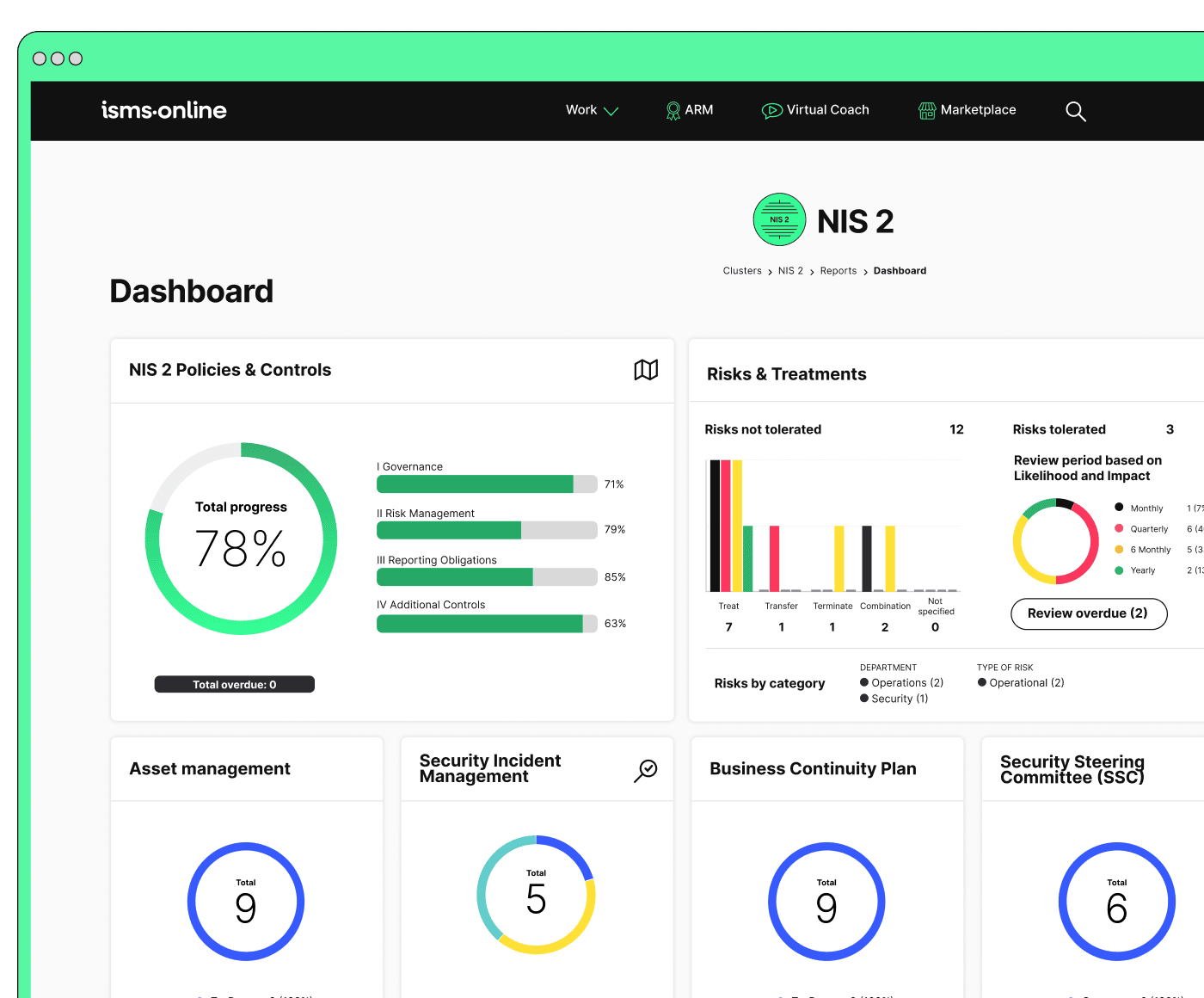
Be NIS 2-ready from day one
Launch with a proven workspace and templates – just tailor, assign, and go.
Can You Bring All Compliance Under One Roof? The Unified Compliance Loop
Fragmented compliance isn’t just inefficient-it’s inherently dangerous under NIS 2. Boards, management, regulators, and auditors now expect continuous, cross-discipline evidence that spans security, privacy, AI, and operational resilience. This demands a unified approach-one that provides real-time visibility and closes compliance loops before they become fines, delays, or missed contracts.
A unified dashboard for compliance isn’t a luxury. It’s your best risk defence and boardroom proof.
What Is the Unified Compliance Loop (UCL)?
The Unified Compliance Loop (UCL) is about systematising all compliance domains-security, privacy, AI governance-within a single, real-time platform. Controls, approval steps, risk registers, policy reviews, evidence libraries, and automated workflows all live together, tracked and mapped. The result: every team sees the same picture, and every board or regulator request is answered instantly, with proof-not just intent.
Imagine a platform view where ISO 27001 controls, NIS 2 obligations, and GDPR tasks cross-link, showing live status, pending actions, and management sign-off in one scan. Dashboards clarify overdue evidence, missing supplier attestations, or bottlenecked incident reports. Each compliance owner has a traceable, assigned task-no gaps, duplications, or missed logs.
Why This Matters
When compliance actions live in different systems, files, or teams, gaps multiply. Audit findings, non-conformities, and even board embarrassment follow. ISMS platforms designed around the UCL make friction disappear: procurement, risk, legal, and IT teams collaborate on shared deadlines, approvals, evidence, and escalations. No team hides issues, delays actions, or loses files to inboxes or disconnected spreadsheets.
Real-Time Proof-Not Annual Surprises
Modern audits demand evidence that is live, mapped, and role-linked-anything static is already out of date.
Mapped, time-stamped dashboards and logs double up as operational improvements. Board, regulator, or client can query risk status by supplier, process, or incident window-and know they will receive current proof, not aspirational statements.
Siloed Evidence = Siloed Failure
Where evidence lives in different places, teams, or disconnected platforms, risk increases and audit readiness stalls. Even the best-run team cannot maintain “living” compliance if evidence management is fragmented. UCL ensures that policy reviews, risk registers, supplier checks, and staff acknowledgements are versioned, assigned, and reconciled-before the auditor or board asks.
| Expectation | Operationalisation | ISO 27001 / Annex A Reference |
|---|---|---|
| Security, privacy, AI split | UCL with mapped controls/tasks/KPIs | ISO 27001 all, ISO 27701, 42001 |
| Manual compliance cycles | Automated evidence, assignment, alerts | Clause 9.2, 9.3, A.5, A.8 |
| Audit/adopted best practise | Dashboarded mapping and review cadence | ISO 27001 5.2, 9.1, SoA |
| Siloed evidence/failures | Continuous cross-domain review | NIS 2 Arts. 21–23, GDPR Art. 32–33 |
Boards and auditors are now “trained” to expect such integrated, living proof in every compliance conversation. Teams with a mapped compliance loop close deals and audits with confidence-and see operational risk reduced day by day.
Plugging the Evidence Gap: Why ISMS.online and Similar Platforms Now Dominate
The future of compliance belongs to organisations with “living” systems-centralising, time-stamping, and mapping every control, approval, risk, incident, and supplier log. The days of hurried evidence-collection, static compliance folders, and “audit panic” are ending.
Mapped evidence isn’t just audit defence. It’s a lever for trust, growth, and board-level confidence.
Turning Compliance into Operational Velocity
ISMS.online transforms compliance into a dynamic, operational function. Instead of scattered files, emails, and calendar reminders, your evidence trail is unified, digital, and instantly retrievable. The platform automates:
- Risk and incident registers: central, live updates with role/owner tracking and escalation proof
- Policy versioning and approval: every change recorded, versioned, and board-approved
- Supplier management: renewal triggers, risk scoring, escalation logs, attestation requests-all in one place
- Instant auditor exports: artefacts mapped to ISO 27001, NIS 2, GDPR, and sector frameworks, ready for board or regulator review (isms.online)
Mapping Across Domains and Frameworks
NIS 2, ISO, GDPR, and soon AI Act compliance requirements increasingly overlap. ISMS platforms allow you to map, cross-reference, and manage these from a single control set-cutting duplicated effort and surfacing live gaps before auditors or procurement find them. Audit logs, dashboards, and management review minutes span evidence domains-raising your lowest compliance ceiling.
| Trigger | Risk Update | Control / SoA Link | Evidence Logged |
|---|---|---|---|
| Vendor breach | Vendor risk | A.5.21, NIS 2 Art. 21 | Vendor comms, audit trail |
| Policy change | Compliance risk | A.5.4, 5.2, 9.3 | Versioned policy, approval |
| Onboarding new supplier | Supply chain risk | A.5.19–21 | Risk assessment, contract log |
| Incident | Service continuity | A.5.25–27, NIS 2 Art.23 | Incident log, closure docs |
Quantitative Impact
Companies report up to 70% less audit prep time and more than 50% fewer missed contract escalations after switching to living ISMS solutions (isms.online). Board members receive actionable dashboards-not last-minute spreadsheets. Recurring audit findings plummet and operational clarity rises.
Modern compliance is measurable. Every missed email, manual log, or silent vendor is a risk waiting to surface.
No More Manual Mistakes
Automated reminders and role-based workflows backstop human error. Scheduled reviews, escalation triggers, and instant exports replace forgetfulness or inbox chaos. Teams stay ahead of auditors and regulators not through brute effort, but through mapped trust and operational clarity.
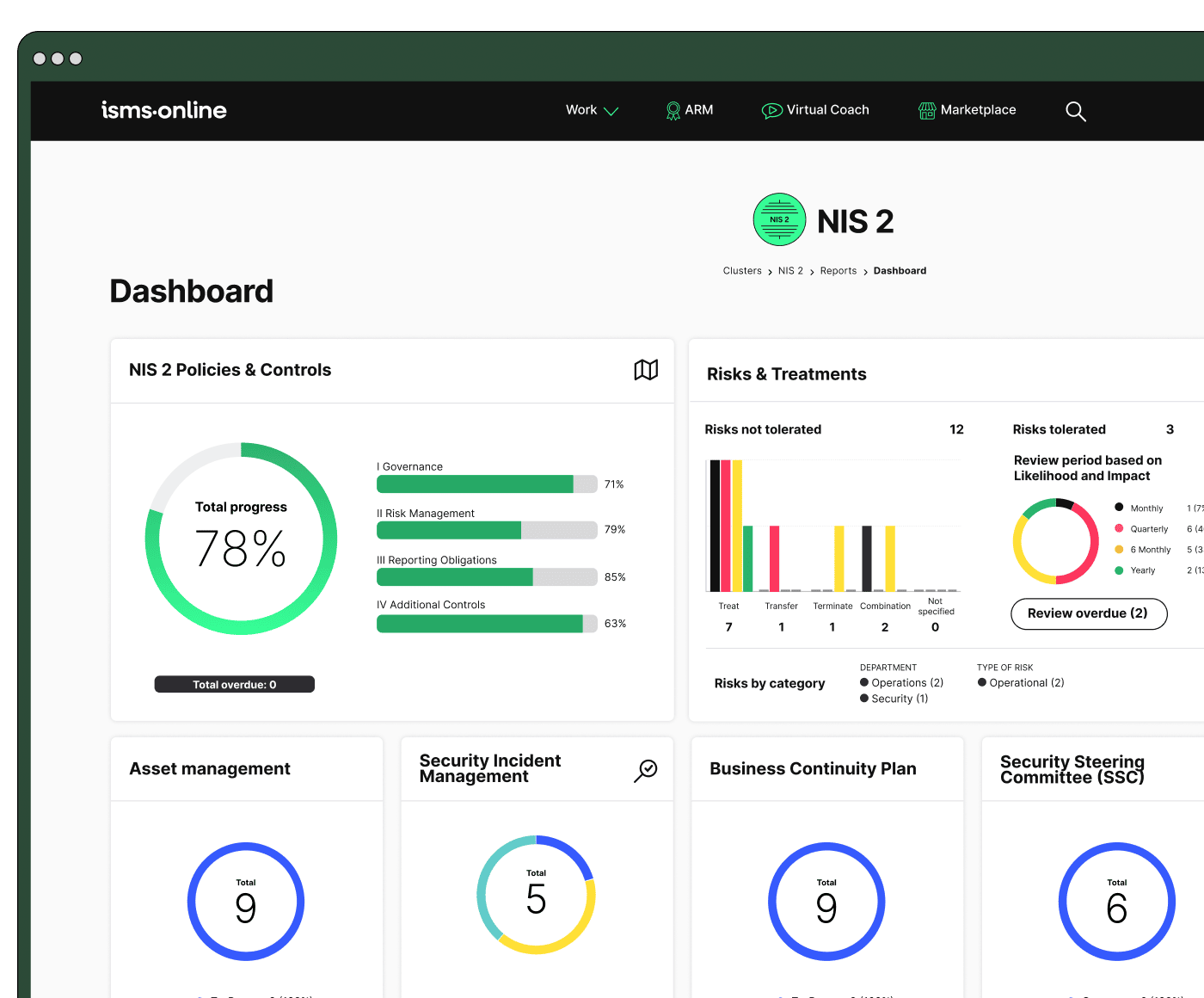
All your NIS 2, all in one place
From Articles 20–23 to audit plans – run and prove compliance, end-to-end.
Always-On Audit: Monitoring, Update, Improvement
Compliance can no longer be treated as an annual headache. Boards and regulators now require continuous evidence and improvement-ready to hand at any moment. This shift creates a distinct advantage for organisations using platforms that blend live dashboards, role-based workflows, automated alerts, and version-controlled evidence.
Audit panic fades when your system lives and breathes compliance every day.
Frequency: When Does Compliance Evidence Actually “Expire”?
- Annual reviews: remain necessary, but will not suffice. Incidents, regulatory change, and supply chain shifts force more frequent, real-time review.
- Trigger-based reviews: -after onboarding new vendors, known breaches, contract escalations, or staff changes-are now seen as non-negotiable.
Using a digital ISMS or compliance management system ensures evidence refresh cycles are mapped, tracked, and assigned. Every major compliance task, from management review to supplier attestation, is handled proactively.
Actionable, Board-Ready Evidence
- Digital policy trail: Policies/controls are versioned, reviewed, and approval-logged.
- Incident logs: Key events, notifications, containment actions, and closure reasons are all timestamped.
- Risk registers: Every update, remediation, and status is indexed to controls and mapped to process owners.
- Management review: Minutes, attendance, and action items auto-tracked with timestamps.
| Trigger | Risk update | Control / SoA link | Evidence logged |
|---|---|---|---|
| New vendor onboarding | Supplier chain | A.5.19–21, NIS 2 Art. 21–22 | Supplier risk log, contracts |
| Policy review/renewal | Compliance risk | Clause 9.3, A.5.4 | Versioned minutes, sign-off |
| Incident/breach | Service continuity | A.5.25, 5.29–30, Art. 23 | Incident log, board comms |
| Audit/management review | Board oversight | Clause 5.2, 9.2, 9.3 | Meeting notes, action closure |
Avoid the Outdated Evidence Trap
Forgetting to update or assign evidence isn’t just a compliance slip; it invites fines, failed audits, and boardroom stress (isms.online). Rely on platform-driven alerts to make timely review an operational habit, not a last-minute scramble.
Accountability: Transparency and Oversight
Live dashboards and audit logs allow boards, auditors, and managers to see not only what’s done, but also who is responsible, when, and how each obligation was met. This culture shift from “evidence on demand” to “evidence always-on” reduces ambiguity, improves readiness, and turns audits into opportunity.
The gold standard? Board, regulator, or auditor can see mapped, up-to-date evidence at any second-digitally, not as intent, but as living proof.
Give Your Organisation Proof, Clarity, and Confidence-See ISMS.online in Action
Demands for proof aren’t easing-they’re accelerating, and so is the complexity of showing compliance. Every moment wasted building evidence after the fact is a moment of risk, lost opportunity, and potential embarrassment to both board and operations. ISMS.online is designed for this reality: living, mapped, role-assigned evidence, always ready.
- Fast path to audit-pass: Template-driven, mapped processes mean your policies, registers, reports, and actions are NIS 2 ready from day one (isms.online).
- Ready for every change: Centralise evidence across risk, supplier, policy, incident, and staff records. Dashboards, alerts, and versioned approvals update as your ecosystem and regulation shifts.
- Operational clarity, no spreadsheets: End the chaos of disconnected files and recycling audit logs. Work from a boardroom dashboard where every requirement, due date, owner, and management review is a click away.
The difference between compliance anxiety and audit readiness is mapped, living proof-the kind only real platforms deliver.
NIS 2, ISO 27001, GDPR, and future standards are converging in demands and expectations. They don’t just ask for policies written, but for proof enacted-each requirement tracked, matched to controls and evidence, and instantly retrievable. Legacy practise is outpaced, but with ISMS.online, every audit, review, and procurement cycle becomes a moment of surety and progress-never panic.
Ready to bring clarity, control, and living proof to your NIS 2 compliance, and unify your security, privacy, and operational resilience in one platform?
Set a standard your board, regulators, and clients recognise. Power your compliance, prove your leadership-see ISMS.online in action.
Frequently Asked Questions
Who is actually in scope under NIS 2, and how do you confirm your organisation’s trigger points?
Nearly every medium or large company working in a regulated EU sector-energy, water, healthcare, finance, public administration, digital infrastructure, manufacturing, research, and more-now falls within NIS 2. But the definition is broader: if your firm delivers, supports, underpins, or supplies any links in the critical supply chain, you’re more likely “in scope” than out, regardless of whether you’re named directly. The most common triggers are having more than 50 employees or €10 million in turnover, but even smaller entities can be swept in if they provide essential tech, managed services, or infrastructure to bigger players. Your clients’ contracts and procurement requests increasingly contain NIS 2 language-look for references to “cyber-security due diligence” or mandatory supplier assessments. Fastest way to verify? Try the, scan any recent tender or RFP for governance sections mentioning NIS 2, and check your upstream and downstream dependencies for new compliance clauses. In today’s ecosystem, your place in the supply web is as important as your size or primary sector.
How do we identify scope before regulators or customers formally alert us?
Don’t wait for a letter-businesses often first discover obligations during a sales cycle, not from authorities. Cross-verify your scope:
- Review your service footprint and sector mapping with ENISA’s guidance tool.
- Audit all major supply and client contracts for new or unexpected “NIS 2” clauses.
- Monitor industry RFPs: many companies learn they’re in scope after being excluded from a tender for lack of a documented ISMS or incident response plan.
Proactive gap checks can mean the difference between a controlled onboarding and a panicked compliance rush.
You’re as in scope for NIS 2 as your clients, partners, or suppliers decide-if they must comply, so must their ecosystem.
What’s new about NIS 2 compared to just running an ISO 27001 ISMS?
Think of ISO 27001 as a strong foundation. NIS 2 overlays sharper, living requirements:
- Board accountability becomes direct and personal. Directors and executive management must actively oversee, sign, and sometimes prove engagement with cyber risk decisions-minutes and review records are needed as evidence, not just ticked-off approvals.
- The ISMS moves from periodic “point-in-time” to continual, digital evidence-rolling risk logs, incident registers, live supply chain assessments, and version-controlled policies.
- Supply chain controls are non-negotiable: every critical supplier must be risk-evaluated, contractually bound to reporting, and subject to audit.
- Incident reporting is now on a clock: “early warning” in 24 hours, detailed notification in 72, and closure with lessons learned in 1 month.
| Expectation | Operationalisation | ISO 27001 / Annex A Reference |
|---|---|---|
| Director oversight | Board minutes, digital sign-off | Clause 5.3, A5.4, A5.36 |
| Living audit evidence | Real-time logs, review history | Clause 9.2, 9.3, A5.31, A5.35 |
| Supplier controls | Contract clauses, registers | A5.19, A5.20, A8.30, A8.31 |
| Reporting deadlines | Escalation workflows | A5.25–A5.28 |
Letting your ISMS lapse into “annual paperwork” ignores living compliance expectations and risks personal fines for directors-make digital, ongoing review your new normal.
How does NIS 2 elevate supply chain and vendor management?
NIS 2 turns supplier cyber risk into a real-time compliance fixture, not an annual afterthought. Every new “important” or “essential” supplier must undergo documented risk evaluation before onboarding, with log evidence for contract clauses covering breach notification, audit rights, and escalation. Ongoing supply chain monitoring is enforced-incident logs, renewals, and breach notifications must be tied back to named vendors, not just high-level registers. Failure to monitor or respond makes your business directly responsible: the “first cascade point” is now always the regulated service, and the blame can ricochet upstream or down.
Best practise: Digitise your entire supply and vendor risk chain-embed supplier registers, contracts, and incident logs into a single, living compliance system to prove control at any moment.
A supplier’s cyber event is now your board’s regulatory headache. Continuous supply chain risk management is not optional; it’s your shield and audit passport.
What are the NIS 2 timelines for incident notification and the penalties for missing a deadline?
NIS 2 sets a strict incident playbook:
- Within 24 hours: Send an early warning (even if facts are incomplete) to your national CSIRT or competent authority.
- Within 72 hours: File a comprehensive notification with technical details, mitigation, and impact.
- Within 1 month: Deliver a closure and lessons-learned report with supporting evidence.
Penalties are formidable: fines up to €10 million or 2% of global turnover (for essential entities), and €7 million/1.4% for important entities. “Non-compliance” can trigger intrusive audits, injunctions, and-uniquely-named accountability for the company board or CISO.
| Triggered Event | Risk/Workflow Update | Control / SoA Ref. | Example Evidence Logged |
|---|---|---|---|
| Ransomware (detected) | Incident recorded, RCA | A5.25, A5.26, A5.27 | Escalation log, comms record |
| Supplier breach notice | Vendor risk update | A5.19, A8.30, A8.31 | Vendor notification, contract |
| Data leak / suspicion | Risk, root cause analysed | A5.28, A7.10, A8.14 | Investigation, board report |
The lesson: treat incident management as a recurring calendar discipline-not a panic-mode paperwork scramble.
How do you weave NIS 2, ISO 27001, GDPR, DORA, and AI Act into one seamless compliance process?
Smart compliance teams now integrate multiple frameworks into a single digital compliance loop. ISO 27001 provides baseline controls and processes; NIS 2 overlays board, supply chain, and rapid incident obligations; GDPR builds in privacy and data subject rights; DORA covers operational resilience; and the AI Act is adding controls for algorithmic accountability.
Instead of duplicating work, map all evidence, processes, and registers to multi-framework obligations: one policy review, supplier assessment, or audit trail can now tick boxes for several legal requirements.
With a digital ISMS or compliance dashboard, you:
- See risk, asset, and incident updates propagate across every linked framework;
- Track staff, supplier, and board engagement in one place-no “rework” after each audit;
- Export mapped evidence bundles tailored to auditors, clients, or regulators;
- Keep readiness high even as new laws come online.
The result: lower costs, faster audit turnarounds, fewer compliance surprises, and a reputation for readiness when regulators or clients call.
Integrated compliance isn’t a bonus-it’s the only way to keep up as regulators and major clients demand live, mapped evidence across all domains.
Why is a digital ISMS (like ISMS.online) now critical for NIS 2-and beyond?
NIS 2, GDPR, and kindred frameworks have set a new bar: continuous, digitally tracked governance. A digital ISMS platform like ISMS.online provides:
- Automatic evidence trails: Every policy change, incident, or board action is timestamped, versioned, and mapped to obligations. Ready for spot checks, tenders, or client audits at any time.
- Templates and workflows: Sector-specific controls, instant audit exports, and automated reminders prevent missed contract or regulatory deadlines.
- Real-time supply chain view: Vendor registers, incident escalations, and risk assessments are always up to date-no “blind spots” between reviews.
- Board and staff engagement: Personalised dashboards keep every player (from the boardroom to technical teams) updated and compliant.
Compliance readiness is achieved and proven in the daily rhythm, not at deadline panic.
When your evidence, assurances, and supply chain data are just one click away, you not only satisfy regulators-you win more contracts, avoid penalties, and strengthen trust with every stakeholder.
What does a robust living NIS 2 compliance cycle look like in practise?
Picture a dynamic system: every board meeting, risk log update, supplier check, and incident response is documented with a versioned record, all connected in a digital platform.
- Scheduled reviews: combine with real-time event triggers: overdue reminders, incident alerts, or policy expiry workflows bring risk and compliance to the surface before an auditor (or regulator) ever does.
- Evidence closes the loop: Every register, workflow, and document is ready for instant review, so your management and board can intervene-proactively, not reactively.
- Reputational advantage: Authorities and auditors favour organisations that can demonstrate “living compliance”-no more lost work, spreadsheets, or policy black holes.
Your next audit, breach, or procurement process becomes a moment to prove resilience-not a race against the clock.
Ready to shift from periodic reviews to living compliance?
ISMS.online unifies your NIS 2, ISO 27001, GDPR, and DORA evidence-digitally, in one living platform. Cut audit prep by up to 70%, automate reminders for every critical deadline, and prove board and vendor compliance with mapped evidence tailored to every challenge. See how ISMS.online’s living ISMS works or download your sector’s NIS 2 checklist.






