





































How Do the NIS 2 Reporting Deadlines Function-And Why Do They Matter to Your Organisation?
Every moment after a cyber incident is discovered, the NIS 2 Directive’s countdown quietly starts ticking against your business. If your company falls under the “essential” or “important” entity definitions (most firms with over 50 employees, €10m+ turnover, or operating critical/digital services in the EU), you’re now unwinding a legally binding, three-step reporting sequence: initial alert within 24 hours, a substantive update at 72 hours, and a comprehensive final report inside 30 days. Missing these windows is far more than a paperwork slip-it risks fines, customer trust, and the very deals your teams work to win.
The clock always begins before you're ready; waiting for certainty only loses the initiative.
Many leaders underestimate the sweep of the NIS 2 clock. It doesn’t matter if your team is ironclad with ISO 27001, SOC 2, or GDPR compliance-NIS 2 overlays these, and sets the tightest incident disclosure schedule in European legal history. Your obligations don’t ask whether you feel ready; they demand evidence the moment you know, or ought to have known, a cyber incident may compromise supply, service, confidentiality, or operational uptime. This includes everything from a ransomware attack to a critical SaaS vendor’s outage.
What’s at stake? Beyond regulatory consequences, clients and insurers now treat reporting discipline as a trust litmus-and missing a deadline invites reputational fallout, audits, and even vendor disqualification.
What Are the Exact NIS 2 Incident Reporting Deadlines and Deliverables?
Understanding the cadence of “24h, 72h, 30d” is not enough. Each clock tick demands a different type of evidence-from raw notification, through rolling facts, to full transparency and closure. Here’s your birds-eye table:
| Reporting Window | Required Submission | ISMS.online Automation Feature |
|---|---|---|
| **24h Early Warning** | Fact-based incident alert | Timestamped event log, auto-notify to CSIRT |
| **72h Notification** | Detailed technical & response update | Structured, role-based submission builder |
| **30d Final Report** | Root-cause closure, evidence, board review | Managed action log, executive signoff |
Who monitors these?
You’ll typically file with your national CSIRT (Computer Security Incident Response Team), and-if in a regulated sector-your sector’s supervisory authority. Forgetting a step, or sending a vague “update in progress,” is a common misstep that can trigger regulatory follow-up or audit.
The real risk isn't failing to spot the breach-it's failing to spot the countdown.
Confusion often erupts where NIS 2 overlaps with GDPR (also 72h) or sector-specific regulations like DORA or NIS 2’s own stricter reporting for finance/health/energy. Smart organisations pick the tightest clock and over-report-all submissions must be timestamped and owned (gdpr.eu; cliffordchance.com).

Master NIS 2 without spreadsheet chaos
Centralise risk, incidents, suppliers, and evidence in one clean platform.
When Does the NIS 2 Clock Start-and What Triggers the 24-Hour Early Warning?
You don’t wait for final forensic confirmation or internal debate before the timer starts. Your 24-hour window opens the moment you believe, or ought reasonably to believe, a cyber event may jeopardise operations, data, or supply chain, regardless of impact certainty. This “potential-impact” threshold is intentionally broad because the goal is to help authorities spot systemic threats, not just “finished” breaches.
Triggers include:
- Severe service outages (including third-party cloud/SaaS failures, not only direct attacks).
- Malware outbreaks, ransomware (even if still “spreading”).
- Data loss or corruption, especially if it threatens critical systems.
- Any supply chain service interruption that could propagate risk.
Your 24-hour alert must contain:
- Incident outline (what is known, timestamped).
- Impact scope (potential reach, not just what’s confirmed).
- Steps taken (even “isolation pending further analysis” counts).
- Declaration of further investigation, if status is provisional.
Reporting pathways:
- National CSIRT, with escalation to sector regulators if relevant.
- For entities with cross-border impact, engage Single Point of Contact for the EU.
A well-handled 24-hour warning demonstrates discipline, not panic. If the report is late, always add a rationale (system outage, delayed detection, etc.). ISMS.online’s platform automates time-stamping and escalation, making your evidence trail defensible by default.
What Does a 72-Hour NIS 2 Incident Notification Actually Require?
Seventy-two hours isn’t just a due date-it’s your first substantive test. The regulator wants demonstrable effort and evolving clarity, not perfection. It’s a showcase of traceable action, management discipline, and cross-team coordination.
Seventy-two hours is about traceability-it's the effort, not the instant answer, that proves resilience.
Core deliverables for the 72h report
- Timelined description: “How it began, how it developed.”
- Impact status: Affected assets, systems/users, likely risk to supply/customer operations.
- Pathway discovery: Entry method, exploited vulnerabilities, and root cause hypotheses.
- Actions to date: All technical, administrative, and stakeholder steps, with timestamps and responsible actors.
- Unresolved issues and next steps (no shame in “still investigating”).
Make explicit what is provisional. Never issue a generic, fluffy report-document owner, current facts, pending analysis. Assign a named contact, and never hide behind group aliases.
ISMS.online workflows structure submission windows, log each piece of evidence and review, and make all content audit-exportable. Each version edit or update is automatically attributed-a regulator’s blueprint for confidence.
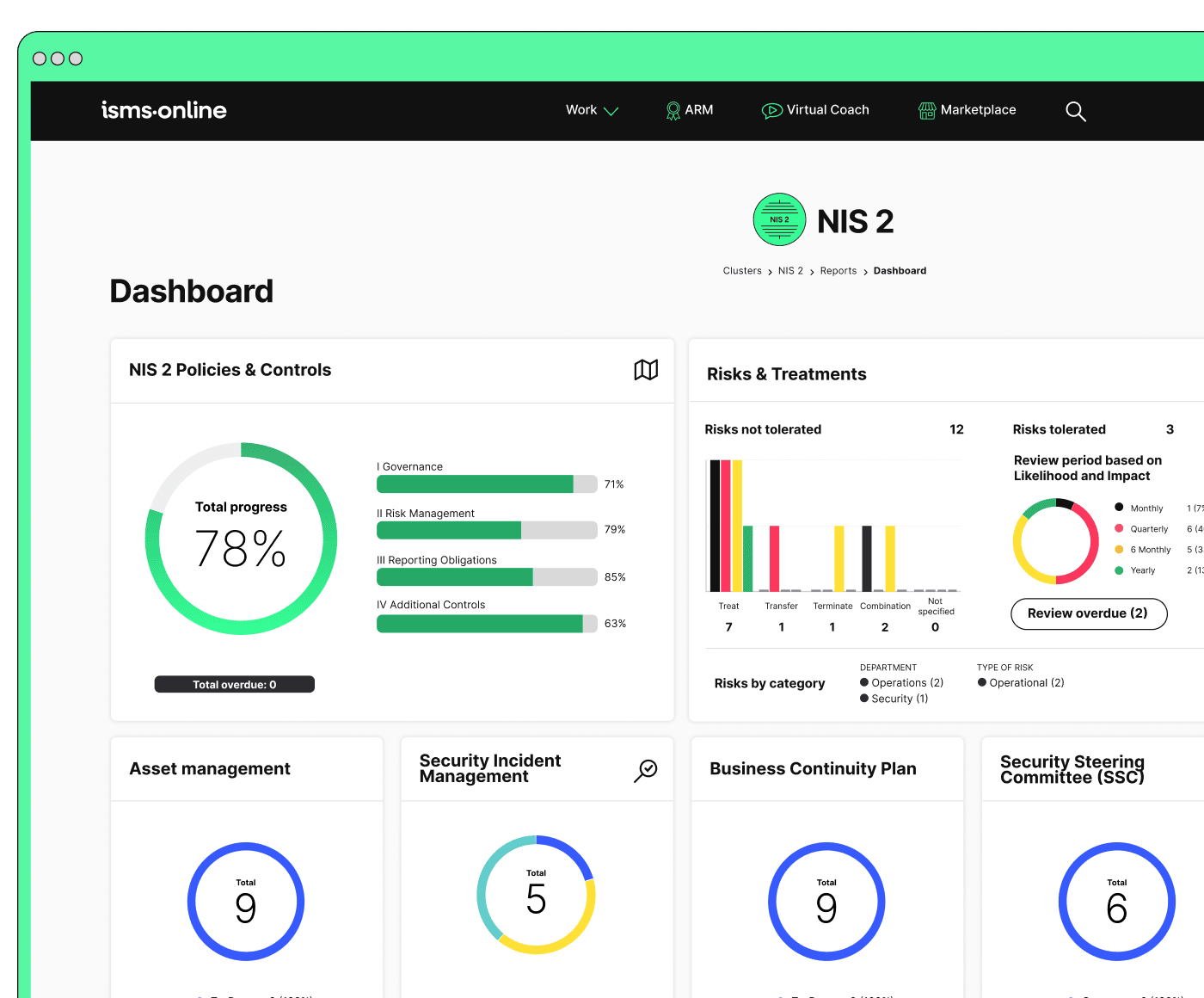
Be NIS 2-ready from day one
Launch with a proven workspace and templates – just tailor, assign, and go.
How Does the 30-Day Closure Report Deliver Full Transparency and Trust?
By the 30-day mark, the “what happened, who owned what, how did we fix it” narrative must be complete and signed off at a senior level (often by board/management).
Transparency in the closure report doesn't just meet legal duty-it builds future insurance and regulatory trust.
Key inclusions in the 30-day closure:
- Root cause: Was it patching, supplier failure, human error, or policy gap?
- Full action log: Who detected, who responded, what was the remediation chain? Every intervention and decision logged with names and dates.
- Fixes and improvements: Show what you changed-technical, human, process, governance.
- Senior signoff: Evidence of board-level review and “tone from the top.”
- Open issues: What (if anything) remains unresolved, and when/do you expect final remediation?
Bonus: Many insurers now require these logs for claims assessment. The same dataset you file with regulators serves as your evidence of “duty of care” when negotiating coverage.
If the closure can’t be finalised within 30 days, a further update is due-never leave a black hole in the record.
ISMS.online enables full export of your logs and submissions as PDF/CSV or evidence bundles for both regulators and insurers.
What Happens Across Borders and Frameworks-Managing Multi-Jurisdiction Reporting?
Incidents straddle borders, cloud platforms, and frameworks: the new normal means CISO and privacy/legal functions are fielding NIS 2, GDPR, DORA, and sector-specific rules simultaneously. Timelines may conflict; authorities sometimes disagree. The only fail-safe approach is to adopt the tightest reporting requirement available.
Race to the strictest deadline and let provenance be your defence-never the gap.
How to manage cross-framework reporting:
- Build a single, timestamped workflow for every notification-ISMS.online automatically logs all user actions and submission times.
- Use a single “evidence ledger” for all frameworks: one update, many reports.
- Structure reporting so each stage can be exported and reused for NIS 2, GDPR, etc.-minimising admin chaos and error.
Iterate openly: regulators expect evolving facts, not instant accuracy. Every update is your proof of intent, not a confession of failure.
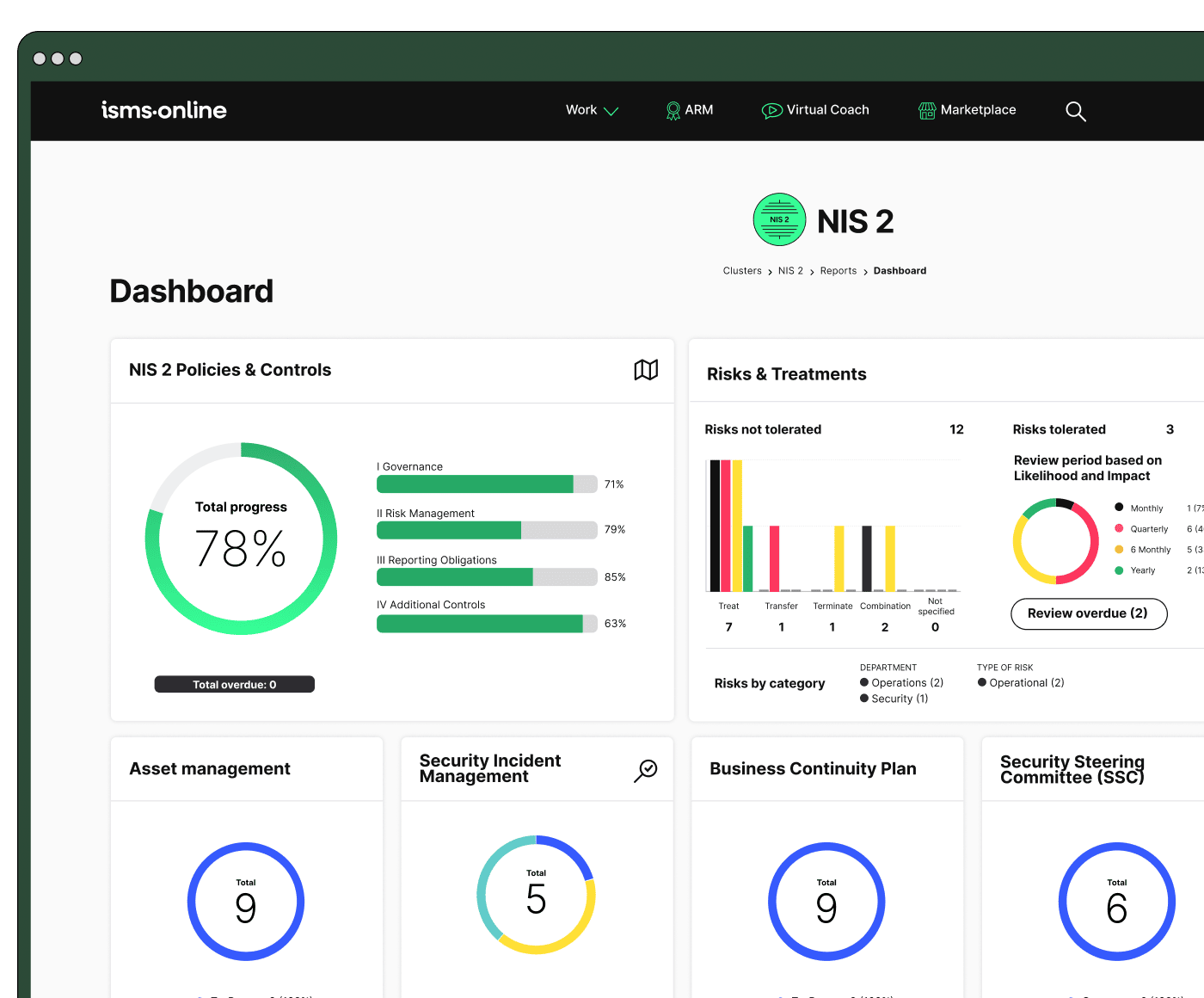
All your NIS 2, all in one place
From Articles 20–23 to audit plans – run and prove compliance, end-to-end.
How Does ISMS.online Enable Living, Audit-Ready Evidence and Board-Level Confidence?
Gone is the era where compliance meant static records. Modern regulators and insurers demand a “living ledger” for every incident. This isn’t just a reporting tool; it’s your continuous audit trail-who decided, intervened, signed off, updated, reviewed, exported, and when.
The difference between reported and resilient is the evidence chain you can show under pressure.
How to build your evidence ledger
- Event logging: Every detection, remediation, and closure-timestamped, role-tagged, and exportable.
- Ownership clarity: No generic “security team”; all actions trace to individuals.
- Evidence bundles: Prepare regulator/board/insurer PDFs, CSVs, and live dashboards on demand.
- ISO 27001 mapping: Directly cross-link incidents with your Statement of Applicability (SoA) and controls registry.
- Board & Management review: Encode learning and close the loop; Board sign-off ensures “tone from the top.”
Traceability Example Table
| Trigger Event | Register Note | ISO 27001 Control | Evidence Example |
|---|---|---|---|
| Ransomware detected | “3pm SIEM alert – entry created” | A.5.24 Incident mgmt | CSIRT log, SIEM alert, email |
| Supplier breach escalated | “Vendor escalation: X Ltd; legal loop in” | A.5.26 Supplier mgmt | Vendor correspondence, minutes |
| Cloud outage | “API failure, services restarted” | A.8.20 Network sec | API logs, error timeline |
| Regulator notification | “Escalation to authorities-update sent” | A.5.35 Audit/review | Submission, acknowledgment |
How Do ISO 27001 and NIS 2 Reporting Chains Reinforce Each Other?
ISO 27001-certified organisations will find themselves at a considerable advantage: NIS 2 reporting mechanisms are embedded within your core management system, converting one compliance challenge into a catalyst for trust-building and competitive advantage.
| Expectation | Operationalisation in ISMS.online | ISO 27001 / Annex A Reference |
|---|---|---|
| 24h Early Warning | Event + trigger auto-logged, notif sent | A.5.24 (Incident mgmt); 7.4 (report) |
| 72h Detailed Report | Action plan, evidence, update trail | A.5.26 (Incident response) |
| 30d Closure Report | Full log, signed-off review, SoA link | A.5.35 (Audit/review); 6.1.2 (risk) |
Redundancy is replaced by alignment: each NIS 2 deadline is an opportunity to reinforce core ISMS controls, test readiness, and automate trust with both your Board and authorities.
Resilience means more than passing checks-it creates a living chain of trust across every compliance event.
What’s Next-From Compliance Scramble to Resilience Leadership?
Treat every 24h, 72h, and 30d clock tick not as a regulatory scramble, but as a leadership opportunity: to show operational maturity, close trust gaps, prove diligence to both board and authorities, and strengthen client confidence.
Use today’s reporting pressure to sharpen tomorrow’s resilience.
ISMS.online automates every deadline and evidence trail, mapping every action directly into your ISMS and audit readiness process-no more last-minute chaos or evidence gaps. CISOs, legal officers, and practitioners can finally break the pattern of manual compliance firefighting-instead, they’ll demonstrate control, transparency, and improvement at every turn.
Identity is built not by “just complying,” but by learning and leading every time pressure mounts. If you’re ready to make every incident an asset for trust, board credibility, and resilience, [see a guided walkthrough of ISMS.online’s workflow] or [download the NIS 2 incident checklist] now.
Frequently Asked Questions
Why does NIS 2 require 24h, 72h, and 30-day incident reporting, and what risks or advantages does this create for your organisation?
NIS 2’s rigid deadlines-24-hour early warning, 72-hour progression report, and 30-day closure-are designed to shake organisations out of reactive silence, forcing operational discipline and transparency from the moment a major incident is suspected. If you’re in energy, SaaS, finance, healthcare, logistics, or digital infrastructure with over 50 employees or €10M turnover, these rules are not distant theory: they define the timeline for your regulatory fate. The stepwise process is more than compliance-it’s a reputational test. Responding fast reassures regulators and your board, turning chaos into a showcase of maturity. Missing these windows signals weakness, triggers audits, can prompt public notices, and even drive fines at a scale that could endanger your business (Sorainen 2023).
How you handle the first few hours after a breach defines how everyone-regulators, customers, your board-sees your credibility.
Treat these mandates as a strategic lever. Timely reporting signals trustworthiness, essential for modern insurance, deals, and executive accountability. Hesitation, by contrast, opens not only wallets for regulatory fines but doors for scepticism from clients and investors. With ISMS.online, compliance shifts from burden to routine-automating every deadline and leaving a full audit trail, so your team operates with defence and confidence.
How do the 24h, 72h, and 30d reporting deadlines work from first suspicion to post-mortem?
The timer starts the moment your team suspects a material incident-ransomware, a prolonged outage, or a data breach.
24-hour early warning:
You must file a preliminary incident alert to your CSIRT (Computer Security Incident Response Team) and, if applicable, sector supervisor. This is for situational awareness: state what happened, when, potential impact, and your first response-detail is less important than speed (Timelex 2024).
72-hour follow-up:
Within three days, provide a detailed update: cause, actions taken, systems affected, and ongoing mitigation. At this stage, your case will be under regulatory review. In systems like ISMS.online, every input is linked back to ownership, technical logs, and structured for audit-reducing gaps and rework (ENISA 2023).
30-day closure:
No later than a month, submit a root-cause closure: full analysis, board-level review, all documents and lessons learned. This audit-grade report becomes the backbone of your defence for insurance, contracts, and future audits.
NIS 2 Reporting Steps at a Glance
| Deadline | Trigger | File/Action Required | ISMS.online Role |
|---|---|---|---|
| 24h Warning | Suspected significant incident | Incident outline, first facts, response kickoff | Deadline alert; rapid filing |
| 72h Notification | Ongoing/major confirmed | Detail, impact, risk, active mitigation, evidence | Owner-tracked submission; logs |
| 30d Closure | Investigation complete/lessons learned | Root cause; board sign-off; audit/contract closure | Export bundle; evidence dashboard |
Which incidents trigger NIS 2 reporting, and how do you assign responsibility for each phase?
Trigger events include:
- Cyberattacks, ransomware, system outages, or supply chain failures causing or risking significant disruption.
- Operational technology (OT) events, not just traditional IT breaches.
- Any “near miss” with high regulatory or financial stakes (Kennedys 2025).
Responsibility map:
- Compliance/Operations: Files the initial incident and manages stakeholder updates.
- IT/Security: Provides technical details, forensics, and recovery verification.
- Legal/Privacy: Determines overlaps with GDPR or DORA, guiding which law’s deadline is “hardest.”
- CISO/Board: Signs off the 30-day investigation, ensures end-to-end defensibility for regulators and insurers.
When multiple regimes (NIS 2, GDPR, DORA) may apply, always default to the quickest, most rigorous reporting standard. Document every step; ISMS.online directly maps incident filings across all frameworks-so you file once, never twice.
What are the consequences of missing reporting deadlines, or of submitting late or incomplete evidence?
Delayed, incomplete, or missed reports trigger harsh penalties:
- Fines: Up to €10M or 2% of global turnover for “essential” entities; €7M or 1.4% for others. New, well-funded regulatory teams are making enforcement a regular reality.
- Regulatory audit: Missed deadlines prompt deep-dive investigations, demand rapid evidence, and can lead to public notification to customers, partners, and supply chain.
- Contract and insurance fallout: Breaching deadlines may void cyber insurance, spark customer clawbacks, or sour key relationships.
- Individual exposure: Boards and executives risk being named-and without a documented trail, any explanation for a missed deadline is hard to defend (Clifford Chance 2024).
To protect your leadership, every delay decision should be logged with timing, sign-off, and rationale. ISMS.online enables interim rationales, so you’re never exposed to “he said, she said” after the fact.
How does ISMS.online enable NIS 2 compliance, audit traceability, and ISO 27001 alignment in practise?
ISMS.online captures every action, update, and decision with immutable, timestamped audit trails-giving you instant regulatory and board-grade evidence. Each incident can be mapped against NIS 2, GDPR, and sector requirements in a single record, with no double-handling.
Features include:
- Automated workflow: Built-in deadlines, role-based assignments, and progress trackers eliminate ambiguity.
- Exportable evidence packs: All logs, correspondence, sign-off, and review artefacts auto-bundled for audits, insurance, or contracts.
- Direct ISO 27001 mapping: Every field and action links to controls such as incident response (A.5.24), logging (A.8.15/8.16), and management reviews (A.9.3).
- Board-ready dashboard: See who owns each step, which deadline is pending, and how each requirement connects to the Statement of Applicability (SoA).
ISO 27001 to NIS 2 Bridge Table
| Expectation | How You Deliver | ISO 27001/Annex A Reference |
|---|---|---|
| 24h notification | Automated templates, deadline alerts | 5.24, 8.7, 9.2 |
| 72h/30d sign-off | Workflow with board sign-off | 9.3, A.5.24 |
| Evidence trail, logging | Audit-ready logging, export bundles | 8.15, 8.16 |
| Audit defensibility | Cross-linked to SoA, direct mapping | 9.2, 9.3, Annex A |
Traceability Examples
| Incident Trigger | Risk Update | Control/SoA Link | Logged Evidence |
|---|---|---|---|
| Ransomware | Containment started | A.5.24 | SIEM logs, incident notes |
| Cloud service outage | Incident + authority notice | A.8.20 | API logs, notification logs |
| Vendor breach | Authority + customer alert | A.5.19, A.5.26 | Supplier comms, report bundle |
Can these NIS 2 reporting deadlines become strategic opportunities for your organisation?
Treating NIS 2 deadlines as a lever for operational trust-not mere regulatory burden-changes the risk landscape. Organisations that demonstrate control with timely, well-logged reporting become more attractive to customers, partners, insurers, and boards. Faster incident response translates directly into resilience capital, while competitors still scrambling will face rising regulatory and reputational costs.
- Speed breeds credibility: Consistent, on-time incident filing signals maturity and readiness in audits, procurement, and C-suite reporting.
- Audit trails reduce stress: With all evidence mapped and export-ready, passing scrutiny from regulators or external partners becomes routine.
- Future frameworks, one system: Building processes on platforms like ISMS.online readies your business for new regimes (AI governance, supply chain security, data privacy)-no re-tooling, no catch-up cycles.
Every incident is a test of your organisation’s operational culture-fail to report, and you forfeit trust; meet the deadline, and you prove your strength.
Is your team ready to turn NIS 2 stress into board-level advantage? With ISMS.online, you centralise incident management, automate every audit milestone, and position your organisation as a leader-not a follower-in resilience and cyber trust.






