





































Does NIS 2 Cross-Border Reporting Ever Allow for One Filing-Or Must You Report Separately in Every EU Country You Touch?
An organisation that operates across the EU can’t treat NIS 2 incident notification like a simple, single submission. Every Member State maintains its own regulatory perimeter: if a disruption impacts people, systems, or data in more than one country, you are obligated to report to each and every national authority that governs affected operations. Centralised, group-level incident management does not translate to “group-level reporting”-in fact, assuming so is one of the most common-and consequential-compliance missteps.
One overlooked jurisdiction can expose every part of the group to scrutiny, penalties, and reputational harm.
This expectation is not a detail hidden in footnotes; it frames Member State implementation and is reinforced by ENISA guidance and law firm analyses (ENISA, ΣG; Kennedys, ΣA). When a breach, ransomware campaign, or service disruption crosses borders, incident notification must be filed with the designated authority in every impacted Member State, using that country’s required form, language, and contact details (CMS LawNow, ΣO).
Why Local Filing Always Wins Over “Group Coverage”
If your operations model uses subsidiaries, local legal entities, or branch structures, NIS 2 places notification accountability on each entity. National regulators do not recognise “copy-paste” filings-CCing a single notification template across multiple countries will not meet audit standards (Mondaq, ΣX). Instead, each local filing must reflect: country-specific fact patterns, local risk exposure, and the direct remit of the national regulator.
Example: When One Incident Multiplies Into a Reporting Cascade
Picture a SaaS provider operating from Dublin, with branches in Paris, Milan, and Warsaw. A ransomware incident disrupts services for users in all three countries. NIS 2 expects: one notification to Irelands NSAI, one to ANSSI in France, one to Italys ACN, and one to Polands NASK. Miss one, and group-level compliance and reputation can unravel-especially as authorities cross-check public notifications and sector alerts.
Book a demoWhat Deadlines, Formats, and Content Rules Shape Multi-Jurisdictional Incident Notifications?
NIS 2 stipulates a universal tempo that must be respected by all regulated groups: headline notification within 24 hours, detailed technical report by 72 hours, and closure update at one month (ENISA, ΣG). However, these deadlines are a floor, not a ceiling-each Member State bolsters the base regime with its own language, template, and, at times, stricter reporting windows.
A submission that is delayed, missing, or incomplete in even one country can jeopardise your group’s entire compliance posture.
Filing needs to be proactive and precisely tailored. For instance, Germany’s BSI mandates local technical logs with every major report; France’s ANSSI requests an early summary of affected individuals; the Netherlands may emphasise penetration test or risk assessment evidence. Most crucially, all filings must be in the national language using the current Member State template-often available only as a PDF or bespoke portal upload (BlazeInfosec, ΣO).
The Trap of Centralization: How Manual Coordination Fails
National regulators continuously evolve templates, adjust reporting portals, and may demand specific local evidence (e.g., staff certifications, audit logs, or supply chain disclosures). Attempting to track these manually across borders significantly expands the risk of missed deadlines when an incident occurs-especially during a real crisis with translation and update lags. High-performing teams therefore build automations that monitor each Member State’s templates, track all version changes, and provide compliance teams with real-time alerts for deadlines and format adjustments (ISMS.online, ΣR).
Rapid-Reference Table: Key Country Notification Demands
A country-by-country reference grid is essential for any group compliance lead. For illustration:
| Country | Initial Deadline | Detailed Report | Language | Template ID |
|---|---|---|---|---|
| Germany | 24h | 72h | German | BSI NIS2 v1.2 |
| France | 24h | 72h | French | ANSSI NIS2-2024 |
| Ireland | 24h | 48h | English | NSAI NIS2-v3 |
Having a compliance calendar that auto-refreshes as these change is not a luxury-it’s a frontline defence. Every regulated territory and entity within your group needs this matrix available at all times; absent it, notification risk increases as incidents compound.
Practitioner & Legal/Privacy Lens: Why Template and Deadline Automation Pays Off
Security practitioners and Heads of Privacy benefit directly from automating template tracking and deadline-alerting: it reduces human risk, accelerates response time, eases translation challenges, and ensures evidentiary completeness under scrutiny. Regulators are more likely to scrutinise organisations that treat notification as a manual afterthought.

Master NIS 2 without spreadsheet chaos
Centralise risk, incidents, suppliers, and evidence in one clean platform.
Is There a “Lead Authority” or One-Stop-Shop for Multi-Jurisdiction NIS 2 Filings-as in GDPR?
No: NIS 2 abandons GDPR’s ‘lead authority’ model. Each regulated entity is responsible for notification in all national jurisdictions touched by the incident-irrespective of where group headquarters sit or where your DPO operates (Mondaq, ΣX). Attempting to file only with a “home” authority-even with a GDPR rationale-is a fundamental compliance error under NIS 2.
You can’t forward your GDPR breach workflow and expect it to satisfy NIS 2; the old one-stop-shop vanished on 17 October 2024.
Incident notification thus requires parallel reporting in every impacted Member State. None of the ENISA guidelines, regulatory portals, or reporting hotlines replace this: national authorities expect reports to be initiated from every entity registered or operating locally. A “group-wide” filing can supplement this, but never replaces it.
Table: Centralization Comparison-GDPR vs. NIS 2
| System | Lead Hub? | Single Portal? | Each Country Notified? | Law Reference |
|---|---|---|---|---|
| GDPR | Yes | Yes | No (lead applies) | GDPR Art. 56–58 |
| NIS 2 | No | No | Yes (per entity) | NIS 2 Art. 26–27, ENISA |
For legal, privacy, and security teams, this means: expect a much heavier operational burden in a cross-border incident, allocate local resources, and rehearse multi-jurisdiction flows before you face a live event.
How Do National Authorities, ENISA, and CSIRTs Coordinate-and Where Does Your Duty Truly Lie?
While ENISA promotes harmonisation and publishes templates, your duty is always to the local Member State authority first-using their forms, portals, and deadlines (ENISA, ΣG). European-level bodies provide structure and guidelines; national regulators wield enforcement, audit, and penalty power.
Best practise does not replace local obligation-and regulators audit for local evidence, not pan-EU intent.
CSIRTs (Computer Security Incident Response Teams) operate in unison for systemic or catastrophic threats, but notification, compliance, and post-incident reporting are still executed by the nationally registered entity. If an incident triggers multiple countries, you must coordinate internal escalation (often at group CISO or Risk Committee level) but file individually everywhere your contractual or operational presence exists.
Board-Level and Legal Coordination: Why Country-by-Country Evidence Chains Are Non-Negotiable
Group compliance teams are invaluable in orchestrating simulation, training, and risk mapping, but they cannot file or defend local notifications without delegation from the actual legal entity. Every notification, template submission, translation, and authority response must be logged in local lines of evidence-indexed per country-for regulator inspection and for pre-empting any accusations of neglect or avoidance.
Traceability Table: Building an Audit-Ready Evidence Chain
| Trigger | Risk Registered | Annex/Clause Link | Evidence Logged |
|---|---|---|---|
| Multi-country event | Risk register | NIS 2 Art. 26; ISO A.5.24 | Submission receipts, authority emails |
| Template version | Compliance Ctrl | ISO 27001 A.5.31 | Versioned template logs |
| Missed timeline | Audit register | ISO 27001 A.5.36 | Regulator correspondence, penalties |
Every step needs to be treated as a country-specific control and source of evidence, not “group-reported.”
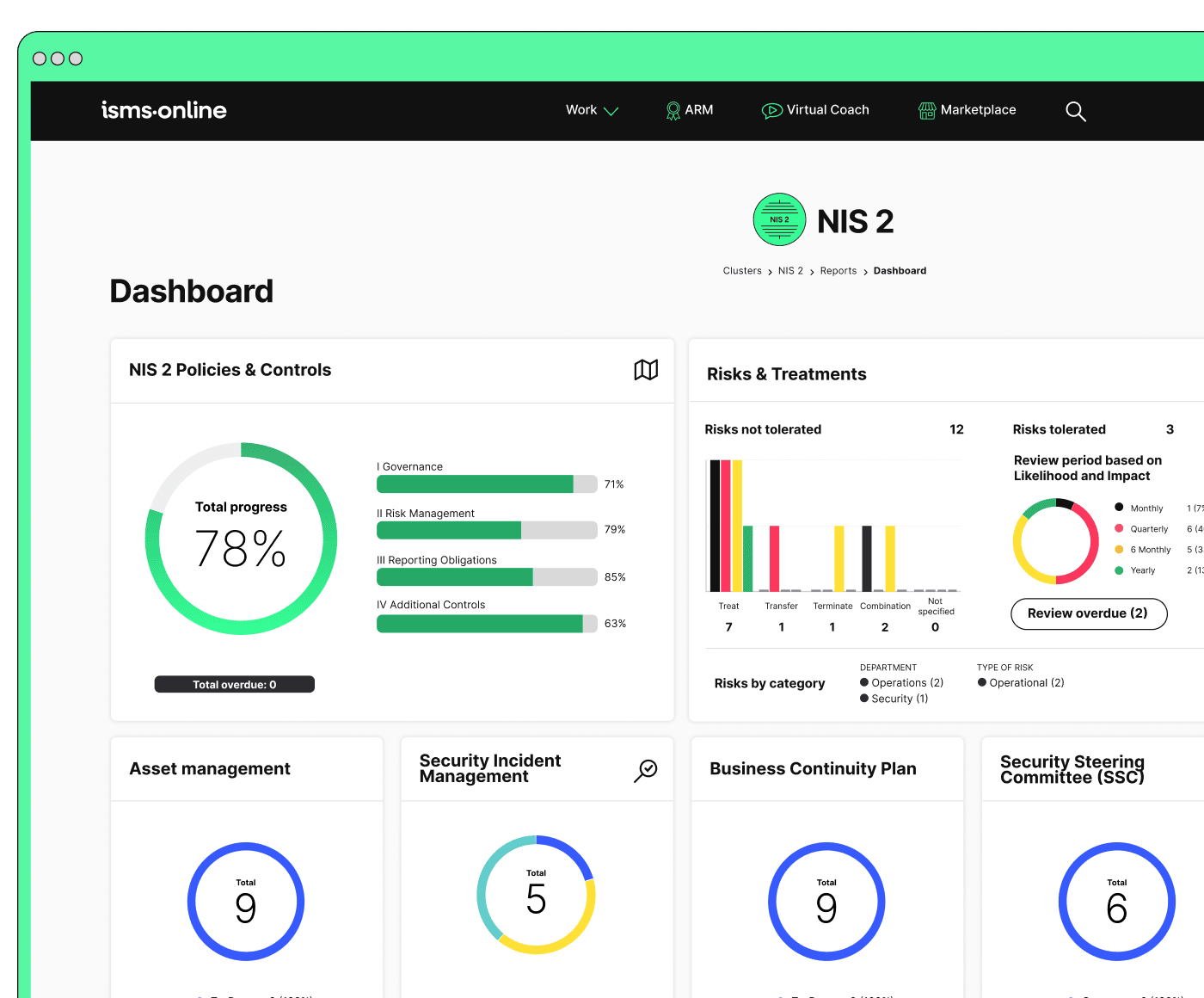
Be NIS 2-ready from day one
Launch with a proven workspace and templates – just tailor, assign, and go.
When an Incident Actually Strikes, What Are the Real Steps to Cross-Border Compliance?
When a ransomware or severe outage unfolds, each relevant Member State’s process must be initiated-in their language, by their rules, inside their window (BSI, ΣO). Germany and France won’t accept an English report; Ireland expects format compliance and “within 48–72 hour” windows, not 73. “CCed” reports do not meet evidence thresholds; only direct submissions count.
Every hour missed, every country skipped, raises audit flags and exposure.
Time difference, translation errors, and parallel deadlines intensify under pressure. Field-proven ISMS platforms should allow you to maintain a log of every step-timed submissions, authority replies, closure confirmations-indexed by territory. A simple error in sequencing or omission of just one Member State can result in double-digit penalty percentages of revenue (CMS LawNow, ΣA).
Real-World Tracking Table: Multi-National Incident Response
| Country | Required Template | Timelines | Language | Audit Evidence |
|---|---|---|---|---|
| Germany | BSI 2024 | 24h/72h/1 month | German | Portal receipt, log |
| France | ANSSI NIS2-2024 | 24h/72h/1 month | French | Submission, authority reply |
| Ireland | NSAI NIS2-v3 | 24h/48h/1 month | English | Email log, audit trail archive |
Practitioner/Legal Note: Cross-link every local report to a unique incident number and keep an indexed log for each entity-this is your audit shield.
Penalties for a Single Miss: Legal, Financial, and Operational Implications
A single missed notification in one country exposes the company-not just to local fines but pan-EU enforcement: penalties escalate to €10M or 2% of global turnover (CMS LawNow, ΣA). Directors and DPOs may face personal accountability, and a public notice of non-compliance often follows – which can have far-reaching reputational consequences beyond regulations.
Just one missed audit trail, deadline, or language can cost more than any compliance budget.
Legal/Privacy officers need bulletproof, time-stamped, per-country filing chains. Practitioners must automate these wherever possible, archiving receipts, correspondence, template versions, and internal escalations as audit evidence.
ISO 27001–NIS 2 Bridge Table: Enabling Defence in Audit
| Compliance Expectation | Operationalisation | Reference |
|---|---|---|
| Multi-jurisdictional evidence | Separate indexed logs for each country | ISO A.5.24, A.5.36/NIS 2 |
| Direct authority notification | Submission receipts, authority replies | ISO A.5.31 |
| Proactive risk management | Pre-populated compliance calendars | ISO 27001 A.5.5, A.5.7 |
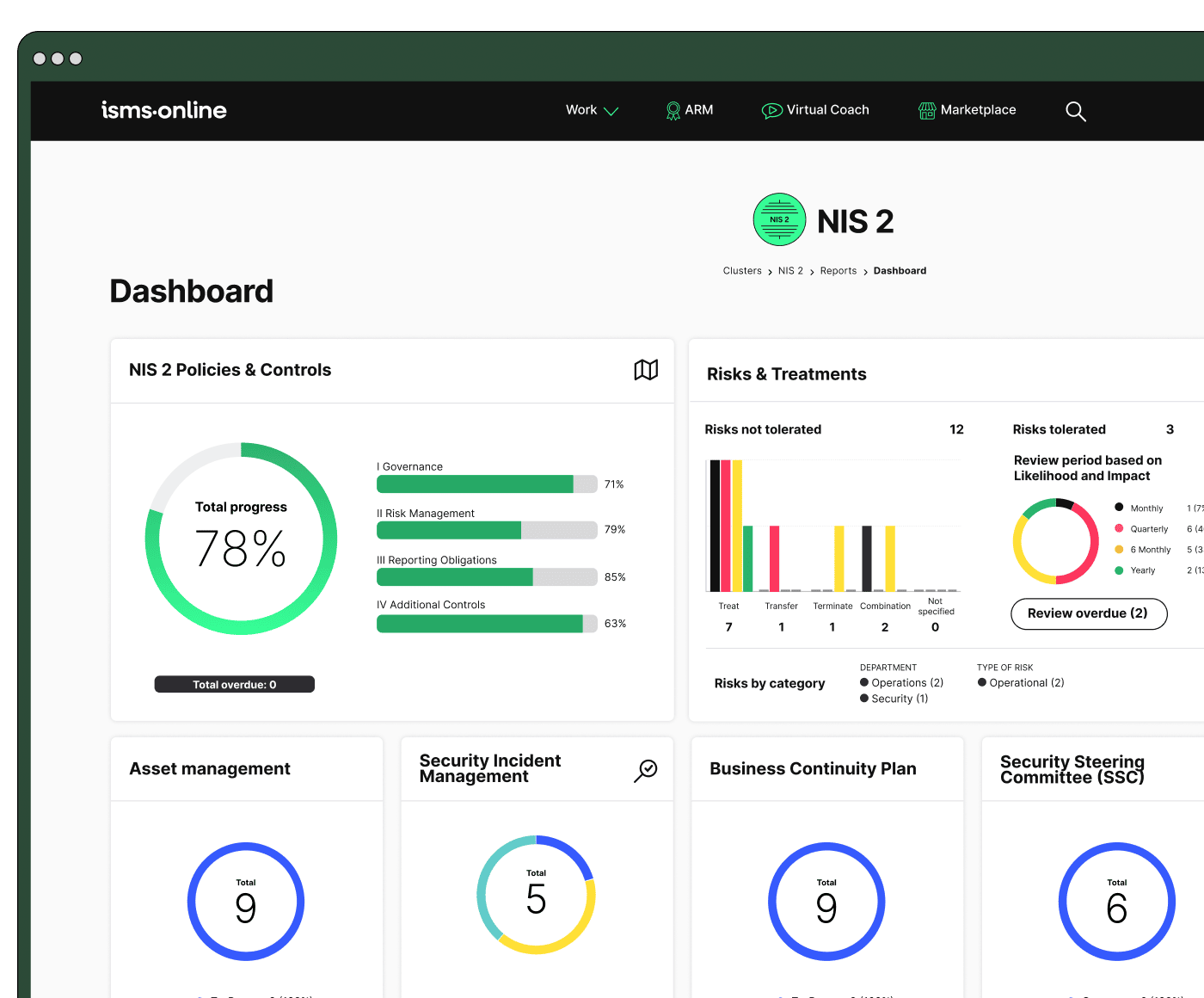
All your NIS 2, all in one place
From Articles 20–23 to audit plans – run and prove compliance, end-to-end.
From Theory to Practise-How to Achieve Audit-Grade, Automated Cross-Border NIS 2 Reporting
Resilience is engineered, not accidental. High-performing organisations:
- Catalogue authorities, templates, portal links, and language requirements for each active country-and keep this data room live.
- Automate every notification, deadline, and language requirement with compliance tools designed for NIS 2 complexity.
- Assign role-specific reporting by jurisdiction and ensure central oversight, so missed alerts are flagged and addressed pre-breach.
- Run periodic end-to-end simulations (not just documentation dry-runs)-testing incident, notification, translation, and closure with real, evolving templates (ISMS.online, ΣR).
You defend your audit and your reputation by proving readiness before-not after-the next crisis.
Steps for Resilient Cross-Border Reporting (Practitioner/Senior Leader View)
| Key Step | Owner/Role | Audit Evidence |
|---|---|---|
| Authority mapping | Senior compliance lead | Country contacts, data room |
| Automation setup | Practitioner / platform admin | Automated logs, time-stamps |
| Assignment & training | Local legal/compliance owner | Role lists, training records |
| Simulation/rehearsal | CISO / Practitioner | Drill logs, closure checklists |
From Compliance Gamble to Defensible Advantage: Outperform NIS 2 Reporting With ISMS.online
Leaders in NIS 2 compliance aren’t lucky-they design organisations, processes, and platforms that thrive on cross-border complexity. Every ISMS.online feature builds your operational shield: country-by-country reporting dashboards, template libraries, up-to-date contact lists, role-based incident distribution, and end-to-end audit evidence rooms for each entity and territory (ISMS.online, ΣO).
The best-protected firms keep their reputations by being provably ready long before the next audit or breach.
With ISMS.online, you gain:
- A living reporting map: template, authority, and portal for every country, always ready.
- Automated team roles and checklists that plug your people directly into the compliance action, wherever they sit.
- Complete evidence automation-every submission, every receipt, every regulatory demand mapped and indexed for audit.
Move beyond compliance roulette-future-proof your readiness, reputation, and resilience:
- Run a simulation with your current process-and spot gaps before they go public.
- Experience a guided walkthrough with automated incident logging, deadline alerts, and dashboard evidence for every country.
- Turn every regulatory change-no matter how many borders you cross-into a new assurance point for your leadership, board, and customers.
When your organisation faces a cross-border NIS 2 event, the difference will be proven readiness, audit credibility, and lasting trust. Let ISMS.online become your competitive edge in compliance-not just your next box to check.
Frequently Asked Questions
Who must your company notify under NIS 2 if you serve customers in multiple EU countries?
You must directly notify the official NIS 2 authority in every individual EU Member State affected by your services, infrastructure, or customer data-not just your home country. NIS 2 does not support “one-stop shop” reporting similar to the GDPR. Each national regulator where your operations or users are impacted requires a fully compliant, country-specific report submitted using their specified portal and template, often in the local language. Skipping a single jurisdiction exposes your organisation to distinct audits and penalties across the EU, with no central European forgiveness or coordination. (ENISA, 2023)
The notification process is parallel and jurisdiction-specific: you must quickly map which countries’ citizens or infrastructure are affected by an incident, then file a 24-hour warning, a 72-hour update, and a closure report to each country-following their precise procedures. It is not sufficient to notify your group’s principal office or usual DPO. Audit trails must demonstrate that you submitted every required filing on time and via the correct national channel.
Responsibility under NIS 2 is distributed; compliance is a relay, not a finish line.
Do incident reporting deadlines and requirements vary between EU Member States under NIS 2?
Yes, significantly. NIS 2 defines minimum notification timelines-24 hours for early warning, 72 hours for an update, one month for closure-but most Member States add stricter national layers. Requirements differ on deadlines, the amount of detail, accepted languages, and the submission portals themselves. For example, France can impose shorter deadlines for sectors like energy or health, and Germany insists that all filings happen in German via a national online system. Relying on generic “EU” forms or English-only notifications puts your compliance at risk. Teams must monitor and follow country-specific rules, not last year’s habits.
| Country | Initial Report | Update Report | Closure Report | Form Language |
|---|---|---|---|---|
| Germany | 24h | 72h | 1 month | German |
| Ireland | 24h | 72h | 1 month | English |
| France* | 24h* | 72h | 1 month* | French |
*Critical sectors may face even stricter timing-always check the latest with each national regulator. Automated platforms like ISMS.online can help ensure you track and act on every country’s deadline and documentation nuance, decreasing the risk of a missed filing.
Can you trust a “main establishment” or lead authority to handle NIS 2 reporting, as under GDPR?
No-NIS 2 explicitly does not allow the GDPR-style “main establishment” or lead authority model. Every country where your systems, services, or customers are impacted must be proactively and independently notified, regardless of your headquarters location or the existence of a group DPO. Centralising internal coordination is useful, but legal reporting requires completely separate, locally compliant notifications for each Member State. Failing to do this invites local investigations, sanctions, and EU-wide enforcement. (Mondaq, 2024)
| Regulation | Lead Authority? | Single EU Portal? | Notify All Countries? |
|---|---|---|---|
| GDPR | Yes | Yes | Not always |
| NIS 2 | No | No | Yes, always |
This distinction is critical: NIS 2 treats each affected country as an independent regulator. One “master” submission never fulfils your full obligations.
How do ENISA, CSIRTs, and national authorities coordinate multi-country NIS 2 reports-and what is your company still responsible for?
ENISA (European Union Agency for Cyber-Security) publishes best-practise templates and offers broad guidance, but your business is always responsible for the actual notifications. Every Member State appoints its own Computer Security Incident Response Team (CSIRT) and Single Point of Contact (SPOC). Your incident process must submit independently to each national portal following that country’s protocol. After you file, authorities may share awareness and lessons at EU level, but your company’s duty is not reduced or consolidated.
ENISA and CSIRTs may help coordinate responses, but these resources supplement, never replace, your multi-country obligations. Your business must log every deadline, template version, filing date, and confirmation for each jurisdiction. Only this end-to-end audit trail can be used to demonstrate compliance in future audits.
Missing one handoff in the reporting relay-on deadline or local form-jeopardises the whole operation.
How should multinational compliance teams build audit-ready, resilient workflows for NIS 2 incident reporting?
Successful cross-border NIS 2 compliance depends on rigorous, parallel workflows and up-to-date country intelligence:
Before an incident
- Maintain a country-by-country reporting matrix: Identify every affected Member State’s regulator, official portal, notification form, and required language.
- Document role assignment: Assign both central and local reporting leads with full access and authority.
- Simulate workflows: Regularly test notification drills, including language and portal variations.
During an incident
- Map impact: Pinpoint every country with affected customers, services, or data.
- Parallel submission: File the initial 24-hour notifications using each country’s template-in the correct language and via the correct portal. Do not rely on email alone.
- Monitor follow-ups: Calendar each 72-hour update and closure report by jurisdiction; keep version-controlled records.
- Evidence trail: Log all proofs of submission, regulator acknowledgements, and any follow-up correspondence; digital, retrievable storage is essential.
| Trigger | Risk update | Control/SoA Link | Evidence logged |
|---|---|---|---|
| Incident in Germany | Update risk register & SoA | A.5.24, A.8.8, A.5.26 | Submission receipt, CSIRT |
| Miss France deadline | Register audit non-conformity | A.5.36 | Regulator inquiry, log |
| Portal/process update | Refresh country template | A.5.4, A.5.35 | Template version, audit log |
A gap in workflow-such as a missed deadline, incorrect portal, or language error-creates direct exposure for regulatory action in that country and can impact EU-wide compliance posture.
What are the risks if you miss a required NIS 2 report or deadline in any EU jurisdiction?
The consequences are substantial: Essential entities face fines of up to €10 million or 2% of global annual turnover, per Member State violation. Each incident and every missed or incomplete notification counts separately. Management can be found personally liable. Additional consequences include compelled public notification (damaging trust), regulator-ordered audits, or further escalations affecting contracts and market access. No amount of internal recordkeeping will shield you if the official submission-and confirmation-can’t be produced on request (CMS Law, 2024).
Likely penalties and implications
- Regulatory fines (per Member State, not per incident)
- Regulator audits and scrutiny-can trigger ongoing monitoring
- Directors/managers may be held liable individually
- Reputational and commercial damage (public notification, lost contracts)
Compliant today means confirmed in every country; assumptions and memory are not enough.
What best-in-class tools and resources help you maintain NIS 2 compliance for multi-country reporting?
- ISMS.online cross-border tracker: Delivers real-time country template updates, multilingual workflows, automated deadline alerts, and evidence storage for every affected Member State ((https://www.isms.online/platform-overview/)).
- ENISA notification templates and guidance: Regularly updated.
- Simulation and drills: Use integrated platform rehearsals to run end-to-end multi-country scenarios, verify team access, and ensure evidence is captured and retrievable by jurisdiction.
- ISO 27001 mapping for NIS 2 reporting:
| Expectation | Operationalisation | ISO 27001/Annex A Ref |
|---|---|---|
| Notify all affected states | Country-by-country matrix and workflow | Cl. 5.4, A.5.24, A.5.26 |
| Audit-logged evidence | Submission receipts and versions for every filing | Cl. 7.5, A.5.27, A.8.34 |
| Deadline assurance | Automated alerts for country deadlines and updates | Cl. 9.1, A.5.36, A.5.35 |
The strongest compliance teams pair automation, up-to-date content, and simulation logic to avoid being caught out by local changes or missed handoffs.
The best time to make your audit trail unbreakable is before the next cross-border incident. Leadership and customer trust depend on it.






