





































Is Dutch NIS 2 Delay a Breather-or a Hidden Compliance Trap?
If you’re leading compliance, security, privacy, or operational strategy in a Dutch organisation, the NIS 2 implementation timeline may look deceptively generous. With the Netherlands’ Cyber-Security Act enforcing NIS 2 from 2026, it’s natural to feel you have the luxury of time to prepare. But most Dutch organisations that “wait for the clock” will find themselves outpaced-by regulators, by competitors, and by their own customers. Across Europe, enforcement and risk appetite are shifting fast, and the “grace period” is more illusion than opportunity.
Teams who treat delay as a buffer for long compliance checklists are the ones likeliest to suffer supply chain setbacks.
As Germany, Denmark, Belgium, and other states operationalise NIS 2, procurement teams and established EU partners begin asking for proof of readiness now-not in 2026. Dutch boards tuned into risk are already raising the stakes: being seen as “already live” with NIS 2 disciplines (risk registers, notifications, supplier tests) earns reputational and commercial rewards. More practically, you will face cross-border questionnaire demands and sectoral supplier approval requests where “we’re waiting for Dutch law” is a non-starter.
Practically, the delay means little: the NCSC-NL and sector supervisors have launched working groups with their European counterparts. Your teams, suppliers, and partners risk exclusion if you don’t proactively map your sector’s evolving rules, notification paths, and evidence demands. Every month, new organisations-SaaS, logistics, manufacturing, digital infrastructure-are added to the NIS 2 scope. Waiting for Dutch ratification only increases the anxiety when your first supplier notification, client request, or partner bid arrives.
Early teams don’t just stay compliant. They win contract trust, board confidence, and sector leadership long before enforcement kicks in.
For security officers, privacy leads, and supply chain managers, the “quiet before 2026” is your chance to build procedures, run notification drills, and evidence your compliance culture ahead of rivals. Dutch boards who champion NIS 2 readiness fortify themselves against rushed, ad hoc fire drills-and show every supplier and auditor they are not just meeting the letter of the law, but setting the benchmark for cyber maturity in the Netherlands.
Dutch NIS 2 Governance: Crystal-Clear Chain of Command, or Regulatory Maze?
Could your organisation confidently handle both a major cyber incident and required NIS 2 notifications without internal confusion? The Dutch implementation of NIS 2 brings together a web of regulatory authorities, each with clear but sometimes overlapping roles. The National Cyber Security Centre (NCSC-NL) sets national policy, but during a live incident, your designated sector supervisor will likely guide the response-a point easily missed until stress levels are high.
Regulatory clarity is operational security-teams that know their escalation chart avoid penalty, late reporting, and board embarrassment.
For financial services, De Nederlandsche Bank (DNB) takes the lead. Telecoms respond to Agentschap Telecom; healthcare activities fall to the Ministry of Health; higher education to SURF; and logistics may have tailored supervisors. In multi-sector supply chains, any incident may trigger dual reporting: imagine an attack that disables digital service in a logistics chain, also halting financial payment flows-a realistic scenario given recent supply chain ransomware events.
Data protection and privacy teams must also align to the Dutch Personal Data Authority for incidents impacting personal data-a reporting obligation distinct from (but often co-triggered by) the sectoral or national notifications expected by NIS 2 protocols.
What most boards and practitioners underestimate is the friction that emerges from static reporting matrices: documents fine in theory quickly fragment during real-world response, especially as digital and physical services converge. This is why Dutch leaders run escalation flow workshops, mapping their “regulator chart” as a living artefact-not a one-time diagram. Teams who engage sector supervisors ahead of time get invaluable clarity in notification formats, escalation rituals, and post-incident reviews.
This isn’t paperwork-it’s operational resilience. A living regulator map ensures that when a crisis hits, boards are not left scrambling for contact details or paralysed by conflicting deadlines. It makes the difference between minimal friction and costly, publicised regulatory scrutiny.

Master NIS 2 without spreadsheet chaos
Centralise risk, incidents, suppliers, and evidence in one clean platform.
NCSC-NL, Sectoral Supervisors, and Your “Regulator Map” for Dutch NIS 2
A robust “regulator map” is foundational to Dutch NIS 2 success. Organisations that maintain live tables of incident types mapped to their respective supervisors can coordinate NIS 2 notifications smoothly, with clear internal escalation and no room for doubt. For leaders, security officers, and practitioners, it shifts compliance from a theoretical concern to an operational discipline.
Building your escalation map:
- List major incident or event types-Everything from a ransomware attack to SaaS outages or data breaches, mapped in real time, not just as an annual paper artefact.
- Assign the supervisory authority-Is it DNB, Agentschap Telecom, Health Ministry, or another?
- Tag dual- or multi-supervisor cases-Many incidents will require dual notifications, especially in multi-domain supply chains.
- Institutionalise trigger events-Any new supplier, significant process change, or digital asset swap should prompt an immediate review and update of the map.
An update drill isn’t bureaucracy-it’s muscle memory for game day.
A well-maintained regulator map sheds light on “dual-reporting” bottlenecks and builds in review points with sector supervisors. The best organisations pair this with directly accessible escalation contacts, preferred formats, and hot-wash notes after every real or simulated incident.
Quick-Reference Table: NIS 2 Supervisors
| Incident/Event Type | Sector Supervisor | NCSC-NL Involved | ISO 27001 Reference |
|---|---|---|---|
| Bank cyber-attack | DNB | Yes | A.5.24, A.5.26 |
| Telecom outage | Agentschap Telecom | Yes | A.5.24, A.7.11 |
| Health data breach | Ministry of Health | Yes | A.5.24, A.5.26 |
| Logistics/SaaS failure | NCSC-NL plus sectoral | Yes; Variable | A.5.21, A.5.26 |
| Education breach | SURF | Yes | A.5.24, A.5.26 |
Case illustration: When a new payment SaaS provider is onboarded, IT performs a “regulator map drill,” identifies DNB as lead, checks contacts, and updates workflow for immediate response should an incident arise. Board and staff can see, at a glance, how to escalate-and who must be notified-across every operational scenario.
Supply Chain Shockwaves: Third-Party Exposure and Dutch NIS 2 Enforcement
If audit day demands evidence of continuous supplier engagement, what do you show: an out-of-date vendor list, or a living record of risk reviews, incident notification tests, and contractual NDAs? Under Dutch NIS 2, passive oversight is now the fastest pathway to enforcement. Board members, CISOs, and practitioners must look beyond contracts to active supplier verification.
Regulators in the Netherlands now expect organisations to demonstrate live supplier management:
- Annual supplier reviews, risk assessments, and drill logs
- Evidence of incident notification exercises (within regulatory windows)
- Up-to-date contact records and escalation workflow test logs
- Proof of contractual compliance-especially for critical vendors, cloud, SaaS, and logistics operators
Inaction in supplier management is interpreted as non-compliance-demonstrable routines, not promise, earn audit relief.
Cloud supply chains and cross-sector IT vendors are where most NIS 2 failures begin. One overlooked supplier is all it takes for ransomware or availability failures to breach every contractual and regulatory promise upstream and down.
Sample: Supplier Management Evidence Table
| Trigger | Risk Update | Expected Evidence | ISO 27001 Ref. |
|---|---|---|---|
| Onboarding | Supplier risk updated | Due diligence, NDA | A.5.21, A.8.30 |
| Major change | Risk & registry review | Incident drill, contact proof | A.8.29, A.5.26 |
| Annual review | Supplier audit log | Risk update, review minutes | A.5.22, A.8.30 |
| Incident | Notification log | Escalation record, registry | A.5.24, A.7.11 |
Practitioners who run quarterly supplier notification drills-logging proof of response time and contacts-equip the board to answer regulator queries and assure customers their risk is not just managed but tested.
Failing to evidence these steps-especially for critical SaaS, digital payment chains, and infrastructure vendors-can trigger fines, notification delays, and lost contract opportunities.
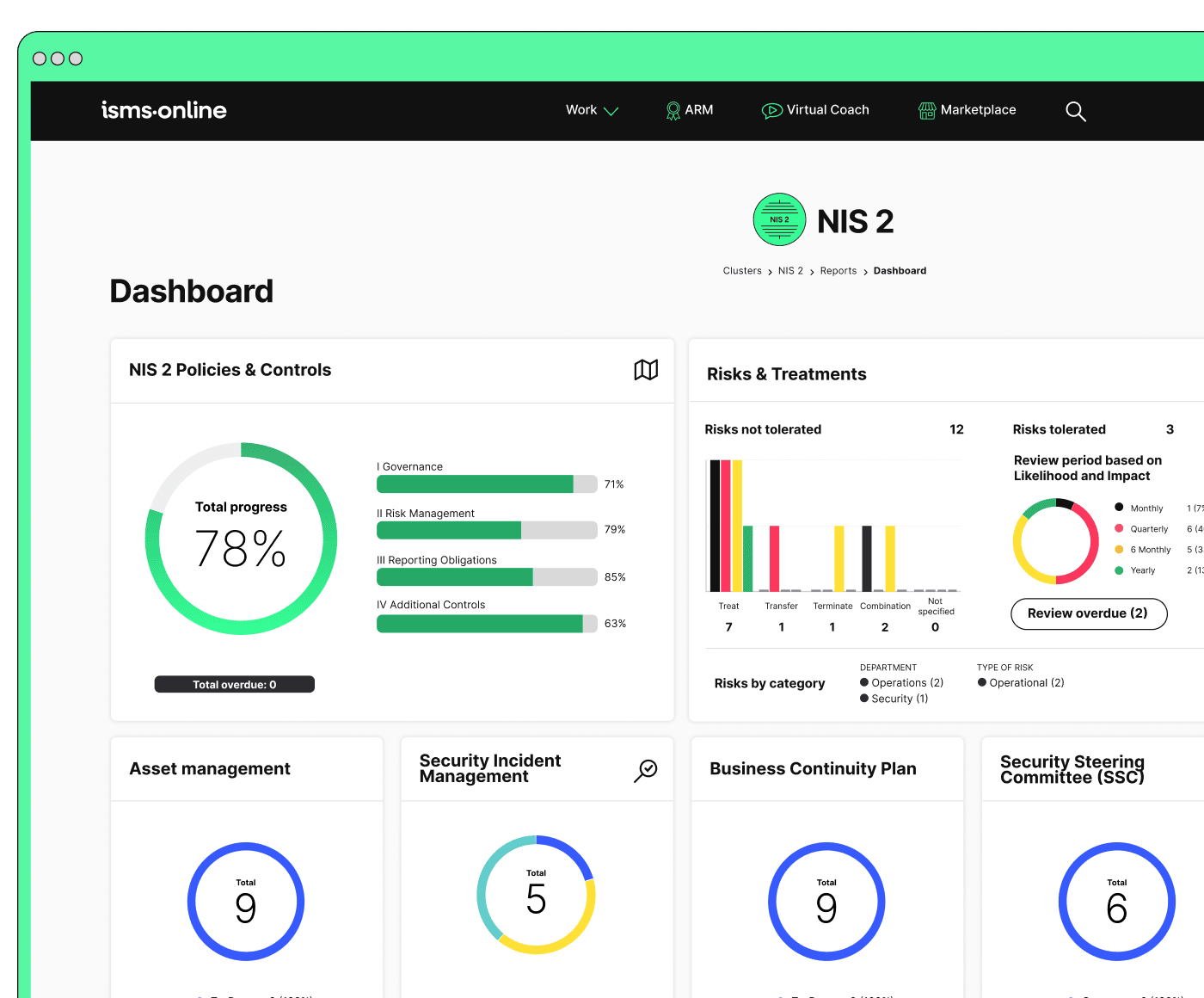
Be NIS 2-ready from day one
Launch with a proven workspace and templates – just tailor, assign, and go.
ISO 27001 vs. NIS 2: Bridging Gaps, Exposing Weaknesses
Too often, Dutch organisations believe a recent ISO 27001 badge is a “get out of NIS 2” card. In reality, ISO 27001 is the baseline-NIS 2 extends and intensifies requirements across accountability, supplier discipline, incident reporting, and board oversight.
ISO 27001 gives you code. NIS 2 demands a living system.
Direct mapping is helpful-incident logs, risk registers, and supplier records all anchor to ISO 27001 controls. But the NIS 2 difference is velocity and granularity: new 24/72/30-day incident clocks, an expectation of continuous risk review, and a board agenda encompassing cyber resilience at every meeting.
Dutch Bridge Table: ISO 27001 – NIS 2
| NIS 2 Demand | Practical Implementation | ISO 27001 Ref. |
|---|---|---|
| 24/72/30-day notification | Workflow with evidence & audit log | A.5.24, A.5.25, A.5.26 |
| Real-time risk updates | Living risk platform, tracked | A.8.2, A.8.3, A.5.7, A.5.21 |
| Supplier engagement | Registry, annual test, evidence | A.5.19, A.5.21, A.8.30 |
| Board oversight | Minutes, registers, reports | A.5.4, A.5.36, A.9.3 |
Traceability Mini-Table
| Trigger | Risk Update | Control Ref. | Logged Evidence |
|---|---|---|---|
| Incident | Registry updated | A.5.24, A.8.2 | Incident log, board record |
| Supplier breach | Vendor risk review | A.8.30, A.5.21 | Test record, registry |
| Board action | SoA update | A.5.4, A.9.3 | Management review log |
For privacy and legal officers: bridging to ISO 27701 closes evidence gaps for GDPR alignment and data subject requests. Ensuring your records meet both standards creating a single, defensible audit trail.
From Board Policy to IT Routine: Making Dutch Accountability Real
Dutch NIS 2 compliance is not just board-level paperwork-true accountability is proven every day by how board directives are operationalised across teams, incidents, and suppliers.
Practitioners and security leaders must anchor every meeting, control review, and supplier check in registrable evidence. Management review minutes-the definitive proof of board oversight-should show live ties to risk register updates, incident records, and supplier logs.
Policies on paper are inert-live registries, documented routines, and evidence dashboards are how you anchor board confidence to audit results.
The monthly registry review-risk items, open incidents, supplier reviews, board minutes-moves accountability from a periodic scramble to a repeatable, high-trust rhythm. Staff turnover or supply chain shakeups lose their sting; every party can see when and why every action was taken.
Practitioner Drill
- Calendar a monthly review of all risk, incident, and supplier registries.
- Link every change to board oversight (minutes, SoA updates).
- Log the evidence inside central dashboards for real-time audit readiness.
When everyone sees their action in the chain of compliance, audit days become routine, not stress events. This approach also immunises organisations against individuals leaving-knowledge and accountability are embedded in the system, not in heads.
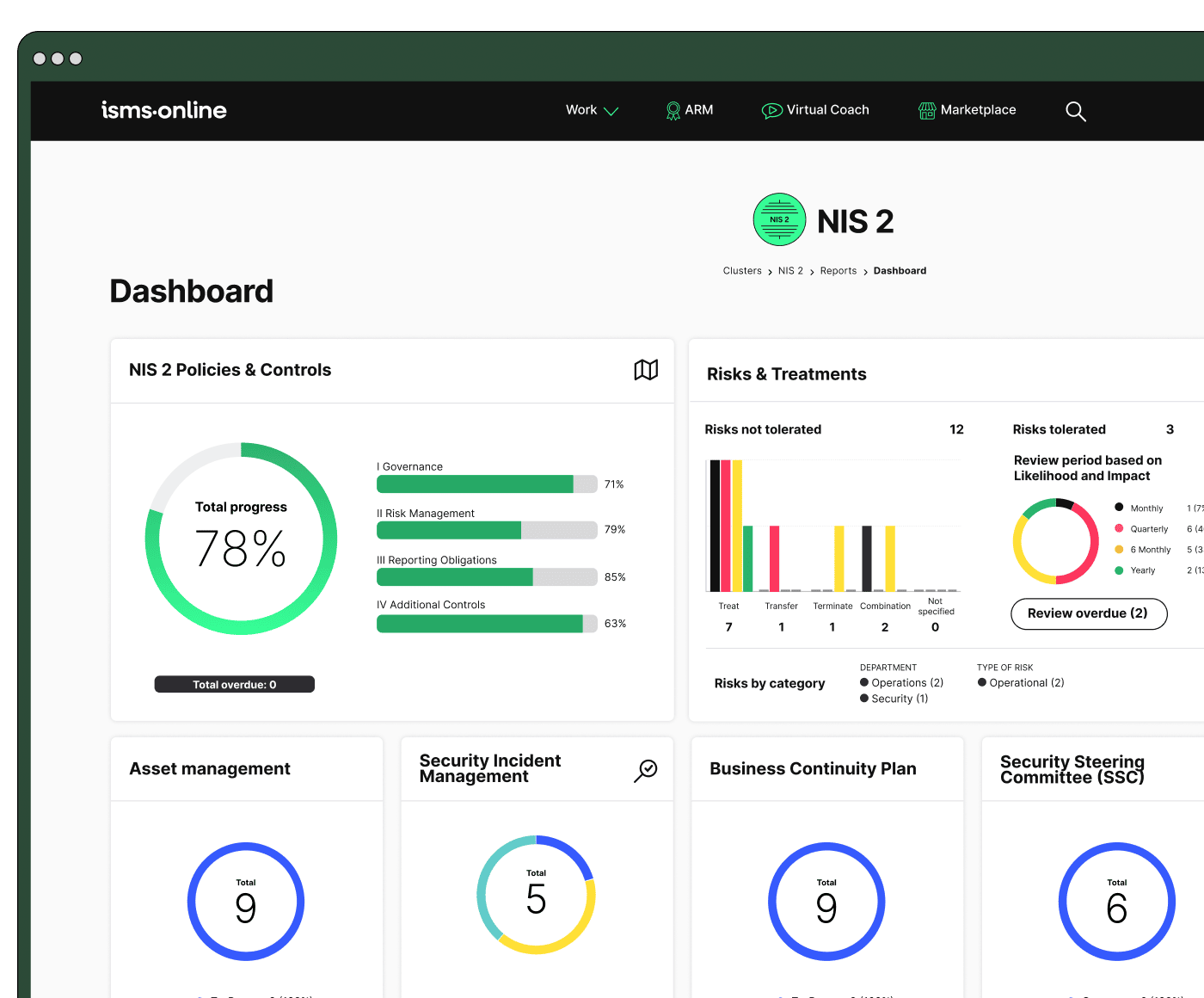
All your NIS 2, all in one place
From Articles 20–23 to audit plans – run and prove compliance, end-to-end.
Mastering Audits, Evidence, and Dutch Supervision
Dutch regulators-NCSC-NL and sector supervisors-have moved on from checklist audits. They seek “living evidence nuclei”: unified platforms where policies, controls, incidents, risk reviews, and board minutes are logged, timestamped, and instantly accessible for review.
A single missing log or outdated review can now cost real money-audits require proof, not promises.
Audit Readiness Table
| Routine Task | Proof Artefact | Check Frequency |
|---|---|---|
| Management review + minutes | Signed records | Quarterly |
| Risk review after incidents | Registry updates, SoA entries | Monthly or event |
| Supplier engagement and test | Updated registry, drills | Annual or trigger |
| Incident notification | Notification log, audit trail | Within 24/72/30d |
Centralising these proofs-inside ISMS.online or a similar evidence nucleus-means audit or incident notification becomes straightforward. Fractured logs and orphaned reviews frustrate supervisors and auditors, creating delays and potentially heavy sanctions.
Imagine the evidence nucleus as a digital compliance operations centre-a dashboard where every policy, incident, and review is visible on demand. Alerts expose review gaps, pushing teams to close them before scrutiny sets in.
Accelerate NIS 2 Readiness: Dutch Roadmaps, Templates, Action Triggers
Proactive Dutch organisations are ditching checklist compliance for dashboard-driven readiness-leveraging official guides, templates, and monitoring systems to drive daily action. ISMS.online, for example, offers a Dutch-language NIS 2 evidence bridge, with mappings between ISO 27001 controls and the evolving requirements of the Dutch Cyber-Security Act.
Confidence comes not from theory, but from walk-throughs, live status dashboards, and readiness maps aligned to day-to-day operations.
Automated review dashboards-board sees “green” (up-to-date), “yellow” (due for review), or “red” (gaps)-turn compliance into a shared responsibility. When policies or supplier statuses update, reviews and logs change instantly-no more searching across spreadsheets or email chains.
Legal, privacy, and IT practitioners find that structured NIS 2 action plans connect GDPR, supply chain, and incident routines, closing gaps fast and aligning all teams in a loop of readiness. The best organisations emerge as sector exemplars, not just box-tickers-passable in audits, visible as trusted partners.
Request Your NIS 2 Evidence Guide With ISMS.online Today
Dutch organisations aiming to move beyond “pass checklists” are using evidence-centric systems that unify all NIS 2 obligations. ISMS.online has partnered with leading Dutch compliance teams to map NIS 2 to ISO 27001, synchronise supply chain and board review logs, and automate registry upkeep for a live, ready-for-inspection proof of compliance (isms.online).
Secure confidence, audit-readiness, and board trust before the deadline-don’t leave your NIS 2 maturity to chance.
Request a Dutch-language NIS 2 evidence dashboard, downloadable templates for board, IT, and privacy lead use, and a customised launch plan that makes your “delay” a competitive advantage (isms.online).
Upgrading to identity-driven compliance means showing any stakeholder-board, client, or regulator-proof that compliance is not just a checkbox, but an everyday discipline, aligned with the highest standards in Dutch and EU cyber-security law. Move now and make your readiness your market advantage.
Frequently Asked Questions
How will NIS 2 transform Dutch cyber-security accountability after October 2024?
NIS 2 fundamentally rewrites Dutch cyber-security accountability, shifting from fragmented sector oversight to a nationally coordinated system anchored by the National Cyber Security Centre (NCSC-NL). From October 2024, NCSC-NL becomes the “single point of contact” for incident reporting, while Justis and sectoral authorities assume new, formalised roles in supervision, registration, and audits. This change brings essential entities, new important sectors, and key SME suppliers under unified notification, crisis coordination, and evidence requirements.
The era of sector silos is ending; Dutch organisations must be ready to answer to a single national standard-swiftly and with clear evidence.
For your organisation, this means:
- Direct accountability: NCSC-NL handles breach notifications and tracks incident response across nearly all critical sectors.
- Expanded scope: SMEs, logistics, digital providers, and supply chain partners are explicitly named and regulated.
- Central supervision: Justis will register entities, oversee compliance reports, and, together with NCSC-NL, coordinate audits and intervention.
By 2026, the Dutch model will, for the first time, enforce unified reporting, cross-sector escalation protocols, and end “gap blindness” between different authorities. Organisations must assess their reporting structure, validate their NCSC-NL registration, and update authority contacts well ahead of the October 2024 deadlines. Late notification or registration risks fines, audit failures, and reputational damage.
Dutch NIS 2 Accountability Matrix
| Entity Type | Lead Regulator(s) | NCSC-NL/Justis Role |
|---|---|---|
| Essential Entity | Sector + NCSC-NL | Notification, CSIRT, guidance |
| Important Entity | Justis + NCSC-NL/Sector | Oversight, incident relay |
| SME Supplier | Sector/Justis/NCSC-NL | Indirect via supply chain |
Next step: Review your official supervisory status and confirm you’re registered with the correct authority by October 2024. Audit trails and notification chains must be mapped and tested before the enforcement window opens.
What’s the timeline and “as-of” deadlines for Dutch NIS 2 compliance (2024–2026)?
The Dutch NIS 2 compliance clock starts ticking in October 2024, with real consequences for delay. Key milestones are now defined via parliamentary timetable and NCSC-NL/Justis guidance. Missing a deadline can rapidly magnify both legal and reputational risk, particularly for entities newly brought under scope.
Dutch NIS 2 Compliance Timeline:
| Action & Requirement | Deadline | Authority Reference |
|---|---|---|
| Final Dutch law publication & prep | May–August 2024 | Uitvoeringswet NIS2, Justis, NCSC-NL |
| Mandatory registration, self-assessment | October 2024 | Uitvoeringswet NIS2, Art. 6–10 |
| Incident reporting system (real-time/logged) | October 2024–Q1 2025 | NCSC-NL, CSIRT bulletin, March 2024 |
| Audit-ready compliance evidence in place | By Q1 2025 (rolling audits) | Justis, sector authorities, CSIRT-NL |
| Full supply chain enforceability | October 2026 | NCSC-NL, Justis, sector ministries |
After October 2024, failure to register or log incidents on time is not an administrative slip-it’s a direct compliance violation.
What should you do now?
- Classify and register: Confirm your entity’s scope and register with Justis or your sectoral authority without delay.
- Update protocols: Assign a nominated compliance lead and ensure your incident detection, escalation, and reporting systems are live-tested.
- Document evidence: Prepare logs, training acknowledgements, board minutes, and policy updates in a format ready for audit.
Staying ahead of these dates will demonstrate leadership to auditors, customers, and partners, providing critical assurance as enforcement tightens.
How does NIS 2 differ from NIS 1 in the Netherlands (regulatory, scope, enforcement)?
NIS 2 is not a minor upgrade-it radically expands who is regulated, how rules are enforced, and the severity of non-compliance. Key contrasts revolve around three axes: scope, centralization, and consequence.
| Area | NIS 1 (until 2024) | NIS 2 (2024–2026) |
|---|---|---|
| Sectors regulated | “Critical/vital” only | Essential, important, supply chain |
| Regulator structure | Sectoral (decentralised) | Centralised (NCSC-NL/Justis matrix) |
| Notification triggers | Only major incidents | ANY significant cyber event/risk |
| Legal liability | Broad/implicit | Specific, board-level, personal |
| Fines & enforcement | Low/moderate | Up to €10m or 2% of turnover |
| Supply chain scope | Minimal | Explicit contracts, due diligence |
NIS 2 names boards and executives as compliance leaders, brings critical suppliers and digital providers into direct scope, and forces continuous, auditable risk management. Audits will focus not just on policies but on operational records: incident logs, management review minutes, and supply chain checkpoints.
Board-level takeaway: Every senior leader is now personally answerable for NIS 2 compliance-delegation is not a shield and lack of evidence is direct exposure.
What makes your company “in scope” under Dutch NIS 2-and how do SMEs & suppliers check readiness?
NIS 2 intentionally captures a much broader slice of the Dutch and European economy, lowering the bar for inclusion and adding indirect duties across the supply chain.
Typical In-Scope Criteria:
- Over 50 staff OR annual turnover > €10 million AND operating in a covered sector (energy, digital, transport, finance, healthcare, water, public sector, logistics, ICT).
- Supplying or servicing an NIS 2 essential/important entity, directly or via outsourcing.
- Named as a critical supplier in procurement, RFPs, or customer contracts.
Hidden supply chain risk becomes visible audit risk; inaction upstream can cost your business downstream.
SME/Supply Chain Readiness Checklist:
- [ ] Scan contracts for NIS 2 obligations-respond proactively to customer demands.
- [ ] Register with NCSC-NL or Justis if meeting criteria.
- [ ] Nominate a compliance lead/contact and update authority details.
- [ ] Review supplier evidence-demand proof of their NIS 2 readiness.
- [ ] Review customer/NCSC-NL FAQs and keep abreast of Q3/Q4 2024 updates.
Failure to self-identify before October 2024 may trigger retroactive obligations-and becomes public during incident inquiries or audits.
How can you bridge NIS 2 requirements with ISO 27001 controls and evidence (Netherlands, 2025–2026)?
Most Dutch organisations will map NIS 2 requirements to existing or planned ISO 27001 ISMS controls, aligning audit trails, operational alerts, and management reviews to satisfy both standards in a single system. The key is operationalising the requirements-proving what’s not just on paper, but in practise.
NIS 2 ↔ ISO 27001 Evidence Bridge:
| NIS 2 Area | Operational Activity | ISO 27001 / Annex A Reference |
|---|---|---|
| Incident reporting | Real-time logging, SIEM alerts | A.8.15–A.8.16, A.5.24 |
| Board accountability | Signed minutes, exec dashboards | Clause 5.2, 6.2, 9.3 |
| Supply chain security | Formal onboarding, contract mapping | A.5.19–A.5.21 |
| Risk assessment | Regular risk registers, mitigation | 6.1, A.5.7, A.8.8 |
| Staff training | Complete records, Policy Pack audits | 7.2, A.6.3 |
Traceability Mini-Table
| Trigger | Risk Update / Action | SoA/Control Link | Audit Evidence Example |
|---|---|---|---|
| Supplier incident | Raise risk, inform Board | A.5.21 | Incident log, supplier audit |
| Board change | Update roles/responsibilities | Clause 5.2 | Updated org chart, board minutes |
Audits now require real workflows, not just policy shelfware-prove with cross-mapped logs, approvals, and contracts.
Action: Digitise policy assignments, document all incidents, and proactively map supplier onboarding to current NIS 2 and ISO 27001 fields.
What real-world scenarios & boardroom signals matter most to Dutch auditors for NIS 2 compliance?
The new audit era means evidence must travel from boardroom mandates to operational logs and supplier attestations, closing the “last-mile” of compliance. Auditors and procurement are now empowered to validate compliance as a continuous, organisation-wide process.
Key Signals & Scenarios Auditors Seek:
- Board engagement: NIS 2 is a recurring topic in management reviews and executive meetings with assigned owner and evidence of follow-through.
- End-to-end incident playbooks: Response and escalation procedures are tested, documented, and include all cyber, legal, and supply chain stakeholders.
- Supply chain documentation: Proof your partners are registered, NIS 2 compliant, and have audit credentials available.
- Workflow completion logs: Every staff member acknowledges training/policies, tracked digitally.
- Procurement integration: NIS 2 requirements are written into supplier contracts/RFPs; bidders must refer to authority status and supply audit documents.
For Dutch organisations, survival and selection increasingly hinge on living, verifiable evidence and leadership signals-checklists and boilerplate are now insufficient.
Resilience is now the test: From boardroom to server room, NIS 2 compliance is organisational muscle, not paperwork.
Where can you find the latest Dutch NIS 2 authority maps, checklists, and action guides (2024–2026)?
Bookmarking and regularly consulting the right sources ensures you’re always audit-ready and able to evidence compliance before it’s demanded.
Key Resources:
- NCSC-NL Portal: – Standard setter for incident notifications, sector mapping, supply chain FAQs
- Justis (Ministry of Justice & Security): – Entity registration, legal Q&A, notified authority matrix
- CSIRT-NL: – Playbooks, cross-border incident handling
- ISMS.online Guidance Centre: – Templates, audit kits, NIS 2/ISO bridge guides
- Dutch Cyber Legal Digest: (search “Uitvoeringswet NIS2 Nederland”) – Full text and Q&A updates
Identity CTA: Download the latest Dutch NIS 2 Authority Map and 2025 Evidence Guide today and cement your place as a leader in organisational cyber resilience.






