





































Why NIS 2 Makes Compliance a Boardroom-and Public-Imperative for Government Agencies
When digital services fail in the public sector, the consequences reverberate far beyond technical teams or IT contractors. Every hour of downtime erodes public trust, escalates to the board level, and opens agencies to regulatory rebuke. The NIS 2 Directive fundamentally reframes compliance as a matter of executive responsibility and national resilience. Public sector agencies now face a world in which inaction is visible, swiftly penalised, and capable of spiralling into reputational crisis or legal investigation.
Every minute of digital downtime now puts public trust at risk-preparedness isn’t optional.
Unlike previous regulations that permitted slow or partial response, NIS 2 demands that agencies treat digital risk as a live executive and political reality. Short, non-negotiable reporting deadlines and direct board accountability are now baked into law. Most critically, the standard for evidence and action is no longer “reasonable effort”-it is “real-time control.”
Regulatory Reporting Triggers-When Does an Outage Become a Crisis?
What used to be managed quietly as a technical hiccup now often transforms, by law, into a crisis event requiring immediate, formal notification. The bar for “significant incident” is clear: any event disrupting a core public function, exposing confidential or citizen information, or impacting the life or well-being of the public (ENISA). As outlined in NIS 2 Article 23 and reinforced by national authorities, agencies must respond when:
- Service outages impact the public for more than 24 hours;
- There is any loss or exposure of personal or sensitive data;
- Key national or regional digital systems become unavailable-even temporarily;
- Multiple entities or ministries report related impacts or security events.
The margin for manual reporting is gone. Real-time, evidence-backed escalation is now expected for any event reaching these thresholds. Delayed or insufficient notifications constitute not just a process failure, but a breach of law-subject to audit, fine, and public consequence (CFCS DK).
Prompt disclosure is a legal must, not a boardroom negotiation.
NIS 2 holds boards and C-suites directly accountable. This shift means every significant incident risks triggering board-level scrutiny and external audit. Missed deadlines, unclear logs, or gaps in documentation quickly escalate from operational concern to regulatory infraction, with personal accountability for organisation leaders (NCSC UK; DPC Ireland).
Asset Mapping: The New Baseline for Control
Todays agencies must move beyond static inventories and annual reviews. NIS 2 compliance is predicated on always-up-to-date asset registers-where every device, application, and database is visible, mapped, and assigned clear ownership. OECD research confirms that gaps in asset mapping are often the weakest link, allowing incidents to go unflagged until secondary impacts force a much wider response (OECD).
Modern compliance platforms now overlay service maps with live incident data, arming leadership with the instant visibility needed to match statutory reporting timelines.
Book a demoWhy Government Compliance Gaps Stay Invisible-Until It’s Too Late
Despite strong IT teams and ample policy documentation, many public organisations continue to stumble at audit or after high-pressure incidents. The reason is almost never a lack of intent, but rather a failure to operationalise compliance at scale.
In compliance, invisible gaps quietly grow into audit failures-blind spots beg to be mapped.
Manual Evidence Loops-Hidden Traps in Audit-Readiness
Audit failures often stem not from lack of controls, but from fragmented, outdated, or manually managed evidence. According to ENISA, manual evidence management is responsible for over 40% of audit findings in European government agencies (ENISA Guide). Disconnected files, unsigned policies, and patchy approval chains invite scrutiny and delay.
A recent French audit highlighted the liabilities of relying on spreadsheets: person-dependent, hard to trace, and nearly impossible to keep current at scale (SSI France). By contrast, agencies adopting platforms that automate audit logs, digital approvals, and dashboard-driven evidence now routinely outperform their peers in audit readiness.
Policy Shelf-Ware Is an Audit-Ticking Bomb
If policies exist but are untracked, unsigned, or ignored by staff, agencies fail a key NIS 2 test: demonstrating widespread engagement, not just intent (EC Regulation). Modern regulations require agencies to prove not just that policies are published, but that they have been read and acknowledged with up-to-date logs to match.
The Approval Loop Paradox-Wasting Time Where It Hurts Most
Chasing busy leaders for sign-off remains a major time sink. Studies show up to 18 hours lost per audit on manual evidence collection and chain-of-approval management. Agencies that automate approval flows cut this burden and protect against the risk of incomplete or lost evidence.
Shadow IT and Orphaned Assets Multiply Non-Compliance
Perhaps most insidious is the rise of “shadow IT”-unknown, unowned apps and datasets. These blind spots account for many high-profile security failures and audit fines (Cabinet Office). Without a live, reviewed asset register, public agencies cannot demonstrate control over their environment.

Master NIS 2 without spreadsheet chaos
Centralise risk, incidents, suppliers, and evidence in one clean platform.
Board Accountability and Timelines: NIS 2’s Executive Mandate
Accountability has shifted firmly to the top. Under Article 20 of NIS 2, board members and executives have non-delegable responsibility for cyber outcomes-they must be able to prove they have directly overseen compliance measures, incident notifications, and mitigation efforts in real time (GT Law).
A once-a-year policy review now satisfies nobody-regulators, auditors, and the public expect board and C-suite leaders to engage regularly with their agencies’ live, evolving compliance posture.
Operational Evidence-Everyday Practise, Not Annual Art
National regulations demand agencies demonstrate not just policies but drills, incident log reviews, and continuous improvement records (CFCS DK). Evidence of daily, real-world practise is now a baseline expectation.
The margin for delay has narrowed: incident reporting windows are as short as 24 hours, and evidence must be produced on demand (ECA). This speed makes streamlining evidence collection and chain-of-command logging non-negotiable.
Boards and C-Suites: Education Yields Resilience
Public agencies where executives regularly review NIS 2 compliance-rather than delegating-show marked improvements in audit outcomes and operational performance (PWC). Continuous board education multiplies resilience.
Team Sport: Compliance Beyond IT
NIS 2 requires agencies to treat compliance as a cross-functional discipline: procurement, HR, communications, legal, and IT must all play an active role (EU Joinup). Siloed efforts or hand-offs lead to audit shortcomings and compliance failures.
Technical Controls That Stand Up to Audit and Incidents
Audit readiness under NIS 2 demands more than “box-ticking” security. Agencies must maintain controls that are demonstrably active, regularly tested, and integrated into everyday operations.
Minimum Controls: Audit Expectation Checklist
As per ENISA, ISO 27001:2022 and EU guidance, auditors expect to see these controls in consistent, platform-evidenced operation:
- Multi-factor authentication (MFA) deployed across all sensitive systems.
- Live event logging and alerting calibrated for fast response.
- Documented, tested backups and restoration procedures.
- Access management mapped to roles, tracked by approval logs.
- Patch management logs with exceptions and unplanned repairs reviewed.
- Business continuity proven by drill records and post-recovery documentation (ENISA).
Audit-ready platforms make MFA compliance, backup status, and live system logs visible in a single dashboard-removing guesswork from compliance proof.
Beyond the Checklist: Automation as the New Standard
ENISA finds audit failures usually stem from manual errors or lapsed cycle reviews-not the absence of controls (CISecurity). Automating everything from approvals to routine log reviews ensures compliance “sticks” through staff turnover and system change.
Practised Resilience: Proving Drill Efficacy
Modern auditors demand proof that incident and disaster recovery plans aren’t just written-but have been drilled by relevant staff, with evidence of learning cycles. Failing here exposes organisations to higher penalties and reputational harm.
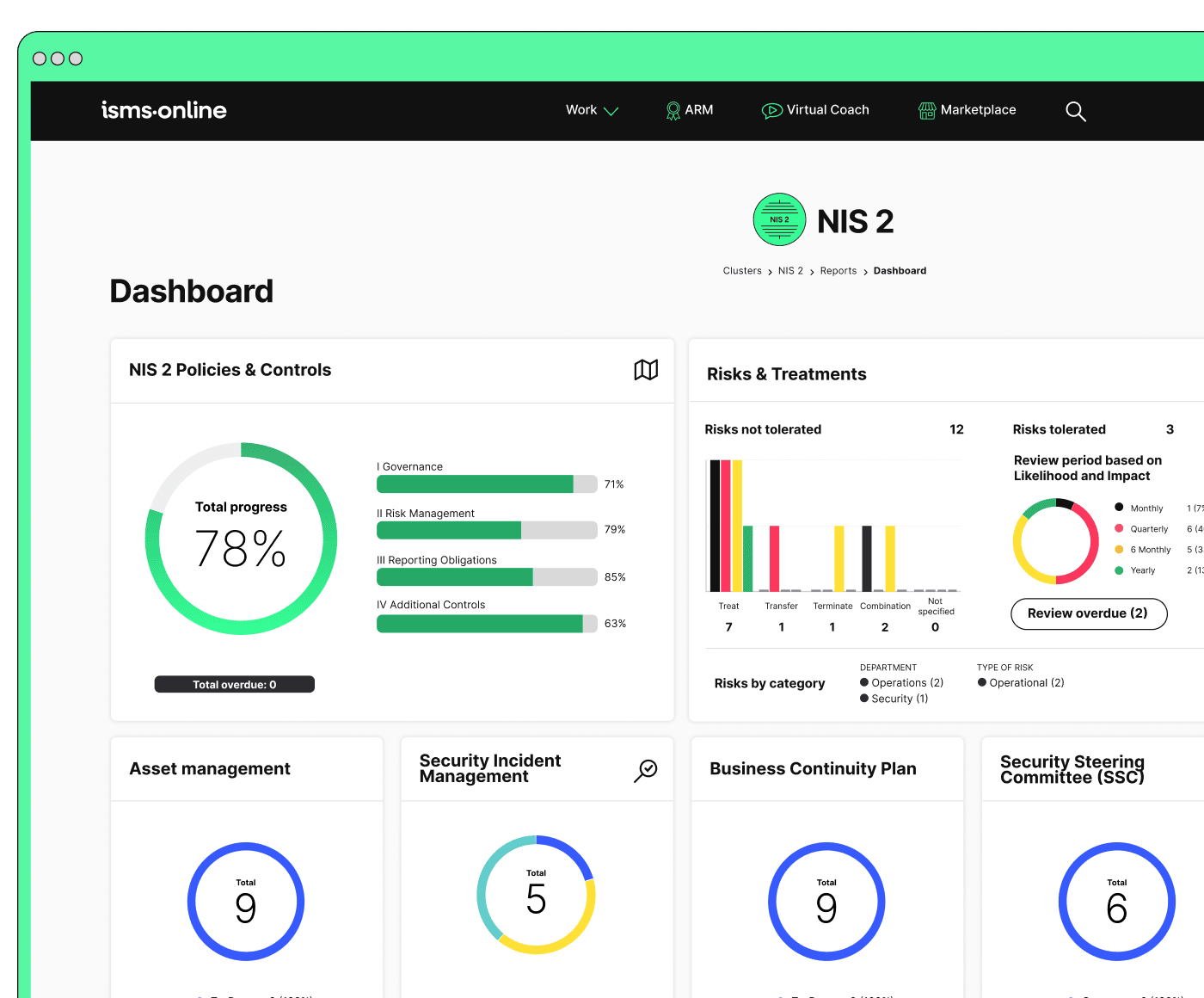
Be NIS 2-ready from day one
Launch with a proven workspace and templates – just tailor, assign, and go.
Complete Traceability: From Trigger to Evidence in One Chain
Successful audit defence requires every risk trigger and process change to flow-without friction-into live, accessible evidence. This end-to-end traceability is the new gold standard for public sector compliance.
Table – Traceability Matrix: Trigger to Audit Evidence
| Trigger | Risk/Update Action | SoA Link / Control | Specific Evidence |
|---|---|---|---|
| System Outage Detected | Log incident, CISO alert | A.5.24, A.5.25, A.8.15 | Incident ticket, action log |
| Staff Role Change | Quarterly review, privilege check | A.5.4, A.5.18 | Exit list, access approval logs |
| Supplier Breach | Update risk, notify stakeholders | A.5.19, A.5.21 | Risk register, contract record |
| Policy Revision | Board sign-off, comms plan | A.5.1, A.5.2, A.5.36 | Approval chain, review log |
Any break in this chain-be it an unsigned policy, missing log, or unlinked risk-can turn a minor event into a full compliance failure.
Accountability by Platform-No Room for Manual Error
Digital responsibility logs, quarterly reviews, and chain-of-custody tracking via a compliance platform eliminate the “human memory” gap identified by KPMG, Deloitte, and Vanta as a persistent cause of audit delays (KPMG; Deloitte; Vanta).
Supply Chain: The Compliance Perimeter is Now Infinite
NIS 2 elevates procurement and supplier management from a background task to a frontline compliance concern. Every critical vendor, SaaS app, and trusted supplier becomes a potential risk propagator.
Your compliance is only as strong as your weakest supplier-third-party risk now propagates in real time.
Supply Chain Controls: Live, Auditable, and Integrated
Regulators expect agencies to maintain complete, regularly updated risk registers for all suppliers-something only possible with a platform that centralises contract logs, expiry monitoring, and due diligence evidence (Sharp; ISMS.online). Every contract, risk score, and status change for critical suppliers is now sought in audits.
Chain-of-Communication: Rapid Escalation and Response
Public agencies must stand ready, with pre-templated notifications for supplier or contractor incidents, to escalate quickly to external authorities (EC Press). Digital track-and-respond capabilities prevent policy from becoming theory-only.
Contract Language: Digital Locks
NIS 2 advises embedding access control, digital responsibility logs, and audit rights directly into supplier contracts, ensuring that every third party is traceable to the same standard as internal teams (Gartner).
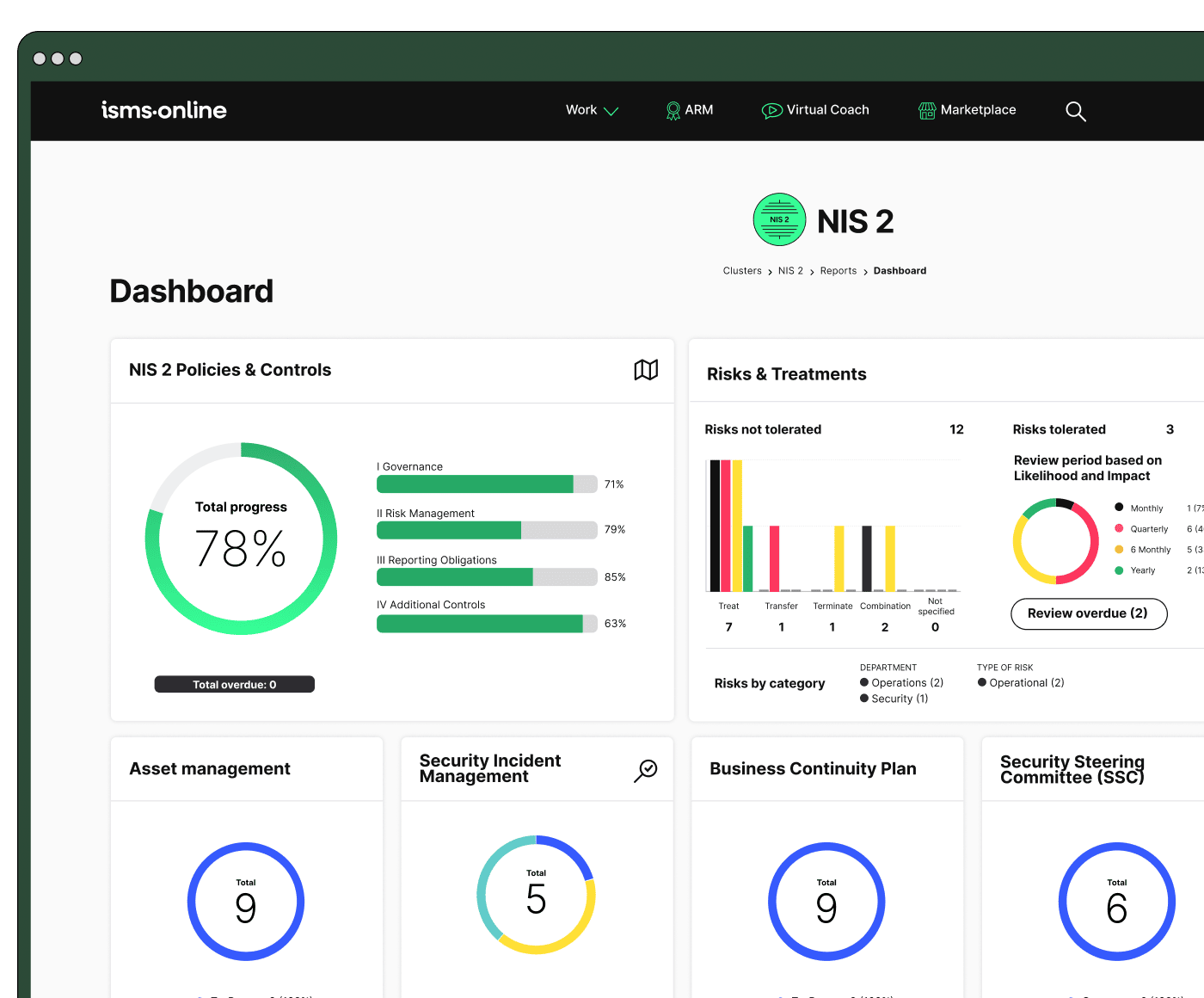
All your NIS 2, all in one place
From Articles 20–23 to audit plans – run and prove compliance, end-to-end.
Avoiding “Audit Overload”: Unifying NIS 2, GDPR, and Sector-Specific Evidence
Evidence silos don’t just slow down audits-they inject inconsistency and raise regulatory flags. Smart agencies are shifting to “map once, prove many” models, unifying risk and policy evidence to serve NIS 2, GDPR, and sector obligations in a single workstream.
Table – ISO 27001 / NIS 2 Bridge Table
| Expectation | Operationalisation | ISO 27001 / Annex A Ref |
|---|---|---|
| Timely Incident Disclosure | Automated reporting workflow | A.5.25, A.5.26, NIS 2 Art. 23 |
| Asset Ownership & Mapping | Live registry, sign-off logs | A.5.9, A.5.2, NIS 2 Art. 21 |
| Board Account. & Review Logs | Leadership sign-off, reviews | A.5.1, A.5.36, NIS 2 Art. 20 |
| Supply Chain Risk | Contract logs, regular review | A.5.19, A.5.21, NIS 2 Rec. 108 |
| GDPR / NIS 2 Notifications | Unified incident templates | A.5.34, GDPR Art. 33/34 |
By mapping risks, controls, and evidence across frameworks and using unified notification templates, leading agencies eliminate duplication and guarantee rapid, regulator-ready responses (EDPB; TrustArc).
Audit-Ready: How ISMS.online Powers Public Sector NIS 2 Success
- Automated, platform-based evidence: Chain-of-evidence is live, digital, and accessible; approvals, policy signatures, and incident logs are captured and mapped automatically at every step.
- Continuous, scalable operational readiness: Ownership mapping, task allocation, and team-based review spaces ensure that compliance is organisational, not just technical.
- Risk-scaled contract and supplier logging: Integrated supply chain management and due diligence logs baked into the same workflow as policy and asset management.
- Audit cycles slashed: Senior public sector teams report 50% less rework and up to eight weeks faster readiness. Auditor feedback consistently points to digital-first platforms as “best practise for NIS 2 compliance.”
When audit day comes, teams armed with real-time evidence stand not just compliant-but confident.
If your agency is ready to shift from box-ticking to operational assurance, book a guided walkthrough with ISMS.online-your digital advantage for NIS 2, GDPR, and every regulatory curve yet to come.
–
Traceability Table – Compliance Chain Example
| Trigger | Risk Update Action | Control / SoA Link | Evidence Logged |
|---|---|---|---|
| Phishing Incident | Incident log, staff alert | A.5.25, NIS 2 Art 23 | Case ticket, staff training response |
| Supplier Contract | Register review, renewal | A.5.21 | Contract log, risk matrix update |
| Policy Change | Board review and approve | A.5.1, A.5.36 | Approval log, comms notification |
| Staff Exit | Revoke rights, log event | A.5.18 | Access change log, exit checklist |
When the next audit or incident comes, will your agency be ready to demonstrate accountability, ownership, and live control? Compliance is no longer about paperwork-it’s about the evidence you can produce, on demand, to prove public trust is earned every day.
Frequently Asked Questions
What makes NIS 2 uniquely challenging for public administration teams in 2024?
NIS 2 redefines public sector security by moving from passive, checklist-style compliance to continuous, board-level accountability, forcing agencies to prove readiness at any moment-on demand, not on schedule.
Unlike earlier regimes where annual self-assessment or a tidy audit binder could suffice, public administration teams must now demonstrate operational security and evidence for every critical process in real time. A single digital outage or data leak can set off regulatory reviews within hours, putting boards, managers, and frontline staff directly in the spotlight. ENISA’s latest reports stress that the threshold for “major incident” status is lower than ever: if your citizens experience downtime, expect questions not next quarter, but the same week [ENISA, 2024].
Regulators expect not only prompt incident escalation (often within 24 hours) and live asset inventories-they also require documented, proactive executive involvement. Where legacy compliance could hide behind “best effort,” NIS 2 enforces trackable sign-offs, policy acknowledgements, and continuous control evidence. The Irish Data Protection Commission leaves no doubt: “Breach notification is a statutory duty, not optional best practise” [].
In the public sector, a lost minute online can turn into an audit that lasts months.
Success in 2024 begins with embedding compliance into daily workflows-automating asset updates, incident tracking, and approval logs from the ground up. Leadership must steer policy, not just sign it. When systems unify evidence, automate reminders, and keep everyone-board to front line-engaged, the risk of audit panic or regulatory slip-ups drops, and public trust becomes a measurable outcome.
Key shifts for agencies include:
- Unified dashboards for incident reporting, asset management, and executive engagement.
- Automated policy approval and acknowledgement cycles.
- Real-time evidence collection tied to board-level monitoring and regulatory triggers.
Compliance is no longer a paperwork problem; it’s an always-on, cross-team discipline built in cycles-not spreadsheets.
Where do most government compliance programmes break down, and what’s the sustainable fix?
Most failures stem from three persistent gaps: manual evidence chaos, shelfware policies never reviewed, and scattered approval logs-best fixed by centralising systems and automating evidence cycles.
Year after year, government teams are caught off guard by missing asset lists, approvals hidden in email chains, and policies that only exist to “tick the box.” According to ENISA, 40% of audit penalties still trace to noncentralized, manually maintained systems rather than technical inadequacy [ENISA, 2024]. In the NIS 2 era, a “set and forget” mindset is a direct path to regulatory intervention or public scrutiny. Critical vendor contracts and asset changes pile up, while management only learns of gaps during the audit.
The costliest infractions often start with a missing signature or an old spreadsheet.
The cure is operational clarity: platforms now automate evidence logging, map assignments, and tie every staff action to audit-traceable records. Each policy, approval, or role change creates a lasting entry-closing gaps from staff churn, unnoticed device rollout, or forgotten supplier reviews. Alerts trigger on expiry, non-responsiveness, or missed deadlines, keeping the audit cycle live and front-of-mind, not relegated to last-minute crisis mode.
Essential fixes include:
- Live, centralised asset and control registers accessible to every key stakeholder.
- Workflow automation for role change reviews, evidence signoffs, and incident escalations.
- Linked work modules connecting policies, tasks, and board approvals in audit-ready logs.
Eliminate silos and spreadsheet sprawl, and audit panic is replaced by audit resilience.
Who faces personal accountability under NIS 2, and how does board engagement reshape audit results?
NIS 2 establishes direct, personal accountability for boards and executives-putting leadership “fingerprints” on every aspect of cyber-security evidence and requiring visible, ongoing engagement.
Article 20 of the directive makes it explicit: senior management cannot simply “sign and delegate.” Boards must approve, review, and be able to evidence understanding and oversight-indifference is a compliance risk [Greenberg Traurig, 2025]. The EU Court of Auditors has already pointed to insufficient board involvement as a top cause for failed audits and regulatory censure [ECA, 2023].
Auditors now seek executive fingerprints, not just signatures, on cyber compliance.
Proactive, recurring board reviews-tracked via digital sign-off and detailed logs-lower the risk of fines or extended investigation. Directors who go through NIS 2 education or upskilling show higher fluency in their legal duties, incident roles, and evidence responsibilities, driving down boardroom anxiety and staff disengagement. Board dashboards, with real-time status of controls and incidents, shift risk ownership from IT or compliance into a shared, lived executive practise.
Build board-level resilience by:
- Requiring direct, recurring board approval and review of all key security policies.
- Tracking education and policy engagement logs for all directors.
- Embedding live, periodic incident simulation results into the board reporting cycle.
Leadership that’s both visible and traceable is now the core shield against audit or enforcement risk.
Which technical controls are non-negotiable under NIS 2-and how can agencies prove ongoing compliance?
Key technical controls required are enforced MFA, continuous and indexed logging, live patch management, tested backups, and documented resilience testing-all with up-to-date, exportable evidence.
Modern regulation expects controls operating every day, not just promised on paper. Multi-factor authentication must protect privileged and remote access; log management should index every user and system event; patching records and backup recovery must be not only executed, but proved, with logs and drill histories. Regulators in the EU and Australia demand evidence not only of plans, but of tests run, failures recorded, and lessons actioned [IBM, 2023;].
Controls untested in the real world are controls missed in the audit.
Strong platforms automate these requirements:
- Backup: routines must be scheduled, tested, and produce actionable recovery logs for the last 12 months.
- Patch cycles: must record exceptions and manual interventions, triggering alerts for overdue actions.
- Event logging: should map each access or critical system change to a specific, authorised user-ready for instant audit review.
- MFA: coverage must be total (including for “temporary” remote users or contractors) and logged for compliance.
Continuous evidence automation-live dashboards, drill logs, alert workflows-transforms compliance hassle into regulator-ready proof, building a culture of defensible, proactive security.
Maintain technical compliance by:
- Automating evidence feeding for all technical controls.
- Scheduling DR test logs and patch reviews with board access.
- Requiring and logging every privileged access attempt or control exception.
The only defence is a platform that proves today’s controls are real, not theoretical.
How do agencies keep their audit trail airtight as responsibilities and risks shift?
Audit resilience depends on role-based, timestamped evidence updates-any team change, vendor shift, or asset update should be logged, assigned, and easily exportable.
As teams grow or reorganise, static charts fall out of date in weeks. Auditors are now trained to test for gaps in handoff (staff left, but no asset or policy reassignment), which Deloitte and BDO link to the majority of public sector failures [;]. The gold standard is automated, periodic review-each new hire or departure triggers a task to validate asset and control assignments; each policy or approval change instantly updates logs for audit defence.
Every audit chain is only as strong as the role change log.
Top-performing agencies ensure:
- Approval logs are timestamped and tied to dynamic org charts.
- Team moves or system updates trigger evidence reviews in real time.
- Quarterly (or more frequent) audits sweep for missing links and archive digital “signatures” for every control.
Automated evidence platforms close the gaps, reducing staff burden and auditor scrutiny, while preserving continuity even through significant change.
What turns supply chain risk into a NIS 2 compliance minefield-and how do leaders neutralise it?
Vendor risk explodes when contract evidence, expiry logs, or notification routines are scattered-leaders turn this into defensible strength by tiering vendors, centralising records, and automating notification and review.
One in five public sector incidents now link back to supply chain lapses; NIS 2 specifically demands live, verifiable logs for all critical suppliers, including breach clauses and expiry notifications; [EC]. A missing contract update or non-responsive vendor can cascade into audit failure, regulatory fines, and reputational harm.
Your compliance chain is only as strong as the last vendor’s log entry.
Modern supply chain management under NIS 2 means:
- Tiering: vendors by risk, updating scores and status on a rolling basis.
- Centralising: every contract, review, and incident log-with expiry and certification alerts.
- Enforcing: real-time notification clauses, so supplier incidents trigger immediate communication both internally and to authorities.
- Auditing: supplier certifications and response plans continuously, not only at contract renewal.
Tools like ISMS.online and Formalise automate contract logs, expiry alerts, and evidence management-ensuring your compliance perimeter is no weaker than your strongest supplier.
How do agencies streamline NIS 2, GDPR, and sector compliance without rework or conflicting evidence?
Centralising evidence, incident, and control logs-mapped once but exportable for every framework-is the difference between constant audit anxiety and harmonised, defensible compliance.
Dual regulatory obligations mean agencies must often prove a single event to both CSIRTs and DPAs. Modern compliance depends on mapping incident and evidence records to cover every applicable framework-avoiding duplicate effort, conflicting logs, or missed notifications; [Bird & Bird].
Compliance is no longer a pile of paperwork but a continuous, harmonised cycle.
Unified platforms allow you to:
- Build a single evidence map-controls, roles, incidents-aligned to NIS 2, GDPR, and local laws.
- Reuse audit logs for multiple regulators through multi-format, role-based dashboards.
- Train privacy, IT, and audit teams together on integrated processes, closing cultural and operational gaps.
Research by DLA Piper, Accenture, and DataGuidance confirms: agencies with cross-framework integration have lower fine rates, faster incident closure, and higher trust scores with both regulators and the public.
ISO 27001–NIS 2 Public Sector Bridge Table
| Expectation | Operationalisation | ISO 27001 / NIS 2 Reference |
|---|---|---|
| Incident disclosure in 24h | Automated reporting dashboard, 24/72-hour triggers | ISO 27001: A.5.24, NIS2: Art.23 |
| Board accountability | Digital signature logs, periodic review cycles | ISO 27001: 5.3, NIS2: Art.20 |
| Asset inventory | Live, searchable asset register, shadow IT detection | ISO 27001: A.5.9, NIS2: Art.21 |
| Policy evidence | Approval trails, auto-reminders, staff logs | ISO 27001: 7.3, 9.2, NIS2: Art.21 |
| Supply chain control | Vendor logs, contract expiry alerts, risk mapping | ISO 27001: A.5.19–21, NIS2: Art.21, 24 |
| Unified incident workflow | Templates, dual notification (DPA/CSIRT) | ISO 27001: A.5.28, NIS2: Art.23 |
| Audit trail integrity | Scheduled evidence reviews, versioned logs | ISO 27001: A.5.35, NIS2: Art.20,21 |
Evidence Lifecycle Traceability Examples
| Trigger | Registered Update | Control / Annex Link | Logged Evidence |
|---|---|---|---|
| Staff change or reassignment | Owner map / update | ISO 27001: 5.3, NIS2: Art.20 | Org chart, approval signature |
| Supplier doc expiration | Contract “at risk” | ISO 27001: A.5.20, NIS2: Art.21,24 | Expiry alert, contract log |
| New system or asset deployed | Asset register update | ISO 27001: A.5.9, NIS2: Art.21 | Register entry, approval |
| Policy or procedure update | Version / alert | ISO 27001: 7.5, 9.2, NIS2: Art.21 | Version log, notification |
| Security incident reported | Event “open” | ISO 27001: A.5.24, NIS2: Art.23 | Incident log, notification |
Ready to navigate audit season without the stress? Explore how automated, unified compliance with ISMS.online can transform public sector resilience-and keep your agency trusted, agile, and always audit-ready.






