





































How does NIS 2 redefine risk and accountability for waste water utility operators?
Waste water utility operators across Europe are facing a regime shift under the NIS 2 Directive. Gone are the days when compliance was a paper exercise and cyber-security was “IT’s problem.” Under NIS 2, risk becomes a dynamic, shared responsibility that reaches from the control room to the boardroom-reframing risk management not as a static policy, but as a living, board-anchored system of evidence and adaptation.
Every regulation is a mirror: it reflects what attackers already know about your weakest link.
What’s changed? Under NIS 2, your legal responsibility starts with how your entity is classified (“essential” or “important”)-a decision that sets the tempo for regulatory scrutiny, board engagement, and how often you must revisit and prove your compliance status. No matter the size of your operation, the expectation is the same: active, operational oversight, not box-ticking. Audit sign-off asks not just for evidence, but for evidence that is refreshingly current, mapped, and role-reviewed.
The key accountability axis is the extension of risk management to all technology platforms-IT systems, operational technology (OT), and critically, your entire supply chain. NIS 2 demands that asset and supplier inventories are always current; incident protocols are routinely tested and revised; and risk reviews are triggered not just on a calendar, but by business events, cyber threats, or significant changes to your infrastructure. If your organisation grows, merges, or restructures, you’re expected to update your status and proofs of compliance. Every incident, contract renewal, or infrastructure change becomes a risk event with a documented, reviewable trail.
What operational foundations unify NIS 2, ISO 27001, and ENISA for multi-standard compliance?
Integration is not a buzzword-it's the only defence against audit fatigue and regulatory whiplash.
A new cyber compliance philosophy is taking hold: regulation-by-proof, not regulation-by-narrative. NIS 2, ISO 27001, and ENISA all converge on operational transparency, evidence integration, and rapid review cycles. This means:
- One evidence mesh-centralised, permissioned, and always current-where risk data, incidents, and asset registers live side-by-side, referenced by every audit and review.
- Automated reminders and audit trails ensure reviews, sign-offs, and incident reports are role-based, timestamped, and traceable for every board and regulatory review.
- Dashboards and reporting channels unite what was once fragmented: supplier lists, incident and change logs, mapped directly to controls and ready for scrutiny.
Manual evidence stitching and last-minute document hunts aren’t just inefficient-they’re audit traps waiting for daylight.
Enforcement is now continuous. Recurring reviews-often quarterly, sometimes by event-mean that outdated Excel sheets and siloed documents are liabilities. Routine, role-based access and live workflow integration are demanded, not just recommended.
ISO 27001 Operationalisation: Expectation Mapping
| Expectation | Operational Practise | ISO 27001/Annex A Reference |
|---|---|---|
| Unified, visible controls | Compliance dashboards linked to live status | Clauses 8.1, A.5.6, A.8.1 |
| Central evidence artefacts | Role-permissioned repositories, real-time access | Annex A.5.37, A.5.31 |
| Risk and incidents unified | Risk register updates automated from incident data | Clauses 6.1.2-3, A.5.24 |
| ENISA/ISO integration | Each guidance mapped to operational proof records | Clause 9.2, A.8.34 |
Picture this: A real-time compliance mesh-a living system where assets, supplier details, and incidents update the audit dashboard, and every change triggers both alert and action.

Master NIS 2 without spreadsheet chaos
Centralise risk, incidents, suppliers, and evidence in one clean platform.
In what ways should boards, security leads, and asset managers adapt NIS 2 risk governance routines?
Board sign-off means front-page accountability, not just buried minutes.
NIS 2 closes loopholes around “responsible but hands-off” governance. Executive teams are mandated to directly participate in risk management alongside security leads and asset owners. Key adaptation routines include:
- Every asset and supplier assigned an active, named risk owner-status reviewed at least annually, and any significant event (breach, contract change, asset acquisition) triggers a risk reassessment.
- Security leads must maintain a rolling risk register that logs every incident and remediation, with direct links to controls and documented board oversight. No indirect sign-offs.
- Boards move from *in-principle* oversight to live dashboard review, approval, and traceable formal sign-off on every risk cycle.
Imagine the process:
A ransomware threat hits the OT side. Immediate incident logging, board alert, asset/supplier re-verification, and a live risk register update all occur within the compliance platform. Remediation, supplier due diligence, and improvement measures are then logged, assigned, and tracked with downstream evidence for the next review meeting.
Traceability Mini-Table: Risk Event to Evidence
| Trigger | Risk Update | Control / SoA link | Evidence Logged |
|---|---|---|---|
| Ransomware on OT | Annual risk register + remediation review | A.8.7 (Malware), A.8.8 | Incident log, control status update |
| Supplier contract change (remote support added) | Supplier risk assessment, new contract | A.5.20, A.5.21 | Supplier list, review memo |
| Board sign-off at quarterly review | Board oversight record, role verification | A.5.4, A.5.36 | Minutes, oversight record |
| Regulator cyber alert | Incident simulation/test scheduled | A.5.29, A.5.30 | Test plan, alert acknowledgement |
High-risk pitfalls:
- Failing to trigger all-hazards reviews post-incident.
- Unassigned or unmapped assets in risk/supplier registers.
- Board sign-off on risk without direct review of remediation.
How does NIS 2 alter incident reporting, log retention, and audit trail expectations for utilities?
You don’t control an incident-you control the evidence of how you learned from it.
NIS 2 revolutionises incident reporting with tight timelines and firm expectations:
- 24-hour early warning: of significant incidents.
- 72-hour formal initial notification: .
- Ongoing monthly updates: until incident closure.
Incident management under NIS 2 is not just about containment but is treated as a proving ground for your compliance process:
- Every event must start a linked audit trail: -from detection to corrective measures, including asset/supplier status and board reviews.
Logs and audit trails must be:
- Timestamped, role-attributed, mapped to risk and assets.
- Linked to learning-meaning, remediation actions are logged, completed, and, crucially, presented to the board for review or escalation.
For cross-border utilities, escalation and communication readiness is non-negotiable. Incident simulation and escalation workflows (“SPoC” tests) are now expected to be documented, tested, and reviewed.
Visualise this:
A breach triggers a red thread across your incident dashboard. Each stage-detection, analysis, board alerting, remediation, and learning log-gets a timestamp. Any missed or incomplete stage is a likely audit finding.
Key reporting pitfalls:
- Weak, ambiguous role attribution (“who did what, when?”).
- Gaps between logs and risk/event register updates.
- Untested escalation trees; lack of evidence for critical comms or board engagement.
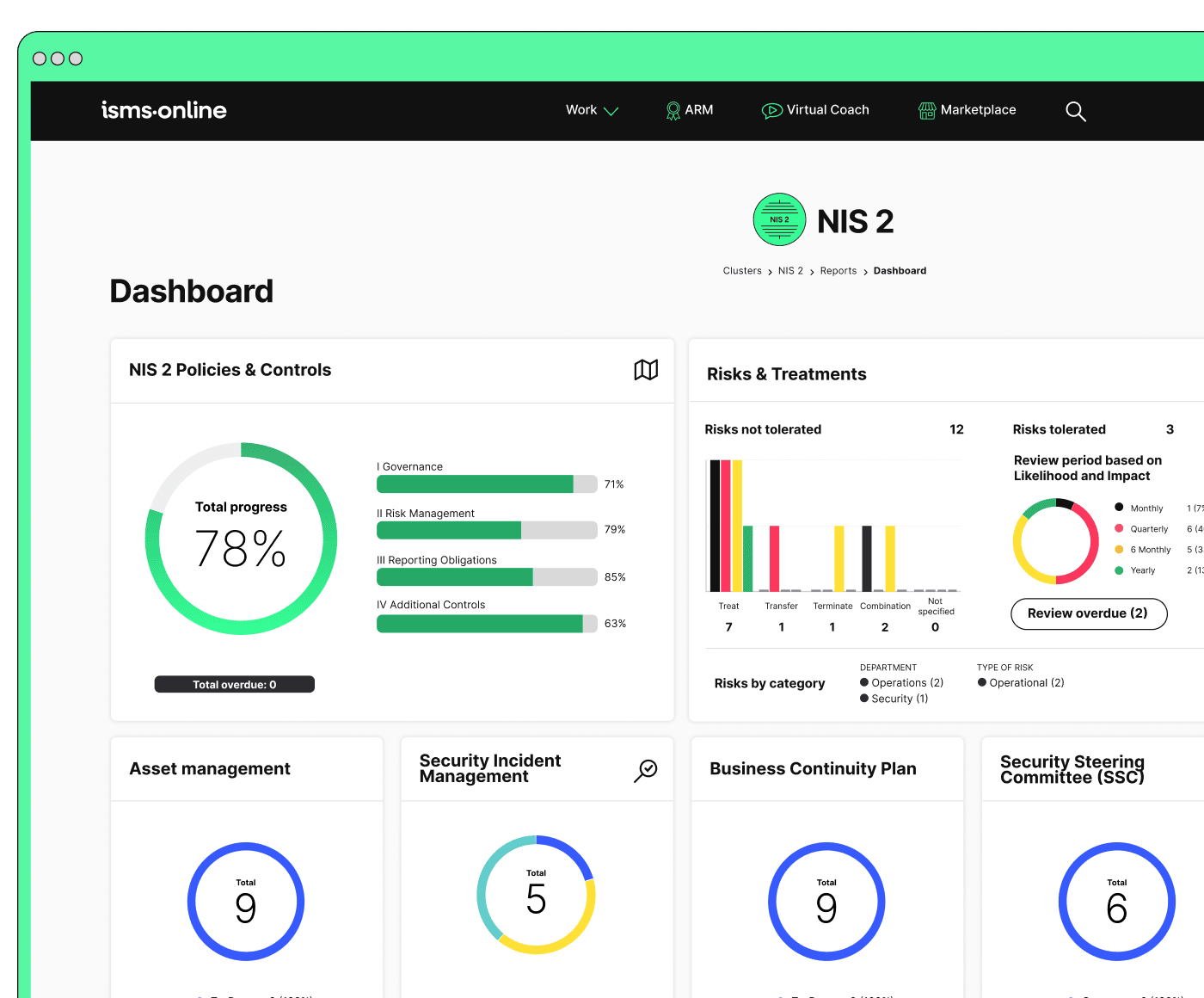
Be NIS 2-ready from day one
Launch with a proven workspace and templates – just tailor, assign, and go.
What are the new supply chain and third-party requirements, and what does “audit-proof” evidence look like?
Neglect the chain, and risk breaks outward-attackers always test your weakest supplier first.
NIS 2 forces supplier risk into the audit spotlight. No longer is it enough to file away contracts or single-name suppliers. Operators must now show:
- Recurring, independent risk reviews for every supplier-timestamped, board-traceable, and tied to their change records.
- Contracts mapped to controls, with active logs of third-party incidents, escalations, and monitoring steps.
- Board-acknowledged logs of every incident, escalation, or unremediated risk.
- Remediation paths tracked from open to close, with delays or failures routed automatically to the next review.
Common supply chain failings:
- Not performing or documenting annual/independent supplier risk reviews.
- Supplier incidents not escalated or logged in time.
- “Remediation complete” marked without updating the board or logging the action.
Is your business continuity and disaster recovery programme robust enough for NIS 2 auditors?
A backup untested is a backup untrusted.
NIS 2 brings business continuity and disaster recovery (BCDR) up to the level of direct regulatory oversight. What’s non-negotiable:
- Offsite backups that are tested and restorable; drills must simulate realistic threats.
- Annual scenario-based exercises-results logged and actioned, including both successes and failures.
- Each scenario matched to specific sector risks (targeted for water utilities, not generic disaster lists).
- Gaps, failures, and lessons learned must update your risk registers and BCP/DRP documentation immediately.
Imagine:
Your DR drill fails. That failure triggers a board agenda item, an update to corrective actions, and new tracking in the living risk register. No update? It’s a compliance finding-not just an operational issue.
Critical BCDR hazards:
- Skipping backup tests or failing to document results.
- Generic BCPs not updated for sector-specific or emerging risks.
- BCP/DR gaps not feeding into risk reviews or board decisions.
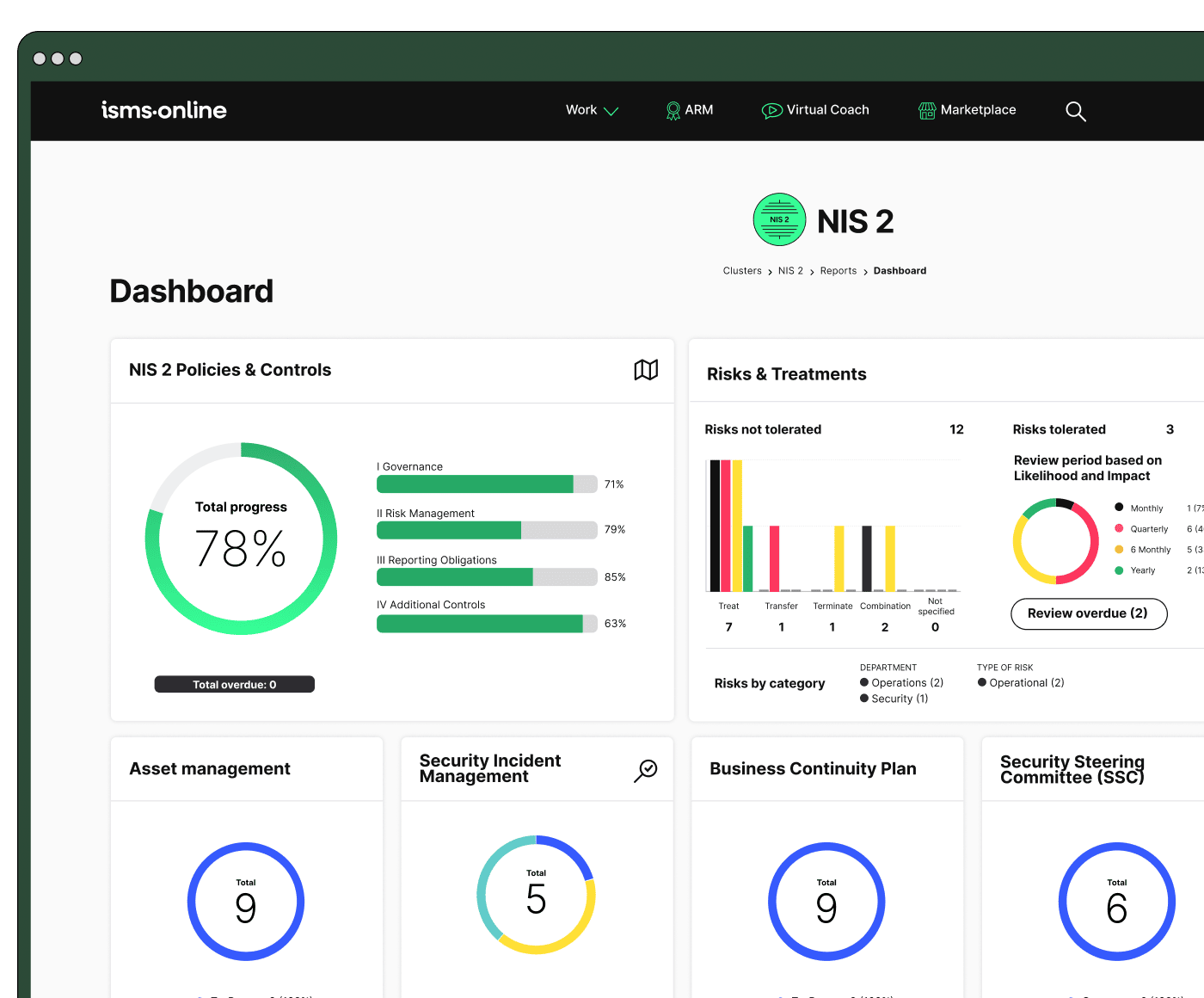
All your NIS 2, all in one place
From Articles 20–23 to audit plans – run and prove compliance, end-to-end.
What documentation and “proof points” maximise both audit and board assurance in the waste water sector?
Regulators and auditors are increasingly looking for evidence that is current, traceable, and board-reviewed. Static documentation is a liability-NIS 2 demands a “living annex” approach:
- Keep live policy packs and guidance, all linked to logs, supplier reviews, and change management evidence.
- Maintain a “living annex dashboard” where new regulatory, sector, or risk updates are instantly mapped to controls and evidence logs.
- Log every control revision, incident resolution, and supplier risk assessment with signatures and revision histories. Meeting minutes and board actions are treated as live artefacts.
Audit trust grows from transparency-real resilience is visible in every log, not just every win.
Avoidable pitfalls:
- Static logs with no revision trail.
- Missing board sign-off on updated mitigation or resilience actions.
- Change management events that aren’t mapped directly to risk or control registers.
Bottom line: Transparency via linked records and direct board involvement turns compliance from an exposure into one of your strongest audit shields.
Book Your “Audit Readiness” Identity Review with ISMS.online Today
The forward-thinking utility operator addresses NIS 2, ISO 27001, and ENISA together-by adopting a living, board-visible compliance mesh, not a pile of static reports. ISMS.online offers an “audit readiness” identity review that benchmarks your risks, controls, and evidence trail against sector and regulatory standards (isms.online).
We map your assets, drills, recovery tests, incidents, and supplier reviews-live-onto a dashboard accessed by both auditors and the board. Every improvement, failure, lesson learned, and new risk is recorded for continual assurance.
Start by downloading a self-review checklist, or book a walkthrough; see first-hand how evidence logs, incident mapping, and board-ready dashboards drive real resilience for utilities. Make every step in your compliance journey auditable, every board review a source of lasting trust.
Compliance is no longer hidden-let transparency become your defining strength before the next regulatory review.
Frequently Asked Questions
How does NIS 2 change daily compliance expectations for waste water utilities in 2025?
NIS 2 transforms your utility from passively maintaining policies to actively proving resilience, every single day. Under the directive, every plant-regardless of size or legacy infrastructure-must demonstrate living, audited evidence that all key risks, assets, incidents, and decisions are tracked, managed, and reviewed at board level (NIS2 Directive – Article 3, 23, 20).
The old cycle of annual risk reviews is replaced by continuous mapping: every piece of OT/IT (from pumps to PLCs and remote sensors) must be listed, assigned to owners, and updated after any significant event. Incidents-whether minor or major-must be logged, investigated, and closed with board oversight, not simply recorded and forgotten.
Tomorrow’s utilities are defined by living resilience, not paperwork perfection.
All operators-including micro-utilities and distributed plants-are reclassified as “essential entities.” This means board sign-offs on risk and policy have real legal teeth, and missed evidence or late incident notifications can trigger fines. Daily operation now demands real-time asset and vendor inventories, supply chain oversight, and instant access to logs and policy reviews for auditors or regulators. Expect stricter, more frequent audits and regulator interventions; static policies and archived logbooks no longer suffice.
Which frameworks must waste water utilities master to achieve NIS 2 compliance in practise?
NIS 2 consolidates fragmented regional rules under a single pan-EU regime, setting ISO 27001 as the spine, CEN/TS 18026 for continuity, and ENISA sector guidance as operational blueprints (ENISA, 2023). Statutory compliance is now defined by interconnected, digital evidence:
- Asset registers,
- Risk and incident logs,
- Supplier documentation,
- Live policy audits.
Each register or control must link directly to a framework reference (ISO/IEC 27001, ENISA guidance, or CEN/TS 18026). Systems must be unified and “living”-no more silos, binders, or periodic catch-up. Registers, incidents, controls, and supply chain risks must sync across teams, updated as situations change. Gaps, drift, or isolated spreadsheets immediately put your organisation at audit risk.
Framework Reference Mapping (Sample)
| Operational Requirement | Framework(s) | Evidence/Linkage Type |
|---|---|---|
| Risk register, owner review | ISO 27001 A6.1, A8.2 | Dashboard, board sign-off, quarterly log |
| Incident logging | ENISA, ISO 27001 A5.25–A5.26 | Timestamped escalation, closure trail |
| Supply chain assessment | ISO 27001 A5.19–A5.21, ENISA supply | Contract audit logs, vendor evidence |
| Business continuity/drills | CEN/TS 18026, ISO 27001 A5.29–A5.30 | Annual test logs, scenario records |
How do board governance and risk management shift for water utilities under NIS 2 rules?
Board involvement is now a living requirement, not a paperwork formality. If you handle risk management as a calendar event, you’re no longer compliant. Leadership must actively review and sign off “living registers” of risks, asset ownership, controls, and remedial actions-quarterly is the norm, but higher-risk contexts may demand monthly reviews (ENISA, 2024). Every risk register entry, change, and closeout must be timestamped and mapped to board-level decisions, assignments, or policy acceptance.
Board silence is a compliance failure-the audit trail must show clear, documented review, challenge, and closure of risks, supply gaps, and incidents. “Rubber stamps” and late sign-offs won’t satisfy regulators. Failures to assign named owners, close findings, or log management actions are evidence of systemic risk.
Resilience is visible in how fast risk updates are logged and acted upon-not just at audit time, but every day you run your operations.
What incident reporting, logging, and audit trail rules does NIS 2 impose on water utilities?
NIS 2 sets out precise, time-bound rules for significant incidents:
- Within 24 hours: An early warning must be issued to your national CSIRT/ENISA.
- Within 72 hours: A detailed notification covering impact, status, and next steps.
- Monthly (or as needed): Progress updates, ongoing until risk is remediated.
Every step-detection, notification, closure-must be time-stamped, mapped to asset and risk registers, and logged with detail. Delayed or incomplete logs are not just audit findings-they are trigger points for fines or regulator intervention. Each incident must trigger a fresh risk review and, where relevant, a root-cause remediation plan.
Incidents that span borders or suppliers must also be reported higher up the chain, so cross-country risks are managed and logged.
Incident Traceability Table (Live Example)
| Trigger | Risk Updated | Linked Control | Evidence Logged |
|---|---|---|---|
| Pump SCADA hack | Owner assigned, status updated | A8.8, A5.25 | Closure log, management sign |
| Supply fail | Supplier risk amended | A5.21, A8.30 | Contract/test results |
| Flooding | BCP drill record | A5.29, CEN/TS | Drill log, scenario test |
What are the supplier, OT/non-IT, and third-party compliance duties under NIS 2?
NIS 2 expands your compliance surface to every supplier and non-IT vendor. Supplier risk is now your risk. All contracts must embed NIS 2 clauses, evidence requirements, and responsibilities for incident reporting and remedial action (ENISA, Supply Chain Security).
Every supplier-chemicals, field engineers, SCADA integrators-must have an up-to-date risk assessment, contract evidence, audit log, and performance review. Board-level contingency plans for high-risk suppliers, and prompt escalation for any failures, are non-negotiable. Gaps in supplier logs or contract evidence are red flags for auditors.
Annual (or more frequent) reviews of all contracts, results, and risk performance are now the minimum expectation.
How is business continuity, disaster recovery, and resilience redefined by NIS 2?
Stamped, “policy in a drawer” BCP/DR plans are obsolete. Utilities must run annual scenario drills, cross-link them to real hazards, remediate gaps, and keep detailed logs, board reviews, and signed test outcomes. Backup validation, offsite storage, and direct linkage between BCP/DR outcomes and live incidents are regulated requirements.
All test logs, drill outcomes, and BC updates must be accessible for audit, showing organisational learning, plan improvement, and remedial actions. Integration with frameworks such as ISO 27001 and CEN/TS 18026 is essential to satisfy both regulatory and operational demands.
ISO 27001 Bridge Table for Audit Ready Documentation
| Expectation | What You Show Auditors | Reference |
|---|---|---|
| Live risk review | Dashboard, quarterly sign-off | A6.1, A8.2 |
| Updated BCP/DR | Drill logs, board approval | A5.29, A5.30 |
| Supplier review | Audit files, contingency plan | A5.19, A8.30 |
| Incident closures | Log, report, closure evidence | A5.25, A5.26 |
How does ISMS.online give water utilities the operational advantage under NIS 2?
ISMS.online arms water utilities with a unified, digital platform-no more spreadsheets, silos, or binder catch-up chaos ((https://isms.online/)).
All assets, suppliers, controls, risk registers, and incidents are mapped, assigned, and tracked in real time, with automated logbooks and board-ready sign-off. Dashboards track every control, owner, test, and update-enabling instant audit retrieval, effortless evidence collection, and frictionless notification and escalation workflows.
Resilience is the evidence you produce every day-not just what you promise during an audit.
Utilities leveraging ISMS.online report audit preparation reduced by half, and “zero non-conformity” audits in under three months.
Move from compliance anxiety to operational confidence: map your risks and assets, assign owners, use live Policy Packs and To-dos, and present your board and regulators with daily proof of resilience.
Define your operation by what you can show-not just what you say.






