





































Why Are Banks and Insurers Facing Simultaneous Compliance Deadlines in 2024–2025?
There’s no coincidence in the collision of NIS 2 and DORA timelines. If you’re running a compliance programme in Europe’s banking or insurance sector, you’ve got a front-row seat to a regulatory double act designed to raise the entire industry’s operational bar-with the stress of parallel deadlines as the price of admission. This is not just paperwork: the stakes include your licence to operate, your credibility with board and customers, and your resilience against digital and legal shocks.
Stress comes not from regulatory ambition, but from overlapping, uncoordinated deadlines.
Unlike previous years when compliance regimes followed their own slow or localised rhythm, 2024–2025 is distinct for its deliberate convergence. NIS 2 (Network and Information Security Directive 2) brings an amplified scope for critical infrastructure-now explicitly including financial services. At the same time, DORA (Digital Operational Resilience Act) lands with a direct, all-at-once enforcement model for banks, insurers, investment firms, and their ICT supply chains.
Dual Deadlines: Why Now and Why Both?
Deadlines aren’t just calendar events-they’re the organising heartbeat of compliance. NIS 2 technically lands in October 2024, but with member states scrambling to transpose it, enforcement becomes staggered. DORA, on the other hand, is a regulation: it hits everyone at midnight on January 17, 2025. For compliance managers, this means an intense four-month stretch where documentation, audits, training, and system upgrades for both must run concurrently across the same personnel and technology estate.
- NIS 2: Varies locally-start tracking now for your local law’s effect date, usually Q4 2024 to Q1 2025.
- DORA: No excuses, no grace period-January 17, 2025, is the starting pistol for banks, insurers, and their critical ICT providers.
- Your teams: Documentation, evidence mapping, board signoffs, technical testing-all must interweave for both frameworks.
According to ENISA, “Regulated entities should anticipate a compressed implementation window and proceed with parallel-track planning to avoid audit and enforcement risks” (ENISA NIS2 Incident Reporting, 2024).
Who Feels the Pinch?
No one is immune. Large banks juggling cross-border business and mid-sized digital-first insurers both find themselves in scope. Even fintechs formerly on the regulatory fringe now face explicit inclusion-because both customer trust and systemic continuity hinge on harmonised, robust controls. EIOPAs 2024 bulletin acknowledges: No institution can afford to delay integrated action; simultaneous documentation, technical, and training demands are significant. Holding out hope for local exceptions could leave your readiness-and your board-at risk.
A dual-regime compliance dashboard becomes your north star. Picture two prominent countdown widgets for NIS 2 and DORA, red-lining toward their respective dates, with real-time tickers for pending policy updates, supplier attestations, and board approvals.
Book a demoWhat Key Differences Between NIS 2 and DORA Shape Your Compliance Strategy?
On the surface, NIS 2 and DORA echo each other-digital resilience, operational continuity, incident reporting, and board accountability. But for anyone responsible, the devil is not just in the detail but in the legislative DNA: NIS 2 is a directive (local translation, some wriggle-room), while DORA is a direct-action regulation (instant, uniform, no adaptation). Missing these distinctions means duplicate work, audit confusion, or outright enforcement risk.
Unlike a directive, a regulation is immediately enforceable in all member states… There’s no transitional leeway.
DORA: Direct, Pan-European, and Uniform
DORA’s force is blunt and clear:
- Who: Applies, without delay, to banks, insurers, payment firms, investment companies, and their critical ICT providers-if you’re in the value chain, your compliance is non-negotiable.
- What: Spells out risk management obligations, incident classification and notification (pan-EU), threat-led penetration testing (TLPT), rigorous third-party risk management, and board-level engagement.
- How: National regulators (e.g., BaFin, ACPR, Banca d’Italia) police enforcement, but are bound by a single book-interpretation is minimal by design.
NIS 2: National Variance in the Details
By contrast, NIS 2’s directive form means:
- Translation: Each Member State must pass its own enabling law-timing can vary, and so can reporting workflows, sector thresholds, or audit detail.
- Agency: Your regulator could be the BSI (Germany), ANSSI (France), or a combination (sectoral or national).
- Local spice: Expect “over-implementation” in Germany (KRITIS/NIS 2+), extra digital readiness drills in France, or contract nuances in the Netherlands.
Convergent Yet Divergent: Where Strategies Go Wrong
The effect is twofold: requirements may “overlap” in function but diverge in how, when, and to whom you report, test, or escalate. Touchpoints like breach notification, risk logs, or supplier evidence must be mapped and de-duplicated to avoid time-wasting (or worse, conflicting evidence). In the words of the European Banking Federation: “Divergent incident thresholds and audit triggers across agencies heighten the challenge of harmonised evidence” (EBF Policy Statement 2024).
The calendar is the easy part. Mapping one set of controls, tests, and evidence across two regimes is the real work.
A feature in ISMS.online compares NIS 2 vs DORA: each essential control in scope mapped column-wise, gaps and overlaps flagged, giving compliance and audit teams a shared “Rosetta Stone” for assignments and sign-offs.

Master NIS 2 without spreadsheet chaos
Centralise risk, incidents, suppliers, and evidence in one clean platform.
How Do Implementation Timelines and ‘Grey Zones’ Affect Compliance Readiness?
On paper, differing national go-live dates for NIS 2 offer wiggle room. In reality, they act more like moving targets than guardrails. The truth is, multinational and even regional banks and insurers operating on or across national borders must prepare for enforcement driven by the “first-mover” and by the pan-EU force of DORA.
Firms operating across borders face heightened audit risk; misalignment can result in conflicting requirements and increased regulatory scrutiny. (openkritis.de, EU deadline monitor)
Timeline Table: Navigating National and EU Dates
Building a unified, accurate timeline ensures you don’t fall into fatal misalignment. Here’s a distilled operational overview for key markets:
| **Country** | **NIS 2 Go-Live Date** | **DORA Effective Date** | **Enforcement Agency** |
|---|---|---|---|
| Germany | March 2025 | Jan. 17, 2025 | BSI + BaFin |
| France | Dec. 2024 | Jan. 17, 2025 | ANSSI + ACPR |
| Netherlands | Oct. 2024 | Jan. 17, 2025 | NCSC + DNB |
| Italy | Pending | Jan. 17, 2025 | AgID, Bank of Italy |
| Spain | Oct. 2024 | Jan. 17, 2025 | INCIBE + Bank of Spain |
| Poland | Oct. 2024 | Jan. 17, 2025 | CERT.PL + KNF |
| EU (all) | National variance | Jan. 17, 2025 | ESAs (EBA/EIOPA/ESMA) |
This table migrates directly into your ISMS.online implementation tracker-giving legal, IT, and audit teams a single view of deadlines and responsibility.
Double Risk: The Enforcement and Evidence Gap
A key challenge is the “grey zone”: When NIS 2 remains partially adopted, but DORA lands hot, teams face real risk of over-reporting (wasting resource and triggering regulatory scrutiny), or under-reporting (incurring penalties or eroding board trust). ENISA underscores the point-“Double jeopardy is the new normal for digital risk teams… cross-agency harmonisation should occur well before deadlines” (ENISA 2024 Regulatory Landscape).
Timelines don’t protect, but well-scoped evidence mapping does-don’t bet on grace periods from risk and audit committees.
Imagine the risk register as a live dashboard, shading “grey zones” by country and deadline so your compliance team sees-at a glance-where additional evidence or stakeholder action is needed, not where to gamble on slow adoption.
Where Do NIS 2 and DORA Collide Operationally: Testing, Incidents, and Supply Chains?
Even the best-laid compliance calendar risks confusion the moment two regimes trigger the same event with different expectations. For digital leaders in banking and insurance, three battlefronts demand daily clarity: incident handling, resilience testing, and supplier oversight.
Conflicting reporting flows can cause audit trail gaps and leave your team exposed. (eba.europa.eu, incident FAQs)
Incident Response-Double Reporting, Double Consequence
Both NIS 2 and DORA expect immediate, accurate reporting of “major” ICT incidents, but with different timelines, escalation paths, and sometimes even divergent definitions of “critical.” In 2023, the EBA noted a “45% increase in incident notification volume, driven by overlapping deadlines and regulators” (eba.europa.eu, Incident Statistics 2024).
- Under NIS 2: You must notify your national CSIRT, with timing that varies by country, detail, and event scale.
- Under DORA: You must immediately alert pan-EU authorities, often through a harmonised digital portal, regardless of local nuances.
Penetration Testing-Different Standards, Common Goals
DORA mandates sector-wide threat-led penetration tests (TLPT) for all critical financial entities-a technical and procedural leap, typically handled via independent red-team testing at least annually. NIS 2 expects regular resilience and continuity testing, but allows national authorities room for discretion and frequency adjustments. One team may face dual test preparation, or worse-overlapping audit windows.
Supplier & Vendor Risk-Navigating National and EU Lanes
DORA introduces new rigour for managing “critical ICT suppliers”: thorough assessments, official registries, and mandatory incident reporting by vendors. NIS 2 can add national benchmarks: in some states, banks and insurers must require supplier attestations, while in others, extra contractual obligations or additional regulatory approval is needed.
| **Scenario** | **NIS 2** | **DORA** |
|---|---|---|
| Report cyber incident | Notify national CSIRT (timing varies) | Notify EU authorities “immediately” |
| Onboard new supplier | Add to national registry, attest controls | Assess as “critical”; elevate controls |
| Schedule pen-test | BCP/DR drills; document results | TLPT required; external assurance |
Operational realignment requires platforms that orchestrate both: ISMS.online’s control and incident modules let teams run scenario-based dual-regime rehearsals-workflow, evidence, and audit logs coalesce, no matter which regime is driving the schedule.
By testing incident notification through both regimes in a single rehearsal, teams cut notification lag and plugged audit trail gaps in advance.
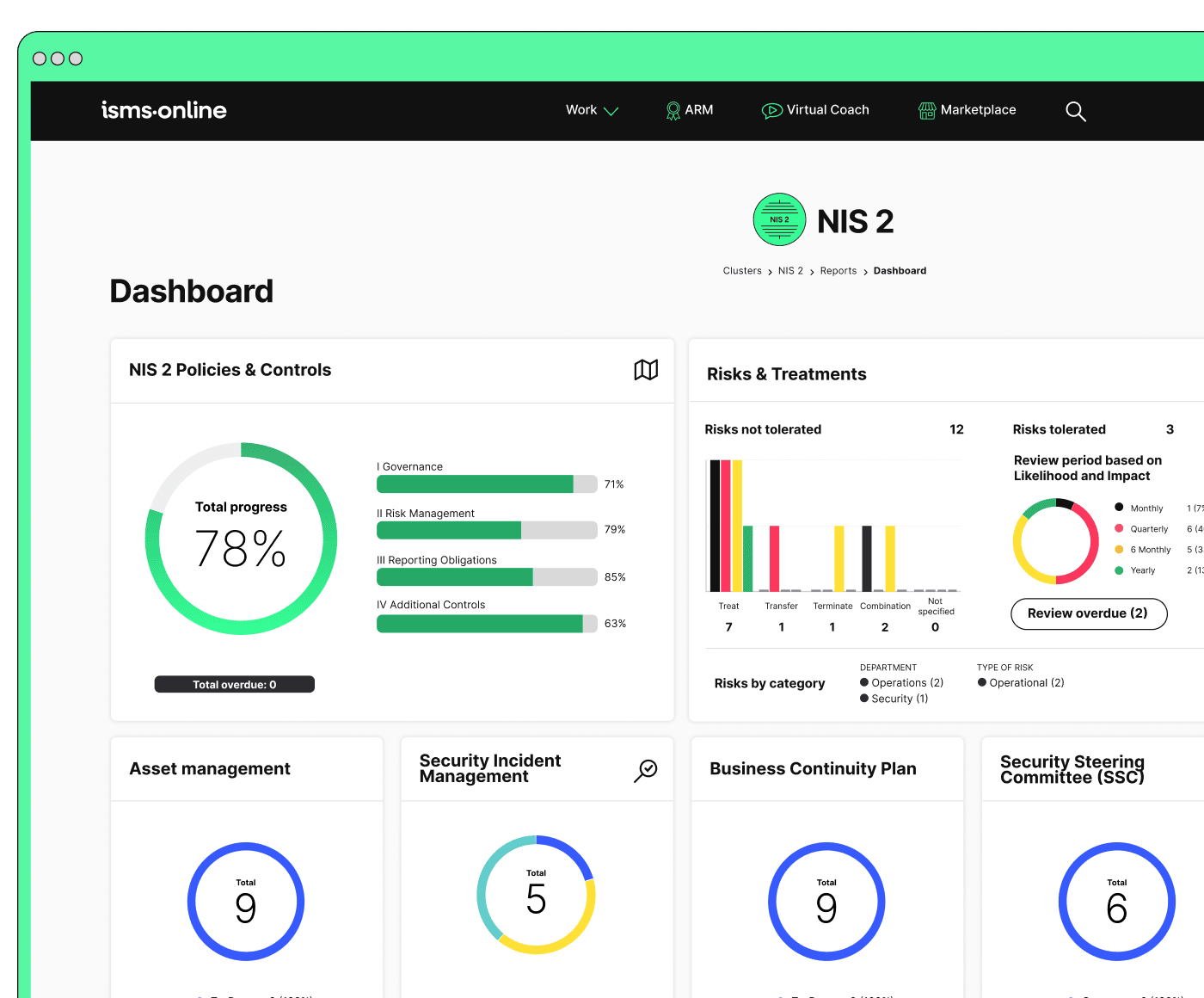
Be NIS 2-ready from day one
Launch with a proven workspace and templates – just tailor, assign, and go.
How Do Industry Guidance and Peer Tools Convert Chaos Into Confidence?
No one wins compliance by checklist alone. In the real-world crunch of Q4 2024–Q1 2025, the difference between teams that struggle and those that audit smoothly will come down to two assets: authoritative playbooks and systems that can turn advice into action.
A checklist is a commodity. A peer-reviewed playbook is a compass-especially under two fast-moving regimes.
Playbooks: From Checklists to Navigational Charts
Industry alliances such as the European Banking Federation (EBF) and Insurance Europe regularly update sector-specific checklists-but top-performing teams reach for dynamic playbooks: mapped workflows, controls libraries, and real incident walkthroughs. These resources reflect the lived pain points exposed in regulatory reports from EBA and ENISA, reinforcing practises that withstand scrutiny and encourage proactive documentation, not simply box-ticking.
A recent ENISA report underscores this: “Firms using integrated controls platforms reported 31% fewer material breaches-best practise adoption is more than compliance” (ENISA 2024 Regulatory Landscape, p.4).
Peer-Validated Platforms: Practise, Not Just Papers
Platforms like ISMS.online embed these peer-best-practises as living templates-dual-regime Policy Packs, supply chain workflow overlays, and audit-ready scenario planners. Instead of static PDFs, your compliance roadmap becomes a constantly updating asset, underwritten by regulator-approved evidence and cross-team acknowledgment.
Policy Pack Template with Dual-Regime Columns-an interactive compliance map within ISMS.online, aligning every control assignment across both NIS 2 and DORA for rapid auditor confidence.
Moving from static to living compliance gives your teams both the operational confidence and the artefacts that examiners recognise as board-grade proof.
How Do Integrated Controls Platforms Like ISMS.online Create One Source of Truth?
At the heart of dual-regime compliance is the reality that evidence must not simply “exist,” but be mapped, living, and instantly exportable. When the CISO or compliance officer can point to a dashboard where every NIS 2 and DORA requirement is tied to live controls, documented training, scheduled policy reviews, and actionable audit logs, audit stress is replaced by control.
Bridge Table: From Expectation to Evidence-ISO 27001 Mapping
A key tactic: mapping operational actions directly to standards, including ISO 27001/Annex A, serving as the “spinal cord” linking DORA and NIS 2.
| **Expectation** | **Operationalisation** | **ISO 27001 / Annex A Reference** |
|---|---|---|
| Board sign-off on controls | Documented executive approval, role-linked | 5.2, Annex A 5.1 |
| Incident management workflow | Defined, tested, and documented process | 6.1.3, A 5.23, 5.24 |
| Supplier risk mapping | Central registry, contracts reflect law | A 5.19, 5.20, 5.21 |
| Staff training/evidence | Acknowledgement tied to policy update | 7.2, A 6.3, 7.8, 7.9 |
| Audit trail accessibility | Linked work, time-stamped logs | 9.2, A 5.35, 8.15, 8.16 |
Digital platforms that tie these together-like ISMS.online-transform the compliance calendar from a bureaucratic burden into a truly proactive risk and evidence engine.
With live dashboards, we reduced audit prep time by 40% by mapping NIS 2 and DORA controls at the source. (ISMS.online customer feedback 2023)
Real-Time Compliance Dashboard-key risk indicators, board approval status, and training acknowledgements updated automatically, integrating evidence for both regimes in one export view.
One audit, one set of proof, two regimes satisfied-without last-minute panic or disconnected artefacts.
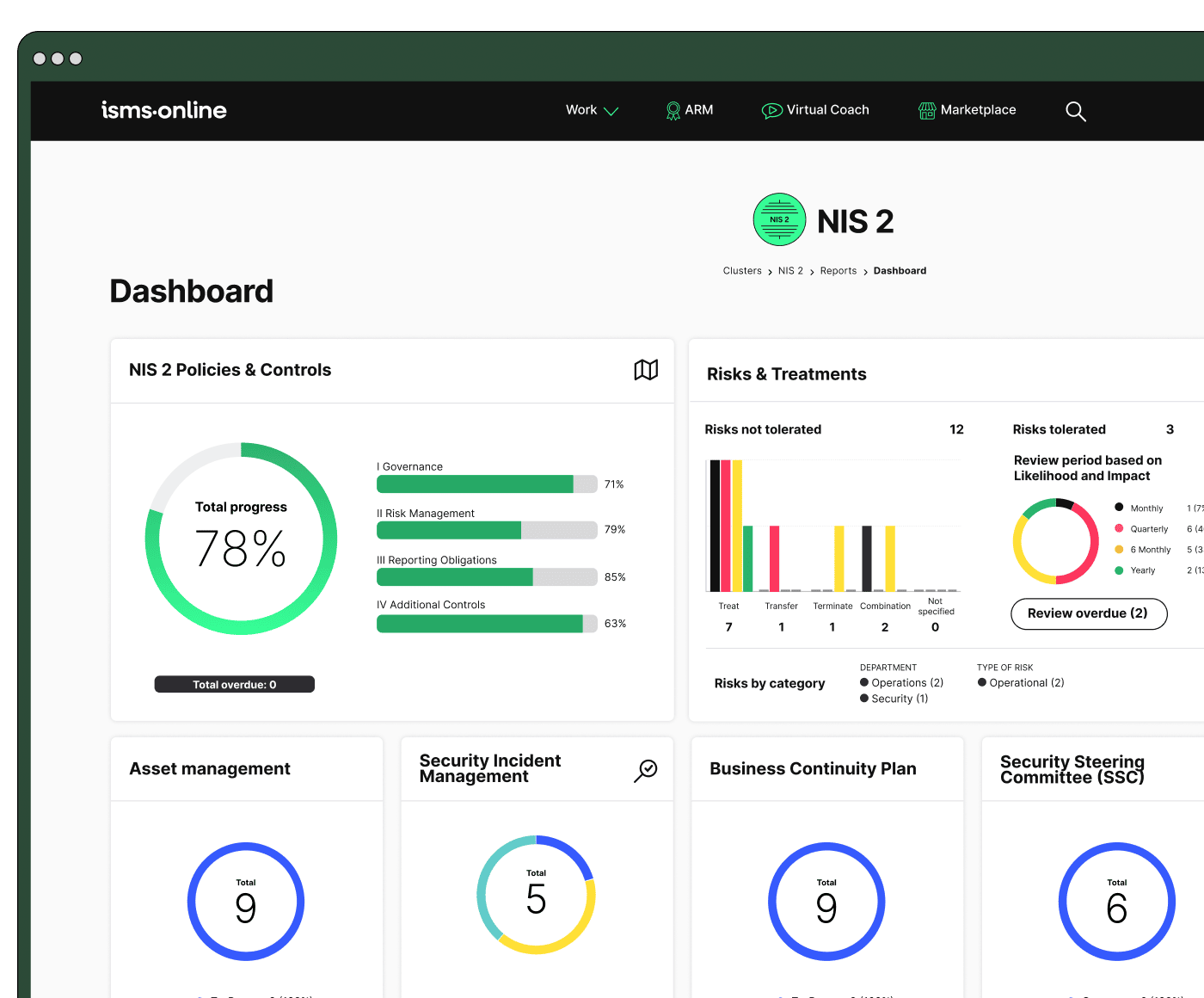
All your NIS 2, all in one place
From Articles 20–23 to audit plans – run and prove compliance, end-to-end.
How Can You Demonstrate Dual-Regime Audit Readiness & Continuous Compliance?
Proving to regulators and your own board that you’re “ready” for both NIS 2 and DORA is no longer a paperwork dance-it’s about showing, live and at any moment, exactly how each event or trigger flows to your risk log, control update, evidence folder, and sign-off chain. Systems like ISMS.online make this traceability visible and actionable.
Traceability Mini-Table
A robust compliance posture means that for every compliance trigger (supplier onboarding, incident detection, policy update, regulatory change, or business continuity drill), your system automatically maps the event to a specific control, ownership, and logged evidence.
| **Trigger** | **Risk update** | **Control / SoA link** | **Evidence logged** |
|---|---|---|---|
| New supplier onboarded | Third-party risk assessed, signoff | A 5.20, SoA onboarding | Signed contract, onboarding log |
| Suspected incident detected | Incident workflow started, notified | A 5.24, 5.23 | Alert, authority notification |
| Policy update required | Linked control revised, staff notified | 5.2, 7.2, SoA ISMS policy | Signed policy, action log |
| Reg change flagged | Gap analysis, evidence checked | 6.1.1, SoA Reg update | Mapping checklist, decision log |
| BCP/DR drill completed | Actions logged, board reviewed | 8.4, A 8.29, 8.33 | Drill report, correction log |
In ISMS.online, this matrix sits at the heart of the quarterly management review and pre-audit workflow, ensuring that “proving readiness” is not a chore, but an everyday standard operating procedure.
Dashboards with KPIs, timeline, and real role acknowledgment turn fire drills into rolling reviews. (ISMS.online user review 2024)
Traceability Matrix-interactive and exportable, visible to board, audit, and operations teams for instant validation at every assessment checkpoint.
Our auditor walked the chain from incident to staff training to board sign-off in one click-no piles, no panic.
What Are the Next Critical Steps to Achieve Smooth NIS 2 and DORA Compliance?
The path to dual compliance is not a marathon you run once, but a continuous relay-handoffs between operations, compliance, IT, audit, and the board. Too many teams still misread the deadline as a “finish line”; in reality, resilience is built in the rhythm of daily work, review, and documentation. Success depends on operationalising that rhythm ahead of the pinch.
Steps to Lock in Dual-Regime Readiness
- Align calendars early: Merge all compliance milestones into one detailed tracker, allowing for policy updates, risk reviews, training, and fire drills to overlap and reinforce each other.
- Clarify role ownership: Assign accountable leads for each regime (e.g., CISO for DORA/NIS 2, IT for technical controls, procurement for supplier chains) and record responsibilities in your ISMS platform with automated reminders.
- Automate evidence: Leverage digital platforms to tie controls, approvals, incident notifications, and change logs together-avoiding duplicative reporting and the drag of after-the-fact reconciliation.
- Audit against peer and authority guidance: Schedule monthly reviews of the latest ENISA, EBA, EBF, and local authority publications-integrate living best practises, not just compliance checklists.
- Run dual-regime drills: Stage incident and continuity rehearsals that hit both DORA and NIS 2 triggers; use playbooks with mapped evidence expectations by role, not just templates.
Readiness isn't about just having a plan-it's about demonstrable, continuous fitness for both regimes.
A 90-day rolling compliance roadmap embedded within ISMS.online, with visual cues for overlapping deadlines, monthly scenario drill reminders, and green flags for audited controls-putting “audit panic” to rest before audits arrive.
Strong teams don’t wait for the law to become clear-they build habits and systems that ensure they don’t fall behind when the calendar flips.
ISMS.online Today – See, Map, and Prove NIS 2 + DORA Compliance, Year-Round
With regulatory timelines converging, the choice for banks and insurers is clear: treat NIS 2 and DORA as twin pillars of a single compliance engine, not duelling sources of stress. ISMS.online was designed for this era-for teams who want year-round assurance, not last-minute panic.
Instead of scattered risk registers, offline approvals, or “evidence hunt” email chains, you operate a living ISMS: every policy, control, incident, and supplier record mapped to its correct regulatory clause, with real-time dashboards for board, audit, and regulators.
When examiners see harmonised evidence tied to real role ownership, audit stress dissolves-and your board sees resilience as a managed asset.
Live dashboards and workflow automations replace anxiety with clarity:
- Single source of truth: Policies, controls, incidents, training-all evidence and approvals tied to both DORA and NIS 2, accessible for audit or board queries at any moment.
- Peer-reviewed templates: ISMS.online integrates and updates sector-vetted policy packs, traceability matrices, and scenario playbooks, grounded in ENISA and EBA best practises.
- Automated resilience: Controls, fire drills, and supplier checks scheduled and logged-board-ready reports delivered at the click of a button; no more spreadsheet scramble.
This is what it means to move past deadline stress-your risk and compliance leadership is proven by continuous visibility, not by hope.
Move beyond deadline anxiety. Start today-see, map, and prove NIS 2 and DORA compliance with ISMS.online, and let resilience become your institutional advantage.
Stop treating compliance as a calendar event-make it a living asset for your institution, your board, and your customers.
Frequently Asked Questions
Who in a bank or insurer holds ultimate responsibility for NIS 2 and DORA compliance-and what are the personal risks if they fail?
Ultimate responsibility for NIS 2 and DORA compliance lies squarely with your board and executive management, not simply with IT or risk teams. Both regulations-NIS 2 (from October 18, 2024) and DORA (from January 17, 2025)-explicitly assign non-transferable legal obligations to directors, CISOs, Chief Risk Officers, and in particular, the board as a whole. This “active duty” means the board must approve, oversee, and review all security and operational resilience measures, with their engagement demonstrable in real time.
If key deadlines are missed, directors and executives face not just reputational fallout but direct regulatory sanctions, including personal fines and public censure. Regulators no longer accept generic sign-off or claimed delegation. Instead, they scrutinise meeting minutes, audit logs, and role-assigned reviews to validate leadership engagement. A lack of documentary evidence can lead to findings against the individual-not just the institution.
A passive board is now a direct regulatory target when resilience lapses-documented decisions are as critical as technical controls.
To mitigate these risks, successful organisations embed executive approvals, automatic reminders, and complete sign-off trails directly into their ISMS (information security management system). Platforms like ISMS.online track every review and sign-off-proving to boards, audit committees, and regulators that compliance isn’t just policy: it’s operationalised, monitored, and sustained.
How can you prevent missed or duplicate incident reports when juggling NIS 2 and DORA requirements?
NIS 2 and DORA each impose strict, yet differing, incident notification workflows-making overlaps (and errors) a high risk. Under NIS 2, any significant cyber event must be reported to a national CSIRT or competent authority within 24 hours of detection, expanded with further details inside 72 hours, and followed by a final summary. DORA, by contrast, demands near-instant reporting-sometimes within hours-to European Supervisory Authorities (ESAs), using prescribed digital templates.
DORA expects group-wide coverage (all banking and insurance arms included), while NIS 2 can require many local authorities in multiple jurisdictions. The risk? Double-reporting the wrong detail, conflicting timelines, or missing one regulator entirely-opening the door to fines and reputational hits.
The solution is dual-mapped, scenario-based playbooks:
- Create a consolidated, platform-based incident workflow that automatically triggers both NIS 2 and DORA notifications, based on incident type and jurisdiction.
- Integrate notification packs, templates, and timestamped logs, so evidence of reporting is defensible and standardised.
- Use a traceable dashboard to track incident status, ensuring that required follow-ups and summaries aren’t lost between teams or frameworks.
| Incident Type | NIS 2 Report | DORA Report | Key Audit Evidence |
|---|---|---|---|
| Ransomware | National CSIRT (24h/72h/final) | ESA (immediate, repeat follow-up) | Timeline, board sign-off |
| Data breach | Regulator, CSIRT | ESA (if “major” ICT event) | Impact analysis, escalation |
| Systems outage | CSIRT & supervisor | ESA (if critical business service) | Root cause, response chain |
When incident playbooks and logging are unified, notifications reach only the right regulator, deadlines are met, and confusion (and penalties) are avoided.
How do NIS 2 and DORA differ in third-party and ICT supplier demands-and how can you streamline overlapping obligations?
NIS 2 intensifies third-party security and supplier risk: every bank, insurer, or critical vendor must maintain an up-to-date supplier register, perform ongoing, risk-based due diligence, and inject cyber requirements into every contract. Authorities are increasing inspections of these registers and evidence of recertification.
DORA ratchets up the standard further. “Critical ICT third-party providers” (including cloud, software hosting, payment networks, and telecoms) come under direct ESA oversight-meaning these suppliers face resilience testing, explicit exit routes, breach escalation requirements, and EU-level audits. Financial services must not only vet suppliers before engagement, but also monitor, test, and log ongoing compliance-retaining the right to audit and, if needed, rapidly disengage in face of risk.
To cope, leading firms centralise supplier management on platforms such as ISMS.online:
- All vendors are categorised, risk-assessed, and tracked by criticality, status, and contract expiry.
- National contract clauses and ESA-mandated terms are assigned by supplier, with automatic reminders for renewal, recert, or exit-plan review.
- Supplier incident response, findings, and contract evidence are stored in a linked, audit-ready register-removing spreadsheet sprawl and closing the compliance gap.
A unified supplier register is now board-level risk capital: it arms you against both unexpected audits and supply chain disruption.
How does ISMS.online fuse NIS 2 and DORA into unified controls, workflows, and audit evidence?
ISMS.online is built to make dual regulation routine. Each policy, control, supplier, or incident workflow can be tagged for NIS 2, DORA, or any other standard (e.g., ISO 27001, GDPR). When you update a policy-say, “Incident Response”-you tag it for both frameworks, attach evidence, and role-assign review (board, CISO, audit).
This means one update flows through both compliance maps, presenting live proof for regulatory inspection:
- Every evidence artefact (meeting minutes, supplier acceptance, incident drill record) is logged with framework tags, timestamped, and traceable.
- Dashboards show at a glance where gaps remain, what evidence is stale or due, and which roles are accountable for the next step.
- When a regulator or internal audit requests a sample, they see the full lineage-from the compliance trigger (new supplier, incident, updated policy) to risk, control, and evidence-without digging through emails or manual logs.
Unified, living registers eliminate duplication and reduce compliance fatigue as the pace of regulatory change accelerates.
What should project leads and CISOs implement now for NIS 2 and DORA readiness in the next 6–12 months?
1. Fix your compliance calendar: Plot NIS 2 (October 18, 2024) and DORA (January 17, 2025) go-live dates. Assign board and operational owners for every major requirement (incident reporting, supplier reviews, policy updates).
2. Run a complete gap analysis: Use ENISA/ESA checklists or ISMS.online matrix templates to scan every policy, contract, workflow, and training log-identify overlaps and holes across frameworks.
3. Assign control-and evidence-owners: Every policy/control/supplier should have a named, accountable owner, with reminders for review, renewal, and drill. Ownership must be demonstrable in audit logs, not just in org charts.
4. Drill both frameworks at once: Conduct scenario-based incident simulations covering dual requirements, logging role-based responses and outcome reviews.
5. Automate regulatory monitoring: Track updates from authorities (Insurance Europe, EBF, ECB). Schedule updates to registers and workflows as guidance or law changes.
With these actions, your compliance engine is always-on and always-proof-ready-not stuck in last-minute scrambles or reactive reports.
How do compliance leads and boards demonstrate continuous, dual audit readiness and improvement to regulators and stakeholders?
Modern regulators and boards expect evidence of “living” compliance-not annual files. With ISMS.online (or comparable IRM platforms), you:
- Visibly map each compliance event-such as supplier onboarding, incident drills, or policy reviews-through a detailed chain:
Trigger → Risk Update → Control/SoA Link → Evidence Logged (timestamp, sign-off)
- Present not just policy documents but audit-ready logs, showing the who, what, when, and why for every risk decision, control sign-off, and evidence file.
- Export or share scheduled management reviews, renewal cycles, and ongoing training attestations, demonstrating progress and proactive improvement as requirements evolve.
| Trigger | Risk Update | Control/SoA Link | Evidence File |
|---|---|---|---|
| Supplier onboarded | Third-party risk | NIS 2 (A.5.20)/DORA (28) | Signed contract, risk assessment |
| Incident simulation | Ops resilience | DORA (6), NIS 2 reporting | Drill log, board minutes |
| Policy review | Governance risk | Both (A.5.4/9.3) | Log of approval, revised SoA |
Continuous, role-based audit trails ensure you’re always ready-directly answering both regulatory scrutiny and the board’s demand for reassurance as rules tighten.
Experience how unified ISMS, supplier registers, and workflow-driven evidence help your team and board lead with defensible, never-late NIS 2 and DORA compliance. Explore or book a walkthrough today to reclaim confidence and efficiency as deadlines converge.






