





































Business continuity keeps the organisation’s critical activities running during a disruption. Disaster recovery restores the technology those activities depend on. They are not competing approaches and they are not the same document. Continuity is a business discipline that decides what must keep going and how. Recovery is a technical discipline that rebuilds systems in a defined order, to targets the business set.
- Different owners: continuity usually sits with operations or risk, recovery with IT.
- Different triggers: continuity activates on business impact, recovery on technical failure.
- Different definitions of success: work continuing versus systems restored.
- One shared set of numbers, both taken from the same business impact analysis.
- The failures happen at the seam between them, not inside either one.
How do business continuity and disaster recovery actually differ?
Ask most people about business continuity vs disaster recovery and the answer comes back as scope: continuity is broad, recovery is technical. That is true, and it is not much use when you are deciding who writes what. The more useful separation is by what each discipline is accountable for and where it gets its instructions.
A continuity plan starts from activities. It asks which things the organisation does that cannot stop, how long each can be interrupted before the harm becomes serious, and what alternative way of working will hold in the meantime. Its output is a set of decisions about priority and workaround.
A recovery plan starts from systems. It asks what has to come back, in what order, to hit the timeframes continuity committed to. Its output is a runbook. The wider picture of how both sit inside a single capability is set out under business continuity.
| Business continuity | Disaster recovery | |
|---|---|---|
| Who owns it | Operations, risk or a dedicated continuity lead, with executive sponsorship. | IT or infrastructure, often the same team that runs the platform day to day. |
| What triggers it | Business impact reaching a threshold, whatever the cause, including causes with no technical component. | A technical failure or loss of a system, site or data set. |
| What recovered means | Critical activities are being delivered to customers again, by any acceptable route. | The named systems are running, reachable and verified against their data integrity checks. |
| Where the objectives come from | The business impact analysis, signed off by the people accountable for each activity. | Inherited from continuity. Recovery does not set its own targets. |
| What auditors ask for | Evidence of exercises involving the business, and that the priorities reflect current operations. | Evidence of restore tests with results, and that backups are actually recoverable. |
| What it costs to get wrong | Work stops even though the systems are fine, because nobody agreed the manual route. | Systems come back in an order that leaves the critical activity waiting longest. |
Who owns each plan, and why does that cause problems?
Split ownership is sensible. The people who know which customer commitments matter are not the people who know the restore sequence for a database cluster. The problem is not the split, it is that the two sides often write in isolation and only discover the mismatch during an incident.
Three patterns show up repeatedly. The first is a recovery plan with targets nobody in the business agreed, usually set from what the infrastructure can comfortably achieve rather than from what the activity needs. The second is a continuity plan that assumes a manual workaround which quietly depends on the same system that has failed. The third is the most common: both plans exist, both are technically sound, and neither says who declares an incident or who decides that normal service has resumed.
The fix is not a merger. It is a defined interface: shared objectives taken from the business impact analysis, one authority to invoke and stand down, and a joint exercise at least once a year where both sides are in the room.

There's a bigger picture behind this.
This page covers one part of business resilience. Real Resilience — IO’s framework for connecting security, privacy and AI governance — is where the full picture comes together.
Where does one hand over to the other?
Most incident post mortems that blame a plan are really describing a handoff that was never defined. Continuity and recovery run in parallel, not in sequence, and they touch at four points: the decision to invoke, the choice of what the business does while systems are down, the moment technology is declared usable again, and the confirmation that the business is genuinely back rather than merely connected.
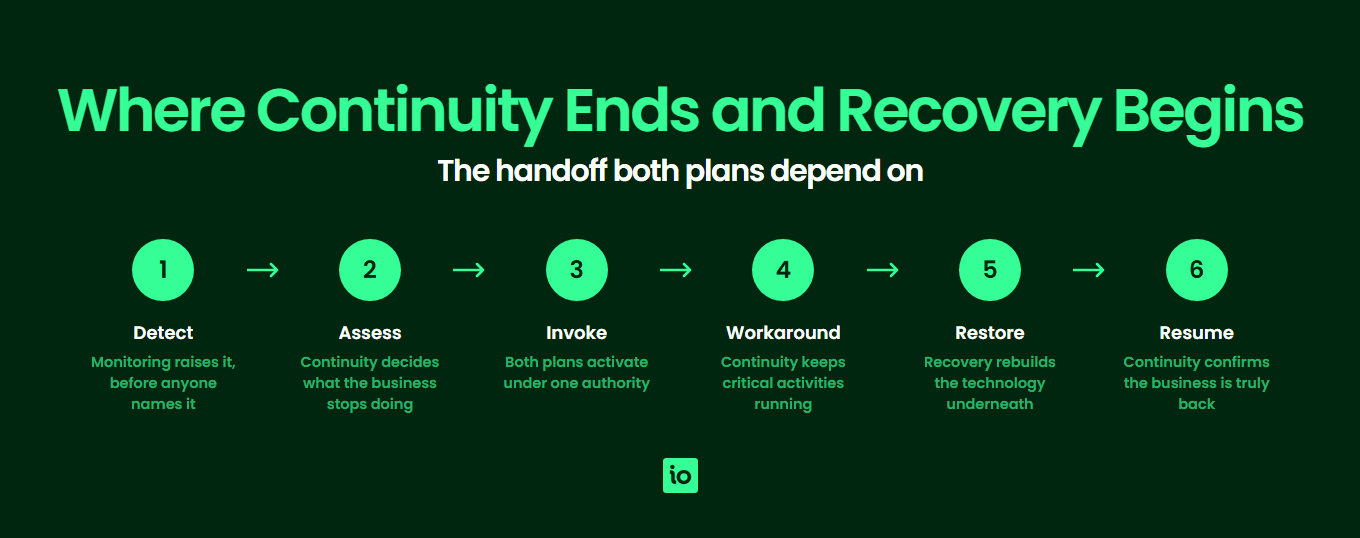
Note where the sequence starts. Detection is almost always technical, which is why so many organisations treat the whole event as an IT matter and involve the business too late. By the time the continuity decision is needed, the useful window for a clean workaround has often already closed.
What happens in the first 24 hours?
Both plans are active at once, doing different work. Setting this out explicitly is the single most valuable page in either document, because it removes the pause where everyone waits to see who moves first.
| Stage | Continuity is doing | Recovery is doing |
|---|---|---|
| First hour | Establishing which activities are affected and confirming who has authority to invoke. | Diagnosing scope, isolating the fault and confirming whether backups are intact. |
| Hours two to four | Standing up the alternative way of working and telling staff and customers. | Deciding whether to repair in place or fail over, and starting the restore. |
| Hours four to twelve | Keeping the workaround supplied with people and tracking what is accumulating undone. | Restoring in dependency order and verifying data as each layer comes back. |
| Hours twelve to twenty four | Managing fatigue, handovers and the growing backlog the workaround cannot absorb. | Bringing the remaining applications back and testing them against real transactions. |
| Beyond twenty four hours | Deciding when to stand down, then clearing the backlog in priority order. | Confirming full service, reconciling data written during the workaround. |
The last row is where most plans stop and most real incidents do not. Work done manually has to be reconciled into the systems afterwards, and a backlog cleared in the wrong order can cause a second disruption of its own.
Do you need both, or can one document cover it?
Small organisations often maintain a single document, and for a genuinely small operation that can work. The test is not size, it is whether the two audiences can each find what they need under pressure. An engineer restoring a database at three in the morning should not be reading about customer communications, and an operations manager standing up a manual process should not be paging through failover commands. What the continuity document itself should contain, and where each section gets its content, is set out under business continuity plan.
Keep them separate once either audience needs more than a page or two, and keep them cross referenced. What must never be duplicated is the numbers. If the recovery timeframe appears in both documents and they disagree, the plans will contradict each other exactly when that matters most. Set the objectives once, in the impact analysis, and reference them everywhere else. The detail of the technical document is covered under disaster recovery plan, and the scenario level beneath both sits in your contingency plans.
If your interest here is framework specific, the comparison scoped to a SOC 2 audit is covered separately in what SOC 2 requires of continuity and recovery.
Which standards cover each one?
The split shows up in the standards themselves, which is a useful sanity check on scope. ISO 22301 specifies a management system for business continuity: it is certifiable and it is about the organisational capability. ISO/IEC 27031 covers information and communications technology readiness for business continuity, which is the recovery layer. ISO 27001 connects them through Annex A, where control 5.29 addresses information security during disruption and control 5.30 addresses ICT readiness.
Working to those standards does not merge the two disciplines, but it does force the interface to exist. A management system has to show that the technical readiness serves the business priorities, which is exactly the seam that fails when nobody is asked to demonstrate it.
ISO 27001 made easy
An 81% Headstart from day one
We’ve done the hard work for you, giving you an 81% Headstart from the moment you log on. All you have to do is fill in the blanks.
How does the pair fit into business resilience?
Continuity and recovery both answer the same question: what happens when something breaks. Resilience answers a broader one. It is the capability to absorb change of any kind, including disruptions you never wrote a plan for and obligations that did not exist when you wrote them. Both plans are components of it rather than substitutes for it.
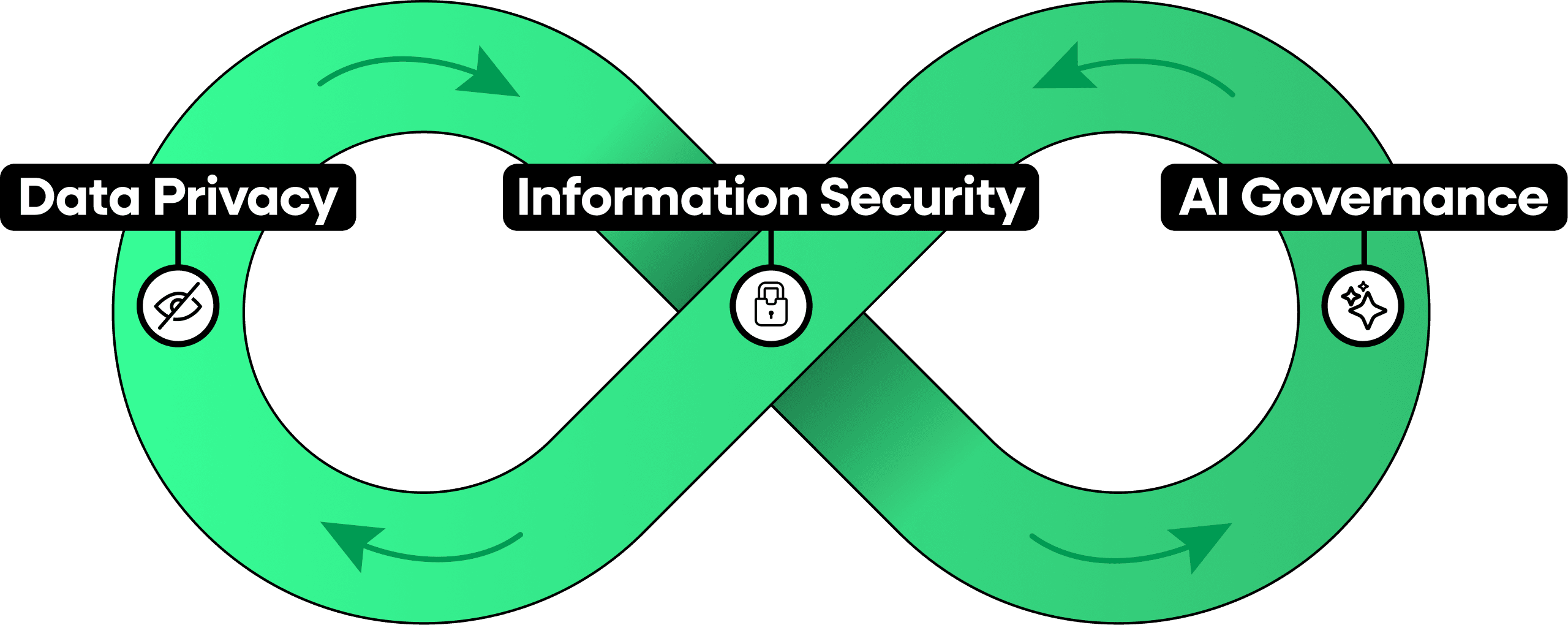
The Resilience Loop runs information security under ISO 27001, data privacy under ISO 27701 and AI governance under ISO 42001 as one connected system. Continuity and recovery sit over the same controls as a further lens. That matters at the seam: the access management, backup and supplier controls that a recovery runbook depends on are the same ones the continuity workaround depends on, so maintaining them once serves both. How the whole set fits together is described in the business resilience framework.
It also explains why an outage can become a privacy matter within hours. Restoring a system from an older backup can reinstate data a person asked you to erase, and a workaround that moves customer records into a spreadsheet creates a processing route nobody assessed. Treating recovery as purely technical is how those consequences get missed.
How do you prove both work?
Nobody is testing whether you own two documents. Customers, auditors and regulated clients ask a harder question: show me that both work, that they agree with each other, and that they reflect how you operate now.
That means the current objectives with evidence of who approved them, a restore test with results rather than a scheduled date, a business exercise with named participants, the findings from both, and the corrective actions closed out. The joint exercise is the one most often missing, and it is the only evidence that speaks to the handoff at all. The approach is set out in how to evidence resilience, and the Resilience Score gives you a baseline.
Why choose ISMS.online for continuity and recovery?
The seam between these two plans is a records problem as much as a planning one. ISMS.online keeps both sides working from the same source.
- One set of objectives: recovery timeframes live in one place and feed both plans, so they cannot drift apart.
- Plans linked to the controls they rely on: the backup, access and supplier controls behind each plan are visible, so a gap in one shows up in the other.
- Exercise records built in: schedule technical restore tests and business exercises together, capture findings and track actions in the same system.
- One control set, every framework: map once and reuse across ISO 22301, ISO 27001, ISO 27701 and ISO 42001 rather than maintaining parallel sets.
- Evidence on demand: show a current plan with a test history, not a document and an assurance.
- Ownership that holds: named owners, deputies and review dates on both sides of the handoff.
- Built for UK and regulated markets: designed for organisations that have to prove resilience to win and keep contracts.
See how it fits together on the business resilience platform, or book a demo.
FAQs
Is disaster recovery part of business continuity?
Yes, in the sense that recovery serves the objectives continuity sets. Business continuity is the wider discipline covering all critical activities and every cause of disruption, including ones with no technical element. Disaster recovery is the technology component within it. Recovery inherits its targets from continuity rather than setting its own, which is why a recovery plan written without a business impact analysis tends to protect the wrong systems first.
Can we have a disaster recovery plan without a business continuity plan?
You can, and many organisations do, but you are then guessing at your own priorities. Without an agreed view of which activities matter and how long each can be interrupted, the restore order is set by technical convenience. It also leaves no answer for disruptions that are not technical, such as losing a site, a key supplier or the people who run a critical process.
Who should own each plan?
Continuity belongs with the business, usually operations or risk, with an executive sponsor who can commit to priorities. Recovery belongs with IT or infrastructure. The important part is not the reporting line but the interface: one named authority to invoke and stand down, one shared set of recovery objectives, and a joint exercise where both sides are present.
Do the two plans use the same RTO?
They should use the same numbers, taken from one source. The recovery time objective for an activity is set in the business impact analysis and the technical plan is designed to meet it, allowing for the fact that a system being back is not the same as the activity being deliverable. If the two documents each carry their own version of the figure they will eventually disagree, and the disagreement will surface during an incident.
How often should we exercise them together?
At least annually, and after any change that affects the handoff: a new critical system, a different hosting arrangement, a reorganisation that moves ownership, or a real incident. Separate technical restore tests can run more frequently and should. The joint exercise is the one that tests the interface, so a programme of frequent technical tests and no joint exercise leaves the most likely failure point unexamined.






