





































A business resilience framework is a structured way to manage the security, privacy and AI risks that threaten your operations so you can withstand disruption and prove it, built on one common control set rather than a stack of disconnected projects. It turns governance from a box-ticking chore into the engine that keeps your organisation running when something goes wrong. Done well, it makes resilience a by-product of the way you already work, not a separate emergency plan that sits in a drawer.
- A single set of controls that satisfies every standard you answer to, mapped once and reused everywhere.
- Evidence captured once and surfaced against ISO 27001, ISO 27701, ISO 42001, ISO 22301 and more.
- A live view of risk and posture, so you respond to change in days rather than discovering gaps at audit.
- Proof you can show regulators, auditors and customers on demand – certifiable, current and defensible.
What is a business resilience framework?
A resilience framework is the operating model that connects your governance, controls, risk management and evidence into one system that keeps working under pressure. It answers a simple question: when disruption hits – a breach, an outage, a supplier failure, a regulator’s knock at the door – can you keep delivering, and can you prove you were prepared? Good governance, done well, is what produces that answer. Resilience is downstream of governance, not a bolt-on you buy after the fact.
The framework sets out who is accountable, which controls protect what matters, how you measure that they are working, and where the evidence lives. Crucially, it treats information security, data privacy and AI governance as one connected discipline rather than three separate workstreams. That is what lets you build resilience once and apply it everywhere, instead of repeating the same work for every standard. To understand the wider concept first, see the pillar on what business resilience means and how it differs from traditional business continuity.
What does a fragmented approach actually cost?
Most organisations do not lack effort. They lack a common foundation. When every standard, audit and project is run in isolation, the same control gets implemented three times, the same evidence gets gathered three times, and nobody can say with confidence what the true state of risk is. The cost shows up in four predictable ways.
- Duplicated effort: the same access control or backup policy is written, owned and reviewed separately for each framework.
- No single source of truth: risk lives in one spreadsheet, controls in another, evidence in inboxes – so no one view is trusted.
- Audit fatigue: every certification becomes a fire drill, with teams scrambling to re-prove what they already proved last quarter.
- Slow response to change: when a regulation shifts or a new risk appears, you cannot see what is affected, so you react late.

The answer is a common control set. Map a control once and use it everywhere. Capture its evidence once and surface that same evidence against every framework that asks for it. An access control you implement for ISO 27001 also answers the privacy expectations of ISO 27701, the governance expectations of ISO 42001 and the continuity expectations of ISO 22301 – because it is the same control, viewed through different lenses. Frameworks stop being competing projects and become lenses over one control set. You do the work once, and every standard reads from the same source of truth.

There's a bigger picture behind this.
This page covers one part of business resilience. Real Resilience — IO’s framework for connecting security, privacy and AI governance — is where the full picture comes together.
What are the components of a resilience framework?
A resilience framework has six working parts, and they form a chain. Each link feeds the next, and skipping one breaks the whole thing. Every part of the chain also reaches outside the organisation, because the activities being protected depend on suppliers you do not control, which is the subject of supply chain resilience.
- Governance: clear ownership and accountability – who decides, who acts, who answers for risk.
- Common controls: a single, mapped control set that protects what matters across every standard.
- Risk management: a living register that connects threats to the controls meant to mitigate them.
- Evidence: proof that controls are actually operating, captured once and reusable everywhere.
- Continuity: tested plans for keeping critical operations running through disruption, aligned to business continuity practice.
- Measurement: metrics that show whether posture is improving or slipping, in near real time.
Read in order, these components describe a single flow: Controls produce Evidence, Evidence enables faster Response, Response sustains a trustable Posture, and Posture is what genuine Resilience is built on. Controls without evidence are claims. Evidence without measurement is noise. Get the chain right and resilience is the natural result; break a link and you are back to promises you cannot prove.
The Resilience Loop: one operating model
At the heart of the framework is ISMS.online‘s Resilience Loop – the idea that information security, data privacy and AI governance are not three problems but one connected system. A weakness in any one domain undermines the others, so they share controls, share evidence and share a single view of risk.
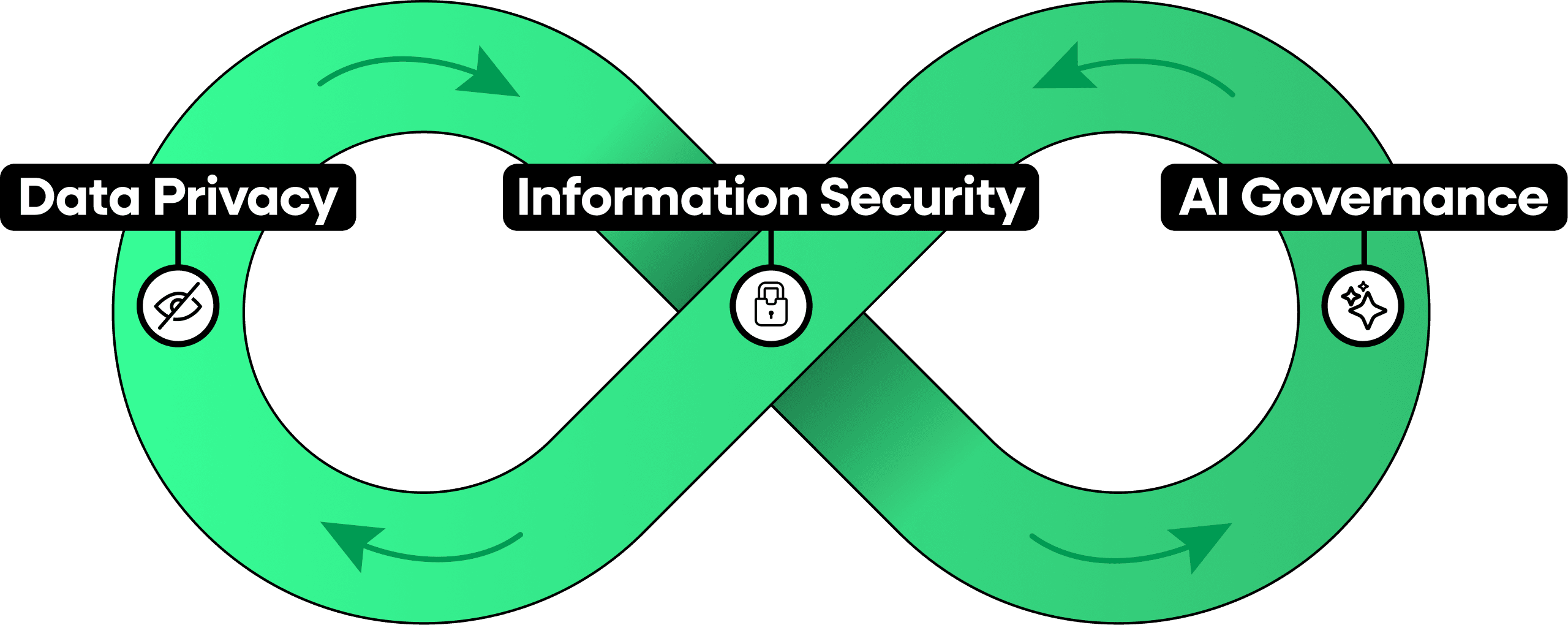
The three domains map directly onto the standards that anchor them. Information security is governed through ISO 27001, data privacy through ISO 27701, and AI governance through ISO 42001. Run them as one loop on a common control set and each reinforces the others, which is exactly what turns governance into resilience. See the full model on the Resilience Loop page.

Start your free trial
Want to explore?
Sign up for your free trial today and get hands on with all the compliance features that ISMS.online has to offer
How do you put the framework in place?
You do not need a separate framework for each standard, and you do not need to boil the ocean. Start by establishing the common control set, then layer the standards on top as lenses. A sensible sequence is: define governance and ownership, build the control set around your most critical operations, connect risk and evidence to those controls, then map each standard you need against what already exists.
The most practical starting point is to map your existing controls against the framework that matters most to you, usually ISO 27001 for security, then extend to ISO 27701 for privacy, ISO 42001 for AI, and ISO 22301 for continuity. Each new standard reuses the controls and evidence you already have. For a step-by-step path, follow the guide on how to build business resilience, narrow it to the operational layer with operational resilience, and benchmark where you stand today with the Resilience Score. Everything links back to the business resilience platform.
The framework by sector
One control set serves every sector. These guides cover the obligations, the services that matter most and the evidence each sector is asked for.
- Financial services and payments: DORA, FCA and Bank of England expectations.
- Managed IT and software: Proving resilience to enterprise customers who audit you.
- Telecoms and networks: Telecoms Security Act duties and network availability.
- Healthcare and health tech: NHS DSPT, patient safety and clinical continuity.
Why choose ISMS.online for a business resilience framework?
Most tools help you tick boxes. ISMS.online helps you build resilience you can prove.
- One control set, every framework: map a control once and reuse it across ISO 27001, ISO 27701, ISO 42001 and ISO 22301, so you do the work once and prove it everywhere.
- One connected system: manage information security, data privacy and AI governance together in a single platform, not three disconnected tools.
- Certifiable by design: every action maps to ISO 27001, ISO 27701, ISO 42001 and ISO 22301, so your resilience is provable.
- Evidence on demand: show regulators, auditors and customers proof of resilience, not promises.
- Informed by deep expertise: guided implementation from real specialists, not no touch automation that hides the risk.
- Continuous, not periodic: a live view of your risk and controls, instead of an annual scramble before an audit.
- Built for regulated markets: designed for organisations where security, privacy and trust drive the buying decision.
Explore the ISMS.online business resilience platform to see how it works in practice.
FAQs
What frameworks underpin business resilience?
Four ISO standards do most of the heavy lifting: ISO 27001 for information security, ISO 27701 for data privacy, ISO 42001 for AI governance, and ISO 22301 for business continuity. Together they cover the security, privacy, AI and continuity risks that threaten operations. The point of a resilience framework is to run all four from one common control set rather than as four separate programmes.
Do I need a separate framework for each standard?
No. A separate framework per standard is what creates duplicated effort and audit fatigue. Build one common control set instead. Map a control once, capture its evidence once, then view that single set through the lens of each standard. The same access control or backup policy can satisfy ISO 27001, ISO 27701, ISO 42001 and ISO 22301 at the same time.
How is a resilience framework different from a compliance framework?
A compliance framework asks whether you meet a standard at a point in time. A resilience framework asks whether you can keep operating through disruption and prove it continuously. Compliance is a snapshot; resilience is an operating model. The two are closely related, but resilience is the broader goal, with certifiable evidence as proof rather than the end in itself.
Where should I start?
Start by establishing governance and a common control set around your most critical operations, then map your highest-priority standard, usually ISO 27001, against it. Benchmark where you stand with the Resilience Score, then extend the same controls and evidence to privacy, AI and continuity. The how-to-build guide sets out the full sequence.






