





































Measuring business resilience means tracking how well you can withstand and recover from disruption, using maturity levels and live metrics rather than a single one-off audit score. A point-in-time pass tells you that you cleared a bar on one day; it tells you nothing about how quickly you would respond next quarter, or whether your evidence is still current. Real measurement is continuous, and it sits across security, privacy and AI governance at once.
- Control coverage: how much of your risk is addressed by controls that are actually in place and operating.
- Evidence currency: how fresh your proof is, so you are never relying on artefacts that expired months ago.
- Response and recovery times: how fast you detect, contain and restore critical services after an incident.
- Risk reduction: whether your exposure is trending down over time, not just holding steady.
Can you measure resilience?
Yes. Resilience feels abstract, but it is measurable through two complementary lenses: maturity (how well-established and repeatable your practices are) and metrics (the hard numbers behind coverage, recovery and risk). You cannot improve what you do not measure, and you cannot prove resilience to a regulator, an auditor or a customer with a feeling. Measurement turns a vague sense of “we should be fine” into something defensible.
The trap is treating measurement as an annual event. Resilience decays between audits as systems change, people leave and threats evolve. Measuring it continuously, against one common control set, is what keeps the picture honest. This is the same discipline that underpins a strong business resilience framework: define what good looks like, then measure against it consistently.
Resilience maturity levels
Maturity describes how embedded and repeatable your resilience practices are. Most organisations move through five recognisable stages, from ad hoc firefighting to a continuously improving operating model.

For a cyber-specific version of this scale, scored against NIST’s four Implementation Tiers, see measuring cyber resilience.
- Initial: resilience is reactive and undocumented. Controls exist in pockets, evidence is gathered in a scramble, and outcomes depend on individual heroics.
- Developing: basic policies and controls are written down, but they are applied inconsistently and rarely tested.
- Defined: controls, roles and recovery objectives are documented and understood across teams, mapped to recognised standards.
- Managed: resilience is measured with real metrics, controls are tested on a schedule, and evidence is current and centralised.
- Optimised: measurement feeds continuous improvement. Lessons from incidents and tests routinely strengthen controls, and resilience is proven on demand.
Knowing your level matters because it tells you what to fix next. Moving from defined to managed, for example, is mostly about measurement and testing discipline. For a structured route between levels, see how to build business resilience.

There's a bigger picture behind this.
This page covers one part of business resilience. Real Resilience — IO’s framework for connecting security, privacy and AI governance — is where the full picture comes together.
Key resilience metrics
Beyond maturity, you need hard metrics that quantify how disruption would affect you and how fast you could recover. Two families matter most: impact tolerances and recovery objectives. Impact tolerances set the maximum disruption a critical service can absorb before the harm becomes unacceptable – to customers, to the market or to the business itself. Recovery objectives define how quickly services and data must be restored, and how much data loss is survivable.
These metrics only mean something when everyone uses the same definitions. Impact tolerances are central to operational resilience, where regulators expect you to set them per important business service and prove you can stay within them. The precise definitions of recovery objectives – RTO, RPO and MTPD – are set out in the business resilience glossary, so teams measure against a shared vocabulary rather than improvising their own.
The point of these numbers is not to collect them; it is to drive action. A recovery time you have measured but never tested is a guess. Metrics, control coverage and current evidence together form the chain that produces genuine resilience: shared controls, captured once, surfaced against every framework, and proven through faster response.
The ISMS.online Resilience Score
You cannot measure what is scattered. When evidence for security lives in one tool, privacy in a spreadsheet and AI governance in someone’s inbox, there is no single place to read your resilience – so every measurement is partial, every audit is a fresh excavation, and gaps hide in the seams between systems. Fragmentation is the real cost: duplicated effort, no single source of truth, and slow response when something changes.
The ISMS.online Resilience Score answers that by giving you one connected view of resilience across the Resilience Loop. It draws on the same common control set that powers your frameworks, so the evidence behind the measure is the evidence you already maintain – mapped once and reused everywhere. Instead of stitching together partial pictures from disconnected tools, you get a single, defensible measure of where you stand and where to improve.
Because it is built on one control set, the score moves as your posture moves: tighten a control or refresh a piece of evidence, and the picture updates rather than waiting for the next annual review. That is the difference between a number you can defend and a number you have to explain away. To turn the underlying evidence into something you can show on demand, see how to evidence resilience.
How the Resilience Loop connects the picture
The Resilience Score works because resilience is not three separate problems. The Resilience Loop is the ISMS.online operating model that treats information security, data privacy and AI governance as one connected system rather than three disconnected tools.
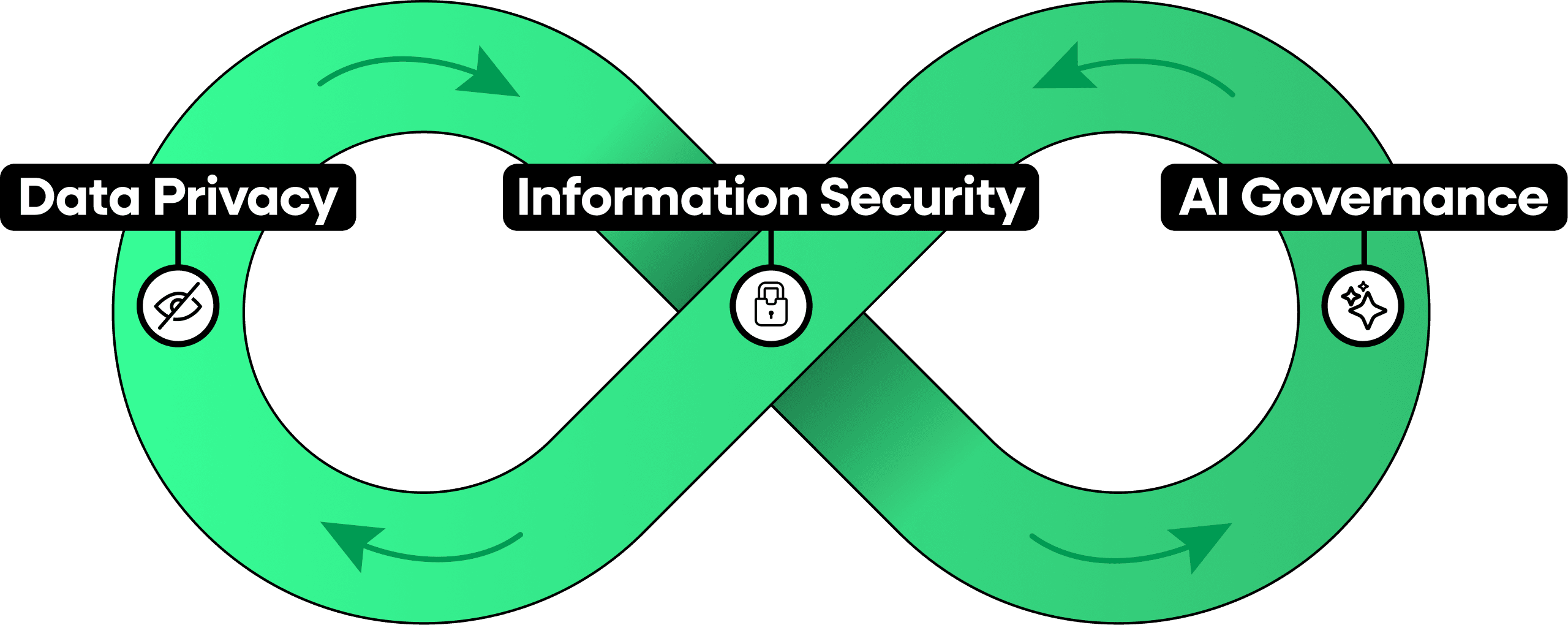
- Information security: protecting the confidentiality, integrity and availability of your systems and data, anchored in ISO 27001.
- Data privacy: governing how personal data is collected, used and protected, aligned to ISO 27701.
- AI governance: managing the risks of AI systems responsibly, guided by ISO 42001.
Map a control once and it counts across all three domains. That shared foundation is exactly what makes a single resilience measure possible – and what keeps it honest as your business changes.

Get started easily with a personal product demo
One of our onboarding specialists will walk you through our platform to help you get started with confidence.
Why choose ISMS.online for measuring resilience?
Most tools help you tick boxes. ISMS.online helps you build resilience you can prove.
- One score, one source of truth: measure resilience from a single connected view instead of reconciling partial numbers from disconnected tools.
- One connected system: manage information security, data privacy and AI governance together in a single platform, not three disconnected tools.
- Certifiable by design: every action maps to ISO 27001, ISO 27701, ISO 42001 and ISO 22301, so your resilience is provable.
- Evidence on demand: show regulators, auditors and customers proof of resilience, not promises.
- Informed by deep expertise: guided implementation from real specialists, not no touch automation that hides the risk.
- Continuous, not periodic: a live view of your risk and controls, instead of an annual scramble before an audit.
- Built for regulated markets: designed for organisations where security, privacy and trust drive the buying decision.
Explore the ISMS.online business resilience platform to see how it works in practice.
FAQs
How do you measure business resilience?
You measure it on two fronts at once: maturity and metrics. Maturity tracks how embedded and repeatable your practices are, from initial through to optimised. Metrics quantify the hard numbers – control coverage, evidence currency, response and recovery times, and whether risk is trending down. Crucially, measurement is continuous rather than a one-off audit score, so the picture stays current as systems, people and threats change.
What is a resilience score?
A resilience score is a single connected measure of how well you can withstand and recover from disruption. The ISMS.online Resilience Score draws on one common control set across the Resilience Loop, turning scattered evidence from security, privacy and AI governance into one defensible figure. Because it is built on evidence you already maintain, it updates as your posture changes rather than waiting for an annual review.
What are RTO and RPO?
RTO (recovery time objective) is the maximum acceptable time to restore a service after disruption; RPO (recovery point objective) is the maximum acceptable amount of data loss, measured as time. Both are core recovery metrics. For precise definitions of RTO, RPO and MTPD, and how they fit alongside impact tolerances, see the business resilience glossary linked above.
What does a good resilience maturity level look like?
A strong organisation sits at managed or optimised. At managed, resilience is measured with real metrics, controls are tested on a schedule, and evidence is current and centralised. At optimised, that measurement feeds continuous improvement – lessons from incidents and tests routinely strengthen controls, and resilience can be proven on demand rather than reconstructed before an audit.






