





































Business continuity software helps you plan for, manage and recover from disruption, but the best choice does more than store a continuity plan: it manages security, privacy and AI risk together and produces audit-ready evidence, not a plan that sits in isolation. Choosing well means looking past a single feature list and asking whether the tool builds resilience you can prove. The wrong choice leaves you with another silo; the right one connects governance, controls and evidence into one operating system.
- Keeps critical operations running through disruption, with tested plans that are actually current.
- Connects continuity to the security, privacy and AI risks that cause most incidents in the first place.
- Captures evidence once and reuses it, so audits and certifications stop being fire drills.
- Maps to recognised standards, so your resilience is certifiable rather than just claimed.
What should business continuity software do?
The label “business continuity software” covers a wide range of tools, from simple plan templates to full resilience platforms. Before comparing vendors, it helps to fix the criteria that actually matter. Good software should do the following, and do it in one place rather than across a patchwork of disconnected products.
- Manage continuity properly: business impact analysis, recovery objectives, tested plans and clear ownership, aligned to recognised continuity practice.
- Connect continuity to risk: link plans to the security, privacy and AI risks that trigger most disruption, not treat them as separate disciplines.
- Use a common control set: map a control once and reuse it across every standard, rather than rebuilding the same control for each framework.
- Produce audit-ready evidence: capture proof once and surface it on demand against any standard that asks for it.
- Map to certifiable standards: ISO 27001, ISO 27701, ISO 42001 and ISO 22301, so resilience is provable, not asserted.
- Offer real support: guidance from specialists who understand implementation, not no touch automation that hides the risk.
The thread running through all of these is simple. Good governance, done well, is what produces business resilience. Software is only useful if it helps governance do that job, turning controls into evidence and evidence into a posture you can defend. To frame the wider goal first, see what business resilience actually means and how it differs from traditional continuity planning.
Spreadsheets vs point tools vs a platform
Most organisations start with spreadsheets, move to point tools as they grow, and only later realise that both approaches recreate the same problem. The cost of fragmentation is predictable: duplicated effort, no single source of truth, audit fatigue and slow response to change. The question is not which tool has the longest feature list, but which approach stops the fragmentation rather than moving it up a layer.

Spreadsheets are cheap and flexible, but they do not scale. They go stale the moment they are saved, no one trusts which version is current, and there is no link between a continuity plan and the risks or controls behind it. Point tools solve one slice well – a dedicated continuity tool, a separate risk register, a standalone audit tracker – but they recreate the same fragmentation one layer up. You still duplicate effort across products, you still have no single source of truth, and you still spend each audit reconciling tools that do not talk to each other. A platform is different in kind, not degree: it unifies controls and evidence so that continuity, risk, privacy and AI governance all read from one source. That is what turns a stack of tools into a connected operating model.

There's a bigger picture behind this.
This page covers one part of business resilience. Real Resilience — IO’s framework for connecting security, privacy and AI governance — is where the full picture comes together.
A buyer’s checklist
Use these criteria to compare options on what matters rather than on demo polish. Each one tests whether the tool builds toward provable resilience or simply adds another silo. Score every vendor against the same list and the genuine platform tends to stand out quickly.
- Coverage across frameworks: does it handle every standard you answer to, or just one, forcing you to buy more tools later?
- A common control set: can you map a control once and reuse it everywhere, instead of rebuilding it per framework?
- Evidence reuse: is evidence captured once and surfaced against multiple standards, or re-gathered for each audit?
- Certifiable mappings: does it map cleanly to ISO 27001, ISO 27701, ISO 42001 and ISO 22301 so certification is built in?
- Continuity done right: does it support proper business impact analysis and recovery planning, aligned to ISO 22301?
- Risk management: is there a living risk register that connects threats to the controls meant to mitigate them?
- Audit-readiness: can you show regulators, auditors and customers current proof on demand, not a scramble before each review?
- Expert support: is there guided implementation from real specialists, or are you left alone with a blank platform?
Two of these deserve a closer look because continuity is where most buyers start. Proper continuity means a tested plan tied to recovery objectives and the controls that protect critical operations, which is exactly what the ISO 22301 standard sets out and what good business continuity practice looks like in operation. If a tool treats continuity as an isolated document rather than something wired into your risk and control set, it will fail the resilience test no matter how strong its templates are.
Software should help governance produce resilience
The deciding criterion sits underneath the whole checklist. Software should help governance produce resilience, and a platform that unifies controls and evidence beats a stack of disconnected tools every time. The reason is the chain that turns governance into resilience, and the chain only holds if each link reads from the same foundation.
Shared controls produce shared evidence; that evidence enables a faster response when something changes; a faster response sustains a trustable posture; and a trustable posture is what genuine resilience is built on. Skip a link and the chain breaks. A spreadsheet captures controls but loses the evidence trail. A point tool gathers evidence but cannot link it to the wider posture. Only a common control set carries the chain end to end – map a control once, capture its evidence once, and surface it against every framework as a lens over the same source of truth. That is the difference between software that documents resilience and software that produces it.
The Resilience Loop: one operating model
The most capable software treats resilience as one connected system rather than a set of separate modules. That is the idea behind ISMS.online‘s Resilience Loop: information security, data privacy and AI governance are not three problems but one. A weakness in any one domain undermines the others, so they share controls, share evidence and share a single view of risk.
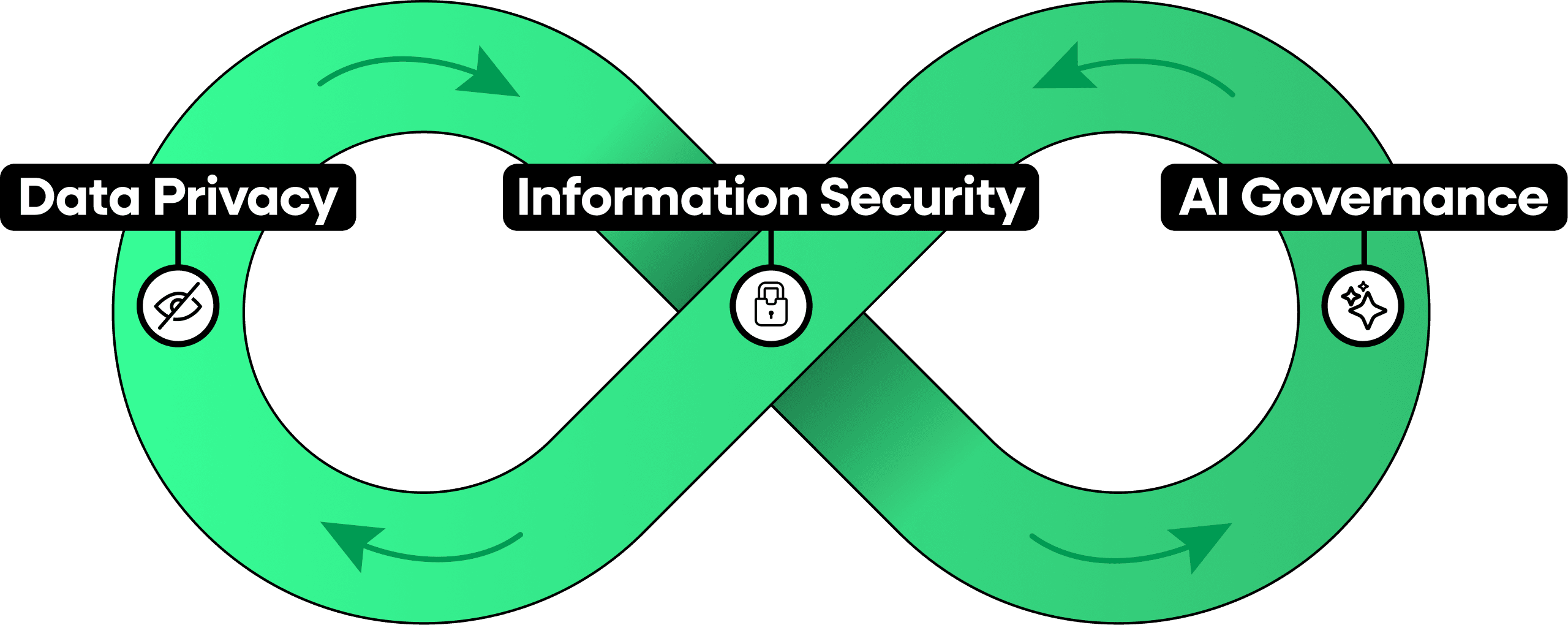
The three domains map directly onto the standards that anchor them. Information security is governed through ISO 27001, data privacy through ISO 27701, and AI governance through ISO 42001. When your software runs all three as one loop on a common control set, continuity stops being a standalone plan and becomes a property of how you already operate. See the full model on the Resilience Loop page.

Manage all your compliance, all in one place
ISMS.online supports over 100 standards and regulations, giving you a single platform for all your compliance needs.
One connected system, not a stack of tools
If your shortlist comes down to assembling several point tools or adopting one connected platform, weigh it against the chain above. A stack of disconnected tools may each be capable, but the gaps between them are where duplicated effort, stale evidence and audit fatigue creep back in. A platform that unifies controls, risk, evidence and continuity removes those gaps by design, because every framework reads from the same control set.
For organisations that want one connected system rather than a collection of tools, the route is the business resilience platform. Start with the resilience framework to see how one common control set spans every standard, equip your team with the resilience toolkit, and narrow the lens to the operational layer with operational resilience. To compare your current approach against a connected one, the guide on how to build business resilience sets out the sequence.
Why choose ISMS.online for business continuity and resilience software?
Most tools help you tick boxes. ISMS.online helps you build resilience you can prove.
- One platform, not a patchwork: replace spreadsheets and point tools with a single connected system for continuity, risk, security, privacy and AI governance.
- One connected system: manage information security, data privacy and AI governance together in a single platform, not three disconnected tools.
- Certifiable by design: every action maps to ISO 27001, ISO 27701, ISO 42001 and ISO 22301, so your resilience is provable.
- Evidence on demand: show regulators, auditors and customers proof of resilience, not promises.
- Informed by deep expertise: guided implementation from real specialists, not no touch automation that hides the risk.
- Continuous, not periodic: a live view of your risk and controls, instead of an annual scramble before an audit.
- Built for regulated markets: designed for organisations where security, privacy and trust drive the buying decision.
Explore the ISMS.online business resilience platform to see how it works in practice.
FAQs
What is business continuity software?
Business continuity software helps you plan for, manage and recover from disruption so critical operations keep running. The best tools go further than storing a plan: they connect continuity to the security, privacy and AI risks that cause most incidents, and produce audit-ready evidence mapped to standards such as ISO 22301. That turns a continuity document into provable resilience rather than a plan that sits in isolation.
What should I look for in resilience software?
Look for coverage across every framework you answer to, a common control set you can map once and reuse, evidence captured once and surfaced against multiple standards, and certifiable mappings to ISO 27001, ISO 27701, ISO 42001 and ISO 22301. Add proper continuity planning, a living risk register, audit-readiness on demand and support from real specialists. Together these test whether the tool builds provable resilience or just another silo.
Is a spreadsheet enough for business continuity?
A spreadsheet can start you off, but it does not scale. It goes stale the moment it is saved, no one trusts which version is current, and there is no link between the plan and the risks or controls behind it. That fragmentation means duplicated effort, no single source of truth and a scramble before every audit. For anything beyond the smallest organisation, a connected platform that unifies controls and evidence is far more defensible.
What is the difference between BCM software and a GRC platform?
Business continuity management software focuses on keeping operations running through disruption: impact analysis, recovery objectives and tested plans. A governance, risk and compliance platform is broader, managing controls, risk and evidence across many standards. The most useful tools merge the two, treating continuity as one lens over a common control set so that security, privacy, AI and continuity all read from a single source of truth.






