





































Compliance is proof that you met a standard at a point in time. Resilience is the continuous capability to withstand and recover from disruption. Put simply: compliance proves you were secure yesterday, resilience proves you can handle tomorrow.
The two are often set against each other, but that framing is wrong. The real relationship is simpler: certifiable compliance is how you prove your resilience is real.
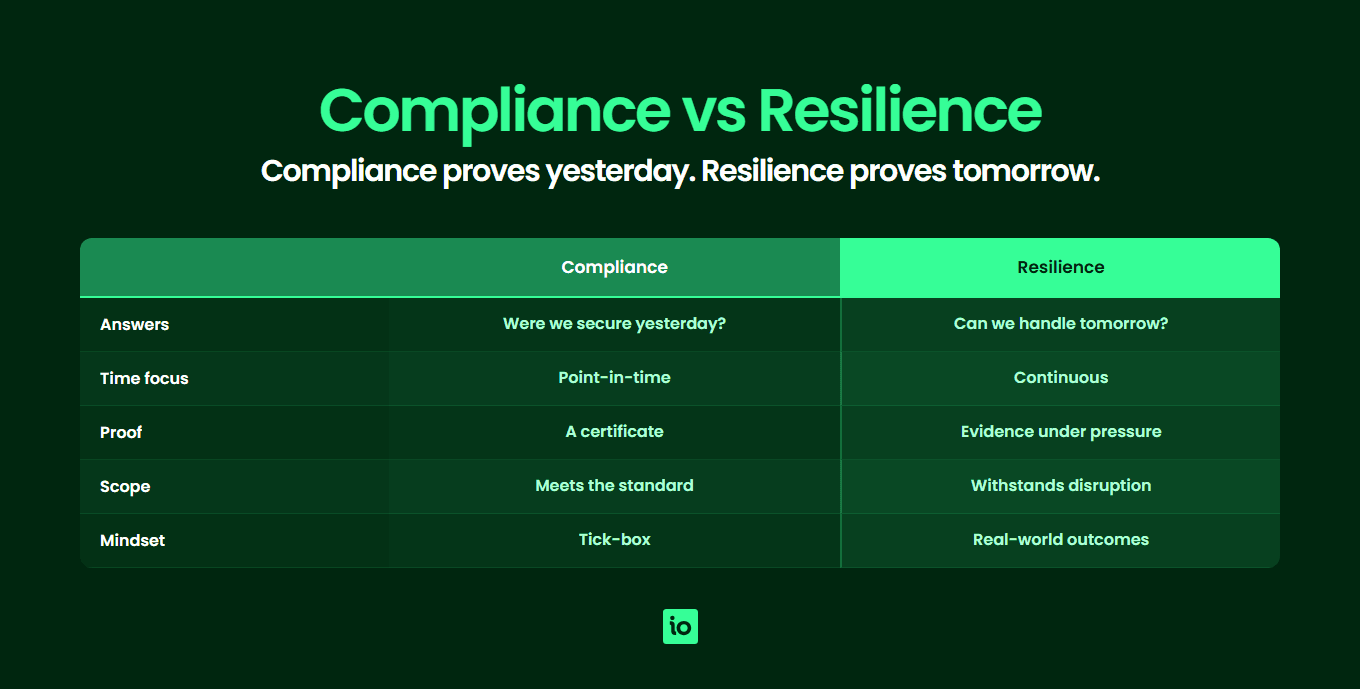
What is the difference between compliance and resilience?
Compliance is point in time, evidence based and standard driven: you demonstrate that, on the day of the audit, your controls met the requirement. Resilience is continuous and outcome based: it is about whether your organisation actually withstands and recovers from disruption, on any day, not just audit day. One is a snapshot, the other is a capability.

Start your free trial
Want to explore?
Sign up for your free trial today and get hands on with all the compliance features that ISMS.online has to offer
Is compliance enough on its own?
No. A certificate proves you met a standard at a moment in time. It does not prove you are ready for the next incident, the next regulation or the next AI risk. Plenty of certified organisations have still been caught out, because a tick in a box is not the same as the ability to keep operating when things go wrong. This is what “beyond compliance” really means.
So why does certification still matter?
Because it is your evidence layer. Resilience that you cannot prove is just a claim. Standards like ISO 27001, ISO 27701 and ISO 42001 give you a repeatable, independently checked way to demonstrate resilience to regulators such as the FCA and PRA, to auditors, and to customers. Certifiable compliance is not the opposite of resilience, it is how you prove it.
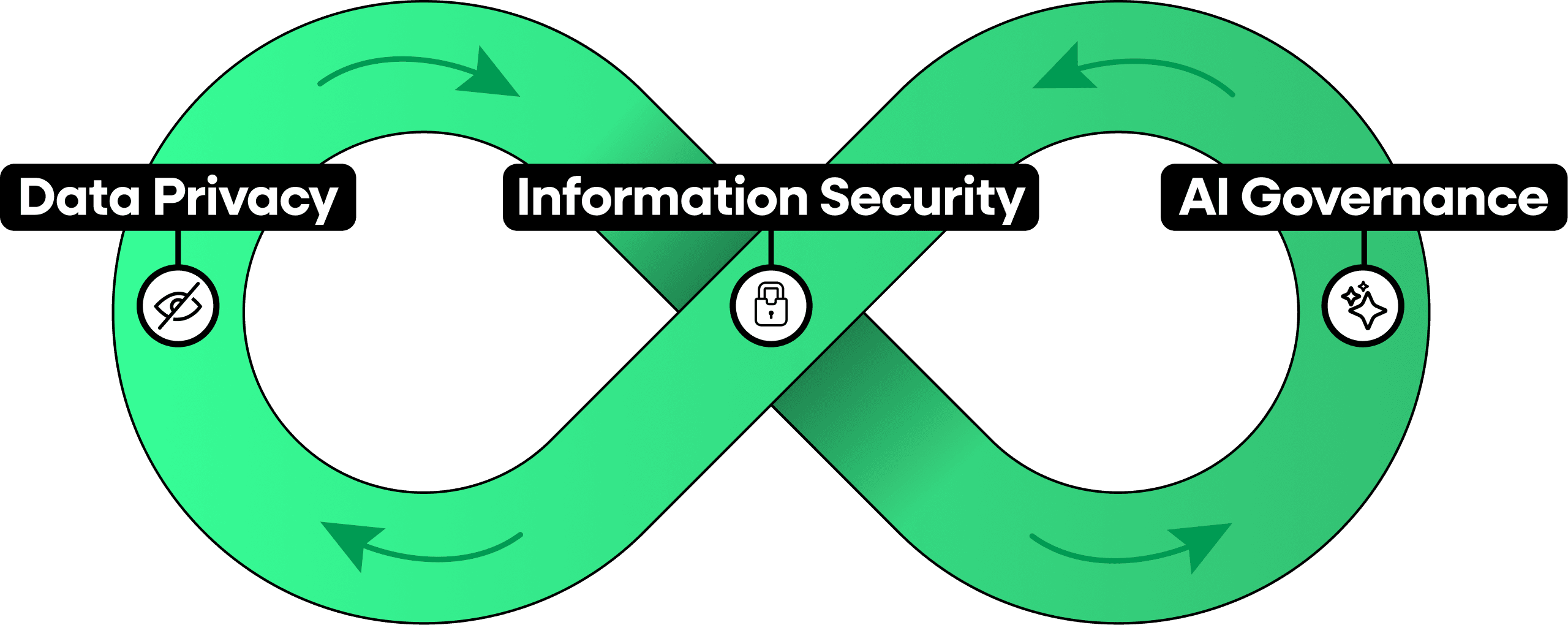
That is the role of the Resilience Loop: it connects the standards into one continuous system so the evidence is always current.

Manage all your compliance, all in one place
ISMS.online supports over 100 standards and regulations, giving you a single platform for all your compliance needs.
How to move from compliance to resilience
The shift is less about new tooling and more about joining things up: stop treating audits as annual events, connect security, privacy and AI risk, and build the habit of evidencing resilience continuously. Our guide to how to build business resilience sets out the five practical steps.
Why choose ISMS.online?
Most tools help you tick boxes. ISMS.online helps you build resilience you can prove.
- One connected system: manage information security, data privacy and AI governance together in a single platform, not three disconnected tools.
- Certifiable by design: every action maps to ISO 27001, ISO 27701, ISO 42001 and ISO 22301, so your resilience is provable.
- Evidence on demand: show regulators, auditors and customers proof of resilience, not promises.
- Informed by deep expertise: guided implementation from real specialists, not no touch automation that hides the risk.
- Continuous, not periodic: a live view of your risk and controls, instead of an annual scramble before an audit.
- Built for regulated markets: designed for organisations where security, privacy and trust drive the buying decision.
Explore the ISMS.online business resilience platform to see how it works in practice.
FAQs
Does being ISO 27001 certified make us resilient?
Certification is necessary but not sufficient. ISO 27001 proves your information security management meets the standard, which is a strong foundation. True resilience also needs privacy and AI risk managed alongside it, tested under pressure and monitored continuously.
What does ‘beyond compliance’ mean?
It means treating compliance as the starting point, not the finish line. Beyond compliance is about the real world outcome, the ability to withstand and recover from disruption, rather than simply passing the audit.
Can you have resilience without compliance?
You can have some operational resilience without formal certification, but you cannot easily prove it. Compliance gives you the independent, repeatable evidence that turns a claim of resilience into something regulators and customers will trust.






