





































Organisational resilience is the ability of an organisation to anticipate, prepare for, respond and adapt to incremental change and sudden disruption in order to survive and prosper. This is the framing set out in ISO 22316, the international guidance on the subject. It is a whole-organisation discipline that spans culture, leadership and strategy, not a single technical capability bolted onto the IT department.
- Anticipate: scan the horizon for threats and opportunities before they arrive.
- Prepare: put governance, controls and capacity in place so the organisation can act.
- Respond: react quickly and proportionately when change or disruption hits.
- Adapt: learn, adjust and emerge stronger rather than simply returning to the old state.
What is organisational resilience?
Organisational resilience is the capacity of the whole organisation to absorb shocks and keep delivering on its purpose over the long term. It is broader than any one team or system. Where business continuity protects specific processes and disaster recovery restores specific systems, organisational resilience asks a bigger question: can the organisation as a whole anticipate change, make good decisions under pressure, and come through stronger?
That breadth is why it touches culture, leadership, strategy, governance and risk management together. Resilient organisations share information well, empower people to act, align decisions with a clear purpose, and treat learning from disruption as routine. None of those traits live in a single department, and none can be bought as a product.
It is important to be clear about the status of the underlying standard. ISO 22316 is guidance, not a certifiable management system standard. It describes the principles and attributes of a resilient organisation, but there is no audited certificate at the end of it. That distinction matters enormously when you need to demonstrate resilience to a board, a regulator or a customer, and we return to it below.
Organisational resilience vs operational resilience
These two ideas are closely related but they are not the same. Operational resilience is about keeping your important business services running through disruption: identifying critical services, setting tolerances for how much disruption is acceptable, and making sure those services hold up when something goes wrong. Organisational resilience is the wider discipline of the entire organisation adapting, thriving and remaining fit for purpose over the long term.

Put simply, operational resilience keeps the lights on for the services that matter most, while organisational resilience keeps the organisation itself viable and competitive as the world changes around it. The two reinforce each other: strong operational resilience is a building block of organisational resilience, and a resilient organisational culture makes operational resilience easier to sustain.
For a deeper look at the narrower discipline, see our guide to operational resilience. It also helps to understand how both differ from continuity planning, which we cover in resilience versus business continuity.

There's a bigger picture behind this.
This page covers one part of business resilience. Real Resilience — IO’s framework for connecting security, privacy and AI governance — is where the full picture comes together.
Why is organisational resilience so hard to prove?
Because ISO 22316 cannot be certified, organisations face a real problem: they can describe their resilience, but they cannot easily prove it. A board paper or a maturity self-assessment is a promise, not evidence. Regulators, auditors and enterprise customers increasingly want proof.
The cost of getting this wrong is fragmentation. When information security, data privacy, continuity and AI governance are run as separate projects in separate tools, effort is duplicated, there is no single source of truth, audit season becomes an annual scramble, and the organisation is slow to respond when circumstances change. Fragmented governance does not just waste money – it actively undermines the resilience you are trying to build.
The way to make organisational resilience tangible and provable is to anchor it on the certifiable stack and a common control set. Standards such as ISO 27001 for information security, ISO 27701 for data privacy, ISO 42001 for AI governance and ISO 22301 for business continuity each produce audited, defensible evidence. ISO 22316 sets the ambition; the certifiable stack supplies the proof. Good governance, done well, is what produces resilience – resilience is downstream of governance.
The mechanism is a common control set. Map a control once and use it everywhere; capture evidence once and surface it against every framework. Frameworks become lenses over one control set rather than separate silos of work. That single chain – shared controls lead to shared evidence, which enables faster response, which builds a trustable posture, which is genuine resilience – is how a discipline with no certificate becomes something you can stand behind. Skip a link and the chain breaks.
The Resilience Loop
ISMS.online’s Resilience Loop treats information security, data privacy and AI governance as one connected operating model rather than three disconnected programmes. The same risks, controls and evidence flow between the three domains, so a control proven once strengthens all of them.
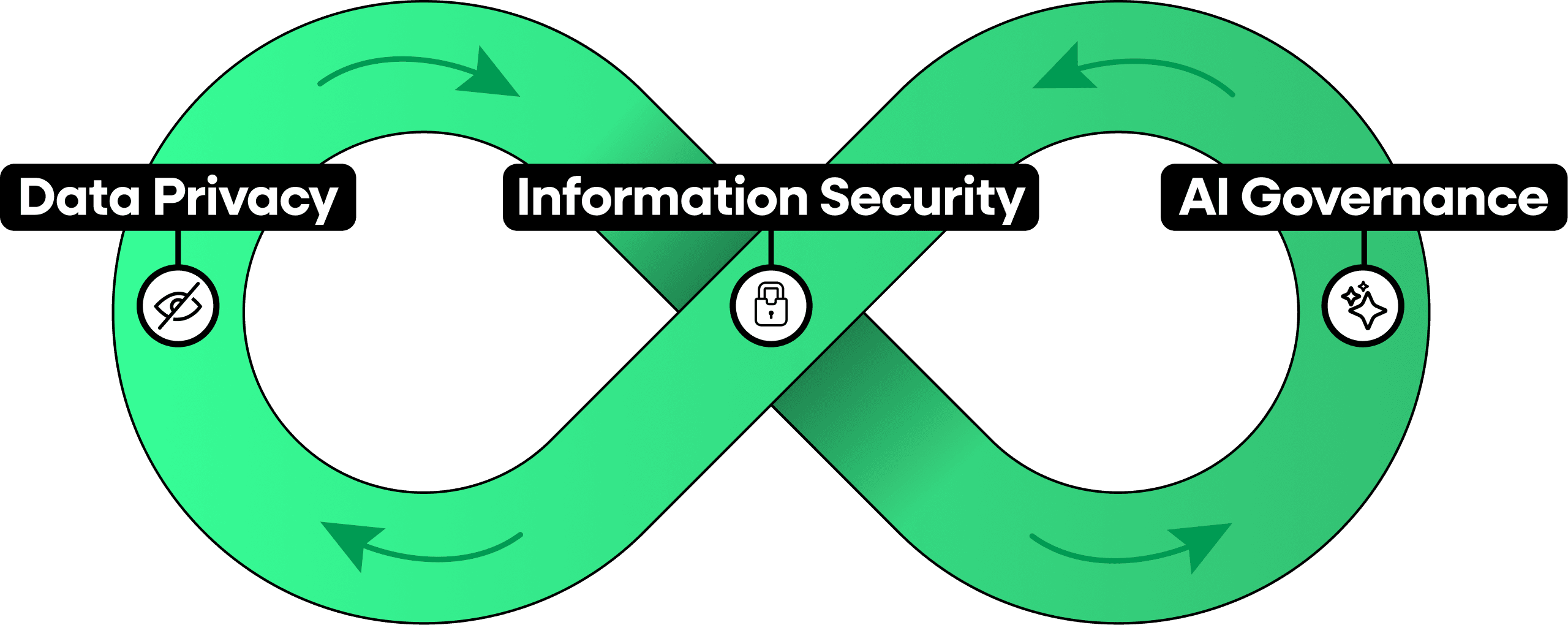
- Information security: protect systems and data against threats, anchored on ISO 27001.
- Data privacy: manage personal data lawfully and transparently, anchored on ISO 27701.
- AI governance: deploy AI responsibly and accountably, anchored on ISO 42001.
Run as one loop, these domains stop competing for attention and start compounding. That shared foundation is what turns scattered compliance activity into organisational resilience you can evidence.

Get started easily with a personal product demo
One of our onboarding specialists will walk you through our platform to help you get started with confidence.
How do you build organisational resilience?
Building organisational resilience is a programme of work across governance, culture, risk and evidence rather than a one-off project. The practical priorities are consistent across sectors:
- Governance: give resilience clear ownership at board level, with defined accountability, decision rights and a common control set that spans security, privacy, AI and continuity.
- Culture: build shared awareness, empower people to raise issues and act, and treat learning from incidents as routine rather than exceptional.
- Risk: maintain a live view of the threats and dependencies that matter, set tolerances, and connect risk decisions to the controls that manage them.
- Evidence: capture proof continuously, not in an annual scramble, so resilience can be demonstrated on demand to boards, regulators and customers.
For a step-by-step approach, see how to build business resilience, and use a structured business resilience framework to organise the work. It also pays to understand how to evidence resilience so your programme produces proof, not just plans. All of this sits under the wider business resilience pillar.
Why choose ISMS.online for organisational resilience?
Most tools help you tick boxes. ISMS.online helps you build resilience you can prove.
- Turn guidance into proof: convert ISO 22316 guidance into certifiable, provable evidence anchored on standards you can be audited against.
- One connected system: manage information security, data privacy and AI governance together in a single platform, not three disconnected tools.
- Certifiable by design: every action maps to ISO 27001, ISO 27701, ISO 42001 and ISO 22301, so your resilience is provable.
- Evidence on demand: show regulators, auditors and customers proof of resilience, not promises.
- Informed by deep expertise: guided implementation from real specialists, not no touch automation that hides the risk.
- Continuous, not periodic: a live view of your risk and controls, instead of an annual scramble before an audit.
- Built for regulated markets: designed for organisations where security, privacy and trust drive the buying decision.
Explore the ISMS.online business resilience platform to see how it works in practice.
FAQs
What is ISO 22316?
ISO 22316 is the international standard that provides guidance on organisational resilience. It sets out the principles and attributes of a resilient organisation, covering leadership, culture, shared information, resource availability and continual improvement. Crucially it is guidance only: it offers a framework for understanding and developing resilience but does not provide a certifiable management system, so there is no audited certificate awarded against it.
Can you get certified in organisational resilience?
No. There is no certification for organisational resilience itself, because ISO 22316 is guidance rather than a certifiable management system standard. To prove resilience in a defensible way, organisations anchor it on certifiable standards such as ISO 27001 for information security, ISO 27701 for data privacy, ISO 42001 for AI governance and ISO 22301 for business continuity. Certification against those produces the audited evidence that organisational resilience guidance alone cannot.
What is the difference between organisational and operational resilience?
Operational resilience focuses on keeping important business services running through disruption, by identifying critical services, setting impact tolerances and ensuring those services hold up under stress. Organisational resilience is broader: it is the ability of the whole organisation to anticipate, prepare for, respond and adapt to change so it survives and prospers over the long term. Operational resilience is a building block of organisational resilience.
What are the principles of organisational resilience?
The principles described in ISO 22316 include behaviour aligned with a shared vision and purpose, an up-to-date understanding of the organisation’s context, the ability to absorb, adapt and respond to change, effective and empowered leadership, a supportive culture, shared information and knowledge, availability of resources, coordinated management disciplines, and continual improvement. Together they describe an organisation that learns from disruption and emerges stronger.






