





































Are You Truly Ready for Article 21, or Just Paper-Compliance?
Passing today’s audits-and defending your business in a cyber crisis-demands more than policies and promises. Article 21 of Regulation EU 2024-2690 (NIS 2) crystallises a new reality: your board, your suppliers, your technology, and your people are all on the hook for living, operational cyber risk management. The days of “document and forget” are over. Real compliance is now defined by evidence, continual action, and traceability at every level.
Real protection is visible, auditable, and lived-every day, not just at audit time.
Under Article 21, you’re not measured by what you say on policy paper, but by what you can prove operates now: board engagement, up-to-date asset and risk registers, controls mapped to threats, live evidence logs, and a compliance rhythm spanning your entire digital ecosystem. If you rely on static documents or siloed IT checklists, you’re exposed-not just to audit findings, but to gaps that can cost millions in reputational and regulatory loss.
For organisations that treat cyber risk as a “nice-to-have” or defer ownership to consultants or isolated IT teams, Article 21 is a wakeup call. The law is explicit: accountability is board-level, supply chain is in-scope, and your ability to demonstrate real-time improvement is a differentiator. Are you ready? Or are you hoping last year’s audit folder will deliver when a regulator, client, or attacker puts you to the test?
What is the New Definition of Cyber-Security Accountability Under Article 21?
The shift is decisive: Article 21 ends the era of plausible deniability. Your organisation’s most senior leaders-board members, managing directors, executives-must own cyber risks, sign off on policies, confirm risk reviews, and evidence every control. No more “I wasn’t told” or “The IT team handled that.” From this moment, your business stands or falls on active, ongoing board oversight.
The Board’s Concrete Obligations
- Direct, recorded approval of the cyber-security risk management system: Every major risk policy must carry a traceable stamp of senior approval-not merely an email nod of acknowledgement.
- Explicit allocation of roles for review and escalation: Article 21 compels you to document who writes, reviews, owns, and escalates every part of the system. Auditors expect clear RACI charts (Responsible, Accountable, Consulted, Informed) with actual names attached, not generic job titles or committees (see BSI citation).
- Mandated, scheduled management reviews: Not just “when convenient”-your risk and control reviews must appear as a fixed item on board agendas, with minutes that show real debate, findings, and follow-up ownership (ENISA guidance).
- Evidence-backed incident and improvement reviews: For every significant event-breach, supplier failure, audit finding-the board or authorised leadership must log their assessment, record lessons learned, and ensure remedial actions are assigned and signed off.
Accountability works when leadership leaves an audit trail, not a gap.
Failure to make this visible and traceable will be a source of instant audit findings-and, more importantly, will undermine confidence from clients, insurers, and regulators. The result? Weak controls, higher risk premiums, and competitive disadvantage.
Why Does This Matter for Compliance Teams and Practitioners?
- Practitioners: Procedure is no longer enough-you must supply evidence, on demand, that a living process exists, roles are documented, and improvements are recorded.
- Legal/Privacy Officers: Controls must map directly to GDPR, NIS 2, and privacy frameworks. Silence or vague “ownership” leaves you exposed to liability.
- CISO & Security Leaders: Only linked, board-reviewed risk registers and SoA ensure your efforts don’t get diluted by siloed documentation or consultant noise.
- Compliance Kickstarters: If you’re launching your first ISMS, prioritise board engagement and auditable change logs over “template-driven” compliance.
Auditors and regulators will demand more than signatures. They expect continual, signed-off, living proof: minutes, policy updates, action tracking. If your system can’t furnish that, it’s time to rethink your approach.

Master NIS 2 without spreadsheet chaos
Centralise risk, incidents, suppliers, and evidence in one clean platform.
How Do You Build a Risk Management System That Aligns With Article 21?
It starts by mapping every hazard-digital, physical, supply chain, human-to specific risks, controls, operational evidence, and responsible roles. This is not a “set-and-forget” system. It’s an active, live, and auditable framework that connects threats to action, action to evidence, and evidence to leadership review.
Elements of a Risk Management System That Passes Article 21 Scrutiny
- All-hazards inclusion: Your system must reach beyond traditional IT risks to incorporate supply chain, physical threats, personnel, and process-based risks. Schedule quarterly reviews with a full hazard list, track these in your risk register (Gartner best practise).
- Asset–risk–control–evidence mapping: Every meaningful risk must link to a specific asset (hardware, software, data, service), one or more controls (Annex A matches), and a log of documentary evidence. The SoA (Statement of Applicability) must tell this story in a way that enables instant audit verification (see CSO Online guidance).
- Supply chain risk at every tier: Documentation must capture risk register entries for every key supplier-including those in the “fourth-party” network-and log the outcome and schedule of regular due diligence or contract review.
- Incident “golden thread”: Every risk update, whether from scheduled review, real-world breach, audit finding or change in law, must trace from trigger to risk update, SoA link, remediation action, and logged evidence.
| Expectation | Operationalisation | ISO 27001 / Annex A Ref. |
|---|---|---|
| All-hazards, quarterly review | Scheduled board/committee, minutes, updated register | Cl. 6.1.2, A.5.7 |
| Asset–risk–control mapping | Living asset register, linked controls, SoA | Cl. 8.2–3, A.8.9 |
| Supply chain risk | Supplier register, outcome logs, contract reviews | A.5.19–A.5.21 |
| Incident documentation | Logged triggers and outcomes | Cl. 10.1, A.5.25, A.5.27 |
What Makes This Evidence “Audit-Ready”?
You must be ready to show a page, log, or record for every live policy, RACI chart, risk review, and remediation. “If a control isn’t mapped to risk and asset, it’s not real,” as IIA notes. Even the best technical controls are irrelevant if you can’t prove how they tie into risk reduction and who owns follow-up.
An ISMS is a living fabric-not a collection of disconnected procedures.
Failing to deliver this golden thread will lead to failed audits, increased regulatory scrutiny, and loss of trust with stakeholders and partners.
What Does Live, Linked Evidence Look Like in Article 21 Practise?
Auditors no longer accept outdated logs or theoretical risk frameworks. You must be able to dynamically produce, on demand, evidence that every event and every control is current, mapped, and reviewed.
Building the Living Evidence Web
- Each risk update links to a cause and a control – For example, a quarterly review detects a new ransomware attack vector; you record this as a risk update, log the new control (A.5.7, Cl. 8.2), and capture the board’s review minutes and SoA update.
- Supply chain breach? – You immediately revise supplier procedures (A.5.19, A.5.21), record new contracts or updated due diligence, and map this to your ongoing supplier assessment logs.
- Technical change? – Upgrading core systems? Patch management logs and updated SoA (A.8.9, A.5.13) document the change.
- Training shortfall? – Track human-centric controls (A.6.3, A.7.7) via scheduled, interactive campaigns, attestation logs, and attendance evidence.
| Trigger | Risk Update Action | Control/SoA Link | Evidence Logged |
|---|---|---|---|
| Risk review | Ransomware vector assessed | A.5.7, Cl. 8.2 | Board minutes, log update |
| Supplier | Procedures updated | A.5.19, A.5.21 | Assessment, contract |
| Patch | Policy revised | A.8.9, A.5.13 | Log, SoA |
| Training | Awareness campaign expanded | A.6.3, A.7.7 | Logs, quizzes, attest |
| Audit | New control initiated | Cl. 10.1, A.5.27 | Audit report |
Why Is This Structure Essential?
Because every “static” moment in your compliance system is now a point of risk. Regulators and clients will expect to see time-stamped, real-world evidence mapped to each event. If you have to search for it, you’re not ready. If it’s instantly available and linked in your ISMS, you own the future of compliance.
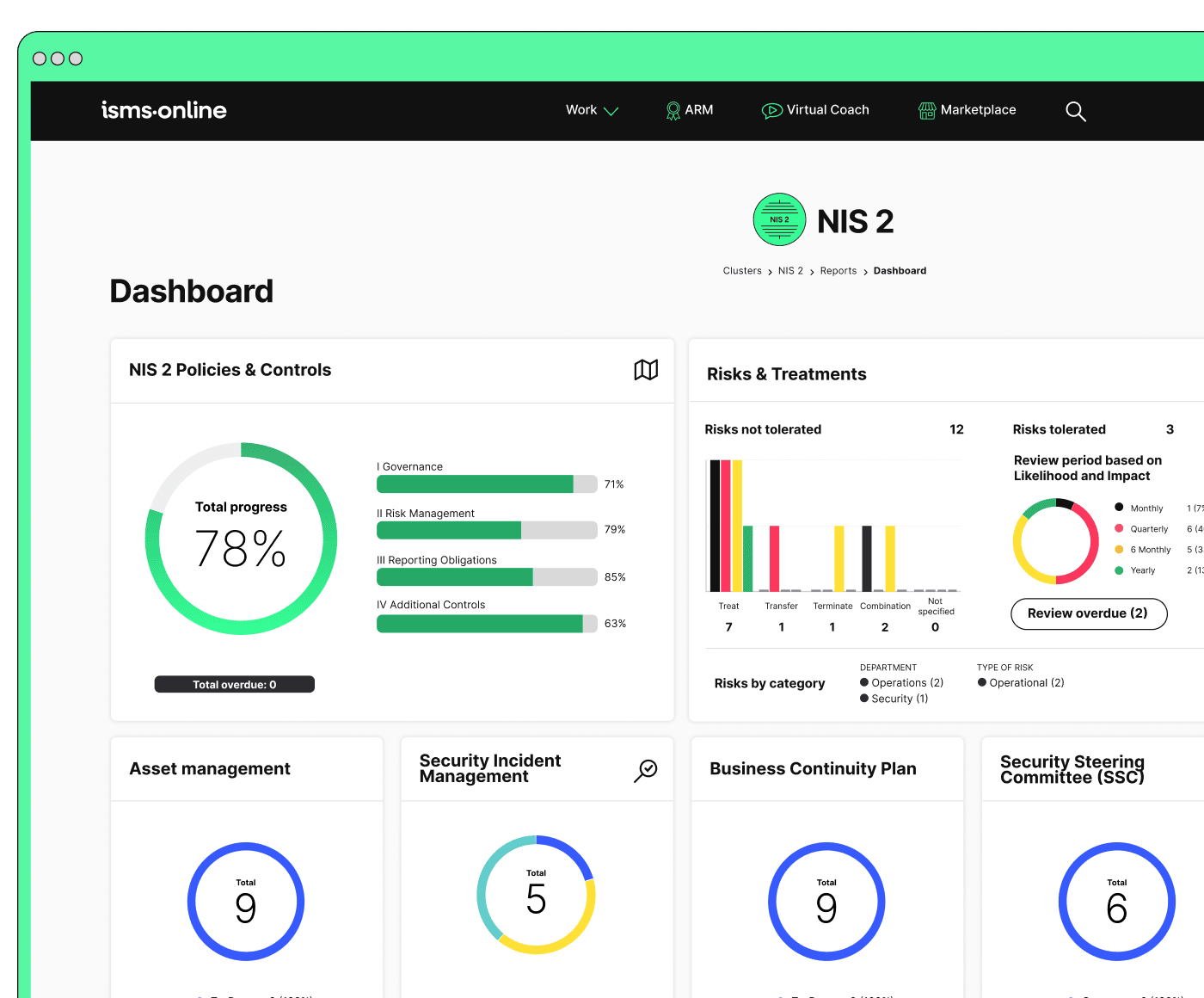
Be NIS 2-ready from day one
Launch with a proven workspace and templates – just tailor, assign, and go.
How Are Technical and Human Controls Embedded and Evidenced?
Article 21 requires that both technical safeguards (e.g., firewalls, MFA, encryption, monitoring) and human routines (training, incident reporting, policy ack) are implemented, lived, and logged-not just described in text.
Technical Controls: No “Drift,” Only Proof
- Active configuration, mapped to SoA: MFA, role-based access, encryption-all must be locked by policy and proven live.
- Live monitoring and alerting: SIEM logs, automated alerts, regular test results. Board sees summary reports; practitioners evidence technical setup.
- Patch management and updates: Documented with change logs, SoA, and regular review intervals.
Human Controls: Prove Staff Engagement
- Policy Packs, quizzes, and sign-off: Evidence not just of recipients, but of attestation, comprehension, and follow-through. Your logs should show who was trained, when, with what material, and who has yet to complete.
- Incident and escalation workflows: Automated tickets, escalation triggers, and logs ensure every event is traceable from end to end.
Ongoing Live Testing: Prove Evolution
- Penetration testing and phishing simulation programmes: Not annual, but ongoing, with evidence logs for each action, result, and remediation.
Controls that can’t be proven live are as risky as controls that don’t exist at all.
How Do You Secure the Supply Chain and Downstream Ecosystem?
Article 21 puts special focus on the expanded digital landscape. Your vendors, fourth parties, cloud infrastructure, and any external partner with system access is now a compliance vector.
Implementing Supply Chain Security
- Contractual granularity: Every supplier must have contracts with explicit security obligations, incident clauses, audit rights, and offboarding requirements. These must be regularly reviewed, updated, and logged (Lawfare Blog, McKinsey).
- Lifecycle reviews and due diligence: Supplier risks are tracked from onboarding to offboarding, with evidence of every review, assessment, and performance metric.
- Incident handoff rehearsals: Drill incident response and document decision and communication chains.
- Chain-of-obligation tracing: Know your suppliers’ suppliers. Track not just your vendors, but their digital dependencies (KPMG).
Making This Operable
Every audit will test random supply chain controls-demanding instant logs, contracts, supplier due diligence evidence, and proof of disengagement speed. Miss a step and not only does trust erode, but you risk material regulatory exposure.
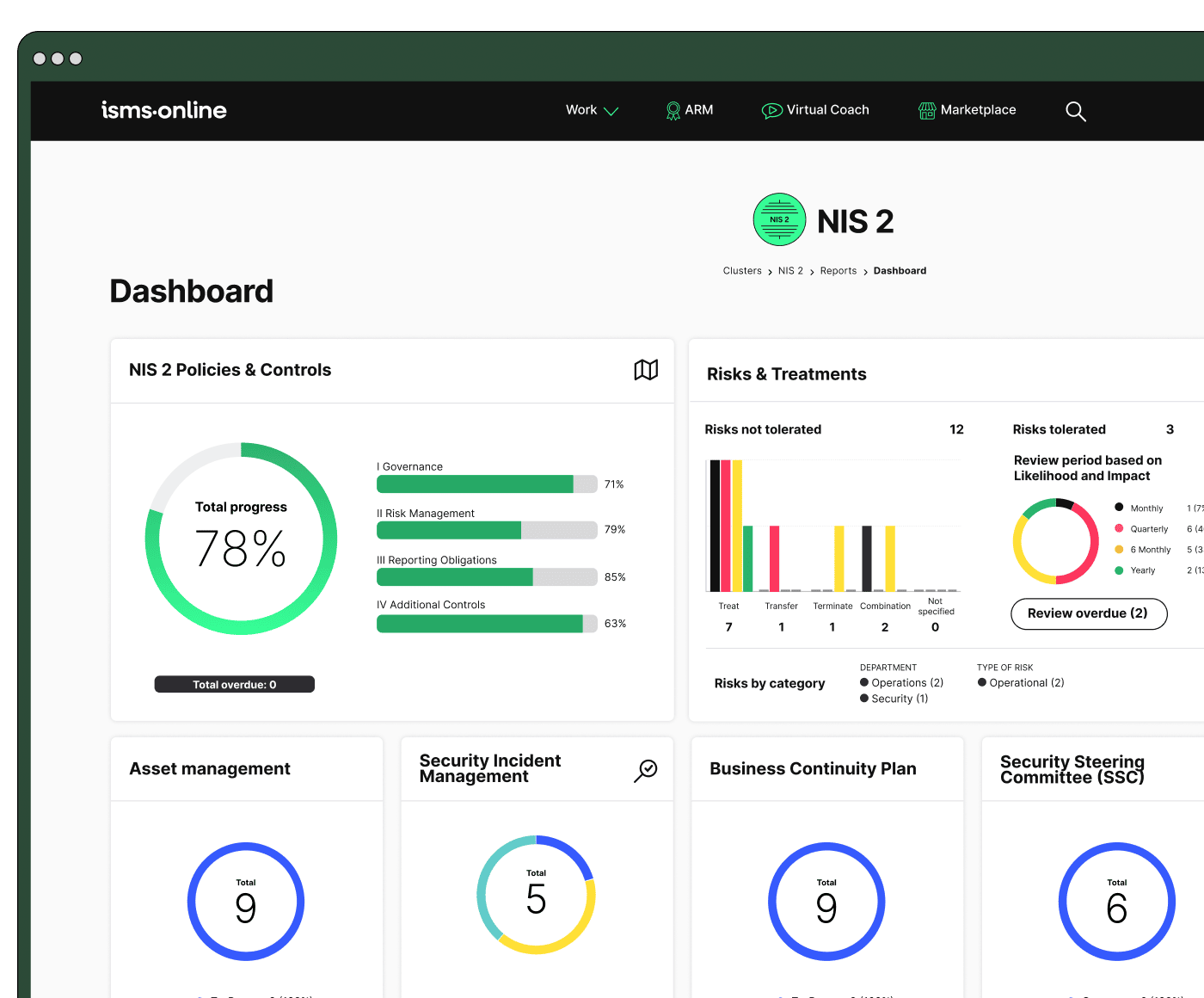
All your NIS 2, all in one place
From Articles 20–23 to audit plans – run and prove compliance, end-to-end.
How Do You Achieve Continuous Improvement and Dynamic Measurement?
Article 21 rejects the static compliance model. Resilience and security readiness are measured by how quickly and thoroughly your system evolves: live logs, continual updates, and real-time metrics.
Requirements for Continuous Compliance
- Quarterly or real-time KPI reporting: Risk dashboards constantly update key metrics-incident rates, policy completion, open vulnerabilities, actions overdue.
- Every incident triggers a documented response and learning loop: Incidents immediately drive improvements-policy or control tweaks, action logs, and lessons-learned sessions.
- Benchmarking against peers and previous performance: Regularly compare your controls and evidence to internal goals and sector standards, updating your system accordingly.
- Comprehensive improvement log: Maintain a chronological, immutable improvement log-this becomes your best defence against the claim of “window dressing.”
- External trigger logs: Supplier incidents, regulatory changes, or client demands must all link to updates, review meetings, and fresh evidence sets.
A living improvement log is your passport to future-proof, regulator-ready assurance.
Audit-Readiness: Can You Deliver in a Crisis?
Real test of compliance comes not from a scheduled assessment, but from real-world chaos-a breach, a regulator demand, or a client inquiry. Article 21 expects your team to deliver, instantly, all mapped evidence, reports, and compliance artefacts.
The Audit-Ready System
- Automated evidence generation: Logs, risk maps, board minutes, and control reviews must be available at a click, not after a week of panic.
- Automated notification workflows: Ensure that every critical stakeholder is notified in real time, with proof of delivery and response (ENISA, Thomson Reuters).
- Multi-jurisdiction audit packs: For enterprises operating globally, ensure every local requirement and authority gets what it needs, formatted and redacted as required.
- Legal sign-off: Bring legal review into your reporting loops-every notification, submission, and regulatory response should include legal oversight and tracking.
- Independent audit readiness: Your system should produce full evidence packs for both internal and external auditors, with granular, certified logs as standard.
With the right system, audits become confidence moments-instead of episodes to dread.
How Does ISMS.online Accelerate and Operationalise Article 21 Readiness?
Traditional compliance platforms force organisations to cobble together documents, policies, and evidence from different silos-producing disconnects, missed reviews, and blind spots. ISMS.online transforms this into a single, version-controlled, action-driven mesh: every control, every review, every improvement, every supplier lifecycle, all in one LINked system.
| Feature/Capability | Article 21 Requirement | Real-World Outcome |
|---|---|---|
| Live Risk Register | All-hazards coverage | Risks, assets, and controls are always mapped |
| Board Approval Workflow | Board engagement | Traceable, time-stamped, review-ready evidence |
| Supplier Risk Dashboards | Supply chain integration | Lifecycle management, due diligence, live review |
| Policy Packs & Training | Human-centric controls | Staff training, engagement, audit logs |
| Audit/Export Automation | Audit readiness | Zero panic, instant evidence for any audit |
Direct Enterprise Outcomes
- Clear, actionable dashboards for board and management: Shift from reaction to live evidence-driven decision-making.
- Automated reminders, sign-offs, and training evidence: End endless chasing; accelerate team engagement and reduce reliance on manual tracking.
- Third-party accountability built in: Suppliers, contracts, and risks mapped and trackable from onboarding to offboarding.
- One, living evidence mesh: Instantly generate audit packs for regulators, clients, or internal leaders-never scramble again.
This is living compliance. This is ISMS.online.
Book a demoFrequently Asked Questions
Who is truly accountable for cyber-security risk management under Article 21, and how does this change board duties?
Article 21 of NIS 2 makes your organisation’s board and executive management directly and personally responsible for cyber-security risk management-no exceptions, no hand-off to IT or compliance managers. This legal and operational shift means the board must now approve, review, and actively oversee the risk management framework, not just sign policies or rubber-stamp reports. Increasingly, auditors expect board-level engagement to be visible in meeting minutes, RACI matrices, and a documented trail of risk discussions and decisions (ENISA, 2023).
Boards demonstrate true cyber resilience not by policy volume, but by how they interrogate, approve, and track concrete actions from the top.
This is the end of plausible deniability: when something goes wrong, “IT owns cyber risk” is no longer an acceptable answer. Leadership teams must now understand, challenge, and drive the organisation’s cyber risk posture in the same way they lead on finance or strategy-transforming boardrooms into guardians of digital resilience.
What outdated practises do auditors treat as non-compliance under Article 21, and how do you operationalise a living, audit-ready risk management system?
Auditors now disqualify organisations relying on static, annual risk registers, checklist-driven “gap analyses,” or evidence assembled only before audits. Article 21 demands that every asset, risk, and control is mapped, owned, and updated in near real-time-never left to stagnate (CEN/TS 18026:2024). The days of treating cyber-security as a once-a-year paperwork sprint are over.
What does modern risk management look like?
- Every asset-hardware, software, supplier, data-has a clearly mapped owner and associated risks, controls, and treatments.
- Risk registers and supply logs are reviewed and updated at least quarterly, not relegated to “set and forget.”
- Policy and control evidence (e.g., incident logs, supplier reviews, meeting minutes) must be linked to specific risks and controls, showing lived history.
- RACI / DACI matrices clarify who is responsible and accountable at all times, backed by workflow and timestamp evidence.
- Real incidents-like a supplier breach or regulatory change-trigger immediate updates to risks and controls, not “wait until next year.”
| Expectation | Operationalisation | ISO 27001 / Annex A Reference |
|---|---|---|
| All hazards identified/owned | Asset-to-risk mapping, owner signoff | Cl 8.2, A.5.7, A.5.19 |
| Quarterly risk review | Board review minutes, update logs | Cl 9.3, A.5.35, A.5.36 |
| Continuous improvement | Evidence, RACI, review audit logs | A.8.15, A.8.16, A.8.17 |
Moving to a living, audit-ready ISMS isn’t theoretical-it lets you deliver the proof regulators now demand.
How can you demonstrate your risk management and evidence are “living”-not theoretical-under Article 21?
Article 21 compels organisations to move beyond “paper compliance” by linking every event, review, and change to live, exportable evidence. It’s no longer enough to show a PDF or checklist; auditors expect to see who, when, and how every key decision was made, and to trace improvements directly to controls, risks, and business assets.
Demonstrate living evidence with:
- Real-time evidence logs that connect incidents (like breaches, supply chain disruptions) directly to updated risks, controls, and owners.
- Management and board review logs, including signoffs and debates, providing a narrative of leadership engagement.
- Exportable evidence packs (incidents, supply reviews, policy updates) that prove historic and current compliance.
- ISMS.online streamlines this: mapping, time-stamping, and linking evidence from risk to action (ISACA, 2022).
| Trigger | Risk Register Update | Control / SoA Link | Evidence Logged |
|---|---|---|---|
| Breach | Severity escalated | Annex A.5.26 | IR log, board review |
| Supplier incident | Third-party risk up | A.5.19, A.5.21 | Contract, supply audit |
| Regulatory update | Context risk revised | A.5.36, A.5.34 | Policy change, legal input |
If auditors can walk the chain from risk to control to evidence-without manual “scramble mode”-you’re audit-ready.
Which technical and human controls must be evidenced for Article 21/NIS 2 compliance-and how do you prove both are effective?
Compliance now requires both technical safeguards and human controls-with the board needing proof that each is deployed, tested, and owned. It’s not enough to have “MFA enabled” or “incident plan created”: you must log configuration, monitoring, and-critically-that staff know, acknowledge, and act on them (IBM, 2023).
Evidence requirements:
- Technical: Automated logs for MFA deployment, patching, asset management, monitoring (SIEM/SOC), and system changes; real-time dashboards; change history against each asset.
- Human/Process: Time-stamped staff policy acknowledgements, completion of security training, simulated drills, RACI logs, escalation/incident registers, and clear records of process ownership.
| Area | Technical Evidence | Human Control Evidence |
|---|---|---|
| Identity/MFA | Config logs, dashboard snapshots | Staff acknowledgements, quiz records |
| Patching | Change records, patch logs | Approval workflows, review minutes |
| Incidents | SIEM/IR logs, playbooks | Drill attendance, escalation logs |
Auditors will expect both sides documented and routinely tested; “set it and forget it” no longer passes muster.
How is supply chain security now central to compliance-and what does “audit-ready” supplier evidence entail?
Article 21 extends regulatory attention to your entire supply chain, meaning you’re accountable for vendors’ cyber hygiene-no more ‘out of sight, out of mind.’ This includes onboarding risk assessments, documented contract clauses, audit and incident handling procedures, routine reviews, and offboarding steps (KPMG, 2022).
Audit-ready supply chain evidence:
- Risk assessment and approval for every supplier, mapped to risk registers and ISMS relationships.
- Contracts with mandatory clauses on incident reporting, audit rights, termination, and remediation.
- Active records of ongoing supplier risk reviews, incident responses, and change updates (not just annual paper reviews).
- Offboarding procedures: evidence of data deletion, deactivation, and access removal for former vendors.
Supplier security has become your compliance perimeter. Proactively managing and evidencing these controls isn’t just about risk-it’s a market differentiator.
What drives true “audit- and notification-readiness” under NIS 2-especially under real-world pressure?
Speed and accuracy are now central to compliance: Article 21 enforces clear deadlines (often 24–72 hours) for incident notification, and auditors demand consistently exportable evidence, logs, and board approvals spanning incidents, supply events, and policy failures (ENISA, 2023).
Steps to high-performance readiness:
- Automate incident workflows that log every notification, recipient, and review, never missing a detail.
- Maintain export-ready evidence packs-contracts, policies, risk logs, and signoffs-for every conceivable request.
- Use immutable ledgers for board and management signoffs, notifications, and legal advice, with timestamped acknowledgment.
- Build cross-border compliance records aligned with regulatory timelines, management review, and legal demands.
| Event | Notification Action | Evidence Pack | Legal/Management Review |
|---|---|---|---|
| Supplier risk | Vendor, regulator alerted | Contracts, updated risk map | Board/legal review |
| Data breach | DPA/authority informed | IR logs, SoA, incident logs | Board review, legal input |
| Policy failure | Regulator, exec notified | Policy, RACI, audit log | Management review minutes |
Automating these steps means you’re never flatfooted-regardless of audit pressure or crisis tempo.
How does ISMS.online reframe Article 21/NIS 2 compliance as a living, board-level resilience advantage?
ISMS.online turns compliance from a scramble-prone “audit event” into a living, linked compliance mesh-one that tracks board decisions, maps risk and controls to every business asset, and automatically logs every update, incident, or supply chain event (TechRadar, 2022). Dashboards give the board and C-suite continuous visibility; evidence packs are exportable any time; sector benchmarking and third-party audits are integrated, not ad hoc.
Why choose ISMS.online for NIS 2?
- Board and execs see real-resilience KPIs-not spreadsheets, but improvement trends and live risk status.
- Every change, awareness, or incident is captured in a digitally signed, audit-proof log.
- Staff engagement, supply chain controls, and risk reviews are always current and linked-never left to drift.
- During audits or crises, your organisation demonstrates living resilience, winning confidence from regulators, partners, and boards alike.
With ISMS.online, you do more than tick boxes. You demonstrate real readiness, resilience, and digital maturity-at board meetings, in audit rooms, and when the stakes are highest.
Empower your board to lead from the front-and show evidence of it-by shifting to a living compliance culture with ISMS.online.






