





































Why “Trust By Default” Is Now a Security Liability
For years, organisations have relied on a “trusted by default” security stance-assuming that staff, suppliers, and internal systems are safe unless proven otherwise. However, modern breaches-especially those affecting supply chains and digital identities-have exposed this assumption as a glaring liability. European regulators now treat “trust by default” not as a neutral baseline, but as an active risk factor with real business costs. NIS 2 and ENISA’s most recent threat models confirm: the window between a missed offboarding and a security event is where attackers thrive-and where auditors now zero in.
Every overlooked access or unmonitored supplier is a door waiting to be opened.
If a supplier wasn’t recently reviewed, or if a departing staff member’s access wasn’t promptly revoked and evidenced, your compliance isn’t just at risk-it’s potentially already breached. ENISA’s analysis shows supply chain compromise as the root of 62% of significant incidents in regulated sectors; this isn’t hypothetical. The result: scrutiny now lands not just on breach response, but on the pathways that made them possible.
Today’s compliance is defined by living proof-Can you demonstrate, without delay, that every user, device, supplier, and process is being continually reviewed, permissioned, and, when needed, revoked? Every delay is a risk multiplier for your business.
NIS 2 turns internal and external trust into a managed risk. Where old policies saw trust as a default, NIS 2 requires you to constantly verify, monitor, and evidence every link-staff, subsidiary, or supplier. If any node is left to assumption, regulators are likely to flag your controls as non-conformant.
Can You Survive Regulator Scrutiny on Access Review?
Every lagged review, missed account termination, or unchecked supplier assessment is a regulatory red flag. Even rigorous controls like multi-factor authentication or privileged access lose their compliance value if you can’t prove they’re enforced for every relevant user, at all times. Evidence must be continuous-not a point-in-time attestation.
Missed offboarding is more than a loophole-it’s an invitation for attackers and a flashing audit warning.
Uniformity or Bust - Why One Weak Link Fails Everyone
Regulators-and increasingly, cyber insurance providers-dont care if most of your system is secured. If one business unit, offshore subsidiary, or critical supplier operates outside your Zero Trust net, the entire organisations compliance posture is called into question.
Proof comes from end-to-end traceability: time-stamped, revocable access for every identity inside and outside the business, mapped and exportable for the entire chain, on demand (isms.online/resources/nis-2-directive-guide/; enisa.europa.eu).
Visual anchor: Imagine an interactive compliance map where each staff or supplier node shows not just their permissions but last audit time, current exceptions, and instant offboarding capability.
Book a demoHow Is NIS 2 Zero Trust Different-Continuous, Not Periodic Controls?
NIS 2 doesn’t just set a new bar for Zero Trust. It redefines it: controls are judged by their continuity, not their presence on a checklist. The essence of “living compliance” is that you can continuously demonstrate, at any moment, proof of identity, control effectiveness, and auditability-not just at annual review.
Continuous control is now the floor. Periodic sign-offs are risk signals, not strengths.
Where previous frameworks accepted annual access reviews or scheduled control testing, NIS 2 and ENISA explicitly frame non-continuous evidence as an emerging risk signal. Auditors may demand a random sample of permissions, supplier reviews, or active exceptions and expect logs-not promises-even between planned reviews.
Zero Trust for NIS 2 means:
- Every identity, permission, and supplier status is actively monitored.
- All changes are tracked in real time, with exportable, time-stamped evidence.
- Control drift, missed reviews, and delayed revocations are auto-flagged-not left for annual audits.
To comply, you must systemise evidence of active controls, enabling auditors to check any date, user, or supplier and discover a fresh, complete record.
Can You Automate Supplier and Identity Trails for Audit Demands?
Manual processes (email approvals, spreadsheet logbooks, or siloed trackers) won’t survive audit now. Auditors expect you to create and export a live chain of evidence, covering identity provisioning, supplier onboarding, and every critical permission grant or revocation-automatically.
When evidence lives only in inboxes, Zero Trust compliance is already broken.
Does Your Coverage Leave Gaps?
Localised Zero Trust-implemented only in a business unit, region, or department-is now actively discouraged. Compliance triggers are organisation-wide: if one part falls out of the continuous loop, overall compliance certification is threatened.
Visual anchor: Heatmapped compliance dashboards-green for compliant, red for action needed-let you spot gaps before audits, not after.

Master NIS 2 without spreadsheet chaos
Centralise risk, incidents, suppliers, and evidence in one clean platform.
NIS 2-Aligned Zero Trust: The Four Pillars Regulators Want Proven
Zero Trust for NIS 2 is not theoretical. It is a concrete operational system that must be visible, measurable, and immediate. EU, ENISA, and ISMS.online guidance converge on four critical capabilities-all of which need to be live and evidential.
Each audit is a real-time spotlight-not a test of intention, but of action.
1. Adaptive Authentication
Continuous, adaptive authentication-covering all identities: staff, third-parties, suppliers. Not just passwords, but enforced multi-factor systems, adaptive checks, and time-stamped log exports. NIS 2 cross-ref: Articles 21, ISO 27001, A.5.16, A.5.17, A.8.5.
2. Least Privilege & Dynamic Access
Role-based controls codified in your ISMS, with automated enforcement and live logs of who gets what, when, and why-plus who revoked access, when. NIS 2 reference: privilege management, segmentation, ISO A.5.15, A.8.2, A.7.3.
3. Segmentation of Network & Supply Chain
Network and asset segmentation (DMZs, VLANs, access controls) must be testable and documented for every business-critical asset or supplier. Supplier due diligence must be evidenced, not just in contracts, but in review logs and risk maps. ISO 27001: A.8.20, A.8.22, A.5.19.
4. Automated Evidence and Exception Management
Exception flagging, review alerts, and deviation logs are evidence for both internal management and regulators. No more “monthly” compliance meetings-evidence is tracked and surfaced automatically, ready for immediate audit.
ISO 27001 Bridge Table
| Expectation | Operationalisation | ISO 27001 / Annex A Reference |
|---|---|---|
| Adaptive Auth | MFA logs, identity events | A.5.16, A.5.17, A.8.5 |
| Least Privilege | RBAC/SoA mapping & change logs | A.5.15, A.8.2, A.7.3 |
| Segmentation | Documented, tested segmentation | A.8.20, A.8.22, A.5.19, A.7.5 |
| Evidence Mgmt | Exception/alert dashboards; proof logs | A.8.15, A.8.16, A.5.28 |
| Central Evidence | Policy Packs, Evidence Bank | A.5.1, A.5.9, A.5.11 |
| Reviews/Updates | Automated review, live sign-off logs | A.8.31, A.8.32, A.5.36 |
NIS 2 Traceability Table
| Trigger | Risk Update | Control / SoA Link | Evidence Logged |
|---|---|---|---|
| New supplier onboard | Third-party/new asset | A.5.19, A.8.2 | Supplier reviews, approval |
| Staff exit / change | Access risk update | A.5.16, A.5.18 | Access revoked, log |
| Missed periodic review | Control drift | A.8.5, A.8.15 | Alert, review report |
| Control tested | Validation/proof | A.5.36, A.8.31, A.8.33 | Signed, time-stamped test |
| Policy exception | Deviation documented | A.7.5, A.8.32 | Mitigation record |
How to Operationalise Zero Trust: ISMS.online Policies & Templates in Practise
Implementing Zero Trust is as much about making operational evidence easy as it is about strong policies. ISMS.online turns best-practise into daily action by:
- Equipping every team-IT, HR, procurement, line managers-with clear, role-based controls and tracking.
- Offering HeadStart Policy Packs-editable, human-friendly, pre-mapped to NIS 2, ISO 27001, and GDPR requirements.
- Centralising every step: approvals, checklists, supplier assessments, risk updates, and exceptions (with transparent timelines and responsibility tracking).
Simplicity at the point of action is true evidence of compliance.
Two-Click Compliance: from Policy Pack to Audit Evidence
Policy Packs transform policies into action items, assignable and traceable to individuals or teams. No more “policy on file, action in the ether”-evidence flows from acknowledgment logs, review cycles, and exception captures, all in one system.
Visual: A dashboard listing all policy acknowledgments and overdue actions by team or unit-exportable at audit time.
Multi-Standard Mapping, Single Update
ISMS.online’s design means updating a password policy or privileged access review in one place instantly evidences compliance with NIS 2, ISO 27001, and (if needed) SOC 2. Audit exports show which controls satisfy which clause in which standard.
Accessibility for Every Department
Zero Trust only works when everyone can use it. ISMS.online’s plain-language templates, reminders, and acknowledgment features mean that compliance isn’t purely an IT or security formality-it’s an organisation-wide practise (isms.online/solutions/nis-2-policy-template/).
Compliance travels faster when everyone owns their part-automation makes that possible.
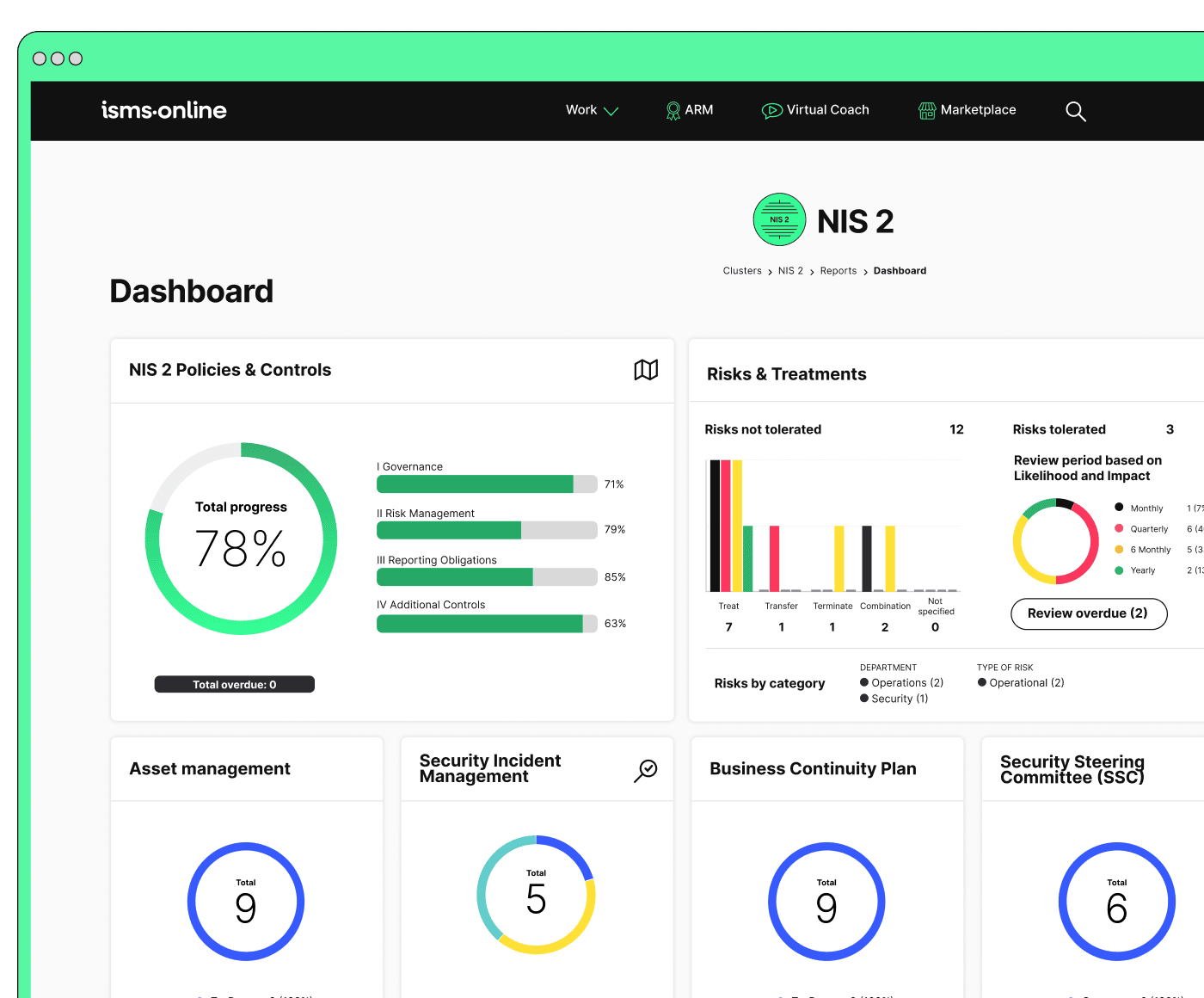
Be NIS 2-ready from day one
Launch with a proven workspace and templates – just tailor, assign, and go.
Automation, Monitoring, and “Living Compliance”
True Zero Trust means automating not only security events but evidence and compliance artefacts. ISMS.online hardwires automation into identity management, supplier reviews, risk assessments, and policy acknowledgments, with real-time dashboards surfacing risk and compliance status at every level-so you know when something is delayed, misaligned, or at risk of audit findings.
Audit day shouldn’t be a panic-it should be a quiet day of business as usual.
Every onboarding, offboarding, policy update, or supplier review generates a time-stamped record, immediately mapped to risk, control, and evidence trails (support.isms.online; enisa.europa.eu).
Visual: Compliance health dashboards, live status gauges-showing coverage and action needed.
Automation: Your Early-Warning System
Orphaned accounts, missed supplier reviews, or overdue controls generate automated alerts and tasks. Dashboards help teams act before audits, not after findings. This isn’t just convenience-it’s defensible proof meeting auditor and regulator expectations (arxiv.org details types of evidence now routinely requested).
Stay Ahead With Preemptive Monitoring
Continuous evidence reviews surface “drift” before it spirals into audit gaps-or worse, unmitigated threats. Exception spikes, overdue access revocations, or policy update lags generate measurable tasks, not just logs.
Audit-Readiness as Routine: Controls, Evidence, and Review Cycles
Being truly “audit-ready” means audits cause barely a ripple. With ISMS.online, every policy, risk, and control is directly mapped to core standards and NIS 2 articles, with all evidence exportable at any time-ahead of, not chasing, the audit calendar.
Audit preparation isn’t an event-it’s the rhythm of effective teams.
Dashboards let you see, at a glance, compliance gaps, overdue items, and exception trends organisation-wide, empowering both team leads and audit owners to allocate resources by actual risk-not just checklist numbers.
ISO 27001 Audit Table
| Expectation | Operationalisation | Reference |
|---|---|---|
| Controls mapped | Linked policies/reviews | A.5.1, A.8.31 |
| Evidence exported | Docs, logs, dashboards | A.5.9, A.8.33 |
| Exception alerts | Automated KPIs/alerts | A.5.36, A.8.15 |
| Live reviews | Scheduled cycles | A.8.31, A.8.32 |
| Remediation | Action logs/sign-offs | A.5.11, A.5.35 |
Extended Traceability Table
| Trigger | Update | Control Link | Evidence |
|---|---|---|---|
| Missed review | Drift alert | A.8.31, A.8.15 | Alert, remediation log |
| Access revoked | Risk closure | A.5.18, A.5.16 | Log, timestamp |
| Supplier status | 3rd party risk | A.5.19, A.8.22 | Review log, approval |
| Control test | Assessment | A.8.33, A.5.36 | Test report, fix summary |
| Policy deviation | Exception managed | A.7.5, A.8.32 | Justification, correction |
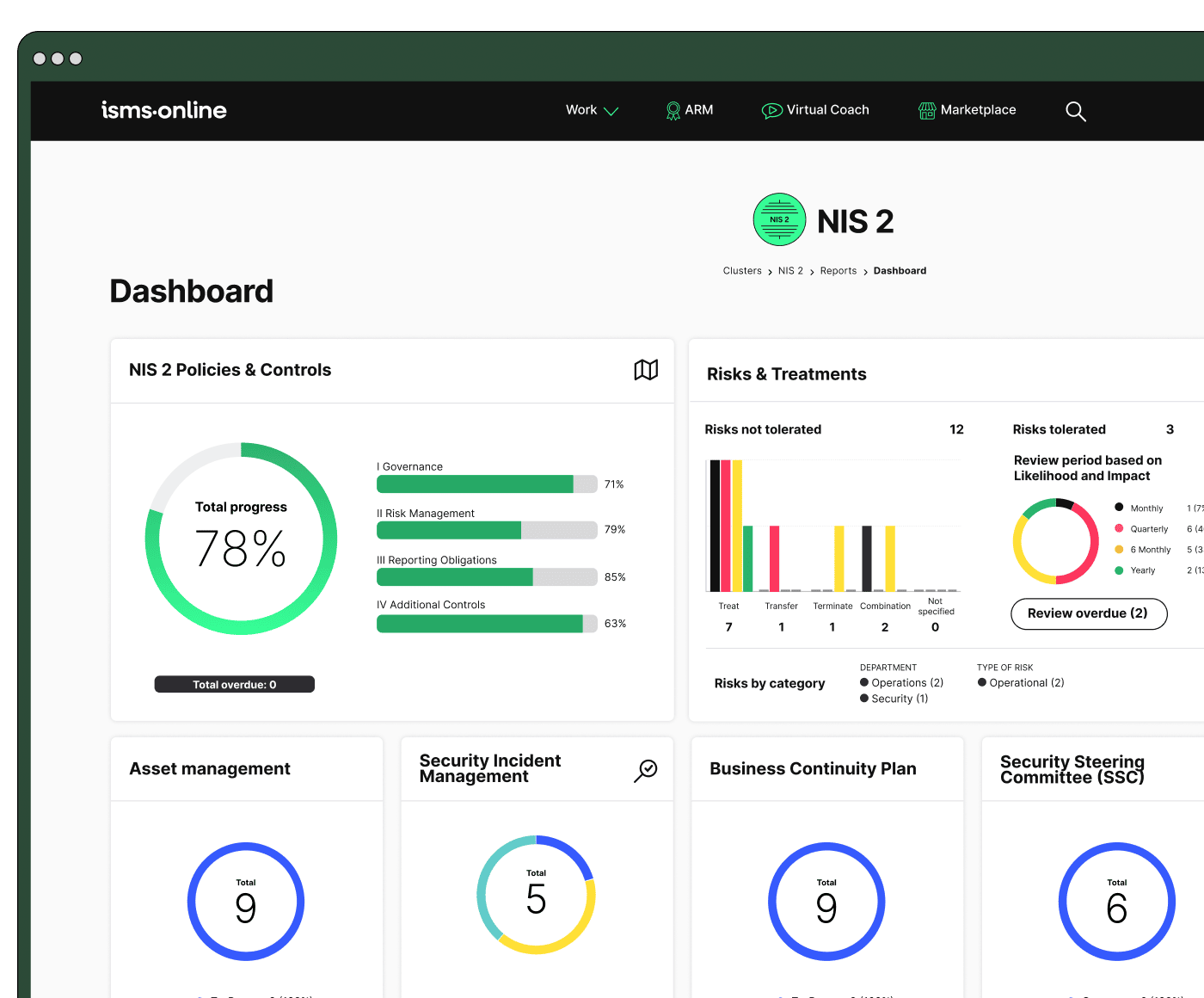
All your NIS 2, all in one place
From Articles 20–23 to audit plans – run and prove compliance, end-to-end.
Building a Real-Time Zero Trust Culture With Metrics and Dashboards
Zero Trust transcends technical controls-it’s about making compliance visible and actionable, every day, at every level. ISMS.online’s dashboards ensure KPIs are no longer invisible or after-the-fact; they’re a driving factor in cultural change.
Risk becomes a fixable fact when everyone can see and own it.
Management dashboards blend technical and cultural compliance metrics: access status, review cycles, policy acknowledgment rates, and overdue tasks per business unit. When KPIs become everyone’s job, compliance is no longer a lonely or annual affair-it’s a muscular, daily discipline (docs.aws.amazon.com; enisa.europa.eu).
Visual: Division-level KPI dashboards, real-time status by team, instantly flagging exceptions, overdue actions, or slipping response rates.
What We Measure, We Fix
Each missed review, lagged acknowledgment, or open access is an opportunity-surfaced not as an embarrassing afterthought, but as a daily, ownable metric. Missed metrics move from invisible risk to shared action.
Every missed metric is an action waiting to be owned.
Start Zero Trust for NIS 2-ISMS.online Today
Compliance can no longer be “projectized” or delegated to annual fire drills. Zero Trust, under NIS 2, is not just a new rule-it’s your new normal. Organisations that systemize live, actionable compliance will find audits are easy, teams are freed from manual chases, and business value flows back into the core. The tools to enable this shift-to automate, monitor, and demonstrate Zero Trust daily-are fully available within ISMS.online.
Transformation happens when you prove it-every day, not just on audit forms.
Action Plan:
1. Activate ISMS.online’s NIS 2-aligned Zero Trust Policy Packs: ensure every access, asset, and supplier is actionable, monitored, and instantly reviewable.
2. Align prebuilt templates: leverage NIS 2, ISO 27001, and GDPR controls across workflows for seamless cross-compliance.
3. Monitor in real time: keep dashboards live, automate reviews, and address acknowledgment lags instantly.
4. Run a 30-day readiness simulation: use ENISA’s checklists and ISMS.online’s automated exports to prove you’re audit-ready at any moment.
With ISMS.online, build a compliance culture where evidence, not promises, is the organisation’s daily habit. Risks become opportunities for action; audits become ordinary; resilience becomes visible in every metric and every business unit.
The strongest Zero Trust cultures are visible, actionable, and shared-one action at a time, by every team member.
Is your organisation audit-proof every day, or just on the audit calendar? Take the next deliberate step. Turn Zero Trust from aspiration to lived compliance-with ISMS.online.
Frequently Asked Questions
Why does “trust by default” create risk under NIS 2, and what proof do auditors now expect?
Trust by default is a deeply embedded habit in most organisations-a legacy built on presuming employees, suppliers, and old systems are safe until proven otherwise. Under the NIS 2 Directive, this assumption is now considered reckless: auditors view unproven trust as a compliance weakness that attackers actively exploit.
The reality is that today’s attack paths almost always exploit overly trusted users or unattended supplier links. ENISA’s research shows that over 60% of major breaches originate in the supply chain or from privileged access left unchecked. NIS 2 demands end-to-end visibility-your business is held accountable for every access, every account, and every connection, even those provisioned years ago. Imagine an old supplier account, forgotten after a system handover, or an employee’s admin credentials left active for “emergencies”-these become Audit Exhibit A and B.
What matters now is not just onboarding or technical controls (like once-a-year MFA rollouts), but a living proof system. Auditors will expect to see time-stamped records of revocations, live rosters of supplier access, and evidence of ongoing review cycles. A missed offboarding or a “ghost supplier” is now a control failure, with potential for regulatory sanctions.
Most breaches and failed audits start not with a malicious outsider, but with an account, device, or vendor you thought you could trust.
Auditor expectation: You must actively demonstrate that trust is proved, visible, and up-to-date-across every user and supplier-not simply assumed and left “until something goes wrong.” With NIS 2, trust is a living process, not a set-and-forget checkbox.
How does NIS 2 turn Zero Trust from an annual checklist into a daily organisational habit?
NIS 2 signals a dramatic end to “security theatre”-where annual audits and stale risk registers sat on the shelf until audit season. Zero Trust is redefined as a daily, visible muscle-evidenced by fresh, unbroken audit trails, across all teams and regions.
Annual reviews and post-hoc risk logs are now evidence of neglect. The Directive and ENISA both insist: changes such as supplier onboarding, employee departures, policy shifts, or network re-zoning must be captured live, with retrievable, system-level evidence (ISMS.online Policies & Controls). If your proof is scattered across emails, forgotten in spreadsheets, or missing for even a single privileged account, an auditor will flag your controls as ineffective.
Audit bottlenecks often appear where change and evidence lag reality-manual tracking and checklists are simply too slow to keep up.
The new expectation: your risk register is a living dashboard, not a static document. Every role change, access review, or supplier evaluation is logged, time-stamped, and visible to both local managers and central compliance. Automation is not simply efficiency; it is a shield against process drift, missed revocations, and “ghost” access. Auditors expect to see ongoing cycles-policy written, workflows enforced, evidence attached, all updated in real time.
Transition: Compliance is now a continuous state, not a seasonal effort. Your living audit trail becomes your best defence against both threat actors and regulatory penalties.
What are the four critical pillars of proving Zero Trust compliance under NIS 2?
For NIS 2, your Zero Trust programme is only as strong as the evidence you can prove across four dynamic, recurring pillars-beyond policy statements.
1. Adaptive Authentication & Access Logging
Every single authentication event should be documented-with clear, context-driven requirements for privileged or sensitive accounts. Audit logs aren’t just for “success/failure,” but must show adaptive controls (location, risk, device).
2. Role-Based Access & Least Privilege
You must map permissions to necessity, not just title. Account rights-user, admin, or service-should be recertified at least quarterly, and logs must show removals, deactivations, and reviews as they happen ((https://www.isms.online/solutions/nis-2-policy-template/)).
3. Network Segmentation & Containment
Breach containment isn’t theory-it’s predictable proof. Diagrams, risk registers, and segment logs must show how a problem in one area cannot cascade across the business.
4. Live Supplier & Workforce Review
You must maintain real-time dashboards and auditable records-across staff, contractors, and suppliers alike. “Spot checks” or only focusing on “top risks” no longer suffice; every link must be visible, reviewed, and ready for inspection.
Crucially: Spot checks and periodic “risk sweeps” don’t cut it. Auditors look for proof that every account, every segment, every supplier is routinely tracked, reviewed, and made visible to relevant management-so nothing is left to hope or habit.
In practical terms, how does ISMS.online make Zero Trust adoption and proof a reality across both IT and business teams?
Zero Trust is not simply a security project; it’s an organisation-wide habit of mapped, living controls-where everyone owns a piece of the audit trail.
With ISMS.online, Policy Packs connect every control point-from user access and privilege escalation to network zone reviews-to drag-and-drop evidence points ((https://www.isms.online/isms-features/)). Even non-IT teams can contribute to compliance instantly with “HeadStart” templates that systematise workflows for onboarding, offboarding, and daily operations ((https://www.isms.online/resources/nis-2-directive-guide/)).
A control tested in HR can be mapped directly (no duplication) to NIS 2, ISO 27001, and SOC 2-all at once-dramatically shrinking questionnaire cycles and eliminating “shadow” or orphan controls (Policies & Controls).
When audit tasks and notifications run in the background, teams surface small gaps before they snowball into major findings.
Every policy review, supplier check, or access certification is time-stamped, linked to business units or countries, and visible in dashboards built for both practitioners and executives. Internal and external audits shift from a scavenger hunt to a check-in-evidence is ready, mapped, and always current.
Result: Zero Trust accountability becomes shared and democratised; audit fitness becomes an outcome of the routine, not a last-minute scramble.
How does automation and visual monitoring transform compliance from firefighting into a trend-driven operating state for NIS 2 Zero Trust?
Automation moves compliance from a reactive exercise-chasing last-minute evidence-to a steady, predictable cycle of assurance and improvement.
ISMS.online integrations seamlessly capture logs, offboarding events, and control statuses directly to the people who care-regulators, auditors, executives-with a single export. Dashboard alerts highlight “zombie” supplier or user accounts before an auditor ever calls them out, while real-time review gaps and closure stats keep teams one step ahead.
Crucially, quarterly control trendlines let management spot and correct process drift-so regulatory trouble is averted proactively.
Automated trendlines and alerts let you fix what’s drifting-often months before a regulator’s question.
This is what “living compliance” looks like: teams measure, adjust, and resolve audit signals in real time-spending time on improvement, not firefighting chaos.
How does ISMS.online enable daily, not annual, audit-readiness across controls, evidence, and cycles?
Audit-readiness isn’t a checkpoint-it becomes your operational baseline when controls, evidence, and remediations are mapped, maintained, and surfaced in real time.
The platform’s dashboards instantly flag overdue reviews, missed revocations, or evidence gaps at the moment they arise. Scheduled quarterly reviews prevent year-end bottlenecks, a process ISACA found reduces last-minute audit crises by 80% or more (ISACA, 2023).
Every control and test is mapped directly to NIS 2 clauses and your Statement of Applicability, eliminating uncertainty in both internal checks and external assessments.
Different business units, regulatory regions, and languages are accounted for within segmented dashboards, so every jurisdiction’s requirements are provable on-demand. Multi-standard mapping (NIS 2, ISO 27001, GDPR) ensures “total pass rate” status is always provable.
| Expectation | Operationalisation | ISO 27001 / Annex A Reference |
|---|---|---|
| User access reviewed | Automated quarterly checks | A.5.18, A.5.15, A.8.2 |
| Supplier due diligence | Built-in onboarding/reminder process | A.5.19, A.5.20, A.5.21 |
| Evidence of testing | Dashboard-driven quarterly validation | A.8.29, A.8.33, A.5.35 |
| Mapping frameworks | Unified control mapping | Clause 6.1, Clause 8.2, A.5.36 |
| Incident audit readiness | On-demand evidence pack export | A.5.24, A.5.25, A.5.26, A.8.17 |
| Trigger | Risk Update | SoA Link | Evidence Logged |
|---|---|---|---|
| User departure | Remove access, close account | A.5.18, A.8.2 | Offboarding event log |
| Supplier onboard | Due diligence verified | A.5.19, A.5.20 | Supplier approval docs |
| Control review | Validate and log | A.5.35, A.8.33 | Review timestamp recorded |
| Config change | Reassess and approve | A.8.9, A.8.32 | Change log, approval chain |
| Incident found | Escalate, evidence captured | A.5.24, A.5.25 | Incident response summary |
Bottom Line: ISMS.online turns audit-readiness into yesterday’s habit. Your teams gain days-not hours-of capacity, with assurance that compliance isn’t a scramble, but a steady, controlled process.
How do real-time dashboards and empowered teams make Zero Trust compliance cultural-and sustainable?
Zero Trust is only sustainable when everyone-not just IT-can see, act, and take responsibility for compliance, fueled by intuitive dashboards and transparent engagement stats.
ISMS.online provides cross-functional, role-aware dashboards: boards see high-level KPIs and trend signals; regional, HR, and operational teams drill into their own policy completions, risks, and pending reviews. A compliance culture is forged when every department sees their slice of Zero Trust and owns it-in their language, on their dashboard.
A compliance culture is when everyone becomes the local owner of their piece of Zero Trust-before the question is ever asked.
Live statistics, multilingual evidence packs, and role-based reporting ensure internal audit, management, and even external partners can access and act on the latest data. The result: improvement and assurance compound with every cycle, building trust with boards, auditors, and-crucially-regulators.
What’s the fastest, proven path to Zero Trust and NIS 2 audit readiness with ISMS.online?
Start with ISMS.online’s Zero Trust Packs-prebuilt templates, policies, and automated workflows that map controls, assign owners, and deliver evidence without guesswork or panic ((https://www.isms.online/solutions/nis-2-policy-template/)).
A 30-day trial allows your teams to configure, test, and experience daily compliance in action-no “implementation cliff,” no hidden cost.
Automated mapping, reminders, and evidence exports make audit prep a background task and prove daily “ready” compliance status, instantly reportable to both internal and external stakeholders ((https://www.isms.online/isms-features/)).
A compliance foundation built today with ISMS.online is your ongoing defence-routine, not exception.
Empower your teams to go beyond talk-own Zero Trust as an everyday habit, and make audit survival routine, not a game of hope.






