





































Why Is Network Segmentation Now a Board-Level Priority Under NIS 2?
Network segmentation has risen beyond a technical safeguard; it’s become a direct boardroom responsibility central to both operational resilience and future market access. The NIS 2 Directive marks a paradigm shift, holding executives personally accountable for segmented resilience that is not just declared, but actively documented, managed, and evidenced-a significant leap from a world where “good enough” diagrams and spreadsheet inventories were seen as compliance.
The real audit is not Do you have a segmentation policy? but Can your board show ownership, reviews, and change logs at any moment-complete and current?
This transformation is driven by the EU’s regulatory expectation that every network segment, boundary, and supplier route must have a named owner, documented review cycles, and readily available proof of both scheduled and event-driven updates (ENISA, 2023). Fines-and perhaps more damagingly, public trust and insurer backing-are now predicated on evidence, not intent. A pan-European analysis in early 2024 put it starkly: One in five regulated organisations failed recent audits simply for lacking up-to-date, owner-traceable segmentation reviews. The platform for passing this new threshold is not another static diagram, but a living chain of digital sign-offs and automated review logs.
ISMS.online turns what was once a hidden risk into an asset. In a single dashboard, boards can respond in real time to proof requests-showing when segmentation was reviewed, who signed off, which supplier connections were checked, and how management actions were logged. This is not just risk mitigation; it’s trust-building currency with insurers, authorities, and shareholders.
ISO/NIS 2 Board Oversight – Segmentation Evidence Snapshot
| Expectation | Operationalisation | ISO 27001 / Annex A Reference |
|---|---|---|
| Segmentation policy owned | Approved, version-controlled, named owner | 5.1, A.8.20 |
| Live network diagram | Change-logged, time-stamped, links to reviews | A.8.20, A.8.22 |
| Owner and review tracking | Named owner, scheduled/event-driven reviews | 7.1, A.8.21 |
| Supplier/3rd party map | Access/removal points mapped and reviewed | A.5.19, A.5.21, A.8.22 |
Most board-level segmentation failures result from missing or lapsed review logs-not from weak diagrams.
Network segmentation is now a direct expression of operational competence and governance. With ISMS.online, boards gain provenance and accountability at speed: documented reviews, clear owner maps, zone-level evidence, and audit-ready exports-all preparing your organisation for regulator and insurer scrutiny.
What Do Recent Breaches Teach Us About Segmentation Risks and Supply Chains?
Recent high-impact cyber incidents rarely begin at a fortress’s front door; they originate at neglected laneways-gaps within, between, and across segmented zones. Breaches in the NIS 2 era have demonstrated that lateral attacker movement is typically enabled not by a lack of firewalling, but by stale segment maps, overlooked supplier routes, and shadow VLANs-those accidental bridges left out of the review cycle (ENISA, 2024).
Silent risk grows where evidence of change and review dries up-attackers seek and find exactly these dormant spots.
Lateral Movement & Supply Chain: The Real Attack Surface
- Endless expansion: Every new supplier, SaaS connector, partner VPN, or cloud route becomes a new checkpoint-and a new risk if not mapped, owned, and reviewed live. NIS 2 and most insurers now require not only “Who connects?” but “Who last reviewed this route, and is there a sign-off?”
- GDPR double jeopardy: If poorly segmenting areas expose personal or regulated data, regulators expect both real-time segmentation evidence and incident logs to satisfy both GDPR and NIS 2 (with potentially reduced breach notification windows and steeper fines).
- Insurance denials: Insurers have started reviewing segmentation logs as part of due diligence, and denial rates for claims have ticked up where “invisible” or unreviewed segments were breached (MIT Sloan, 2023).
Segmentation Traceability: From Trigger to Logged Evidence
| Trigger Event | Risk Update | Control / SoA link | Evidence Logged |
|---|---|---|---|
| Supplier onboarding | Supplier risk documented | A.5.21, A.8.22 | Review log, asset register |
| VLAN or firewall update | Change control captured | A.8.9, A.8.20 | Config log, change approval |
| Zone review (scheduled/ad hoc) | Owner sign-off | A.8.21, Mgmt Review | Digital review log, policy sign-off |
| Security or privacy incident | Incident report, corrective | A.5.24, A.8.22 | Incident, updated mapping |
In a segmented network, the only real weak link is the most out-of-date (or unreviewed) bridge-usually a supplier connection or a decommissioned zone.
ISMS.online centralises this workflow, fusing change, ownership, and review so that every bridge, segment, and vendor is visible and provably managed. When a breach is being dissected, your board and management team have something no spreadsheet or point solution can provide: a digitally signed, time-stamped, and review-traceable segmentation log.

Master NIS 2 without spreadsheet chaos
Centralise risk, incidents, suppliers, and evidence in one clean platform.
Is “Zero Trust” and Micro-Segmentation the New Baseline for Regulated Sectors?
Regulators and auditors are retiring the idea that simple “internal vs. external” segmentation is sufficient. Network segmentation, under NIS 2 and adjacent frameworks, means micro-segmentation and “Zero Trust” as the regulatory default: each user, device, asset, and connection is scrutinised and justified-never simply assumed safe (OWASP, Zero Trust Architecture, 2023).
Zero Trust means proving your control over every zone, mapping every exception, and documenting every review-always, not just at audit time.
Micro-Segmentation Operationalised
- Granular zoning: Segments are now differentiated by *purpose* (production, test, SaaS, admin, OT), *criticality*, and *risk exposure*-not geography or convenience.
- Named, proved ownership: Every zone or segment must have a *named, accountable owner*-with rights, responsibilities, and review tasks explicitly assigned (and evidence of sign-offs ready for audit).
- Active, continuous policy: The segmentation “map” is no longer static: it is an evolving system, auto-triggering reviews with every new supplier, device, or incident. ISMS.online links these processes and pushes overdue reviews or unsigned changes into dashboards-moving segmentation from the back office to executive oversight.
Coloured status tiles indicate live zone health: green for current, amber for nearing review, red for overdue. Clicking any tile traces direct ownership, review logs, asset contents, recent incidents, and a one-click audit evidence export. Automated triggers-asset moves, supplier onboarding, policy updates-keep the segmentation artefact always audit-ready.
A major utility network, facing NIS 2 and DORA requirements, fast-tracked their compliance by leveraging these dynamics-a living dashboard, fully automated workflows, and immediate supplier/zone review escalation. They crossed the audit threshold not with promise, but living proof.
Which Policies, Clauses, and Proofs Satisfy NIS 2, ISO 27001, DORA, and GDPR?
The regulatory landscape is now dense, but the expectations for segmentation are remarkably consistent: “Show the policy, map the asset, evidence the review.” The following ISO 27001 and NIS 2 touchpoints are central:
- A.8.20 (Network Security): Current segmentation must show live management, patching, and review logs-not just theoretical plans.
- A.8.21 (Network Service Security): Supplier/admin/cloud connections require explicit mapping, owner assignment, and live review cycles.
- A.8.22 (Segregation): Every element must be able to show regular review, re-mapping, and-crucially-links to recent incidents and changes.
- A.8.9 (Configuration Management): Each VLAN, firewall, or access change is tracked, signed, and mapped to live policy.
Operationalising the Bridge Between Standards
| Expectation | Real-World Implementation | ISO/NIS 2 Reference |
|---|---|---|
| Named owner, signed policy | Policy with digital sign-off, versioning | 5.1, A.8.20 |
| Asset→zone, live mapping | Registry of assets to zone, review log | A.8.22, A.8.21 |
| Change triggers review | Notification + digital confirmation | A.8.9, A.5.24 |
| Supplier, SaaS route review | Supplier workflow log, route checks | A.5.19, A.5.21 |
For GDPR/ISO 27701, any zone with personal data must have provable risk mapping, latest review dates, and fast incident-to-asset linkage (e.g. DPIA outputs).
ISMS.online bridges these: out-of-the-box templates and policy packs mapped to ISO/NIS 2/DORA references, with live evidence bundles. Unless your evidence artefacts and workflow logs can be instantly exported and tracked, even policy-rich organisations are at risk of failing an audit.
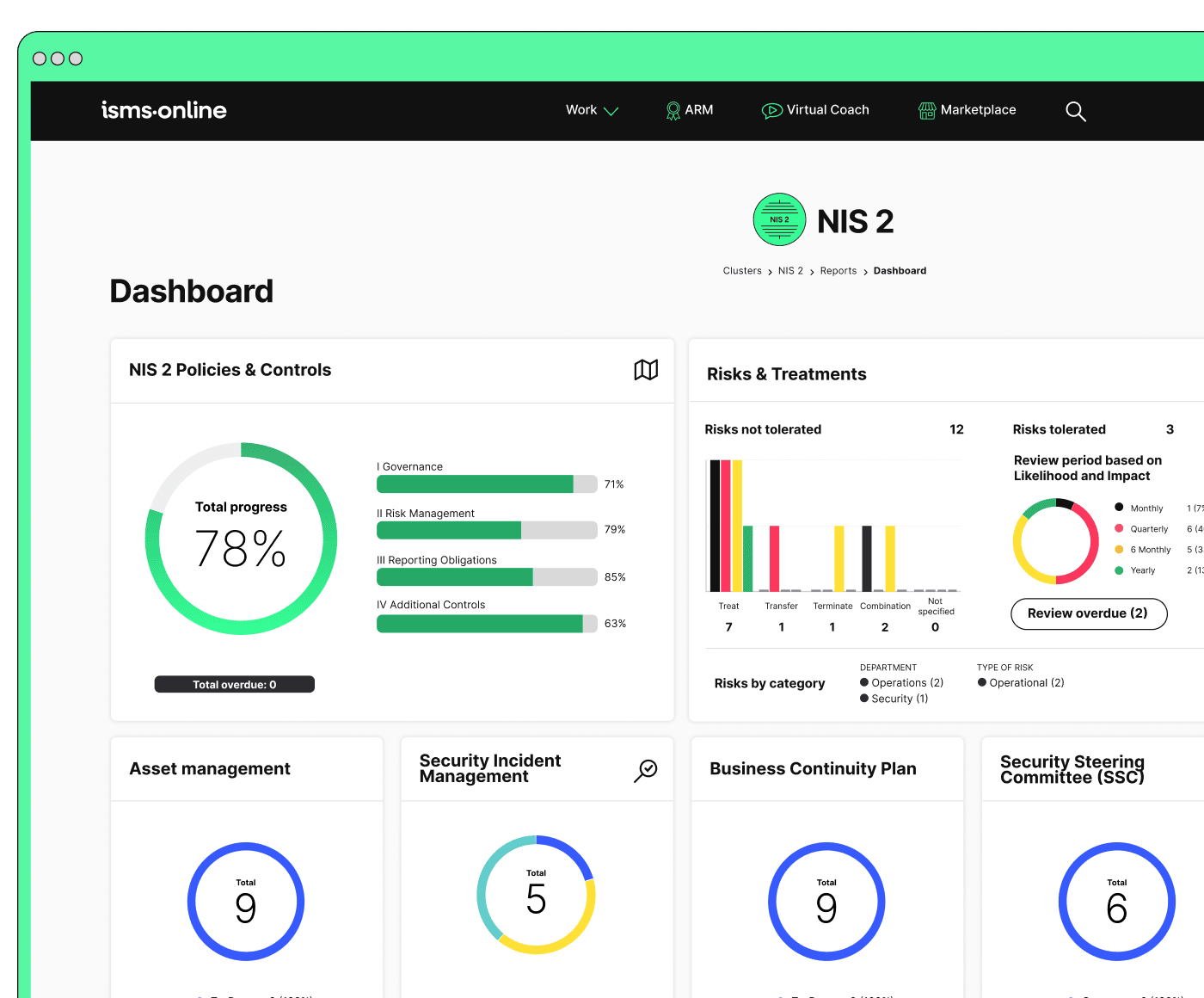
Be NIS 2-ready from day one
Launch with a proven workspace and templates – just tailor, assign, and go.
What Evidence and Workflows Do Auditors and Inspectors Demand Today?
Auditors, regulators, and insurers want living proof-stepwise workflows that record: who owns each segment, who reviewed it, what changed, and when was it approved. Passing an NIS 2 or ISO 27001 audit is now less about “the big book of policies” and more about “the living chain of reviewed, owner-signed, time-stamped logs.”
Policies are the easy part-it’s seamless, real-time approval and event logs that win audits.
Real-World Proof Points
- Zone-asset-owner maps: Every device, supplier, or service is mapped to a segment, with a named owner and a live review tracker.
- Digital, signed reviews: Each scheduled/ad hoc review is digitally signed and stored, auto-reminding both reviewers and owners.
- Event-driven workflows: Incidents, supplier changes, and asset shifts trigger live approval workflows and escalate unreviewed items in dashboards.
- Pen-test/SIEM linkage: Audit logs connect every test finding to affected zones, demanding review and digital sign-off before closing the loop.
Persona Fit
- *Compliance Kickstarters*: Get guided, approval-ready templates and step-by-step workflow guidance.
- *CISO/Board*: Survey zone status, overdue reviews, and evidence exports live for internal or regulator visibility.
- *Practitioner*: Automate review/approval requests, centralise evidence, and dramatically reduce administrative drag.
How Do You Automate Asset Mapping and Ongoing Policy Review in ISMS.online?
Automation is not optional: it’s the lifeblood of a resilient, always-ready ISMS. ISMS.online obviates spreadsheet chaos and manual evidence tracking by offering:
- Bulk asset onboarding: CSV/API imports instantly assign assets to zones, populating registers for ongoing management.
- Dynamic zone creation and editing: Rapid segment assignment matches technical and supplier changes in real time.
- Accountable owner allocation: Every segment must have a named, digitally traceable owner-a persistent, auto-reminded responsibility.
- Automated review cycles: Built-in scheduling ensures routine and ad hoc reviews trigger reminders, approvals, and escalations.
- Incident and config change triggers: Every asset move, supplier event, or breach kicks off a linked policy review, workflow, and auto-logged evidence-no more missed handoffs or “lost” audits.
With every asset and policy mapped, every change or incident becomes both a compliance event and a new opportunity for audit-ready evidence.
Status tiles colour-coded for compliance show zone health at a glance. Drill in to see last review, owner, overdue actions, or export an audit file. Every activity, policy sign-off, and incident is tied directly to evidential artefacts-just a click away for the board or regulator.
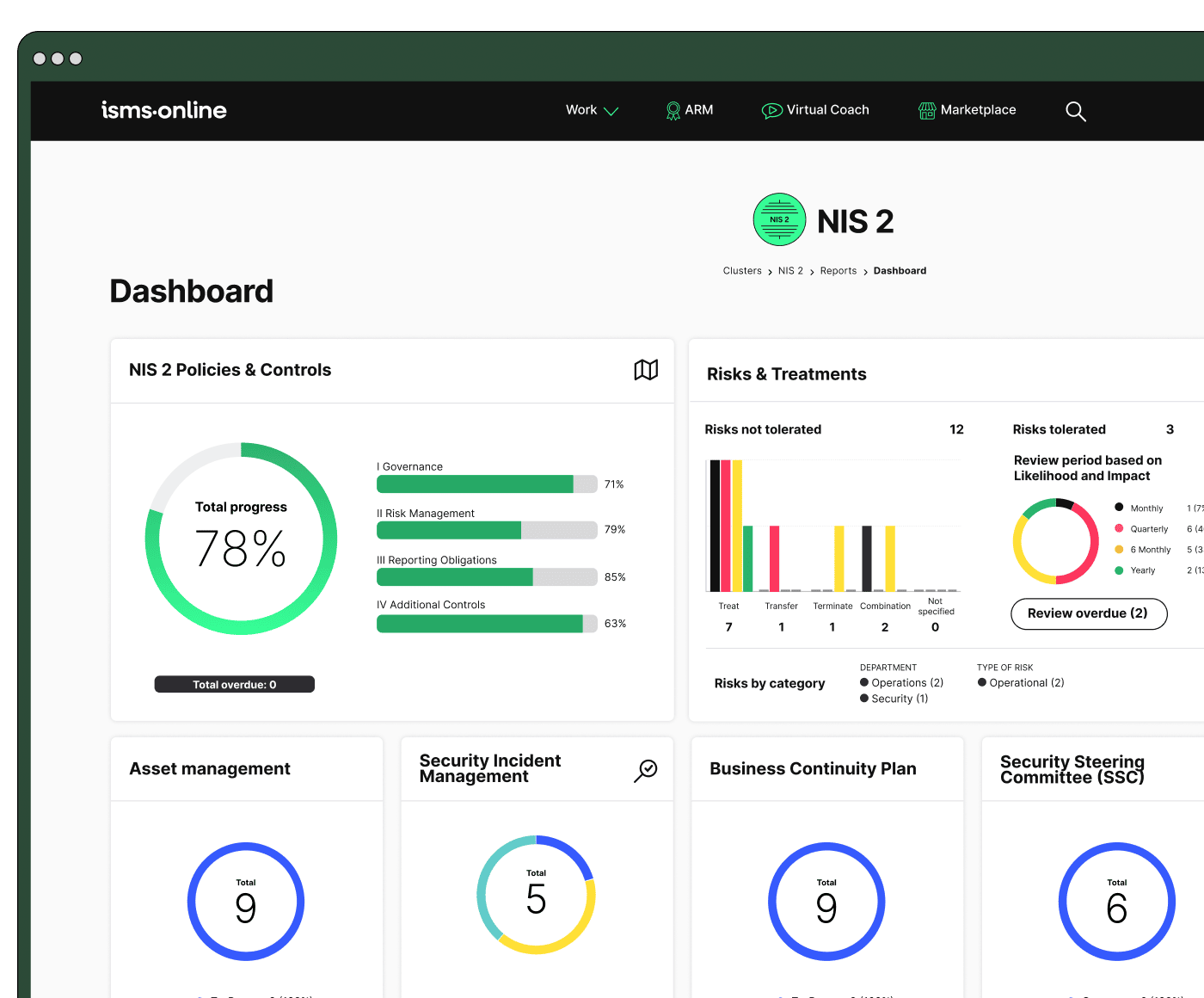
All your NIS 2, all in one place
From Articles 20–23 to audit plans – run and prove compliance, end-to-end.
How Is Evidence Continuously Tested, Triggered, and Traced for Segmentation Resilience?
In a living ISMS, resilience is functionally measured by the system’s ability to detect, trigger, escalated, and evidence every meaningful event.
- Pen-test findings: Instantly mapped to affected segments/zones, opening mandatory reviews with sign-off requirements.
- SIEM asset drift: Automated alarms for misaligned assets trigger re-mapping and review assignments.
- Supplier on/offboarding: Immediate, mandatory re-verification of each affected zone, linked to updated contract/SLA evidence.
- Incident post-mortem: Full zone audits and review cycles automatically launch after events, with evidence linked for compliance and insurance purposes.
For the Practitioner:
Every workflow is digitised, removing manual follow-ups. Missed reviews, unassigned assets, and unsigned approvals escalate visibly-making the “paper gap” almost impossible to hide.
Continuous Audit Table
| Trigger Event | Risk Control Review | Control / SoA Link | Audit Evidence Log |
|---|---|---|---|
| Pen-test finding | Immediate review | A.8.22, SoA | Zone log, signed review |
| SIEM asset drift | Asset re-alignment | A.8.20 | Device & zone record |
| Supplier update | Contract/routing check | A.5.21 | Contract log, workflow |
| Breach/incident | Segment-wide audit | A.5.24 | Incident, review log |
ISMS.online ensures every control update, asset drift, or incident is not just a risk, but an impetus for new evidence-strengthening the chain of resilience and offering perpetual audit-readiness.
How Do You Turn Segmentation Into Resilience, Audit Wins, and Board Trust?
The compliance landscape is no longer about admiring technical solutions-it’s about proving, continuously, that resilient segmentation is enacted, traceable, and board-visible. When segmentation workflows are automated with ISMS.online, you gain:
- Practitioner uplift: Evidence chasing becomes a background process. Reviews, approvals, and asset mapping are scheduled, logged, and surfaced automatically. Over 60% less “audit scramble,” fewer errors, and more time for proactive security.
- Privacy & legal assurance: Asset/zone traces map instantly to privacy impact areas for GDPR and ISO 27701; you can instantly show up-to-date logs, reviewed DPIAs, and policy links-no more “find the evidence” scramble.
- Board/CISO confidence: Real-time dashboards cut lag between operations and oversight. Every overdue, assigned, or unreviewed segment is evident on first glance, ready for export or inspection-demonstrating resilience as an ongoing, board-owned asset.
- Kickstarter velocity: Even those new to compliance can confidently execute segmentation policy, review, and owner handoffs thanks to guided workflows, plain-language templates, and auto-triggered digital sign-off paths.
Checklist for Effective Segmentation with ISMS.online
- Map your entire asset inventory, segment by live zone, assign owners.
- Embed review cycles-scheduled, incident, or supplier-driven.
- Use automated triggers for all changes (VLAN, firewall, supplier, asset, or incident).
- At any time, export a complete evidence bundle-proof not just for audit day, but year-round resilience.
Segmentation was once a paperwork chore-now it is living capital for resilience, lowering insurance, and protecting shareholder value. (ISMS.online customer, board reporting, 2024)
Action: Map, assign, automate. With ISMS.online, segmentation becomes resilience-the engine of audit success and institutional trust.
Request Your ISMS.online Network Segmentation Tour
Experience segmentation as a living asset:
– See NIS 2 and ISO 27001 templates operating in real time
– Map assets, assign owners, automate reviews, and surface evidence in a single workflow
– Practitioner, CISO, Privacy, and Kickstarters-see your unique dashboard view
Your next step:
Run a segmentation gap analysis with ISMS.online. Surface your assets, streamline your reviews, and tie evidence to live workflow. Accelerate your journey from compliance to resilience-and meet the board’s new standards before an auditor or regulator asks.
The bar for resilience has been raised. Evidence is the only standard. Upgrade with ISMS.online, where segmentation delivers more than compliance-it powers trust.
Frequently Asked Questions
Why has network segmentation become a critical compliance and audit issue under NIS 2 and ISO 27001:2022?
Network segmentation is now a centrepiece of both NIS 2 and ISO 27001:2022 because regulators and auditors have raised the bar from static diagrams to proof of dynamic, risk-aligned, and owner-assigned segment controls that are actively reviewed and updated. Gone are the days when a broad “zones policy” or yearly diagram sufficed: you’ll now need to demonstrate to auditors that each network segment is mapped to real assets, owned by a named business stakeholder, routinely reviewed, and tightly integrated with your risk register and change workflows. NIS 2 explicitly demands up-to-date, business-driven segmentation-backed by logs of who reviewed what, when, and why. ISO 27001:2022’s controls (notably A.8.22, A.8.20, A.8.9) reinforce live asset-to-zone mapping, owner traceability, version control, and workflow automation, ISO 27001:2022 Annex A).
The new compliance bar is simple: can you show exactly who owns each segment, when it was last reviewed, and what action was taken? If not, your policy is a paper shield.
Segmentation Expectation vs. Operational Reality (ISO 27001/Annex A Ref)
| Expectation | Operationalisation | Reference |
|---|---|---|
| “Zones” policy exists | Ownership assigned, versioned policy, review-logged | 5.1, A.8.20, A.8.22 |
| IT manages all zones | Business/service owners mapped to zones | A.8.22, A.8.21 |
| Annual reviews | Biannual, incident-driven review cycles | A.8.22, A.8.9 |
| Diagrams stored | Live asset-to-zone and supply chain mapping | A.8.21, A.8.22 |
Where do modern breaches, third-party risks, and insurance denials reveal segmentation failures?
Most catastrophic breaches-and cyber insurance claim denials-now trace to invisible, outdated, or poorly reviewed zone boundaries, especially involving suppliers and SaaS links. Attackers rarely brute-force the front door; instead, they sidestep via misclassified VLANs, unchecked vendor VPNs, or supply chain links that have quietly gone unreviewed. Regulatory fines and denial-of-coverage events often hinge on missed documentation: an incident log missing an owner update; a legacy segment not reviewed after a supplier integration; a gap in the review cadence (Infosecurity Magazine, 2024; MIT Sloan, 2024).
Security dies where segmentation ownership ends. Every vendor port or forgotten subnet is an unguarded front.
The evidence that counts is not a single diagram or annual policy-it’s a logged sequence of asset-to-zone updates, incident-driven segmentation checks, and digitally signed reviews triggered by every meaningful business event.
What does Zero Trust segmentation look like in a business workflow-and is it now the new compliance default?
Zero Trust segmentation has become the enforced standard, not just a best-practise suggestion. The old “trust this subnet” model doesn’t hold-now, every segment, admin path, and supplier link must be mapped, owned, justified, and automatically reviewed for every change and incident (ENISA, 2023,. Your system should:
- Assign owners for every admin/development/production/supplier segment, with continuous sign-off.
- Trigger instant, logged reviews and re-approvals when suppliers are added, zones altered, or incidents reported.
- Track version changes and gather digital evidence (what changed, who signed off, operational justification).
ISMS.online automates these checks: creating owner review prompts, linking incidents to necessary segmentation reviews, and maintaining evidence for auditors. Auditors and insurers increasingly request logs-because static diagrams don’t reflect current risk.
How do NIS 2, ISO 27001:2022, and DORA turn segmentation policy into continuous risk-driven workflow?
Regulatory frameworks have converged on one message: segmentation controls only matter if they’re operationalised, risk-aligned, and evidenced as part of daily workflows.
- Versioned policies: All segmentation practises must be version-controlled, owner-tracked, and carry a change log. The document itself is not enough-regulators want acknowledgment and update logs ([ISO 27001 A.8.20, A.8.22]).
- Asset-to-zone mappings: These maps must reflect ongoing asset changes, supplier onboarding/offboarding, and be automatically updated and reviewed ([A.8.21, A.8.22]).
- Automated workflow triggers: Reviews should run on a recurring schedule and after every incident or configuration change ([A.8.9, NIS 2 Art. 21]). Task assignment and escalation for overdue reviews must be in place.
- Supplier and incident traceability: Each business event must update access controls, launch a zone review, and generate a digital record (SoA/A.5.19/A.5.21/A.5.24–A.5.28).
Segmentation Traceability Matrix
| Trigger | Risk/Update Step | Control/SoA Link | Evidence Logged |
|---|---|---|---|
| Supplier joined | Owner/zone review | A.8.21, A.5.19, A.8.22 | Owner sign-off, timestamp |
| Scheduled cycle | Asset/zone analysis | A.8.22, A.8.9 | Review log; change log |
| Incident | Segmentation review | A.8.20, A.5.24–28 | Incident report, update |
Every workflow step, from supplier add/drop to incident notification, now triggers review-and each review must be logged, owner-linked, and export-ready.
What evidence “moves the needle” for auditors, regulators, and insurers?
Static policies no longer satisfy regulators or insurance underwriters. What earns trust-and unlocks audit/insurance/contract approvals-is living, owner-signed, time-stamped records that show continuous control and adaptation. High-maturity organisations provide:
- Owner-linked “living” diagrams: mapping assets/zones/suppliers to business units.
- Time-based review and escalation logs: , alerting leaders to overdue or skipped reviews.
- Change and incident logs: tied directly to zone mapping and SoA, closing the loop from policy to incident recovery.
If your team can answer “who owns this zone, when was it last approved, what changed after the last incident or supplier integration?” with digital proof (not anecdote), you’ll exceed even the harshest audit or insurance demands.
How does ISMS.online automate the segmentation lifecycle, reviews, and evidence generation?
With ISMS.online, you can:
- Bulk import assets/zones: Map every device, cloud resource, or supplier directly to a zone, automating business-driven segmentation.
- Assign/reassign owners on every change: Every configuration update, supplier change, or asset addition triggers a review and digital sign-off workflow.
- Automate real-time and scheduled reviews: Set automatic reminders based on cadence or business events (supplier onboarding, incident, config change).
- Log every action and approval: Every review, owner change, and incident-triggered update is time-stamped, archived, and available for audit export.
- Link reviews to incidents and audits: Incident response triggers segmentation checks, with all updates and decisions linked to SoA controls and evidence logs.
- Export proof in a single click: Create regulator-, customer-, or insurance-ready bundles with diagrams, logs, and digital sign-offs-showing complete segmentation health at a glance.
Dashboards surface overdue reviews, ownerless zones, supply chain blind spots, and ready-to-export evidence-making resilience visible for all stakeholders.
What do CISOs, Boards, Legal, Practitioners, and First-Time Compliance Leads gain from live segmentation?
- CISOs and Boards: Get instant, continuously updated dashboards mapping segmentation health against risk, audit, and regulatory requirements-enabling rapid, data-driven executive action.
- Compliance/Legal/Privacy: Tie DPIAs and SoA directly to business zones, providing defensible evidence for regulator inquiries or customer questionnaires in moments.
- Security Practitioners: Save hours with auto-reminders and workflowed owner assignments; streamline incident reviews and handoffs without admin strangleholds.
- Compliance Kickstarters: Rely on templates, live zone mapping, and tracked owner sign-offs to navigate first audits with confidence, not chaos.
When every review, owner, and diagram is mapped, logged, and ready on-demand, segmentation becomes your reputation asset-not a compliance risk.
How do you move from audit scramble to segmentation confidence in ISMS.online?
Begin by running a segmentation gap analysis in ISMS.online: instantly surface review overdue zones, missing owners, outdated diagrams, or supply chain blind spots. Use templates to bulk-define zones and assignments. Set up automatic reviews and sign-off triggers for every asset, supplier, and incident. From onboarding to export, every update leaves a digital trail-so you can prove segmentation control, not just intend it.
Ready to make segmentation your compliance advantage? Start mapping, reviewing, and evidencing every segment lifecycle in ISMS.online-so you’re always ready for audit, regulator, or insurance review, all year round.






