





































Why Estonia’s NIS 2 Rollout Is Rewriting the Cyber-Security Rulebook-And Why It Means More for Your Organisation Than “Compliance”
Estonia’s rollout of the NIS 2 Directive isn’t just another line in the regulatory ledger; it’s a wholesale reinvention of how organisations-from regional utilities to digital-first startups-defend, evidence, and prove resilience in a digitised economy. Where the old world of annual audits and dusty policy folders papered over gaps, Estonia’s 2024 regime, enforced by the Estonian Information System Authority (RIA), brings a new urgency: visibility, speed, and unbroken accountability are now the operating system of digital trust.
In Estonia, you don’t pass compliance-they verify you live it, every day.
The boardroom has become a front-line actor. Over 7,000 entities-many new to regulation-face real consequences: relentless audit cycles, real-time incident reporting, and personal liability for board members. Missed onboarding, supply chain gaps, or failure to update evidence now carry risks measured not just in fines (up to €10 million or 2% of global turnover), but in lost deals and shattered trust.
Where some see pain, the wise organisations see a competitive trigger: resilience and readiness are becoming visible differentiators in the European and global cyber economy. The question is no longer, “Can we afford compliance?”-but “Will we still earn the right to compete if we lag?”
The End of Passive Compliance: Whats Now Expected-And Penalised
Estonias transformation collapses the old cycle of sleepy compliance sprints. Legal checklists and once-a-year reviews are replaced by hard milestones, continuous onboarding, live evidence, and sector-wide drills. For every entity-especially essential operators and SaaS-driven suppliers-the new bar is an always-on defence, with regulatory, reputational, and commercial consequences for slippage.
For IT and risk managers, ambiguity is over. Estonias model locks the window of evidence on a quarterly cycle-every missed check or delayed handover isnt just a paper cut, but a contract risk and a persistent regulators flag.
Book a demoHow Estonia’s National Authority and CSIRT Network Hardwire Risk Ownership Into Your Operations
Estonia has engineered a tight bond between legal oversight and operational muscle by merging regulator (RIA) and responder (CSIRT) functions. This model stretches beyond “letters from the authority”: RIA isn’t merely a policy captain but a “nerve centre” that sets onboarding checklists, supply chain standards, and escalation procedures directly into the operational heartbeat of each organisation.
You’ll find sectoral CSIRTs woven throughout, operating 24/7 tech hotlines, running sector drills, and embedding drill/test routines into onboarding flows. Compliance is no longer procedural or theoretical. Instead, it’s mapped to the daily rhythm of logs, drills, evidence updates, and rapid-response chains, with failures instantly flagged at operational, not just legal, levels.
If you don’t know your incident escalation route, your board carries that risk-not just your IT team.
Executive Accountability Isn’t Optional-It’s Digital and Daily
Board responsibility is now “lived” in the digital thread: approvals, protocols, and evidence routines must be actively administered and logged in real time. The obligations stretch further in Estonia-boards are expected to green-light incident plans, supply chain mapping, and evidence cycles, signing off on digital documents with the same vigilance as financial risks.
On the ground, this means sector CSIRTs and RIA collaborate to test, spot, and pre-empt reporting failures before they escalate. The result? Organisations in Estonia now treat digital drills and audit readiness as habitual-built into onboarding, job descriptions, and quarterly management reviews, rather than as afterthoughts forced by a looming audit or feared breach.
Technical Onboarding: Drills, Hotlines, and SOPs Gone Live
IT and security practitioners in Estonia now operate in a culture where practising incident notification is as routine as applying critical patches. Every regulated entity traces and logs “near-misses,” runs scheduled sector drills, and rehearses the steps for reporting to both national authority and CSIRT. For newcomers, Estonia offers onboarding resources, supply chain tools, and sector-specific checklists-eliminating the guesswork that so often sinks first-time compliance efforts.

Master NIS 2 without spreadsheet chaos
Centralise risk, incidents, suppliers, and evidence in one clean platform.
What “In Scope” Really Means Under NIS 2-Why Even SaaS-Focused and Mid-Market Firms Must Mobilise
Estonia’s definition of “in-scope” casts a wide net. Gone are the days when only state-owned or critical infrastructure giants faced regulatory scrutiny. Under the new regime, any business categorised as “essential” or “important”-including SaaS providers, third-party logistics, and suppliers to high-criticality sectors-is compelled to register with RIA, complete rapid onboarding, and satisfy ongoing evidence requirements.
Scope mapping mistakes risk breached contracts, fines-and instant RIA escalation.
Your Supply Chain Is Now a “Compliance Cascade”-You’re Responsible for the Whole
Supply chain risk is no longer the problem of “the big provider.” If your offer supports critical infrastructure-energy, health, digital platforms, or you’re a SaaS contractor in that ecosystem-your regulatory obligations cascade relationally. RIA and sectoral CSIRTs enforce supply chain registry, contract mapping, and evidence tracing. A slip or omission by a downstream partner can break your own status, delay deals, or trigger fines.
Milestone Vigilance-Legal Teams and CSIRTs Watching Every Step
Legal deadlines and onboarding milestones matter. Counsels now map deadlines, onboarding windows, and SaaS/PPP contracts tightly against RIA’s schedule. Compliance partners and CSIRTs not only provide onboarding help-they maintain live registers and escalate at the first sign of a deadline or operational miss.
Traceability Table: How Operational Triggers Map to Compliance and Audit
| Trigger | Risk Update | Control / SoA Link | Evidence Logged |
|---|---|---|---|
| Scope notification received | Supply chain risk register updated | A5.19, A8.8 (ISO 27001) | NIS2 registry entry, contract audit trail |
| New supplier onboarded | Third-party risk added | A5.21, A8.30 | Supplier assessment, onboarding checklist |
| CSIRT guidance updated | Incident playbook revised | A5.24, A5.25 | Drill log, board meeting record |
| Incident reported (PPP) | Cross-entity incident log extended | Sectoral CSIRT response, RIA req. | Shared incident file, regulator evidence submitted |
| Milestone missed | Board-level risk flagged | A9.3, A5.35 | Compliance review, corrective actions logged |
Failing any of these hand-offs means a regulator or auditor will see an immediate red flag, with real-world consequences for contract status and audit outcomes.
The New Burden-Or Opportunity? – Penalties, Audit Fatigue, and the Move to Evidence as Board Currency
NIS 2 compliance in Estonia brings sharp pain-but also a path to outsize advantage. The risks for “essential” entities include fines up to €10 million, 2% of global turnover, and full board accountability for missed evidence or reporting missteps. The indirect consequences-lost contracts, negative auditor opinions, supply chain suspensions-carry even longer-lasting commercial risk.
It’s not just fines-it’s losing the right to be a supplier or trusted partner.
Audit Fatigue Is Out; Evidence Routines Are In
Old patterns of audit dread no longer apply; the best organisations treat audit readiness as a rolling routine-anchored in systemised evidence, not scattered PDFs or email trails.
Execs & Board-Evidence is the CEO’s, Not the Auditor’s, Problem
Senior leaders can’t delegate cyber responsibility to the IT corner. Evidence now means planning, reviewing, and logging all changes and incident workflows across every key control-showing not just intent, but action taken and outcome achieved. Every quarterly review, each contract signed, every drill practised leaves a board-level digital audit log.
IT/Practitioners-Manual Chasing Is Replaced by Connected, Digital Logs
The days of scrambling between spreadsheets, emails, and SharePoint folders are conclusively over. Practitioners now rely on workflow platforms purpose-built for traceability (like ISMS.online), automating every approval, evidence link, management review, and contract check-in-giving staff, board, and third-party auditors live status updates at a glance.
Rapid Reference Table: From Regulatory Demand to Daily Practise
| Expectation | Operationalisation | ISO 27001 / Annex A Reference |
|---|---|---|
| Board-level review | Quarterly review + evidence logging | 9.3, A5.24, A9.3 |
| 24/7 incident reporting | Live logs; automated escalation systems | A5.24, A8.16 |
| Supply chain diligence | Supplier risk checks; contract audits | A5.19, A5.21, A8.30 |
| Drill/evidence mapping | Scheduled drills + audit log review | A5.25, A8.29 |
| Onboarding + assignation | Digital records; confirmation trails | A7.2, A6.3 |
These aren’t optional extras-they are the new threshold for passing audit and securing contracts in Estonia’s regulated sectors.
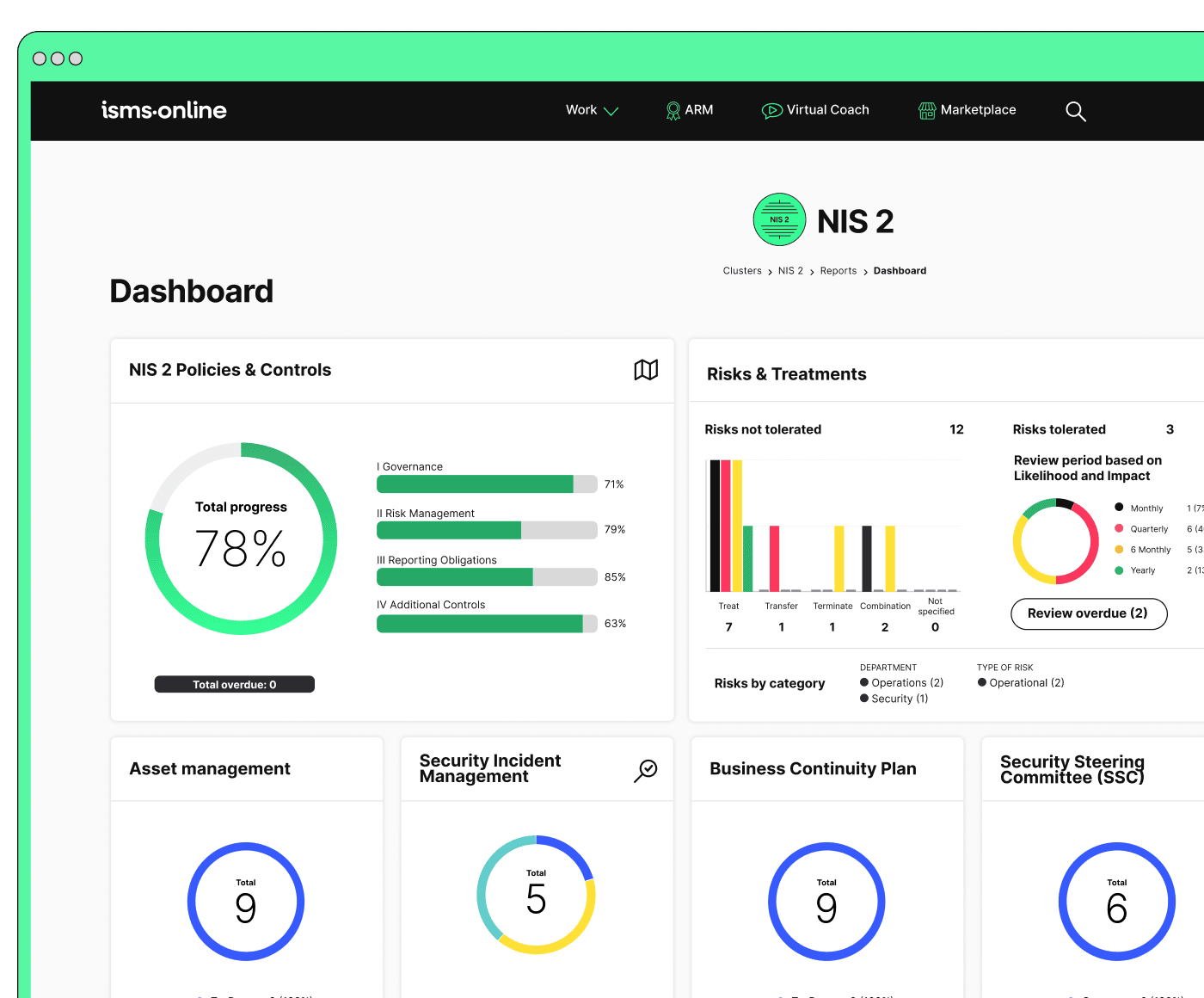
Be NIS 2-ready from day one
Launch with a proven workspace and templates – just tailor, assign, and go.
How to Build and Prove 24/7 Security: Practical Steps for Surviving Estonia’s NIS 2 Audit Cycle
Continuous compliance is now a living discipline: every incident, drill, and risk register must be traceable and up to date. Evidence and logs are dynamic, not static. The question for boards and practitioners alike is simple-can you show your digital thread at any hour, or only when prodded for the annual audit?
If your logs aren’t current, you’re failing-even if incidents haven’t happened.
Board Ownership-Contracts, Reviews, and Embedded Accountability
Quarterly management reviews and contract sign-offs must explicitly log who approved what, when, and how follow-through was achieved. Key clauses (ISO 27001: 9.3, A5.24, A9.3) require digital confirmation and mapped linkage to controls and incident records. Automated audit tools are expected, not optional. Contracts must give “right to audit” clarity for supply chains-evidence gaps reflect immediately on the contracting party.
From Manual to Automated-How Practitioners Ditch the Chaos
For frontline IT, automation isn’t a luxury but a shield. Digitised evidence collection, real-time dashboards, and traceability nets reduce admin, catch reporting gaps, and let teams focus on actual security. Not only does this prevent “audit panic,” but it cements practitioner credibility as the architects of compliance and resilience-highly visible in board, auditor, and customer conversations.
| Trigger | Risk update | Control / SoA link | Evidence logged |
|---|---|---|---|
| Staff onboarding | Policy pack acknowledgements tracked | A6.3, A7.2 | Training log, onboarding record |
| Incident drill | Risk register, incident playbook recalc | A5.24, A5.25 | Drill log, management review log |
| Supply contract signed | Supplier risk aligned, contract mapped | A5.21, A8.30 | Supplier risk register, contract trail |
| Audit log review | Evidence status, gap analysis flagged | A9.3, A5.35 | Audit review, corrective actions |
By wiring these steps into automatic routines, Estonian organisations outpace those left fumbling for last-minute logs or evidence.
What Estonia’s High-Risk Sectors Now Face: Drill Discipline, Sector CSIRTs, and the Era of Continuous Verification
Energy, health, and digital infra providers anchor Estonia’s cyber economy-so the standard is strict. Sectoral CSIRTs now run harmonised onboarding, peer-reviewed drill schedules, quarter-end evidence loops, and shared contract registers. Quarterly, sector-specific drills, cross-entity evidence checks, and root cause audits aren’t “best practises”-they’re baseline survival.
Evidence is no longer optics-it’s the lubricant of sector trust and cross-supplier resilience.
Centralised Templates and Playbooks: No More Siloed Compliance
RIA and CSIRTs curate sector-vetted checklist templates-enabling every sector to drill on the same baseline. Cross-drilling and feedback loops standardise what good looks like and accelerate detection of audit weakness across the economy.
Sector webinars, portals, and onboarding resources (often running on ISMS.online) keep knowledge fresh and requirements visible. This means that even as the regulatory bar rises, organisations in energy, health, and digital infra can stay aligned-reducing the risk of reputational damage or regulatory delay caused by slow manual updates.
Cross-Sector Early Warning-Why Estonia Sets the New EU Standard
Estonia’s pan-sector mesh links RIA and CSIRTs via ENISA and CyCLONe, prototyping not just EU “minimum” compliance but the interoperability and evidence-pooling that future EU resilience will require. Contractual onboarding and digital audit logs don’t just catch local gaps-they strengthen the whole EU supply chain bench.
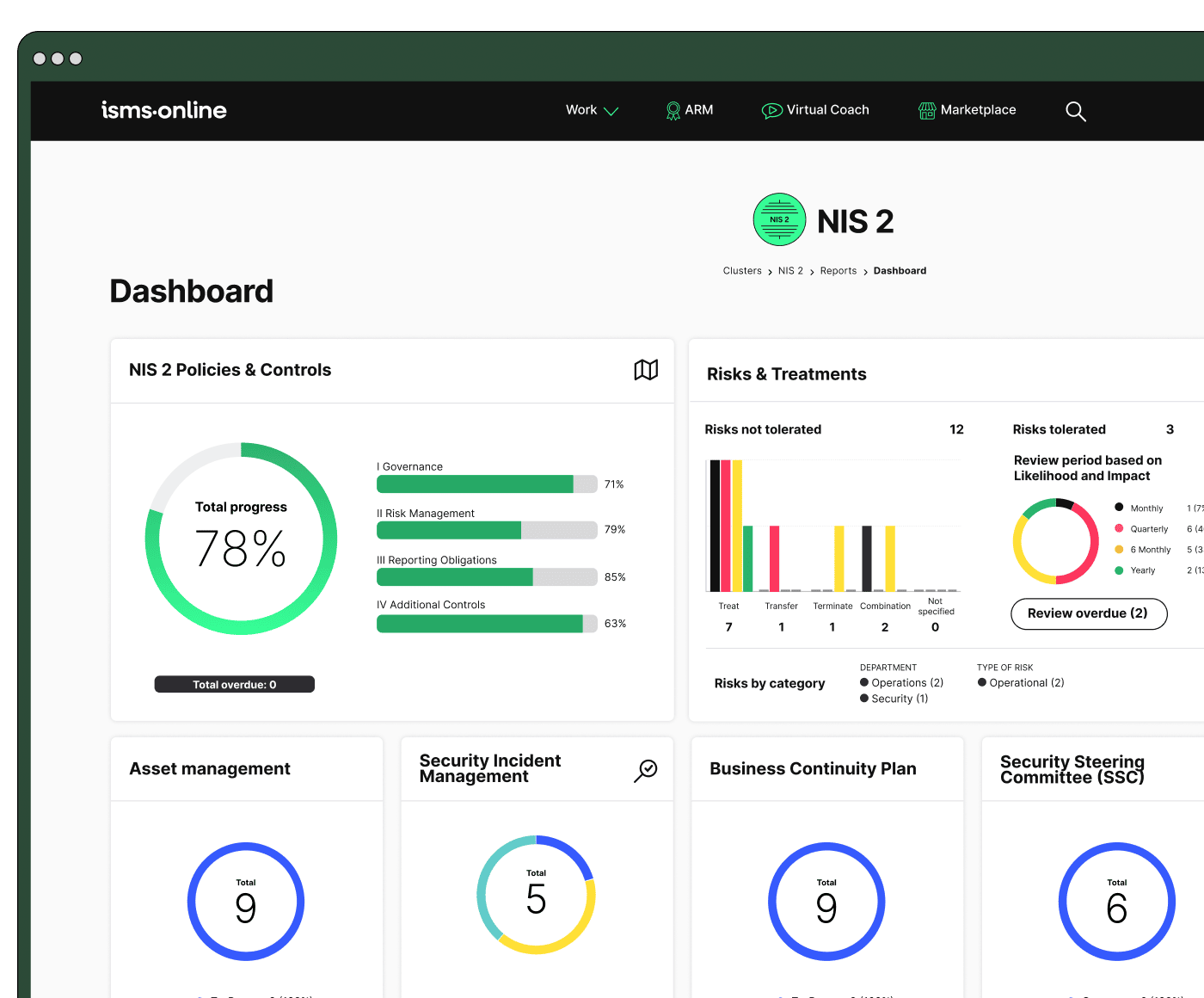
All your NIS 2, all in one place
From Articles 20–23 to audit plans – run and prove compliance, end-to-end.
Everyday Audit Readiness-From SMEs to Boards: Habit, Not Panic
Audit readiness is no longer a scramble in Estonia. It’s a rhythm, built from routine log reviews, disciplined evidence habits, and an evergreen, digital onboarding loop.
Checklist for the 2024 Deadline:
- Scope and register: Confirm scope status, notify via RIA portal.
- Supply chain: Audit supply chain relationships, contract rights, and onboarding flows.
- Evidence ownership: Assign clear roles; each control, risk, and audit log needs a named owner.
- Quarterly reviews: Log every management review and control update-no skipped quarters.
- Onboarding: Every staff member receives digital policy packs, acknowledges templates, and is tracked in a live system.
Waiting for an external audit or “compliance review” misses the point: Estonia’s leaders bake audit defence into their daily practises, not annual sprints.
True audit readiness is a team habit, not a one-time scramble.
Join Estonia’s Audit-Ready Leaders-Why Everyday Digital Discipline Wins
The compliance race in Estonia is no longer to the cheapest or fastest, but to the most disciplined organisations-those that anchor compliance in daily practise, digital evidence, and board ownership. Platforms such as ISMS.online, built and vetted for regulatory environments, streamline this journey for all: Compliance Kickstarters, veteran CISOs, privacy teams, and hardened practitioners alike.
Ready for your audit?
If you want confidence that stands up to scrutiny-not just from regulators, but from clients and the board-the path is open. It starts with digital onboarding, routine evidence logs, and supply chain integration. Book a demo and see how Estonia’s vanguard are redefining resilience, trust, and competitive advantage under NIS 2.
In Estonia, digital trust is a daily discipline-starting with compliance, and ending in resilience.
Stand With Estonias Audit-Ready Cohort
Dont risk being left behind.
Estonias model proves that proactive, system-integrated compliance is the new minimum-embedding resilience into your contracts, partnerships, and reputation. Make daily compliance your competitive advantage. Join the leaders-bake NIS 2 readiness into your workflow and stay audit-ready, always.
Frequently Asked Questions
Who enforces NIS 2 in Estonia, and why is the National Competent Authority pivotal for your compliance strategy?
Estonia’s NIS 2 regime is enforced by the Estonian Information System Authority (RIA), which acts as both the National Competent Authority (NCA) and the Single Point of Contact (SpOC) for all regulated organisations. This means RIA not only interprets and applies the Directive, but also supervises compliance, registers in-scope entities, oversees or escalates incidents, and leads sectoral support (RIA, 2024). For leadership and practitioners alike, this concentrated authority turns NIS 2 from a distant EU policy into a local, operational reality: the RIA’s requirements and onboarding steps are not optional-every regulated company must liaise directly with their allocated RIA contact or sector specialist.
In 2024, with nearly 7,000 Estonian organisations brought formally under the regime, RIA’s digital onboarding process leaves little ambiguity: if your board or compliance lead receives an onboarding notification, there’s no waiting for details-you are regulated and under active review.
Regulatory Expectation Table: Estonia NIS 2
| Expectation | Required Action | ISO 27001 / NIS 2 Reference |
|---|---|---|
| Timely incident notice | Immediate notification to RIA | ISO 27001 A.5.2; NIS 2 Art. 27 |
| Evidence register | Board-overseen audit logs | ISO 27001 Cl.9.3; NIS 2 Art. 20 |
A practical takeaway: keep RIA onboarding links, contacts, and digital registers up to date, build notification reporting into your evidence routines, and be ready to demonstrate your board’s active oversight at short notice. Gaps in this chain are now fast-tracked for penalties and public scrutiny.
How do CSIRT-EE and sector CSIRTs protect Estonian NIS 2 entities during cyber incidents and audits?
CSIRT-EE, nested in the RIA, is Estonia’s national 24/7 Computer Security Incident Response Team responsible for all NIS 2-regulated organisations, while sector CSIRTs (healthcare, energy, digital infrastructure) are tightly integrated and routinely coordinate with both CSIRT-EE and the EU-wide ENISA CSIRT network (ENISA, 2024). This whole-of-economy mesh removes historical silos-critical incidents, drills, or supply chain events automatically trigger escalation paths that involve sector and national CSIRTs, not just internal IT teams.
What does this look like for your team?
- Hotline & Playbooks: 24/7 access to CSIRT-EE’s hotline (see immediately produces an audit-grade, timestamped incident record. Boards must sign off incident follow-up, ensuring no “missed call” ends up blamed on operations alone.
- Drills & Exercises: Sector/national CSIRTs run annual drills mapped directly to ENISA expectations (e.g., CyCLONe), so management reviews and audit logs are shaped by real-world crisis scenarios, not theory.
- Escalation & Continuity: Board or role changes? CSIRTs provide onboarding, escalation contacts, and continuity playbooks, which are now cited as core evidence in NIS 2 audits.
Engagement with CSIRT is now an executive responsibility; outsourcing incidents to IT is obsolete under Estonia’s NIS 2 implementation.
Trigger → Escalation → Evidence Table
| Trigger | CSIRT Step | Audit Evidence |
|---|---|---|
| Breach detected | National hotline call | Timestamped, logged incident |
| Key role turnover | Request CSIRT onboarding | Playbook/continuity evidence |
| ENISA drill | Joint sector exercise | Participation, post-mortem log |
Boards and practitioners should script incident response and drill logging routines into their ISMS to ensure compliance is not person-dependent.
Which Estonian organisations are classified as “essential” or “important” under NIS 2, and what has changed for SMEs and suppliers?
Estonia’s 2024 NIS 2 roll-out dramatically broadens scope: “essential entities” are typically major operators in energy, finance, ICT, healthcare, and public sector; “important entities” now capture SaaS firms, technology providers, PPPs, SME suppliers, and a wide pool of logistics and utility support vendors (Sorainen, 2024). Each May, RIA issues updated annexes-and any entity notified by these annexes has legal, not optional, onboarding and compliance requirements.
For SMEs and contractual suppliers:
- Direct notification = direct responsibility: If RIA sends your organisation or parent a notification, you’re in scope, with no “waiting period.” Missing onboarding deadlines quickly escalate to penalty risk.
- Upstream risk propagation: Even companies not previously regulated (SME contractors, SaaS, local government suppliers) are now in-scope if their services impact an essential or important entity-so supply chain compliance is a board-level issue.
- Public contract partners: Any SME/PPP managing digital services or infrastructure for public or essential entities automatically takes on NIS 2 obligations via contract clauses, regardless of headcount.
Estonia’s onboarding removes silent noncompliance-if you received an annex, you are regulated, full stop.
Annex Type → Coverage → Steps Table
| Annex Type | Covered Entity | Initial Steps |
|---|---|---|
| Essential | Utilities, Finance, Health | Onboard, assign board contact |
| Important | SaaS, IT, Suppliers, SMEs | Onboard, review contracts |
| Indirect/Supplier/PPP | Contracts with annexed orgs | Contract due diligence, evidence |
Missed onboarding or contract clause absence is now an audit finding for both provider and client-forcing a two-sided compliance culture.
What are the key realities: penalties, audits, and board routines under Estonian NIS 2 regulation for 2024/25?
Every “essential” NIS 2 entity in Estonia must show 24/7 response capability, board-approved security policy, and pass a tri-annual full audit; “important” entities face audits every five years. Maximum penalties-for missing onboarding, audit evidence, board logs, or supply chain controls-are €10 million or 2% of global turnover for essentials, €7 million or 1.4% for importants, and non-financial (disciplinary) sanctions for the public sector (Estonian Ministry of Justice, 2024).
Practical audit realities:
- Evidence trail and board logs-no audit equals “desktop review”: Auditors now demand digital, board-reviewed evidence for every incident, contract audit, and management decision, to both NIS 2 and ISO 27001.
- Supply chain is audit scope: Contractual audit rights are enforced-if your supplier fails, your board’s “lack of oversight” is penalised.
- Missed drills/unmapped contracts = rapid escalation: The top audit findings in 2024 were missing incident drill logs, incomplete contract review, and board disengagement; all trigger accelerated audits and public notices.
Estonia’s regime anticipates EU risk: audit findings for one entity rapidly cross to partners, pushing supply chain resilience from aspiration to daily requirement.
Trigger → Audit Gap → Penalty Table
| Audit Trigger | Audit Deficit | Fine (Ess./Imp.) |
|---|---|---|
| Drill log missing | Major finding | Up to €10M/€7M |
| Onboarding missed | Direct control breach | 2% / 1.4% turnover |
| Contract audit fail | Supply chain red flag | Accelerated audit/fine |
How do you automate compliance evidence and link daily work to ISO 27001 and NIS 2, ending last-minute audit panic?
Progressive Estonian organisations are embedding digital ISMS platforms-like ISMS.online-to directly map every compliance trigger (user onboarding, incident, contract review, staff drill) to live controls, risk logs, and evidence, across both ISO 27001 and NIS 2 (Sorainen, 2024). Industry-proven playbooks (from RIA, CSIRT-EE, and sector CSIRTs) are increasingly central to audit readiness.
How to build this muscle:
- Automate every evidence step: Dashboards/checklists trace each trigger (new user, incident, contract) to its mapped SoA/risk entry/evidence file. Recurring tasks like management review, training, and supplier vetting move to digital logbooks.
- Standardise processes: Use RIA and ENISA drill templates; copy digital playbooks for sector-specific scenarios and supply chain checks.
- Assign ownership: Attach a role and owner to every compliance checkpoint-Ops for staff, Legal for contracts, Security for incidents, Board for strategy.
- Build boardroom traceability: Quarterly/annual reviews are now timestamped, digitally signed, and board-owned; survival of evidence through staff exits or regulator curveballs is routine, not exceptional.
ISMS.online allowed us to replace email chains and folders with a live, auditable compliance trail-our board now sees issues before auditors do (Major Estonian telco, 2024).
Compliance Trigger Trace Table
| Trigger | Evidence | Control/Annex Mapping | Accountable Role |
|---|---|---|---|
| User onboarded | Role log, SoA note | ISO A.5.2, NIS 2 Art. 21 | HR/Ops |
| Incident resolved | Audit trail, RCA | ISO A.5.25, NIS 2 Art. 23 | IT/Security |
| Supplier review | Contract evidence | ISO A.5.20, NIS 2 Art. 24 | Legal/Procurement |
By moving compliance from “snag list” cleanup to “daily digital habit,” your audit day disappears as an existential stress.
Where is Estonia leading the EU for NIS 2, and what are the implications for sector resilience and supply chain trust?
Estonia stands apart as an EU NIS 2 pacesetter because:
- Centralised onboarding & audits: RIA’s digital registry/database ∞ onboarding removes ambiguity-every in-scope entity is mapped, notified, and tracked continuously.
- Board–CSIRT–supplier mesh: Regular joint drills, public audit outcomes, and “evidence vault” culture now underpin sector resilience.
- Transparency for commercial edge: Annual publication of anonymised KPIs and findings (e.g. KPMG, 2025) lets the best outperform-and the slowest close vulnerability gaps quickly.
Compliance in Estonia is now more than a check-the-box-it’s a requirement to compete, contract, and access new markets. Those who treat it as a daily digital discipline consistently win the trust of clients, regulators, and boards.
Visual: Sector Resilience Mesh (Described)
- Key nodes: RIA, CSIRT-EE/national, sector CSIRTs, Boards, Procurement, Supply Chain partners.
- Connectivity: Flows of contract audit logs, KPI readouts, incident drills, and onboarding cycles-resilience is the sum of these live connections, not a paper policy.
What immediate actions must Estonian organisations take to plug NIS 2 gaps before deadlines?
- Pin your scope: Check RIA annex assignments, confirm status, and sign up for sector CSIRT alerts.
- Digitise evidence chains: Use ISMS.online or RIA-approved tech for onboarding, contract, and incident records-mapped directly to both NIS 2 and ISO controls.
- Automate management reviews: Shift quarterly/annual board reviews onto digital logbooks with timestamped sign-offs; delegate review/ownership across the management team.
- Institutionalise drills: Schedule/record drills using sector templates, then log outcomes for board and CSIRT review.
- Audit all contracts: Check supplier/client deals for NIS 2 audit rights and digital evidence clauses.
- Leverage sector and national guidance: Use ISMS.online, RIA, and sector CSIRT playbooks for control mapping, staff onboarding, and incident handling routines.
Audit readiness is a living discipline; mature Estonian teams are those already habitually managing compliance, not fire-fighting at year-end.
Final action:
Request sector-mapped evidence templates or a digital workflow assessment-preparing your board, supply chain, and contracts to stay ahead of Estonia’s evolving NIS 2 regulatory environment.






