





































Why Is NIS 2 Redrawing the Cyber-Security Map in Germany?
In 2024, Germany’s digital risk map has been fundamentally redrawn. The NIS 2 Directive expands legal and operational accountability across thousands of German organisations, not just those previously designated as critical infrastructure or “KRITIS.” Now, public entities, municipal services, SaaS platforms, regional digital providers, and a huge swath of the Mittelstand are held to new, harmonised cyber-security requirements. Delays are no longer hidden from view: organisations not registering or reporting on time find themselves named in public directories, exposed to both financial penalties and reputational scrutiny.
When complexity multiplies, leaders who move early create the new standard.
NIS 2 doubles the scope of regulated entities, creating two high-stakes categories: “essential” and “important” organisations. City councils operating municipal platforms, SaaS and cloud providers breaching new headcount or financial triggers, and a revised slate of public interest sectors-all are in scope practically overnight. The regulatory perimeter is now tied to a blend of real-world triggers: entity size, sector role, and functional relevance as defined in BSI checklists. Status reviews are ongoing, so organisations can move in or out of scope as their operations change.
What’s crucial isn’t just acknowledging eligibility, but mapping this status through the BSI’s public portal and its downloadable sector guides. These resources are vital for anchoring your self-assessment and for maintaining real-time awareness of compliance requirements.
Rather than overriding existing law, NIS 2 overlays it. Established sectoral frameworks-in energy, finance, telecoms, healthcare, and more-now coexist with new, cross-cutting mandates. This new map is complex: documentation, audit, and decision logs now cross both national and sector-specific lanes. The challenge? Ensuring your compliance documentation doesn’t “fall between the cracks” of two legal regimes.
The window for complacency is closed. Authorities are actively naming and penalising organisations who miss a growing web of registration, reporting, and evidence deadlines. Late adopters now face not just fines, but lasting public reputational damage.
The very first and most essential act is prompt registration through the BSI portal. This isn’t bureaucratic busywork; it’s the formal handshake that initiates every downstream compliance process-granting access to tailored guidance, eligibility status updates, and sector-specific support. Failing to register on time leads not just to missed warnings, but missed prep for critical system milestones.
Initiative is the difference between a silent risk and a public crisis.
Your ability to pre-empt compliance gaps, manage stakeholder anxiety, and avoid reputational landmines depends on how swiftly your leadership adapts to this expanded, harmonised regulatory perimeter.
How Has BSI Reinvented Its Role – and What Does That Mean for Your Compliance Operations?
Germany’s Federal Office for Information Security (BSI) now acts as much more than a cyber advisor-it functions as the “control tower” for national NIS 2 oversight. Registration with BSI ignites the continuous compliance routines that board leaders, managers, and practitioners now face.
In the NIS 2 era, registration is your control tower-not red tape.
For the first time, BSI can demand random or incident-triggered audits, request live evidence on demand, and escalate issues directly to governance boards. Audit is a rolling function-no longer an annual calendar slot. The burden of providing mapped, real-time documentation, traceable workflows, and evidence libraries has never been higher. Digital ISMS tools, including ISMS.online, are no longer a luxury but an operational necessity.
The BSI’s official FAQs and onboarding guides now set the standard for both initial entity onboarding and subsequent periodic reviews. These resources back the “control tower” analogy by making compliance a routinised, auditable function.
But BSI oversight doesn’t run in isolation. Sectoral ministries-for energy, health, telecoms, and finance-retain their own audit, incident, and supervision powers. This means organisations must define precisely which events will trigger BSI involvement, sectoral audits, or both. Without mapping these touchpoints, deadlines may collide, efforts may duplicate, or-worse-entire incident logs may be lost between silos.
Incident response is now designed around a “single point of contact,” ensuring incidents are escalated, reviewed, and logged in line with the strict timelines that BSI and sector authorities require. This centralisation facilitates proper closure and proof for future audits-preventing the compliance equivalents of “dropped calls.”
One of the most overlooked pain points is documentation “inflation”: onboarding and recurring audit cycles now demand a broader, deeper, and more current range of artefacts. Policy logs, change documentation, approvals, incident records, access audits-the list grows, and tolerance for “I’ll update it later” has evaporated. Workflow automation and real-time alerting have shifted from “best practise” to board expectation. For mid-market and critical sector organisations, leveraging ISMS automation is now essential to avoid costly lapses and defend against audit findings.

Master NIS 2 without spreadsheet chaos
Centralise risk, incidents, suppliers, and evidence in one clean platform.
How Do Sector-Specific Controls and NIS 2 Overlap – and Where Does This Leave German Organisations Today?
Public and private entities now find themselves balancing a tightrope between sectoral and NIS 2 obligations. The dynamic is not one of replacement; NIS 2 overlays sectoral requirements, creating “double mandate” complexity and new opportunities for documentation gaps.
Complexity isn’t the cost of compliance; it’s the penalty for sluggish alignment.
Sectoral regulators, from VDE in energy to BDEW in water/utilities, define operational and resilience controls as a matter of statute. Simultaneously, BSI mandates incident-centric, evidence-heavy frameworks. Failing to cross-map every control to both regimes invites mishaps: duplicated tasks, monitoring gaps, or conflicting responses to the same audit prompt.
Operational pain spikes when audit cycles for the sector and BSI collide, demanding time, staff attention, and an ever-expanding evidence file. Fatigue is a real risk for practitioners bridging both cycles. The antidote? Automation that lets dashboards integrate reporting calendars, flag outstanding actions, and surface evidence gaps in time for remediation.
Case studies offer cautionary tales: German utilities and digital providers who failed to map controls or log supplier assessments have faced penalties from both sector and BSI/Brussels. The lesson is clear: every material workflow gets a “sector-NIS” log, and supplier risk is an explicit board-level KPI.
Supply chain risk-especially third-party digital providers-has become a top audit finding. Mapping onboarding, reviewing controls at triggers (e.g., contract changes), and digitising the audit trail is now board-driven. A new supplier is no longer a procurement event; it’s a compliance inflexion point.
Every new supplier is a chance to close-or open-a compliance loophole.
In the era of NIS 2, merging these regimes through mapped controls and digital platforms is essential to avoid double jeopardy.
How Do You Minimise Reporting Duplication and Documentation Silos Under NIS 2?
Reporting redundancy isn’t just a theoretical risk. Filings in the Bundestag’s own risk register highlight up to 30% of incident registrations as duplicated. This creates confusion, drains resources, and increases the risk of audit gaps-especially for SaaS and digital-first entities new to these requirements.
Non-traditional organisations are especially vulnerable. Who is responsible for logging incidents-finance or IT? Where does evidence reside-sectoral system, or BSI portal? Without clear assignment, things fall through the cracks, leaving organisations open to both compliance failures and real-world cyber incidents.
Timely accountability and mapped reporting are game changers for incident agility.
Finance-often ahead of other sectors due to BaFin and BSI cooperation-offers a model: shared templates, aligned audits, and joint reporting have increased pass rates and slashed inefficiency. This is a blueprint available to other industries, not a privileged club.
Unified evidence libraries, as found in ISMS.online, deliver traceability for every compliance trigger:
| Trigger (event/change) | Risk Update Triggered | Control/SoA Link | Example Evidence Logged |
|---|---|---|---|
| Suspicious user login alert | Credential/identity risk review | A.5.16 (Identity), A.5.18 (Access), NIS 2 Art. 23 | SIEM alert, incident ticket |
| Security policy is revised | Control/SoA update and signoff | A.5.1 (Policy), A.5.36 (Compliance), NIS 2 Art. 21/36 | Policy log, SoA revision, staff acknowledgement |
| New supplier is onboarded | Third-party supply chain risk | A.5.19 (Supplier), A.5.21 (Supply Chain), NIS 2 Art. 21 | Due diligence record, audit log |
This traceability means spot audits are passed with less friction and confidence soars within compliance and leadership teams alike.
The “audit dividend” is real: clarity and verified evidence not only reduce compliance failure risk but also reveal operational gaps before outsiders do. Embedding automation and traceability is your best ticket to a successful audit cycle.
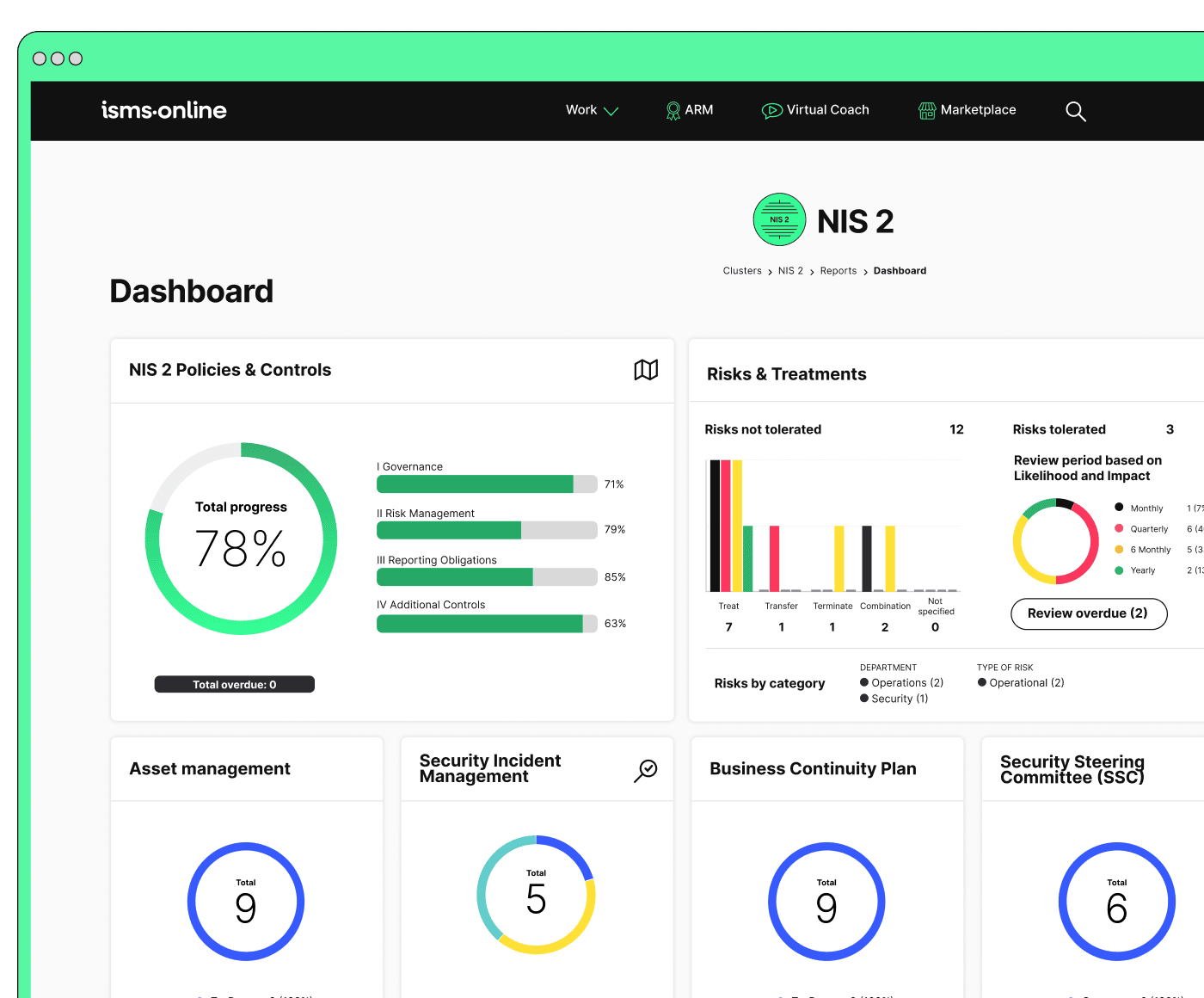
Be NIS 2-ready from day one
Launch with a proven workspace and templates – just tailor, assign, and go.
What Role Does ENISA Play in German NIS 2 Compliance, and How Should You Leverage European Harmonisation?
BSI’s guidance increasingly reflects ENISA (EU Cyber-Security Agency) frameworks and playbooks. ENISA’s sectoral guidelines are not just legal “box-ticking”-they’re operational roadmaps that are directly impacting German audit pass rates.
Compliance is not about ticking a national box, but mastering a European loop.
Organisations actively blending ENISA guidelines with ISO 27001 Annex A controls are halving duplicate efforts and preparing for future regulatory overlays such as DORA and the EU AI Act. When audits demand “show your evidence,” cross-mapped frameworks close the gap quickly and convincingly.
Peer collaboration-within and across industries-delivers measurable returns. German teams participating in BSI and EU working groups exchange incident templates and audit tools, closing critical evidence gaps, and even accelerating registration adoption.
Compliance leaders are those who treat today’s harmonisation as an everyday workflow, not a periodic event.
Choosing to use ENISA-mapped, digitised controls places your organisation at the front of the compliance curve not just for NIS 2, but for future waves like DORA and AI governance.
What Makes a Modern ISMS and BSI Audit Really “Audit-Ready”?
Audit readiness is now a rolling target, enforced by random and event-driven spot checks. The question is no longer if you have compliance artefacts, but whether you can prove-instantly and with confidence-their currency, traceability, and cross-mapping to both NIS 2 and sector expectations.
Audit readiness is not a goal, but an operating principle.
Boards, BSI, and sector-specific supervisors expect mapped evidence, dashboarded metrics, and proof of action-on demand. Here’s how the standard now looks in practise:
| Expectation | Operational Step | ISO 27001 / NIS 2 Ref. |
|---|---|---|
| Asset inventory and ownership | Live register mapped to staff/responsible parties | A.5.9, A.5.12, NIS 2 Art. 21 |
| Incident response/reporting | Workflow logs, documented escalation and resolution | A.5.24, A.5.26, NIS 2 Art. 23 |
| Staff awareness/training | Policy assignment, staff acknowledgements, training logs | A.6.3, A.5.1, NIS 2 Art. 20 |
Dashboards are now moving from “nice to have” to “boardroom standard.” Non-compliance triggers regulatory fines of up to 2% of turnover-a material risk factor for listed and private companies alike.
KPI sets used by senior German teams increasingly track days to audit-readiness, incident closure intervals, % of mapped controls, and live “evidence freshness”. These are measured in real-time through ISMS portals and included in routine board reviews.
Board accountability is now inseparable from compliance mapping. Resilient teams include control dashboards, mapped SoAs, and KPI oversight in the agenda of every management review.
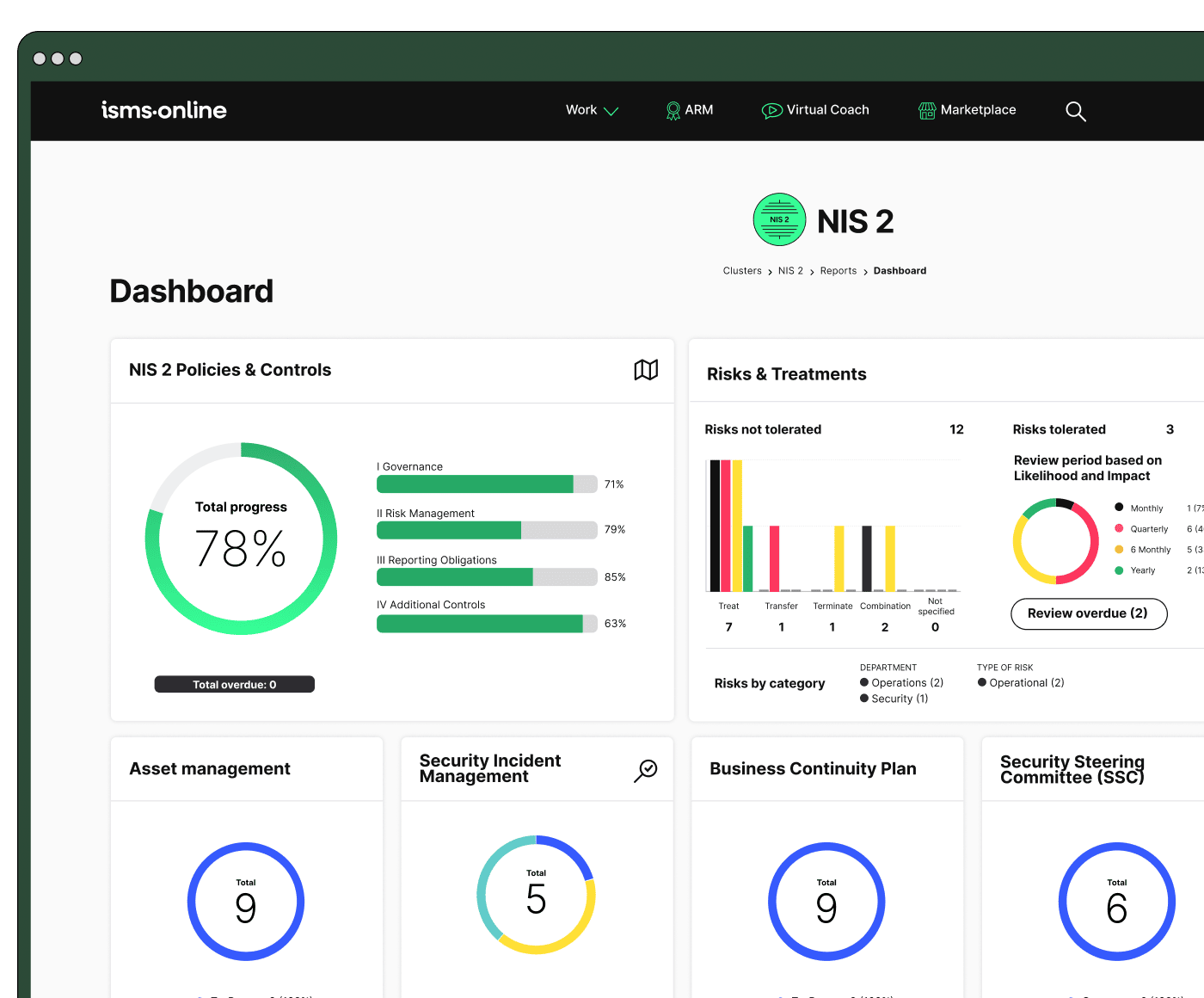
All your NIS 2, all in one place
From Articles 20–23 to audit plans – run and prove compliance, end-to-end.
How Should Organisations Approach ISO 27001, Annex A, and NIS 2 Cross-Mapping in the German Regulatory Landscape?
Complex compliance is now won-or lost-through mapping, not merely documentation. The capacity to map controls across Annex A, sector-specific and NIS 2 requirements is the strongest predictor of audit success and operational resilience.
Organisations equipped with dynamic SoA tools-pairing live evidence to mapped controls and sector overlays-are passing audits faster and with fewer clarifications. In practise, a modern SoA is a living asset, not a static checkmark: it pulls in updated audit logs, sector mappings, and cross-framework references automatically. When controls are updated, every dependent process and document updates itself.
A powerful compliance function now embeds control mapping into scheduled management reviews, ensuring that board accountability isn’t just a regulatory sound-bite, but a daily practise. Dashboards, evidence freshness trackers, and mapped sector overlays mark today’s high-performing teams.
What Does Evidence Automation Look Like in Practise – and How Can You Avoid Compliance Blind Spots?
Evidence automation is at the heart of the “always on” compliance function. These aren’t just buzzwords: incident triggers, policy changes, and onboarding steps now dynamically link to controls, prompt SoA updates, and log evidence in real time.
Best-in-class organisations use trigger-based automation: every event ties immediately to its risk, control, and documentation, delivered in the audit window. Efficiency gains, audit reduction times, and risk-table clarity all move decisively upward.
Resilience is proven by how fast your system learns and documents-not just how much it knows.
The gold standard matches real-time automation with scheduled human oversight: dashboards remind leaders to spot-check for drift, artefact freshness, or missed updates. Such a hybrid approach closes the gap between “automation blindness” and true compliance.
Dashboards that surface overdue tasks, incident recovery timelines, and control mapping progress let boards see and act on gaps before auditors do.
In practise, today’s audit pass rate is a direct measure of how seamlessly-and visibly-automation and oversight combine.
How Can ISMS.online Future-Proof German NIS 2 Compliance – and Turn Complexity Into a Competitive Advantage?
If your organisation is targeting NIS 2, ISO 27001, or sector-integrated, boardroom-grade evidence, ISMS.online provides a unified, mapped, and continually updated compliance workspace (isms.online). Recent pilot studies in Germany show that digitised compliance infrastructures halve audit prep windows, shorten incident reviews, and slash unsatisfactory findings by over 30%.
The organisations that pass audits fastest are the ones whose evidence is already mapped, logged, and dashboarded before the auditor calls.
ISMS.online enables German compliance leaders to:
- Map policies and controls across ISO 27001, NIS 2, and sector-specific annexes.
- Automate event-driven logs and evidence updates, tied directly to SoA revisions.
- Dashboard KPIs and compliance progress for real-time board oversight.
- Share mapped evidence and audit readiness with BSI, sectoral, and EU authorities in one system.
- Benchmark KPIs and compliance status against German and European peer data.
Ready to experience audit comfort and hand competitors the complexity headache?
Schedule a readiness dashboard session and benchmark your compliance maturity-and see how real-time mapped evidence can move your NIS 2, BSI, and sector obligations from fragmented to execution-ready. Complex compliance isn’t a burden-it’s how leaders build trust, inspire boards, and future-proof their entire operation.
Frequently Asked Questions
What is the BSI’s new authority under NIS 2, and how does it reshape compliance strategy for German organisations?
Under NIS 2, the BSI (Federal Office for Information Security) is now Germany’s nerve centre for cyber-security compliance-acting simultaneously as national regulator, audit initiator, and incident response conductor. Registration with the BSI isn’t a passive step: it turns on regulatory oversight, puts the board on formal notice, and exposes your organisation to active monitoring, random compliance audits, and the potential for real sanctions, not just warnings. The BSI can escalate incidents beyond sectoral ministries and intervene if gaps are found, even where traditional sector laws (like those for energy, healthcare, or finance) still operate in parallel. This duality means German businesses must juggle overlapping inspections, evidence requests, and reporting deadlines-and risk regulatory gaps or duplicated work if their ISMS doesn’t synchronise both regimes. For every regulated entity, a mapped, real-time compliance system is no longer just prudent; it’s the shield against fragmented findings, delayed evidence, and financial penalties.
Once you register with the BSI, your compliance burden is live-your board and systems are on the radar, and every missed audit or delayed report brings swift scrutiny.
Visual Cue:
Place the BSI at the centre of a dynamic flowchart, with sector regulators on either side, showing dual pathways for registration, audit, and incident escalation.
How can you determine if your organisation falls under NIS 2 in Germany-and what’s at stake if you misjudge?
NIS 2 now covers a sweeping spectrum of German entities-upwards of 29,000, including city IT, SaaS firms, utilities, and critical service providers far beyond previous lists. “Essential” and “important” categories are based on sector, headcount, and turnover, but thresholds change as your business evolves or if your services gain new societal relevance. The BSI’s online self-assessment tool is the authority for scope, clarifying whether registration, documentation, and reporting requirements are triggered. The most damaging error is complacency-assuming you’re out of scope, slow to register, or late confirming a newly acquired entity. Consequences include public disclosure in BSI directories, reputational damage before penalties even land, and a loss of trust from customers and partners. Routine reassessments and immediate updates as your business changes are now operational requirements in the NIS 2 era.
Quick-Glance Table
| Entity Type | NIS 2 Scope? | BSI Registration? | Notable Sanction |
|---|---|---|---|
| Energy / water supplier | Yes | Yes | Fines, dual audits |
| SaaS provider (>50 staff) | Yes | Yes | Late reporting, public listing |
| City IT department | Yes | Yes | Reputation, cross-audit risks |
| Small local business | Maybe* | Use BSI check | Oversight risk, regulatory lag |
Always use BSI’s up-to-date tool to confirm inclusion and avoid assumptions.
How do sector-specific rules and BSI/NIS 2 mandates interact, and where do compliance failures occur?
German compliance is now a two-lane road: sectoral authorities (energy, transport, financial, health) maintain technical and process requirements, while the BSI enforces risk management, incident reporting, and board accountability nationally under NIS 2. Both lanes can audit and sanction independently, and both expect their evidence standards to be met-often on different timelines or formats. The risk is obvious: evidence that satisfies one regulator can leave dangerous gaps for the other. For example, a city utility may pass an energy-sector audit but fail BSI/NIS 2 documentation for incident logs, triggering penalties and additional oversight. The organisations that thrive are those who treat every workflow-incidents, assets, SoA-as points on both regulatory tracks. Cross-references in your ISMS, version control, and shared evidence libraries become your safety net, making every requirement visible and traceable to both authorities, reducing the scramble and the risk.
German compliance is no longer a relay; it’s a simultaneous race-most penalties arise where sector and BSI audits collide.
Visual:
A Venn diagram with sectoral obligations and BSI/NIS 2 requirements, with the shared zone as “audit intersection” and gaps flagged as active risk areas.
What is the real cost of siloed documentation and duplicate reporting, and how can you break the cycle?
Bundestag data shows that nearly one in three incident reports are now double-filed-first to sector authorities, then to the BSI-leading to redundant effort, conflicting investigation versions, and increased audit complexity. Disparate documentation versions not only frustrate audits but also trigger escalating requests for supplemental evidence or even fresh board certifications. Sectors that have reduced these pain points-like German finance-do so through harmonised joint committees and unified templates, ensuring incident logs, asset registers, and SoA are “single source of truth” artefacts visible to both authorities. The best-performing organisations use ISMS platforms to centralise evidence, assign ownership, and automate reporting-so every control, incident, or policy update is visible to all the necessary stakeholders. This transparency decreases errors and accelerates audit close-outs. Shared dashboards and mapped workflows transform compliance from an anxious sprint to a sustained operational advantage.
Reference Table
| Activity/Document | BSI Required? | Sectoral Required? | Optimal Approach |
|---|---|---|---|
| Incident report | Yes | Yes | Joint log, single source |
| Asset inventory | Yes | Often | Live, shared register |
| Statement of Applicability | Yes | Sometimes | Cross-mapped linkage |
| Board risk dashboard | Yes | Board discretion | Shared, role-based view |
Why do ENISA harmonisation and EU-wide alignment matter for German NIS 2 compliance?
ENISA’s (European Union Agency for Cyber-Security) technical guidelines now permeate both BSI and sectoral audit playbooks, shaping the checklists and evidence thresholds for German NIS 2 reviews. Aligning your ISMS to ENISA best practises-and interlinking with ISO 27001-streamlines audits, minimises documentation drift, and smooths future transitions into overlapping frameworks like DORA or the AI Act. EU task forces are standardising gaps between national rules; adopting ENISA-aligned routines early gives you a head start before such harmonisation becomes mandatory. In practise, firms that bake ENISA and ISO 27001 into their evidence libraries pass audits more quickly, with fewer surprise remediation demands or report rewrites. Boards and management reviews that use ENISA-mapped dashboards can confidently report security posture for both national and EU oversight.
Harmonise to ENISA and ISO 27001 early-your systems will be future-proofed for any compliance shift that follows.
Visual Matrix:
Columns: Sector law, NIS 2, ENISA, ISO 27001; Rows: Key control requirements, with ticks showing overlap and highlighting mapping priorities.
What documentation and routines does “audit-readiness” require in the NIS 2 era?
From 2025, both planned and unannounced BSI audits expect immediate access to live, mapped records-current asset lists, up-to-the-minute incident logs, board-reviewed statements of applicability, and proof of continuous staff training. Paper-chasing weeks before audit is obsolete; delays or incomplete evidence prompt regulatory action, sectoral escalations, or fines reaching up to 2% of annual turnover. Audit-readiness is built from daily routines: management reviews, automated evidence capture, and scheduled incident reviews turn compliance into an operational muscle. Board-level dashboards with live SoA linkage give leadership both defensibility and real-time visibility.
ISO 27001 / NIS 2 Reference Table
| Expectation | Routine Operation | ISO 27001 / NIS 2 Cross-Ref |
|---|---|---|
| Asset inventory (live) | Assigned updates, validation | A.5.9, A.5.12, Art. 21 |
| Incident closure review | Workflow audit, escalation | A.5.26, A.5.24, Art. 23 |
| Training acknowledgment | Staff log, audit trace | A.6.3, A.5.1, Art. 20 |
| Board risk dashboard | Linked, automated reporting | Annex A, Art. 21/36 |
How can organisations keep compliance mapping dynamic across NIS 2, ISO 27001, and German sector laws?
Static, annual mapping is now a liability-every significant business, legal, or operational change can shift your NIS 2 scope or audit readiness overnight. High-performing teams maintain living dashboards that cross-reference every control (SoA or Annex A) with NIS 2, sectoral, and German requirements, triggering instant updates when staff size, services, or laws change. Board or management sign-off on these maps correlates directly with low audit error rates, timely evidence delivery, and lower operational stress. “Living documents” are reviewed on a schedule, but also on demand after incidents or readiness checks-your ISMS should track every update, flag unlinked controls, and log evidence trail for both internal and regulatory eyes.
What role does automation play in reducing risk-and how do you maintain control?
Sector pilots confirm that automating ISMS evidence, incident triggers, and workflow reporting dramatically cuts duplicate records, rework, and fatigue-empowering compliance leads and boards to maintain real-time audit readiness. Automation ensures that nothing slips through the cracks on personnel changes, supplier incidents, or incident escalation. But the human factor can’t be ignored: periodic review cycles and spot-checks are essential to ensure that the automation reflects reality, and that outlier risks or unusual incidents are caught before they become regulatory alerts. The blend of automated triggers and human oversight is the sweet spot, keeping your business ahead of the audit, not chasing it.
Why is ISMS.online a strategic asset for NIS 2 and German sector compliance?
ISMS.online gives German organisations a mapped, real-time dashboard integrating NIS 2, sector, and ISO 27001 requirements-automating registration, audit evidence, incident documentation, and workflow mapping in one live environment. Pilots have shown that organisations using ISMS.online cut audit prep time in half, double their board’s visibility of compliance status, and maintain a defensible proof trail for every regulatory authority. Every event, approval, or incident becomes automatically traceable, preventing errors and preparing you not just for today’s audits, but also for future compliance regimes. Forward-thinking teams aren’t just ready for the BSI-they’re shaping their compliance programme to become a source of resilience and reputation, regardless of the EU’s next shift.
Schedule a working session to see ISMS.online’s mapped dashboards, live evidence, and harmonised workflow automation in action-future-proofing your compliance strategy from BSI to sector to EU level.






