





































Who Actually Owns Cyber Compliance in Greece – And Why It Matters Now
When a regulator picks up the phone or an incident barrels through your operation, there’s no time for finger-pointing-only for certainty. In Greece, the National Cyber-Security Authority (NCSA – Εθνική Αρχή Κυβερνοασφάλειας) is your anchor, locking all cyber obligations under a single roof via Law 5160/2024. This new legal structure finally ends the era of scattered responsibilities, centralising jurisdiction, escalation, and audit defence into one body. Companies that still guess at escalation paths or rely on legacy contacts risk more than fines: they risk lost deals, board scrutiny, and regulatory censure masked as “inaction.”
Certainty cuts the risk; guessing at the chain of command risks reputational and financial loss.
Why So Many Still Fail the Authority Test
Greek companies-across size and sector-keep stumbling at the same hurdles:
- Outdated escalation contacts; teams using last year’s registries.
- Regulatory “whiplash” as sector definitions shift. What was once secondary can turn essential after an acquisition, growth, or tender win.
- The absence of a single, colour-coded authority chart. Escalation flows become folklore, not fact.
Prevention is simple-but rarely routine: update and share an authority escalation matrix twice a year. Trigger a review after every major NCSA/ENISA regulatory bulletin. Each revision is an insurance policy; failing to do so isn’t just a process gap-it’s a visible, auditable deficiency.
The Directory Shuffle: New and Overlooked Agencies
- EDYTE (GRNET): Think of this as the nerve centre for research and education sector security. If no one on your team has their number, youre already exposed.
- EKOME: Managing public media, often falls between the cracks. Make sure theyre on your escalation chart.
- Ministry of Digital Policy: The air traffic controller of sector definitions. Every critical sector shift starts here.
Ignoring these updates isnt just bureaucratic drag; it turns minor reporting errors into headline enforcement actions. Set automated reminders and treat your registry as critical infrastructure.
Book a demoHow to Reach-and Prove Contact With-Greece’s Core Cyber Authorities
When a breach strikes, minutes matter. In practical terms, Greece’s Single Point of Contact (SPOC) at spoc@mindigital.gr is your front door for all NIS 2 matters-incident reporting, registry questions, and sector clarifications. Waiting for a crisis is no way to test the doors. Instead, send a procedural question now and log the response; these “fire drills” turn unknowns into muscle memory and provide evidence for audit defence.
You want no surprises? Test your escalation route before the real emergency lands.
What’s the NCSA–CSIRT Division of Labour?
- NCSA: Holds the pen on sector entities, scoping, enforcement, and fine imposition. It’s your statutory compliance partner, and your legal answer for regulators.
- CSIRT-GR: Functions as your technical emergency response team, from first intake to forensics. They’re the hands-on triage and lessons-learner.
Collaboration is the hallmark here, but ambiguity is the enemy. When rules or lines of responsibility blur, escalate to the SPOC-insist on a written reply, and keep every exchange in your audit file.
SME and New Entrant Advice
Sector-specific guides exist for everyone, not just “critical” infrastructure. Save all Q&A with NCSA or CSIRT as a growing log of compliance evidence-these records defend your team if an audit or regulatory question arises.
Keeping Incident Response Instant-and Documented
Sector-specific CSIRTs (health, finance, digital, etc.) maintain reference SLAs for every stage: acknowledgment, escalation, closure. Your incident template isn’t complete without this escalation ladder-diagram it, save it to every incident response file’s front page, and validate it quarterly.
If guidance from different authorities ever collides, pause. Demand a written directive; document the request and the eventual answer. These are your best “regret insurance” in an audit.

Master NIS 2 without spreadsheet chaos
Centralise risk, incidents, suppliers, and evidence in one clean platform.
What Does Greece’s CSIRT Network Look Like-and Where Are the Blind Spots?
Greece’s two-tier structure blends CSIRT-GR (national, for cross-sector emergencies) with sectoral CSIRTs for everyday management. A ransomware attack on a regional hospital may escalate to national CSIRT-GR; a compliance failure in transport could escalate to the sector CSIRT only if defined thresholds are passed.
Your incident map should begin with sector response, escalate only when the protocol triggers demand.
Secure, Documented, and Proactive Escalation
- Critical or sensitive events: Secure (PGP-encrypted) channels are a must for certain sectors, especially healthcare and state infrastructure. Regularly test these-not during an incident, but as a dry run.
Don’t Overlook “Hidden” CSIRTs
- Changes in sector coverage or org structure demand a live update of your CSIRT contact tree. New digital providers or research bodies (EDYTE, EKOME) may not announce their role loudly-but a missing node breaks your reporting chain.
- Law 5160/2024 compels every CSIRT to log event receipt, escalation, closure, and provide a full audit trail. If your template ends with notification, but skips the “receipt” and “sign-off” steps, your compliance is incomplete.
Traceability Table: How Triggers Map to Evidence
| Trigger (Event) | Risk Update Needed | Control/SoA Link | Evidence Logged |
|---|---|---|---|
| Sector webhook alert | Yes, within 1 hour | A.5.24 Incident Mgt.; A.5.25 Event Assessment | CSIRT notification, registry receipt |
| National-scale incident | Immediate escalation | A.5.26 Incident Response; A.5.27 Lessons Learned | Escalation mail, post-incident notes |
| Safety notice conflict | Legal/Risk documentation | A.5.35 Indep. Review; Compliance Review | Emails, clarifications, records |
Which Sectors Are Within NIS 2-and How Is Scope Changing?
Essential Entities (υποχρεωτικοί): Energy, health, finance, digital infrastructure, ICT services, public administration, space, and water head the list.
Important Entities (σημαντικοί): Food, digital business, waste, postal/courier, certain manufacturers or research units, and select SMEs joining sector chains.
One new contract, supplier, or client can flip your compliance category in a quarter.
Action: Check your entity every year against both NCSA and ENISA registers.
Practical visual: Tri-colour onboarding matrix-green (essential), orange (important), blue (“review eligibility”)-that updates not only on schedule, but every time a new contract, client, or supply chain entry is made.
Common Tripwires in Greek Compliance
- Not monitoring latest sector/law updates: A quarterly blind spot can mean an annual audit penalty.
- Business model “scope creep”-a shift to a software platform or new region can transform your entity class silently.
- Eligibility reviews conducted only by IT-legal, privacy, and leadership must join the matrix.
Terminology consistency is non-negotiable: Use correct labels (e.g., Σημαντικός φορέας, Ουσιαστικός φορέας, “ΕΔΥΤΕ”, “ΕΚΟΜΕ”) in all logs and policies; mismatches invite audit friction.
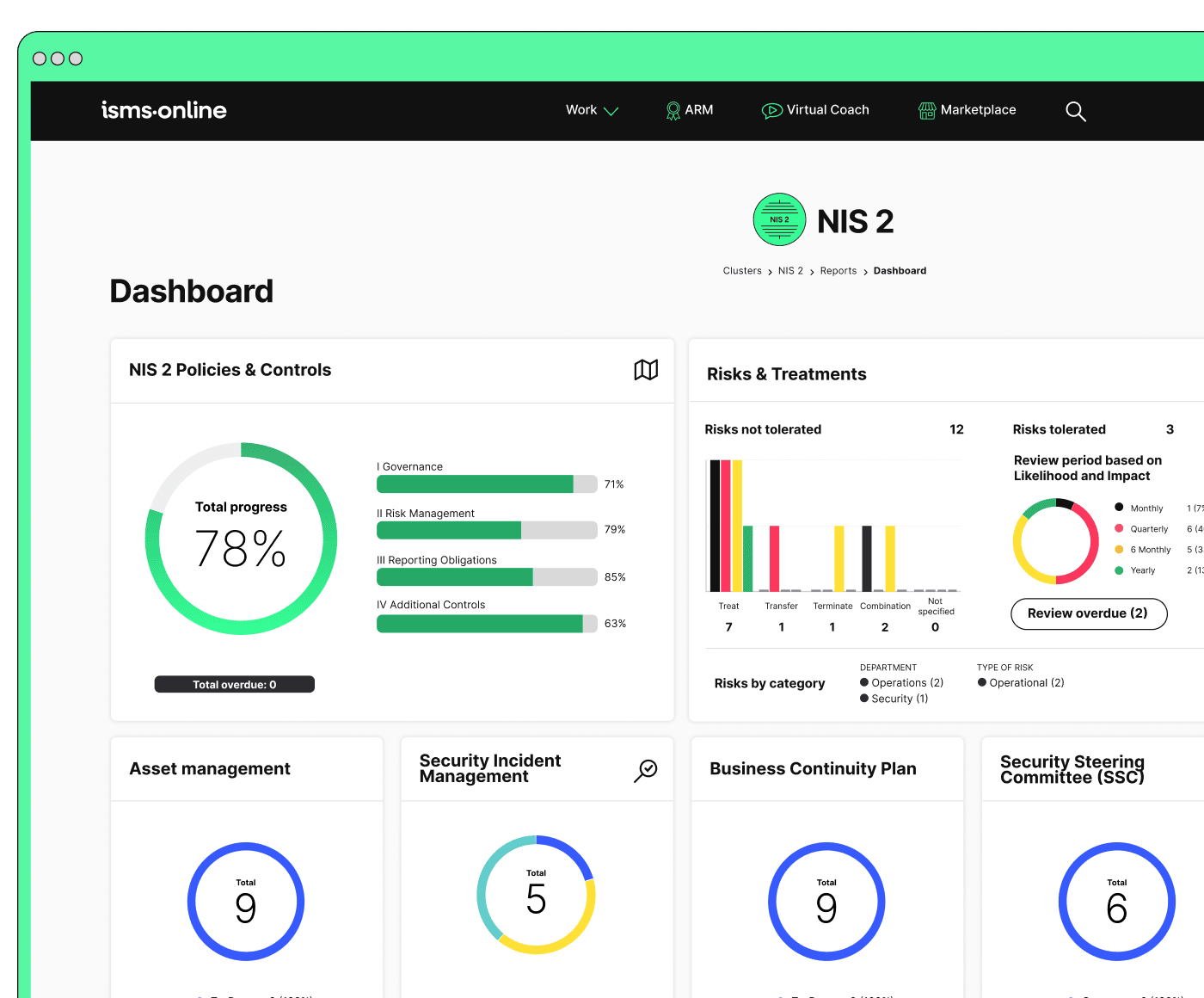
Be NIS 2-ready from day one
Launch with a proven workspace and templates – just tailor, assign, and go.
The SME and Local Org Perspective-Why the Real Risk Is in Delay
SMEs and smaller organisations learn too late-often after a breach, contract kick-off, or supply chain check. Don’t let “small” lull you into inaction; NIS 2 entities are defined by role, not just by size.
The difference between a close call and a fine is usually timely eligibility awareness-start sooner.
SME and Local Org Checklist
- Annual dual check: NCSA + ENISA sector status.
- Clearly named eligibility review owner across IT, legal, and ops.
- Every new contract triggers a status check.
- Immediate download, review, and circulation of latest NCSA templates to all staff.
- Perform dry-run notification, log outcomes.
- Signed log of every compliance-related training, call, or incident.
- Calendar out semiannual eligibility reviews (all relevant functions present).
Every regulatory outreach-call, mail, or ticket-must be logged as evidence, not chatter.
KPI to include: query volume, median response, closure on each regulatory question.
ISO/NIS 2 Bridge Table (audit-ready):
| Expectation | Operationalisation | ISO/NIS 2 Control |
|---|---|---|
| Know your eligibility | Annual NCSA/ENISA registry review | ISO 27001 Cl.4.1; NIS2 Art.2–3 |
| Prove compliance | Checklists, signed logs, board review | ISO 27001 A.5.1, A.5.2; NIS2 Art.21 |
| Alert on status change | SPOC notification and signed handoff | ISO 27001 Cl.6.1, NIS2 Art.21–23 |
Mastering Incident Reporting: Timelines, Evidence – and Audit Confidence
NIS 2’s reporting windows are precise, and Greece is enforcing them at pace.
| Event Step | Required Action | Deadline (Legal Reference) |
|---|---|---|
| Initial notification | Notify NCSA (SPOC) once incident is suspected | 24 hours (NIS 2 Art.23) |
| Full report | Submit impact summary and evidentiary files | Within 72 hours |
| Closure | Address inquiries, archive, record lessons | Within 1 month (or as regulation dictates) |
Missing a reporting window is not just a compliance failure-it becomes a billboard for future audit scrutiny.
Audit-Proof Evidence: Taxonomy and Best Practise
- Use every official template from NCSA and ENISA; renew quarterly.
- Timestamp everything-notifications, reviews, even “no action” logs.
- Digital logs-board and CISO sign-off must be present for key events.
- Version-controls-keep every step for multi-year lookbacks.
- ENISA’s post-NIS 2 casework shows: missing early-stage notifications is the #1 driver for escalated sanctions.
Cycle Time Comparison: ISMS.online vs. Typical SME Process
| Incident Step | ISMS.online Workflow | Manual SME Process | Compliance Advantage |
|---|---|---|---|
| Notification | 15–45 mins, pre-set template | 2–12 hours | Rapid, audit-proof, versioned |
| Escalation/Response | Immediate, templated | 4–24 hours | Cycle time compressed, sign-off built |
| Evidence Collection | Auto-versioned, collated | 2+ days | Audit log embedded, traceable |
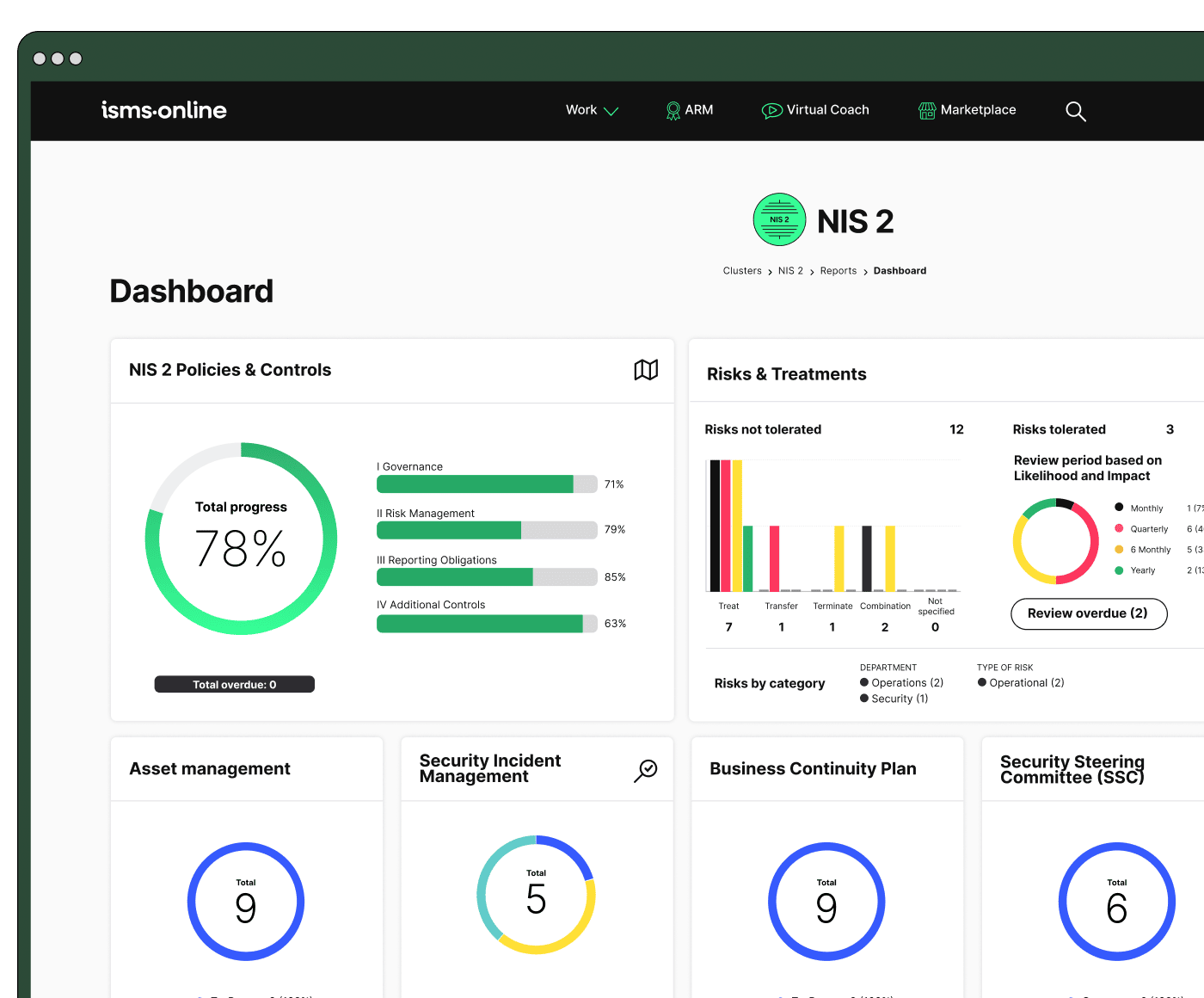
All your NIS 2, all in one place
From Articles 20–23 to audit plans – run and prove compliance, end-to-end.
Learning Loops: Audit Findings, Lessons, and Process Evolution
Under NIS 2, compliance isn’t just a checklist-it’s a feedback loop. ENISA, NCSA, and regulators track your incident logs for improvement, not just completion. What matters is how lessons become new controls, updates, or policies.
What isn’t logged as a lesson often re-emerges as an audit finding, or, worse, business loss on the next big RFP.
Building Your Own Resilience Dashboard
- Assign alert monitors for every new NCSA/ENISA bulletin.
- Require “lessons learned” on every incident, simulated run, and audit-log centrally.
- KPIs to track: notification times, incident rates, compliance training, repeat audit findings, improvement rates.
- Share improvement stats in management reviews and, when possible, board-level decks.
Expanded Audit Evidence Taxonomy
- Event triggers and acknowledgment timestamps (CSIRT, NCSA)
- Reporting confirmations (receipts, signed logs)
- Board/CISO sign-off for material or escalation events
- Lessons-learned field, attached to reviews and policy files
- Template-based responses for drills, incidence, and closures
- Multi-year, versioned evidence, ready for all regulatory lookbacks
Closing the Loop: Audit-Ready in Practise-Steps to Resilience and Leadership
A mature NIS 2 operation is not a “compliance project”-it’s the backbone of your business continuity and trust. Your best signal to the board and market is the capacity to close the loop: eligibility, registry, evidence, reporting, and lessons all pre-wired, cycle-ready, and version-locked.
ISMS.online brings it into one view: evidence chains, incident triggers, escalation contacts, and tracked deadlines-mapped against Law 5160/2024 and ISO/Annex A-to compress reporting times and eradicate missed notifications (isms.online).
Close your compliance loop before regulators or customers spot the gaps; those who move first set the reputational tone in their sector.
Four Steps to Operational Sovereignty
- Eligibility and Registry: Map your entity to the current NCSA/ENISA list and review after every major contract, customer win, or business model change.
- Workflow: Use (then adapt) NCSA incident and evidence templates, ensuring cross-departmental signoff at every step.
- Simulation: Quarterly run-throughs of your incident workflow, benchmarking response times and evidence logging. Make holes and delays visible now, not later.
- Stakeholder Engagement: Every staff member, from legal to IT, knows the why and when of notifications. Treat induction and refreshers as live drills, not mere paperwork.
ISMS.online: The Shortest Path from Risk to Action
By unifying compliance, evidence, contact management, and sector checklists, ISMS.online not only accelerates your cycle times but sets your line of defence in stone-ready for audits, board questions, or regulator calls.
Action signal: Assign workflow and evidence owners. Automate reminders and monthly evidence reviews. Use audit logs as differentiators in every board packet and customer call. Teams that lead with well-logged reviews and incident closure arent just avoiding fines-they become the standard-bearers in Greeces new NIS 2 era.
Book a demoFrequently Asked Questions
Who actually governs cyber-security in Greece, and why does this matter for your compliance and audit outcomes?
Greece’s cyber-security landscape rests on a multi-agency structure led by the National Cyber-Security Authority (NCSA – Εθνική Αρχή Κυβερνοασφάλειας), established through Law 5160/2024 as the statutory backbone for national cyber resilience. The NCSA controls regulatory policy, national incident reporting, sector audits, and coordinates with the Hellenic Data Protection Authority (DPA) and Hellenic Telecommunications & Post Commission (EETT) for privacy and telecom compliance. Critically, most cyber incidents-especially those with the potential to disrupt public services or critical infrastructure-are now handled by or escalate through the NCSA. Organisations that rely on stale authority contact lists or outdated reporting workflows risk missed deadlines, failed regulatory notifications, or audit citations for “dormant compliance.”
When your authority matrix goes out of date, you risk silent compliance gaps that only show up when it matters most-during an incident or an audit.
Your authority and escalation map should be a living document: reviewed annually, tracked in your risk register, and reflected in every incident and audit response. Per ENISA and NIS 2 guidance, organisations must expect to report simultaneously to multiple authorities (e.g., both the NCSA and DPA when incidents involve both operational and personal data impact). Confirm all regulatory contact details with the NCSA and your sector SPOC; embed backup contacts, escalation triggers, and sign-off records. Most importantly, make sure every notification attempt and reply is logged, timestamped, and linked to the current compliance role-holder internally, supporting clean audit trails and quick-survey board reviews.
Why does this matter?
- Missed or double-reported incidents are the #1 root cause of audit findings-not technical failures.
- Annual authority mapping is now an explicit audit expectation under both NIS 2 and ISO 27001.
- Board and DPO sign-off logs aren’t just “nice-to-have”-they’re a defence against regulatory fines and a badge of operational seriousness.
For official references and real-time regulation:,.
What is the NCSA’s SPOC, and how should your organisation engage CSIRT-GR during cyber incidents?
Greece’s legal linchpin for incident disclosure is the NCSA’s Single Point of Contact (SPOC) at spoc@mindigital.gr-a regulated address for all major incident notifications under NIS 2, with 24-hour deadlines for notification and 72 hours for full updates. Your compliance documentation and incident response plan must embed this address, assign a responsible owner, and back up every sent email or phone outreach with control logs and signed receipts. Simultaneously, the Computer Security Incident Response Team (CSIRT-GR) operates as the technical arm for both national threats and cross-sector incidents, running forensic triage, threat analysis, and confidence restoration in tandem with NCSA regulatory workflows.
“Drills beat documentation-if you’ve never run a notification test, your audit trail won’t stand up when the pressure hits.”
Practical notification and escalation steps:
- Embed both SPOC and CSIRT-GR contact points in your incident response playbooks.
- Assign both a primary and backup responsible person, and practise notification drills at least annually.
- Log every sent notification, confirmation, and reply-treat this as legal evidence, not just process history.
- Use sector-specific templates and notification forms provided on the NCSA and CSIRT-GR sites.
Medium-sized entities and SMEs should review NCSA’s tailored SME guidance and pre-built incident notification templates-these offer actionable frameworks for first-timers or growing teams.
See:
How does Greece’s cyber incident response (CSIRT) network function-and when must you escalate beyond your sector?
Cyber-Security incident management in Greece functions on a dual-tier CSIRT system: sector-specific CSIRTs (for finance, energy, digital, research, and health) manage most “business as usual” events, while high-impact or cross-sector disruptions-such as ransomware on a major supply chain or national cloud service outage-demand immediate reporting to CSIRT-GR and the NCSA. Secure, logged, and (ideally) PGP-encrypted email is the standard reporting channel. Incidents that remain within the boundaries of your sector should flow through your sector’s CSIRT first. However, any real or imminent risk of national or cross-sector impact triggers a double notification requirement-log both authorities, note the time and reply, and keep evidence ready for inspection or audit.
| Escalation Scenario | First Reporting Step | Next Steps if Widespread Risk |
|---|---|---|
| Localised/sector event | Sector CSIRT (e.g., health, finance, digital) | Escalate to NCSA/CSIRT-GR if sector guidance triggers |
| National/cascade impact | Notify NCSA and CSIRT-GR immediately | Document all notifications and replies |
| EU-wide/cross-border potential | Add ENISA, sector lead, and document all correspondence | Store in cross-border risk file for audit |
You should simulate these scenarios annually; dry runs will reveal workflow gaps and highlight evidence weak points for audit or legal defence.
Official CSIRT network:
Who is actually in scope for NIS 2 in Greece, and what hidden risks can leave organisations “between the cracks”?
NIS 2 brings a dramatically widened net: both “essential” entities (critical national infrastructure, health, digital, energy, water, etc.) and “important” entities (digital providers, manufacturers, waste management, supply chain nodes, even some SMEs and micro-businesses) must comply if a disruption would hit society or security. Risk triggers include not only formal designations but also contract amendments, M&A events, new supplier dependencies, or unique provider status. This means you might be drawn into scope during a long contract, or after an audit or assessment by a critical buyer-by the time you learn, gaps may already be audit-worthy.
By logging your eligibility checks and contract triggers now, you’re preventing audit drama when it’s too late to react.
Key strategies for staying compliant:
- Review your eligibility, registry entries, and contract-dependent designations every year-triggered by board review, contract change, or role modification.
- Keep a signed log (e.g., PDF, DocuSign) and save evidence for every scope-defining review; absence of this is an auditor’s flag.
- If you’re not sure, consult the NCSA, check ENISA’s registry, and document the outcome.
Further reading:
Why are Greek SMEs especially exposed to NIS 2 noncompliance, and how do you fix “silent failures” in your business?
SMEs commonly miss compliance because they underestimate their regulated status, ignore subtle changes in vendor contracts, or assume “small” means “outside the net.” A vendor risk review, sole-provider status, or sectoral role shift can expose an SME overnight-sometimes without explicit notification from authorities. NCSA and ENISA have made eligibility and registry checklists available, but ultimate responsibility for review, documentation, and proactive outreach remains with you.
Defensive actions for SME resilience:
- Build in annual NIS 2 status checks, mandate reviews after any contract or service change, and log everything.
- Archive all outgoing communications (email/call logs) with NCSA, ENISA, and sector regulators; dated evidence is an audit lifesaver.
- Secure staff onboarding and compliance training logs, even for short-term or agency personnel.
- Embed eligibility-review clauses in your legal and sales contracts to force attention during role/contract transitions.
A fully documented SME compliance workflow is not just legal armour but a trust builder with enterprise buyers and regulators.
For practical checklists: Sedicii – NIS2 and Greek SMEs
What are NIS 2’s non-negotiable reporting, escalation, and audit logging rules in Greece-and how can you assure audit resilience?
Under Law 5160/2024 implementing NIS 2, every in-scope entity faces strict, time-bound obligations and evidence requirements:
| Protocol Phase | Action Required | Deadline | Audit Evidence |
|---|---|---|---|
| Initial notify | Email NCSA (spoc@mindigital.gr) + sector CSIRT | 24 hours | Confirmation receipt, audit timestamp |
| Incident report | Full technical/log/follow-up report to all authorities | 72 hours | Signed incident report, escalation log |
| Closure/Lessons | Board-reviewed analysis & future-proof iteration | 1 month | Versioned closure file, management signoff |
Every step must be digitally timestamped, signed by the responsible lead, and version-controlled. Regularly rehearse the entire cycle-and store simulations in compliance evidence packs. Penalties can run up to €10M for reporting failures; a log gap is treated as an oversight, not a technicality.
Greek compliance doesn’t reward box ticking-the record of learning and adaptation is now your best legal shield and reputation asset.
Deep dive: Zeya Law – NIS2 Greece
How does NIS 2 force a learning loop-building audit and Board resilience from real evidence, not just paperwork?
Law 5160/2024 and the NIS 2 regime mark a shift from checkbox compliance to demonstrable learning: every notification, advisory, post-mortem review, and policy upgrade must be version-controlled, board-signed, and centrally logged. Your annual registry checks, incident drills, and management reviews must yield actual audit records and performance KPIs (incident response times, compliance rates, training records)-each tracked in platform dashboards.
Audit trail essentials:
- Chronological, versioned logs of every incident, notification, and authority reply.
- Formal sign-offs (with timestamp and role) for all lessons learned and management reviews.
- Signed, versioned policy/process updates after any significant event or regulatory advisory.
- Living KPI dashboards measuring closure times, reporting rates, and staff training engagement.
Every log, every lesson, every completed simulation signals to stakeholders and auditors that resilience is lived, not just claimed.
For implementation tools and audit-ready tracking: ENISA – NIS2 Guidance | (https://isms.online/?utm_source=openai)
ISO 27001 / Annex A Quick-Bridge Table: Greek NIS 2 Operationalization
| Expectation | Operational Action | ISO 27001 / Annex A Ref |
|---|---|---|
| Fast, documented notifications | SPOC/CSIRT mapping & drill evidence | A5.5, A5.24, A5.26, A5.27 |
| Audit-ready evidence | Versioned, signed logs, policy updates | A7.4, A5.28, A5.36, A9.1, A10.1 |
| Documented learning & closure | Board-signed review, iteration logs | A5.27, A9.3, A10.1, A5.35 |
| Active scope eligibility review | Annual logs, legal triggers mapped | A5.2, A5.9, A7.2, A5.11 |
Traceability Table-Event to Control
| Event/Trigger | Risk & Evidence Update | ISO Control | Example Audit Evidence |
|---|---|---|---|
| New contract/role | Eligibility log, signed | A5.21, A5.9 | Attestation, scope review log |
| Incident detected | Dated notification & reply | A5.24, A5.25 | Timestamped email, CSIRT reply |
| Lessons/closure | Policy/process update | A5.27, A10.1 | Signed minutes, update log |
Ready to shift from “minimum viable compliance” to resilience leadership? Make your evidence chain living. Assign role owners, rehearse your notification playbooks, and tie every new lesson to a log entry. Your next audit won’t just depend on avoiding penalties-it will set your credibility benchmark for customers, regulators, and your board.






