





































How Do Latvia’s NIS 2 Authorities, Sector Directories, and Incident Duties Actually Work?
Latvia’s approach to NIS 2 is a study in decentralisation-and the consequences for compliance teams are immediate and concrete. Instead of a single central regulator, different ministries preside over different slices of the country’s “essential” and “important” entities. The Ministry of Defence, Economics, Transport, and Health each wield oversight across aligned sectors: think critical grid, digital infrastructure, healthcare, or transportation. No matter your organisation’s size, this means your first compliance hurdle is figuring out who is responsible for you-and what happens if you get it wrong.
For early-stage Compliance Kickstarters, IT managers, or legal leads, simply misidentifying your lead authority risks more than bureaucratic inconvenience. Registration windows for NIS 2 open and close with precision; sending your details to the wrong ministry delays recognition, exposes your organisation to duplicate or missed audits, and muddles your entire policy log. Overseeing this matrix, CERT.LV acts both as national incident handler and as an escalation bridge between ministries and EU-wide cyber authorities.
Every regulator you skip is one more gap in your defence if your controls are ever scrutinised.
The real-world hazard emerges at onboarding and registration. Essential and important entities must “pre-map” their sectoral triggers-that is, link every new service, vendor, or major infrastructure change to the correct ministry before submitting final policy documentation. Multi-jurisdiction and pan-Baltic entities require special vigilance: being listed in both the right Latvian directory and the EU-wide lists is a non-negotiable for smooth cross-border operations.
Table: Latvia Regulatory Mapping-From Trigger to Authority
| Sector Event (Trigger) | Regulator Responsible | Operational Control Ref | Evidence for Audit |
|---|---|---|---|
| Launch new SaaS/digital service | Economics or Defence | SoA 5.2/5.5, Ann. A.5.2 | Email, registration form, ISMS note |
| Supply chain issue in grids | Ministry of Economics | Ann. A.5.21/5.19–5.22 | Updated register, risk log, contract |
| Major data breach | CERT.LV + DVI (GDPR link) | Ann. A.5.24, GDPR Art.33/34 | Incident log, notification copies |
CERT.LV remains central-and ambiguous sector cases are routinely referred by it to the right ministry. For compliance leaders, the operational imperative is clear: keep a validated trail of every regulatory contact, whether accepted, referred, or rejected. With every touch point captured in your ISMS, you build both defensibility and an audit-proof trace.
What Must Essential & Important Entities in Latvia Deliver Under NIS 2?
Compliance under NIS 2 in Latvia isn’t achieved with a one-off file drop; it is a living, breathing cycle of readiness. Entities designated “essential” or “important” are expected to operate on a rolling calendar: annual registrations and sector mappings, policy and risk documentation in autumn, and ongoing incident preparedness. The responsibilities set out by Latvian law translate control lists into real operating cadence, particularly for organisations registering for the first time or lacking compliance maturity.
Missing evidence-not missing security-is the main cause of fines and failed audits.
The registration process is only the first checkpoint. After filing, organisations must maintain continuous proof-throughout the year-that policies, risk files, and audit-ready registers stay current. October is the sharp edge: a hard deadline for all core documentation to be updated and board-attested. Afterwards, joint reviews by ministries and CERT.LV intensify, raising the stakes for defensible log trails and live evidence of compliance. For digital service providers, every new contract or major project sparks additional notifications and updates, often with a linkage to pan-EU risk directories.
Table: Latvian Compliance Milestones and Deadline Traceability
| Month | Action | ISO/NIS 2 Reference | Audit Evidence |
|---|---|---|---|
| April | Entity registration, sector mapping | Clause 4.2, Ann. A.5.2 | Email confirmation, ISMS register |
| October | Submit policy pack, risk file, SoA | Clause 6.1, Annex A | Policy docs, risk/audit logs |
| 24/72h | Incident initial/full notification | Ann. A.5.24, GDPR link | Notification logs, CERT.LV alert |
The most successful teams elevate this calendar to a board-level artefact. Embedding real-time completion metrics into board reporting is not only good governance-it’s now fast becoming the norm in regulated Latvian sectors.

Master NIS 2 without spreadsheet chaos
Centralise risk, incidents, suppliers, and evidence in one clean platform.
How Does CERT.LV Function as Latvia’s Cyber-Security Nerve Centre and Ally?
CERT.LV is the keystone of Latvian cyber operations, holding dual roles as the sectoral escalation hub and the technical incident responder. Recognised as both a regulatory entity and an operational partner, CERT.LV is assigned as the go-to national CSIRT (Computer Security Incident Response Team) for every “essential” and “important” entity. The distinction: for every incident, you are required to script CERT.LV engagement into your ISMS escalation process and business continuity manual.
A well-documented CERT.LV notification is a reputational shield when audits turn hostile.
During a major incident, CERT.LV assumes the role of escalation authority, triggering ENISA (European Union Agency for Cyber-Security) and cross-border CSIRT hand-offs when the situation threatens pan-EU operations. For organisations with EU or Baltic-wide presence, pre-engaging with CERT.LV-roomed through liaison meetings or their ticket system-streamlines notification and ensures your incident isn’t lost in translation.
CERT.LV Reporting Checklist
| Playbook Step | Audit Requirement | Evidence for Defence |
|---|---|---|
| Identify | ISMS doc, CERT.LV contact | Playbook, staff training |
| Log | Time-stamped notifications | Audit logs, email alerts |
| Escalate | ENISA/CERT handoff noted | Cross-border notification |
Latvia’s hardest audit questions often come down to whether a team can produce instant, system-generated proof of how it acted-and when. Building the CERT.LV logic into daily compliance routines is a front-line defence for practitioners at audit time.
What Are Latvia’s Hard Incident Reporting Deadlines and the Defensible Audit Moves?
Latvia enforces strict, multi-stage reporting clocks for every NIS 2 classified entity: organisations must notify CERT.LV within 24 hours of a qualifying incident, submit detailed analysis within 72 hours, and deliver a close-out report inside one month. These clocks are non-negotiable-incidents and evidence trails must be maintained simultaneously.
Evidence is not about perfect reporting-it's about honest, timely logs that the board can stand behind.
Audit defence in Latvia pivots on two practises: (1) record and submit initial reports immediately, even if facts are emerging; and (2) attach a rationale for any lapse, late notification, or partial disclosure into your ISMS as it happens. Authorities expect to see full transparency, not after-the-fact stories or retroactive write-ups.
Table: Latvian Incident Reporting Audit Trail
| Incident Event | Reporting Deadline | SoA/Annex Link | Audit Evidence Logged |
|---|---|---|---|
| Major cyber incident | 24h | Ann. A.5.24, VI/NIS 2 | CERT.LV ticket, logprint |
| Follow-up analysis | 72h | Ann. A.5.24 update | Report file, board notes |
| Final close-out | 1 month | Ann. A.5.27, A.6.5/6.6 | Closure log, SoA update |
The standing instruction for CISOs: “log everything, now.” Boards need to be positioned to defend every operational delay or deviation as a conscious, documented decision-not an omission discovered after the fact.
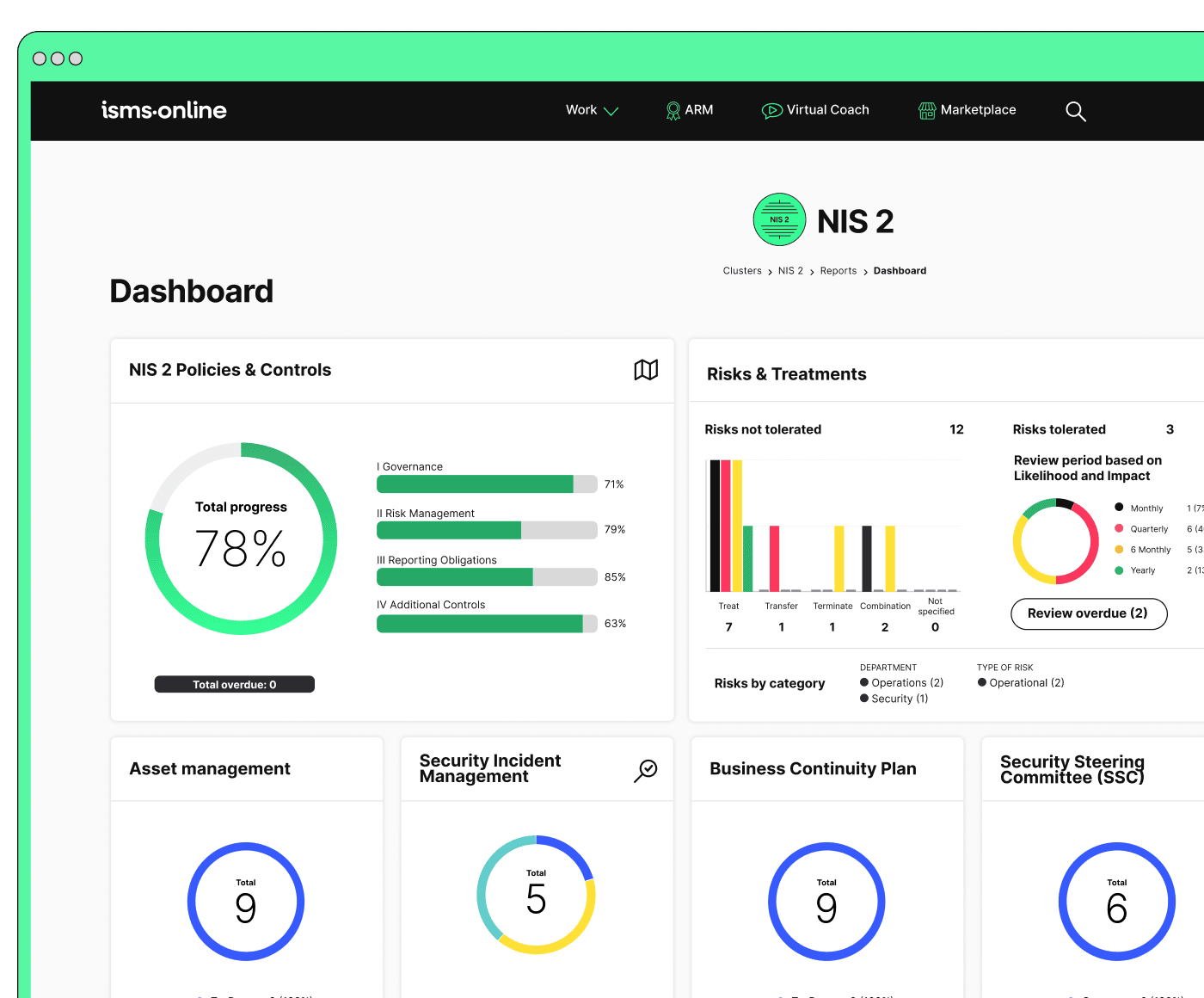
Be NIS 2-ready from day one
Launch with a proven workspace and templates – just tailor, assign, and go.
Why Is Audit Traceability the Foundation of NIS 2 Compliance in Latvia?
In Latvia, audit traceability functions as both a sword and shield: it is the pivot point between routine compliance and crisis-driven investigation (ISMS.online, advisera.com). For compliance leads, this means every milestone-registration, risk update, incident event, or board review-must be logged by system, time-stamped, and cross-referenced in the ISMS. “Paper trails” or synthesised logs after an event risk nullifying otherwise sound defences.
- All logs must be system-generated, time-stamped, and instantly accessible.
- Deviations (late reports, missing, or “generalised” incident logs) require a contemporaneous “rationale” file, attached at the time and tied to board records.
- A robust audit trail, ideally automated through ISMS.online, delivers visible confidence to both board and regulator.
Audit Readiness Traceability Table
| Trigger/Event | Required Evidence | ISO/Annex Link | Audit Proof Example |
|---|---|---|---|
| User logs in/action | System audit log, logprint | Ann. A.5.24 | ISMS log screenshot |
| Late incident report | Rationale (“excuse log”) | Ann. A.5.27 | ISMS entry, board note |
| Annual compliance cycle | Full log export | Clause 9.2, Ann. A | Dashboard export, report |
A mock audit run now is your best form of insurance-don’t wait for a real regulator to run the script.
Organisations that rehearse and export their audit trail periodically are positioned to withstand both surprise regulator checks and market-based due diligence from partners and major customers.
Latvia’s Supply Chain & Cross-Border Security: Top NIS 2 Pressure Points
Latvia extends NIS 2 obligations beyond your organisation’s perimeter: every supplier, managed service, and cross-border digital dependency falls under the compliance net. Contracts must now include NIS 2 clauses, annual risk reviews, and attestation mechanisms. The supply chain is now fully visible to auditors-and real-world incident escalations often initiate with vendor “events.”
Action Checklist:
- Tag and periodically update every supplier with current NIS 2 contractual clauses.
- Score and attestate each vendor’s compliance annually-reports must be accessible through your ISMS.
- Cross-log every incident involving a third party in your ISMS and, if the event has cross-border implications, apply ENISA notification protocols as well.
Every supplier is now part of your compliance evidence-ignore at your own risk during your next audit.
Table: Latvia Supply Chain Compliance Checklist
| Supply Chain Trigger | Control & Ann. Link | Evidence Needed |
|---|---|---|
| Onboard new supplier | Ann. A.5.19, 5.21 | Risk log, contract, attestation |
| Vendor cyber incident | Ann. A.5.24, ENISA | Incident log, alert notification |
| Annual review/attestation | Ann. A.5.20, dashboard | ISMS audit export, compliance note |
Organisations that breed discipline in supply chain evidence are rewarded with faster audits and lower enforcement risk.
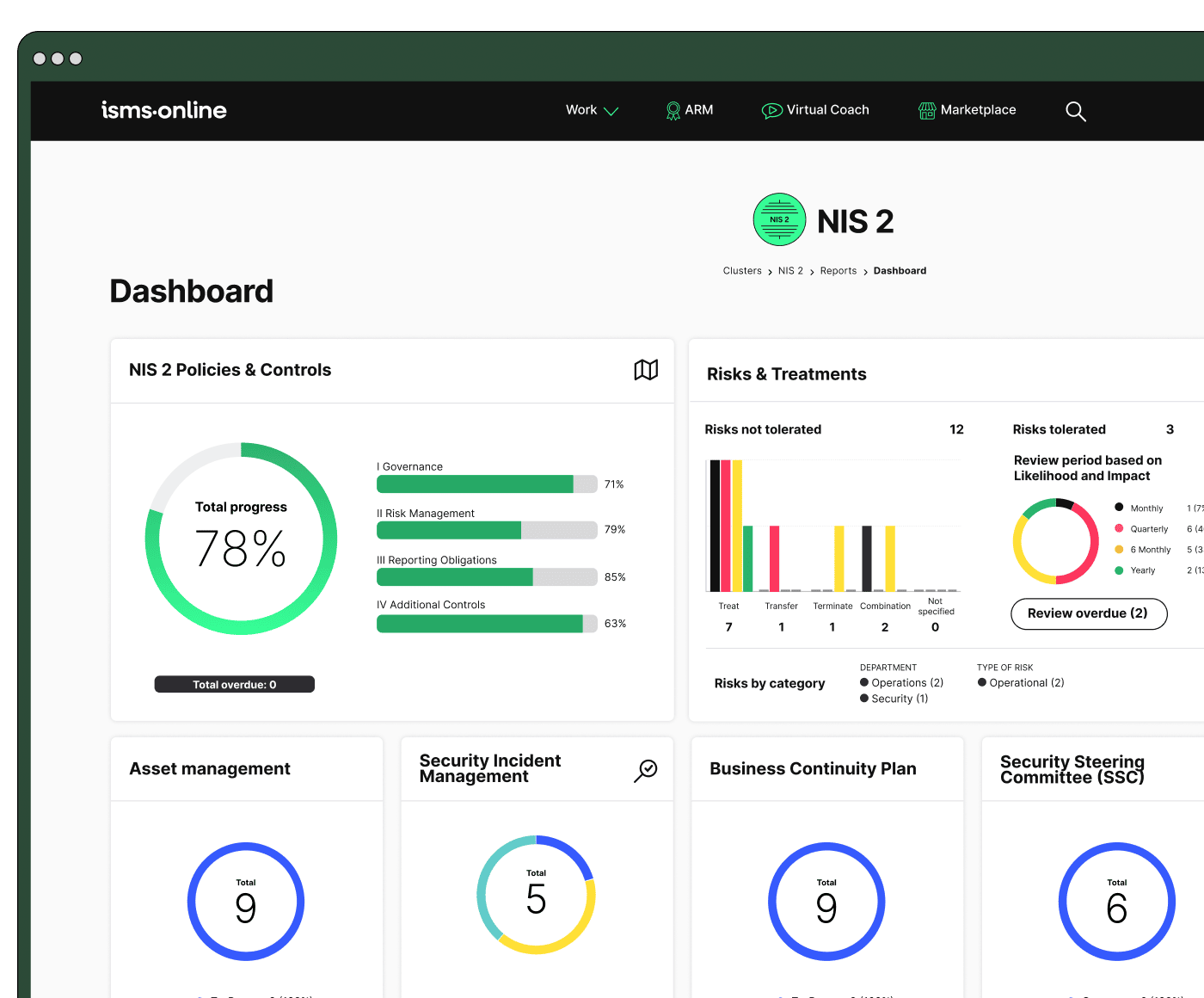
All your NIS 2, all in one place
From Articles 20–23 to audit plans – run and prove compliance, end-to-end.
How Do You Integrate NIS 2 and ISO 27001 for Latvian Audits?
Latvia’s “double-hinge” audit environment demands explicit cross-mapping: ISO 27001’s Statement of Applicability (SoA) must align, clause-for-clause, with Latvian NIS 2 obligations. Evidence files, audit logs, and staff training cycles must be digitised, time-stamped, and directly linkable from SoA statements to daily operations.
To succeed:
- Regularly synchronise your SoA with NIS 2’s evolving sectoral directives and ministry rules. Don’t treat your SoA as a one-off artefact-it is the heart of cross-audit proof.
- Export and dry-run audit tables *before* audits; not as a fire drill.
- Integrate checklists for sectoral rules and ministry notifications into the ISMS workflow-making them hardwired, not afterthoughts.
ISO 27001 ↔ NIS 2 Bridge Table
| Expectation | Integration Move | Ref. (ISO/NIS 2) |
|---|---|---|
| Proof of continuous ops | Annex A controls, board minutes | Ann. A.5.29 (BC) |
| Evidence of notification | CERT.LV ticket, SoA, logupdate | Ann. A.5.24, NIS 2 |
| Staff privacy training | Policy Pack, ISMS tracker, training rec | Ann. A.6.3, GDPR |
ISO on paper isn’t enough-Latvian NIS 2 expects continuous cross-mapping, not a static file.
Best practise: Design a traceability mini-table showing [Trigger] → [Risk update] → [Control / SoA link] → [Evidence logged]. Example: A supplier incident (trigger) leads to a refresh of your risk log (update), links to the supply chain clause in your SoA (A.5.19), and is evidenced by an incident notification copy.
What Leadership Actions Build Latvian Cyber Resilience and Audit-Ready Trust Capital?
Cyber resilience in Latvia is determined as much by board discipline as by technical controls. The best-performing organisations integrate compliance routines into board activity: simulation of incidents before audits, systematic documentation and review of drills, and recurring compliance review atop every meeting agenda. Boards and senior management transform regulatory pain points into trust capital-each audit or simulation becomes proof of reliability for customers and partners.
Board and Leadership Playbook:
- Schedule and document live incident simulations before audits-identify weaknesses and repair in advance.
- Record every drill, simulation, and “near miss,” circulating lessons learned through management channels.
- Embed compliance review as a recurring agenda item, not a one-off event.
Table: Audit-Ready Leadership Actions
| Leadership Action | Why it matters | Audit Trace Evidence |
|---|---|---|
| Board simulation pre-certification | Expose compliance risk | Board minutes |
| Document & share drills/tests | Transparency & learning | ISMS drill/test logs |
| Attach compliance cycles to board agenda | Year-round improvement | Agenda/doc, ISMS entry |
Resilient organisations don’t just pass audits-they’re trusted in every customer and partner conversation.
Boards must take ownership: regular simulation, transparent logs, and continuous evidence cycles are now the difference between mere certification and reputation-enhancing compliance.
Anchor Your Latvian NIS 2 Compliance with ISMS.online-Get Audit-Ready Now
Latvia’s NIS 2 regime leaves no room for fiction or improvisation. A robust, living ISMS is not only your legal defence-it is your competitive edge, your board’s assurance, and your customers’ signal of trust. ISMS.online is purpose-built for Latvia’s multi-ministry, multi-regulator landscape:
- Direct regulator–entity mapping: One-click view to see which sector authority and ministry govern your requirements, with workflows to match triggers and deadlines.
- Audit-edge evidence management: System-generated log trails, version-tracked policy packs and registers, and exportable, time-stamped audit files.
- Supply chain automation: Vendor contracts, incident notifications, and annual attestations managed and mirrored against NIS 2 benchmarks.
- Pan-EU, pan-Baltic readiness: Templates and interfaces span Latvian, EU, and cross-ministry obligations, with dual-language capacity.
Audit-ready isn’t a slogan here-it’s your competitive edge and trust signal to board, auditor, and customer alike.
Next steps: Connect for an onboarding or entity mapping session, harness the full range of evidence and incident libraries, and automate every supply chain and reporting trigger. With ISMS.online, every complaint, audit, or regulatory inquiry becomes a catalyst to deepen trust and reinforce your organisation’s resilience story.
Build your Latvian NIS 2 resilience story with ISMS.online-turn every compliance pain point into trust capital and audit-proof outcomes.
Frequently Asked Questions
Who are Latvia’s NIS 2 authorities and how do you identify the right compliance contact for your business?
Latvia’s NIS 2 enforcement is coordinated nationally by the Ministry of Defence, acting as single point of contact (SPOC) for both the European Commission and ENISA, but your assigned lead regulator depends on your sector. For daily compliance and registration, the Ministry of Economics covers energy and critical infrastructure, the Ministry of Transport handles transport and the digital sector, the Ministry of Health governs healthcare and water, while the Financial and Capital Market Commission (FCMC) leads for banks and insurers. CERT.LV is Latvia’s national CSIRT: it receives all incident reports, acts as technical authority, and may direct ambiguous cases to the appropriate sector lead.
To map your organisation’s compliance contact:
- Start with the EU Digital Strategy: Latvia NIS 2: page, which links sectors to their lead authorities and supplies SPOC referrals.
- If your business spans sectors or doesn’t fit neatly, submit a sector query to CERT.LV-they will formally assign or route your entity, and this reply creates your first ISMS evidence (audit traceability begins here).
- Document every contact and instruction in your ISMS with timestamps and reference numbers; this builds a resilient audit trail.
Clarifying regulator relationships before your first board review prevents missed deadlines, registration bottlenecks, and audit vulnerability.
Table: Latvia NIS 2 Sector Authority Map
| Sector/Function | Lead Authority | CERT.LV Incident Role |
|---|---|---|
| National SPOC, EU/ENISA coord. | Ministry of Defence | Mandatory for all incidents |
| Energy, critical infrastructure | Ministry of Economics | Technical escalation |
| Transport, digital | Ministry of Transport | Technical escalation |
| Health, water supply | Ministry of Health | Technical escalation |
| Finance, insurance | Financial & Capital Market Commission (FCMC) | Technical escalation |
What are Latvia’s binding NIS 2 compliance duties, and what evidence will auditors require your ISMS to provide?
Latvian NIS 2 legislation classifies organisations as “essential” or “important,” both of which must meet five operational compliance duties, each traceable through documented ISMS evidence:
- Annual registration and sectoral classification: You must register and self-attest compliance by April each year with the mapped authority.
- Policy suite & board approval: An up-to-date suite of information security policies, a live Statement of Applicability (SoA), and board sign-off with evidence (meeting minutes, e-signature, or attestation)-usually by October.
- Continuous incident preparedness and timely reporting: 24/7 readiness to report qualifying incidents through documented processes, with notification integration to CERT.LV.
- Supply chain extension: All key suppliers must be risk-assessed annually, entered into your ISMS, and have contracts referencing NIS 2 security and incident notification requirements.
- Exportable digital evidence: Your ISMS must permit rapid export of versions, approvals, supplier attestations, and incident logs, all traceable to events/audits.
Reference Lex Mundi’s Latvia NIS 2 summary for templates and routinely consult regs published by relevant ministries.
ISO 27001 ⇄ NIS 2 Bridge Table
| Board Expectation | ISMS.online Implementation | ISO 27001 / NIS 2 Reference |
|---|---|---|
| Board-approved, versioned policies | Policy Pack, Board Minutes, SoA linkage | A.5, 9.3, NIS 2 Art. 20 |
| Supplier risk mapping and contracts | Risk Map, Review Log, Contract Library | A.5.19–5.21, NIS 2 Arts. 21–22 |
| Board-logged incident response | To-Do, CERT.LV export, Board Review | A.5.24–5.27, NIS 2 Art. 23 |
| End-to-end audit evidence linkage | Time-stamped ISMS/SoA exports | A.5.36, A.8.15, NIS 2 Arts. 31–36 |
When and how must Latvian organisations notify CERT.LV of incidents, and what events meet the “qualifying” threshold?
CERT.LV is the mandatory incident gateway for all sectors under Latvian NIS 2 law. The following escalation applies to any significant cyber, supply chain, or service-impacting event:
- Notify CERT.LV within 24 hours of first suspicion: (confirmation not required); submit via secure email or webform.
- Submit detailed impact and root cause within 72 hours,: including affected assets, technical diagnosis, business implications, and any supplier involvement.
- Deliver a final closure and remediation report within 30 days.:
Every interaction-initial notice, follow-up, and final report-must be time-stamped, cited in the ISMS, and available for both board and regulator scrutiny. Even minor or near-miss events must be recorded; gaps in these logs weaken your audit defence and credibility.
In Latvia, effective incident preparedness is proven by a living evidence chain-not simply by policy on paper.
Incident Notification Table
| Event | Notification Channel | Deadline | ISMS/Evidence Requirement |
|---|---|---|---|
| Detection/suspicion | CERT.LV email/webform | 24 hours | Initial log, ISMS export |
| Investigation/update | CERT.LV ticket thread | 72 hours | Technical and impact analysis |
| Final closure | CERT.LV report | 30 days | Remediation proof, board minutes |
What is Latvia’s NIS 2 reporting timeline, and how do dry runs or rationale files build audit resilience?
Latvia enforces strict, staged reporting:
- 24 hours: Notify CERT.LV as soon as suspicion exists.
- 72 hours: File a deep-dive cause and impact report.
- 30 days: Issue a closure record, with remediation evidence.
If you ever miss a deadline or cannot obtain all required evidence, immediately file a “rationale note” stating the cause, corrective steps, and responsible owner-this becomes essential audit defence. Running scheduled incident “dry runs” and board-level simulations is both an expectation and a pragmatic safeguard. These stress-test your systems’ ability to log, export evidence, and engage key stakeholders under pressure-raising board confidence and audit scores.
How does Latvian NIS 2 audit traceability function, and how does ISMS.online support evidence mapping?
Audit traceability dominates Latvian NIS 2 enforcement. Every regulatory or board event-registration, policy update, supplier issue, incident-is mapped as a living ISMS record with version, timestamp, responsible party, and SoA/log cross-reference. “Rationale folders” are maintained for each late event/exception, signed and referenced for board review. Regular ISMS evidence exports and management review minutes should be filed as operating proof-not ad hoc before an audit.
Evidence Traceability Table
| Trigger/Event | ISMS Log Ref | SoA/NIS 2 Clause | Evidence Exported |
|---|---|---|---|
| Supplier incident | Vendor log A.5.21 | NIS 2 Art. 21 | Contract file, CERT.LV escalation |
| Board incident review | Board min., To-Do | A.5.36, Mgmt. Review | PDF export w/ signatures |
| Training completed | Acknowledgement file | A.6.3, NIS 2 Art. 22 | Training register export |
How are supply chain obligations and cross-border escalations enforced in Latvia under NIS 2, and what is “audit-ready” proof?
For Latvia, NIS 2 supervision turns every important supplier into an extension of your compliance perimeter:
- All critical contracts include NIS 2 clauses (security, reporting, risk extension), renewed annually or on relevant events.
- Each supplier is tracked and risk-assessed in your ISMS, showing annual status and legal notifications.
- Supplier incidents, especially cross-border/regional, are logged and escalated through CERT.LV using ENISA templates, ready for bilateral or EU-wide audit scrutiny.
“Audit-ready” is outcome-based: you must be able to export supplier registers, attestations, contract files, and incident logs instantly on demand-not weeks later. The proof is in traceability and export speed, not volume.
Supplier and chain failures rarely stop at borders. Audit resilience in Latvia is about real-time evidence, not remedial paperwork.
How can Latvian organisations unify ISO 27001 practise and NIS 2 evidence for true board-level resilience?
Latvian regulators, boards, and customers now expect integrated ISMS operations-not superficial mapping. To operationalise:
- Map every ISO 27001/Annex A control to its corresponding NIS 2 clause and relevant sector/board requirement (via SoA crosswalk).
- Practise regular evidence exports, with board sign-off and version control, showing timely, living compliance activity.
- Schedule board-level reviews and incident simulations year-round, not just before audit cycles.
Organisations that run incident rehearsals, evidence exports, and board engagements as a loop-not a project-signal real resilience and trustworthiness across Latvian and EU markets.
Final step: Future-proof NIS 2 with ISMS.online
Connect with ISMS.online to access Latvian NIS 2-specific templates, sector onboarding, supply chain modules, and one-click ISMS exports. Build an audit trail that not only protects your licence to operate, but earns customer and regulator confidence as Latvia’s digital trust landscape evolves-making your organisation audit-ready and resilience-driven by design.






