





































How Do NIS 2’s Shifting Deadlines Threaten (or Propel) Your Compliance Game?
The NIS 2 Directive’s timetable isn’t theoretical-one missed milestone can block procurement, freeze onboarding, or trigger urgent contract “remediation” requests. If your business operates in or sells to the EU, you know the pain. It’s not just the central EU date of 18 October 2024. The real risk is regional drift: some countries are live with strict rules, others in legislative limbo, and sector-specific “shadow deadlines” pop up months ahead of national law. For many, this means compliance is a moving target with legal, revenue, and reputation on the line.
Being almost compliant isn’t a safety net-one missed deadline can cost a deal, stall onboarding, and erode trust overnight.
The urgency is real: over 67% of halted tenders and renewals across the EU can be traced back to a slip on NIS 2 timelines. Every week sees updates to sector, national, or even unpublished regulatory “go/no go” dates, and the pace is relentless. Legal liability isn’t waiting for laggards-cross-border contracts, customer questionnaires, and third-party audits are wired to the fastest-acting regime you touch, not just your home country’s excuses.
The only practical defence? Develop a compliance ecosystem that pulls live deadlines from multiple sources-ENISA, sector regulators, procurement alerts-and bakes them into your ISMS. Real-time calendar feeds, embedded To-dos, and role-specific automated reminders become your first line of defence. In this landscape, manual monitoring is a liability, not a best practise.
A single missed NIS 2 date-even by a subsidiary-can pause customer deals and escalate onboarding backlog.
Why Is “Deadline Truth” a Moving Target?
No savvy team bets all-in on a national implementation date alone. Effective compliance monitoring now merges national authority updates, sector alerts, and even FAQs or bulletins from each country’s “competent authority.” Conflict is common-sector standards or global client requirements will overrule slack national laggards every time. Choose the strictest requirement as your baseline, and be ready to pivot before the ink dries.
Which source do you trust? The shrewdest answer is: all of them-simultaneously. Rigorous compliance means you never let a softer local rule lull you into a false sense of safety.
Visual Dashboard:
A timeline grid mapping country-by-country NIS 2 enforcement with real-time sector overlays. Philtres highlight which internal teams and suppliers face next up statutory obligations.
Book a demoWhere Are the New Bottlenecks-And What Do They Mean for Your Liability?
The patchwork is real and growing. Some countries (Denmark, Germany, the Nordics) are fully live by Q2 2024; others-France, Poland, Spain, much of Southern Europe-remain in negotiation limbo. Over half the EU faces Commission warnings for delay, and cross-border groups are especially exposed.
Legal liability migrates with your presence, not just your head office. Multinational contracts and supply chain clauses demand that you “operate to the highest applicable standard,” regardless of hometown excuses. The most demanding deadline you touch is the only one that matters.
Legal liability is no longer dictated by a single country’s pace-multinational contracts and borderless regulation set a higher bar.
Can You “Wait for Law” if Your Country Lags?
No. Enforcement patterns prove it. Commission infringement trackers are active, and major buyers or suppliers-especially in go-live countries-require up-front disclosures of NIS 2 readiness. The slowest legal regime is irrelevant if your customer base or procurement chain is governed by stricter standards. Don’t be blindsided: proactive, evidence-backed compliance is now a pre-requisite to even sit at most B2B negotiation tables.
Are You Simultaneously Exposed to Multiple National Regimes?
Almost certainly, if you serve EU-wide or partner with customers who do. Shadow compliance is now the new normal-maintain equilibrium with the toughest law in your group, and document it (procurement, legal, operations). “Main establishment” is a thin shield for subsidiaries; digital supply chains have zero patience for geographical excuses.
Visual Map:
A Europe-wide Risk Map colour-coded by enforcement status, flagged with zones of contractual and audit exposure-because liability travels.

Master NIS 2 without spreadsheet chaos
Centralise risk, incidents, suppliers, and evidence in one clean platform.
How Do “Hidden” Sector and Supply Chain Rules Dictate Your Next Moves?
Critical sectors face breakneck momentum. Health, finance, energy, infrastructure, and ICT supply-chain operators are already dealing with sector-specific “go-lives” and guidance that can leap ahead of national statutes.
Missing an early adopter sector deadline can sideline entire revenue lines for a quarter or more.
Watch for unpublished implementation acts, sector-specific FAQs, and fast-moving policy bulletins. These aren’t academic-many EU states nest sector rules months after main legislation, and procurement/contract penalties can be triggered retroactively. Your ISMS should import sector-specific addenda and map owner accountability to every policy refresh and legal act.
Does a Grace Period Mean Less Exposure?
Almost never. While countries like Belgium or Croatia offer “soft” grace periods, most procurement contracts and supply chain partners push for the earliest plausible compliance date. Treat ambiguous or phased deadlines as “active now,” not “wait and see.”
ISO 27001–NIS 2 Bridge Table (for Audit-Ready Operationalisation)
| Expectation | Operationalisation | ISO/Annex A Reference |
|---|---|---|
| Multi-jurisdictional | Integrated calendar + owner alerts | ISO 27001 A.5.2, A.5.5, A.5.8 |
| Early sector warning | Sector overlays, cross-mapping | ISO 27001 6.1.2, A.6.1, A.8.8 |
| Implementation updates | Legal scan loop, policy cadence | ISO 27001 9.1, 9.3, A.5.36 |
How Can You Keep Up with Cross-Border Fragmentation and Minimise Compliance Drift?
Operating in multiple countries and sectors means a risk of “silent divergence”-where a lag in a subsidiary, distributor, or supplier triggers tender delays or penalty clauses. The moment ENISA or a sector body updates risk thresholds, the strictest applies everywhere in your footprint.
Don’t wait for a monthly compliance review. Integrate every new sector law and threshold alert into your ISMS as an immediate policy update, assign new To-dos, and set automated reminders for each compliance owner. Manual tracking? You’re inviting disaster for cross-border teams.
Traceability Mini-Table
| Trigger | Risk Update | Control/SoA Link | Evidence Logged |
|---|---|---|---|
| New sector bulletin | Policy update, comms | 6.1, A.5.5 | Change log |
| Supplier contract update | Workflow refresh | A.8.8 | Incident report |
| New penalty regime | Exec review, dashboard | A.5.2 | SoA, KPIs |
You only hold the competitive edge when your compliance is perpetual, distributed, and told in real time.
Who “Owns” the Living Compliance Roadmap?
Best-practise is unambiguous: assign a live, accountable owner (country auditor/sector lead) for every compliance timezone-KPIs must reflect their burden. Don’t insulate ownership at group level alone; failures are local, and leadership must set cross-silo reminders and escalation triggers.
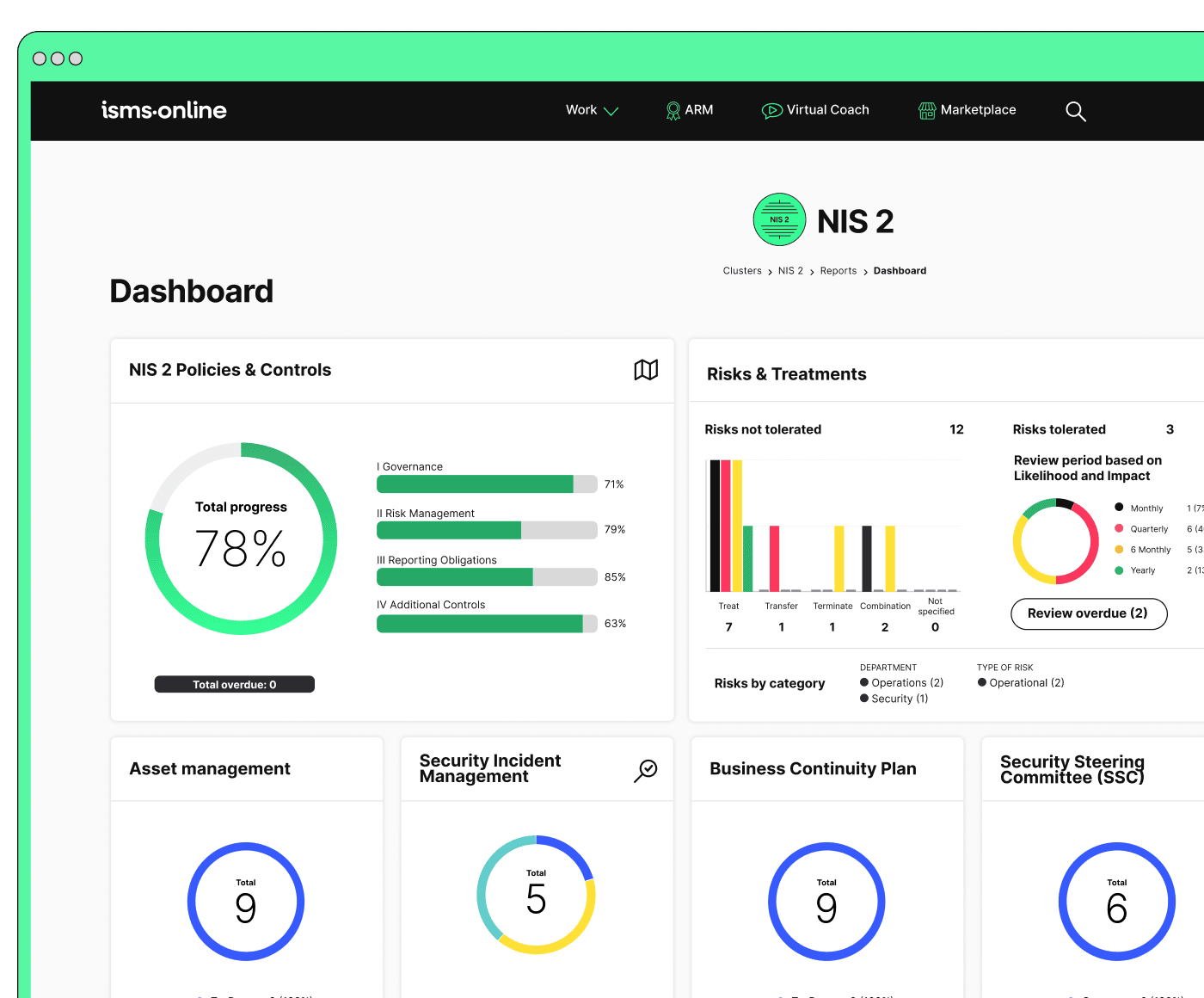
Be NIS 2-ready from day one
Launch with a proven workspace and templates – just tailor, assign, and go.
Which Real-World Bottlenecks Are Crippling Compliance Teams Today?
Audits are bottlenecking because everyone is chasing new and old standards-especially in health, ICT, and supply sectors. In some industries, penalty spikes hit 28% year-on-year in 2024, and audits are stacking up as suppliers scramble to prove new controls. A missed milestone by any downstream provider? Expect withheld payments, blocked contracts, and crisis meetings.
In Germany, health sector firms faced a 28% spike in NIS 2-related penalties in 2024-ENISA data
Does One Supplier’s Failure Put Your Whole System at Risk?
Yes. Chain reactions are more than theory: a late or failing supplier in any jurisdiction can freeze contracts across the network and raise direct regulatory alarm. Smart teams use quarterly crisis simulations and keep evidence packs current across subsidiaries-a routine that halves the odds of emergency escalation.
Visual:
Hot spot table of NIS 2 penalty surges by country and sector; team dashboards show where to marshal resources, not just tick boxes.
Why Does “Documentation Failure” Now Outpace Real Cyber Incidents for NIS 2 Penalties?
The enforcement lens is widening. Documentation gaps-missing evidence, outdated registers, or incomplete incident logs-cause up to 60% of NIS 2 penalties. European regulators now inspect documentation readiness in “semi-compliant” states, with inspection rates climbing 60% post-2024.
Gaps in evidence lock you out of tenders, freeze payments, and trigger regulatory audits faster than a technical breach ever did.
Can Board-Level Engagement Really Halve Your Penalty Risk?
Without board visibility, compliance effort is invisible (and fragile). But companies with live executive dashboards see up to 2× higher audit pass rates and 50% fewer penalty events. When boards are engaged, contracts unfreeze faster and regulatory findings are preempted.
Every contract, every audit, traces compliance not just to security controls-but to the integrity and recency of your documentation.
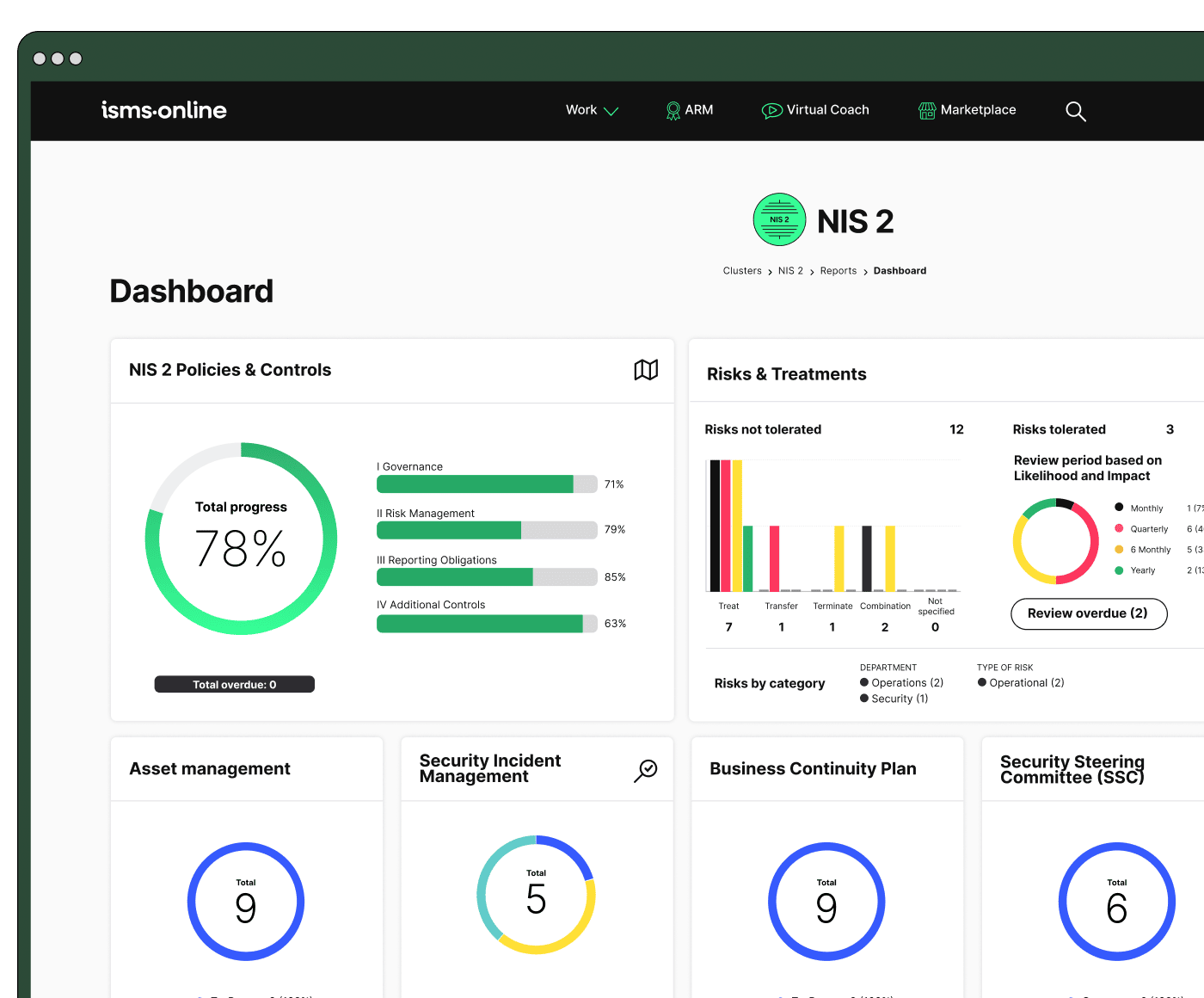
All your NIS 2, all in one place
From Articles 20–23 to audit plans – run and prove compliance, end-to-end.
Which Tools and Frameworks Actually Operationalise NIS 2-And What’s the Fastest Path to Readiness?
ISO 27001:2022 is the operational standard-and not just a tick-box exercise. The difference? Teams who automate gap analysis and assign live To-dos to every responsible function track progress, escalate evidence blockages, and keep all audit packs current (isms.online). ISO 27001 and NIS 2 controls must be crosswalked to every entity, geography, and owner. The Statement of Applicability (SoA), evidence trails, and risk registers should never be more than a week out of date.
How-To Checklist: NIS 2 Readiness Mapping for Teams
- Load the ISO 27001 framework and overlay active NIS 2 clauses.
- Assign owner roles for each region, sector, and subsidiary, with clear KPIs.
- Automate legal/sector alerts into actionable To-dos and reminders.
- Link evidence by role/task; sync every policy approval and test.
- Monitor dashboard metrics-with benchmarks to peer groups for rapid insight.
Documentation Power Table
| Asset | Linked To | Review Cycle | Audit-Ready? |
|---|---|---|---|
| SoA | All policy controls | Quarterly | Yes |
| Evidence packs | Every audit task | Rolling, event-driven | Yes |
| Risk registers | Each region/sector owner | Monthly | Yes |
A ready-as-routine ISMS isn’t just good governance-it’s a business accelerator.
Why Does ISMS.online Become a Force-Multiplier in a Shifting NIS 2 Timeline?
ISMS.online was engineered for turbulent compliance. It unifies the workflow-live deadline tracking, owner assignment, and dashboard monitoring-across every business size, sector, and jurisdiction. That means no more spreadsheet slippage: every new legal or sector requirement is mapped to an accountable person, automated reminders nudge at-risk KPIs, and audit packs are updated for procurement, legal, and executive in parallel (isms.online).
Our platform helps customers cut audit turnaround by 35% and reduce tender bottlenecks by half in the first 12 months. That translates into earlier revenue recognition, lower compliance overhead, and less “firefighting” when new laws drop.
ISMS.online customers report audit turnaround times improved by 35% and tender blockage reduced by half in the first year.
What Is the Fast Path to Board-Level Assurance-with ISMS.online?
- Capture every new deadline; assign real, named owners.
- Automate reminders, update controls, and keep all stakeholders informed.
- Export SoA and complete evidence packs to board, procurement, or authority on demand.
- Raise unique or urgent scenarios instantly with in-platform chat or collaboration.
- Benchmark your readiness against peers, and fix gaps proactively in days, not months.
CTA
If youre ready to reclaim compliance as a business weapon-not a regulatory burden-nows your moment. Use ISMS.online to transform audit fear into competitive advantage, secure every deal, and trust that every deadline is tracked, logged, and owned.
Are you set to master NIS 2 and future-proof your readiness?
See ISMS.online in action-empower your compliance journey, accelerate readiness, and turn every deadline into an asset.
Frequently Asked Questions
Which countries are already enforcing NIS 2, and how can you avoid a compliance countdown surprise?
A growing list of countries-including Belgium, Greece, Italy, Latvia, Lithuania, Croatia, Hungary, Slovakia, and Slovenia-have now fully enacted NIS 2 into national law, meaning organisations operating in these jurisdictions are under active compliance deadlines. In these states, registration for in-scope entities typically opens from January 2025, while full operational duties kick in from October 17, 2025, the EU-wide go-live. However, heavier-weight economies such as Germany, France, and Spain remain in draught or consultation mode, with final deadlines drifting into late 2025 or beyond. This creates fragmented risk for any organisation with cross-border operations-missing a local compliance trigger can instantly lead to revenue blocks, missed RFPs, or audit setbacks.
| Country | Law Live? | Entity Reg. | Full Enforcement | Regulator |
|---|---|---|---|---|
| Belgium | Yes (Oct 2024) | Jan 2025 | 17 Oct 2025 | CCB |
| Greece | Yes (Nov 2024) | Jan 2025 | Nov 2025 | MoD |
| Italy | Yes (Oct 2024) | Jan 2025 | 17 Oct 2025 | ACN Italy |
| Germany | No (draught, 2025+) | TBA | TBA | BSI |
| France | No (draught) | TBA | TBA | ANSSI |
| Spain | No | TBA | TBA | INCIBE |
The moment a new law is published, your compliance clock starts ticking-miss it and your group’s certifications, tenders, or vendor status may be on the line.
Timely alerts: Each country’s authority (e.g., Belgium’s CCB, Italy’s ACN) sets its own registration and sector enforcement dates. Some sector windows activate ahead of formal law, so monitor bulletins closely and set reminders for every jurisdiction in which your organisation (or its vendors) operates.
How do staggered NIS 2 national deadlines disrupt contracts and procurement across borders?
The slow, piecemeal rollout of NIS 2 transposition across EU countries means contract risk is now sharply tied to your slowest jurisdiction. A missed registration in one country-say, Germany-can block a group-wide tender or trigger an audit non-conformance for all subsidiaries, even if every other entity is up to date. In 2024 alone, more than two-thirds of procurement holdups and onboarding failures in regulated supply chains have stemmed from NIS 2 registration confusion, with legal and procurement teams scrambling to keep track (NIS2verify, 2024). Contracts are evolving to state “strictest-in-scope” applicability-meaning one slow subsidiary exposes the group.
Best-in-class organisations mitigate this by:
- Setting up monthly cross-border compliance dashboards and sector-specific deadline reviews.
- Amending contracts to default to “whichever NIS 2 requirement is earliest or strictest.”
- Using real-time NIS 2 trackers and legal alerts to eliminate last-minute shocks.
One country’s delay can put your entire group’s new business at risk-synchronise NIS 2 status across borders before your next audit or RFP.
What are the most urgent new sector and supply chain risks under NIS 2?
NIS 2’s real teeth in 2024–2025 come from strict, uneven sector deadlines and aggressive supply chain obligations. Financial services, healthcare, ICT, and critical infrastructure sectors face rapid “go-lives,” sometimes before the overarching national law-meaning sector authorities may audit, request evidence, or impose fines before other businesses even register. Further, your third-party and fourth-party suppliers-even those outside the EU-may now need to demonstrate NIS 2-aligned controls if they impact EU operations. Most of 2023–2024’s major fines have resulted not from breach events, but from missing evidence, unlogged policies, or supplier documentation gaps (All-About-Industries, 2024).
Supply chain action pointers:
- Fully catalogue supplier NIS 2 status and regulatory windows-even for non-EU vendors.
- Highlight contract clauses that treat ambiguous sector deadlines as enforceable now.
- Simulate a supplier’s missed evidence update-trace business impact and procurement fallout.
Supply chain evidence gaps-not technical hacks-are now the top source of NIS 2 enforcement risk. Each audit must trace evidence end-to-end, not just at your door.
How are NIS 2 penalties, audits, and enforcement patterns evolving?
Enforcement is increasingly about process quality, policy governance, and board-level oversight, not just technical control settings. Over 60% of penalties in 2023–2024 have been for documentation lapses: missing management reviews, outdated or absent policy signoffs, delayed incident reporting, or untracked supplier audits (ICLG, 2024). Some countries (e.g., Hungary) demand biannual audits for critical sectors; others (Belgium, Italy) will check incident and evidence logs long before a breach is reported. Fines reach €10 million or 2% of global turnover for essential entities; €7 million or 1.4% for important ones. Where lapses recur or cross multiple countries, penalties rise fast.
| Entity Type | Max Fine (Euros/%) | Hot Sectors | Audit Triggers |
|---|---|---|---|
| Essential Entity | €10M / 2% group turnover | Health, ICT, Finance | Unlogged evidence, late reporting |
| Important Entity | €7M / 1.4% group turnover | Energy, Utilities | Missed board review, doc gaps |
Boards that demand live compliance dashboards and management review logs consistently halve both incident rates and regulatory risk.
How does ISO 27001:2022 streamline NIS 2 compliance for every country and sector?
ISO 27001:2022 has become the recognised “operating system” for NIS 2 compliance. Its blueprint-documented policies, controls, assigned ownership, risk processes, and the Statement of Applicability (SoA)-precisely mirrors NIS 2’s expectations in every national and sectoral context. All national authorities cross-reference ISO 27001 as the gold standard for risk, incident, and supply chain controls. By aligning your ISMS to ISO 27001 and updating your SoA monthly, you create a single evidence base and board-ready audit rhythm for every supply chain, sector, and regulatory review.
| Expectation | ISO 27001 / Annex A Ref | Key Audit Step |
|---|---|---|
| Monitor deadlines and assign owners | A.5.2, A.5.4 | Live tracker, control responsibility delegated |
| Evidence readiness, incident drills | A.5.24–A.5.26 | Document exercises, update evidence logs |
| Supply chain assurance | A.5.19–A.5.21 | Supplier compliance audits, mapped contract reviews |
| SoA updates and board review | 6.1.3, A.6.2–A.8 | Board-level review, SoA sync, audit exports |
Managing NIS 2 “sidecar spreadsheets” or point tools only increases audit risk and delays-consolidating all work in a live ISMS platform harmonises compliance, slashes error rates, and builds continuous audit readiness across all legal domains.
In what ways does ISMS.online actively reduce NIS 2 risk and raise control for agile teams?
ISMS.online translates moving-target legislation into a live compliance engine that guarantees traceability, resilience, and board trust. The platform automates deadline and bulletin tracking for every country, sector, and authority, links every control to an accountable owner, then maps and monitors evidence in real time-all for your own ops and your critical suppliers. Customers experience up to 50% fewer audit findings and procurement delays after migrating from scattered tools to ISMS.online’s unified, export-ready dashboards (ecs-org.eu, 2024).
Key advantages:
- Centralised, automated tracking: for every local, sector, supplier and EU-wide compliance deadline.
- Role-based assignment: ensuring every policy, incident, or evidence trail is owned, updated, and logged.
- Live compliance dashboards: for management review, board-level KPIs, and regulator/auditor export-all from one source.
- Instant, export-ready packs: for tenders, audits, or regulatory demands.
With ISMS.online, our audit timelines halved, procurement approvals doubled, and the board finally gets real-time assurance instead of last-minute scramble.
Next step for leaders: Don’t let NIS 2’s rolling-law landscape block your growth.
Empower your team to translate local, sector, and supply chain requirements into confident, board-ready proof at every deadline. (https://www.isms.online/contact-us) and see how ISMS.online turns legal complexity into an agile advantage you can defend to customers, partners, and auditors.






