





































Are You on Slovenia’s Official NIS 2 Register-and What’s at Stake for 2024?
In Slovenia, the difference between confidence and anxiety about your compliance future now lives on a single directory. If you’re tasked with NIS 2 oversight-whether you’re an executive sponsor, compliance lead, or legal owner-confirming your spot on AKOS’s registry is no longer optional. The ZInfV-1 Act draws a crisp line: if your organisation provides critical infrastructure, digital services, or supplies public utilities, your “essential” or “important” status becomes legally binding from October 2024.
The most constant pain among new compliance leaders is not knowing if they’re in scope. Slovenian law sets clear tripwires: “important” status applies to those with at least 50 employees or €10m turnover; “essential” at 250 headcount or €50m revenue. A timely registry check now can mean the difference between audit certainty and a boardroom scramble.
The line between compliance hero and high-risk outlier is drawn at the registry.
Regulatory Scope and the New Stakes for Boards
With NIS 2, old public sector “fine immunity” has quietly faded: while municipalities may avoid direct financial penalties, new enforcement tools-public corrective orders, leadership accountability, and sector-wide scrutiny-lie ahead. For private sector operators, especially telecoms, energy, and digital platforms, reporting loads and penalty ceilings have mounted. AKOS manages live registers and sector guidance; SI-CERT watches for incident alert times and authority handoffs; URSIV keeps the governance score and can block non-compliant leaders (akos-rs.si, si-cert.org).
Public-sector “exemption” ≠ escape:
Municipalities and public bodies can’t avoid accountability. Even without fines, corrective orders and reputational exposure create strong incentives-shaping the board agenda for the rest of 2024.
Quick-Start Checklist for Slovenian Compliance Owners
- AKOS registry: Confirm your listing for accuracy and update as needed.
- SI-CERT protocol: Practise mandatory incident playbooks; document every incident call and review.
- Gap review: Use ENISA and URSIV toolkits to catalogue your documents; archive every board packet and review session.
Navigating Slovenia’s Cyber Authorities: Who to Call, When, and How to Survive an Incident
Compliance in Slovenia isn’t about theory-surviving an audit requires a working radar for when and how to escalate. The wrong move, or an hour’s delay, makes governance questions land at board level as quickly as any technical failure. For CISO roles, compliance officers, or company-side incident leads, knowing when to contact SI-CERT, URSIV, or AKOS is baked directly into audits.
The Escalation Matrix: Slovenia’s Three Pillars
- SI-CERT: Any suspected breach, data loss, or system tampering triggers the clock. You must file an alert (phone, form, or email) within one hour-missed windows = “systemic compliance failure” in every future file review.
- URSIV: Handles filings, documentation, and formal compliance queries or follow-up after incidents.
- AKOS: Registry maintenance, sector notifications, and escalation of company or sector status changes.
Delay a single SI-CERT notification, and every audit becomes a potential board risk event.
Handling cross-border and third-party incidents:
If your breach could propagate across the EU or supplier chain, you must file and show working evidence of both domestic and cross-border notifications.
Real-World Escalation Workflow
- Log the trigger (system alert or human report); call or file with SI-CERT.
- Activate your incident plan-internal escalation, documentation, IT and board notifications.
- Notify URSIV with your compliance snapshot; document additional controlling actions.
- Archive the incident file-include logs, communications, IT evidence, board review notes.
- Close with a full audit pack-signed off by the board, with every compliance loop closed.
Having a named “incident lead” and up-to-date contact list closes audit gaps and empowers your team to avoid finger-pointing when speed is critical.

Master NIS 2 without spreadsheet chaos
Centralise risk, incidents, suppliers, and evidence in one clean platform.
The New Anatomy of Incident Reporting: Timers, Evidence, and Real-Time Triggers
Under NIS 2, incident reporting isn’t about waiting for all the facts-it starts at suspicion. Slovenian authorities measure your performance from the moment something seems amiss, not when certainty arrives.
These new reporting expectations demand technical and cultural discipline.
The moment you suspect, you must act-delay guarantees greater penalty risk.
Anatomy of Slovenian Incident Reporting
- Trigger: Outage, suspicious access, or data loss-any can start the timer.
- Filing: Use SI-CERT or AKOS online forms; upload logs and timestamped evidence; keep the confirmation receipt.
- Reporting windows: Immediate alert in ≤1 hour; full report by 24 hours; comprehensive close-out by 72.
ISO-Mapped Incident Response Table
| Trigger | Action/Update | Control / SoA Link | Evidence Logged |
|---|---|---|---|
| Data loss detected | Notify SI-CERT (≤1hr) | Annex A 5.25, 5.26 | Hotline/email log, initial form |
| Incident confirmed | Full SI-CERT report (24hr) | Annex A 5.27, 8.15 | Completed report, log extract |
| Cross-EU involvement | Notify SI-CERT, ENISA | Annex A 5.29, 5.30 | ENISA alert, comms trail export |
| Closure & sign-off | Board/audit sign-off | Annex A 9.3, 5.35 | Board minutes, closure evidence |
Slovenian audit cycles increasingly hinge on this evidence chain. ISMS.online and similar systems help integrate these controls and audit artefacts for streamlined closure.
Operational tip: Run quarterly table-top drills, version your logbook, and regularly archive board reviews to stand up to regulatory challenge.
Who Is “Essential”, Who Is “Important”, and Who Gets Exemptions? Snapshot Compliance in Slovenian Companies
For compliance owners and board sponsors, categorisation under NIS 2 is more than formality-it’s the lever that can swing audit risk from manageable to existential.
How your category shapes pressure:
- Essential: 250+ employees or €50m+ in revenue. Demands full NIS 2 compliance, sector reporting, and board-level audit sign-off.
- Important: 50+ employees or €10m+ turnover. Slightly lighter on penalties, but reporting gaps still trigger URSIV orders.
- Municipality/Public: Typically exempt from fines, but answerable to corrective orders and public exposure.
| Size/Turnover | NIS 2 Class. | Primary Regulator | Penalty Type |
|---|---|---|---|
| ≥250/€50m | Essential | AKOS/URSIV | Max fines/corrections |
| ≥50/€10m | Important | AKOS/URSIV | Corrections/fines |
| Municipality/Public | Exempt/Hybrid | AKOS/URSIV | Corrections/orders only |
Running an annual “snapshot” meeting on classification, triggers (growth, M&A, sector pivot), and audit evidence preserves traceability and keeps your designation up to date. Documentation of size/churn and sector updates can save months of regulatory wrangling after-the-fact.
Legal caveat:
Sector carve-outs and value triggers may change. Always check the latest guidance from AKOS and ENISA. Rely only on current official references.
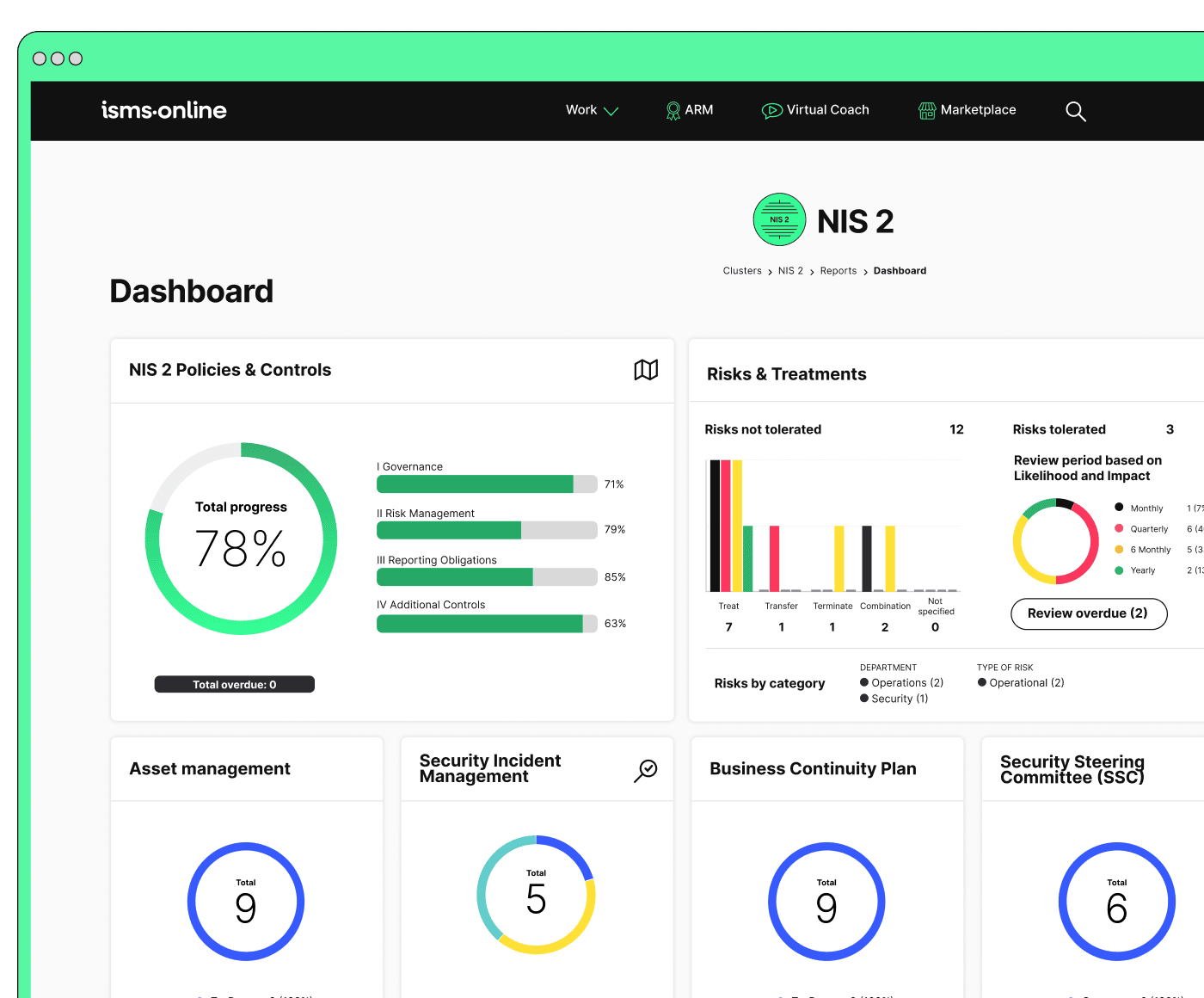
Be NIS 2-ready from day one
Launch with a proven workspace and templates – just tailor, assign, and go.
Slovenian Audit Loops: Reporting Routines, Documentation, and Automation for NIS 2
The NIS 2 regime isn’t about annual checklists-it’s a loop: Run, Evidence, Audit, Repeat. Where compliance leaders and executives once fretted over yearly reports, now continuous live traces and rapid access to proof dominate-especially during surprise reviews or post-incident inquiries.
Each time a workflow runs-an incident filed, a risk re-assessed-you build an audit chain that’s hard to break.
New Routines, New Discipline
- Essential entities: Clock-like 24hr/72hr reporting, board sign-off, and cross-supply chain logs must now be standard, not contingency.
- Important entities: The reporting dance is nearly as brisk, but regulatory corrections tend to focus on remediation, not outright fines.
- Automation as risk defence: Platforms such as ISMS.online consolidate logging, evidence linkage, and notification logs-saving staff time and audit worry (isms.online). A live risk dashboard is fast becoming not just “nice” but necessary.
- Quarterly drills: Missed events, absent documentation, or delayed board engagement are consistent triggers for URSIV scrutiny and penalty.
Mini-table: Slovenian NIS 2 Traceability Loop
| Trigger | Risk update | Control / SoA link | Evidence logged |
|---|---|---|---|
| Major incident | Risk re-scored | ISO 27001 6.1.2, A.5.25 | Updated risk log, report |
| Audit cycle | Policy pack refresh | ISO 27001 5.2, A.5.1 | Approved policy, version |
| Supply event | Vendor attestation | ISO 27001 5.19, A.8.30 | Attestation, checklist, log |
Supply Chain Security and Third-Party Compliance: Who Pays When Partners Fail?
NIS 2 compliance isn’t isolated-your supply chain’s mistakes, oversights, and risk lapses are now written into your board’s liability, not theirs. The name of the game is layered due diligence, auditable logs, and recurring checks-in short, paperwork that stands scrutiny after an incident.
One missing attestation or onboarding document can unravel your entire audit defence.
Practitioner Playbook: Building Supply Chain Defence
- Annual supplier risk reviews: -always signed by your procurement/risk lead, always logged.
- Attestation renewal triggers: -M&A, jurisdiction changes, or critical supplier events demand updated proof.
- Partnering on drills: -This isn’t “extra credit.” Regulators will ask for records of joint incident walk-throughs, as well as logs of incident call trees and communication.
- Centralise evidence: Cross-link supply risk data, incident records, and contract attestations in your ISMS dashboard (isms.online).
- Calendar and log every step.: Each action must be traceable: date, owner, proof.
Table: The Essential Supply Chain Audit Log
| Supplier Event | Required Action | Proof / Evidence |
|---|---|---|
| New supplier onboarded | Risk review, onboarding | Checklist, signed log |
| Annual review cycle | Attestation re-collection | Updated attestation file |
| Incident escalation | Joint SI-CERT/AKOS report | Escalation log, notice confirmation |
| Audit preparation | Consolidate reports, logs | Audit pack, board sign-off |
Drills aren’t optional; evidence is your only insurance against computed liability.
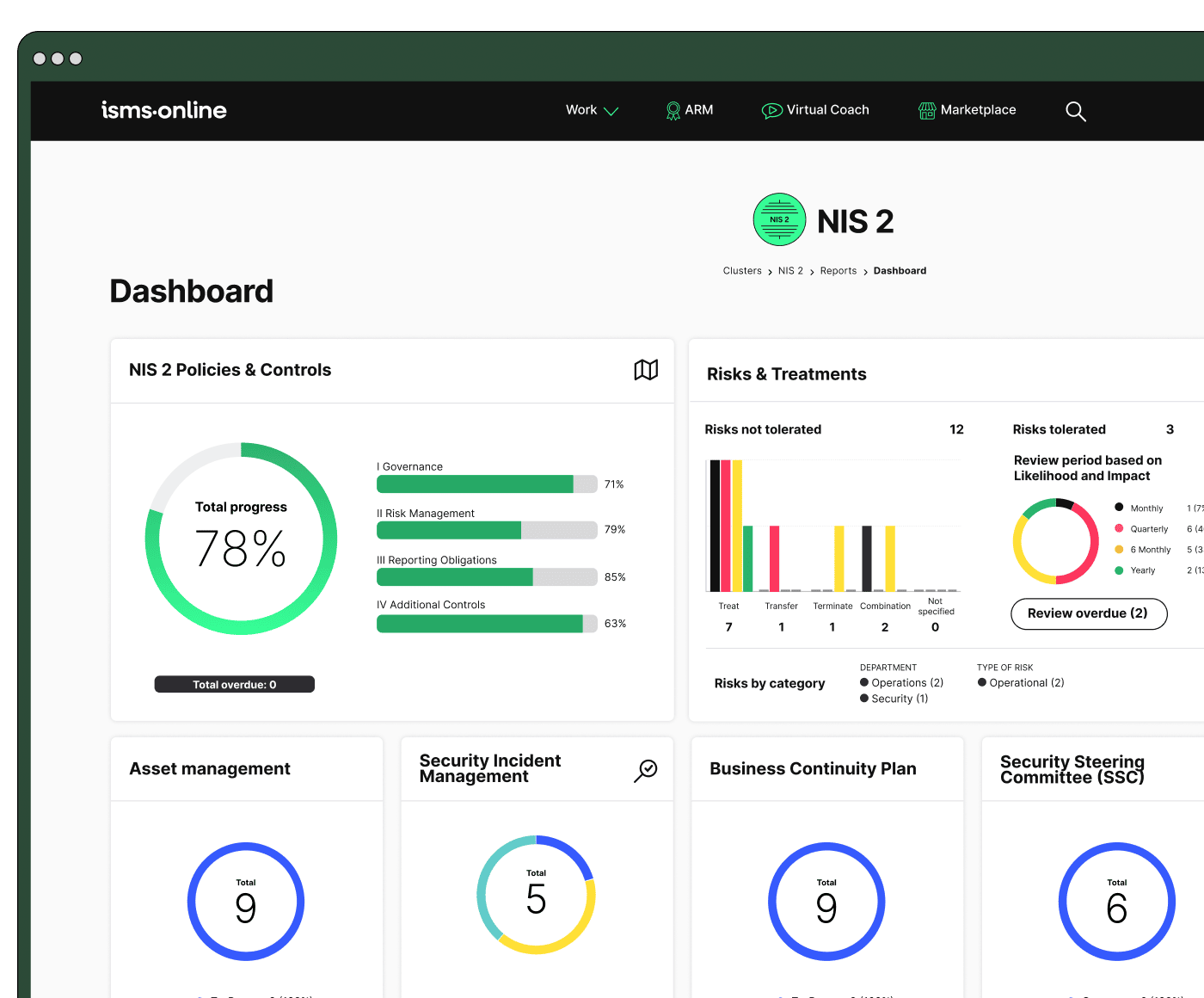
All your NIS 2, all in one place
From Articles 20–23 to audit plans – run and prove compliance, end-to-end.
Boardroom Certainty: What Proves Slovenian Compliance to Auditors in 2024?
The headline question for Slovenian boardrooms this year: can you “prove” not just technical compliance, but continuous, accountable oversight? Regulators, auditors, and the public will pose that challenge directly. Successful leaders have shifted from merely annual approvals to live dashboards, micro-evidence across every control, and documented closure loops.
Boardroom audit evidence checklist:
- Signed incident logs, complete with timestamps and closure stamps.
- Current supply chain attestations-distinguishable from last year’s bundle.
- Direct evidence in board or management minutes: decisions, risk discussions, upcoming actions.
- Logs of staff compliance: policy acknowledgment, training, task closure.
- Leadership accountability matrix-clearly mapped from detection to closure.
Regulators will name and publish repeat offenders-delaying or skipping board oversight can risk leadership positions and reputation.
Board defence-ready dashboards:
Bring together SoA registers, incident response logs, and meeting minutes in one environment using platforms configured for Slovenian NIS 2 and ISO 27001 (isms.online). Auditors are shifting their questions from “are you compliant” to, “Can you catch, close, and prove every event-end-to-end, in real time?”
2024-2025 trend:
Increasing demand for evidence linkage-incident to remediation, to policy revision, to engagement or training, all mapped to ISO/NIS 2 annex checkpoints.
Ready for Real-World NIS 2 in Slovenia? Accelerate Board Proof With ISMS.online
Passing a Slovenian NIS 2 audit in 2024 requires more than a checklist – it calls for ongoing, provable certainty at every level: boardroom, practitioner, supply chain, and regulator. ISMS.online’s Slovenian configurations remove the daily friction: from live registry checks and incident playbooks, to dashboard evidence linking and local-language support (isms.online, ursiv.gov.si).
- Audit-ready launch packs: Registry triggers, authority directories, and SI-CERT reporting flows pre-loaded for each entity type.
- Live dashboards: Track status, closure, and signatures across supply, incident, and board evidence-so your next audit is always ready.
- Peer benchmarking: ENISA toolkit access to calibrate your company’s NIS 2 maturity, oversight, and response cadence.
- Expert, local support: Specialised guidance for regulated, hybrid, and public sectors-without ambiguity.
Don’t wait for an audit to find your weak spot. Test your evidence dashboard and benchmark your board’s proof before the October deadline exposes the gap.
Bring your compliance team, board, and technical leads together-deploy the ISMS.online audit loop and transform NIS 2 into a platform for real, reputation-saving resilience, not fear.
Frequently Asked Questions
Who is formally accountable for NIS 2 compliance and cyber-security breach reporting in Slovenia?
NIS 2 compliance in Slovenia is overseen by the Information Security Administration (URSIV), with operational and sector support from SI-CERT and AKOS. Organisational accountability runs to the board or senior management: under ZInfV-1, directors and executives of all “in scope” entities are personally liable for compliance, not just system admins or IT leads. URSIV conducts regulatory oversight and enforcement, while SI-CERT (cert@cert.si) handles real-time incident intake, triage, and international notification 24/7; AKOS is responsible for registry and compliance among telecom and digital service providers. Each covered organisation must confirm its “essential” or “important” status, register with the right agency, and formally designate a compliance lead who coordinates reporting and evidence submission.
Slovenia’s NIS 2 Oversight & Contact Points
| Function | Institution | Contact |
|---|---|---|
| NIS 2 authority | URSIV | gp.uiv@gov.si; +386 1 478 4778 |
| Incident response | SI-CERT | cert@cert.si; +386 1 479 88 22 |
| Telecom registry | AKOS | akos.box@akos-rs.si; +386 1 583 63 60 |
Accountability for NIS 2 is now traceable-not theoretical. Directors and boards are required to demonstrate ongoing, documented engagement or face direct regulatory and reputational exposure.
What incident reporting procedures and timelines are required for NIS 2 entities in Slovenia?
You must follow a rigid “24 hour / 72 hour / 1 month” incident reporting chain, with the clock starting the moment a significant cyber incident is suspected-not only after internal validation.
- Within 24 hours: Initiate an alert to SI-CERT by phone or email, recording the timestamp and providing a summary of the suspected impact.
- Within 72 hours: Submit a comprehensive incident report via the SI-CERT template, including affected systems, technical/log evidence, and preliminary remedies.
- Within 1 month: File a closure report signed by an executive or board member, documenting remediation, root cause analysis, and actionable lessons learned.
All materials-logs, reports, sign-off records-should be attached at each stage and must be traceable. Delayed, patchwork, or incomplete submissions often trigger URSIV audits and can be flagged for EU or ENISA escalation. You are expected to flag unresolved issues for cross-border coordination, and SI-CERT provides English-language guides and forms.
Incident Reporting Timeline
| Phase | Deadline | Must Include |
|---|---|---|
| Initial alert | 24 hours | Summary, timestamp, contact |
| Full report | 72 hours | SI-CERT template, logs, RCA |
| Closure file | 1 month | Board sign-off, evidence, lessons |
Which Slovenian organisations are “in scope” for NIS 2 and what obligations apply?
The NIS 2 Directive, transposed via ZInfV-1, covers any private or public entity in critical or digital sectors that meets the following thresholds:
- Important entity: ≥50 employees or €10 million turnover;
- Essential entity: ≥250 staff or €50 million turnover;
- Municipalities: Over 50,000 residents.
Included sectors range from healthcare, utilities, energy, water, and financial institutions to ICT, digital providers, and large public administrations. For full scope, see.
Your obligations:
- Annual, board-reviewed risk assessments and tested incident response plans.
- Live, auditable supply chain security registers-every new or renewed vendor must be risk reviewed, approved, and logged.
- Comprehensive evidence trails: audit logs, records of board sign-off, staff training/showing completion, and security updates.
- Ongoing staff training and vendor/supplier drills, logged and reviewed at least yearly.
Most public sector bodies (notably small municipalities and some micro public services) must still ensure transparency and management-level accountability, even when formal fines are rare.
NIS 2 Scope Table (Slovenia)
| Entity Type | Scope Trigger | Core Compliance Cycles |
|---|---|---|
| Essential | ≥250 staff or €50m turnover | Maximum fines, full audit loop, reporting |
| Important | ≥50 staff or €10m turnover | Moderate fines, all compliance duties |
| Municipality | ≥50,000 residents | Board liability, incident reporting |
Which documentation and operational records are mandatory for NIS 2 compliance in Slovenia?
You must run controlled, versioned workflows spanning incidents, supply chain, and oversight.
- Incident Management: Execute the 24/72/1-month reporting sequence using SI-CERT/ENISA templates; log escalation, remediation, and root cause reviews. Keep every alert, report, and board sign-off traceable (digitally or via platform).
- Supply Chain Security: Maintain a real-time register; conduct annual or event-triggered supplier risk reviews; keep evidence of drills, onboarding checklists, and vendor attestations; log every step for all vendors.
- Board and Audit Pack: Archive all sign-off records, attendance, KPIs, and policy acknowledgements-ideally on a dedicated platform (e.g., ISMS.online). Make sure materials remain instantly ready for URSIV inspection or auditor discovery.
Breakdowns in hand-off-between incident, supplier, and board records-are the most common source of URSIV enforcement actions.
Compliance Traceability Table (Example)
| Trigger | Required Action | Evidence to File | Platform |
|---|---|---|---|
| Ransomware hit | Alert SI-CERT | Email receipt, form, log | SI-CERT |
| Vendor compromise | Run supply chain drill | Drill evidence, vendor email | isms.online |
| Board audit | Quarterly review | KPI dashboard, signed minutes | URSIV/isms.online |
What fines and reputational risks do Slovenian organisations face for NIS 2 non-compliance?
Essential entities risk fines up to €10 million or 2% of worldwide turnover; for important entities, limits are €7 million or 1.4%. Public sector boards may face management bans, naming in state transparency orders, or removal from public tenders-beyond formal fines.
Regulatory action most often arises from:
- Gaps in documentation: missing incident or supplier evidence, or incomplete board records.
- Missed deadlines for incident reports or audits.
- Ad hoc supply chain management.
- Disengaged or untrained staff.
Suspension of external certifications (e.g., ISO 27001) and forced public disclosures have occurred. See analysis: Clifford Chance, NIS 2 Europe.
Regulatory penalties always focus on what’s documented; process gaps, not just outcomes, are the root cause of most fines.
How should Slovenian organisations “prove” continuous NIS 2 compliance to auditors and regulators?
Auditors and URSIV expect you to show:
- Full, timestamped logs for every incident reporting step, escalation, and closure.
- A live, cross-referenced supply chain register: show evidence of supplier reviews, compliance checks, and drill outcomes.
- Routine board and management reviews-with centrally archived, timestamped minutes, resolutions, and KPIs.
Best-practise entities unify incident, audit, and vendor logs on integrated cloud platforms (like ISMS.online), linking controls and evidence for instant recall during audits or regulatory reviews; (https://www.isms.online/)).
Compliance Evidence Snapshot
| Area | What Auditors/Regulators Look For | Sample Proof |
|---|---|---|
| Incident Workflow | Time-stamped logs, signed reports | SI-CERT templates, email logs |
| Supply Chain | Register, audit drills, supplier letters | Vendor attestations, drill logs |
| Board Oversight | Meeting minutes, policy sign-off, KPIs | isms.online, signed board logs |
Where do Slovenian teams obtain NIS 2 templates, tools, and support resources?
Combine local and EU resources for a comprehensive programme:
- : Downloadable incident reporting forms, step-by-step guides, sample responses.
- : Registry, digital/telecom reporting, FAQs.
- : Cross-EU workflows, entity checklists, peer examples.
- (https://www.isms.online/): End-to-end compliance workflow, real-time risk and supplier auditing, audit pack management.
Blend sector-specific tools, official templates, and integrated compliance platforms to meet both regulatory minimums and best-practise standards effortlessly.
What practical actions should NIS 2 compliance leaders in Slovenia take next?
Execute these steps for immediate risk reduction and audit readiness:
1. Check your registry status: Confirm with URSIV/AKOS that your entity is correctly registered and that compliance contacts are updated.
2. Download/align official templates: Use SI-CERT, AKOS, and ENISA forms for all incidents, vendors, and audits; avoid custom or ad hoc documents.
3. Centralise controls, logs, and supplier records on a version-controlled, cloud platform (such as ISMS.online), keeping every compliance cycle traceable and audit-ready.
4. Run a real-world drill: Simulate a full 24/72/1-month incident and board response cycle-assign roles, walk through every file/log, and finish with a management review. Ensure all steps are signed and timestamped.
5. Book a sector-specific compliance review-consult SI-CERT or an ISMS.online expert before your next audit deadline, (https://www.isms.online/)).
NIS 2 isn’t static-problems multiply if gaps are found during audits. Prove your cycle works before auditors do.
Ready to shift from reactive to always-audit-ready?
Access expert-vetted forms, automate control logs, and connect with local guidance-via,,, and (https://www.isms.online/)-to secure your NIS 2 compliance, now and as regulations evolve.






