





























Why Are Board Directors Personally on the Hook Under NIS 2?
NIS 2 has redrawn the fault lines of boardroom accountability. Personal liability for cyber-security is no longer theoretical: board directors’ own names can appear on enforcement notices, sanction registers, and shareholder communications if their oversight fails. Where previous rules allowed risk to be diluted across committees and corporate shells, NIS 2’s Article 20 assigns direct and individual responsibility to management bodies. For most directors, the pivotal shift is the threat of personal fines-up to 2% of global turnover-and, in extreme cases, disqualification from corporate management. This is already playing out in regulated sectors, where authorities have signalled intentions to name and penalise individuals as much as entities (cms.law; vanta.com).
The cost of hesitating on governance is no longer just operational-your name may be the headline.
For multinational boards and parent company directors, the risks are magnified. Subsidiaries invoking Article 26 or 20 may trigger board accountability up the chain. This means directors cannot rely on annual, boilerplate governance-they must demonstrably participate in cyber-security oversight. Boards are now compelled to provide logs of their engagement (crisis simulation records, technical briefings) and show a clear line of challenge to technical decisionmakers. ENISA’s message is blunt: directors who fail to check and resource cyber functions expose themselves and their organisations.
Accountability is no longer collective comfort-a board seat means personal risk.
Board Governance Bridge Table
Here’s how NIS 2 expectations align with operational board practise and ISO 27001 mapping:
| NIS 2 / Board Expectation | Operationalisation | ISO 27001 / Annex A Reference |
|---|---|---|
| Board-level engagement & personal liability (Arts 20, 32) | Quarterly security briefings; attendance log | Cl. 5.3, 9.3, A.5.2/A.5.35 |
| Live evidence of involvement | Signed management review minutes; approvals | Cl. 9.3, 9.2, A.5.1, A.5.4 |
| Supply chain governance & oversight | Supplier risk review; signed risk register | A.5.19, A.5.21, A.5.20, A.5.22 |
| Regular update on regulatory/ENISA guidance | Board packs attach ENISA reports; checklists | A.5.7, 5.36, A.5.31, A.5.37 |
| Rapid incident responsibility & reporting | Crisis exercise logs; after-action review | A.5.24, A.5.27, Cl. 10.1, A.8.8 |
How Will Supervisory Authorities Scrutinise Board Engagement?
The era of checkbox compliance is gone. Supervisory authorities now probe for proof of active board involvement-not just signatures, but evidence of challenge, escalation, and resource shifting (cms.law; gtlaw.com). Boards face pointed questions: Who raised concerns? Was corrective action funded? Did directors attend cyber briefings? In a breach review, authorities pair management minutes with technical and supply chain logs to cross-verify real engagement.
Audit fatigue is a sign of evidence gaps, not effort.
Supplier risk is the new frontline: should an incident cascade through your value chain, expect the regulator to request your latest supplier reviews, escalation logs, and minutes where the board took or ignored action. ENISA urges the appointment of “compliance champions” (often board secretaries), responsible for maintaining and testing the completeness and traceability of these records even before a crisis occurs.
Naming and shaming is now standard. Authorities publicly identify non-engaged directors; news of bans and fines travels fast-undermining both corporate and individual reputation. Board assurance is no longer measured by having paperwork-but by retrieving, in hours, logs of directed engagement.
Scrutiny is not theoretical-auditors inspect what actually happens, not what’s written in last year’s policy.
Traceability Mini-Table
Here’s how traceability unfolds from real-life triggers to actual evidence under ISO 27001 mapping:
| Trigger (Event) | Risk Update | Control / SoA Link | Evidence Logged |
|---|---|---|---|
| Supplier data breach | Third-party access risk escalated | A.5.21, A.8.8 | Supplier log, board minutes noting escalation, risk register |
| Board not minuted | Governance process compliance risk | Cl. 5.3, Cl. 9.3, A.5.2 | Attendance log, remedial training record, agenda snapshot |
| New ENISA guidance | Framework/technical compliance risk | A.5.7, A.5.36 | Board pack, evidence of action/agenda adaptation |
| Missed audit deadline | Audit outcome reputational risk | A.5.35, A.5.36, Cl. 9.2 | Email correspondence, compliance dashboard, approval trail |
| Incident (e.g. ransomware) | Business continuity, legal, operational risk | A.5.24, A.5.27, A.8.8 | Incident log, after-action review, management review minutes |

Master NIS 2 without spreadsheet chaos
Centralise risk, incidents, suppliers, and evidence in one clean platform.
Where Does the Patchwork of EU NIS 2 Transposition Leave Your Board?
While NIS 2 dictates a universal rulebook, in practise directors face a patchwork. At the latest count, nineteen EU member states had failed to fully transpose the Directive into national law. Others “gold-plate” requirements, making them even stricter. The result: a multi-speed, multi-standard compliance challenge for boards-especially those overseeing subsidiaries in multiple EU markets.
Directors must govern for the strictest standard across the group. Article 26’s extended territorial scope and Article 20’s accountability regime mean that a compliance gap in one jurisdiction can roll uphill, putting parent board members at direct risk (onetrust.com; nis-2-directive.com). “Essential” or “important” designation-set locally but impacting at group level-defines the range of possible sanctions and required evidence. ENISA now openly urges boards to maintain living registers of status, obligations, and enforcement landscape-a map to be updated at least quarterly.
Every gap in local compliance, every delay in annual mapping, now exposes boards to both operational and personal risk. Yet, boards that harmonise standards across jurisdictions don’t just dodge fines-they demonstrate resilience and emerge as trusted market leaders (forrester.com; enisa.europa.eu).
How Does an Audit-Ready Board Prove Compliance vs. Intention?
Evidence is king. Auditors want more than policies-they demand live, timestamped proof of who signed, who challenged, and what happened as a result (isms.online). Audit-ready boards can instantly surface signed approvals, risk updates, supplier reviews, crisis exercises, and management review outputs. Your board’s compliance doesn’t live in checklists-it lives in a system that produces retrievable evidence under pressure (secureframe.com; cms.law).
Our board is audit-ready because every approval is one-click away.
Where internal challenge is logged-and supporting evidence uploaded-audits become value-adding exercises, not threats. Modern ISMS platforms such as ours automate this cycle: directors can access their decision trail, challenge log, and learning reviews immediately, without document hunting. The board’s readiness is proven daily-by the ease and speed of retrieval when external auditors knock.
The distinction between “audit intention” and “audit readiness” is clear: only boards that build automated, living review cycles-with every director, every policy, and every supplier tracked-can withstand scrutiny and accelerate future compliance (Clifford Chance).
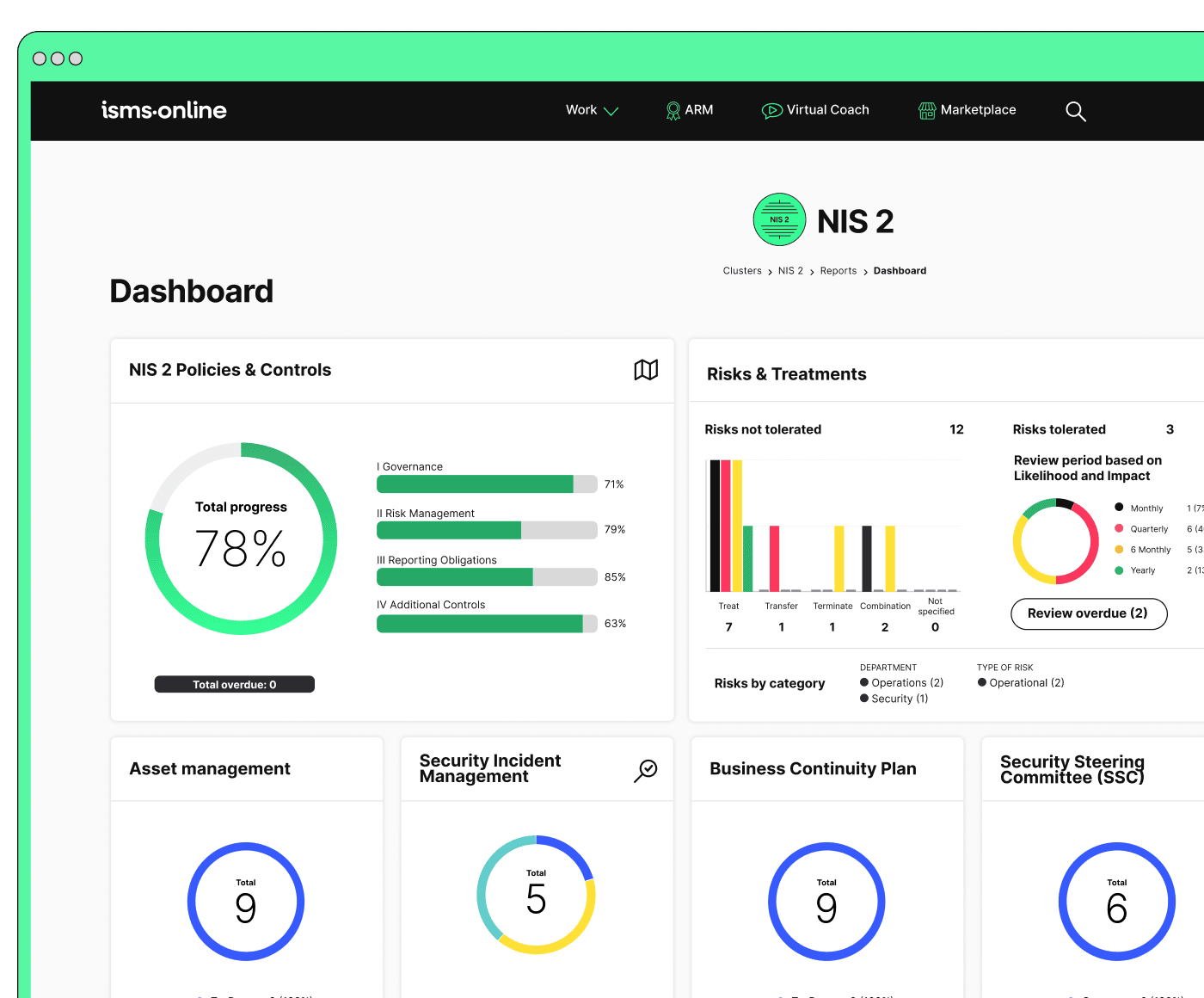
Be NIS 2-ready from day one
Launch with a proven workspace and templates – just tailor, assign, and go.
What Are the Real Board-Level Sanctions-And How Can You Mitigate Them?
NIS 2 enforcement now singles out individuals for failings. The threat isn’t just theoretical: directors face personal fines, public censure, and exclusion from management roles where oversight lapses can be proven. In practise, this most often follows high-profile breaches, but it’s lax routine oversight and missing evidence that set the stage.
Sanctions fall harder where directors ignore automation and clear documentation-they survive when evidence lives, not when explanations do.
Supply chain accountability is a core pressure point: boards must proactively assign risk ownership, maintain auditable trails of supplier diligence, and run bi-annual reviews. This is no mere “policy”; it’s a workflow repeated across the year-supplier logs, signed reviews, incident debriefs. Management dashboards powered by automation make possible what manual processes cannot: every director’s action, every challenge, every approval logged, and retrievable in hours, not days (isms.online).
Boards should lock in these KPIs:
- Evidence retrieval for all incidents and actions within 72 hours.
- Quarterly management reviews logged and minuted.
- Supplier risk review and owner sign-off twice annually.
Incident response should always culminate in a learning loop: after-action reviews become routine and logged, not “special” exercises. Automation builds a buffer of evidence between the board and sanction risk-keeping directors off the enforcement front pages.
How Can Boards Turn Governance Fatigue Into Strategic Value?
Governance fatigue isn’t always the mark of a diligent board-it signals that the system itself is broken.
Governance fatigue is a sign the system is failing, not just the people.
Directors going through the motions of compliance lose effectiveness and put the organisation at risk. Instead, boards should seek living systems that automate the repeatable-delegating reminders, surfacing gaps, and logging every approval or challenge (isms.online). Well-designed board dashboards combine management reviews, supplier logs, and incident records, giving directors instant command over risk trends and resource allocation.
The real opportunity: turn compliance from a buffer cost into a source of risk and revenue insight. By linking incident reduction, supplier review timing, and trust metrics directly to automated board interventions, the modern board becomes a catalyst for resilience and market confidence (isms.online; forrester.com).
For high-performing boards:
- Median evidence retrieval metrics fall below 48 hours.
- Percentage of on-time approvals climbs above 95%.
- Board dashboards show downward trends in uncontrolled incidents.
Redefining governance fatigue as a system symptom helps transform compliance into a platform for opportunity.
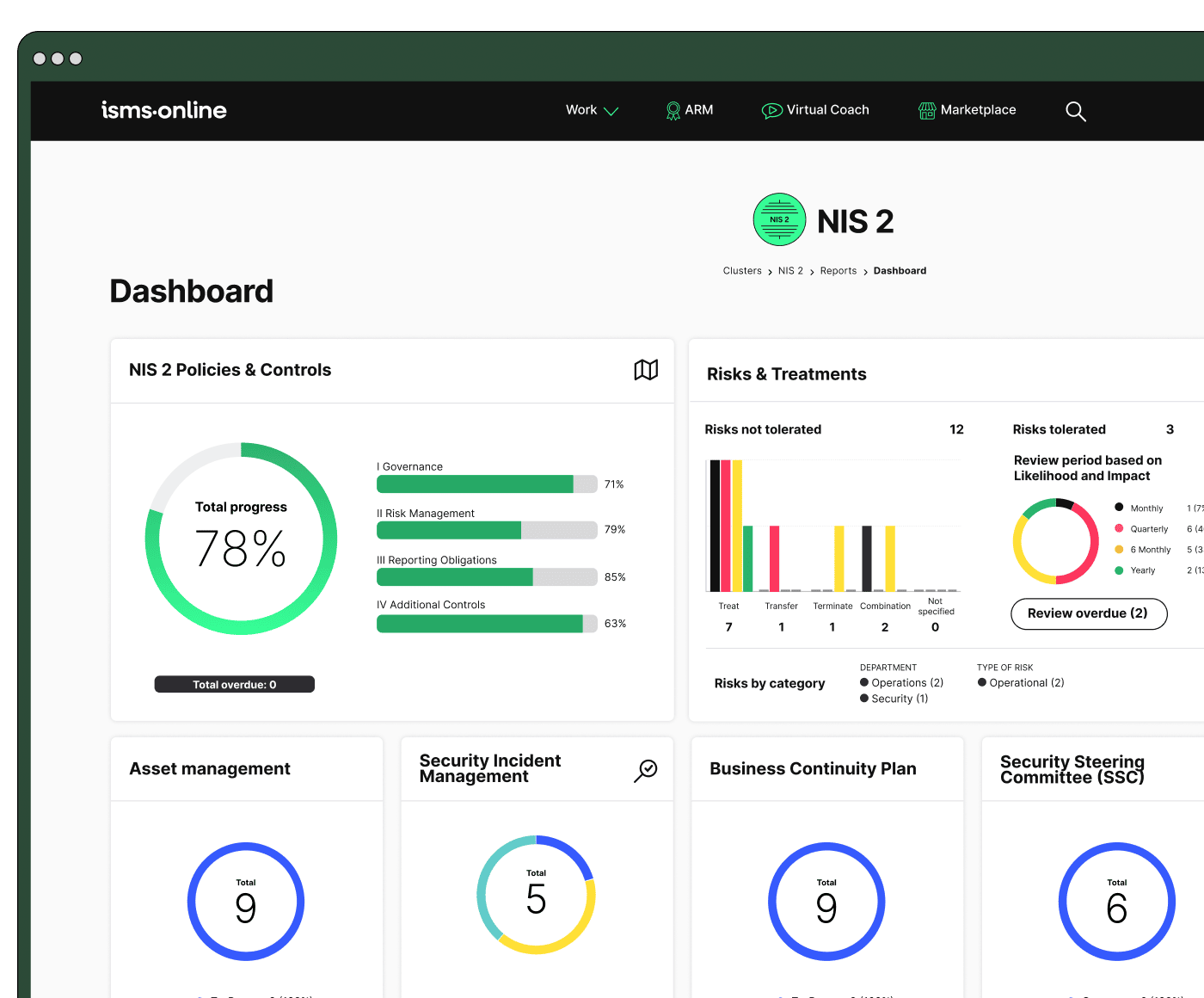
All your NIS 2, all in one place
From Articles 20–23 to audit plans – run and prove compliance, end-to-end.
Why Are Policy Checklists Not Enough-How Boards Prove Living Compliance?
There’s no room for static “tick box” approaches under NIS 2. Audit-ready boards operate with systems that log and synchronise policy approvals, risk registers, incidents, and reviews as living evidence, not recyclable annual paperwork (isms.online).
Static policy lists don’t pass audits. Living dashboards do.
Best-in-class boards use unified platforms to unite NIS 2, ISO 27001, DORA, and other frameworks along a single evidence stream-bringing policy reviews, incident logs, and audit approvals into a single workflow. This tightens audit collection cycles, ensures no gaps are invisible to decisionmakers, and keeps directors off the back foot if challenged.
Automation doesn’t just speed up reviews-it keeps compliance always-on, eliminating the late rush, and making every director’s engagement traceable. Living dashboard metrics are the modern board’s shield: directors who can demonstrate evidence in real time don’t need to justify intentions-they can prove oversight with certainty.
Step Into Live Board Assurance with ISMS.online Today
Boards that are “audit-ready” don’t wait for incidents or scrambles-they lead with living assurance. That means role-based dashboards, automated reviews, scheduled supplier checks, and instant approval trails (isms.online).
With ISMS.online your board can:
- Activate harmonised, workflow-driven dashboards that unify NIS 2, ISO 27001, DORA, and more-ensuring continuous audit readiness and stakeholder trust.
- Benchmark your present state: live tracking of board approvals, incidents, and supplier reviews keeps every director engaged and every action evidencable.
- Empower directors: role-based access, scheduled reminders, and tracked engagement beat governance fatigue and make critical actions instinctive.
- Join the ranks of forward-looking boards reducing audit and evidence cycles by up to 40%, elevating assurance, and making compliance a strategic board asset (isms.online).
Let ISMS.online be your living governance partner: automated, transparent, and resilient by design. Resilience is the new board expectation-meet it, and thrive.
Frequently Asked Questions
What new forms of personal liability do NIS 2 rules introduce for board members?
NIS 2 introduces direct, named accountability for board members-executive and non-executive-by attaching personal liability, fines, and even bans from management roles to those who fail to oversee cyber-security with evidence and intent. It is no longer sufficient for the board to approve a policy once a year; directors now face the risk of regulators addressing enforcement notices to them personally, particularly if an incident unfolds and there is no audit trail of scrutiny, challenge, or resourcing.
Your signature is now a direct link to your name on regulatory action-oversight can’t be delegated or hidden behind collective responsibility.
How is this liability different from previous standards?
- Board members can be individually fined: -up to €10 million or 2% of global turnover, whichever is greater.
- Temporary or permanent disqualification: from senior management roles for clear neglect or inadequate engagement.
- Liability follows you across subsidiaries and operational jurisdictions; not just the country where the breach occurred.
- Absence, silence, or passive sign-off are actively sanctioned: ; continuous, evidenced engagement is the minimum threshold.
Practical scenario:
If a cyber breach in a subsidiary exposes group-wide weaknesses and investigation shows that board directors neglected to evidence oversight or resourcing, they may be personally fined or barred from director roles-regardless of headquarter location.
How do authorities and auditors evaluate board engagement under NIS 2?
Auditors and regulators under NIS 2 are hunting for evidence of real, continuous engagement, not just formal attendance or “check the box” moments;. They assess whether directors are present for cyber briefings, approve actual resourcing, challenge technical claims, and remain involved as incidents and risks evolve. Boards must be able to produce a timeline: review logs with challenge/comments, supply chain risk sign-offs, incident drills attended, and resource allocations tied to directors’ own decisions.
Your value is shown not by presence, but by what you question and change-and how quickly you learn.
Key evidence areas for NIS 2 board scrutiny:
- Management review logs, showing challenge, dissent, and escalation.
- Signed digital approvals mapping to specific directors, not just collective votes.
- Attendance at-and records from-annual and ad hoc director training and crisis drills.
- Incident and supplier risk reviews with tangible action logs.
- Cross-reference with budget/resource approvals and the precise timing of these decisions.
Regulators are embedding these checks into post-incident probes, increasingly requesting exportable logs and board minutes showing real-time judgement-not perfunctory sign-off.
What documentation and workflows make a board “audit‑ready” for NIS 2?
To be audit-ready, boards must build a living, cross-linked evidence chain that is retrievable, current, and irrefutably mapped to real decisions ((https://www.isms.online/nis2-board-responsibility/);. Modern ISMS platforms make this possible: every director’s challenge, approval, training completion, and incident review is logged centrally and attached to the relevant policy, risk, or supplier relationship.
| Evidence Board Must Produce | Event / Review Trigger | ISO 27001 / Annex A |
|---|---|---|
| Management review logs (with dissent) | Quarterly + after incidents | Cl. 9.3, 5.3, A.5.2 |
| Digitally signed policy approvals | On every major update | A.5.1, 5.2, 5.36 |
| Director training & attendance | On appointment, then annual | 7.2, A.6.3, 5.35 |
| Supply chain risk review (sign-off) | Biannual, post-supplier event | A.5.19–21, 5.20 |
| Incident and escalation logs | Within 24–72 hours of event | A.5.24–A.5.27, 5.27 |
To meet the “always-on” standard, boards rely on platforms that instantly surface everything from supply chain incident drills to audit sign-off, with each link closing the regulator’s “gap” for directorial proof.
What are the most common pitfalls or misunderstandings about NIS 2 board duties?
Many directors-especially those with experience in previous regulatory cycles-underestimate how swiftly historical playbooks have become risk triggers. Retroactive document gathering, blanket group policies, or assuming local teams absolve the group board are key missteps. A hidden trap is ignoring the strictest local implementation in a pan-EU structure-regulators apply the highest available standard. Supply chain oversight often rests with IT or procurement, but NIS 2 expects direct board questioning and documented approval.
Avoid these missteps to stay sanction-free:
- Relying on yearly approvals or “after action” record collection; this is now seen as willful neglect.
- Delegating all documentation to local entities-regulators routinely “pierce the veil.”
- Overlooking local variations and not keeping a “jurisdiction harmonisation map.”
- Treating supply chain risk as an operational (not board) issue; every board needs its own challenge log and sign-off.
Embedding live documentation roles and supply chain reviews within board management reviews is now a base expectation.
Which practical steps help boards turn NIS 2 burden into reputational value or market advantage?
Automating compliance documentation and using dashboards to monitor board activity turns NIS 2 requirements from burden into a lever for market trust ((https://www.isms.online/features/board-dashboard/);. Setting KPIs like “audit retrieval <48 hours,” automating director training reminders, and surfacing supply chain challenge cycles distinguish you from laggards.
Market-leading boards aren’t just audit-ready; they’re seen as the standard for resilience, both by regulators and investors.
High-impact actions:
- Institute evidence-KPIs with targets like “95% retrieval in under 48 hours.”
- Automate reminders for approvals, risk reviews, supply chain incidents, and director training.
- Use real-time dashboards to narrate challenge, escalation, and recovery cycles-a story for auditors and investors alike.
- Benchmark before/after adoption of ISMS platforms; show audit improvement and reduction in findings as a selling point.
Investors and insurers increasingly demand proof of these board-level metrics before committing capital or offering coverage.
How does integrating ISO 27001 and ISMS platforms make NIS 2 board assurance tractable?
When boards use an ISMS aligned with ISO 27001 and NIS 2, audit stress transforms into proactive leadership ((https://www.isms.online/features/board-dashboard/)). Policies, controls, risk reviews, supplier sign-offs, and incident responses all link to each other across frameworks (NIS 2, DORA, GDPR), and dashboards allocate approvals and flag lagging issues. Quarterly crosswalks keep the board’s evidence chain current with local, sectoral, and EU changes.
| ISMS Alignment Benefit | What It Proves | Board Impact |
|---|---|---|
| Audit cycle reduction | Faster evidence pull | Less director burnout |
| Always-on dashboards | Continuous oversight | Clear signals for regulators |
| Supplier/Incident linkage | Challenge/approval map | Named director defence |
| Resource and training audit | Staff diligence logs | Trust from regulators/investors |
| Multi-framework harmonisation | No contradictions | Agile response to new mandates |
A harmonised ISMS board dashboard becomes a core reputational and operational asset-moving assurance from “hurdle” to “advantage.”
Which sector benchmarks and enforcement trends must boards watch for in 2025–26?
Regulators and industry observers (ENISA NIS360, Forrester) are publishing evidence that boards using automated dashboards and linked documentation resolve audits faster, receive higher trust ratings, and face fewer personal sanctions;. Healthcare, energy, and digital infrastructure are especially visible. Laggards, by contrast, are being flagged for longer audit times and lack of director audit readiness.
Key sector alerts:
- Expect more directors personally named in regulator actions and public fines.
- Real-time, always-on evidence trails are now contractual requirements with investors and customers.
- Audit response times and board automation are factored into insurance/premium and even market access.
- Sector frameworks (NIS 2, ISO 27001, DORA) must be kept “crosswalked” and aligned to avoid gaps.
Market trust is increasingly measurable-and board-level readiness is a headline metric for external evaluations.
What is the fastest route to providing “always-on” board evidence and assurance for NIS 2?
Deploying an ISMS built for NIS 2 and ISO 27001 that automates role-based dashboards, policy approval, evidence retrieval, and director reminders is the most efficient accelerator ((https://www.isms.online/features/board-dashboard/)). Directors are prompted for action, instantly see the status of evidence and compliance, and produce on-demand audit packs mapped to every regulatory standard. Real-time dashboards and living logs future-proof the board against both audits and regulator timeframes while creating a track record with customers, investors, and insurers.
Visual:
ISMS.online board dashboard → Linked audit chain → Digital sign-offs & training → One-click evidence pack → Measurable trust leap.
Board leadership is now defined by rapid, real-time assurance-ready for the next audit, or the next opportunity.
Ready to equip your board?
Modernise your NIS 2 resilience and reputation. ISMS.online unites your controls, evidence, and dashboards-so directors always have what’s needed, every time the call comes.