





































Who Is at Real Risk of NIS 2 Fines-and Why “Exempt” No Longer Means Safe
The comfort zone that once protected companies outside the obvious “critical infrastructure” remit is gone. Under NIS 2, nearly every business providing digital services, supply chain support, or technical infrastructure in Europe-whether you officially classify yourself as “essential,” “important,” or just “supporting a regulated entity”-is a compliance target. Previously, organisations could cite narrow sector boundaries or SME status as shields. But NIS 2 explicitly sweeps up anyone above 50 staff or €10 million in turnover-and sharpens its claws for those holding key data, running digital platforms, or forming essential supply chains.
Being outside formal regulation won’t stop the audit clock or the threat of fines; your connections make you visible.
Scope is the silent expander. If you deliver cloud services, host platforms for regulated clients, supply digital infrastructure, or operate in food, production, transport, finance, healthcare, or logistics, an enforcement net can catch you-directly through your own reporting or indirectly via a partner’s supply chain audit. If an enterprise client invokes NIS 2 audit rights, you’re required to show not just high-level policies but complete logs, role assignments, incident reports, and proof of board engagement.
Entities that once leaned on their customers’ compliance codes to “shield” them now face an uncomfortable truth: supply chain assurance has become a lever for regulatory reach. If your service underpins, processes, or even risks disrupting a vital sector, the regulator can and will audit or fine on a contract or incident basis.
The new exposure model:
- Direct: You meet the size, criticality, or sector criteria-NIS 2 applies, full stop.
- Indirect: Your products, hosting, or support directly affect a regulated customer’s operation or cyber hygiene, so their audit becomes your requirement.
- Cascade: A breach in your subsystem triggers regulatory interest in your logs, board actions, and internal ISMS.
Immediate actions for directors and managers:
- Confirm your entity classification today using directorate and sector guidance (ENISA, 2024).
- Scrutinise all inbound and outbound contracts for explicit NIS 2 “cascade” clauses, especially those relating to digital services or outsourced security.
- Proactively map where your data, incident, or supply chain decisions intersect with a client’s or regulator’s reporting regime.
Regulation by association isn’t a legal abstraction any more-it’s the lived reality of interconnected digital business.
How Are NIS 2 Fines Actually Calculated-And What Deflates or Inflates Penalties?
Media spotlights on punitive fines-€10 million or 2% of global revenue-can obscure the real risk calculation. Not every breach equals a seven-figure penalty, but every incident becomes a test of both facts and proof. NIS 2 penalties operate on a granular evidence ladder: from how quickly you report, to evidence of board oversight, and-crucially-your ongoing workflow of improvement after any incident.
Regulatory logic is not linear:
- The more robust your minutes, action logs, incident notifications, and role assignments, the stronger your mitigation.
- Every incomplete, delayed, or scattered record nudges the penalty higher.
Regulators repeatedly halve or even waive penalties for organisations with visible ISMS reviews and rapid, transparent remediation.
Penalty calculation starts with breach gravity (e.g., scope, sector impact, recurrence), but quickly pivots to your demonstrated governance:
- Up-to-date board risk reviews and documented ISMS meetings.
- Incident logs: with precise timestamps and immutable storage.
- Staff training: and acknowledgment records mapped to risk/role changes.
- Remediation logs: showing what changed, who authorised it, and when gaps closed.
A regulator may begin with maximum calculations but systematically steps down the fine if:
- You meet all incident notification deadlines (24h/72h as required).
- There is clear evidence of continuous board engagement and management review cycles.
- Post-incident improvement actions are mapped and signed off.
Table: NIS 2 Fine Calculation Levers
| Expectation | Operationalisation | ISO 27001 / Annex A Reference |
|---|---|---|
| Board oversight documented | ISMS committee minutes; quarterly risk update | 5.2, 9.3 |
| Timely incident notification | Automated alerts; log export for review | 5.25, 6.8, 9.1 |
| Accountable ownership | Role matrix (RACI); periodic training records | 5.2, 7.2, 8.1 |
| Actionable improvement evidence | Remediation logs, board sign-off | 5.36, 10.2 |
When your evidence forms a living feedback loop, the regulator tends to recommend improvement over punishment.
The consequence for laggards and latecomers grows beyond “mere fines,” including repeat audits, loss of public trust, or-at the board level-director disqualification (ENISA, 2024). But if your workflow and logs show honest diligence, the system rewards you with warning letters or improvement mandates-penalties that preserve both status and market trust.

Master NIS 2 without spreadsheet chaos
Centralise risk, incidents, suppliers, and evidence in one clean platform.
What is the NIS 2 Enforcement Pipeline-and Where Can You Lose Control?
A single incident or audit flag is all it takes to set the penalty machine in motion. The enforcement pipeline is now rigorously time-bound-and for most, it is not technology gaps but delays, missing logs, or poorly logged communications that break the chain and accelerate financial and reputational exposure.
Typical steps:
1. Incident trigger: Security event, whistleblower report, regulatory review starts the countdown.
2. 24-hour notification: Legal requirement to inform authorities, with a full report inside 72 hours.
3. Evidence and action logs: Submission of incident logs, assignment charts, decision records.
4. Board/executive review: Authorities may demand direct access to board minutes and approvals.
5. Assessment and sanction: Fine, remediation order, or warning based on the clarity of your chain.
A broken log, a missing sign-off, or a delayed notification: any one of these can turn a warning into a career-defining penalty.
Case vignette: A digital supplier suffers a breach affecting a healthcare client and reports it 20 hours after detection. Logs are well kept, but a missing board meeting sign-off and lapses in staff training documentation surface. While the breach itself isn’t catastrophic, these process gaps trigger a hefty fine, which is then reduced when a new ISMS.compliance review and evidence of closure are logged within days.
Repeatable gaps that commonly trigger escalated fines:
- Disconnected evidence (e.g., logs spread across systems and teams).
- Incomplete or outdated management review records.
- Missed notification, training, or remediation deadlines.
- Lack of clarity in board- or executive-level assignment of risk ownership.
Most escalated enforcement begins at the first sign of evidence chain weakness, not at the technical cause of an incident.
What Does Board Accountability Look Like-And How Can Leadership Prove Readiness?
NIS 2 closes the gap between institution and individual. Officially, liability applies to the company; in practise, board, CISO, and security managers can face personal fines and bans when “systemic neglect” is found. For regulated entities, and increasingly their largest suppliers, personal accountability is no longer theoretical.
Practical board readiness:
- *Quarterly risk, ISMS, and executive management reviews* must be minuted, signed, and auditable-these are now required artefacts, not just best practise.
- *RACI charts* (Responsible, Accountable, Consulted, Informed) or equivalent systems must be updated, versioned, and referenceable if a regulator calls.
- *Incident logs* must be linked to named decision-makers and remediation approval trails.
The regulator no longer cares about paper policies; board-level engagement is the living evidence of compliance.
Management platforms such as ISMS.online turn defensive routines into proactive shields:
- *Automated meeting cycles*: Boards are prompted, cycles are enforced, and digital signatures track who acted.
- *Centralised evidence stores*: Minutes, actions, and risk logs are retrievable in seconds, not weeks.
- *Versioned, role-specific accountability*: As roles evolve, so does the permanent record-ready for cross-reference at any moment.
In the era of personal liability, this workflow transforms the boardroom from a risk centre to the fulcrum of compliance defence.
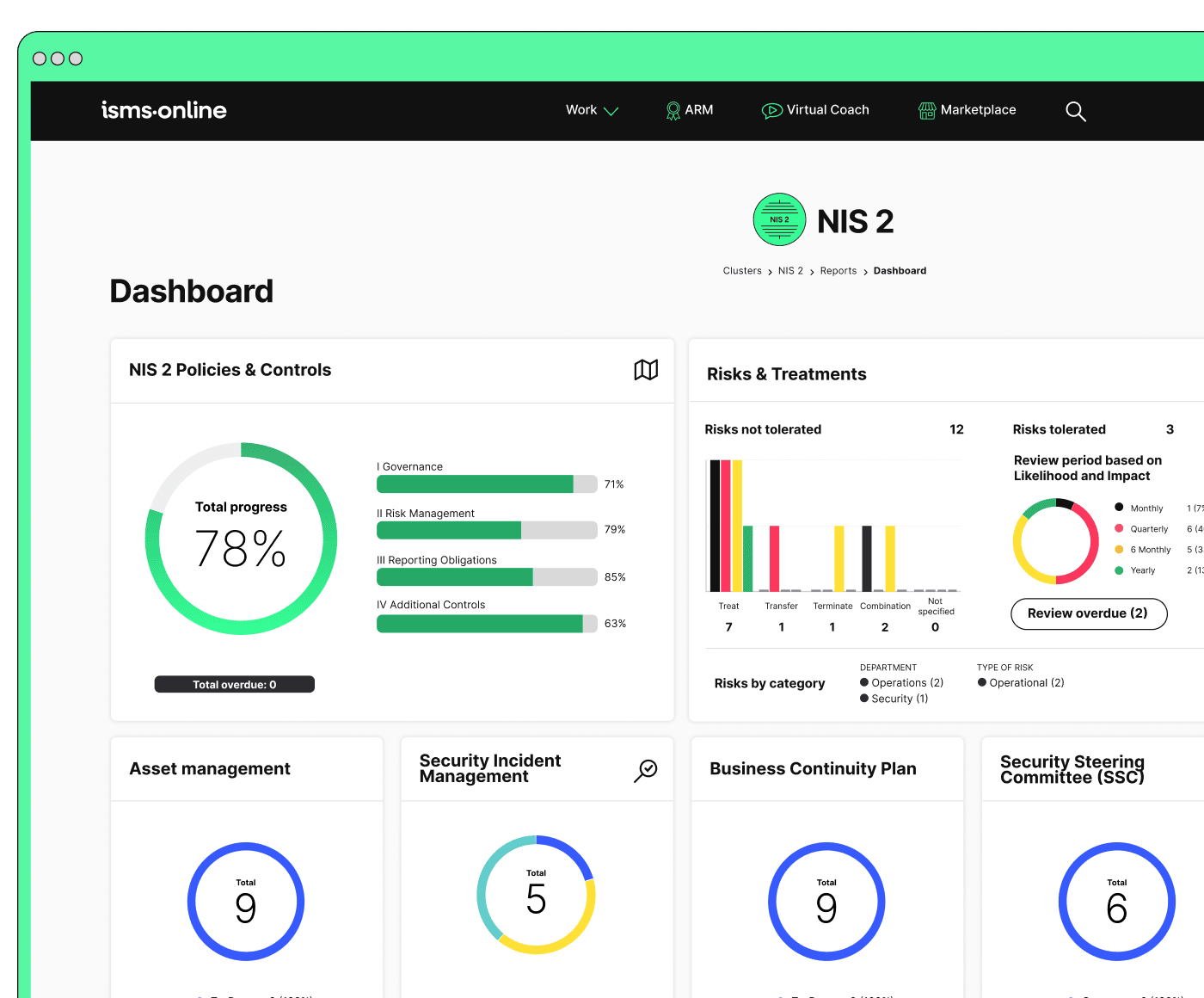
Be NIS 2-ready from day one
Launch with a proven workspace and templates – just tailor, assign, and go.
How are Cross-Border and Sector Fines Coordinated-And Why Does Jurisdiction Now Matter for Everyone?
NIS 2 breaks down the “national wall.” Enforcement is coordinated by sector and cross-border authority. Digital firms, SaaS providers, and supply chain partners operating in multiple EU member states now face a web of coordination: Single Points of Contact (SPoCs), ENISA as a central actor, and sectoral agencies, each with investigative and penalty powers.
Jurisdiction triggers:
- Breach or audit with multi-country impact or supplier/customer data flows.
- Sector regulator or auditor flags a pan-EU risk (e.g., across health, finance, transport).
- Simultaneous or overlapping GDPR and NIS 2 notifications drive compounding scrutiny.
Table: Cross-Border Penalty Traceability
| Trigger | Risk Update | Control / SoA Link | Evidence |
|---|---|---|---|
| Supplier breach (multi-EU) | All-jurisdiction risk mapping | A.5.24, A.5.25 | Cross-border impact logs |
| Sector regulation overlap | Sector-specific control update | A.5.36, A.5.35 | Multilingual audit docs |
If any notification or log is missing, clashing, or untranslatable, regulators may opt for stacked or public penalties (Twobirds, 2023). Maintain synchronised, multi-country workflow and keep jurisdictional contacts and PSIRT roles updated in platform directories.
Assume your evidence may be reviewed in three languages, by three different authorities, within days of an incident.
How Does Reputational Fallout Multiply the Cost of Fines-And How Can Smart Compliance Flip the Narrative?
Regulators increasingly prefer “naming and shaming” as deterrence: fines, publicised enforcement, and sector-wide sharing of non-compliance. Once listed, your case becomes ammunition for competitors, a flag in all future procurement, and can trigger contract rewrites and renewal delays.
A single public fine can stall or end deals faster than any technical breach.
Reputational cascade:
- Customers reevaluate vendor status (“credibility” vs. “risk”).
- Partners harden contract clauses-more audits, stricter evidence language.
- Investors and boards lose patience as headlines circle.
- Morale tumbles, driving staff departures and hiring challenges.
This risk can be turned into a business advantage, if managed correctly:
- Treat each audit or incident response drill as a “proof exercise” to reassure customers and partners.
- Proactively communicate lessons learned and demonstrable, living improvements after any event.
- Use ISMS logs, management reviews, and readiness drills as *sales assets*-evidence that your team anticipates the risk and grows from adversity, rather than waiting for enforcement to catch up.
Modern resilience is visible and communicable; every incident, handled right, can become trust capital.
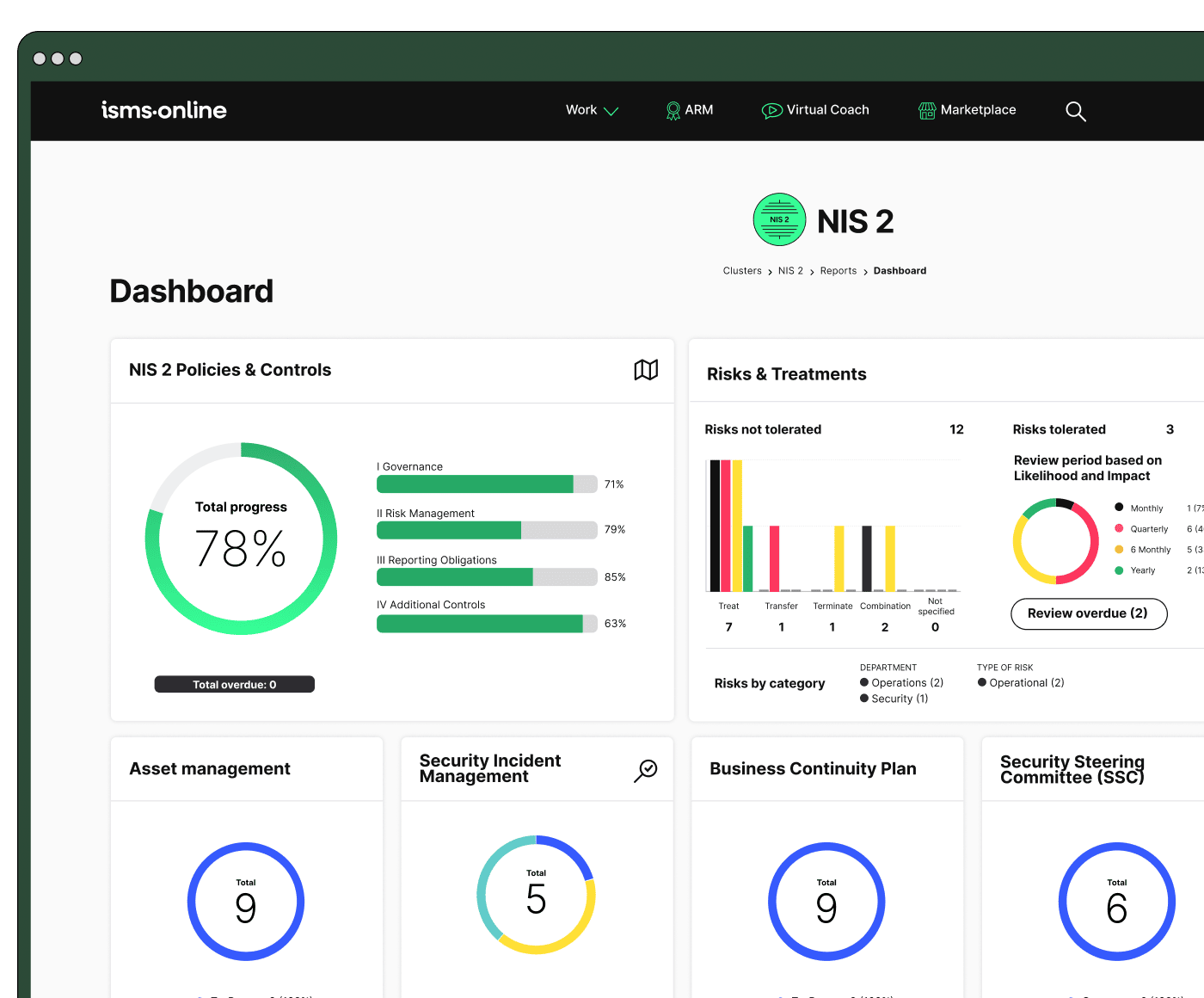
All your NIS 2, all in one place
From Articles 20–23 to audit plans – run and prove compliance, end-to-end.
Why “Ongoing Evidence” (Not Just a Policy) Is Your Only Real Defence
The ultimate protection in the face of NIS 2 scrutiny is on-demand digital evidence-not just policies on file, but logs, minutes, and improvement actions integrated into your actual day-to-day workflow.
Evidence priorities for penalty prevention:
- Automated digital ISMS (platforms such as ISMS.online) logging every action-mapped to ISO 27001 and sector controls.
- Timestamps, role assignments, and decision logs, kept immutable and instantly retrievable.
- Regular, scheduled management reviews and board sign-off recorded as part of supply chain and regulatory filings.
- Real-time task tracking: incident closure, remediation, training logs-all visible in audit trails.
Table: ISO 27001 Audit / NIS 2 Readiness
| Audit Expectation | Operationalisation | ISO 27001 / Annex A Reference |
|---|---|---|
| Evidence of incidents | Continuous logging, easy retrieval | A.5.25, A.5.28 |
| Proof of role accountability | Roles mapped, regular reviews | A.5.2, A.7.2 |
| Board oversight | Quarterly signed minutes, digital signatures | 9.3, A.5.4 |
| Closed-loop improvement | Remediation logs, task completion | A.10.2, A.10.1 |
Traceability Example Table:
| Trigger | Risk Update | Control / SoA link | Evidence |
|---|---|---|---|
| Security incident | Post-mortem review | A.5.26 | ISMS.online action log |
| Policy update | Training mapped | A.6.3, A.7.8 | Attendance/acknowledgement |
| Audit finding | Remediation doc proof | A.5.36, A.8.34 | Corrective action record |
Teams that adopt this approach outperform: their audit readiness not only reduces the chance and amount of penalties-it reinforces trust with customers and partners, and turns resilience into a competitive advantage.
Your Edge: Turn Compliance into Leadership-Before the Regulator Comes Calling
The new penalty regime is about daily conduct, not heroic last-minute reaction. To future-proof your position, make audit trails, risk registers, incident workflows, and management reviews part of real operations. Serving your team, your board, your customers, and your markets means you must own the compliance feedback loop-before regulators, clients, or suppliers demand to see it.
- Conduct a full supply chain exposure review-identify secondary or “hidden” obligations.
- Centralise risk registers, evidence logs, and incident workflows within a digital ISMS built for both audit and live operations.
- Schedule cross-functional “lived compliance” reviews and ensure the board is present and accountable every quarter.
- Regularly test your readiness with incident and communications drills-if you don’t, the next audit will.
In a NIS 2 world, the leaders are those who treat compliance as real-time proof of resilience-not a checked box.
ISMS.online provides the infrastructure to bring risk, controls, logs, and improvement actions together. With full traceability, real-time readiness, and a demonstrable compliance loop, you address the challenge and seize the opportunity: making your board, your business, and everyone connected to you safer-and, ultimately, more attractive to every partner and customer you want to serve.
Frequently Asked Questions
Who determines a NIS 2 fine’s size, and how much does your compliance behaviour matter?
National regulatory authorities decide NIS 2 fines, but your actions dramatically shift the outcome-fines are not lottery tickets pulled out after a cyber incident. Regulators operate under Article 34, weighing factors such as the severity and duration of non-compliance, intent, reporting timeliness (24/72 hours), audit trail depth, and the extent of cooperation. If you can show clear evidence that incidents were reported swiftly, board-level involvement is logged, and remedial steps are traceable from day one, you’re likely to see penalties drop-sometimes replaced by correction orders instead of cash fines. Delay, omission, concealment, or missing documentation pushes your organisation into the upper fine bands.
Every timestamped log or board sign-off is a line of defence; excuses evaporate fast, but real evidence lowers fines.
Regulators must keep penalties “proportionate, effective, and dissuasive”-but the ceiling is rarely imposed when evidence shows structure, speed, and learning. Inconsistent or absent records immediately trigger maximum risk. The core rule: the quality and integrity of your compliance records determine how authorities interpret intent and responsibility.
Quick Decision Impact Table
| Compliance Behaviour | Expected Fine Adjustment |
|---|---|
| Fast reporting, deep logs | Reduction/Correction order |
| Gaps/late notification | Escalated penalties |
| Obstructive or missing evidence | Full fine + reputation exposure |
Are fine limits higher for “essential” than “important” entities-and how does turnover affect exposure?
NIS 2 intentionally imposes stricter maximums on “essential” entities-think energy, telecoms, health, and digital core-compared to “important” entities like SaaS, regional ISPs, or manufacturers. Essential entities face up to €10 million or 2% of global annual revenue (whichever is higher); important entities face €7 million or 1.4%. But it’s the higher of these two values, so fast-growing SaaS, supply chain, or fintech firms may outgrow the euro cap, joining utilities in headline risk territory.
| Entity Type | % of Turnover Ceiling | Max Fine (€) | €500M Turnover | €3B Turnover |
|---|---|---|---|---|
| Essential | 2% | €10 million | €10M | €60M |
| Important | 1.4% | €7 million | €7M | €42M |
Regulators can treat “important” firms as “critical” in practise when they underpin markets or infrastructure, and some Member States may apply even stricter local caps. For a €1B SaaS, “important” status could mean a multimillion-euro risk on the table if compliance is lax. The takeaway: sector and size dictate risk, but actual impact and evidence steer the consequences, not just your nominal status.
How do NIS 2 investigations and penalties play out-and can you fight back if a fine seems unjust?
The enforcement process is triggered when an authority notices a breach, receives a whistleblowing disclosure, or uncovers audit irregularities. You’ll first receive a request for logs, incident records, board minutes, and remediation evidence. If your records are gaps-filled or your response sluggish, a draught penalty or improvement order lands on your desk. Crucially, you’re entitled to a response window: submit counter-evidence, clarify intent, or show documentation to challenge error or harshness.
Escalation and appeals follow national (and sometimes EU-coordinated) procedures, typically allowing you to challenge the process, the proportionality, and the facts-especially if board involvement or corrective action can be proved after the incident. When incidents cross borders, your “lead” national regulator coordinates with ENISA to harmonise penalties and prevent overlap, but distinct frameworks (GDPR, DORA, NIS 2) may result in parallel, not merged, fines.
A chain of board-logged actions and notifications turns a regulator’s penalty into a lesson-silence or confusion does the opposite.
Smart organisations audit everything from incident triggers to closure, keep all evidence centralised, and respond collaboratively-not adversarially-to reduce ultimate exposure.
At what point does personal liability attach to the board, and how can poor documentation escalate reputational risk?
Board-level liability kicks in when authorities spot absent or poor oversight, repeat incident mismanagement, or delegated responsibilities with no traceable evidence. Regulators are empowered to levy personal fines, temporary management bans, and, most critically, name organisations and even individuals in public notices. Unlike a regulatory audit focused on process or IT controls, failure to show regular, signed board minutes, RACI assignment matrices, and management actions makes leadership a spotlight target.
Your best protection against naming and shaming is a digital trail showing board fingerprints at every major decision and incident.
Infrequent meetings, unsigned minutes, or generic approvals multiply the risk of both regulatory sanctions and sector-wide embarrassment. By contrast, quarterly scheduled governance sessions, digitally signed minutes, and clear training and acknowledgment logs prove the board didn’t abdicate or defer responsibility-often the deciding factor between contained damage and reputational crisis.
How does cross-border or multi-sector status increase NIS 2 fine exposure, and what’s the best defence?
Incidents that span countries or sectors (think multinational SaaS, fintechs active in both finance and healthcare, or cloud infrastructure supporting several critical domains) elevate the compliance bar and the enforcement risk. Here, national Single Points of Contact coordinate with ENISA. The “home” regulator leads investigation and penalty negotiations, but you must be able to deliver harmonised evidence in every affected jurisdiction-fragmentation or inconsistent logs invite fragmented, duplicated penalties.
When incidents overlap with GDPR/DORA or health/finance rules, separate fines stack, and cross-sector investigations may run concurrently. Fragmented ISMS processes, access models, or incident protocols become a force amplifier for risk. The antidote: centralise and align compliance evidence, appoint clear cross-border roles, and ensure logs and board actions can be surfaced instantly in every market.
Harmonise compliance-or risk your group’s fate being decided by the slowest or least-prepared entity in the chain.
Which evidence most reliably drives down NIS 2 fines and tips decisions to improvement orders?
Regulators routinely reward organisations that provide timestamped incident logs, signed board/management minutes, documented escalation and remediation, regular staff training records, and clear, continuous audit trail updates. Early, voluntary, well-documented notification (even before a formal investigation) consistently causes authorities to downgrade penalties or focus on improvements rather than punishing financials.
Any sign of templated, generic, or inconsistent records-or missing evidence after a breach-throws you into high-penalty territory. The base expectation: authorities want to see not just intent, but live engagement across governance, training, and operational response-all on record.
ISO 27001 / NIS 2 Compliance Bridge
| Regulator Expectation | Operationalisation | ISO 27001/Annex Ref |
|---|---|---|
| Swift incident reporting | Notification logs, escalation steps | Cl. 6.1.2, A.5.24 |
| Board oversight & sign-off | Signed minutes, RACI, action logs | Cl. 5.3, 9.3, A.5.36 |
| Staff competence/training | Attendance records, acknowledgements | Cl. 7.2, A.6.8 |
| Audit trace & updates | Role-based/access logs, change logs | Cl. 7.5, A.5.18 |
| Proof of response/remediation | Approved action records, closure docs | Cl. 10.1, A.5.27 |
Incident Traceability Table
| Trigger | Immediate Update | Control Linked | Example Evidence |
|---|---|---|---|
| Breach detected | Risk reassessment | A.5.7, 6.1.2 | Incident log, closure note |
| Audit finding | Mitigation assignment | A.5.35, 10.1 | Plan, approval, sign-off |
| Staff change | Access review, update | 5.3, A.6.2 | RACI, system access log |
| 3rd party breach | Supplier review | A.5.19, A.5.21 | Supplier audit record |
A single missed log can cost you millions; a single well-timed board minute can save your brand and your wallet.
Standardising ISMS documentation and automating review and training reminders (ideally ISO 27001 aligned) makes compliance evidence not just easier to surface but stronger in a crisis-turning regulatory risk into an operational asset.
By instilling clear, board-endorsed, cross-border compliance behaviour and documenting every key action, your organisation turns NIS 2 from a threat into evidence of leadership-building trust with regulators, customers, and your own team.






