





































How Does Asset Handling Under NIS 2 Article 12.2 and ISO 27001 Move Beyond a Simple List?
In today’s compliance landscape, “asset handling” is no longer about ticking off a list of hardware. It’s the living connective tissue of your organisation’s risk posture. Under NIS 2 Article 12.2 and ISO/IEC 27001:2022 (notably A.5.9, A.5.10, A.7.10), asset handling is defined as a unified, up-to-the-minute regime that spans hardware, data, SaaS, cloud platforms, operational technology, and legacy systems. Modern regulators-ENISA, national authorities, and certification bodies-now demand evidence that every asset is not just listed, but classified, assigned to an accountable owner, mapped to its policy environment, tracked through every lifecycle event, and linked to real-time risk registers.
The risk isn’t what you track, but what you don’t. Visibility is compliance; anything less is a liability.
Contrast this with the old paradigm of static asset lists, where records were updated in quarterly bursts-often only when audit season approached. Today, compliance hinges on a continuously refreshed register powered by live workflows. Each asset, whether physical or virtual, is directly mapped to an owner and operational controls, its status ready for real-time export and filterable by auditors at a moment’s notice (ENISA Guidance).
ISMS.online accelerates this approach by transforming asset handling into a dynamic backbone-automatically linking procurement, assignment, transfer, and disposal events to policy approvals, risk reviews, and evidence logs. This closes compliance blind spots, reduces audit fatigue, and offers an audit-ready chain of accountability.
What Are the Key Gaps Exposed by NIS 2 and Why Do Most Asset Registers Fail Under Audit?
The typical failings in legacy asset registers become starkly apparent under NIS 2 and ISO 27001 scrutiny. Most non-conformities stem from three persistent sources: unregistered “shadow assets,” lack of ownership traceability, and fragmented evidence trails.
The Real Risks in Shadow and Orphaned Assets
Unregistered SaaS logins, transient cloud workloads, mobile endpoints, and abandoned backups frequently escape static lists. Modern attack surfaces change daily-if your register lags, you’re simply unaware of exposure points. NIS 2 makes it clear: completeness and currency aren’t “nice to have”-they’re non-negotiable.
- Shadow assets: Unmonitored SaaS tools, unclaimed cloud storage, or devices issued in haste become the “soft underbelly” for breaches or failed audits.
- Orphaned entries: Outdated equipment, forgotten databases, or expired virtual machines often linger in the system, clouding true risk.
The difference between a passed audit and a breach is often a device or login that no one realised was still active. (NCSC Asset Management)
Ownership Without Ambiguity
Auditors and regulators now insist every asset has a named, accountable owner-no “shared” or generic attributions. Missed ownership means missed responsibility; ambiguities are finding magnets.
Evidence That Survives Scrutiny
Checklists fade under live interrogation. Auditors want to see digital signoffs, role-based approvals, and timestamped change logs for every significant lifecycle event-not after the fact, but on-demand during a walkthrough. Without these, controls are performative, not protective.

Master NIS 2 without spreadsheet chaos
Centralise risk, incidents, suppliers, and evidence in one clean platform.
How Do Regulators and Auditors Test Asset Handling-And What Evidence Do They Want?
When an external auditor or regulator walks through your ISMS, they’re not looking for a static “inventory.” They demand a dynamic, filterable, and fully traceable stream of asset events- from acquisition through usage to retirement. The gold standard is rapid, real-time response: you should be able to surface any asset’s current status, owner, risk classification, lifecycle stage, and control links within seconds, not hours or days.
The Audit Table Stakes
| Expectation | Operationalisation-How to Prove It | ISO/IEC 27001 / Annex A Reference |
|---|---|---|
| **Total asset scope** (hardware, SaaS, data, cloud) | Asset registry fields: type, classification, owner, risk | A.5.9, A.5.12, A.5.13 |
| **Ownership linkage** | Name + role, mapped to usage/logs, digital signoff | A.5.10, A.5.15, A.7.10 |
| **Full evidence** | Timestamped logs, lifecycle change tracking, approval e-signatures | 7.5.3, A.8.15, A.8.17, 10.1 |
The Live “Walkthrough” Challenge
- Trace asset status at any point in its lifecycle, with all policy assignments, approvals, and handovers digitally evidenced.
- Philtre by department, location, risk level, or control to answer auditors’ questions in moments.
- Highlight which assets are overdue for review or disposal-showing not only compliance but proactive governance.
Each of these expectation lines must be readily executed during an on-site or remote audit. In ISMS.online, philtres and exports are live, and audit packs are generated in minutes-mapping every asset to its control references, linked evidence, and owner’s digital signoff.
How Should You Map Every Asset to Controls, Risk, and Evidence-Not Just Track a List?
Passive tracking is dead weight: dynamic asset management cross-links every asset to its risk rating, applicable policies, control requirements, and role-based approvals within a unified ISMS. This is essential not just for successful audits, but for operational defence-because incomplete mapping equals unmanaged risk.
Real-World Asset Mapping in Practise
- On-boarding an endpoint (e.g. new laptop): triggers registry update, owner assignment, and attaches it to usage, privilege, and secure disposal policies. Risk level is set and owner is notified for onboarding training or policy review.
- SaaS system sign-up: mandates owner and user assignment, records which policies apply, and logs every privilege escalation or deprovisioning.
- Evidence automatically trails along-every edit, owner handoff, and policy event is logged and timestamped, forming a defensible chain-of-custody.
Traceability Table: Lifecycle Events to Evidence
| Event (Trigger) | Risk/Control Update | ISO Control | Evidence Logged |
|---|---|---|---|
| Asset acquisition | Endpoint risk, owner | A.5.9, A.5.10 | Registry + digital sign-off |
| Owner change | Access review/audit | A.5.11, A.5.15, A.7.10 | Approver sign-off, updated access logs |
| Secure disposal | Data leakage risk | A.7.10 | Destruction record, sign-off |
These mappings let you answer “who did what, when, to which asset-under which control and policy” at a moment’s notice. Auditors and boards raise trust when they see this level of clarity.
An asset out of sync with its controls isn’t just a compliance risk-it’s a potential incident waiting to happen. (ENISA, 2023)
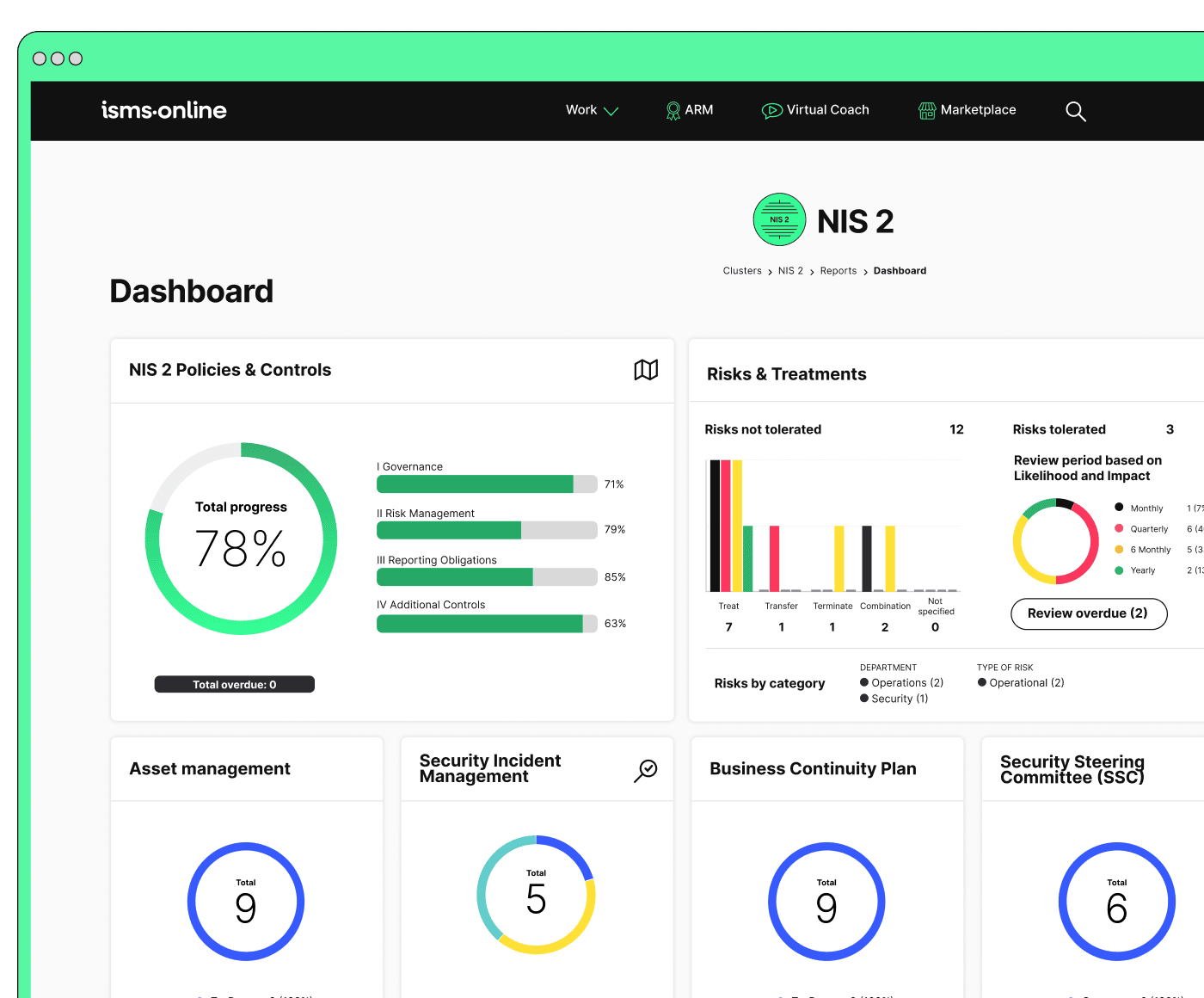
Be NIS 2-ready from day one
Launch with a proven workspace and templates – just tailor, assign, and go.
Lifecycle-Driven Asset Management: What Steps Are Mandated for Cradle-to-Grave Control?
Lifecycle-based asset management is where asset handling stakes its claim under NIS 2. Every phase, from procurement to final decommissioning, requires triggerable workflows, role-based assignments, and logged approvals.
Cradle-to-Grave Flow: What’s Required at Each Stage
- Acquisition: Asset immediately registered, tagged with owner and classification, before operational use.
- Active use: Each handover, privilege escalation/reduction, or configuration change is logged. Automated reminders ensure regular review.
- Transfer/assignment: Ownership changes (including staff departures or role moves) prompt digital signoffs and updates to associated risk/applicability fields.
- Disposal/retirement: Secure destruction or decommissioning logs must show dual approval and link to corresponding data deletion and privilege revocation records.
With ISMS.online, each lifecycle event triggers an assignment, notification, and role-verified approval-leaving an indelible, exportable audit trace. Assets can never drift outside the system without explicit, logged action.
Lifecycle Evidence Bridge Table
| Stage | Mandatory Step | Evidence Created |
|---|---|---|
| Procure | Owner assignment, classification | User register, purchase log, owner e-sign |
| Use | Policy/event log, periodic review | Review logs, owner acknowledgments |
| Retire/dispose | Dual approval, destruction signed | Destruction record, chain-of-custody file |
How Do High-Performing EU Firms Pass Regulator Spot Checks for Asset Handling?
Experienced organisations use their ISMS to demonstrate the breathing, live state of asset management. Here’s how successful EU enterprises outperform under regulator scrutiny:
- Live registry with full lifecycle mapping.: Every asset, including cloud and SaaS, is within a single, filterable system, mapped to policies, risk levels, and controls.
- Chain-of-custody logs exportable on demand.: Digital audits cut review times; regulators see history, not just current state.
- Management dashboards show staff, asset, and control completeness.: Gaps and delays are flagged proactively-not as audit surprises.
The easiest audit question is the one you can answer right now-with the evidence in hand and linked to controls.
ISMS.online power users generate audit packs by asset type, owner, or critical function-batch-exported with signatures and timelines. These packs form the basis for demonstrating compliance or responding to regulatory data subject requests and breach investigations.
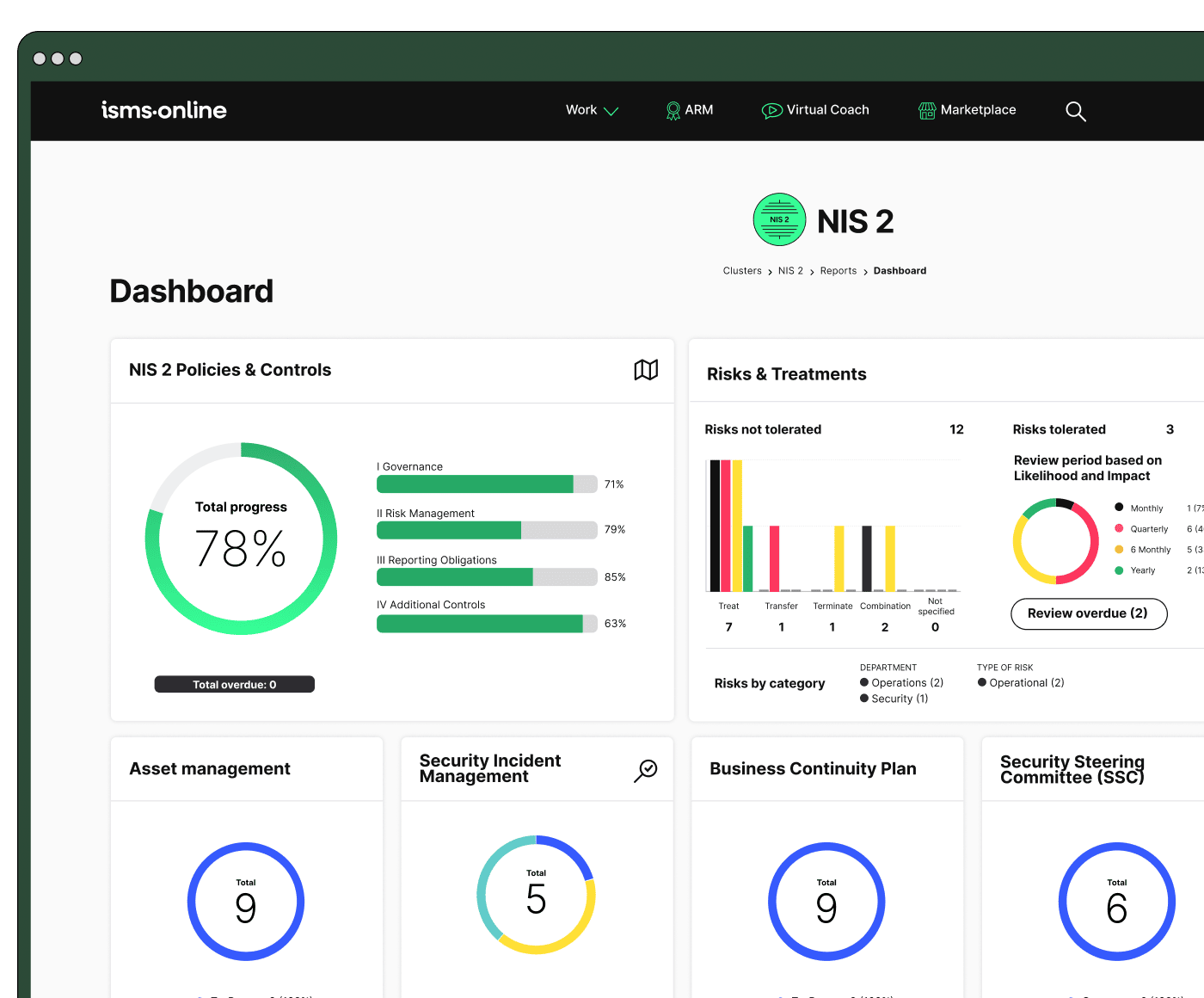
All your NIS 2, all in one place
From Articles 20–23 to audit plans – run and prove compliance, end-to-end.
Why Manual Registers Are Obsolete-And How ISMS.online Automates Audit-Ready Asset Handling
The shift is from manual, spreadsheet-driven drudgery to automated, always-on evidence-building. ISMS.online replaces disconnected lists, email handoffs, and verbal approvals with an integrated compliance platform.
Our Automation Approach
- Import assets from existing lists or via API; instant assignment and required approvals triggered for each new entry.
- Key lifecycle transitions (issue, role change, disposal) prompt policy review and evidence log update.
- Ownership and history are mapped forward for every asset, ensuring no shadow entries, orphans, or data residuals.
- Export philtres let you package evidence for auditors by asset type, owner, lifecycle stage, or control linkage.
Asset management anxiety fades when your ISMS surfaces every event, owner, and policy-no more missed steps or scramble at audit time. (ENISA, 2023)
Staff hours previously burned in retrospectively “cleaning up” the asset register become surplus for real risk improvements-increasing operational security and audit passing rates.
The Audit-Ready Compliance Loop: Making Asset Handling Your Compliance Foundation
When your asset regime fits regulator and auditor expectations from the start-every device, system, SaaS login, and cloud platform documented, mapped, and owned-compliance confidence scales. ISMS.online delivers not just a living asset register, but a mapped environment where controls, policies, and digital evidence move at business speed.
Modern compliance means having a live, mapped, and export-ready asset environment-linking controls, reducing risk, and letting audits become a formality, not a fire drill.
Turn asset handling into a trust accelerator: benchmark your current state, test drive live exports, and see how ISMS.online closes gaps from day one.
Connect now for a real-world walkthrough or downloadable audit-ready templates-see your asset handling transformed into a competitive, lasting, and audit-proven compliance advantage.
Frequently Asked Questions
Who sets the rules on asset handling under NIS 2 Article 12.2 and ISO 27001, and what does this mean in practise?
Asset handling isn’t left to interpretation-it’s defined jointly by your regulator under NIS 2 (most often a national cyber-security authority) and by the globally recognised ISO/IEC 27001:2022 framework. This dual authority makes asset handling a mandatory, auditable discipline for organisations across regulated sectors in the EU and every ISO 27001-certified company worldwide. The standard requires you to register, classify, assign, monitor, and ultimately dispose of every information asset: not just IT hardware, but cloud and SaaS accounts, third-party devices, proprietary software, business-critical data, media, and even physical documents.
True compliance means every asset is visible, every owner accountable, and every activity-from onboarding to disposal-creates a traceable, digital evidence trail.
Responsibility is shared. Executives and board members (data owners, CISOs) set governance and policy, but IT/Security and business process owners must keep registers up to date, events logged, and controls mapped at every lifecycle stage. That means regulators and auditors expect your organisation to demonstrate a living system-not a static list, but an up-to-date, role-mapped registry linked to policies and controls, ready for real-time export and drill-down.
Key lifecycle checkpoints regulators expect:
- Acquisition: No asset enters operation without registry entry and named ownership.
- Active use: Assignment, access, and policy acknowledgment are digitally logged.
- Transfer/disposal: Every movement or destruction leaves an auditable signature, with explicit approval.
- Orphans/exceptions: Unassigned assets are rapidly detected and risk-treated-never ignored.
Explore ENISA’s official NIS 2 guidance.
Which asset types are included, and how do you build a compliant, evidence-ready asset management process?
Both NIS 2 and ISO 27001 mandate inclusion of every asset that could affect information security, regardless of format or technology. This means your process goes well beyond laptops or servers-covering SaaS, cloud accounts, remote/user devices, third-party assets, codebases, operational data, paper, and removable media.
Typical asset categories and their evidence requirements
| Category | Examples | Evidence Required |
|---|---|---|
| Hardware | Laptops, servers, phones | Registry, owner logs, assignment records |
| Cloud/SaaS | CRM, productivity suites | Account/provisioning logs, policy maps |
| Paper/Media | Contracts, USB, reports | Handling logs, destruction certificates |
| Third-party/BYOD | Vendor laptops, home PC | Supplier register, consent logs, access trail |
| Proprietary Software | Custom code, tools | Source control, user/review logs |
Five essentials for audit-safe asset handling
- Register everything: No asset is used until registered and assigned.
- Policy binding: All assignments include digital policy acknowledgment.
- Event-log triggers: Any change (ownership, privilege, location, disposal) creates a system log.
- Evidence of disposal: Destruction or transfer is always logged and signed; paper-only events don’t pass audit.
- Continuous review: Regular, automated reminders ensure assets and evidence never fall out of scope.
A compliant process flexes as new risks, controls, or asset types emerge-never a one-and-done spreadsheet.
Where do most organisations fail NIS 2 and ISO 27001 asset handling audits, and what are the hidden traps?
Audit failures rarely come from dramatic oversights-they come from routine gaps that accumulate. External auditors and regulators see these every month:
- Shadow assets: SaaS tools, BYOD, or legacy accounts operating outside the official registry or without mapped owners.
- Orphan/unassigned assets: Devices or user accounts left after staff exit, rarely updated and outside regular review cycles.
- Manual-only trails: Disposal, access, or handover handled by email or paper-missing from digital registry or not signed-at-point-of-action.
- Broken policy chain: Key lifecycle actions (transfer, destruction) unlinked to controls or signoff, leading to audit chain breaks.
- Missed reviews: Assets skipped in routine checks, especially following org changes or new regulations.
Auditors now demand instant, filterable registry exports covering asset, owner, mapped control, policy linkage, and signed event logs.
The critical difference between audit-ready and failed is proving every handoff, privilege change, or disposal step was logged and authorised-without delay or loopholes.
Classic audit triggers that expose weaknesses:
- Laptops assigned or removed “in emergencies,” off books.
- SaaS or cloud tools spun up by business units, found only by surprise billing or incident.
- Asset destruction confirmed by chat/email, not in registry.
- Orphans after user exit, left unreviewed.
- All evidence in paper or ad hoc files, impossible to philtre or export.
Reference:
What evidence will auditors and regulators demand by 2025, and what qualifies as “audit-ready”?
By 2025, you’ll need to produce export-ready digital evidence for every asset and every lifecycle event-instantly, filterable, and traceable from procurement to destruction.
Primary evidence requirements
| Event | Registry-Logged | Screen/Export-Ready? |
|---|---|---|
| Assignment/ownership | Yes | Yes |
| Policy acknowledgment | Yes | Yes |
| Access or privilege change | Yes | Yes |
| Transfer/disposal/destruction | Yes (dual signoff) | Yes |
| Incident, review, or alert | Yes | Yes |
Evidence isn’t complete unless it is:
- Preserved digitally: Email or paper won’t suffice as primary proof.
- Mapped end-to-end: Asset → Owner → Action → Control/Policy → Signature/Timestamp.
- Comprehensive: Includes new, transferred, reviewed, reassigned, or retired assets.
- Filterable/exportable: Board, auditor, or regulator can scan by asset, event, or owner on demand.
Paper checklists may supplement but cannot replace system logs as auditable evidence.
How do top-performing organisations cross-link assets, controls, risks, and evidence to deliver resilience, audit-readiness, and trust?
Best-in-class teams don’t treat asset management as a silo-they link each asset to policies, mapped controls, risk entries, user events, and incident reviews. Every new asset or change triggers not just a log, but a ripple effect across all assurance domains.
| Sample Asset | Owner | Controls Applied | Lifecycle Status | Proof/Evidence |
|---|---|---|---|---|
| Laptop #3481 | J. Smith | A.5.9, A.5.10 | Registered, in use | Register, assignment log |
| Google Suite | Legal Team | A.5.9, A.8.13 | Provisioned, reviewed | Register, account log, review |
| Vendor PC | Marketing | A.5.9, A.7.7 | Tracked, in review | Supplier record, evidence entry |
How traceability is enforced in a compliant workflow
| Trigger | Risk Entry | Control Reference | Evidence Required |
|---|---|---|---|
| New asset onboarding | Register updated | A.5.9 | Assignment, control map |
| Privilege change | Access review | A.5.10 | Signed log, export |
| Asset destruction | Orphan risk flagged | A.5.11, A.7.10 | Certificate, signoff |
| Missed review/reminder | Non-compliance | A.5.10, A.5.11 | System log, record |
Automated ISMS platforms, like ISMS.online, bundle these links by default: every registry event, policy assignment, review, or removal is tied to controls and instantly retrievable.
How can you benchmark your asset handling compliance-and what proves you’re truly “audit-ready”?
An audit-ready asset management system ensures that:
- No asset-hardware, SaaS, vendor, data, code-is invisible or orphaned.
- Every event (assignment, use, handover, review, retirement) is logged, signed, and mapped, with system reminders to trigger reviews.
- Every control or policy mapped to an asset is digitally acknowledged and review-triggered, never just filed.
- Registry status, reports, and evidence can be exported instantly, sorted by asset, owner, lifecycle event, or mapped control, to satisfy any audit or board inquiry.
Quick self-check: Are you audit-ready?
- Is your asset register complete and live, with all assets assigned and categorised-including third-party, SaaS, and BYOD?
- Does each significant event (ownership, review, destruction) create a digitally signed, accessible record?
- Are reviews and reminders logged and exportable, never left to email or memory?
Teams who move from audit fire drills to boardroom trust are those whose asset registers are screen-ready, fully mapped, and integrated-not spreadsheet shadows waiting to be caught.
With ISMS.online, you can bulk-import assets, automate reminders and reviews, and trigger audit exports-letting your audit posture become a channel for confidence, not anxiety.
ISO 27001:2022 audit bridge-expectation to operational evidence
| Audit Expectation | Operationalisation | ISO 27001 / Annex A Ref |
|---|---|---|
| Every asset registered/owned | Register + named owner | A.5.9, A.5.10 |
| All events digital, traceable | System logs + exportable reports | A.7.10, A.5.11 |
| Controls/policies cross-mapped | Linked registry, policy packs | All mapped annexes |
| Active review/reminder loop | Automated logs, signoffs | A.5.9, A.5.10 |
Traceability example
| Trigger | Risk Entry | Control/SoA | Evidence Logged |
|---|---|---|---|
| Asset onboarded | Register | A.5.9 | Assignment, policy ACK |
| Change of owner | Priv update | A.5.10, A.7.10 | Signed event, log |
| Destruction | Orphan risk | A.5.11, A.7.10 | Cert, signoff, log |
| Missed review | Non-compliance | A.5.10, A.5.11 | Reminder, review log |
Ready to see a live, audit-ready evidence chain?
Import your asset data, run a registry export, and experience the difference between anxious compliance and board-level confidence. Your next successful audit starts by making asset handling a system, not a patchwork.






