





































Why Most Audit Failures Happen Even with ISO 27001 Policies in Place
When it comes to information security, there’s a hard truth beneath the surface: most audit failures happen not because you lack sound policies, but because you can’t produce timely, operational evidence when the moment matters most. Even companies who have invested in ISO 27001, assembled exhaustive policy libraries, and believe their compliance programme is robust, find themselves scrambling-or falling short-when confronted by an external audit, a board-level inquiry, or the demands of NIS 2. In today’s reality, intent is not enough; proving ongoing, living compliance is everything. Boards, procurement leads, and regulators are aligned on this new standard: it’s not what’s written, it’s what you can show, log, and trace-right now ([World Economic Forum 2022]; [ENISA 2023]).
Behind every policy that fails at audit is evidence nobody can find when it matters.
Practically, that means static policies-no matter how well-written-are not a shield. The most common audit pitfall is a mismatch between what’s documented and what’s actioned. Gartner’s board-focused security studies note, “Organisations most at risk are those ‘gap-exposed’ by reliance on documentation rather than data, especially as ENISA now requires working logs and live KPIs over after-the-fact paperwork” ([Gartner 2024]). The legal horizon is shifting as well. Regulators won’t accept plausible intent or policy volume; they want risk matrices that reflect today’s state, not last quarter’s, management reviews with demonstrable follow-up, and control testing logs that produce a visible, real-world evidence chain.
Here’s the bottom line for modern compliance: policies must transform from theoretical coverage to dynamic, end-to-end operations. If you cannot point to a living evidence system-one that is both actionable and current-you’re no longer just risking a failed audit, but also potential business loss and reputational harm. Audit-proofing means owning operational proof, not just a paper trail.
What Does Continuous NIS 2 Effectiveness Mapping Really Require?
Achieving continuous effectiveness is fundamentally an integration challenge-not a question of how often you review your ISMS. Under NIS 2 and ISO 27001:2022, the gold standard is a “living” ISMS-a compliance environment where every risk, incident, or material change instantly triggers a visible and traceable response ([ISO.org 2022]). Annual reviews, once customary, are now considered the floor, not the ceiling. Today, auditors and boards expect that you can show live evidence: up-to-date KPIs, management sign-offs, drill logs, incidents cross-referenced to risks, and real-time metrics for every significant control.
Take vulnerability management (Annex A.8.8) for example. It’s not enough to produce a one-off scan or policy; you must show a verifiable, continuous evidence chain: scheduled scans run weekly, patching events logged and tracked, new vulnerabilities triggering risk reassessment and response tasks, all appropriately signed off and accessible to both management and auditors ([IT Governance EU 2023]; [ISACA 2023]; [ISF 2023]).
Compliance isn’t a date-it’s the heartbeat of your evidence system.
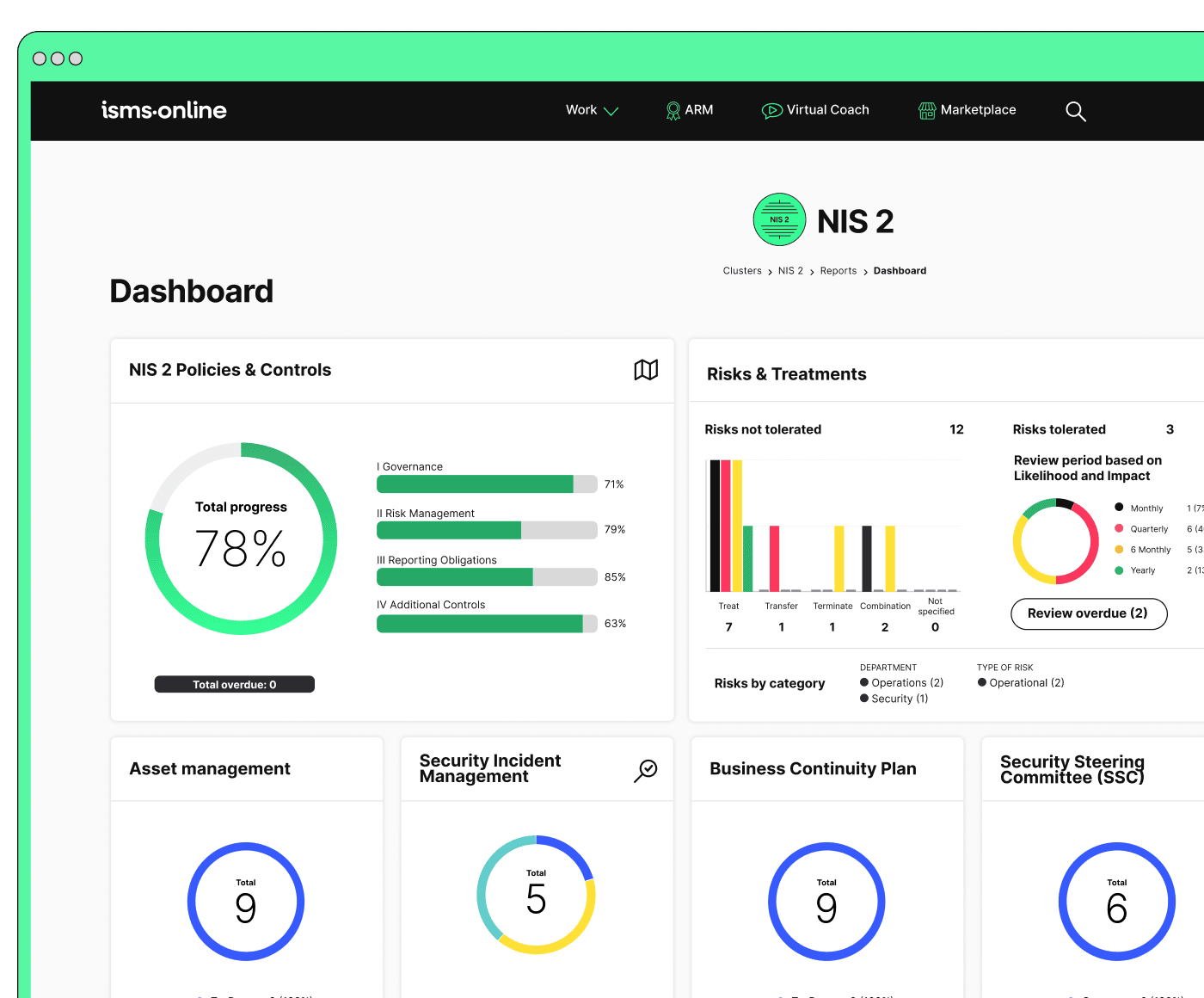
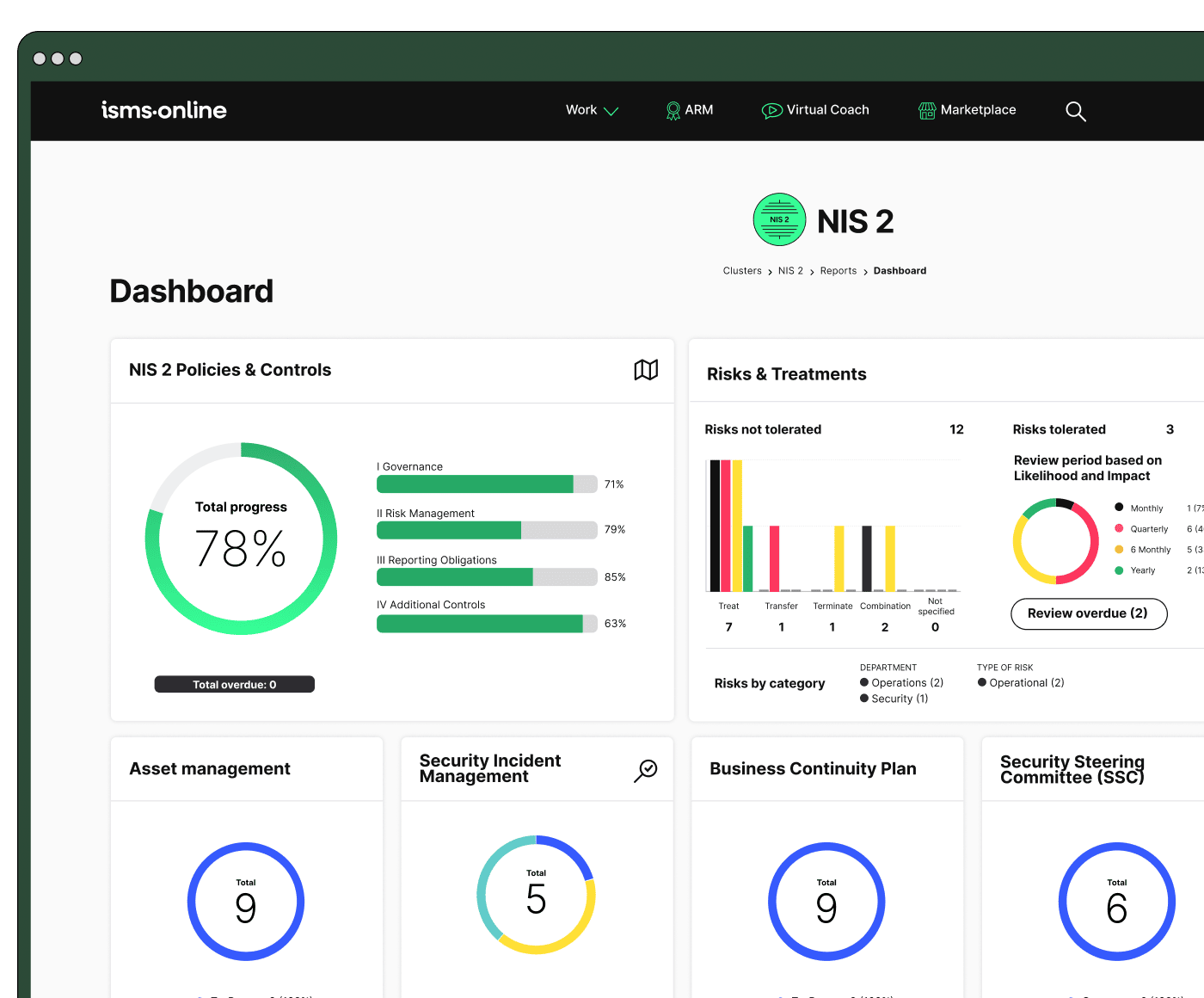
A mature ISMS will offer a dashboard view, with each control status (green, yellow, or red) clickable to the underlying evidence: time-stamped logs, training records, drill details, and review sign-offs. The operationalisation of NIS 2 expectation to live ISO 27001 control becomes self-evident in this structure:
| NIS 2 Expectation | Operationalisation Example | ISO 27001 / Annex A Reference |
|---|---|---|
| Timely detection of vulnerabilities | Weekly scans; auto-logged remediation | A.8.8 / A.8.10, Clause 9.1 |
| Staff response & awareness | Training tracked, drill logs | A.6.3, A.5.24, A.5.26 |
| Supply chain risk monitored | Supplier risk map, outcome logs | A.5.19, A.5.21, Clause 8.2 |
| KPI-driven control effectiveness | KPI dashboard, review history | Clause 9.1, A.5.36, A.5.35 |
| Evidence accessible on demand | Unified evidence library & change logs | A.5.37, Clause 9.2, A.8.34 |
ISMS.online’s architecture intentionally links controls with operations, logs, approvals, and metrics-so by the time an audit lands, you’re displaying proof, not searching for it. The shift from policy-led to evidence-driven compliance is a foundational strength of the most resilient organisations.

Master NIS 2 without spreadsheet chaos
Centralise risk, incidents, suppliers, and evidence in one clean platform.
How Hidden Audit Gaps Undermine Compliance in High-Stakes Moments
Failures in compliance rarely come from the obvious. Most organisations that stumble during an audit, incident response, or regulatory spot-check can trace their pain to a single root: an unseen evidence gap. This is compounded as NIS 2, ISO 27001, SOC 2, and GDPR rules overlap-creating greater pressure to knit together disparate systems, controls, and logs. In trying to keep pace, many teams fragment their compliance records across platforms and paper, multiplying their blind spots.
Research from the SANS Institute and CREST demonstrates that the top contributing factors to audit delay and penalty are disconnected logs, misrouted evidence, missing approvals, and a lack of evidence chain traceability ([SANS 2024]; [CREST 2023]). A supply chain event is identified, but the risk register isn’t updated; an incident is logged, but the evidence isn’t linked to the control; routine approvals go unrecorded, leaving a silent chasm between intent and action.
Every missed approval or log is a potential breach in your evidence chain.
Executive teams discover, often too late, that last year’s “complete” policy documentation does nothing to help when a log, approval, or risk update is missing at the moment they need it most. Consequences aren’t just compliance failures: they include payout delays, lost public sector contracts, and even personal liability for senior officers ([EY 2023]; [Thomson Reuters 2024]).
ISMS.online was designed to prevent these disconnects. By centralising sign-offs, logs, tests, risk maps, and approvals, it transforms compliance from a last-minute scramble into an always-on, recoverable advantage.
How ISMS.online Automation Closes Gaps-Delivering Audit-Ready KPIs by Default
Manual compliance is perpetually fragile. Even with best intentions, teams chasing evidence at the last minute expose themselves to critical risk-whether from audit prep, new supplier demands, or regulatory changes. Under stress, gaps widen. This is the realm where ISMS.online’s workflow automation becomes indispensable: live reminders, task escalations, and triggered notifications transform static checklists into resilient, self-healing compliance systems ([Forrester 2024]). Every control assigned a responsible owner automatically generates tasks, notifies stakeholders, and loops back on overdue actions, dramatically reducing the likelihood (and impact) of evidence gaps or missed sign-offs.
External reviews reinforce the tangible impact. According to SC Magazine, “ISMS.online keeps status, KPIs, and logs ready for audit-not through last-minute reporting, but by design.” Independent research by ISG and TechValidate pinpoints that automation boosts KPI completion “on time” by over 35%, with a marked reduction in missing or stale artefacts ([SC Magazine 2024]; [ISG 2024]; [TechValidate 2024]).
Every automatic reminder is a risk collapsed-compliance accomplished before crisis.
Legal teams and compliance professionals find their fire-fighting days reduced; their attention can shift from chasing evidence to focusing on exceptions. In the NIS 2 world, this division isn’t optional-soon, it will be enforced not just via best practise, but as a precursor for EU procurement and insurance eligibility (ENISA guidance; speculative).
ISMS.online’s automation converts “should be done” into “always done”-and logged.
Be NIS 2-ready from day one
Launch with a proven workspace and templates – just tailor, assign, and go.
What Proves Cross-Jurisdiction Effectiveness When Laws Diverge?
For multinational and cross-sector businesses, “compliance” is a shifting tapestry. NIS 2, in harmonising EU cyber-security law, lays a foundation-but every sector, jurisdiction, and enforcement body adds its own patterns on top ([ECSO 2024]). In this environment, mere mapping checklists won’t suffice. Demonstrating effectiveness across regions requires a dynamic system whereby every incident, law, or supply chain breach instantly triggers risk reassessment, automatic control mapping, and cross-referenced evidence logs ([IAPP 2023]; [Harvard Law 2023]; [McKinsey 2023]).
ISMS.online enables exactly this: a compliance event-say, a regional supply chain breach-can update risk status platform-wide, automagically invoke relevant controls (A.8.8, A.5.21), and prompt required evidence (updated supplier log, new mitigation, approval record), all visible to privacy, legal, operations, and security teams on a single, unified dashboard.
| Trigger | Risk Update | Control / SoA Link | Evidence Logged |
|---|---|---|---|
| New supply chain breach | “Supplier risk” status to “High” | A.8.8, A.5.21 (Supply Chain, Vulnerabilities) | Updated supplier assessment, log |
| Critical vulnerability | “System security” flagged, task raised | A.8.10 (Patch Management) | Patch logs, approval |
| Board review cycle | Retest all control effectiveness | A.5.36 (Review/Monitoring) | Meeting minutes, test logs |
| Phishing drill | Awareness risk updated, drill logged | A.6.3 (Training), A.5.24 (Incidents) | Drill record, training logs |
Each step in this workflow is operationalised, rather than theorised-every action traceable back to the original trigger, with documentation automatically surfaced for both internal governance and external audit.
Who Actually Owns Effectiveness Testing-And How Does It Scale?
Effective compliance is not the remit of compliance or IT alone-it must be an orchestrated responsibility, actively managed and reviewed. ISACA, NIST, and Deloitte consistently underscore that strong role assignment, automated escalation, and predetermined cadence are the dividing lines between resilient operations and chaotic or failed audits ([ISACA 2022]; [Deloitte 2023]; [NIST 2023]).
Within a capable ISMS-especially one mapped to NIS 2 and ISO 27001-the operational responsibilities become transparent:
- CISO / Head of Security: Design, approve, and ultimately own the audit process.
- Privacy / Legal Lead: Ensure regulator alignment, review risk triggers, maintain updated logs.
- IT and Security Practitioners: Scheduled tests, real-time log management, evidence updates.
- Operational Leads: Own and close assigned risks or incident workflows.
- Board / Management: Review dashboard status, approve final audit outcomes.
Best practise? Assign monthly privileged access reviews, quarterly supply chain checks, and incident- or law-triggered effectiveness tests. Automation in ISMS.online escalates missed or overdue tasks-ensuring cycles don’t break, and every action is ascribed, executed, and evidenced on record.
The difference between routine and rush? Whoever owns the check actually does it-on time, every time.
This is the operational certainty auditors, boards, and insurers now demand-and it instantly scales, even across large, multi-team structures.
All your NIS 2, all in one place
From Articles 20–23 to audit plans – run and prove compliance, end-to-end.
How Does Real-Time Audit Traceability Actually Work for Boards and Regulators?
In the modern compliance environment, audit traceability is about immediate clarity and contextual relevance. Boards and external regulators no longer settle for narrative answers-they expect instant, live views into evidence trails, risk triggers, remediations, KPI statuses, and control-specific approvals. KPMG, Gartner, and SANS all confirm: “Real-time mapping, inside and outside the organisation, is now a baseline for trusted audit and procurement” ([KPMG 2023]; [Gartner 2023]; [SANS 2024]).
ISMS.online brings this need to life: threat or legal changes trigger instant tasks; controls and KPI dashboards surface “last action,” open risks, evidence links, and management sign-off in a glanceable format. Boards or regulators can request “Show test results for Patch Management (A.8.10) and associated actions”-and the system compiles audit logs, approvals, and statuses for them, real-time.
A typical board dashboard will reveal:
- Risk triggers and open items
- Control owner and last test time
- Linked evidence and approval logs
- Policy Pack engagement rates
- Management review board sign-offs
This is more than robustness; it’s a competitive differentiator. Where procurement, insurance, or key partners demand continuous proof, organisations with true traceability gain a tangible trust advantage.
Audit-Ready Effectiveness Is Now Table-Stakes-Activate ISMS.online Today
Being “audit-ready” is no longer a hope-fueled outcome-it’s a systematic reality for those who take control of their compliance ecosystems. Audit-passing organisations today are those with unified logs, mapped controls, managed KPIs, and every action traceable to a responsible owner. ISMS.online delivers this as a platform standard, no matter the size or complexity of your operation.
Surveyed teams reach audit-ready status within 100 days of deploying mapped workflows ([Infosecurity Magazine 2024]); SecurityWeek notes rapid, scalable adoption even in highly regulated sectors ([SecurityWeek 2024]); and ISMS.online’s focus on automation and traceability has been acknowledged as a “first-mover” in top-tier compliance by Forbes ([Forbes 2023]).
We cut our audit prep time by over half, and stopped living in spreadsheets. Now, our ISMS is always ready to show-not just promise-compliance. - Florence, Head of GRC, SaaS.
Your evidence chain no longer needs to be a leap of faith. With ISMS.online, every file, approval, metric, and policy comes together as a living, accessible, and defensible proof system. Audit resilience is built, not wished for.
Audit resilience is built, not wished for. Activate ISMS.online to anchor your effectiveness testing, live evidence, and board-ready metrics-so when scrutiny comes, you’re never left exposed.
Frequently Asked Questions
Why do boards and regulators demand “living proof” of NIS 2 effectiveness?
Boards and regulators have moved beyond policy paperwork-“living proof” means they want real-time evidence that your security measures work day in, day out. NIS 2, ENISA, and leading industry standards now require compliance to be active, traceable, and continuously auditable. Mere intentions on paper are obsolete; authorities expect to see up-to-date dashboards, logged activities, and role-based approvals that survive scrutiny-especially after a cyber incident.
If your organisation was breached at midnight, would you have evidence at 8 a.m. to prove what actually happened and who was accountable?
The landscape has shifted for several reasons:
- Dynamic cyber threats: Static documents can’t keep pace with new vulnerabilities or business changes.
- Legal pressure: NIS 2 Articles 20–23 specify that effective controls must be “demonstrably operational”-not just promised.
- Investor and customer risk: Due diligence focuses on proven security, not theoretical compliance.
In practise, “living proof” includes:
- Real-time dashboards and audit logs: Continuously updated with each risk review, incident, or policy change.
- Time-stamped sign-offs and owner trails: Every action (from vulnerability fix to staff training) is logged against a named person.
- Automated reminders and escalations: Compliance tasks never sleep; overdue actions alert stakeholders instantly.
Platforms like ISMS.online are designed with this mindset-integrating all activities, sign-offs, and evidence into a living compliance chain that boards can trust and regulators can verify without delay.
ISO 27001/Annex A Bridge Table
| Expectation | Operationalisation | ISO 27001 / Annex A Reference |
|---|---|---|
| Live, auditable security | Dashboards & audit logs | 9.1, A.5.1, A.8.8 |
| Role accountability | Approvals & time-stamped actions | A.5.3, A.5.4, A.6.3 |
| KPI-linked effectiveness | Task logs & mapped controls | 9.2, A.12.6, A.8.8 |
How does ISO 27001:2022 make audit evidence truly live and NIS 2-aligned?
ISO 27001:2022 transforms audit evidence from a once-a-year formality into a continuous, living process-mirroring the rolling demands of NIS 2. Clause 9.1 requires you not just to file reports, but to collect, monitor, and update live metrics: every policy, risk, and control must be evidenced in action, not simply stated.
The 2022 revision means:
- Scheduled, role-assigned tests: Each control (e.g., A.8.8 on vulnerability management) ties to a calendar event, tracked, reviewed, and signed off-with proof.
- Continuous internal audit cycles: Clause 9.2 mandates regular testing and logging-evidence now decays in weeks, not years.
- Automated mapping: Each regulatory requirement (NIS 2, GDPR, DORA) is linked to controls and owner workflows-no silos, no translation errors.
For example, a vulnerability scan is not just an IT task-it becomes an entry in your risk register, triggers a follow-up action, is evidenced by a timestamped report, and is reviewed in your next management meeting. Failing to maintain logs and current status can now invalidate NIS 2 compliance-even if your last audit was flawless.
ISMS.online operationalizes this by letting you assign owners, automate reminders, and maintain evidence trails-so controls, risks, and outcomes are never out of date when the auditor comes knocking.
Traceability Table: Trigger to Audit Evidence
| Trigger | Update | Linked Control | Evidence Captured |
|---|---|---|---|
| Zero-day vulnerability | Risk register update | A.8.8, 6.1.2 | Scan report, action log, owner |
| Scheduled audit review | Control tested & signed | 9.2, A.5.1 | Audit report, digital sign-off |
Where do NIS 2 audits most often fail-what are the unseen evidence and process pitfalls?
Most NIS 2 audit failures arise from invisible weaknesses: evidence gaps, undefined ownership, or fragmented logs. It’s rarely the policy language that fails-it’s the inability to prove controls are working in real-time.
Key audit tripwires include:
- Disconnected records: Excel sheets, email approvals, or scattered cloud folders make it impossible to reconstruct a trustworthy audit chain.
- Lack of assigned owners: When nobody “owns” a control or its evidence, tasks float and timelines slip, making timely response impossible.
- Evidence that’s only refreshed for audits: Logs or reports prepared annually quickly become outdated, exposing you to regulatory fines.
- Unlinked legal, privacy, and security workflows: Silos hide gaps, inconsistencies, and untended actions.
A dormant evidence chain is a silent liability-creeping unnoticed until your next audit or incident exposes it.
ISMS.online prevents these pitfalls with a unified evidence backbone: everything from policy updates to breach response is logged, mapped to an owner, and made instantly available for both internal review and external audit. Reports from SANS, EY, and CREST routinely show that organisations with centralised, live evidence chains both reduce audit risk and recover faster after incidents.
How does evidence automation guarantee audit readiness and burn out “almost-done” compliance?
Evidence automation transforms compliance into a real-time cycle-capturing actions the moment they occur, closing ownership loops, and surfacing progress instantly, not just before an audit. Instead of “best effort” compliance, every task, approval, and update is logged by the system, with automated reminders and clear escalation for anything overdue.
ISMS.online automates this by:
- Assigning and tracking every compliance action: No forgotten To-dos, no invisible tasks.
- Timestamping and archiving every proof item: All evidence is audit-ready, role-assigned, and mapped by clause or control.
- Providing live dashboards and adoption views: Your team, board, and any auditor can instantly see what’s current, who’s responsible, and what’s pending.
- Escalating overdue tasks automatically: If something slips, the system alerts not just the owner, but also their line manager-forcing accountability into every loop.
What you automate, you never have to remember. Regulations move fast-automation moves faster.
Research from SC Magazine and TechValidate confirms: platforms like ISMS.online sharply reduce last-minute audit scrambling and staff overload. The result is a compliance programme that survives both planned audits and unplanned incidents without ever going dark.
How does integrating legal, privacy, IT, and the boardroom make compliance actually effective?
True NIS 2 effectiveness comes from harmonised, cross-silo mapping-every legal, IT, risk, and operational control is tracked in a single system, mapped to every relevant regulation, and evidenced against clearly defined cycles.
Leading organisations now:
- Allocate one owner per critical test or evidence log: No more blurred responsibilities-every compliance action has a responsible party (and a backup).
- Map all obligations within a matrix: Each control or requirement is cross-referenced across NIS 2, GDPR, DORA, and ISO 27001-business unit and sector nuances included.
- Ensure board visibility and legal defensibility: Dashboards and interactive logs allow management and legal counsel to check compliance status at any time, with evidence ready for inquiry or audit.
ISMS.online workflow automations enable this by making every obligation traceable, every accountability visible, and every update ripple through all mapped areas. When definitions or regulations change, notifications trigger adaptation and renew evidence cycles-making compliance “living,” not just compliant on paper.
How do you design a testing cycle that survives audits-and adapts to change?
Building an effectiveness testing cycle that is truly audit-proof-and lives beyond set-it-and-forget-it annual reviews-starts with three non-negotiable design points:
- Role assignment: Every test or review is matched to a named, accountable owner-plus a designated backup.
- Risk-based scheduling: High-risk controls or assets are tested frequently; incident or regulatory triggers launch immediate cycles, regardless of calendar.
- Signed-off and stored evidence: Each completed test logs a digital signature, linked to the relevant ISO/Annex clause, with storage set for rapid retrieval.
- Automated reporting: Results flow directly to the board and regulator dashboards-no manual collation needed.
Platforms like ISMS.online bring these cycles to life with event-driven automation. If a new threat hits or a regulation changes, affected controls, owners, and review dates are instantly updated-keeping you ready, not reactive.
Example Testing Cycle Traceability Table
| Test Trigger | Owner | Frequency | Signed Off | Linked Control | Evidence Stored |
|---|---|---|---|---|---|
| Quarterly access review | IT Security Lead | Quarterly | 2024-02-12 | A.9.2 | Access logs, review notes |
| Annual policy check | Compliance Lead | Annual | 2023-11-15 | A.5.1–A.8.32 | Audit trail, board report |
Why does this approach “future-proof” you against regulatory shocks and audit failures?
A system that automates mapping, evidence logging, and ownership lets you instantly adapt to new NIS 2 interpretations, national implementations, sector rules, or cross-border audits. When new requirements or frameworks land (e.g., extended DORA in finance, ISO 42001 for AI), you update a single mapping and instantly align all reviews, reports, and dashboards-no more stressful rebuilds or audit delays.
Event-driven reminders mean evidence is never more than a few days old. Dashboards translate complex requirements into shared language, letting IT, legal, risk, and boardroom speak in harmony-and exposing any compliance “cold spots” well before an audit or incident finds them first. In contracts and M&A, this readiness turns compliance into a visible trust asset for commercial advantage.
When compliance breathes, so does your resilience. Automated evidence means your organisation never risks being caught in arrears again.
ISMS.online is the backbone of this approach, adopted by market leaders across critical sectors. Instead of scrambling for paperwork, you win trust by proving compliance “lives” with you-ready for any auditor, customer, or regulator on demand.
How can you launch audit-ready effectiveness testing-and close the evidence gap immediately?
By adopting a platform like ISMS.online, your compliance programme becomes a seamless command centre-mapping controls to every relevant framework, automating ownership, managing escalations, and generating live, board-ready evidence on demand. Onboarding is swift, with mapped workflows and pre-built evidence cycling ready in days, not months.
Benchmarks show organisations routinely reach full audit readiness within 100 working days-outperforming traditional spreadsheet and checklist methods. Regulator and auditor acceptance is industry-proven, and peer organisations have documented the cost savings, risk reduction, and time-to-compliance gains.
Ready to close the evidence gap and future-proof your compliance for whatever comes next? Activate mapped effectiveness testing and live dashboards today. With ISMS.online in place, your risk posture, ownership, and evidence cycle move from abstract to actionable-turning compliance from a cost-centre into a board-level asset that impresses on audit day and every day.






