





































Why NIS 2 Makes HR Security a Board-Level Priority-And What Changes Now
Today, HR security isn’t just an operational necessity; it’s a living, board-level priority redefined by NIS 2. Gone are the days when background checks and policy sign-offs lingered as forgotten paperwork in the HR drawer. With NIS 2, the scope and expectations of HR security widen-demanding real-time clarity, digital traceability, and board-room insight on every individual linked to mission-critical systems, from temporary developers to executive directors.
Every overlooked HR log becomes an open door-invisible to you, obvious to an attacker or auditor.
Regulators and clients now expect “living” HR controls, visible from the boardroom to the back office. It’s not enough to say a process exists; you must be equipped to pull up, at a moment’s notice, a current register of who holds which responsibilities, the vetting they have undergone, and whether their onboarding and ongoing access aligns precisely with company policy and legal requirements.
The shift to “live” compliance means annual audits and static records are obsolete. Digital dashboards now lead the way; supervisors and directors alike must know that HR status-who’s passed vetting, signed which agreements, or exited the organisation-reflects reality up to the minute. NIS 2 draws a direct line between HR controls and operational resilience, placing missed or outdated HR records in the same risk category as open firewall ports or expired certificates: a catalyst for investigation, client mistrust, and, if unchecked, regulatory sanctions.
The difference between compliant and exposed isn’t size or spend-it’s how ‘live’ and visible your HR system is from the board to the front line.
ISO 27001:2022 accelerates this new compliance landscape. Instead of waiting for annual reviews, clauses 5.3 (roles and responsibilities), 6.1 (risk and controls), and Control A.5.2 require risk-aware, evidence-driven responses for every key HR event. This is operationalised effectively in platforms like ISMS.online, where every exception-missed vetting, unclear role assignment, unsigned policy-is immediately visual, traceable, and mapped to evidence ready for audit or regulatory review. Now, the board isn’t just accountable for “HR policy.” They’re directly responsible for HR security, role mapping, and real-time evidencing-turning what was once a compliance afterthought into a board-level discussion with tangible, operational risk.
Who Must Have Mapped Roles-And How Often to Update
Expanding compliance means expanding the people map. Under NIS 2, the days of mapping only your IT managers or core employees are gone. Every individual connected to your operational or security posture-directly or through supply chains-falls into scope, requiring live assignment, role documentation, ongoing verification, and traceable digital logs.
With every new hire, contractor, or access change, your HR compliance clock resets.
Modern enforcement doesn’t allow for gaps or delays. Role-mapping must extend to:
- Full-time and part-time staff, regardless of job title
- Contractors, temps, remote contributors, and consultants-even on short-term or high-trust projects
- Service providers and suppliers with system access (physical or digital)
- Board members, advisors, non-executive directors (NEDs) and all with access to strategic or sensitive information
NIS 2’s message is blunt: compliance blind spots-across the supply chain, in pop-up project teams, or among overlooked execs-are simply not tolerated. If onboarding or ongoing record-keeping doesn’t capture assignment, timing, and evidence for every one of these players, your organisation is exposed.
Rapid Mapping Table-Who, What, When
| Stakeholder | What You Must Track | Update Trigger |
|---|---|---|
| Employee/Manager | Name, role, assignment, evidence | Onboarding, promotion, critical change |
| Contractor/Temp | Assignment, access, expiry, vetting | Every hire/change/contract event |
| Supplier/Advisor | Assignment, contract, proof | Contract start/renewal, major change |
| Board/Exec | Role, responsibility, assignment | Annually; after leadership/duty change |
Digital tools like ISMS.online bring this role mapping to life- flagging gaps, surfacing overdue updates, visualising dependencies, and enabling instant export, audit prep, or board review, all in real time.
The Hidden Cost of “Backfilling”
Backfilling without live mapping-not tracking a temp developer assigned to patch critical systems, for example-leads to regulatory findings and competitive fallout faster than any technical misstep. With NIS 2, every assignment and update needs to be digitally registered, timestamped, and instantly available for audit queries.

Master NIS 2 without spreadsheet chaos
Centralise risk, incidents, suppliers, and evidence in one clean platform.
Efficient Vetting, Induction & Ongoing Responsibility: The Compliance Backbone
Robust compliance isn’t a one-off act. From day one, every individual-employee, contractor, supplier, advisor-must have a digitally logged sequence of vetting, induction, and assignment that stands up to on-demand review and export.
Digital Vetting Sets the Standard
NIS 2, under ENISA and other national supervisors, now treats digital background checks as table stakes. This sequence includes:
- Verifying identity and appropriate vetting (background checks, professional certifications, competency logs)
- Documenting risk acceptance or mitigation, especially for high-privilege access
- Tracking the full record in a manner ready for instantaneous export
No modern regulator accepts “initiation by manager word,” nor will “paper trail” in a locked file cabinet suffice for contracts, suppliers, or temp staff.
Induction-A Tracked, Repeatable Cycle
Structured onboarding is more than a checkbox:
- Enforce digital sign-offs for every mandatory policy, code of conduct, or security requirement
- Automated training, with logs for attendance and completion
- Reminders for overdue acknowledgements and action items, with traceable follow-up
If you can’t instantly export induction logs and evidence for any individual in your organisation, you’re no longer compliant under NIS 2.
For remote and contingent staff, the risk is even higher-all induction steps must be logged, evidenced, and made exportable in real time, or your compliance shield collapses.
Managing Temporary and Remote Workers
Temporary, freelance, and remote staff-often onboarded without due ceremony during surges or crises-are the Achilles heel of too many audit cycles. Every step in their onboarding and ongoing status now sits under the compliance microscope. Using workflow platforms with automated reminders, dashboard health checks, and single-click exports (as in ISMS.online), HR teams can finally eliminate the risk of “silent pass” gaps.
Digitally managed onboarding means never explaining a missing contract or unchecked access in front of a regulator again.
How to Prove Everyone Actually “Gets” Your Policies (and Auditors Believe It)
Policies and codes of conduct have lasting value only when you can demonstrate, in seconds, that everyone-not just employees but all contractors, suppliers, and partners-has read, accepted, and signed off at every critical policy revision. In the new order, whether a single missed acknowledgment is a matter of inconvenience or a regulatory vulnerability is by your design.
A missed policy acknowledgment isn’t a trivial HR slip-up; it’s a compliance crack likely to be exploited.
Acknowledgment Evidence as Compliance Gold
Authoritative sources including ICO, BSI, and ENISA are unequivocal: acknowledgment must be:
- Digital, timestamped, and exportable
- Escalated for non-completion, with visible record of all interventions
- Complete for every individual in scope, i.e., *individually* evidenced and tied to every policy revision
Whether managed through ISMS.online’s Policy Packs or similar digital HR platforms, this system ensures delivery, acknowledgment, and, just as critically, the resolution path for lapsed acknowledgments. “Forgetting” is now a managed incident-not a benign oversight.
Completing the Compliance Loop With Resilience
Leaving out a single staff member, supplier, or partner from policy acknowledgement can collapse your compliance posture. Inclusivity and resilience mean every participant is enrolled, reminded, and escalated when slow or nonresponsive. If not, your incident logs and regulator readiness will fail first contact.
Real-World Logging Failure-The Silent Risk
Consider a scenario where a mid-tier logistics firm rolled out an urgent anti-phishing policy but had no mechanism to register delivery or acknowledgment among their temporary warehouse staff. The absence was only discovered after an incident-tracing the problem back to a policy that no one had verified reading. The regulator did not isolate blame; the penalty fell on the entire organisation for failing to close the feedback loop.
ISMS.online and similar workflow solutions bring automation, centralised tracking, and clear audit logs to each policy delivery-empowering your compliance team to spot and rectify acknowledgment gaps before they escalate into risks.
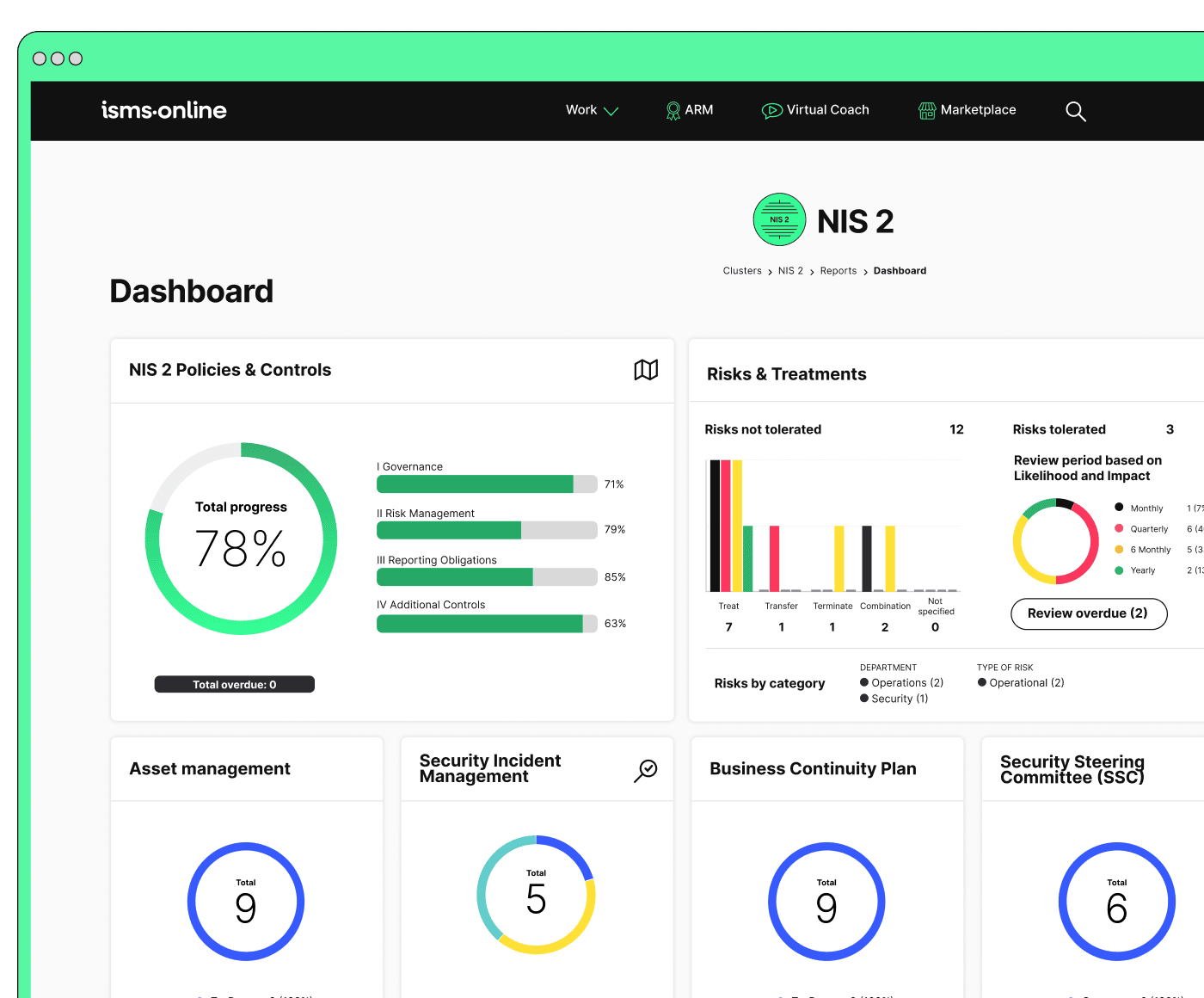
Be NIS 2-ready from day one
Launch with a proven workspace and templates – just tailor, assign, and go.
Triggers for Instant Review-Incidents, Change, Mergers & Board Moves
Stale HR compliance is now seen as a systemic failure. Dynamic organisations-fast-moving, merging, or incident prone-are especially at risk. NIS 2 requires that every material event triggers an immediate HR review, realignment, and evidence collection. Static compliance systems, or those requiring manual updates, fall short; delay equals danger.
If a major personnel or supplier change isn’t instantly mirrored in your HR system, risk compounds every minute.
Mandatory Review Triggers
- Security or regulatory incident: Each must prompt a complete review of all assignment and responsibility logs.
- Structural transformation: Including mergers, acquisitions, leadership rotation, or any board-level change.
- Critical supplier or contract update: Whether engagement, replacement, or change in scope.
- Standards or legal alignment shifts: When NIS 2, DORA, or ISO update any requirement.
Deloitte finds the root cause of most audit failures-post M&A or incident-comes from lagging HR records. With workflow-driven compliance, such as ISMS.online’s HealthCheck dashboards, every trigger is met with instant prompts, dashboards, and exportable evidence-ready for regulators, auditors, or the boardroom.
Traceability Table: Trigger to Evidence
| Trigger/Event | Required Update | ISO 27001/NIS 2 Ref. | Evidence Logged |
|---|---|---|---|
| Supplier breach | Access review, reassign | ISO 27001/A.5.2; NIS2 | Registry log, assignment record |
| Board change | Role map, fresh assignment | ISO 27001/5.3, 8.1 | Org chart, board minutes, sign-off |
| Security incident | Role gap, fresh sign-off | 5.3; incident workflow | Checklist, exception report, dashboard |
ISMS.online HealthCheck features highlight event-driven review triggers, pushing instant HR alignment and audit export-before crises become audit failures.
Segregation of Duties and the “Four-Eyes” Principle-What Works in Practise
The “four-eyes principle” (SoD) underpins risk control against everything from fraud to critical error. But for many organisations, splitting every duty is unattainable. NIS 2 is pragmatic-insisting not only on routine separation but on measured, board-logged exceptions. Exception without documentation is simply failure.
Auditors won’t fault an exception-unless you hide it, or fail to version and escalate it.
Making SoD Work for All Organisation Types
- Large organisations: Digital approval workflows, tracked at every step and tied to explicit separation of roles. Audit logs provide grid visibility.
- Smaller organisations: If separation isn’t possible, log the exception, manager review, and elevate for sign-off by a senior or board member-quarterly and on-demand.
- Supplier and third-party relationships: All assignments requiring single-party control must be flagged, assigned risk level, and logged as an exception with board awareness.
A high-growth MedTech startup couldn’t split certain duties due to staff size, but failed to approve or log exceptions for its CTO covering all data protection. During audit, the absence of documentation and escalation stalls certification and risk review, putting market opportunities at risk.
Best Practises for SoD Documentation
- Track every approval digitally, whether fully split or managed as an exception.
- Log all exceptions, escalate to policy-defined approvers, and hold quarterly reviews.
- Store all approval and exception records in a single, searchable registry-ready for board or regulator demand.
ISMS.online surfaces these exceptions and SoD violations, allowing for real-time review and export-prioritising remediation, not cover-up.
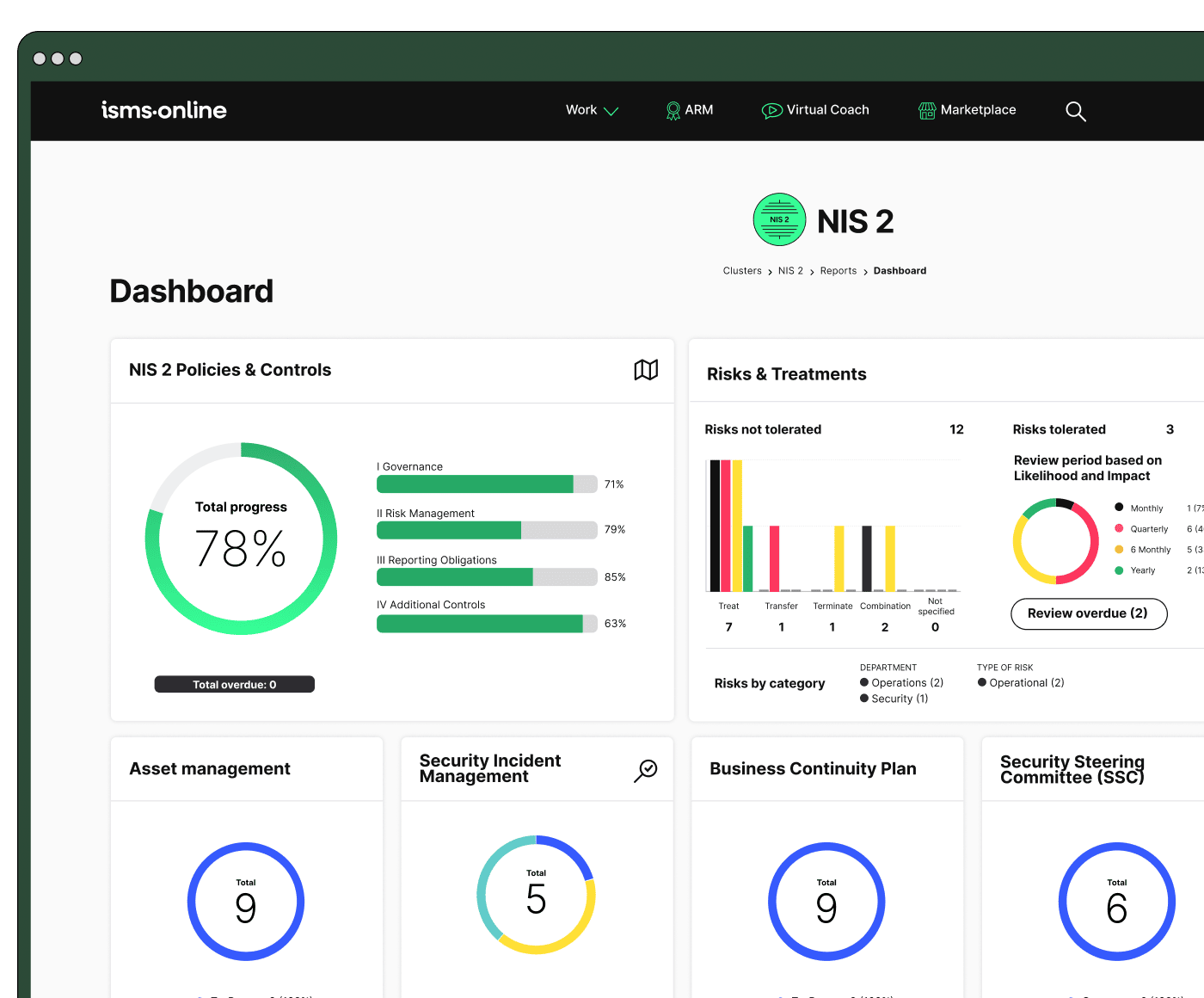
All your NIS 2, all in one place
From Articles 20–23 to audit plans – run and prove compliance, end-to-end.
Supplier, Contractor, and Third-Party Accountability-The Last Blind Spot
Even a single vial of supplier ambiguity poisons audit trust. NIS 2 reclassifies every supplier, contractor, and third-party participant as full compliance extensions of your organisation. Their mapping, onboarding, sign-off, and acknowledgment trails are now under regulator scrutiny and must remain current, digital, and accessible at all times.
A single missing supplier assignment log is enough to topple your compliance stance like dominos.
Essential Third-Party Mapping & Acknowledgment
- Assignment logs: Document each vendor’s specific duty, start date, and contract nexus.
- Version control: Update logs upon every contractual renewal, project, or major responsibility change.
- Digital acknowledgment: Capture sign-off as digital, time-stamped records, not email chains or manual addendum.
Rescue Plan for Non-Compliant Vendors
If a supplier delays or refuses compliance steps:
- Record all requests, responses, and attempts to resolve directly in your system.
- Escalate to board-level risk review, and document for audit or procurement review.
- Where necessary, proactively flag non-response in supplier registry and risk logs.
This level of operational and legal transparency builds trust with both clients and regulators, while also protecting the board and procurement chain.
Third-Party Mapping Table
| Type | Log Required | Update Triggers |
|---|---|---|
| Major supplier | Yes | Contract/change |
| Software provider | Yes | Access/renewal |
| Short-term contractor | Yes | Entry/exit, project |
| Advisor/consultant | Yes | Engagement, board |
Platforms like ISMS.online automate and flag missing assignments, helping your compliance team-no matter its size-anticipate and address gaps before they endanger the audit outcome or supply chain reputation.
Beyond Audit-Ready: Dynamic Digital Evidence With ISMS.online
True compliance is alive-a daily, quietly monitored state, not a scheduled ordeal or fire drill. Only by adopting unified, digital, centrally managed platforms such as ISMS.online can your organisation transition from annual compliance dread to a state of real-time assurance.
Resilience comes from daily readiness, not a heroic scramble before the audit.
Frequently Asked Questions
How does NIS 2 shape the scope and priorities for human resource security-and why does it matter beyond policy documents?
NIS 2 elevates human resource security from a supporting act to a headline requirement for every essential or important entity, placing people-related risk on par with technical controls. Your organisation must treat HR security as a continuous practise-integrated into risk management, not a set of afterthought HR policies. Article 21 makes clear that screening, onboarding, ongoing training, access management, and rigorous offboarding are baseline. The sector specificity in Annexes I and II means the bar is especially high for operators in energy, finance, health, ICT, and other regulated spheres.
What’s changed is the assumption: “People are the weakest link” is now a regulatory premise-ENISA’s guidance names personnel risk as the fulcrum of resilience. Modern attackers target users, not just firewalls.
You build resilience in the rhythm of hiring, coaching, and exit-not just your codebase.
Key operational strategies
- Map each HR control (from staff screening to access review) to Article 21(1)(a-c) and record in your SoA, so your audit tells a clear, trigger-to-control-to-evidence story.
- Specify vetting criteria for high-risk roles in line with GDPR and labour law; sectoral annexes determine which job categories require what level of scrutiny.
- Document every access grant, privilege change, and exit as risk updates with evidence-showing you close the loop, not just write the rule.
- Conduct annual or event-driven reviews (incident, role change, contract renewal); automate reminders where possible.
- Train, test, and trace: log onboarding, keep a pulse on awareness (especially for high-risk roles), and have exit checklists ready to reconstruct evidence at any review.
NIS 2 compliance means treating people risks as active controls-with digital proof that you’re managing them in real time.
What HR screening, onboarding, and exit practises will withstand NIS 2 and ISO 27001 audits?
Under NIS 2, every phase of the staff or supplier lifecycle-from candidate screening to contract conclusion-becomes a point of audit. Gone are the days of “supplementary” HR records; inconsistent onboarding and “ghost” credentials are among the most cited audit failures. To audit standards, your team must operate structured, repeatable, and evidence-backed HR controls.
Essentials for compliance
- Screening: Execute documented pre-employment checks for all sensitive or privileged roles, and log both positive results and exceptions justified by GDPR or local law. If a role can’t be screened, flag and mitigate it via risk register and management sign-off.
- Onboarding: Run a role-based security induction for every new starter (including contractors), log signed policy/SoA acknowledgments and initial access assignments, and restrict system activation until completion.
- Continuous Review: Use a digital register for all access rights, updating upon each significant event (role promotion, incident). Revalidate and log training at least once per year for every person with business-critical or privileged access.
- Offboarding: Enforce prompt, logged revocation of access, return of assets, secure data removal, and a signed exit attestation (especially for key roles). Prove this for staff and high-risk suppliers-past audits show failures here tie directly to major incidents.
Every untracked login or lingering credential could escalate into your next regulatory finding.
By automating the cadence of onboarding and offboarding (plus third-party oversight), you anchor your ISMS in operational reality.
How can you ensure security awareness training actually meets NIS 2 and ISO 27001 expectations?
NIS 2 makes “continuous, role-based staff training” part of the law (Articles 20/21), not just certification jargon. ISO 27001:2022 (Annex A–6.3, 7.2) locks this in for audits. Excellence is about more than content: resilience comes from adaptive, risk-transparent awareness.
Effective adoption tactics
- Baseline induction: Foster immediate recognition of NIS 2 duties and reporting channels at onboarding, then tie attendance to live audit logs and the SoA.
- Segment by risk: Designate privileged staff, admins, leadership, and third parties as distinct groups for bespoke content. For regulated sectors, provide heightened scenario training (e.g., energy or finance simulations).
- Board and exec focus: Document annual (or event-driven) briefings for the C-suite or board on NIS 2 liability, and log these into management review cycles.
- Feedback and frequency: Refresh at least quarterly for high-impact roles, and after any significant threat or regulatory change. Use phishing simulations and quiz data to measure actual behaviour change, not just attendance.
- Audit and redesign: Regularly survey as well as test staff on their awareness. Feed real incident findings into content updates, closing the loop between risk and awareness.
Proof is in the cycle: can you show not only that people attended, but that your awareness programme resulted in changed behaviour and fewer “avoidable” incidents?
What policies, records, and artefacts must HR and compliance keep ready for NIS 2 and ISO 27001 scrutiny?
Regulators and auditors look for chains of evidence-logs, documents, and acknowledgments that go deeper than policies on file. NIS 2 and ISO 27001 expect you to reconstruct a full trajectory for any staff member: from how they were vetted, to what access they held, to how and when they departed.
Non-negotiable documentation
- Screening files: Store pre-hire/background check evidence, with clear legal rationales for any exceptions or refusals, tied to the risk register.
- Role definitions: Maintain current org charts and signed job specs linking security responsibilities to key roles and documenting privilege assignments.
- Policy sign-offs: Keep digital or physical proof for each staff member’s acceptance of security, privacy, and code of conduct policies.
- Training logs: Track every attendance, renewal, and assessment (onboarding and refreshers alike); for scenario-based or “phishing” tests, store results by role.
- On/Offboarding logs: Evidence every access grant/revoke action, asset hand-back, and compliance with data/media destruction-for staff, contractors, and critical suppliers.
Alignment Table: ISO 27001 & NIS 2 (HR Security)
| Expectation | Operationalisation | ISO 27001 / Ann. A Ref. | NIS 2 Reference |
|---|---|---|---|
| Staff screening | Pre-hire checks, evidence retention | A.6.1, A.6.2 | Art. 21, Recital 88 |
| Onboarding | Role-based induction, access logs | A.6.3 | Art. 21, Annex I/II |
| Training & awareness | Documented, periodic, role-based | A.6.3, A.7.2 | Art. 21, Art. 20(2) |
| Access review/offboarding | Revocation, asset return, documented | A.8.2, A.8.3, A.8.9 | Art. 21, Art. 23(2) |
| Policy documentation | Signed codes, digital policy pack logs | A.5.1, A.7.7 | Art. 20, Art. 21 |
| Screening data retention | Retention schedule, purge logs | A.8.9, A.5.9, A.5.11 | Art. 21, Art. 28 |
When your records prove the journey from screening to exit, compliance stops being a scramble and starts being assurance.
How can you balance privacy, fairness, and transparency in HR security practises under NIS 2?
NIS 2 explicitly defers to GDPR and anti-discrimination law. Screening, monitoring, and automated decisions must always be risk-proportional, legally justified, and transparently communicated. Overreach can mean as much regulatory trouble as underreach.
Principles for lawful, balanced controls
- Proportionality: Only initiate screening and surveillance necessary for the role or risk; use DPIAs to document the logic and limitations.
- Transparency: Disclose all screening, monitoring, and data retention practises to employees and candidates; obtain informed consent where appropriate.
- Non-discrimination: Scan policies for practises that could disadvantage protected groups-test assignment and promotion decisions for hidden bias.
- Retention discipline: Adhere strictly to GDPR data minimization and storage limits; automate purge routines where possible; record deletion events.
- Accountability: Make HR and Data Protection leads the owners of these controls; involve them in reviews and audits for oversight and audit traceability.
A control without proportionality is noncompliance in disguise; balance is a prerequisite for trust.
What are the recurring HR security audit failure points-and how can digital ISMS/GRC platforms help eliminate them?
Audits across the EU show the same sharp edges: incomplete records (especially for temps/contractors), access rights drift (“ghost” accounts), outdated or untested training, muddled roles, and the gap between written policy and daily reality.
Frequent audit pain points
- Incomplete records: Screening, onboarding, offboarding, or refresher logs missing for just one user can trigger a finding.
- Orphaned access: Credentials left live after exit (staff or supplier) undermine the entire ISMS; automate access revocation and evidence it.
- Weak or infrequent reviews: Unscheduled, informal, or poorly evidenced access, policy, or privilege audits.
- Role confusion: Fuzzy job specs or unclear segregation of duties-invite privilege creep and blame-shifting.
- Policy-practise divide: Written intentions not mapped to repeated, proven actions.
Traceability Table: HR Security Evidence in Action
| Trigger | Risk Update | Control/SoA Link | Logged Evidence Example |
|---|---|---|---|
| New staff hired | Insider threat, access risk | A.6.1, A.6.2 | Background check filed, induction log |
| Role promotion | Privilege escalation risk | A.6.3, A.8.2 | Access review, responsibility matrix |
| Incident report | Process gap, staff error | A.7.2, A.8.9 | Training refresh, gap report, sign-off |
| Exit (staff/sup.) | Orphaned credentials risk | A.8.3, A.5.11 | Asset return, access revoke, offboarding |
| Third-party start | Supply chain insider threat | A.5.19, A.5.20 | Supplier attestation, contract clause |
Digital ISMS/GRC advantage
Systems like ISMS.online centralise all audit artefacts-screening, training, access rights, SoA mappings-enable audit-ready exports, automate reminders and triggers, and surface anomalies instantly. Less time firefighting, more time building resilience.
What would your team achieve this year if HR security audits became a routine click-instead of a caffeine-fueled scramble?
Mastering HR security as a living, operational control transforms compliance from an obstacle into an asset. You don’t just pass-you demonstrate the maturity and trust regulators and customers demand. If a one-click audit freed up your focus, what risk or innovation would you conquer first?






