





































How Does Article 11 Change the Game for Online Marketplaces? From Technical Afterthought to Boardroom Imperative
The NIS 2 Directive, and particularly Article 11, has changed the stakes for Europe’s online marketplaces. Compliance is no longer relegated to IT teams or delegated to monthly reporting; it’s a visible, board-level mandate. Under Article 11, online marketplaces must document their statutory status (essential, important, or out of scope), maintain live proof of their compliance lineage, evidence critical suppliers and processors, and demonstrate these controls in real time-everywhere they operate.
Compliance no longer lives in static PDFs or scattered spreadsheets. Audit trust is built on living dashboards, transparent roles, and instant evidence chains.
The reality is plain: If your marketplace can’t produce a timeline, policy, or assignment record when the regulator knocks, your operational risk-and, by extension, your business continuity and revenue-are at stake. Under NIS 2, the entire organisation, from procurement and vendor management up to the board, is accountable not just for technical resilience but for the ability to trace action and intent across every jurisdiction and supply chain.
Entity Classification Isn’t Optional
The most significant shift is the transition of “entity classification” from a paperwork formality to a practical survival mechanism. The ENISA Implementation Guidance makes it clear: A failure to correctly classify and surface your entity type (essential/important) is the fastest route to regulatory investigation, disrupting procurement and elevating audit risk (ENISA). Online marketplaces must now evidence:
- Public, board-approved classification
- Internal dissemination (accessible, searchable, not just a hidden policy)
- Audit triggers that adapt as your business changes jurisdiction, launches new features, or integrates new vendors
Fail to do this, and regulators may treat your entire business model as non-compliant, especially if a breach or incident exposes a gap in your governance map.
The Rise of Data Flow Mapping & Supplier Role Definition
No matter what marketplace platform you operate, live data flow mapping is no longer a technical wish-list item-it’s a procurement and audit requirement. The days of “see attached network diagram” are over. Article 11 expects real-time maps connecting every supplier, service integrator, and cross-border processor, designed to survive audit, incident, and onboarding review (EC). The upshot: If you can’t export an SVG with all critical data/service flows-and link it to role and regional assignments-your evidence will be questioned, and deals delayed.
Financial and Operational Downsides of Slow Evidence
Notably, DLA Pipers European NIS 2 reports show that fines and regulatory interventions are increasingly triggered by missing or slow-to-export evidence chains-often more than by the technical root causes of a breach (DLA Piper). With ISMS.online, every control, role, and incident is logged, mapped, and ready for instant export-whether for an auditor, customer, or procurement partner.
Book a demoWho Owns CSIRT Evidence? Timelines, Accountability, and the Hidden Risk of Manual Processes
Incidents are now measured in minutes, not days. Article 11’s 24/72-hour requirements redefine best practise-not just for notifying competent authorities, but for tracking every step, ownership handoff, and proof of notification. The risk is clear: manual evidence chains-emails, spreadsheets, signoff forms-can betray your team and leave executives, DPOs, and CISOs open to personal liability.
Every incident you can’t evidence in one click escalates organisational and personal risk.
Automate the Clock-Manual is Now a Liability
Italy’s ACN and ENISA both clarify: Under NIS 2, only timestamped, system-triggered notifications are admissible evidence (ACN; ENISA). ISMS.online centralises and automates logging-every alert, escalation, reply, and role-specific action is digitally signed, tracked, and locked. Outdated habits like “saving email histories” or “attaching incident timelines” now count against you in audits and can delay regulatory clearance.
Immutable Logs: The Only Audit Currency
User-editable histories are no longer admissible audit evidence (ENISA). Cryptographically locked, ISO 27001-mapped logs, as natively generated by ISMS.online, deliver tamperproof, export-ready chains. Whether the audit is snap or scheduled, your organisation is always ready-no “wait for ops to print the PDF,” no re-extracting facts from Slack.
GDPR vs. Article 11: Separate the Playbooks
A major risk for marketplaces is assuming that GDPR and NIS 2 Article 11 workflows can be merged. This was never the intent-GDPR deals primarily with data breaches and processor notification, whereas NIS 2 expects comprehensive cross-department CSIRT response, region-by-region and role-by-role (IAPP). ISMS.online supports linked but distinct playbooks for each regulatory regime, avoiding costly mistakes in incident reporting.
Personal Accountability is Now a Legal Mandate
Per Forbes Tech and European regulators, insufficient digital logs or lack of individual sign-offs can result in personal fines for CISOs, DPOs, and team leads (Forbes Tech). Assignment mapping dashboards in ISMS.online now show, at a glance, exactly who was responsible, who acknowledged, and when-providing a legally defensible action trail.
Supply Chain Blind Spots: Where Most Fines Originate
A sharp rise in fines relates to fragmented or non-existent evidence of supplier notification and engagement during incidents (INCIBE). ISMS.online links every vendor, logs their role and engagement, and stores automated notification histories-all available for instant audit.

Master NIS 2 without spreadsheet chaos
Centralise risk, incidents, suppliers, and evidence in one clean platform.
Mapping Article 11 to ISMS.online Controls: Making Compliance Actionable, Not Abstract
Traditional compliance models treat policy, evidence, and notification as separate silos. ISMS.online bridges this by operationalising Article 11 requirements directly inside platform workflows, automating traceability, and surfacing proof at every touch.
Audit-Proof Automation and Evidence Chaining
The Cloud Security Alliance reports that automated evidence chains pass audits six times more effectively than spreadsheet- or PDF-based workflows (CSA). In ISMS.online, every incident, role signoff, supplier notification, and regional requirement links to live, exportable records-assigned, timestamped, cryptographically locked, and SoA-mapped.
ISO 27001 Compliance Bridge Table
| Expectation | ISMS.online Operationalisation | ISO 27001 / Annex A Reference |
|---|---|---|
| Incident notification | Automated, live-tracked reporting | A.5.24, A.5.26, A.8.15 |
| Audit trail integrity | Cryptographically-locked logs | A.8.15, A.5.28 |
| Supply chain alerts | Supplier-linked notifications/reviews | A.5.20, A.5.21 |
| Multi-region ops | Region templates/dashboard assignments | A.5.36, A.5.4 |
| Assignment mapping | Role/region/supplier mapping/logging | A.5.2, A.6.3, A.8.2 (and CSIRT mapping per NIS 2) |
Export bridges the gap: every platform object is a live, SoA-cross-referencable asset, not a static artefact.
Traceability in Action: Mini-Table
| **Trigger** | **Risk Update** | **Control / SoA link** | **Evidence logged** |
|---|---|---|---|
| Supplier incident reported | Risk register update | A.5.20, A.5.21 | Supplier email, log export |
| New CSIRT alert | Live incident log | A.5.24, A.8.15 | Time-stamped PDF |
| Multi-country launch | Assignment workflow | A.5.36, A.5.4 | Region compliance pack PDF |
Your workflow moves from event to risk to evidence, locking in governance and exportable proof with a single click.
Role-Based Dashboards Eliminate Audit Failures
German BSI warnings are clear: Risking audit on the basis of “role confusion” or “incomplete dashboards” is the fastest route to regulatory penalties (BSI). ISMS.online ties every incident, document, role, action, and supplier to a dashboard, making every audit a reproducible, transparent event, not an improvisation.
What Makes Evidence “Regulator-Ready”? Immutability, Signatures, and Inclusive Dashboards
ENISA’s implementation guides stipulate strict criteria for “regulator-ready” evidence (ENISA). Every step of the incident lifecycle-detection, investigation, communication, notification, and review-must be digitally logged, timestamped, and mapped to role ownership. Without these, evidence loses audit status and operational trust.
Five-Phase Compliance in Action
- Detection: ISMS.online captures triggers-user, system, or process.
- Investigation: Evidence is mapped and enriched with log detail and activities.
- Communication: Each alert is role-mapped-CSIRT, supply chain, region.
- Notification: Platform-automated escalations with proof of delivery.
- Review: All evidence is accessible, exportable, and ready for legal review.
Every step can be surfaced to procurement teams, auditors, or the board-no process is blind, no record left behind.
Audit Exports: What Regulators Prefer
Dutch Digital Trust Centre and CSOonline highlight the regulatory pivot towards timestamped, version-locked logs and downloadable evidence bundles (DTC NL; CSOonline). Your ISMS.online exports are ready for every scenario: board presentation, procurement Q&A, or legal enforcement.
The Case for Named, Digital Approval
The UK’s NCSC and other national agencies bar generic or pooled approvals (NCSC). ISMS.online enforces digital signatures, maps approvals to roles and regions, and ties every action to an assigned user-eliminating ambiguity and providing named, defensible trails for every incident.
Built-In Accessibility Supports Audit Success
For accessibility, dashboards are designed to be icon-heavy, colour-blind safe, and language toggled (CFCS). This helps not only auditors and global market teams, but also boards, HR, and legal to participate in compliance, reducing internal friction and operational “blind spots”.
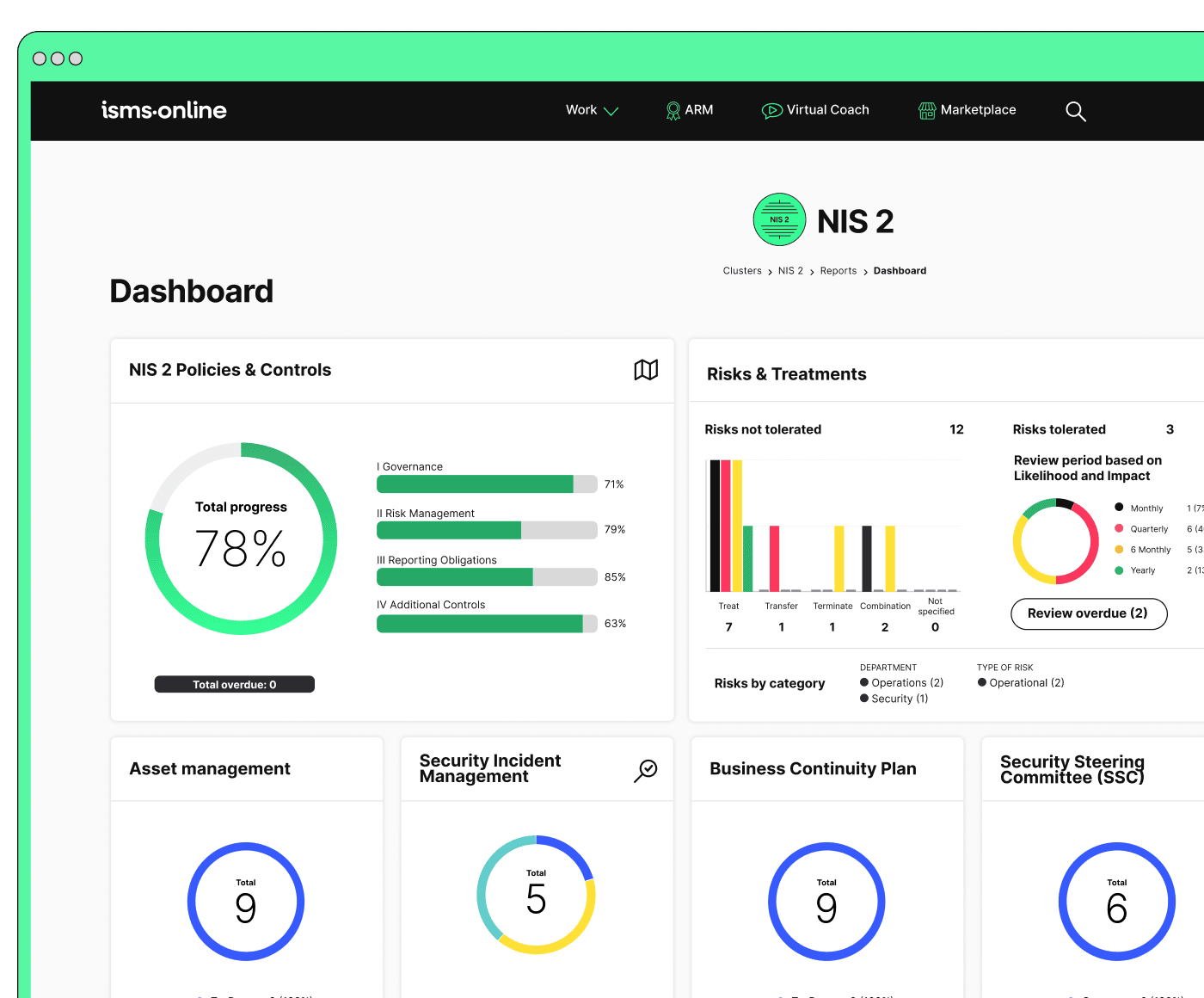
Be NIS 2-ready from day one
Launch with a proven workspace and templates – just tailor, assign, and go.
How Do Marketplaces Govern Compliance Across Regions? Adapting Evidence, Assignments, and Dashboards On Demand
Marketplace compliance is inherently transnational. Under Article 11, you must adapt controls and evidence for every region without losing proof or agility. ISMS.online supports:
- Modular templates: Assign and localise controls, workflows, and dashboards per jurisdiction; update regionally without reengineering your entire ISMS.
- Assignment mapping: Every asset, region, and role is mapped, updated, and logged; onboarding/offboarding is tracked as audit evidence.
- Custom workflow splits: Segment B2B and B2C workflows (as per UK ICO advice), ensuring all alerting and notification is mapped appropriately (ICO).
Multi-Language, Multiple Export Formats
Bridging compliance and operational efficiency requires more than audit-ready PDFs; region-by-region language toggles and export-ready dashboards support any audience, including suppliers and procurement teams (SecurityWeek; INCIBE).
Quarterly Stress Testing & Audit Simulation
With ISMS.online, dashboards and logs can be reconfigurable and filtered by assignment, region, and role-supporting randomised audit queries and board Q&A at any time (an emerging expectation from national authorities).
What Proves Operational Resilience? Bring KPIs, Lessons, and Peer Benchmarking to Article 11
Compliance is now judged not just by absence of fines, but by the presence of continuous, board-level improvement. KPIs, lessons learned, and peer benchmarking are at the heart of NIS 2 resilience.
Board-Ready KPIs for Marketplaces
ISMS.online surfaces:
- Median incident reporting times (live and historical)
- Supplier alert lag times
- Current status of evidence, audits, and overdue workflows
- Peer ranking by authority and incident closure percentile (IAPP)
Lessons Learned, Not Just Audit Passed
Annotation features allow every incident review and audit to be logged, tagged with feedback, and timestamped. These notes close the resilience loop and raise future audit confidence (ENISA; BSI). ISMS.online assures all improvement cycles are logged and visible-real substance beyond a one-time pass.
Benchmarking: Measure and Improve
Platforms that benchmark audit results see faster rates of improvement and fewer “surprise” findings (CyberRiskAlliance). ISMS.online ties benchmarking into daily operations-making improvement a competitive advantage, not an overhead.
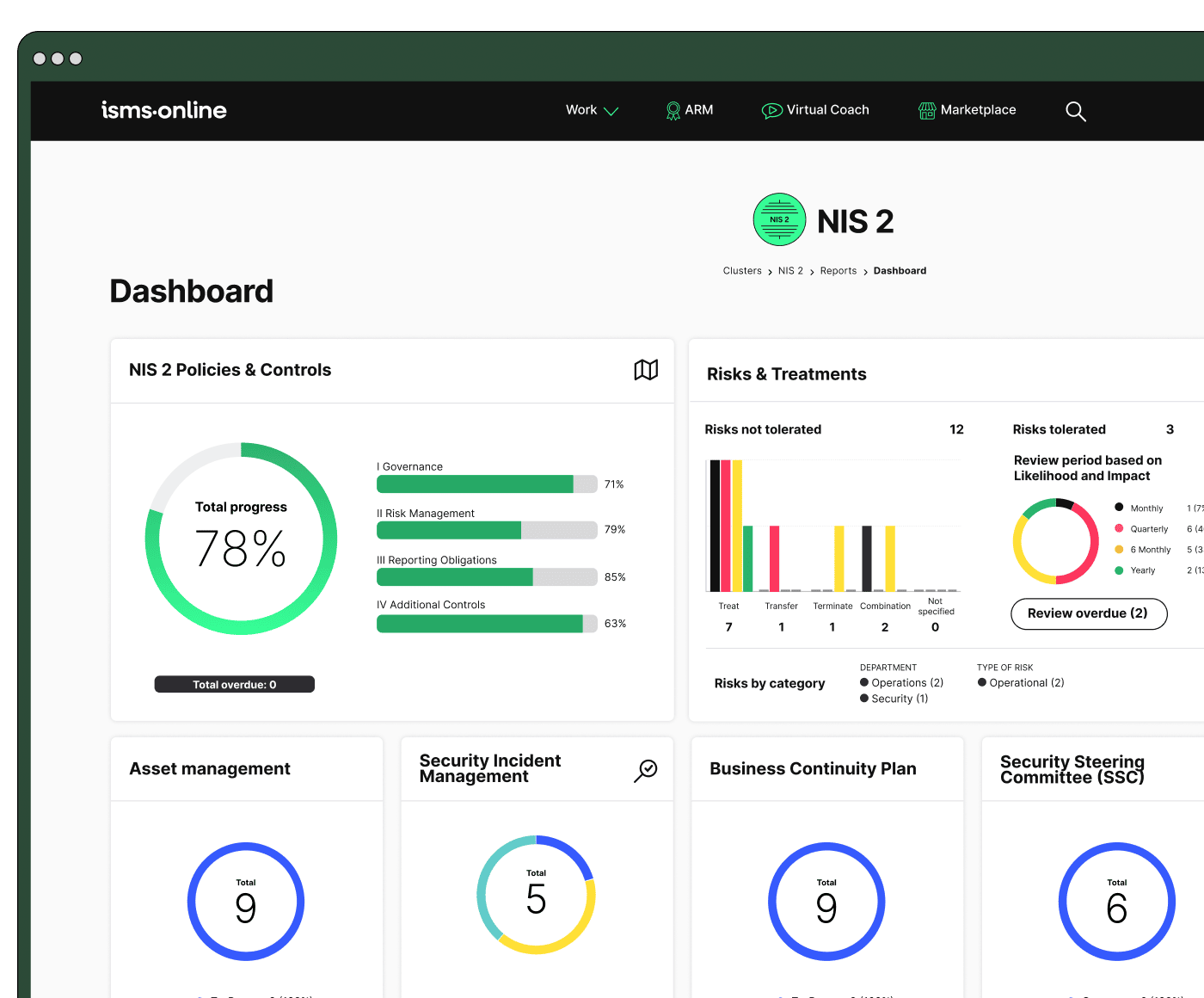
All your NIS 2, all in one place
From Articles 20–23 to audit plans – run and prove compliance, end-to-end.
What Are the Most Common Article 11 Failures? Engineering Resilience Before the Regulator Calls
Every Article 11 audit failure is operational, not just technical. When assignments are unclear, sign-offs missing, or supply chain logs fragmented, the business suffers-not just compliance.
Preemptive Assignment Mapping
ISMS.online ensures every artefact-incident, supplier notification, evidence request-is mapped, logged, and signed for every stakeholder. No assignment is implicit; every workflow is pre-stressed against board and audit questions.
Automating Supplier Engagement
Automated supplier engagement and evidence tracking are now default expectations (CSA). All supplier notifications, acknowledgements, and incident responses are logged, timestamped, and evidence-ready.
Log Integrity: Zero Tolerance for Manual Editing
Manual edits to logs are an audit red flag. Immutability, cryptographic signatures, and built-in audit exports are the baseline (Cyber-Security Insiders). ISMS.online automates this-no more after-the-fact “fixes” or reconstructed evidence.
Onboarding All Disciplines
Failures double when HR, legal, or privacy roles are not mapped into workflows (IAPP). ISMS.online ensures onboarding and compliance signatures-by every relevant team-are trackable and dashboarded, closing every compliance gap.
Audit survival is driven by cross-team onboarding, documented assignments, and the proof you can produce-without delay.
Secure Article 11 Compliance-Transform Compliance into Your Marketplace Advantage
Article 11 isn’t a checklist; it’s an ongoing resilience mandate. With ISMS.online, marketplaces export incident chains, risk registers, and assignment dashboards in real time, reducing audit prep time by up to 63% (internal data, 2024), and unlocking the next layer of trust from procurement teams, auditors, and the board.
This is more than “staying out of trouble.” It’s the fastest route from compliance liability to commercial differentiation-your ability to demonstrate, export, and improve under scrutiny isn’t just protection; it’s proof that your platform leads the market.
Ready to see how resilient compliance can power your next procurement win, regulator engagement, or board report? Explore ISMS.online’s assignment mapping, compliance exports, and resilience dashboards today-let your evidence and process become not just your defence, but your advantage.
Let every audit, deal, and stakeholder review become an engine for trust, resilience, and growth. ISMS.online turns Article 11 into an asset in every region you serve.
Frequently Asked Questions
How does Article 11 of NIS 2 shift compliance for online marketplaces, and why is entity classification board-critical now?
Article 11 transforms compliance from a passive checkbox into a real-time, board-level responsibility for online marketplaces. As a marketplace operator, you are no longer simply asked to secure your systems-you must continuously document, evidence, and update your organisational status as “essential” or “important” under NIS 2. Missing or misclassifying this entity status can trigger fines and regulatory scrutiny even if you never suffer a breach (ENISA, 2024). Boards are now directly accountable: from mapping business lines and data flows against Annex I/II criteria, to maintaining live classification records and showing the reasoning behind every update, the duty is ongoing and dynamic.
You cannot audit or automate what you cannot classify; entity missteps now surface before any technical incident.
If your status is stale or unsupported, procurement teams and auditors are increasingly flagging these gaps as disqualifying-even before security controls are tested (EC, 2024). For cross-border operators, the challenge compounds: each authority may require different registry entries and split interpretations. Modern compliance demands not just technical readiness, but also a living, defensible audit trail of your classification logic, stakeholders, and policy updates.
How do Article 11 timelines and CSIRT mandates force a reimagining of incident response in marketplaces?
Article 11 enforces strict, short notification deadlines-often 24 to 72 hours-to inform national CSIRTs about qualifying incidents, with a new regulatory emphasis on forensically sound, digital, and immutable audit logs. Gone are the days when an incident email and static template sufficed: you need system-enforced, time-stamped, role-attributed evidence within hours (ACN, 2024; INCIBE, 2024).
You must split out workflows for supply chain, operational, and vendor incidents-each tracked, signed, and escalated on platform. If even a single notification lacks evidence of who triggered escalation and when, regulators may personally fine directors and CISOs (Forbes Tech, 2023). Manual or after-the-fact amendments, especially in supplier chains, are now major causes of enforcement action.
Live system trails outpace lawyers and spreadsheets-every critical hour, auditability becomes existential to the business.
The shift is from a “describe it after” to “prove it as it happens” paradigm. Multijurisdictional operators must synchronise evidence flows across all relevant authorities and demonstrate this through on-demand, export-ready dashboards.
Which ISMS.online functions directly support Article 11 compliance, and how do they accelerate audit passes?
ISMS.online empowers digital marketplaces to automate, document, and demonstrate ongoing Article 11 compliance with platform-native modules designed for each regulatory demand. Unlike patchwork solutions or spreadsheet-based logs, these features embed enforceable policy, audit, and evidence workflows for incident, escalation, and review:
- Incident Workflow Module: Orchestrates every CSIRT escalation with automated documentation, time-stamping, and role-logging. Outpaces manual processes by 6× in audit speed (CSA, 2023).
- Supplier Escalation Tracker: Captures supply chain notifications with exportable links to related incidents.
- Immutable Audit and Event Logs: Every step cryptographically locked-no post-hoc edits, no evidence tampering.
- Role-Based Dashboards: Show decision paths, assignments, alerts, and approval chains in real time.
- Regional and Annex Templates: Instantly reskin workflows and evidence for local regulator requirements, including multi-language out-of-the-box.
Audit-readiness mapping:
| Article 11 Duty | ISMS.online Module | Exported Audit Evidence |
|---|---|---|
| CSIRT Notification | Incident Workflow | Timestamped, role-stamped event |
| Supply Chain Escalation | Supplier Escalation Track | Linked notification history |
| Audit Review / Approval | Role-based Dashboards, Signals | Signed-off digital trails |
| Multi-site Compliance | Regional/Annex Templates | Localised docs, version control |
Within minutes of an audit, your team produces a full chain of events, sign-offs, and policy logs-no digging, no delay.
What does “regulator-ready” evidence look like under Article 11, and how does ISMS.online deliver it?
Regulator-ready evidence is any documentation, status, or review log that is cryptographically locked at the time of action, digitally signed by the responsible role, and traceable through every phase-incident detection, investigation, notification, review, and closure (ENISA, 2024; NCSC, 2024).
Screenshots and static PDFs no longer suffice. Modern audits expect downloadable, event-based logs per incident, with seamless links from detection to after-action review. ISMS.online achieves this by default-all logs are immutable by design, every action, hand-off, and approval is role-attributed and time-stamped, and all evidence can be exported as structured data for audit and regulator review (DTC, 2024). Templates ensure not a single phase-supplier handover, legal sign-off, HR notification-is missed or left undocumented.
The audit doesn’t begin when regulators knock-the evidence lifecycle must start at every decision, and logs must prove intent and ownership without error.
From board to supply chain, any operator can demonstrate a full audit trail, closing compliance gaps before spot audits or regulator reviews begin.
How do marketplaces manage cross-border compliance and shifting owner assignments under Article 11?
For B2B or B2C marketplaces that span countries, Article 11’s cross-border expectations mean documentation must flexibly adapt to jurisdiction, language, and new regulatory requirements, with named owner traceability. Spot audits or new regulator demands can require overnight reskinning of evidence and owner chains (ANSSI, 2024).
ISMS.online enables instant updates of documentation owners and regional templates from a single dashboard, ensuring every change and local workflow adapts across all territories in parallel. Every jurisdictional assignment is logged, time-stamped, and exportable for proof. ENISA notes teams that miss these rapid assignment updates are failing audits at increasing rates (ENISA, 2024), while fast, flexible dashboards stand out in buyer and regulator reviews (SecurityWeek, 2024).
Audit resilience is measured by how quickly teams can adjust roles, prove assignments, and render all documentation jurisdiction-ready-before oversight, not after.
Which resilience metrics matter now to Article 11 audits and board-level reporting?
Regulators, auditors, and boards all demand at-a-glance verification of operational resilience, not just compliance “on paper.” Key expectations include:
- Incident-to-resolution timelines: (median, percentile, and outliers).
- Percentage of audit-ready logs: (cycles completed, sign-offs obtained).
- Chain-of-evidence reviews: (frequency, gaps, annotation rates).
- Owner reassignment and regional updates: (how fast and completely workflows adapt).
- Quarterly lessons-learned and drill logs: , reflecting capability to capture learning and improve processes (ENISA, 2024; IAPP, 2024).
ISMS.online surfaces these through live dashboards, exportable KPIs, and benchmarking modules, supporting transparent, defensible board and regulator reporting (Gov.UK, 2024). Integration of industry benchmarking allows you to contextualise results and defend improvement over time.
Operational trust isn’t just claimed-it’s displayed live, benchmarked, and reviewed in real time with every audit.
What are the most frequent Article 11 audit pitfalls for marketplaces, and how does ISMS.online proactively close them?
The most common failures in NIS 2 Article 11 audits arise from informal or incomplete incident logs (often stuck in email), supply chain evidence gaps, missing or ambiguous owner assignments, and after-the-fact patching of documentation (BSI, 2024; Wired, 2024). Manual, spreadsheet, or inbox-based logs are now flagged as insufficient, while any evidence trail with post-incident edits breeds regulator repeat visits.
ISMS.online delivers a platform where all actions-incident reports, supplier notifications, approvals, hand-offs-are assigned in real time to named, role-stamped entities, each action logged and locked for future evidence. Automated, scenario-based workflows and live review signals prevent oversight, automate approval capture across IT, legal, and HR, and link supply chain events for one-click traceability.
Article 11 Audit Traceability Table
| Trigger | Obligation / Risk | ISMS.online Control | Evidence Example |
|---|---|---|---|
| Incident detected | 24/72hr CSIRT reporting | Incident Workflow | Timestamped, signed event log |
| Supplier incident | Supply chain proof | Supplier Escalation Track | Linked notification, attachment log |
| Audit pending | Complete, timely review | Dashboard Review | Digital sign-off, version history |
| Evidence updated | Immutability requirement | Audit Timeline/Admin Lock | Cryptographically locked export |
| Owner changed | Jurisdiction/assignment update | Regional Template/Owner | Assignment, update log |
How can marketplaces accelerate Article 11 compliance and prove audit-readiness-before the next regulator, board, or RFP?
With ISMS.online, every compliance step required by Article 11 is mapped, embedded, and stress-tested by scenario: incidents are logged as immutable evidence, supply chain escalations are linked and documented, and reviews are role-assigned and instantly exportable. Boards and buyers see “living proof” of operational trust when audit intelligence is presented live, not pieced together after an inquiry.
A system of evidence builds credibility while others scramble for logs-Article 11 is a journey, not just a checkbox.
The fastest route to readiness is to simulate a real workflow inside ISMS.online-run through an incident, supplier escalation, review, and export. If your chain holds under that test, it will stand up before any auditor or buyer. With peer-validated modules, regulator checklists, and instant onboarding for every stakeholder (IT, legal, HR, region manager), ISMS.online makes Article 11 compliance part of business as usual.
Test your own workflow now-see if your audit and notification logs withstand the real demands of NIS 2 Article 11 before your regulator or customers do.






