





































How Does ISMS.online Transform TLD Registry Incident Handling Under NIS 2 Article 6?
Running a TLD registry places your organisation under a spotlight-ESPECIALLY as NIS 2 now tightly defines what counts as a “reportable” incident and expects nothing less than demonstrable, real-time control. Most registry leaders fear the uncertainty in the threshold. Is this small outage the one that triggers legal escalation? Should this configuration blip reach the regulator-or is it just routine? One thing is clear: the boundary between a compliance win and a disciplinary letter often rests on how quickly, accurately, and repeatably you identify and document incidents.
ISMS.online fundamentally changes the game: every asset, action, and threshold is mapped and embedded into your incident response, so you always know what the law expects-no gut feeling required. There is no room for confusion about which incident needs notification; ISMS.online overlays Article 6 criteria (availability, integrity, authenticity, confidentiality of registry data and systems) and ENISA best practise into your operational reality. Even subtle transitions-like asset ownership changes, operator switches, or ad hoc workarounds-are logged and recalibrated instantly for risk level, notification needs, and legal defensibility.
Clarity at the moment of detection is what separates response from regret.
By embedding ENISA’s latest incident typology and national regulator guidelines into dashboards, teams avoid false positives and ensure that only the right events are escalated. For asset types such as ccTLDs, stricter rules trigger higher scrutiny and more granular documentation flows. ISMS.online adapts escalation matrices by asset and operator automatically, closing the audit gap before it opens. Routine system glitches are logged but quarantined, ensuring you compile a comprehensive operational record without polluting your legal reporting surface. Crucially, database and interface handovers (often a breeding ground for silent failures) are reinforced with role mapping and notification prompts-if an operator or asset changes, so does the compliance trace, without manual intervention.
Make every incident trigger defensible with living context, not static checklists. Your registry steps into audit with live “what happened, who did it, how was it closed” clarity-delivering not just reporting, but reassurance to board, regulator, and customer alike.
What Is the Step-by-Step, Audit-Ready Response for Article 6 Incidents Using ISMS.online?
One of the greatest challenges for any TLD registry operator is knowing that response delays, ambiguity in role ownership, or murky status updates can rapidly escalate from a technical hiccup to a reputation crisis. Every board, risk committee, and national regulator now expects near-instant reaction, crystal-clear proof, and evidence that stands up during both the incident and any future review.
ISMS.online provides a backbone of time-stamped, assigned, and auditable workflows that move your team from reactive to proactive. The process begins with continuous incident monitoring mapped directly against NIS 2 and ENISA definitions. Significant incidents-disruptions to DNSSEC, unauthorised change events, persistent abuse, and any high-confidence data integrity compromises-are automatically flagged, logged, and moved through a rapid triage and escalation channel.
The first 60 minutes of response decide months of regulatory conversation.
Every incident is immediately owned by a named operator, with backup assignments for handovers across shifts, holidays, or time zones. This undercuts the classic “shared inbox” trap-no more audit-day finger-pointing or “I thought someone else was on it” confusion.
Under NIS 2, reporting thresholds often require early notification to regulators (typically within 24–72 hours, or as otherwise mandated by your National Cyber Security Authority). ISMS.online workflow logic pushes out deadline reminders, auto-fills sections of the legal incident report, and prompts supplementary filings when incident boundaries or regulator requirements change mid-response.
Status change triggers matter. An incident is rarely static (and neither are the regulator’s expectations). As lessons are learned or additional evidence surfaces, ISMS.online prompts updates, files interim reports, and times every action. Should evidence be required forensics months later, a full timeline-detection through closure, staff escalations, vendor and supply chain handover, board oversight-lies at your fingertips. For multi-vendor, multi-timezone operations, ISMS.online ensures all third-party handlers are notified, logs are updated, and SLA compliance is evident-making you resilient to blame games or missed escalations.
Escalation is only real when you close the who and when gaps for every link in your supply chain.
The final result is a living stepwise evidence log-ready for board management review, regulator inspection, or independent assurance at a moment’s notice. You retain trust capital not by intention, but by proof delivered in real time.

Master NIS 2 without spreadsheet chaos
Centralise risk, incidents, suppliers, and evidence in one clean platform.
Can You Proactively Map TLD Registry Assets and Assign Responsibility to Prevent Compliance Gaps?
If there’s a single, recurring pain for registry compliance and security leaders, it’s not a blindspot in detection-it’s the creeping grey zone in asset ownership. A missed provider, an untagged record, a staff transition that’s lost in email: even world-class systems creak under the stress of fragmented asset-to-ownership mapping. Acute incidents become chronic regulatory risks, and audits surface gaps that cost fines, trust, and supplier relationships.
ISMS.online makes this a solved problem. Every asset-zone file, DNSSEC key, registrar liaison, glue record-is mapped to explicit owners and reviewers. Real-time RACI matrices (Responsible, Accountable, Consulted, Informed) are updated in the dashboard interface, rendering asset and incident visibility across operations and compliance tracks.
Ownership is only real if it’s visible, enforced, and regularly revalidated.
Supply chain dependency is a persistent stress. When key DNS services, registrar functions, or compliance processes rely on vendors or external service providers, full traceability becomes non-negotiable. With ISMS.online, every linked third-party contract and notification SLA is anchored to real asset and incident registers, so if an escalation falls flat, you immediately see where the accountability chain snaps.
Handover events are forensic: every staff, vendor, or administrator transition is confirmed by time-stamped acceptance and automated evidence of review. No handover gap, however subtle, can escape your audit trail.
Collaboration friction is a common source of error: operations want to move fast; compliance needs careful sign-off; both need up-to-the-minute insight into “what’s next”. ISMS.online bridges this with real-time, checklist-driven workflow, prompting each required review, sign-off, or notification-ending the “wait, who was supposed to…?” guesswork.
Automated, scheduled, and ad hoc asset audits surface shadow IT, forgotten DNS entries, and legacy code-giving registry leaders a continuous sense of visibility, all monitored and recorded for audit and review. Every “rogue” asset is assignable and reviewable, making regulatory risk a known, not hidden, quantity.
How Does ISMS.online Automate Incident Evidence and Close Manual Reporting Gaps for TLD Registries?
Manual logging remains the weak link in most registry incident processes-a misfiled email or an unchecked status box can leave months-long gaps that create regulatory pain and erode board and regulator trust. Whether through staff turnover, a vendor change, or simple human error, lack of a single, automated chain of evidence is a leading reason for failed audits and regulatory warning letters.
ISMS.online replaces manual reporting with automated, role-based, and workflow-driven logic. Every incident response action is a prompted task, linked to due dates, auto-reminders, reviewer signatures, and full cross-referencing with contract/SLA or legal notification deadlines.
Most NIS 2 penalties are for evidence that’s missing-not evidence that proves blame.
Notifications-whether to national authorities, CSIRTs, or embedded supply chains-are sent within the system, time-stamped, and version-protected, ensuring nothing slips through the cracks. Mutable logs are a thing of the past; instead, you own a complete, immutable chain of custody for every incident and review.
Evidence is continually available to every layer of registry management. Dashboards present timeline snapshots-detection, escalation, handover, remedial action, closure-with each node exportable for board packs, regulator submission, or legal reassurance.
Vendor and supply chain actions receive automated notification prompts and requisite compliance reminders. Whether coordinating a multi-supplier migration or tracing a registrar escalation, evidence is always up to date and audit-ready.
Even unplanned, crisis-driven actions-such as emergency fixes or fire-fighting interventions-are logged, date- and user-stamped, and directly added to the incident evidence pack. Routine becomes the foundation of defensibility.
ISO 27001/Annex A Table – Incident Handling Snapshots
| Expectation | Operationalisation | ISO 27001 / Annex A Reference |
|---|---|---|
| Ownership mapped for every asset/event | RACI matrices, role-mapped dashboards | A.5.2, A.5.3, A.5.7 |
| Notification within strict deadlines | Automated reminders, timestamped logs | A.5.24, A.5.26, A.5.27 |
| Immutable, defensible evidence trail | Version-controlled export, custody chain | A.5.28, A.9.1, A.9.2 |
| Supplier/3rd-party chain covered | Cross-mapped notifications, onboarding | A.5.19, A.5.20, A.5.21 |
| Audit reporting and exports | Live dashboards, PDF-downloads, evidence logs | A.9.3, A.10.1 |
Indexing evidence to each control closes the loop between technical action and audit/board expectation-with every action just a click away.
Traceability Mini-Table – Risk Event Pathway
| Trigger | Risk Update/Action | Control / SoA Link | Evidence Logged |
|---|---|---|---|
| DNSSEC outage detected | Ownership escalation, root notified | A.5.24, A.5.26 | Timestamped incident log |
| Vendor migration | Asset owner reassignment, review | A.5.2, A.5.19 | Asset handover/exported log |
| Repeat late alert | Task for recurring issue review | A.9.1, A.9.3 | Action log, meeting minutes |
| Upstream DNS abuse | Supplier escalation, event record | A.5.21 | External evidence chain |
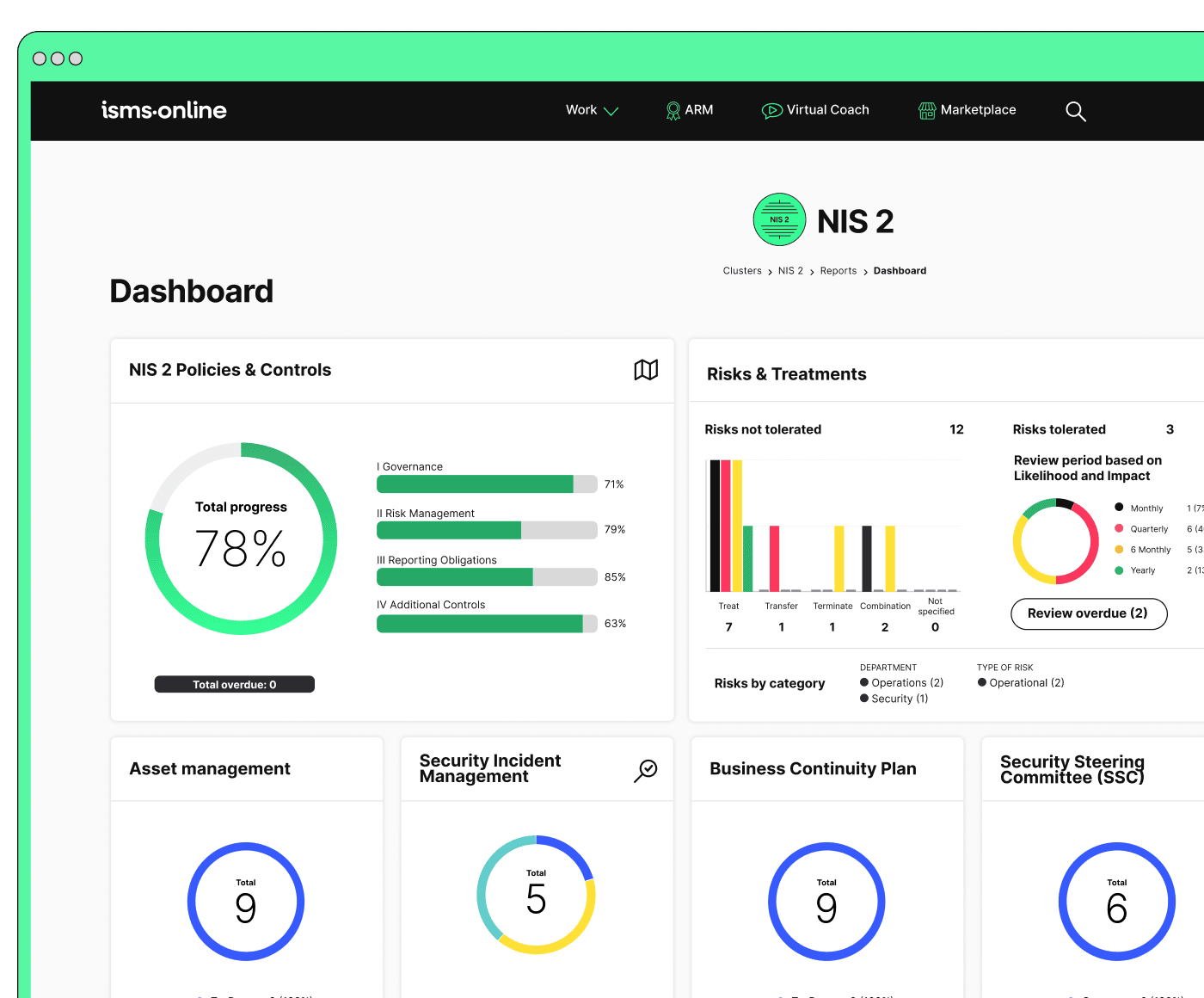
Be NIS 2-ready from day one
Launch with a proven workspace and templates – just tailor, assign, and go.
What Defines Real-Time “Board and Regulator-Ready” Compliance for TLD Registries?
The global push for transparency (under NIS 2 and beyond) means simply having logs isn’t enough-your board, CISO, and national authorities now expect live dashboards, real-time evidence chains, and auditable proof that no incident goes unrecognised or uncorrected. Anything less, and regulatory trust is eroded before the audit even begins.
ISMS.online brings every KPI-incident closure time, overdue handovers, monitoring bottlenecks-to the surface in an instantly digestible format. No hidden reports or “wait until end-of-quarter” catchup: each status, evidence chain, and assigned role is always current, always export-ready for board or regulatory review.
Resilience is proven by instant transparency, not quarterly reviews.
With 24/7 supply chain and internal mapping, no incident-internal, supplier-driven, external-can fall into a blind spot. Automated reminders, escalation logs, and dashboard signals ensure every action, update, and gap is surfaced for immediate correction or learning.
Dashboards also refine what matters for senior stakeholders: only the events that affect risk, compliance, or operations appear in the default board view, while deeper logs are always just a click away for auditors or investigators. Export functions ensure evidence is fit for external reviewers, not locked up in a proprietary or opaque format.
Crucially, each reviewer (internal or external) is prompted for sign-off in every workflow-no action remains orphaned or unsigned-off. The system lets you trace every oversight, escalation, approval, and compliance checkpoint in real time.
How Does ISMS.online Demonstrate “Audit-Ready” Regulator Defensibility at Every Step?
In an era when every major registry operator faces scrutiny at board and regulatory level, the old paradigm of “good intentions” in compliance no longer holds. To pass-and stay ahead-what matters is a demonstrable track record where each action, status update, or handover is logged, exportable, and mapped to its requirement or legal clause.
Defensibility here means that every compliance sponsor and audit facilitator can show-immediately, and without panic-where, when, and how each requirement under Article 6 was met. With ISMS.online, workflows are built from the same template regulators use, mapped line-by-line to ENISA and local authority formats.
Defensibility is peace of mind-it’s the difference between an audit win and a warning.
After-action reviews and lessons learned, often neglected, are methodically linked back to original incidents, giving your auditors and board a direct line from event to improvement.
Archival is strict and future-proof. Whether six months or six years later, every notification, handover, and change approval is retrievable-sealed with an immutable time stamp and protected against later tampering or accidental deletion.
No supplier exit, staff transition, or asset migration leaves behind a “missing” record. ISMS.online’s custody chain ensures every step-upstream, downstream and internal-is documented.
The result: measurable improvement in audit outcomes and regulator trust. Clients using ISMS.online for TLD registry incident resilience see significantly higher audit acceptance and speed of evidence delivery, making their compliance a tangible asset rather than a source of stress.
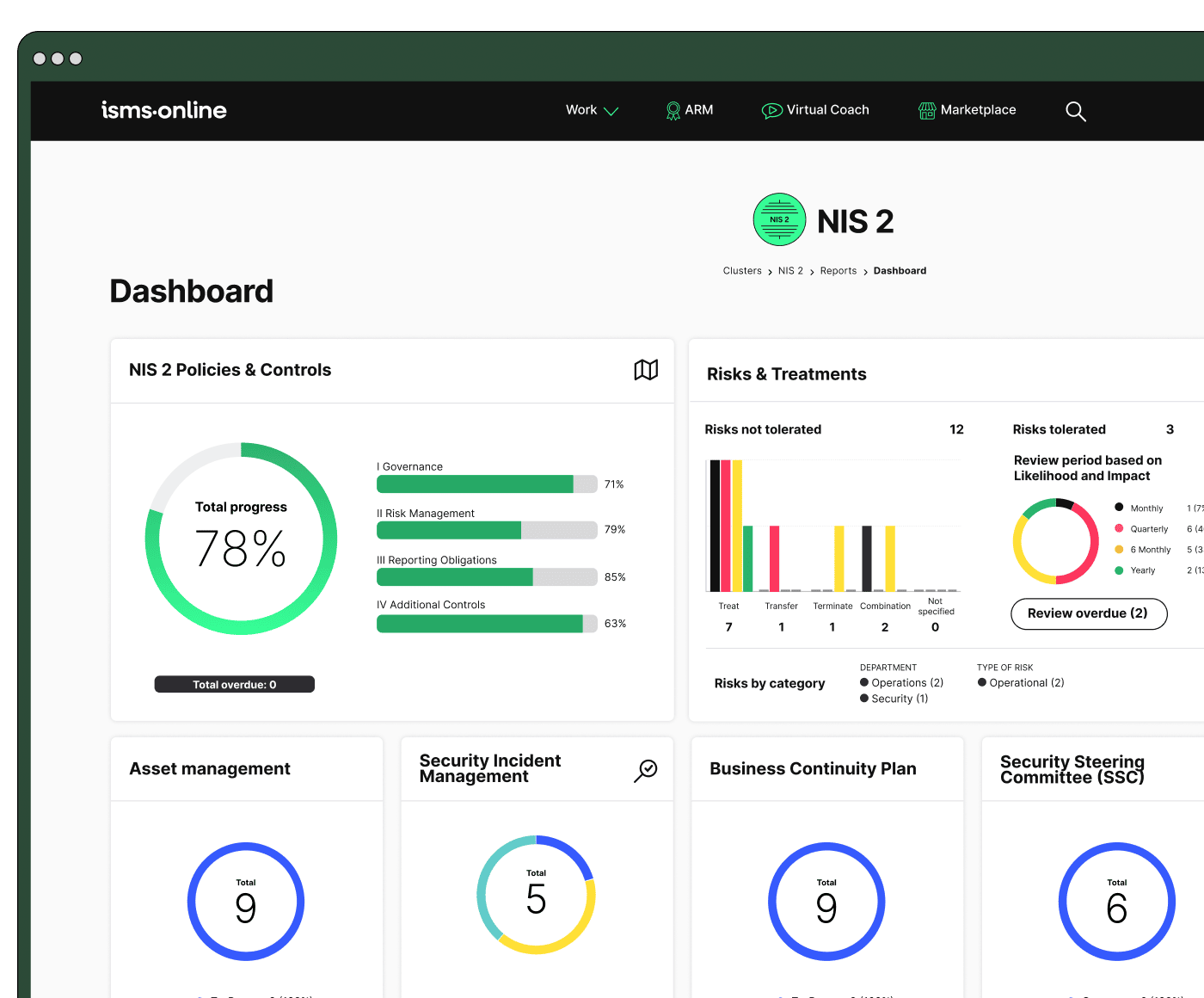
All your NIS 2, all in one place
From Articles 20–23 to audit plans – run and prove compliance, end-to-end.
How Is Continuous Improvement Embedded in the Incident Handling Loop and Management Review?
True TLD registry maturity-in compliance, reputation, and governance-rests not on one-off “incident passes” but on a cycle of continuous improvement. For compliance sponsors and review facilitators, the challenge is to tie each incident not just to resolution, but to verifiable, review-ready metrics: lessons learned, controls adjusted, gaps closed.
Every lesson learned linked to an incident is a reputational asset for your management reviews.
ISMS.online brings these cycles together. Each remediation action, control adjustment, or policy learning is logged per incident, linked by dashboard to management review sessions, and benchmarked against prior cycles.
Overdue tasks, process bottlenecks, and recurring issues are surfaced-making both audit preparation and cultural improvement visible, not accidental. Real-time metrics (task closure rates, time-to-remediation, incident closure) can be pulled for annual, board, or “on demand” reviews-enabling external advisors and peer registries to benchmark your process.
Increasingly, external governance advisers recommend-under NIS 2 and best practise-that management reviews are linked directly to platform evidence. ISMS.online enables this, making every improvement and after-action review a living, scored asset in your compliance journey.
Why Does Real-Time Evidence and Incident Resilience Matter for Boardroom Trust and Technical Excellence?
Great registry operators know: excellence in compliance isn’t just about preventing negative headlines-it’s about actively earning the trust of boards, regulators, and the wider DNS ecosystem. It’s not authority that drives resilience, but how you operationalise and evidence every critical step.
ISMS.online lets your registry move from fire-fighting to credibility-building. Live dashboards give executives rapid visibility into risk, asset ownership, open incidents, and improvement trajectories-no more lag, no more hidden bottlenecks. With each incident, after-action, and remediation tied to real controls and exported to relevant standards, you establish a competitive edge and solidify regulatory trust.
The highest form of trust is proactive proof-where management, board, and regulator all see every step before they ask.
Your team becomes known for demonstrating resilience in the face of disruption-not improvising under duress. The evidence you present during audits, reviews, and routine operations becomes the narrative of your board’s governance story.
Experience the difference of a living ISMS.online compliance dashboard for your registry-where trust, accountability, and technical excellence are embedded into every click and every outcome.
Ready to See How ISMS.online Delivers Board-Ready, Audit-Proof Registry Compliance? (Identity CTA)
Your registry’s reputation and business value depend on staying a step ahead of both disruption and the regulatory curve. Whether you’re an operational lead, compliance sponsor, board member, or technical practitioner, ISMS.online delivers a living platform where every incident, escalation, and improvement is traceable, role-owned, and regulator-ready. Don’t let confidence rest on incomplete evidence or hope-see real compliance in action.
Equip your team, reassure your board, and raise your standing in the DNS community. Request a tailored ISMS.online demo, review live incident evidence exports, or ask for a walk-through of your registry dashboard-and discover how trust and resilience become your default.
Frequently Asked Questions
What incidents must TLD registries report under NIS 2 Article 6-and how is “significance” determined in practise?
TLD registries must report any incident that poses a significant threat to the availability, authenticity, integrity, or confidentiality of their core systems or domain data, especially where this could disrupt public services, user trust, or operational continuity. Under Article 6, “significant” means more than a routine glitch-it involves events such as DNS outages that last longer than one hour, unauthorised changes to critical DNS records, compromise of registry credentials leading to broad access risks, or incidents that reach across jurisdictions or sectors. The practical threshold is risk-driven: incidents triggering service outages, impact to multiple customers or domains, or requiring cross-border notifications meet the bar. ENISA’s reinforce that “significant” is defined by operational, regulatory, or economic consequences, not just technical severity (NIS 2, Article 6).
Every minute you delay reporting a major registry incident is a minute your public trust is quietly eroding.
ISMS.online operationalizes this by embedding ENISA thresholds and “significance” matrices into its incident workflows. As soon as a registry event matches a reporting criterion, automated triggers launch the escalation-reducing ambiguity and mitigating the risk of missing a regulatory deadline.
ISO 27001 Bridge Table – Incident Reporting
| Audit Expectation | ISMS.online Response Workflow | ISO 27001/Annex A Reference |
|---|---|---|
| Timely incident alert | Automated detection, real-time triggers | A.5.25, A.7.9 |
| Role-based reporting | Owner assignment, audit trail | A.5.26, A.7.8, A.5.7 |
| Regulatory SLA | 24/72hr notification escalator | A.5.36, A.8.13 |
How does ISMS.online automate the incident lifecycle and ensure audit-readiness for TLD NIS 2 compliance?
ISMS.online streamlines the incident lifecycle for TLD registries so that every incident is mapped, monitored, and proved audit-ready-start to finish. Detection can be system-driven (from SIEM input, monitoring integrations, or platform users). Workflow rules then auto-assess if an event is NIS 2 “significant”, assigning owners using RACI matrices and launching role-based escalation.
If significance is confirmed, NIS 2 notification clocks start (24hr for CSIRT/advisory notice, 72hr for fuller reporting). Evidence-alerts, actions, communications, and handovers-is captured automatically. Every management or supplier handover, policy change, or board decision becomes an immutable record linked to your SoA and contracts. Closure cycles (root cause, lessons learned) are embedded, so you can always prove incident closure, not just resolution.
Incident Traceability Table
| Trigger | Risk Update | Control / SoA Link | Evidence Logged |
|---|---|---|---|
| DNS service outage (>1hr) | Service continuity | A.8.13, A.7.11 | Downtime event, ticket log |
| Unauthorised zone edit | Data integrity alert | A.5.25, A.8.8 | Change log, registry audit |
| Registry credential leak | Confidentiality risk | A.5.16, A.5.17, A.7.8 | Forensic snapshot, notification |
Which KPIs and dashboards reflect real-time NIS 2 Article 6 compliance for registries?
ISMS.online translates Article 6 requirements into live dashboards built for registry operations, compliance teams, and board review. Key metrics include:
- Mean Time to Response (MTR): Median time from detection to first action-target is <2 hours.
- 24h/72h Notification SLA: % of incidents reported within regulation: aim for 100%.
- Asset/Owner Mapping Completeness: Shows whether every system or interface is assigned; target >98% accuracy.
- Audit/Export First-pass Rate: % of incident summary exports accepted by auditors or CSIRT on first review (>90% ideal).
Dashboards flag overdue steps, highlight gaps in asset attribution, and display evidence export success rates. Trend lines reveal process improvements or repeating handoff bottlenecks, equipping you to act before audits or board reviews expose a weakness ((https://www.isms.online/frameworks/nis2/)).
Metrics at a Glance
| KPI | Target |
|---|---|
| Mean Time to Response (MTR) | <2 hours |
| 24h/72h Notification Compliance | 100% |
| Asset/Owner Mapping Accuracy | >98% |
| Evidence Export First-pass Success | >90% |
What supply-chain and escalation risks are unique to TLD registries, and how does ISMS.online address them?
TLD registries operate with complex, distributed supply chains-spanning global DNS operators, legacy partners, and federated registrar infrastructures. The main risks are orphaned assets (unassigned nameservers, DNSSEC keys), accountability gaps after supplier changes, or loss of visibility across jurisdictional handovers. Audits now routinely flag these “responsibility breaks” as critical risks.
ISMS.online’s RACI mapping ensures that every asset, credential, and process maintains a living owner and role trace, visible and updateable in real time. Onboarding/offboarding triggers automatic contract/RACI reviews. Changes create immutable log entries, and all handovers/escrow events can be escalated, flagged, and confirmed by both internal staff and third-party partners. Analytics pinpoint where supply-chain lags or “broken chains” raise risk, enabling corrective action long before audit time.
Supply Chain Escalation Table
| Event | Usual Weakness | ISMS.online Safeguard |
|---|---|---|
| Vendor offboarding | Orphaned registry asset | Automated RACI & contract check |
| API compromise | Blurred incident ownership | Owner-mapped escalation workflow |
| Cross-border update | Time lag, missed notifications | Real-time confirmations, reminders |
How are regulator-ready evidence exports structured for ENISA/CSIRT/board reviews?
Every step-detection, notification, handover, remediation-is captured with a time-stamp and owner via ISMS.online’s export packs. Each pack aligns with ENISA/CSIRT templates, bundles all required evidence, and links every event to your Statement of Applicability (SoA), contracts, and system logs.
Exports can be filtered by incident type, severity, or recipient (auditor, CSIRT, board). Timestamps show every notification and acknowledgement. Closure notes and root cause reviews are attached for five-year traceability. No more last-minute evidence scramble; every action is regulator-ready the moment you need it ((https://www.isms.online/product/tour/incident-management/)).
When you can trace every handover and notification, audit anxiety is replaced by boardroom assurance.
How does ISMS.online support automated NIS 2 notification and cross-border CSIRT integration-and why is this critical?
NIS 2 expects not just fast notification-but automated, cross-border, and error-free reporting. ISMS.online includes prebuilt connectors (API, secure webhook, standards-driven email) to transmit incident metadata in real time once significance is determined, meeting every jurisdiction’s field requirement. Board, CSIRT, or regulator replies-advisory, escalation, closure-are mapped back into your incident chain for unbroken proof.
This bi-directional compliance trail supports both national and EU-multistate events. Real-time alerts prevent missed deadlines, while ongoing chain updates prove not only compliance, but operational competency in incident management.
Ready to replace reporting panic with automated proof? Experience ISMS.online’s Article 6 NIS 2 export or see your registry’s compliance risk turned into a reputation asset-request a demo or export sample today.






