





































Are You Testing Often Enough for NIS 2? Destroying the “Annual Checkbox” Myth
Every cyber-security leader knows the feeling: the calendar turns, audit season looms, and the urge is strong to schedule just another annual penetration test or red team exercise-because that’s what has always “ticked the box.” But for anyone chasing compliance with NIS 2, DORA, or even ISO 27001, the old patterns have snapped. The question no longer revolves around “How often is enough?” but “How decisively can you prove your logic, readiness, and resilience-under live scrutiny?” Regulators now demand evidence of a defensible, risk-based cadence, not repetition of a calendar ritual. Whether you’re an ambitious Kickstarter, a seasoned CISO, or a privacy/legal specialist anticipating audit questions, it’s time to rewrite the rules of compliance testing.
Old calendars don’t protect against new threats-your testing must move with your risk, not your tradition.
The shift isn’t subtle. European directives, especially NIS 2, now expect your scheduled and ad hoc tests to directly reflect current risk, business priorities, and dynamic operational or supply chain changes. External benchmarks-ENISA, Gartner, and practical ENISA toolkits-repeat: demonstrate adaptability, not inertia (enisa.europa.eu; gartner.com). Static annual cycles are risky: perform a pen test in Q3, get breached in Q4, and you’ll quickly find that “calendar-based compliance” collapses under regulator review or after a security incident.
If you want your compliance team to inspire confidence in front of auditors, boards, and your own legal counsel, the solution is to pivot to a logic-first, stakeholder-ready testing regime-one that stands up to any challenge, not just the predictable ones.
Does “Regular” Testing Mean the Same Thing for Your Business, Sector, and Jurisdiction?
It’s easy to imagine that “regular” testing is just an annual event, or perhaps biannual if you’re especially risk-averse. But in reality, the word “regular” is kaleidoscopic-changing shape as it passes through sectors, national authorities, and overlapping standards like DORA and ISO 27001. A financial institution under DORA faces an explicit minimum: threat-led penetration testing (TLPT), using external teams, every three years-sometimes more if mandated by supervisors. Many national authorities transpose NIS 2 with stricter overlays: Belgium expects annual external pen tests, while Ireland may require telcos to test every six months, and Germany or France add further nuances.
What’s ‘regular’ in Brussels isn’t ‘regular’ in Berlin or Dublin-your schedule is only defensible when mapped to current rules and sector risks.
ISO 27001, meanwhile, rewards judgments that reflect the real world: scheduled and event-driven (ad hoc or incident-triggered) tests, justified each time by documented risk logic-not just old habits. International organisations quickly encounter friction if they apply the lowest standard everywhere: harmonisation is an ongoing process, not a one-off fix.
The savvy move for cross-border teams is a dynamic testing register that, at a glance, shows how frequently each asset, jurisdiction, or business process is tested, cited against internal policies and every relevant legal overlay. This register doesn’t just keep auditors happy-it insulates you against regulatory drift and the dangerous surprise of a failed compliance check after a change in law or business structure.

Master NIS 2 without spreadsheet chaos
Centralise risk, incidents, suppliers, and evidence in one clean platform.
How Do You Maintain Schedule When Vendors, Auditors, and Regulators Don’t Sync?
Testing cycles break more from operational friction than regulatory logic. Holiday periods, vendor backlogs, supply chain incidents, and unsynchronized national rules can derail even the best made plans. Authoritative sector data reveals almost 40% of major pen tests or red team exercises are rescheduled, delayed, or fragmented due to resource constraints, business disruptions, or vendor bottlenecks. The challenge multiplies in federated organisations: a DORA-triggered event in Spain, a NIS 2-driven demand in France, and suppliers in Singapore-all needing alignment.
You can’t always control vendor availability or regulation, but you can make your escalation and documentation process bulletproof.
Leading teams adopt a rigorously escalated, transparent, and documented approach. Early flagging of scheduling risks isn’t just an internal act but a governance requirement: log every deviation, missed window, or risky deferral in your ISMS or risk management system, with assigned owners and time-stamped rationale. When an incident or supply chain shock hits, a visible log-auditable by management and the board-proves you were in control, even amid chaos.
Assigning clear ownership, building buffer time into cycles, and using ISMS tools to automate reminders and evidence capture are the new best practises. Even when regulators aren’t fully harmonised, centralising schedule control reduces audit failure risk, improves resilience, and readies you for post-breach scrutiny.
When Should You Override the Calendar and Test Early? The “Risk-First” Model
One-size-fits-all scheduling belongs to the past. A pen test due every November is almost meaningless if you’ve launched a new customer portal in July or completed a business acquisition in March. Risk-driven testing frequency should flex with your business’s real heartbeat: core apps, customer interfaces, and “crown jewel” infrastructure warrant more frequent, even unscheduled, attention.
Testing is strongest when triggered by risk, not routine-a platform launch or supply chain change today trumps a calendar reminder tomorrow.
There are three major triggers for “emergency” or out-of-cycle testing:
- Security incident or breach: in a material system always calls for immediate testing and risk review-postponing invites regulator suspicion and board anxiety.
- Material change: , such as cloud migrations, new products, supplier onboarding, or significant architectural modification, demands ad hoc pen tests or full red team exercises.
- External pressure: -regulators, customers, or partners may require proof of testing well before your cycle says it’s “due.”
Balance remains essential: too frequent “over-testing” drives up cost and resource fatigue; under-testing leaves blind spots and hard-to-defend audit exposures.
Here’s a practical mapping of risk-perceived triggers to your test cadence and actions:
| Trigger Event / Situation | Cadence Decision | Action (Evidence Path) |
|---|---|---|
| Cloud migration (Q2) | Advance red team to pre-move | SoA, Risk log, test results attached |
| New core app-customer-facing | Ad hoc pen test within 30 days | Control A.8.8/ A.8.29 evidence linked |
| Major supplier replaced | Pen test of new chain pre-go-live | Third party controls; Board sign-off |
| Regulator submission request | Immediate evidence review/ prep | Compliance pack, exception note if needed |
Review and iterate on each trigger, linking to not just policy but operational outcomes, learning logs, and corrective action cycles.
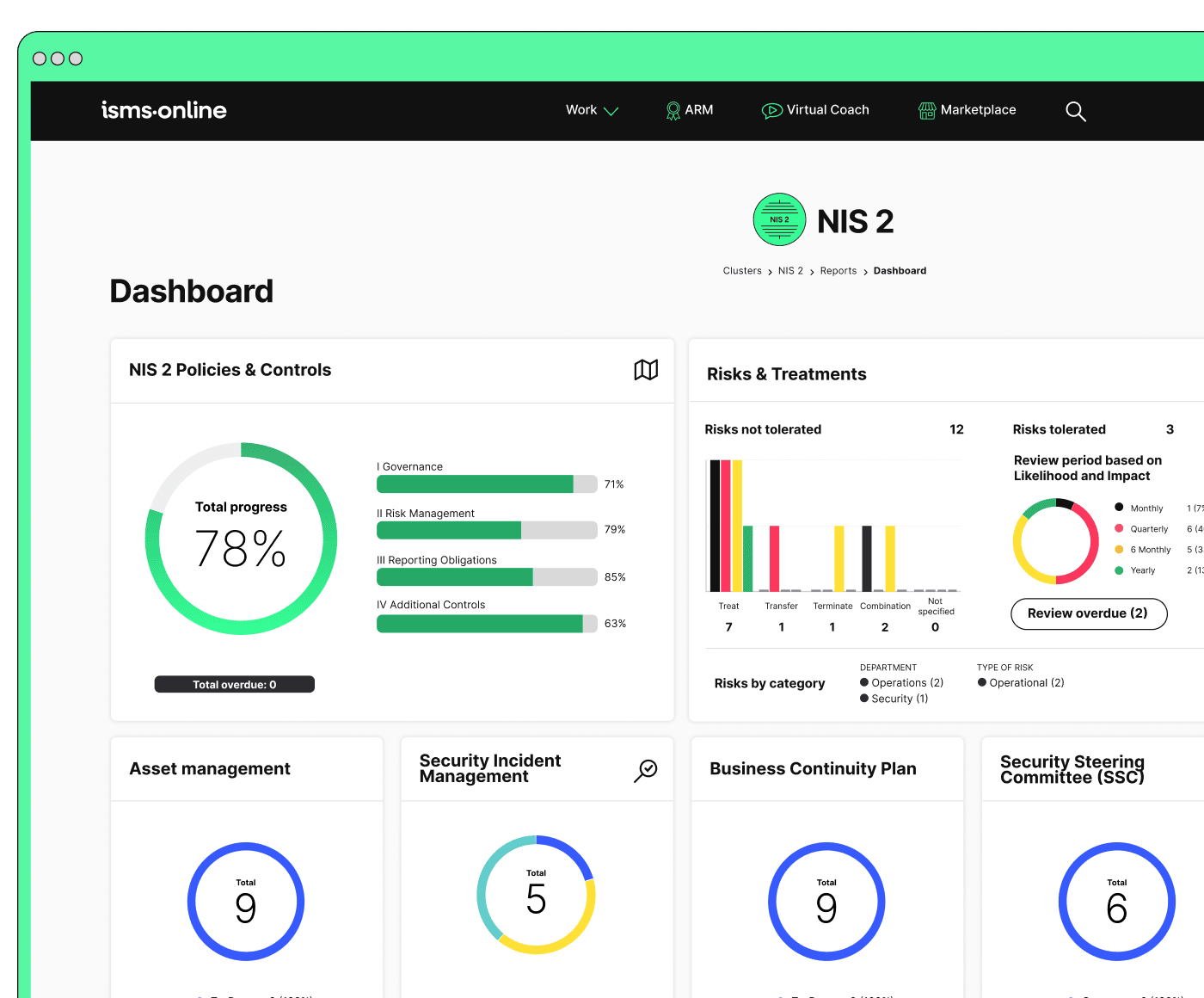
Be NIS 2-ready from day one
Launch with a proven workspace and templates – just tailor, assign, and go.
What Does ISO 27001:2022 Demand for Test Frequency-And How Do You Translate Expectation to Evidence?
ISO 27001:2022 marks a sharp turn away from “ritualised” audit cycles. Its centre of gravity is in defensible decision-making-the ability to justify both planned intervals and every exception, mapped against changing risks, assets, and threat landscapes.
Here is a concise operational bridge to audit-ready evidence for top ISO 27001 requirements:
| Expectation | ISMS Operationalisation | ISO 27001 / Annex A Ref |
|---|---|---|
| Planned intervals | Testing calendar + explicit rationale for every change | Cl. 9.2, 9.3, A.8.8 |
| Risk-based cadence | Risk register links, per asset/process decision | Cl. 6.1.2, A.5.7 |
| Documenting exceptions | Management-approved log for changes to cadence | Cl. 8.1, 9.3, 10.1 |
| Complete audit trail | Pen test report archive + owner, date, action log | A.5.26, A.8.14 |
| Continuous improvement | Lessons learned / corrective & preventive actions logged | 10.2, A.5.27 |
| SoA linkage | Every cadence, deferral, or test mapped into the SoA | SoA, A.5, A.8.29 |
Organisations advanced in ISO 27001 practise automate audit reminders, role assignments, escalation triggers, and evidence collection. Your SoA, corrective actions, and risk registers should reflect live decisions-never static documents, but version-controlled evidence of every cycle, exception, and improvement.
Auditors now seek logic over ritual-they want to see your decisions, evidence, and lessons at every turn.
How Can You Prove Testing and Response Workflows Are Linked, Live, and Audit-Ready?
Having an incident response on paper and actually running it are different worlds. Audit-grade trust depends on this traceability: each risk trigger (incident, change, external demand) must be loggable, schedulable, and evidence-rich, connected end-to-end from the board room to the security and operations frontlines.
Here’s a minimal, audit-friendly traceability matrix for dynamic testing:
| Trigger | Risk Update | Control / SoA Link | Evidence Logged |
|---|---|---|---|
| New supplier onboard | Risk rescored | A.5.19, A.8.8 | Fresh pen test; contract review |
| Deferred test | Risk accepted | A.8.8, SoA | Mgmt sign-off; register link |
| DORA rule change | Requirement added | A.5.1, A.8.8, SoA | Board note; new cadence set |
| Post-breach fix | Risk mitigated | A.5.27 | Corrective action; re-test |
Best practise is to use an ISMS or compliance platform with robust workflow-assigning owners, automating reminders, linking incidents ↔ testing, and locking evidence. Each manager action becomes part of the audit record, not a post-hoc justification. Board and management confidence come from seeing the logic and sequencing of every delegated action, not just “the test got done.”
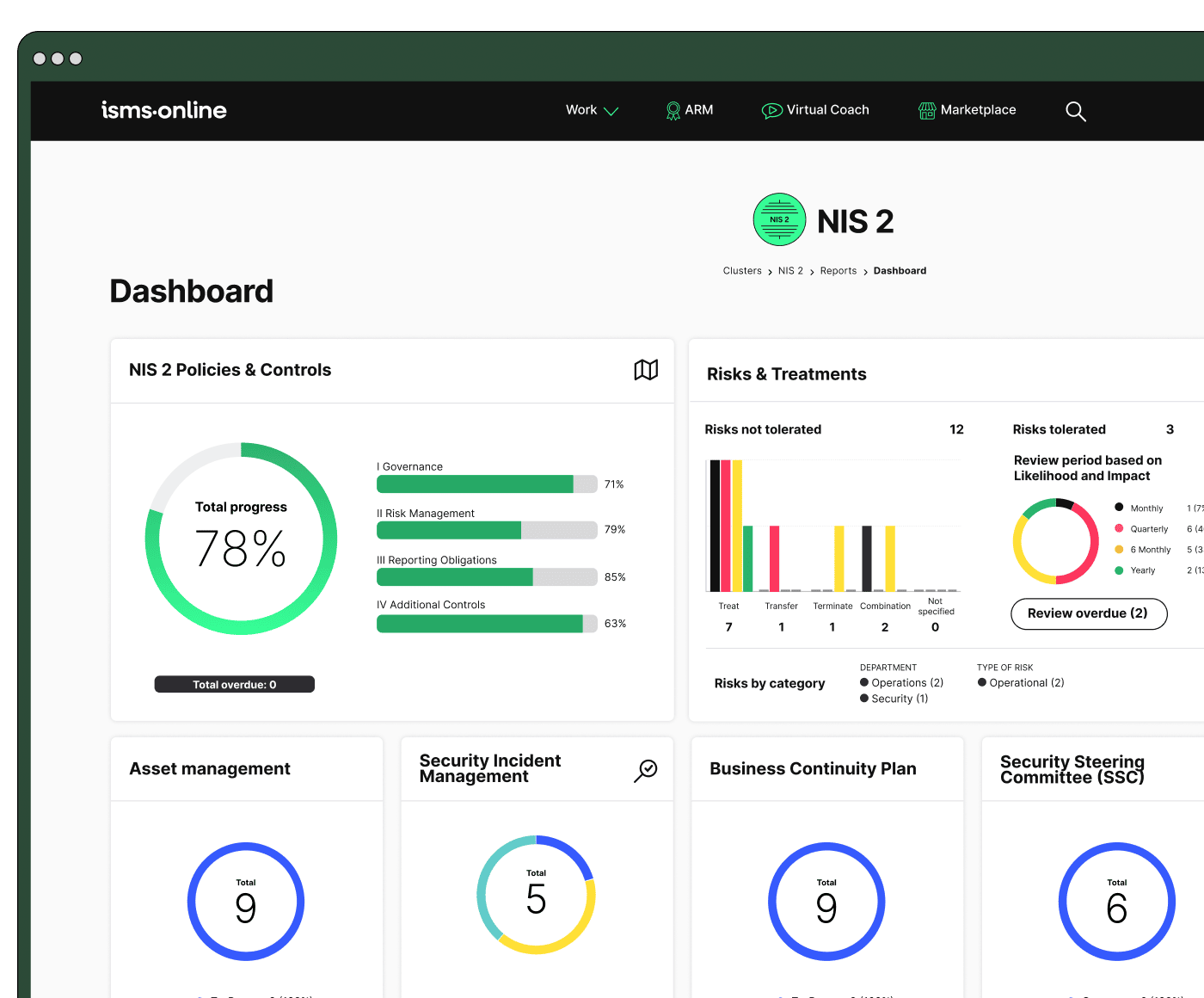
All your NIS 2, all in one place
From Articles 20–23 to audit plans – run and prove compliance, end-to-end.
What Do Executive and Regulator-Grade Audit Reports Look Like? (And How Do You Deliver Them?)
Senior leaders, regulators, and auditors expect more than just binary test logs. Modern compliance reporting means a living dashboard that reveals every action, rationale, lesson learned, and KPI over time. A “board-ready” register-centralised, version-controlled, and permissioned-integrates:
- Planned/actual/ad hoc: test logs, with reasons for every exception and escalation.
- Clear role assignment: , owner accountability for every schedule risk, test, and action.
- Benchmarked KPIs: -test completions, exceptions, corrective actions, and board review notes.
- Direct tie-in to SoA: -ensuring nothing can slip between documented control and operational practise.
Audit prep now serves not just compliance but resilience and reputation-your board’s trust is as vital as the auditor’s tick.
Platforms like ISMS.online have moved far past static registers, offering real-time dashboarding and reporting, permissioned review workflows for cross-functional teams, and simulation capabilities for internal audits or pre-audit rehearsals. Organisations that simulate audits or run peer reviews are statistically proven to increase audit pass rates and lessen post-breach fines.
Embrace proactive, recurring internal reviews-not just auditor-preparedness but as a risk mitigation tool, strengthening your executive and regulator relationships. Turn “audit” from an anxiety event into a continuous asset.
How Do You Build Continuous Improvement and Future-Ready Compliance Across NIS 2, DORA, and ISO 27001?
Future-ready resilience is a team sport. Your compliance posture wins when it moves beyond siloed spreadsheets and legacy hand-offs, and every stakeholder-Kickstarter, CISO, DPO, practitioner-gains live visibility, collaborative workflows, and rapid evidence access across every framework. This is where homing compliance on a modern ISMS platform pays off: continuity through staff changes, board transitions, and regulatory overhauls, because resilience is hard-coded into the workflow-not left to chance, memory, or static how-to PDFs.
Resilience is proof you evolve as fast as risk does-not just that you pass this year’s audit.
To operationalise long-term compliance alignment:
- Peer review and escalation: No testing cycle closes without a review and sign-off; lessons learned are logged and cross-referenced for next time.
- Role-based dashboards and ownership: Tags every actor in the cycle; managers see status, auditors see evidence, the board sees decisions.
- Central ‘learning log’: Imagine a channel where every corrective action or review is visible, versioned, and instantly accessible for the next team, next cycle, or external auditor.
In ambitious organisations, this is more than process-it’s strategic insurance, proving to customers, regulators, and executive sponsors that you survive, adapt, and grow even as complexity and expectations climb.
Ready to Turn Penetration Testing from Headache into Board Asset?
The compliance landscape has evolved-and so can your NIS 2 and DORA test strategy. With ISMS.online, you gain not just control, but resilience: automated role assignment, living audit trails, and pro-grade dashboards that put you ahead of every audit-and every change. Assign owners, automate workflows, and surface proof where it matters. When your compliance workflow inspires confidence, every pen test and red team exercise transforms from a regulatory checkbox to a reputation asset. Get ready for a world where your team, your board, and your regulators all read from the same script-and trust what they see, year in and year out.
Frequently Asked Questions
How often should penetration tests and red team exercises be performed for NIS 2-and is there ever a “one-size-fits-all” standard?
There is no single calendar interval that guarantees full NIS 2 compliance; instead, you must set and justify a frequency based on your own risk profile, sector overlays, and national transposition. For most, annual penetration testing is the accepted starting mark-supported by ENISA and reflected in common industry audits. However, in critical sectors like finance or telecommunications, national law or sectoral overlays (such as DORA or telecom regulations) may demand far more-twice-yearly, even quarterly, cycles. Red teaming is generally required every 1–3 years in sensitive sectors, but risk events or system changes demand flexibility.
Regulators want to see testing cadence that evolves with your threat landscape-a fixed frequency is a floor, not a finish line.
To stay audit-ready, document your rationale for deviating from “annual” (up or down), respond quickly to new risks with extra tests as needed, and capture evidence of board review. Align with ENISA’s technical guidance for sector overlays. ISMS.online streamlines this with built-in routines and live registers mapped to every overlay.
Frequency Table: Baseline and Overlays
| Overlay / Sector | Pentest | Red Team | Extra Tests Triggered By |
|---|---|---|---|
| NIS 2 (baseline) | Annual (min.) | 1–3 years | Incidents/changes/supplier risk |
| DORA (EU finance) | Annual (req’d) | Every 3 years | DORA-triggered events |
| Telecom (IE example) | 6 months (req’d) | Risk-based | Authority-mandated |
| Belgium (critical sectors) | Annual (req’d) | Risk-based | National overlay |
Can national law override-or strengthen-NIS 2’s “regular” testing requirements?
Absolutely. “Regular” under NIS 2 is designed to flex: national law and sectoral mandates nearly always set the real bar. Some nations require annual or more frequent penetration testing; for example, Belgian regulators enforce annual pentests in critical sectors, while Ireland’s telecom authority demands a six-month rhythm. Overlay frameworks like DORA mandate both annual pentesting and triennial red teaming for EU financial services.
Your legal minimum is dictated by the strictest control-NIS 2, national law, or sector/contractual overlays. If multiple apply, your policy must match or exceed the highest requirement, and the rationale for any deviation must be documented and justifiable for audit.
Maintain a live testing register to log all overlays and changes. Sector summary: Tixeo’s overlay guide.
Overlay Mapping Table
| Rule Type | Who Sets It | Audit Signal |
|---|---|---|
| NIS 2 (baseline) | EU directive | “Regular” (risk-based, flex to overlays) |
| National law | Gov’t regulator | Fixed intervals override baseline |
| Sector/contract | DORA, BaFin, etc. | Always adopt the strictest, document logic |
What events or changes require out-of-cycle testing, and how do you prove compliance at audit?
NIS 2 and mature ISMS practise both demand “event-driven” or “trigger-based” testing above your regular schedule. Typical triggers include any critical security incident, system upgrade or change, onboarding of a key supplier, third-party or platform integration, new product launch, or new threat intelligence.
For every unscheduled test:
- Record the trigger event (what, when, why)
- Update your risk register to capture impact and response
- Map each test to a relevant control (e.g., ISO 27001 A.5.24, A.8.8)
- Capture and log all evidence: report, owner, actions, board oversight
Your ISMS should build an audit chain that links the initial risk update, testing rationale, and remediation completion for each event. Living evidence trails (with proof of sign-off and lessons learned) make regulator challenges survivable-and prevent audit-day panic.
Trigger Table: Audit Trace Links
| Trigger Event | Risk Register Update | Control Link | Evidence Logged |
|---|---|---|---|
| Security breach | Escalate/record | A.5.24 Incident Mgt | Red team report + actions |
| Supplier onboarded | Risk assessment | A.5.21 Supply Chn | Pentest + mitigation plan |
| Tech platform upgrade | Post-“go live” review | A.8.8 Vulnerability | Test logs, board sign-off |
How do ISO 27001 and NIS 2 requirements combine for best-practise testing and reporting?
ISO 27001:2022 and NIS 2 both prioritise risk-justified, evidence-backed testing with traceable rationale-but offer different angles on reporting. Here’s how to harmonise them:
- Map every test to a control (SoA and Annex A references-for example, A.8.8, A.5.24).
- Justify the timing with a live, dated risk assessment (ISO 27001 6.1.2/6.1.3; NIS 2 Art 21).
- If tests are delayed, skipped, or repeated out-of-cycle, document the rationale in exception logs and present for management review (Cl 9.3, 10.1).
- Board and management groups should regularly review test schedules, rationale, and outcomes.
- Use cross-framework reporting to satisfy both cyber-security and business audit teams.
Integration Reference Table
| Expectation | ISMS.online Operation | Compliance Reference |
|---|---|---|
| Documented rationale | Risk register, asset link | 6.1.2/6.1.3 ISO, Art 21 NIS 2 |
| SoA-test mapping | Test mapped to control in SoA | Annex A/SoA, NIS 2 Art 21 |
| Reviews/reporting | Board management cycle, audit log | Cl 9.3, 10.1; sector law |
More: |
What specific documentation and evidence will satisfy NIS 2 auditors for penetration or red team testing?
Auditors now expect full transparency across the test lifecycle-not just a final report. Sufficient evidence means:
- Test plan with risk/context justification (routine *and* out-of-cycle)
- Signed technical report, scope, and mitigation actions
- Updated control and risk/asset registers pre- and post-test
- Management sign-offs and board oversight notes
- Exception/lesson logs (where tests are missed or fail)
- Live link to the Statement of Applicability for control mapping
- Evidence pack with version history and peer/board approvals for every material test
A compliance-driven ISMS (like ISMS.online) makes this traceable, generating auto-linked evidence packs, audit dashboards, and role-based review trails. The burden is not “did you test” but “why, when, who decided, who closed gaps.”
Regulators grant trust to those who show not just the test, but a risk-driven response and a signed-off record.
Detailed procedures: |
What’s the best way to future-proof your testing and compliance loops for NIS 2 and beyond?
Elevate testing from a “tick-box” routine to an adaptive, resilient discipline that survives new rules, threats, and evidence challenges:
- Use role-based dashboards to embed ownership and automate reporting for every test, from scheduling to sign-off.
- Make peer review and management/board oversight part of the testing cycle-ensuring lessons drive controls, not just reports.
- Automate overlay mapping between all frameworks (NIS 2, ISO 27001, DORA, sector rules) to keep compliance aligned as requirements evolve.
- Maintain a living exception and lesson-learned log for every test-reviewed and fed back for future improvement.
- Opt for ISMS platforms (like ISMS.online) that retain evidence, update registers in real-time, and surface gaps before the next audit.
Continuous Improvement Cycle
| Step | Action | Result |
|---|---|---|
| Schedule | Map risk, overlay to cadence | Compliance + context-fit |
| Execute | Log tests, track actions | Threats mitigated |
| Review | Peer/board review & lessons | Loops close, learning in |
| Document | Update evidence in ISMS | Always audit-ready |
| Update | Revise test plan/controls | Flexes with new threats |
See: | (https://www.isms.online/)
If your organisation wants to pass the NIS 2 bar-not just this year, but every audit to come-make real, risk-driven testing and defensible, automated evidence a standard step. Let ISMS.online handle the heavy lifting: schedule, logs, overlays, reviews-so every test strengthens both compliance and resilience.






