





































Why Are Postal & Courier Firms Under Pressure? The New Compliance Reality
Regulatory reform lands hardest where legacy ways of working linger, and for Europe’s postal and courier sector, NIS 2 represents a generational compliance reset. “High-criticality” status isn’t just a label-it’s a demand for instantaneous, traceable evidence delivered at regulator speed.
Boards now carry direct cross-border accountability. Audits pivot from static policies to living proof: logs, registers, and stakeholder actions all mapped to the moment. Paper trails and spreadsheet silos dissolve under scrutiny, replaced by a mandate for live, defensible audit chains that connect every event, decision, and stakeholder acknowledgement to daily operations.
In modern compliance, good intentions don’t bridge the gap- provable activity does.
Postal leaders must now orchestrate IT, operational, and legal responses with registers specifically formatted for both internal oversight and external verification. The consequence is twofold: increased scrutiny, but also a path to bigger contracts and lower risk-for those ready to adapt.
Success demands a shift from “document what you did” to “prove what was done, by whom, with recovery and closure in clear sight.” This guide equips you to pre-empt external audit curveballs, ground executive sign-offs, and finally move your organisation from fragile spreadsheets to a resilient, export-ready backbone.
Where Are Your Hidden Weaknesses? Post-NIS 2 Documentation Gaps Exposed
Gaps in compliance never arise by accident. They stem from the friction between business-as-usual and regulatory momentum: delayed digitisation, fragmented policy hand-offs, and misunderstood board obligations.
Unprepared teams scramble for version control, miss critical evidence chains, or lean on the hope that “this year’s audit will be easier.” Regulators are no longer satisfied by the appearance of discipline-they require prompt access to records that span staff, suppliers, assets, and incidents.
Where Does Compliance Break Down?
A typical breakdown sequence:
- Change registers stagnate, with hardware swaps or software patches logged at the team level but missing board‑approved signatures.
- Incidents are tracked retrospectively-details reconstructed for audit season, not captured at every handoff.
- Executive sign-off often means little more than a blanket email-NIS 2 demands named leadership roles and logged board review.
- Staff acknowledgements get lost; absence of a digital “receipt” can trigger expensive contract delays.
ISO 27001 Bridge Table: What Auditors Now Expect
| Expectation | Operationalisation | ISO 27001/Annex Ref |
|---|---|---|
| Timestamped change logging | Automated register, versioned | A.8.32 (Change Mgmt) |
| Incident tracked to closure | Linked log, status tracker | A.5.26/A.8.15 (Logging) |
| Board review & sign-off | Approved register, dashboard | Cl.5.3/A.5.4 (Leadership) |
| Living asset inventory | Central, real-time list | A.5.9/A.8.9 |
| Staff policy acknowledgement | To-do + confirmation trail | A.7.3/A.6.3 |
Teams conducting quarterly gap analyses with sector templates (ENISA, PostEurop, ISMS.online) catch nonconformities early, halving the pain of audit surprises. Pilot studies show up to 60% less audit prep workload for organisations with role-assigned, automated evidence chains (ISMS.online, Case Review).
Real audit resilience is built on the bones of living, role-assigned registers, not static compliance reports.
A digital dashboard-exposing coverage and weak spots, ready for board review or incident drill at a click-becomes a make-or-break asset in today’s audit landscape.

Master NIS 2 without spreadsheet chaos
Centralise risk, incidents, suppliers, and evidence in one clean platform.
Automation: Promise and Pitfalls-How Digital Evidence Actually Wins (or Fails)
Digital transformation underpins NIS 2 success, but automation alone creates a fresh set of risks. The difference lies in what is automated-and how it can be proven. Audit disappointment too often follows rushed vendor deployments or poorly scoped “checklist” automation, leaving log gaps invisible until the worst moment.
Are You Truly Audit-Ready-or Visibility-Deficient?
Defensible digital audit trails require:
- Immutable, timestamped logs: Every change, incident, action, and approval marked in real-time and tied directly to process owners.
- Routine configuration reviews: ENISA’s technical guidance calls out “outdated config” as the leading penalty trigger; monthly checks, not annual “spring cleans,” are now best practise.
- Sector-aligned templates: Use ENISA, PostEurop, ISMS.online blueprints out of the box. No reformatting at audit time means fewer last-minute gaps.
- Layered dashboards: Board, IT, ops, and audit teams must see their evidence quickly, with drilldowns tailored to role and incident type.
- End-to-end traceability: Each linked chain-from event to closure-must have no ambiguous steps or “rogue” handoffs.
Wireframe: Digital Audit Dashboard Features
Picture a live filterable dashboard: green = evidence logged and acknowledged; amber = overdue sign-off; red = incomplete; blue = pending supplier review. Downloadable exports match template specs for every regulator or partner request.
Automation that hides information is worse than paper logs. Audit readiness is clarity, not just speed.
Establish habits: monthly board walk-throughs, quarterly third-party reviews. Each session updates dashboard alerts and refines your living risk map.
Partner Risk Isn’t Just a Box-How Supply Chains Fuel (or Undermine) Your Compliance
Today’s postal landscape is a web of contractors, vendors, and last-mile partners. NIS 2 expands your accountability perimeter: you’re responsible not only for your internal logs, but also for live, auditable control over external partners.
Partnership is no longer static. Regulators expect ongoing, evidence-backed supplier oversight- not annual PDFs.
How Do You Prove Ongoing Third-Party Oversight?
- Contractual clauses: must enable direct audit access and evidence sharing. PDFs archived in procurement folders are no longer enough.
- Assessment cadence: Move from annual to at least quarterly supplier attestations for critical partners, with ad hoc spot checks for detected incidents.
- Joint audit logs: ENISA/PostEurop templates support cross-org checklists, with automated RBAC (role-based access control) to ensure closure and accountability.
- Rolling updates over “big-bang” audits: Digital dashboards enable incremental risk review-no more year-end panic.
- Procurement as an audit proof point: Modern buyers assess *dynamic* live evidence of supplier oversight; static annual reports increasingly fail buyer scrutiny.
Traceability Table: Partner Incident Response Example
| Trigger | Risk Update | Control / Link | Evidence Logged |
|---|---|---|---|
| Supplier phishing attack | Third-party breach | A.5.21 (Supply) | Shared log, closure report, updated contract |
| Missed quarterly attestation | Compliance gap | A.5.20 (Agree) | Attestation log, To-do trail, exported audit note |
| New last-mile partner added | Access mapping | A.5.22 (Service) | Onboarding doc, asset register, RBAC log |
A web-enabled, multi-party risk register-layered concentric rings of trust-becomes your shield and accelerant. Trust that is live is trust that survives both audit and breach.
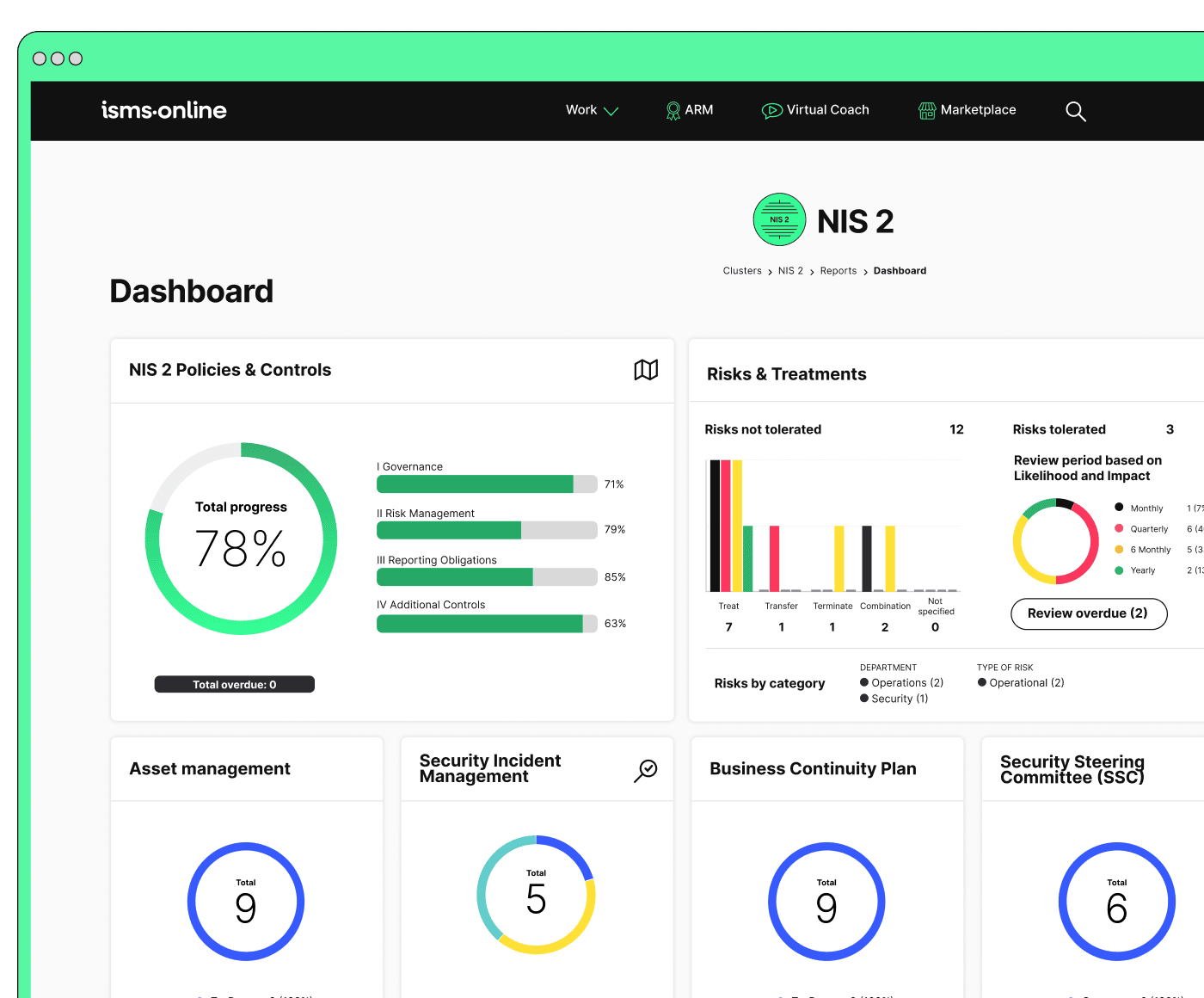
Be NIS 2-ready from day one
Launch with a proven workspace and templates – just tailor, assign, and go.
What Makes or Breaks Incident Reporting? Timelines, Traps, and the Human Factor
Under NIS 2 Article 23, incidents must be reported within 24 to 72 hours. In a world where delays are documented as lapses, the stress of incident management turns clarity into currency.
Failing an audit is rarely about non-compliance with the rulebook-it’s about an inability to prove timely, disciplined response across all involved teams and partners.
How to Build Audit-Ready Incident Response?
- Real-time digital stamping: Use CSIRT-ready tools or ISMS.online to stamp every action, owner, and decision step. No more backfilled emails or ambiguous sign-offs.
- Evidence over fiction: ENISA/ISMS.online checklists require every incident log to specify impact, timeline, evidence, and closure. Unstructured stories are audit liabilities.
- Stakeholder notification proofs: Digital sign-off flows-tracking board, ops, supplier, and regulatory engagement-are now the auditor’s expectation.
- Delegation dashboards: Assign and monitor clear stage owners for incident cycles; reduce dropped handoffs and accelerate closure.
- Post-mortem discipline: Auditable lessons, not simply “resolved” statuses, build organisational resilience and close the trust loop.
Real resilience is the difference between issue closed and issue fixed, learned from, and recorded.
A well-drilled, dashboard-powered response team can transform incident reporting into a competitive advantage, lowering real risk and audit pain simultaneously.
Transformation from Register to Resilience: Accountability vs. Automation in Audit-Ready Evidence
Digital registers, left unowned, risk becoming automated compliance traps. NIS 2 moves accountability up the chain: board directors and executive teams must own, sign, and periodically review logs, not just visit dashboards at audit time.
Patterns of Accountability That Win Audits in 2024
- Assign role ownership for each workflow stage; visibility is as vital as speed.
- Use digital registers as a safety net, not a replacement for roles. Configure per‑action notification, but hardwire quarterly board review and executive sign-off.
- End-to-end traceability: ensure every risk or incident update links closure back to a named corrective action and stakeholder.
- Open registers: audit, board, ops, and regulatory views must be filtered, logged, and exportable.
- Trending metrics: automate closure rates, overdue actions, and incident cause tracking, always mapped to specific role owners.
Boards that sign registers every quarter see fewer regulator callbacks and over 50% less remediation time.
Bridge Table: Evidence Ownership & Audit Impact
| Accountability | Register Action | Audit Outcome | Risk If Missed |
|---|---|---|---|
| Board/Exec | Review, sign-off | Traceable, signed log | Regulator rejection, penalties |
| Security Lead | Assign workflow | Role-updated logs | Missed incidents, slow cycles |
| Ops/IT | Log, remediate | Timestamp, closure | Gaps, untracked issues, lost trust |
A signed, role-mapped audit trail brings order to complexity-and signals seriousness to any third party.
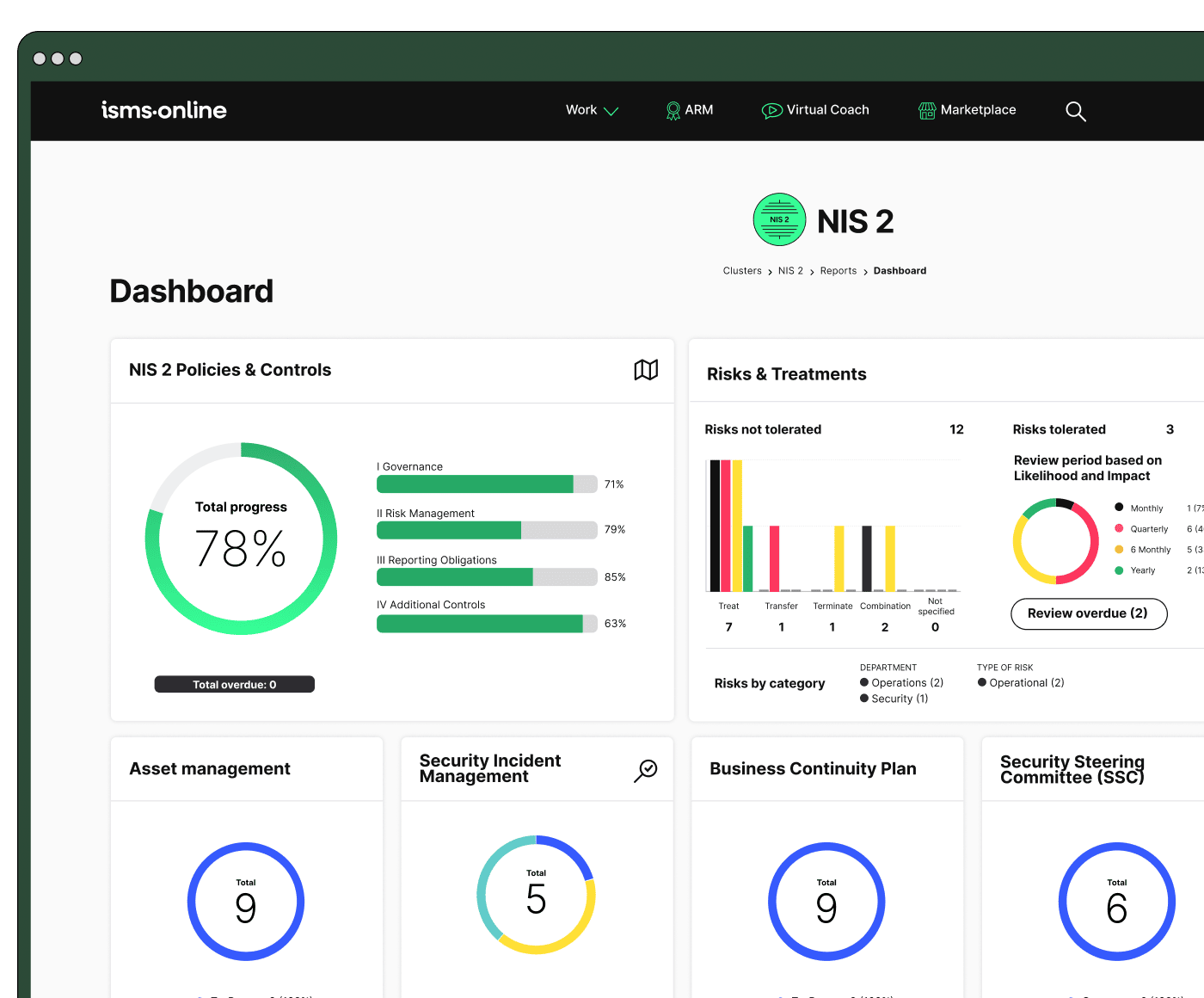
All your NIS 2, all in one place
From Articles 20–23 to audit plans – run and prove compliance, end-to-end.
EU Audit, Cross-Border & Third-Party Surge: Setting the New Bar for “Ready Enough”
NIS 2 compliance is no longer a single-office affair. With cross-border service, multinational suppliers, and regulators requesting multi-language evidence, “ready enough” means audit proof at all vectors, all times.
Cut Through Audit Friction with Next-Gen Registers
- Multi-lingual compliance: Exportable logs in at least two languages-required in multinational audit sweeps.
- Supplier incident referencing: Registers must cross-link every event involving an external party; simple “incident closed” is no longer sufficient.
- Adaptive scope: Use dashboards to scan for “scope creep” (new partners, contracts, processes) so nothing is missed at the compliance edge.
- Snapshot reporting: Advanced filtering by geography, incident, staff, or document accelerates both audit review and regulatory response.
Snapshot Table: Cross-Border Audit Triggers
| Audit Trigger | Evidence Needed | Proof Mechanism | Logged Example |
|---|---|---|---|
| Multi-state | Multi-lang export logs | Downloadable register | ENISA/ISMS.online PDF report |
| Supplier breach | Linked incident thread | Dashboard link, closure | Joint closure record |
| Policy update | Staff digital receipt | Timestamped log export | Signed acknowledgment |
Ready enough means evidence is live, multi-user, and instantly exportable-anything less is a latent risk.
Continuous Improvement: Living Registers, Corrective Actions, and Proof in Motion
Postal and courier operations change daily; so must your evidence. Living registers don’t just meet audit cycles-they shape them, tightening the loop between detection, action, and learning.
How to Operationalise Continuous Audit Improvement
- Closure cycles: Every audit trail should document a clear journey: event → action → closure, with explicit responsibility mapped.
- Quarterly and event-based reviews: Automated reminders bring lagging items to closure, preventing evidence drift.
- Improvements on display: All minutes, logs, and actions should be visible to staff, board, and auditors-not hidden away in folders.
- Training loop closure: Policy engagement rates, tracked digitally, are now a KPI as central as incident closure stats.
- Trend dashboards: Live, role-based metrics must feed board and practitioner views, signalling operational attention and enabling strategic refinements.
Living registers are the heartbeat of operational trust-internally and externally.
Nested Checklist: Audit Improvement Loop
- Detect: Alert or review triggers action.
- Assign: Clear responsibility, acknowledged in-system.
- Act: Remediate (training, process, system fix).
- Document: All evidence, lessons, and handoffs logged.
- Review: Leadership validates closure, trends improvement.
- Feed: Learnings trend into risk and strategy dashboards.
Traceability Table: Live Corrective Actions
| Issue Triggered | Actioned by | Measure Applied | Evidence Logged |
|---|---|---|---|
| Staff missed training | Compliance Lead | Make-up session assigned/tracked | Attendance + digital acknowledgment |
| Supplier outage | Ops/IT | Process update with supplier | Incident report, signed closure |
| Policy revision | Board/Exec | Communicate, update registers | New policy log, acknowledged receipt |
Track improvement cycles as you would asset or incident logs-proof of learning is now proof of compliance.
Prepare for the Next Audit With Confidence-Empower Your Postal Team with ISMS.online
Only provable, living evidence-linked, owned, and instantly exportable-shields your company in the new NIS 2 compliance era. ISMS.online brings together automated registers, live audit logs, frictionless tasking, and export-ready proof in one platform, trusted by market leaders to half their audit prep time and eliminate regulator “callback” risk (ISMS.online, Case Review).
When trust, resilience, and operational confidence sit on the line, live evidence is your best defence and sharpest edge.
Set up your living audit backbone now: map every requirement to a digital register, fill every traceability gap, and empower your team with instant evidence links-before the next request (or breach) arrives.
Start now: Book a sector-focused audit prep review with ISMS.online-see how your organisation benchmarks on live evidence, automate compliance, and build trust for every board, customer, and regulator.
Frequently Asked Questions
Who defines what “audit-proof” evidence really means for NIS 2 compliance in the postal and courier sector?
The standard for “audit-proof” evidence under NIS 2 in postal and courier services is set jointly by your national cyber-security authority or NIS 2 regulator and the EU’s ENISA agency, which provides sectoral guidance and baseline templates. Your country’s authority translates NIS 2 into local requirements and issues audit protocols, while ENISA offers official cross-border guidelines, such as its. In practise, “audit-proof” means maintaining a living, digital register with time-stamped, role-assigned, and version-controlled evidence for every operational and cyber event-incidents, changes, supplier attestations, board sign-offs, training records, and policy acknowledgments. This evidence must be not only present but immediately accessible, filterable, and directly mapped to specific NIS 2 articles and responsible roles or users. Static files or scattered spreadsheets rarely meet this bar; digital, system-managed registers are now expected as the standard.
How is “audit-proof” enforced and checked?
Sector supervisors conduct both routine and triggered audits, requiring filtered exports by template, often on short notice. Boards must sign off, typically every quarter, attesting that evidence is both current and complete. Digital platforms like ISMS.online support this with live dashboards, automatic logs, and export-ready views that align to NIS 2 roles, articles, and responsibilities.
Audit confidence is built not by what you could assemble in a crisis, but by what you can demonstrate live, mapped, and board-verified at any moment.
How do postal/courier evidence requirements differ from other “important entities” in NIS 2?
For postal/courier companies listed in NIS 2 Annex II, audit requirements go beyond those in many other sectors by integrating digital and physical operations, cross-border logistics, and last-mile delivery partners. All “important entities” must record cyber-security incidents and report them, but the postal/courier domain adds additional expectations: you must show evidence for not just IT disruptions, but also any breakdown affecting parcel delivery, tracking, physical handoffs, or route logistics-including when failures originate with suppliers or delivery partners abroad. Compliance means gathering multi-format evidence: partner logs, supplier attestations, and event histories that span both the digital and physical, often in multiple languages or formats. Boards may need to sign off regularly, and authorities can require evidence sharing across countries. Unlike sectors with only digital operations, you must maintain registers that map and link events from parcel to platform, supplier to customer, and jurisdiction to jurisdiction.
Table: Audit Comparison – Postal/Courier vs. Other Sectors
| Audit Requirement | Postal/Courier Sectors | Other Sectors (Energy, Water, etc.) |
|---|---|---|
| Incident Types | Digital + delivery, last-mile, supplier disruptions | Primarily IT / digital |
| Cross-Border Obligations | Multi-format, multi-language, partner-triggered audits | Usually single-language, local |
| Supplier Evidence | Joint, integrated registers and attestations required | Often limited to supplier declarations |
| Audit Timeline | Dual (EU + national); rapid sign-off cycles | Typically national / sector |
What digital automation and tracking features does NIS 2 now require for postal and courier evidence?
NIS 2 demands that all evidence registers migrate from manual, static collection to continuous, digital, and automation-first systems. Every log-incidents, asset changes, supplier actions, training, and policy acknowledgments-must be captured and version-controlled automatically, with each entry time-stamped, role-assigned, and digitally signed. Audit trails must reveal who entered or changed information, when, and under what authority. Authorities and ENISA emphasise that manual uploads, spreadsheet tracking, or scattered files are instantly non-compliant. Compliance platforms must provide real-time dashboards that philtre and export evidence by incident, supplier, language, or jurisdiction. Quarterly automated reviews, regular export rehearsals, and instant access to mapped, audit-ready evidence are non-negotiable features. The absence of automation-such as missing access logs or ad hoc corrections-can result in severe audit failures or fines, especially for entities managing high-volume, cross-border delivery.
Table: Core Digital Evidence Automation Features
| Capability | Minimum NIS 2 Standard | Proof of Compliance |
|---|---|---|
| Automated Logging | Time-stamp, digital version control | No manual log or spreadsheet allowed |
| Access Audit | Complete role and access audit trail | Immutable, system-generated logs |
| Export Options | Real-time, filtered, multi-format | Cross-border and multi-role support |
How do last-mile partners and suppliers fit into NIS 2 audit evidence for postal/courier companies?
NIS 2 holds postal and courier entities jointly accountable with their entire supply and delivery chain. Every logistics, delivery, or technology partner is now bound by contract to NIS 2-aligned controls, including mandatory audit rights, incident notification, regular risk reviews, and evidence sharing on agreed timelines. Contracts should dictate how partners log and deliver their incident, performance, and training records-which your system must then import, timestamp, and cross-link to your own registers. Supplier attestations, board sign-offs, and joint incident logs (with timelines from 24–72 hours, depending on severity) are standard. When incidents happen, supplier evidence must be merged into your main register, not maintained in isolation. Audit failures often stem from incomplete partner logs or evidence gaps at handoff points. Regulations increasingly demand that you can show, on demand, an unbroken, board-attested audit chain for every major incident or delivery disruption.
What are the biggest cross-border NIS 2 evidence challenges, and how can they be resolved?
Postal and courier operations spanning multiple EU countries face four persistent cross-border evidence hurdles:
- Conflicting timelines/templates: Different national authorities may impose distinct deadlines, fields, and log formats.
Solution: Use registers that tag logs by country, auto-export per required template, and base workflows on ENISA/PostEurop sectoral guidance. - Varying admissibility rules: Some states or supervisors only accept certain formats or digital signatures.
Solution: Maintain the ability to export all evidence in multiple regulator-approved formats (PDF, XML, CSV), with digital signatures and access logs. - Data privacy (GDPR) conflict: Cross-border log transfers can raise privacy flags.
Solution: Embed DPO sign-off into export workflows, auto-redact where required, and tag every record with privacy metadata for review. - Language barriers: Evidence often needs translation for regulator or partner review.
Solution: Choose systems that support multi-lingual export and tagging, and designate localised staff for review and interpretation.
A trustworthy audit process is built long before it’s demanded-across borders, teams, and legal requirements.
Well-prepared teams rehearse all cross-border evidence exports and translations annually to avoid costly surprises.
What does a sector-proof evidence register architecture look like for NIS 2 postal/courier compliance?
A postal/courier sector-proof NIS 2 evidence register:
- Maps: every register entry to a specific NIS 2 article, responsible role, and (where relevant) local law or template.
- Records: all incidents, change logs, supplier reports, policy/training acknowledgments-each with machine-stamped time, role, version, and digital sign-off.
- Links: related events, supplier attestations, board reviews, and corrective actions in a “closed-loop” workflow for each incident or compliance cycle.
- Supports: flexible export-multi-language, multi-format, jurisdiction-based-allowing rapid regulator, board, or partner review.
- Assigns responsibility: every record is owned and tracked by a named user/role (IT, Operations, Compliance, Vendor Management, Board).
- Automated audits: schedules quarterly live review and sign-off, ensuring entries are updated, current, and auditable.
- Rejects: any manual or email-based collection and enforces digital centralization.
Table: NIS 2 Postal/Courier Evidence Register Blueprint
| Register Feature | Required Purpose | Example Practise |
|---|---|---|
| Digital, time-stamped | Traceability & currency | ISMS/NIS 2 register auto-logging |
| Role-based entry/owners | Accountability | Named jobs: Ops, Board, Compliance |
| Incident linking | Closed compliance loop | Handoff event → corrective/action → signoff |
| Export flexibility | Multinational readiness | PDF/CSV/XML, multi-lingual tags |
| Quarterly reviews | Prove “living” status | Board sign-off, audit logs, live exports |
A sector-proof register both insulates your business from regulatory risk and projects operational maturity-transforming compliance from a defensive manoeuvre to a source of customer and partner trust.






