





































What’s Forcing Space Sector Compliance to Evolve-And Why Do Classic Methods Fall Short?
Space sector leaders are no longer judged by tidy document stacks or annual box-ticking; compliance now rides on provable traceability, cross-border accountability, and the cold realism of live systems data. If your organisation still relies on static ISO folders, disconnected Excel, or last-minute evidence hunts, the NIS 2 Directive and ENISA/ESA mandates will put you on the losing side of regulatory trust (ENISA Technical Guidance, 2024; ESA ISMS Essentials). Under these new regimes, auditors and authorities demand a responsive “evidence mesh”-live, versioned, instantly attributable, and mapped across every launch, uplink, and supplier link.
A year’s worth of beautiful paperwork provides no shield in a world that expects to see your controls acting live-minute by minute.
Your evidence chain is now only as strong as its weakest gap or untended asset-compliance staleness creeps in through files never opened or logs never linked. Old habits-batch collecting logs for auditors or letting asset registers drift-build untracked risks. The new line between sector resilience and failure is drawn by how rapidly your team can prove what happened, who signalled, who reviewed, and what was done.
Annual Audits and Spreadsheets: Why They Now Accelerate Your Risk
Slow cycles and static libraries actively harm readiness. NIS 2 frameworks demand instant incident and risk evidence for every critical event, mapped within 24 or 72 hours. Delay, field omission, or fragmented reporting invites multi-layer oversight penalties-cross-agency, multi-jurisdictional, or EU-wide. Real-time demands require living, interconnected systems-where logs, controls, incidents, and approvals can be surfaced, verified, and exported on demand (isms.online best practises).
When compliance is treated like homework that can be turned in at deadline, you invite audit findings that linger, regulatory questions that escalate, and operational drag that never quite disappears.
Book a demoWhy Does Space Sector Evidence Move the Goalposts-And How Should You Rewire Your Controls?
Space compliance isn’t about “having” enough documentation-it’s about proving that every action, update, and incident leaves a traceable, role-stamped mark at the point of execution. A log stored in a share drive, a spreadsheet mapping vendors to assets, or a “print to PDF” approval chain: these are all audit landmines if they fail to provide live linkage, attribution, and versioning (ENISA Sector Profile: Space, 2023).
Evidence That Meets the New Standard
A system is only robust if any stakeholder-a board member reviewing risk, a regulator cross-referencing a ground station log, a peer operator benchmarking your SAR closure rate-can trace an issue from occurrence to closure live, with no ambiguity or loss of chain.
| **Expectation** | **Operationalisation** | **ISO 27001 / Annex A** |
|---|---|---|
| Logs for all launch/comm ops | SIEM feeds aggregation, exportable daily logs | A.8.15, A.14.1.2 |
| Asset-to-risk mapping | Cross-linked registry and risk map | A.5.9, A.8.2, Cl.6.1.2 |
| Redundancy proof | Live failover tests, backup reports, change logs | A.8.13, A.8.14, A.5.29 |
| SoA links per mission/vendor | Project/vendor/cycle-specific SoA chains | A.5.4, A.5.36, A.8.32 |
| Role- and intent-tagged logs | Attributable logs, rationale for key actions | A.5.2, A.5.3, A.6.1, A.7.10 |
The traditional batch approach-collecting or reconciling evidence after the fact-leaves dangerous blanks, attribution ambiguity, and can trigger compliance decay.
What does “fit-for-purpose” look like? Every author, reviewer, and timestamp is visible. No system admin is left to guess who approved or who responded to the last alert. Every change, approval, and incident is mapped to its origin and auditable chain.
The Fatal Flaws of Fragmented or Inactive Evidence
Whether it’s vendor performance, asset risk, or a field update: evidence must flow in a living chain, not as static snapshots. Operations are now “audited in the moment.” Any missing log, murky attribution, or incomplete mapping is a compliance and operational gap, and that gap becomes the focus of regulatory attention. Fragmented systems or bottlenecks now escalate to sector-wide scrutiny faster than ever.

Master NIS 2 without spreadsheet chaos
Centralise risk, incidents, suppliers, and evidence in one clean platform.
Who’s Actually Looking Over Your Shoulder? The Multi-Layer Space Accountability Mesh
Oversight has moved beyond single-agency audits-it’s an EU-wide mesh of authorities, sector networks, and international partners. One untracked hardware update on a Spanish uplink, when your satellite company is headquartered in France and vendors operate in the US, can result in scrutiny from ENISA, ESA, national cyber agencies, and every supply chain participant (ENISA, 2024). Authority isn’t a single point; accountability now flows through your entire network, horizontally and vertically.
In the modern space sector, every operation, vendor, and event can become tomorrow’s regulatory benchmark-passed or flagged.
Table: Sector Event Traceability in Practise
| **Trigger** | **Risk Update** | **Control / SoA Link** | **Evidence Logged** |
|---|---|---|---|
| Supplier asset alert | Supplier incident flagged | A.5.19 / A.5.21 / A.8.30 | Third-party log, supply notification |
| Cross-border event | New jurisdiction logged | A.5.5 / A.7.3 / A.5.6 | Notification, audit chain |
| Ground-to-orbit failure | Risk map + asset registry | A.5.9 / A.5.29 / A.8.14 | Incident + backup logs |
| Field patch/update | Asset register changed | A.8.8 / A.8.32 / Cl.8.2 | Change log, linked SoA, sign-offs |
Your ability to surface and demonstrate these linkages-live, up-to-date, fully attributed-is the threshold between smooth audits and cascading findings or penalties. The more systematically these relationships are mapped, the less you risk operational blockers or “public warning” escalations.
How Do Modern Space Sector Audits Really Work-And How Can You Survive Them?
“Annual audit season” is gone. Contemporary audits are kinetic: auditors and agencies run spot-checks, simulate incidents, demand a walk-through of SIEM logs, policy updates, and board-level reviews-all linked to roles, timestamps, and assets (ENISA, Cyber-Security Audit FAQ). A single communication failure now triggers an end-to-end review: who detected and triaged, how the asset registry was updated, which board members approved the corrective plan, and how evidence was recorded and exported.
Static PDFs are powerless against a live audit that follows your tracks from detection through closure.
Checkpoints for Audit Success
- Every update-system patch, asset movement, vendor alert-must record a verifiable, timestamped log entry.
- All key actions must connect to the risk register, asset registry, and SoA, with attributed sign-offs visible at every step.
- Incidents must show a full corrective loop: detection, registration, management review, closure, and peer/auditor export.
- Management and board reviews are expected to be both scheduled and event-triggered, not just annual calendar items.
Beyond controls, auditors compare your speed, closure rates, and traceability against peer benchmarks. Fall behind, and your process becomes a sector “fix” test case-not a role model.
Scenario: Traceability Walkthrough
An emergency patch disrupts mission comms:
- Detection: SIEM flags; vendor notifies asset risk.
- Update: Asset registry reflects new risk.
- Control: Mapped (A.8.8, vulnerability; A.8.32, change management).
- Evidence: Change log, SoA, sign-off, incident report.
- Oversight: Live trace available for review-roles, times, links all visible in ISMS.online.
Failures to maintain this chain trigger escalated remediation, not just “correct and submit” cycles.
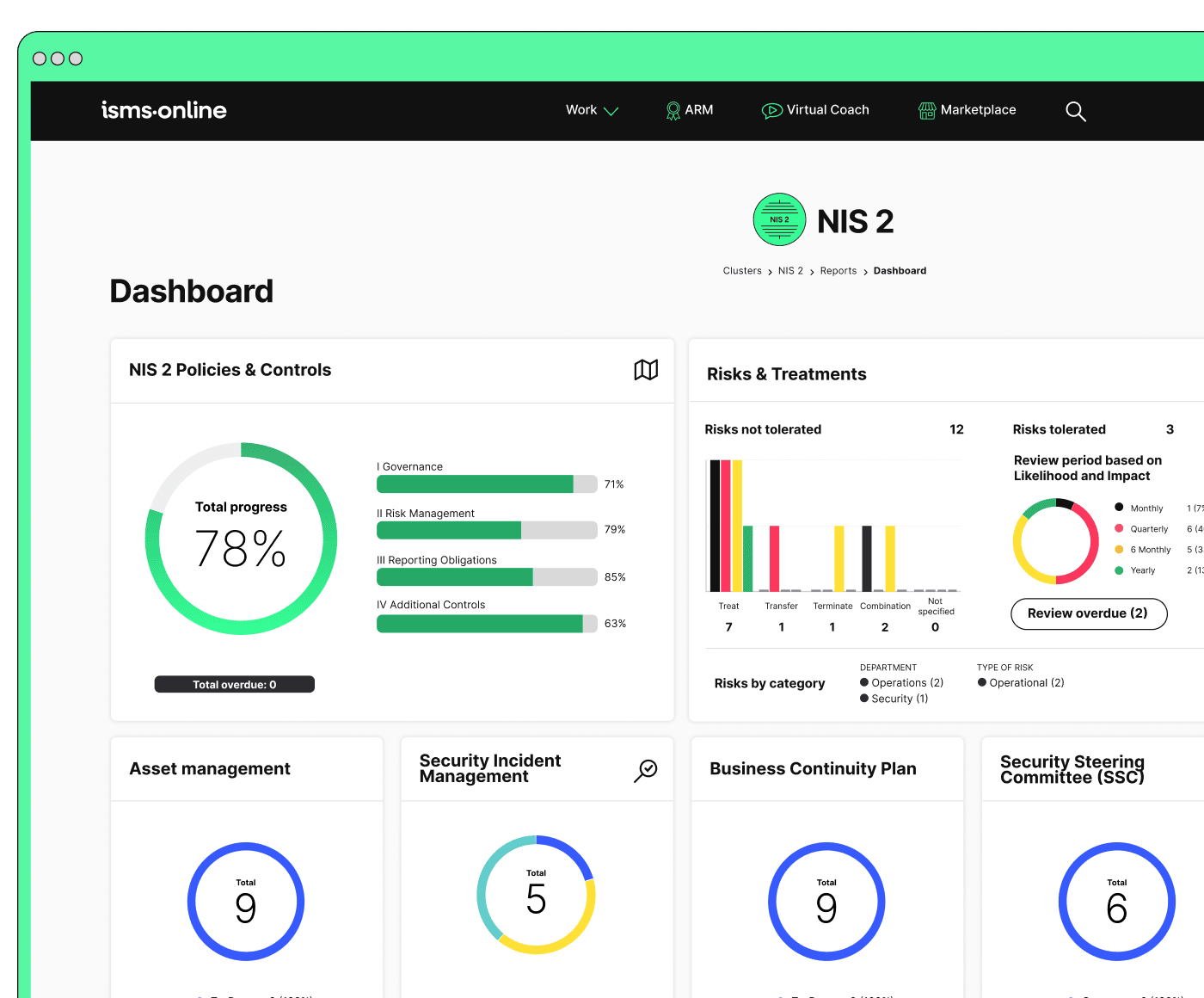
Be NIS 2-ready from day one
Launch with a proven workspace and templates – just tailor, assign, and go.
What Counts as Robust Evidence Now? Spotting Decay and Proving Readiness
The value of your evidence is only as strong as its recency, traceability, and connection to your actual operations-not as a backup to compliance paperwork (ESA, ISMS Guidance). Static, batch-imported, or incomplete logs invite regulatory questions.
Warning Signs: Your Evidence May Be Decaying If…
- Data or incident logs are updated only before an audit or after a finding.
- Key events lack asset or SoA linkage.
- Approvers or roles are unclear, or approval gaps exist.
- Management reviews or audit trails are skipped, merged, or bulk-uploaded.
When your records rest, your risks rise; evidence must keep pace with operations or you’re betting on luck, not control.
Readiness Proof: Healthy Evidence Chains Look Like…
- Every operational or compliance event is mapped instantly to controls, assets, risks, and SoA-complete with versioned timestamps and reviewer sign-offs.
- All entries, SoA links, and closure actions are peer-reviewed, board-logged, and rapidly exportable.
- Systems support on-demand evidence: if asked, every incident, decision, and action can be retrieved with its context and attribution.
Recency and auditability-building trust that holds under live scrutiny-are worth more than any storehouse of archived records.
Where Do Space Sector Teams Fail Under NIS 2 Reporting-And What Steps Outpace the Audit Curve?
NIS 2 compliance sets an uncompromising pace: incidents must be reported within 24/72 hours, mapped in real-time to SIEM, asset, and risk registers (ENISA Incident Reporting Template, 2023). Delays, missed fields, or incomplete mappings quickly undermine both compliance status and regulatory trust. Most failures stem from “batch” or decoupled reporting and field omissions.
Most Common Failure Traps
- Relying on periodic or backfilled notifications, not live entry/mapping in SIEM and registers.
- Partial template completion-missing attribution or log details.
- Incidents outside SIEM scope, or supplier events not tied to internal controls.
- Dependency on manual or siloed reporting workflows.
Regulatory credibility is a perishable good-hours of lag or gaps in mapping shrink your trust capital fastest.
Steps to Stay Ahead (and Audited) in Real-Time
- Integrate SIEM, asset, and incident systems for automated mapping and live visibility.
- Schedule both regular and ad-hoc peer audits to catch gaps before authorities do.
- Run monthly “friendly fire” readiness drills-simulate incidents, track time-to-closure, and attribute roles.
- Build reporting dashboards that confirm every mapped event hits the right notification fields, attribution tags, and regulatory window.
In modern compliance, speed and completeness aren’t a bonus-they’re your main defence against escalation or oversight action.
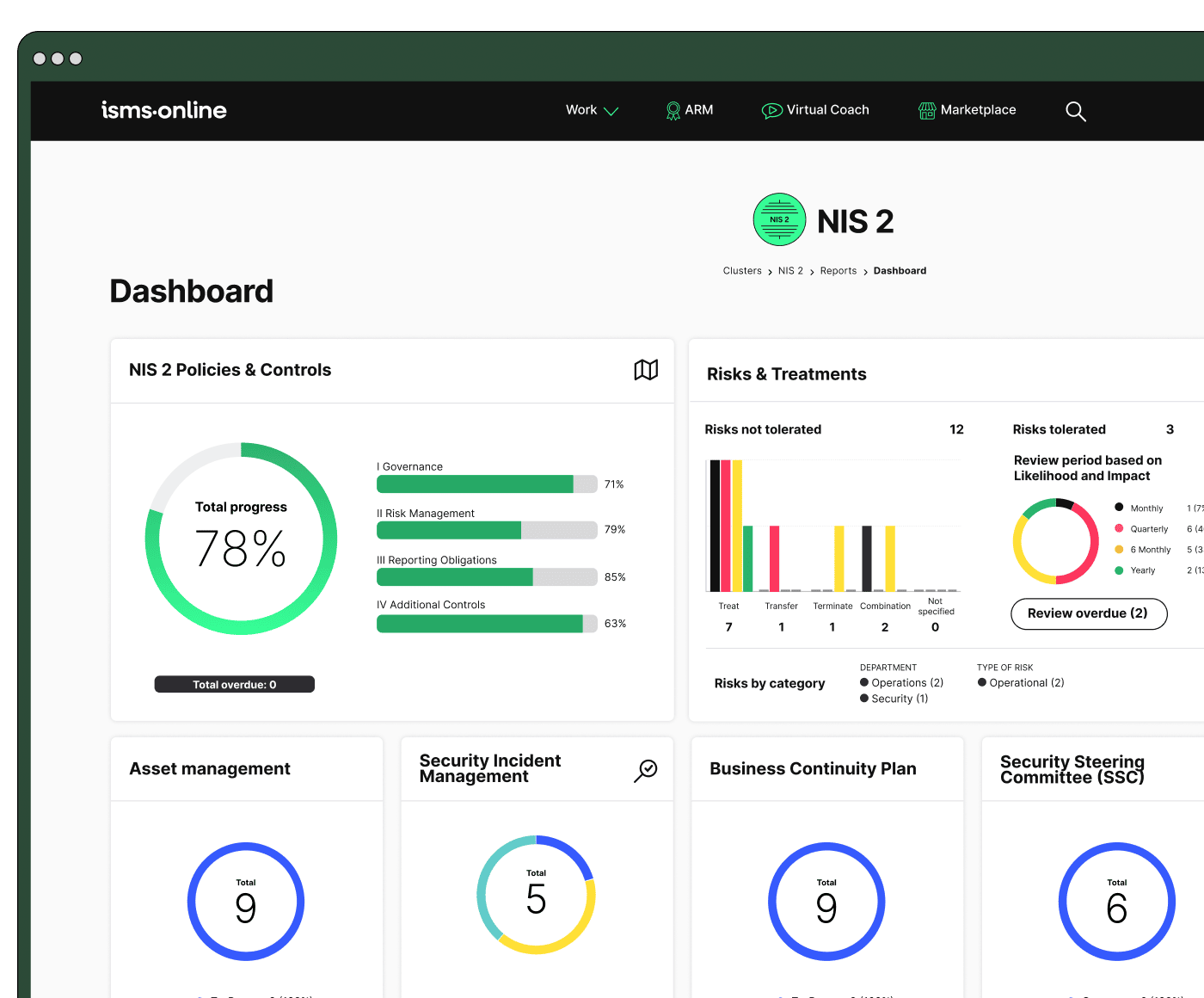
All your NIS 2, all in one place
From Articles 20–23 to audit plans – run and prove compliance, end-to-end.
Why Do Board-Level, Versioned Documentation Chains Matter Now More Than Ever?
An effective ISMS is no longer about box-ticking; the chain of authors, reviewers, and actions from document to board must be versioned, attributed, and instantly traceable (ENISA, Technical Implementation Guidance, 2024). Smart teams instil the discipline of versioning and attribution for every policy, asset, incident, and review.
Strong Documentation Chains Survive Scrutiny
- Every major change-policy, asset, incident-shows author, role, and date. Change logs are versioned and living.
- Reviewers and owners are attributed, with clear hand-off and scheduled review points (not just at the annual audit).
- Regular peer and management/board reviews are tracked, exported, and supply clear “show, don’t tell” capability.
- Audit outputs can demonstrate not just that an event was “logged,” but precisely how it was seen, reviewed, and closed.
Teams with continuous documentation chains convert compliance from a point-in-time reaction to a constant, evidence-based signal-winning the board’s trust and defending against regulatory surprise.
What Do Auditors and Authorities Focus On in Sector Benchmarking-and How Do You Stay Out of Remediation Loops?
Modern audit performance is now measured by closure speed, traceability, and evidence chain completeness. Auditors expect chains that run from issue creation to closure, with every step time-stamped, attributed, and mapped to controls. Peer benchmarks (national, ENISA, ESA, NASA) provide “living” targets-fall behind, and you’ll find your deficiencies going not just to management, but to sector oversight (ENISA, Sectoral Profile: Space).
Building Audit Resilience-Not Just Passing, But Leading
- Capture peer closure rates and traceability as core KPIs-improvement shows maturity.
- Log every control action, review, and closure with tight attribution, speed, and mapping.
- Blend benchmarking and continuous improvement into daily practise-not just periodic reflection.
- Document, export, and review lessons learned fast; close gaps in days, not quarters.
Leadership isn’t avoiding findings-it’s documenting improvement cycles faster than the sector norm, surfacing readiness as your competitive edge and regulatory signal.
ISMS.online: Enabling Uninterruptible Space Compliance and Traceable Trust
Your space mission is too valuable for evidence gaps or manual audit panics. ISMS.online is designed for precisely these oversight demands-mapping every asset, incident, and control into a living, versioned, fully attributed compliance chain. Automated backups, end-to-end log traceability, and exportable on-demand reports make your system not just compliant, but audit-ready every day.
Every action you log or approval you assign today shrinks your risk tomorrow and builds trust at every level.
ISMS.online transforms evidence management: every decision, role, and update is mapped, linked, and instantly surfaced for board, peer, or regulator review. When live traceability is built into your workflow, “readiness” isn’t a box to tick; it’s your normal state and the core of your sector reputation.
Take Control of Space Sector Traceability-Start Building Your Compliance Advantage Now
Each event you map, each log you attribute, each approval you secure pushes your operation further ahead-shrinking risk, strengthening the chain, and turning compliance from a recurring headache into an operational asset. With ISMS.online, every log, control, and incident is mapped and audit-ready from day one. It’s the difference between chasing compliance and leading with resilient, transparent trust.
Begin now-transform your evidence discipline into sector leadership, and let today’s mapped actions be the proof that wins tomorrow’s trust.
Frequently Asked Questions
Why has NIS 2 evidence and audit oversight become so rigorous for space sector organisations?
The NIS 2 Directive now requires space sector organisations to demonstrate ongoing, operational evidence for every action, shifting from annual documentation to a living, real-time compliance system.
Where regulators once accepted static policies or annual audit packs, today’s expectations extend across mission launches, satellite uplinks, supply chain transfers, and board-level approvals. Every event and change-no matter how routine-must be time-stamped, mapped to a responsible party, and linked directly to the relevant risk or control.
Regulators and auditors demand immediate access to evidence chains; if an event, approval, or incident is not traceable from origin to closure, both compliance and operational integrity are called into question. This principle is now widely enforced: “if it isn’t attributed, mapped, and exportable, it didn’t happen” (ENISA, 2024). A fragmented or incomplete record risks immediate escalation, reputational impact, and regulatory intervention.
In the space sector, every approval, incident, and change-from ground to orbit-must leave a digital breadcrumb a regulator can follow with a single click.
Visual Bridge:
Picture a mission control timeline-where SIEM alerts, asset updates, incident notifications, and board decisions connect in a seamless chain, each element attributed and instantly reviewable in a single dashboard.
How do national and EU authorities concretely evaluate NIS 2 compliance for the space sector?
NIS 2 compliance is enforced through both national and EU-level oversight: competent authorities within each Member State supervise their space sector organisations, while ENISA coordinates sector-wide and cross-border reviews.
Audits operate on a continuous-access model. Regulators routinely demand instant retrieval of risk registers, asset logs, policy versions, signed management reviews, and full SIEM or incident logs. A typical review starts with “Show us the evidence from this incident six months ago-who handled it, what controls were triggered, where was the hand-off to the next responder?”
Live spot-checks are now the norm. Auditors may require attribution evidence for a recent anomaly, proof of supply chain notifications for a cross-border event, or board sign-off records for a mission deviation. Siloed or delayed responses-once tolerated-now trigger close scrutiny and, for cross-jurisdictional incidents, notification to both ENISA and other Member States ((ENISA Sectoral Profile: Space)[]; ESA ISMS).
Oversight Roles Matrix:
A multi-layered matrix aligns national authorities, ENISA, sector regulators, and supply chain partners, ensuring that evidence checkpoints and accountability span from operational teams through executive and board functions.
What essential evidence is required for a NIS 2 space sector audit-and how is it mapped?
Space sector organisations must deliver a unified, instantly exportable portfolio of live, versioned evidence mapped to operational reality. Key requirements include:
- Live SIEM and event logs: Every mission-critical operation (launch, ground event, uplink, handoff) must be logged in real time, attributed to individuals or teams, and cross-referenced to risk/control registers (e.g., ISO 27001: A.8.15, A.14.1.2).
- Asset-to-risk crosslinks: Asset inventories must show direct links to risk assessments, incident reports, owners, and controls (A.5.9, A.8.2, Cl.6.1.2).
- Redundancy/failover test logs: Organisations must maintain proof of ongoing tests, backup currency, and documented resilience actions (A.8.13, A.8.14, A.5.29).
- Statement of Applicability (SoA) mapping: Every control listed in the SoA must correspond to live evidence of activity, with clear mapping to project records and vendor actions.
- Change and attribution records: Every configuration, access, incident, or asset update must be time-stamped, version-controlled, and attributed to a responsible party (A.5.2, A.5.3, A.6.1, A.7.10).
- Management and board review minutes: Signed records showing review, decision, and linkage to operational controls are now expected as a default.
Each piece of evidence must be exportable, traceable to the original actor, and stored in a form that survives audit cycles. Organisations relying on ad-hoc or post-hoc collation risk compliance failure ((ISMS.online NIS 2 Audit Guide)[]).
ISO 27001 Bridge: Expectation to Execution
| Expectation | Operationalization | ISO 27001 / Annex A Ref |
|---|---|---|
| Redundancy proof | Live failover test log | A.8.13, A.8.14 |
| Incident attribution | Named individual + SIEM | A.5.2, A.8.15 |
| Asset-risk crosslink | Asset/risk log w/report | A.5.9, Cl.6.1.2 |
| Supplier action | Contract + notification | A.5.19, A.7.10 |
| Board review | Signed minutes, linkage | A.5.4, A.8.9 |
What reporting risks and advantages do the new NIS 2 timelines create for space enterprises?
Fast-moving NIS 2 reporting timelines-24 to 72 hours for incident notification-mean that incomplete evidence or unclear attribution is now a critical threat.
Key vulnerabilities include:
- Attribution gaps for who detected, escalated, or closed an incident
- Missing or stale asset or event metadata
- Mismatches between incident reports and technical logs
- Notification delays or omissions, especially crossing borders or supplier lines
Organisations that automate their incident reporting, attribution, and closure-linking every step from detection to board-level response-set themselves up not just for compliance but for competitive advantage. Real leaders benchmark their incident closure times, completeness, and audit cadence against ENISA and ESA medians, turning operational reporting into a credibility signal for customers and authorities ((ENISA NIS 2 Incident Reporting Template)[]).
When you can trace any incident-across mission, supplier, or jurisdiction-from trigger to board-level closure in under 72 hours, you lead the sector’s new compliance curve.
Process Timeline Table
| Step | Required Record | Ownership |
|---|---|---|
| Detection | SIEM entry + timestamp | Operator/Team |
| Notification | Draught + sign-off record | Ops/IT/CISO |
| Review | Board/CISO signed review | Board/CISO |
| Corrective action | Technical report/closure proof | Engineering/Sec |
| Archive/export | All evidence mapped/ready export | Compliance/Admin |
Where do space sector organisations most often struggle on NIS 2 evidence, and how do high performers close the gap?
Most organisations falter by treating evidence collection as a periodic or last-minute activity, rather than embedding it in daily operations.
Common symptoms:
- SIEM or log updates happen only before audits or after an incident occurs
- Asset and inventory records are incomplete or not cross-linked to controls/incidents
- No single sign-off for incident or vendor notifications (missing attribution chains)
- Board or management reviews are infrequent or lack actionable documentation
- Siloed toolsets mean risk, asset, and incident data remain unconnected
High-maturity organisations run monthly readiness drills and peer audits, ensure system-driven attribution for every action, and continuously map all events to SoA controls and sector benchmarks. Evidence management moves from check-the-box to continuous leadership ((ENISA Sectoral Profile: Space)[]).
Checklist Table: Signs of Evidence Decay vs. High Maturity
| Signs of Decay | High-Maturity Practise |
|---|---|
| Batch log updates | Live auto-attribution/export |
| Omitted asset/event fields | Asset-risk crosslink, no gaps |
| No sign-offs | Instant, timestamped approvals |
| Board review gaps | Peer audits, regular review |
| Siloed toolsets | Unified SoA mapping/analytics |
How do auditors and regulatory bodies now measure success-and why is sector benchmarking non-optional?
NIS 2 audit success is no longer just about passing internal checks-it’s about your position relative to sector benchmarks on speed, completeness, and transparency.
Auditors cross-check your KPIs (incident closure time, evidence export, attribution, board review cycles) against ENISA and ESA peer data. Regulators prioritise organisations whose records are instantly accessible, time-stamped, attributed, and complete, pulling non-random samples for validation and trending analysis.
Sector benchmarking is now a requirement-not a nice-to-have. To stay off regulatory radar (and maintain market trust), your metrics need to consistently meet or exceed sector medians across evidence completeness, board review cadence, and incident closure times ((ENISA Sectoral Profile: Space)[]).
KPI Benchmark Table
| Metric | Internal Target | Sector Median | Oversight Focus |
|---|---|---|---|
| Incident closure time | <48h | 24–72h | Yes |
| Evidence completeness | 100% | 97% | Spot sampling |
| Attribution accuracy | 100% | 95% | Security review |
| Management review cycle | Monthly | Quarterly | Board minutes |
| Peer audit readiness | 100% | 87–100% | ENISA audit |
What immediate actions position your organisation for audit-proof NIS 2 compliance with ISMS.online?
Adopt a continuous, living evidence system-where every asset, control, policy, and incident is mapped, versioned, attributed, and linked for instant audit readiness.
ISMS.online transforms your compliance process by integrating automated evidence collection, compliance dashboards, attribution analytics, and one-click export for every stakeholder-from mission control to the boardroom.
With ISMS.online, your organisation moves from audit anxiety to sector leadership-proving that every control is active, every incident mapped, and every chain of accountability is unbroken. Leaders don’t just pass audits; they set the evidence and trust benchmark for the entire sector ((ESA ISMS)[]).
Audit leaders don’t just answer questions-they show the evidence chain, attribution, and closure in real time.
Next Move for Sector Leadership
Schedule a compliance review session-bring together your IT, operations, security, and board stakeholders. Demonstrate the ability to map any event or risk closure to sector benchmarks, setting a foundation of trust and operational excellence that goes far beyond minimum NIS 2 requirements.






