





































Are Your Transport Operations Genuinely NIS 2 Compliant, or Teetering on a Hidden Risk Cliff?
The transport sector throughout the EU is entering uncharted regulatory territory. Even the most established rail operators, airport authorities, logistics networks, and municipal road managers are realising that NIS 2 recasts both the threshold for “essential” status and the responsibilities tied to it (ENISA). Many teams have learned the hard way that legacy lists and static org charts now invite regulatory surprise-not reassurance. The update that defines “in scope” for NIS 2 is no longer a once-a-year event, but a moving frontline across cross-border supply chains, divested subsidiaries, and digital depots.
The fastest-growing source of compliance gaps? An unnoticed change in operational scope-missed because no one thought to ask.
Today, a dormant road haulage subsidiary or a cloud-based booking API can flip from obscurity to priority overnight, either through national regulatory updates or turnover changes. A director who last year “signed off” on an asset map may be personally liable for a gap this year-if processes lag behind reality (Lloyd’s). Relying on last financial year’s annex, or failing to monitor subsidiary movements, leaves your transport group open to both audit shock and real incident risk.
What Cyber-Security Controls Are No Longer Optional for Transport Organisations Under NIS 2?
The minimum bar for cyber-security has been decisively raised across the European transport ecosystem. Authorities and auditors no longer accept “cyber hygiene” rhetoric or paper-filled evidence folders. Now, every privileged access, every incident drill, every cloud-connected endpoint must be real-time auditable-and you need to prove it, not just claim it (ENISA).
You only own the risk you can see, control, and retrieve proof for at a moment’s notice.
Asset Inventories: From Spreadsheets to Living Operations
No regulated transport operator can afford a stale asset register. Now, you must track every programmable logic controller on a tram, every staff badge reader in a warehouse, each cloud-based support terminal, and-critically-every remote supplier integration. A real-time digital manifest, with role-based access and evidence of regular review, is your first line of defence.
Privileged and Remote Access: Active, Audited, Remediated
- Quarterly audits and reviews: on all privileged accounts-including contractors, seasonal staff, and platform vendors-must be scheduled and logged with digital sign-off.
- Immediate offboarding: for all departing personnel; automate evidence that shows every account retired and tested for ghost access.
- Network and remote access: MFA must be enforced for all external connections, and its policy verified through real logs, not policy statements (AGID).
Automated Incident Response That Proves What Happened-Not Just What Was Planned
Response plans are only as strong as their evidence trail. Every playbook should map to notification timelines and include backup escalation for staff absence, with rehearsals logged and available for review (CIRT Slovakia).
Digital, Tamper-Proof Evidence By Default
No more manual record collations. Every review, drill, and sign-off must be auto-logged, time-stamped, and locked for retention-three years or more in many cases. Anything less risks audit failure.
Change, Risk, and Supplier Records: Context-Linked
Whenever a digital asset, supply chain relationship, or operational workflow changes-especially across jurisdictions-a risk-aware change record and cross-referenced sign-off must be tied into your ISMS.
For Board and Internal Audit:
- Live asset and supplier inventories, with audit logs
- Certified quarterly privilege/risk reviews
- Playbooks mapped to regulator notification chains
- Tamper-evident, automated log retention
- Context-linked review records-change, risk, supplier
The new board risk is what you can’t show instantly and can’t tie to a named owner with a digital signature.

Master NIS 2 without spreadsheet chaos
Centralise risk, incidents, suppliers, and evidence in one clean platform.
Can Your Incident Response Stand Up to a Regulator on Your Worst Day?
NIS 2 turns every incident-from cyber-attack to supplier failure-into a regulatory test. The real threat now comes not only from the breach, but from delayed escalation, absent owners, or incomplete evidence logs when the regulator asks for answers.
Only what is actively evidenced, in-the-moment and end-to-end, will be your shield on audit day.
Building “Absence-Proof” Playbooks
Test your workflows for staff or vendor absence; escalate incident simulation to validate chain-of-command and cross-national notification. Assume a key player is unavailable and prove your alternate escalation path is real (gov.uk; ANPCERT). This isn’t just good practise-it’s now a compliance expectation.
Multilingual, Cross-Jurisdiction Shot Calls
Europe’s transport flows cross borders; incident response must, too. Scripts and templates must cover multiple languages, cross-border authorities, and holiday overlaps. A Paris-Hamburg route or Milan-Vienna supply chain can no longer be managed by “call the usual manager”-you need named relays and tested translation supports.
Tamper-Evident Evidence: The Board’s Last Defence
Every action, contact, escalation, and notification should create an immutable log-digital signatures, timestamped records, and protected against post-facto edits.
| Trigger | Risk or Action | Control / SoA / Example ref | Evidence Log or Record |
|---|---|---|---|
| Incident detected | Escalate, log, notify | A.5.24, A.5.25; NS Railways; NIS2 Art 23 | Incident time-log, handler record |
| Regulator contacted | Notify, record, confirm | A.5.26; national code; SNCF Rail | Notification log, board note |
| Cross-border event | Relay, translate, document | SoA/crosswalk; Eurostar-DB | Multilingual comms, chain record |
If the only proof you have is after-the-fact, your resilience is imagined, not operational.
What Separates “Audit-Ready” Evidence From Outdated Annual Folders?
One of the realities of NIS 2 is the end of the “audit folder” mentality. Audit-ready evidence is not a synonym for archival volume. Modern compliance is a live, digital pool: policies and version history, approvals, onboarding logs, risk reviews, acknowledgments, supply chain dossier-each retrievable on demand, cross-linked, and always up to date.
What matters is live retrievability: evidence surfaced in seconds, not archived and hunted down.
Real-Time, Linked Evidence Pools
Use a compliance platform or ISMS that connects every policy, risk, and person: SoA documents with approval chains, supplier logs, and risk registers with board minutes or meeting logs digitally attached (isms.online). This is not just auditor preference-it’s a board expectation.
Supply Chain and Audit Gaps
Demand that your partners participate in quarterly risk and remediation log updates. Automated reminders and missing-compliance alerts move the conversation from “what’s the minimum?” to “where are we at risk, right now?”.
| Event or Trigger | Audit-Ready Evidence | Example Record / Platform Reference |
|---|---|---|
| External audit query | Timestamped policy sign-offs | SoA direct export, compliance platform |
| Supplier engagement | 3rd-party risk logs verified | Partner logs, supplier onboarding documentation |
| Incident closure | Signed-off log, chain record | Digital signature, ISMS chain of custody |
A living digital audit pool closes the loop between compliance, operational resilience, and board confidence.
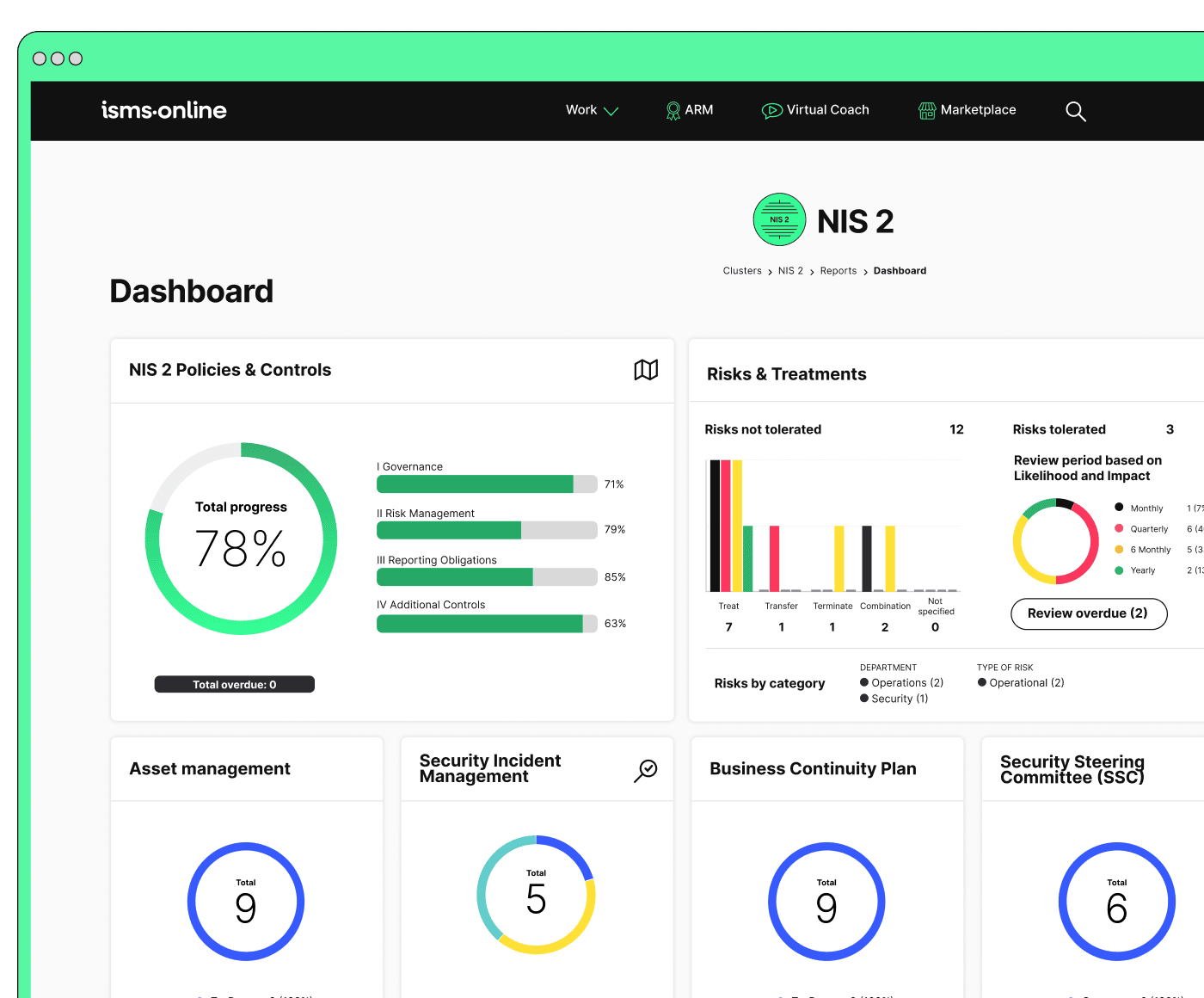
Be NIS 2-ready from day one
Launch with a proven workspace and templates – just tailor, assign, and go.
Is Your Board Empowered to Withstand Liability-Or One Regulator Letter Away From Crisis?
Personal liability now carves a direct path to the board. NIS 2 requires not just technical controls but demonstrable director involvement-training logs, signed-off risk registers, board minutes digitally archived and surfaced on demand. Anything less is a gap personally ascribed to a named leader.
In the eyes of regulators, intent means little-but a digital archive of actions means everything.
Building Digital Governance Into the Boardroom
Secure your position by ensuring every board discussion of cyber risk, compliance amendment, or incident escalation is digitally logged with proof of both review and action. Automation isn’t just about convenience-it’s about individual protection and visible trust.
| Scenario/Trigger | Board Action | Evidence Record |
|---|---|---|
| Major incident | Sign-off on escalation/closure | Board minutes, digital signature |
| Regulation or risk update | Training, document action | Training logs, evidence review history |
| High-severity board alert | Review, act, log | Action log, chain of decision |
Make it impossible for any audit to claim “we didn’t know” or “no one was responsible.” Ensure that digital evidence substantiates every board-level statement.
How to Actually Unify NIS 2 Controls With Rail, Maritime, Air, and Sector-Specific Standards?
Today’s transport leaders are, by necessity, standards integrators. NIS 2, IEC 62443, IATA, IMO, TISAX, national annexes-each poses distinct requirements, but evidence must be unified, defensible, and always mapped back to live operations. Fragmentation not only drains resources, it signals unmanaged risk to any regulator or procurement auditor.
Confidence grows in organisations that cross-map controls; suspicion grows in those with silos and disconnected audits.
Build a Standards Integration Map
- Cross-reference everything: Each asset, SoA clause, and control should be mapped to sector-specific articles and NIS 2/ISO 27001 reference (isms.online), enabling tailored audit outputs for rail (IEC 62443), air (IATA), maritime (IMO), and local codes.
- Single-platform management: Use solution(s) that automate cross-framework evidence and version alignment. Regulatory and customer trust builds on outputs that match the standard invoked and can display traceability across all codes.
- Dynamic cadence updating: Set reminders for both legal and sector-specific standard changes, driving live SoA updates as new requirements drop.
| NIS 2/ISO Control | Sector Standard | Operator Example | Evidence for Integration |
|---|---|---|---|
| A.5.24 Notification | IATA / IMO | Air France / Maersk | Notification comms/log |
| A.5.9 Asset Inventory | IEC 62443 | Deutsche Bahn | Live asset dashboard |
| A.5.19 Supplier Audit | TISAX | Renault Logistics | Supplier audit register |
Standards mapping is the reliable path to smooth audits and regulator faith-and the common cause for internal stakeholder confidence.
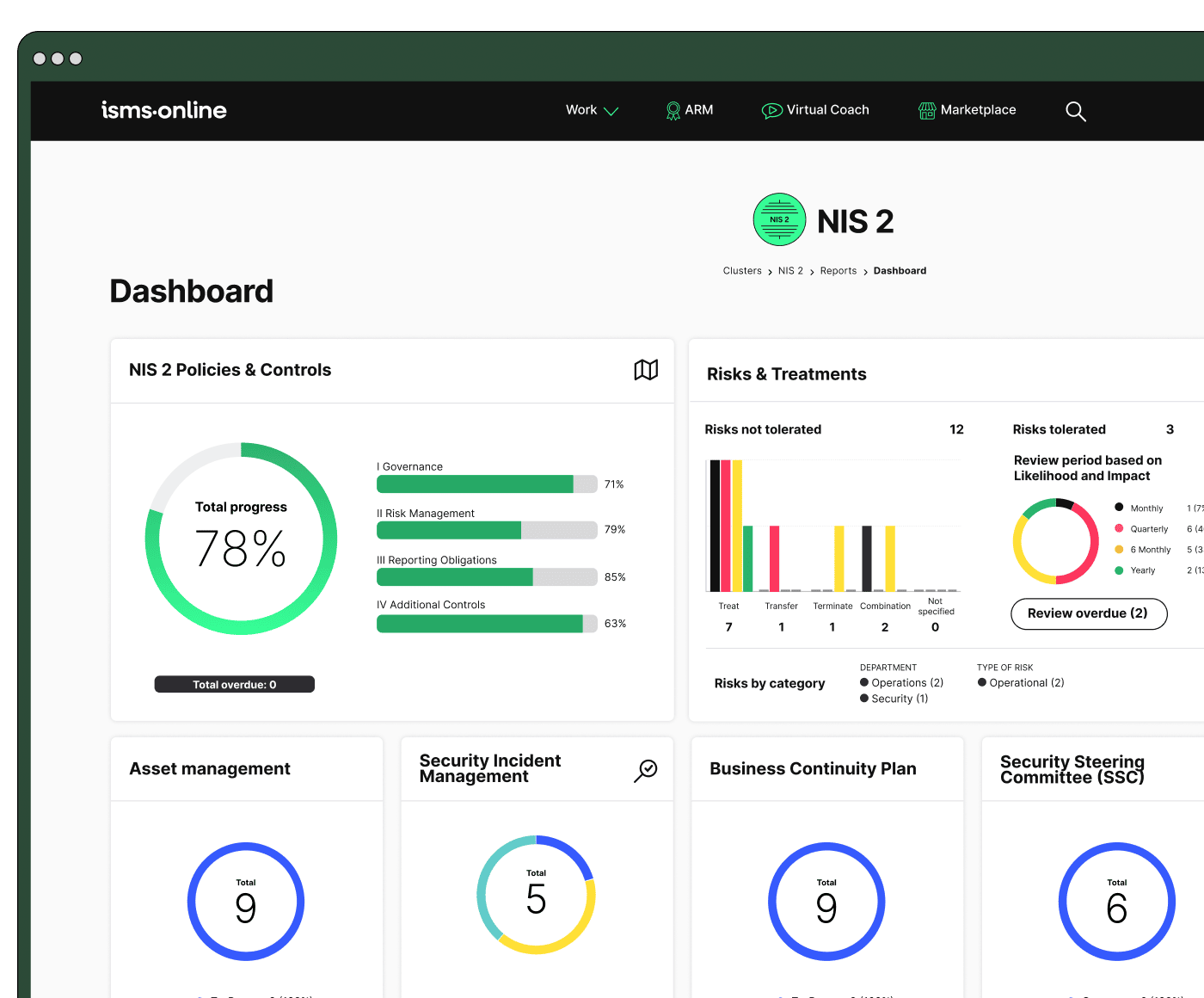
All your NIS 2, all in one place
From Articles 20–23 to audit plans – run and prove compliance, end-to-end.
Is Your Supply Chain and Legacy Fleet Up to the “Trust by Default” Standard-Or Your Weakest Link?
The entire trust chain-suppliers, field systems, cloud routes, legacy vehicles-must now stand up to “trust by default” scrutiny (isms.online). The days when a supplier’s security gaps or an unmaintained legacy asset could be excused as “outside our perimeter” are over.
Only organisations whose supplier logs update faster than the next exploit will be trusted to steward passenger and market data.
Managing Supplier and Legacy Risk-with Evidence
- Onboarding verification: Every new supplier review and legacy asset intake triggers a digital audit-contract review, policy alignment, and exception handling, all recorded in your ISMS.
- Quarterly supplier reviews: Mandate proof not just of onboarding but of ongoing compliance status, supported by digitally signed logs.
- Legacy asset roadmaps: Track every in-field exception; show plans, ownership, and improvement cycles for each asset that falls short of the ideal, with logs highlighting acceptance and review cycles.
| Trigger | Control Action | Evidence Example | Role |
|---|---|---|---|
| Supplier onboarding | Policy/risk review | Audit log, register | Maersk Supply Chain |
| Quarterly review | Proof, log, signoff | Documented remediation entries | Network Rail |
| Legacy stewardship | Plan, exception log | Owner logs, improvement roadmap | SNCF Rolling Stock Manager |
These records become the first port of call in any board inquiry, regulatory investigation, or market assurance statement.
Resilience Capital: Unifying ISMS.online for Board-Grade NIS 2 Leadership in Transport
NIS 2 is not a one-off compliance scuffle-it’s the new axis of operational and reputational trust for European transport leaders. The difference between sector laggards and tomorrow’s trusted operators isn’t jargon-filled policies: it’s cross-department evidence, board-level digital assurance, and automated, defensible compliance flows.
The trust you automate and evidence today is the equity you defend when exposed to regulators, passengers, and critical partners.
To cement your compliance leadership:
- Unify department, asset, and supplier dashboards: Leverage a platform like ISMS.online to create a living, resilient compliance fabric-linking policy, evidence, risk, supplier, and board actions.
- Automate evidence generation and audit export: Use auto-logging, digital signature cycles, and configuration management to meet every regulatory and procurement demand at the click of a button.
- Deliver board-ready trust, every day: Provide directors with true evidence of engagement-trainings archived, minutes digitally signed, escalation actions time-stamped, risk logs linked to real incidents.
- Turn compliance from cost into resilience capital: Leverage your logged supplier stories, audited staff engagement, and remediation cycles as brand assets-not only as audit requirements.
Your compliance journey isn’t just a hurdle for this year’s contracts. It’s your opportunity to build resilience capital, cement leadership, and secure your place in Europe’s next decade of safe, trusted, ambitious transport innovation.
Frequently Asked Questions
Who is classified as “in scope” under NIS 2 for the transport sector, and what’s different about obligations?
NIS 2 brings a paradigm shift for transport organisations-rail, air, road, ports, logistics-by making scope a matter of criticality and systemic impact instead of just size or legal entity. If your company provides services or supports infrastructure that impacts national, cross-border, or essential logistics (from airport operators to rail network managers and major ports), you are very likely “in scope.” It doesn’t matter if you’re state-owned, private, or a key supplier-if your operations are vital for continuity, NIS 2 casts a wide net over you.
What’s changed is direct legal and operational reach: local subsidiaries, branch offices, and even smaller partners can be regulated if they enable core transport flows. You now must identify under which national “scope list” you fall (since countries will expand the EU baseline), and any mistaken assumptions risk non-compliance. Senior leadership can no longer “delegate away” these risks: board-level responsibility is explicit, with new personal liabilities and mandatory evidence of compliance. Every terminal, logistics node, and digital asset must be mapped to a named owner, with board oversight and regular, audited progress checks.
In practise, NIS 2 ensures that digital and operational blind spots inside transport logistics are replaced with traceable accountability-everyone knows who owns what, right down to the last server or switch.
Scope Comparison Table
| NIS 1 (Old Law) | NIS 2 (2024 Onward) |
|---|---|
| Only vital, large operators | Essential & Important Entities, all size-by service criticality |
| Board liability ambiguous | Board and directors now directly liable |
| Subsidiaries sometimes exempt | Every critical location included if part of main operation |
| Compliance can be delegated | Direct mapping, continuous oversight required |
Which NIS 2 cyber-security controls are most urgent for transport, and how do you actually prioritise them?
The foundation is total visibility. All digital assets, infrastructure, and operational systems-including legacy systems, outsourced subprocessors, and IoT-must be mapped in a real-time, auditable inventory. Every system, not just the big ones, is now part of your regulatory perimeter. If an asset is unmanaged or untracked, it’s a compliance red flag.
Next, privileged access management must be watertight: all accounts (internal, vendor, legacy) are reviewed, with strict joiner/mover/leaver controls and rapid revocation. For transport, this means scanning out disused remote access, vendor “back doors,” and ensuring admin privileges are never left unmonitored, even during night shifts or holidays.
Incident response steps out of the binder: assigned leads, drilled alternates for every critical role, and automated notification triggers linked to the operational dashboard. Drills should run at unpredictable times (not just regular working hours) to catch weaknesses. Automation is key for log collection, acknowledgement tracking, and evidence snapshots-your audit trail must be available at any moment, tamper-evident, and mapped to every NIS 2 requirement.
Finally, the supply chain is absolutely in-scope. Risk assessments must run across suppliers and partners (especially with cross-border dependencies). Neglecting third-party networks, even if not owned, will risk the organisation-regulators are known to target the weak link in multinational chains.
Key Transport Controls (2024+)
| Control | Why Prioritise | Typical Failing Pre-NIS 2 |
|---|---|---|
| IT/OT asset inventory | Prevents “invisible” attack vectors | Untracked legacy or remote assets |
| Privileged access controls | Stops unmonitored system-wide breaches | Dormant or supplier accounts left open |
| Incident drills & logs | Enables regulatory notification duties | “Paper plan” but slow IR response |
| Automated evidence | Passes audits, reduces task fatigue | Scattered or delayed records |
| Supply chain risk reviews | Closes third-party vulnerabilities | Partners outside risk framework |
How have incident reporting and evidence requirements changed for transport operators under NIS 2?
Regulators now demand that any “significant cyber event” be reported within 24 hours, with a full assessment in 72 hours-weekends and holidays included. This reporting clock starts ticking the moment a relevant incident is detected, not after internal investigations.
It is critical that internal workflows flag and escalate incidents immediately, with named owners and clear alternates to ensure nothing stalls if someone is unavailable. Each step-alert, assessment, communication, resolution-must be logged, timestamped, and stored in a tamper-proof manner. Reporting must be adapted for every country in which your operations affect systems, since national authorities may have differing details and escalation paths.
Evidence logs have become live documents. Regulators don’t accept retroactive, summary-based logs. Instead, your operational, legal, and technical logs must be accessible in real time and mapped to predefined NIS 2 templates. Delays or incomplete submissions not only risk fines but undermine confidence in resilience. Prompt partial reporting now beats comprehensive reports delivered late.
Transport teams should rehearse not just the technical fix, but the exact pathways for regulatory communication-across borders, at night, with alternates assigned for every major service.
What does it actually mean to be “audit-ready” for NIS 2, and how can transport teams show true resilience?
Audit readiness is the ability to show, at any moment, that all controls are not just on paper but are live, logged, and functioning. For every requirement-dynamic asset register, privileged access, incident timelines, supplier assurance-your organisation must be ready to produce dashboard snapshots, event logs, signed staff acknowledgements, and mapped Statement of Applicability (SoA) references.
“Just compliance” is no longer enough. Auditors (internal and external) will seek evidence of real risk reviews, regular supply chain checks, up-to-date workflows, and proof that lessons learned from past incidents are tracked and applied. Automating these processes-linking logs to controls and mapping to ISO 27001 or similar standards-not only passes checks faster but demonstrates to leadership, customers, and regulators that your company is operating above “check the box” minimums.
| Audit Requirement | Example Live Evidence | ISO 27001 / NIS 2 Link |
|---|---|---|
| IT/OT asset control | Real-time asset inventory | A.5.9 / NIS 2 Art.21 |
| Privileged access logs | User revocation audit log | A.5.18 / NIS 2 Art.21 |
| Incident notification | Timestamped comms log | A.5.24 / NIS 2 Art.23 |
| Supplier risk review | Quarterly supplier audit | A.5.20 / NIS 2 Art.21 |
What actions must boards and executives in transport take to manage new NIS 2 accountability?
Direct board accountability is one of NIS 2’s most transformative elements. The board and C-level suite can now be personally sanctioned for failures-no more invisible hand-offs. Agendas must move from periodic sign-off to ongoing cyber risk review, active scenario planning, and evidence-based escalation paths.
Any audit finding, incident, or targeted regulatory question must trigger a clear, documented review at the highest level-with action items, updated minutes, and traceable dashboard changes logged. Proactive scenario drills and crisis simulations test the real flow of escalation: can a key director or manager step up if another is out? How do issues move up the chain, and how quickly do they reach a decision log?
Given the collision of NIS 2 with sector laws like DORA, boards need live tracking for legal change, an assigned compliance owner, and scheduled briefings to avoid drift or siloed reforms. Evidence of accountability now means showing-not just stating-how each risk is owned and improvement cycles are run, visibly from operational teams up to the boardroom.
How do ISO 27001, IEC 62443, TISAX, and other sector standards bridge to NIS 2 for transport-and how do you avoid “framework silos”?
NIS 2 compliance thrives on unification, not fragmentation. Sector standards like ISO 27001 (information security), IEC 62443 (OT/system integration), TISAX (automotive), and IATA (aviation) should be mapped directly onto NIS 2 articles, using a single Statement of Applicability or live compliance dashboard as the “one source of truth.”
Organisations that succeed in audits show that certifications, policy packs, and evidence mapping are linked-not siloed. This approach enables faster, more confident responses to EU or local audits, reduces duplicate effort, and ensures every new law (like DORA or national transpositions) is versioned, assigned, and monitored across all sites and subsidiaries.
Any new requirement-whether sector, national, or EU-wide-should immediately be logged, mapped to controls, and assigned an owner. Framework silos and ad hoc spreadsheet exports will lead to gaps and audit failures as requirements overlap.
| Standard | Prime Focus | Audit Mapping Example |
|---|---|---|
| ISO 27001 | Asset/risk control | SoA: A.5.9/A.5.24 |
| IEC 62443 | ICS segmentation | OT/ICS SoA reference |
| TISAX | Automotive supply | Supplier management logs |
| IATA | Aviation security | Ops compliance dashboard |
How do you build resilience for transport after NIS 2-what does continuous assurance look like?
True resilience after NIS 2 is built through routine, documented, forward-looking risk management-not just annual audits or crisis exercises. This means quarterly verification for each supplier (with visible logs and remediation progress), milestone-based management for legacy assets (all upgrades, exceptions, and workarounds tracked), and institutionalised learning from incidents.
Share status and learnings not just internally, but with sector peers and authorities, to boost the network’s ability to respond to major threats. Leading organisations measure their “time to assurance” from risk detection to board resolution, and make this capability a competitive advantage. Transparent onboarding checks, supplier updates, and fast response metrics are benchmarks for sector leadership, not just compliance.
Make sure every process, exception, and lesson is stored in a live, staff-accessible system to support high staff turnover, board queries, and faster audits-moving institutional memory into the digital core.
How does ISMS.online help transport organisations accelerate and de-risk NIS 2 compliance and resilience?
ISMS.online was built to bridge gaps across transport entities, making NIS 2 not just achievable but sustainable as sector requirements evolve. The platform aggregates asset inventories, privileged access logs, audit schedules, incident notifications, and supplier due diligence into one living repository. This replaces piecemeal tracking and ensures every asset, control, and action item is visible, actionable, and mapped to all applicable standards-NIS 2, ISO 27001, IEC 62443, TISAX, and more.
Live dashboards give boards, auditors, and regulators instant access to evidence without scrambling for files or waiting for manual signoffs. Automation handles policy distribution, quarterly supplier audits, response reminders, and evidence collection-reducing manual load, minimising fatigue, and supporting continuous assurance across the entire operational chain.
Trading reactivity for resilience starts by centralising compliance and actionable data-sector leaders use ISMS.online to make audits routine and demonstrate live accountability every day.
With ISMS.online, transport leaders transform compliance chaos into sector leadership, actionable trust, and a foundation to adapt to DORA, supply chain expansion, and new digital threats. Discover our full transport sector compliance solution or request a tailored demo and see how your team can move from firefighting to audit-ready confidence.






