





































Is Your Organisation Truly Ready for NIS 2’s Enforcement Day?
October 2024 is not a gentle warning shot-it’s the official launch date for a seismic shift in how European transport demonstrates operational trust. If your organisation operates in air, rail, water, or road and it meets the NIS 2 size or criticality thresholds, the liability clock has already started ticking (European Commission). Supervisors expect that, on any given day, you can produce digital traces of incident response logs, supply chain attestations, board decision minutes, and escalation records. Compliance can no longer be a frantic quarterly scramble; it must be a continuous, demonstrable state.
In a live compliance world, risk isn't a monthly summary-it's a daily dashboard.
Financial penalties up to €10 million or 2% of turnover may dominate headlines, but ENISA’s analysts stress the real cost: contracts revoked, reputations stained, or competitive positions lost (ENISA Threat Landscape for Transport Sector). A supplier’s weak compliance could cost an airline its biggest contract; a single incident could jeopardise a port’s regulatory licence. Gaps are no longer hypotheticals. They’re seen as failures to prove trust.
The era of spreadsheet-based ISMS is over. Today’s leaders utilise centralised ISMS platforms like ISMS.online that enable permissioned, timestamped evidence trails, automated reminders, and instant dashboard visibility. The NIS 2 net now drags in digital partners, outsourcers, and almost any vendor that can influence a “critical function.” Running on hope, manual reviews, or hidden folder systems isn’t a contingency plan-it’s a compliance risk.
A forgotten supplier control or missing digital audit trail can instantly shift you from trusted partner to regulatory problem.
At a typical management review, could your CISO open a dashboard and surface live compliance status, by partner or transport mode, in two clicks? If not, the exposure is real. This is the time to build future-proof processes-not in response to a breach, but in anticipation of the new normal.
How Will Your Incident Reporting Chain Stand Up to Article 23?
Article 23 of NIS 2 demands incident reporting as a precisely rehearsed choreography-timed, documented, and digitally traceable. For European transport operators, cyber attacks, major supply chain disruptions, and significant operational incidents must trigger reporting to authorities within 24 hours. Not only that, but an evidence-based update is due at 72 hours. Gone are the days when verbal assurances or email chains sufficed.
The difference between a contained threat and a public crisis is measured in minutes-and proof.
ENISA’s sector risk assessments reveal that most teams are overly optimistic about their reporting “readiness.” Supervisors, however, no longer rely on trust-they expect timestamped digital evidence of every step in the chain: from detection and escalation to notification and final reporting (ENISA Secure Supply Chain). Incidents must be mapped from alert logs right through to supplier and regulator notifications-with evidence stored centrally, accessible, and versioned.
Ask yourself: The moment an incident triggers, can every step-internal escalation, supplier contact, regulator report-be demonstrated, live, in your ISMS or audit files?
Sample Evidence Chain for NIS 2 Incident Response
| Step | Typical Role | Sample Digital Evidence |
|---|---|---|
| Detection | IT Ops/SOC | Alert log entry, timestamp, owner ID |
| Internal Escalation | CISO/IR Lead | Escalation email, approval file |
| Supplier Notification | Procurement Lead | Notification log, vendor reply |
| Regulator Reporting | Legal/CISO | Digital report form, submission stamp |
A quarterly walkthrough of this chain, using your actual ISMS platform, shifts compliance from a paper promise to routine practise. In a real audit, the evidence always wins.
Being able to deliver your last 72-hour report’s full evidence chain is not a bonus-it's the entrance ticket for continued business.

Master NIS 2 without spreadsheet chaos
Centralise risk, incidents, suppliers, and evidence in one clean platform.
Does Your Scope Truly Capture Your Network, Partners, and Digital Risk?
Most NIS 2 failures don’t begin with ignored controls; they start with scope drift. The Directive explicitly mandates transport operators to maintain clear, living evidence of exactly “who and what is covered” by your security and resilience regime. This isn’t just your immediate business unit-it’s every IT outsourcer, critical supplier, and digital partner.
Audits fail not on the day, but in the months scope is left unchecked.
All it takes is a forgotten partner or a minor contract renewal bypassing the ISMS protocol. When an incident exposes that oversight, regulatory attention intensifies. Annual scope reviews are no longer enough. Instead, every contract amendment, new asset onboarded, or change in operational responsibility should trigger an immediate review and update of your scope documentation.
Transport Scope Evidence Table
| Entity | Inclusion/Exclusion | Key Evidence Reference |
|---|---|---|
| Rail Operator | Annex I ‘essential’ | Supplier Register, SoA, Board Minutes |
| Cloud Provider | In-Scope (vital IT) | Data Flow Diagrams, SoA, Contract |
| Minor Vendor | Excluded, with reason | Exclusion Note, Board Waiver |
Embed the process: Store every scope update in a central ISMS folder, require digital sign-off, and ensure automated reminders surface excluded entities for review at every change point.
Auditable scope clarity is the greatest guardrail against both regulatory fines and strategic surprises.
Are You Linking Living Risk Management with Control Execution and Contract Flowdown?
True NIS 2 compliance is not a “once-a-year” review. It’s an ongoing, digitised mesh, showing that live risk registers drive not just policies, but concrete escalations and contractual expectations (eur-lex). Any gap between your risk log, your contracts, and your control execution is a potential source of regulatory scrutiny-or board alarm.
The surest way to lose trust is to have disconnected risk acknowledgment and incident response.
What’s required? Every critical contract must flow down NIS 2 obligations: explicit audit rights, timely notification clauses, and responsibility assignments. Each supplier’s review, sign-off, and remedial action needs to be version-controlled and logged, with responsible owners named.
Control Flow for Transport Modes (Condensed Table)
| Mode | Key Evidence Example | Clause / Mapping | ISMS Register |
|---|---|---|---|
| Air | Incident/drill logs | A.5.24, A.5.26 | Air Operations |
| Rail | SCADA patch/testing reviews | A.8.20 | Rail Infrastructure |
| Water | Resilience drills | A.8.7, A.5.29 | Port Operations |
| Road | IoT fleet audit, training | A.5.9, A.8.31 | Road Asset Logs |
Automate reminders for quarterly reviews, centralise log files, insist on digital signatures. No more chasing paper; audits are increasingly digital-first.
In compliance, documentation is defence-the absence of live proof is risk exposure.
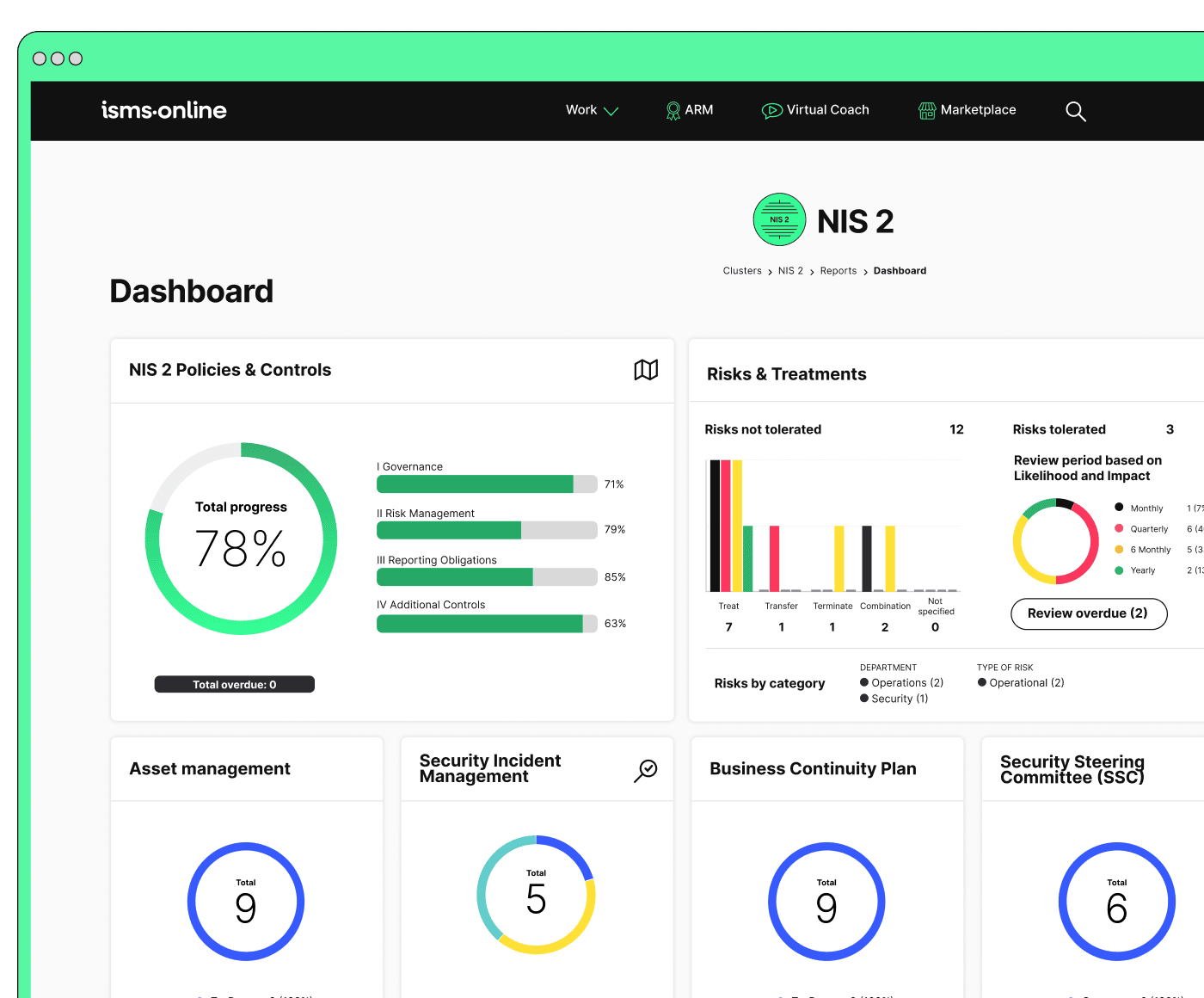
Be NIS 2-ready from day one
Launch with a proven workspace and templates – just tailor, assign, and go.
Are You Demonstrating Mode-Specific Evidence, Not Just Generic Security Policies?
Generic IT security policies no longer satisfy regulatory or boardroom expectations. Both are demanding mode-specific, evidence-based proof, tailored to the unique realities of air, rail, water, and road transport (ENISA sector threat guides).
- Air: Navigation log drill records, minutes signed by chief pilots or risk committees.
- Rail: Asset inventory reviews, patch logs, and legacy risk assessments.
- Water: Ransomware readiness evidence, resilience exercises, GPS logging.
- Road: Registers for connected asset updates, regular safety training records.
Audit pain points evaporate when you show, not tell. Policy is only the start; dashboards and file evidence confirm real resilience.
Domain-Specific Evidence Table
| Transport Domain | Audit Evidence Example |
|---|---|
| Air | Navigation logs, incident drills |
| Rail | Patch/asset register dumps |
| Water | Drill logs, GPS audit trails |
| Road | IoT audit snapshots, training |
Action: Build mode-specific review tracks into your ISMS, linked to scheduled reviews and sign-off logs. If a peer asks for your last port ransomware drill evidence-or your latest road IoT audit-you should be ready to demo it, not describe it.
Does Your Crosswalk from NIS 2 to ISO 27001 Stand Up to Scrutiny?
Leading transport compliance teams now run crosswalk tables: clear mappings from NIS 2 articles to the ISO 27001 Annex A controls and sector standards (isms.online). This isn’t just neat paperwork; the crosswalk streamlines audits, shortens RFP preparation, and underpins defensible risk decisions.
ISO 27001 Bridge Table (Condensed Form)
| NIS 2 Requirement | Operational Action | ISO 27001 / Annex A Reference | ISMS Folder |
|---|---|---|---|
| 24h incident notification | Plan & notify flow, live log | A.5.24, A.5.26 | Incidents |
| Live risk management | Real-time register, ownership | A.6.1, A.5.7, A.5.20 | Risk Register |
| Supplier obligation/flowdown | Contract log, clause tracker | A.5.19, A.5.20, A.8.30 | Contracts |
| Board oversight | Board minutes, SoA updates | Clause 9.3, A.5.36 | Board Docs |
| Evidence retention | Archive logs, version files | A.5.31, A.8.13–A.8.16 | Evidence Register |
Audit Traceability Mini-Table
| Event | Risk Update | Control/SoA Ref | Evidence File |
|---|---|---|---|
| Incident | Register + log | A.5.24, A.5.25 | Incident Log |
| Supplier review | Contract log | A.5.19, A.5.20 | Supplier Checklist |
| Board approval | SoA update | A.5.36, Clause 9.3 | Signed Minutes |
Digital crosswalks allow you to automate flagging of controls when NIS 2-related risk events occur-reducing manual error, improving audit outcomes, and letting you move faster.
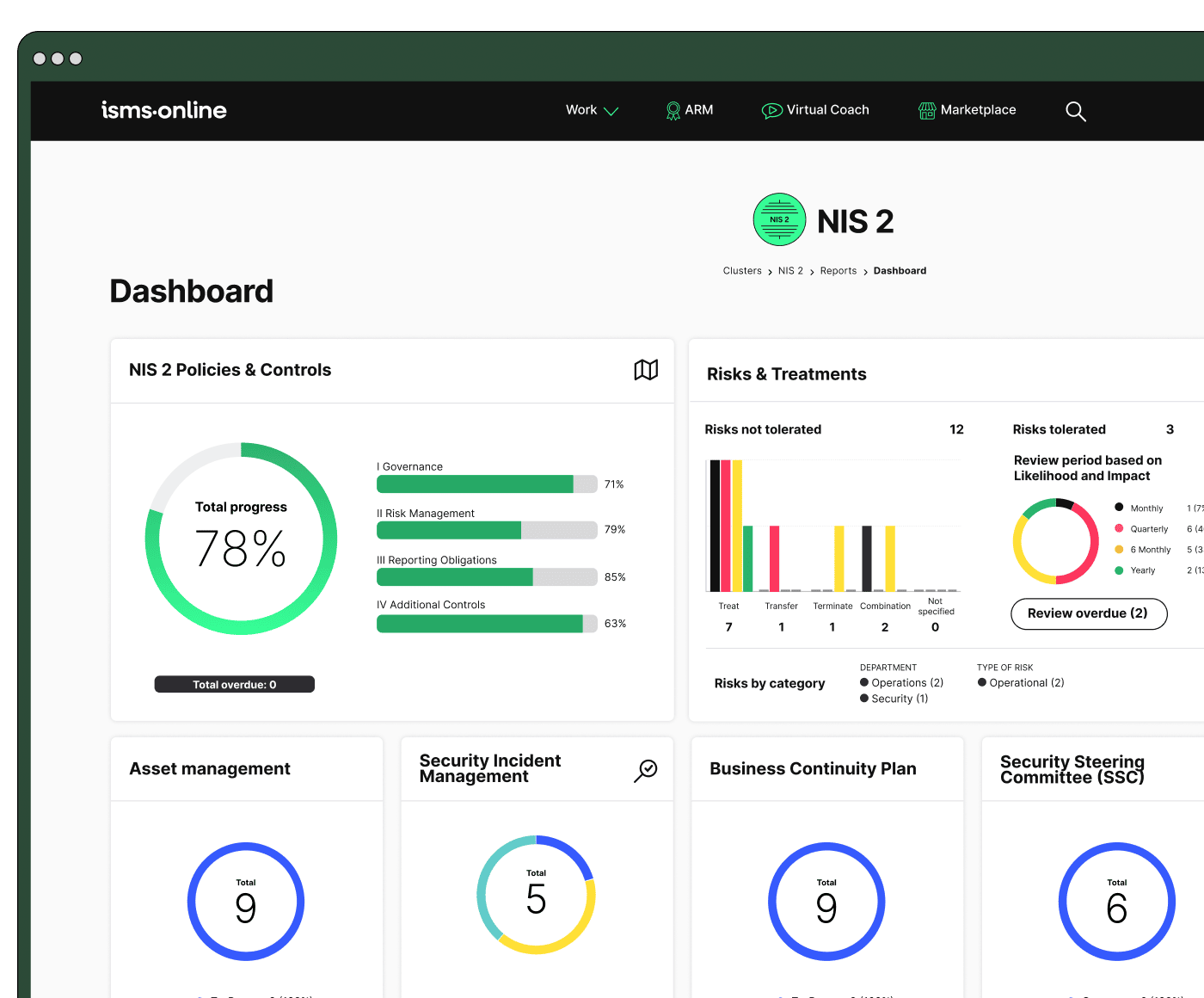
All your NIS 2, all in one place
From Articles 20–23 to audit plans – run and prove compliance, end-to-end.
Have You Automated Evidence, Centralised Proof, and Closed Your Audit Gaps?
A system is only as resilient as the evidence it can produce under pressure (isms.online; pwc.ie; eur-lex.europa.eu). NIS 2 requires that your evidence-whether for incidents, contract flowdowns, or board oversight-is centralised, version-tracked, and accessible by role. Losing a file, overwriting a log, or relying on untracked spreadsheets is a risk too great to tolerate as enforcement approaches.
When regulators or customers ask, instant dashboards are confidence, while scattered files are excuses.
Priority actions for 2024 and beyond:
- Dashboards for live incident and supply chain exposure.
- Automated reminders for policy reviews, contract checks, and supplier audits.
- Digital registers update in real time; changes are traceable, deletions are archived not lost.
- Centralised permissioning: Staff, suppliers, and auditors receive only the access required.
This is more than compliance; it is a statement of operational confidence. No more chasing evidence or scrambling ahead of audits-the process becomes an ongoing, self-updating loop.
Micro Traceability Table
| Trigger | File Logged | ISMS.online Area |
|---|---|---|
| Supplier contract | Updated attachment | Supplier Contracts |
| Cyber incident | Alert, response log | Incident Response |
| Policy review | Checklist sign-off | Policy Packs |
| Periodic compliance | Reminder, owner | Audit Programme |
Smart compliance is continuous and visible. Teams that automate updates never fall behind; those that delay risk missing more than just deadlines-they may lose contracts.
Will You Lead Transport Sector Compliance, or Be Left Explaining Headlines?
The hardest lesson from NIS 2 is that compliance is no longer an annual report-it’s a real-time, role-aware, and fully automated living system (isms.online; ba.lt; eur-lex.europa.eu). Leaders who invest in digital-first ISMS unlock operational freedom: audits become a routine check, contracts push through faster, and teams focus on growth, not compliance firefighting.
Don’t be the operator explaining an incident. Be the leader who can prove, live, that you control risk.
This is the year to centralise, automate, and demonstrate readiness before audits, customers, and regulators demand it unexpectedly. Whether your next obstacle is a new supply chain partner, a digital transformation, or simply a sharp audit deadline, your best asset is a living record-centralised, auto-updating, instantly provable.
Take ownership now: If your team can’t open a digital dashboard today to answer incident, contract, or board queries in real time, it’s not a technology gap-it’s a leadership opportunity. Let ISMS.online help design your automated compliance loop, streamline evidence management, and put your operation ahead of enforcement, not behind it. When October 2024 arrives, let the headlines reflect your confidence-not your scramble.
Frequently Asked Questions
What are the real NIS 2 cyber and risk management requirements for air, rail, water, and road transport operators?
NIS 2 turns cyber and risk management for transport into a constantly updated, evidence-first discipline that’s board-accountable and built for live regulator inspection. If your operation-air, rail, water, or road-meets the “essential” or “important” entity definition, your obligations go well beyond static policies:
- Continuously update your digital entity map: Include all IT/OT assets, SaaS tools, critical infrastructure, third-party providers, and subcontractors. Any operational change (new supplier, system upgrade, merger) must be promptly documented and signed off.
- Maintain a live, actionable risk register: Every route, function, system, and supplier must be logged with a named risk, mitigation measure, and responsible owner. Edits must be time-stamped, digitally authorised, and review reminders automated.
- Flow down cyber controls through contracts: All suppliers and contractors must sign agreements that cascade your NIS 2 obligations, enforcing mandatory cyber, notification, audit, and breach duties through every critical link and sub-contractor.
- Define incident response roles and run regular drills: You need named, trained contacts and executive backups. Scheduled incident simulations must be logged, reviewed, and referenced for post-incident learning.
- Retain permission-controlled, digital evidence for all actions: Every risk update, vendor agreement, drill, or incident report must be stored in a versioned, easily retrievable format, with full traceability and role-based access for audits.
The difference is simple: inaction or missing updates can equal fines-even if your written policy is flawless. Only digitally evidenced, up-to-date controls count for NIS 2.
Core Transport Compliance Workflow
Scope Mapping → Risk Register Update → Supplier Clause Flowdown → Incident Drill/Escalation → Digital Evidence Archive (Board, IT, Operations, Procurement each with clear accountability)
How does NIS 2 incident reporting work for transport, and what digital evidence must you provide regulators?
Regulators expect a tightly sequenced, fully evidenced process:
- Within 24 hours: File an “early warning” for any disruption, emerging threat, or significant vulnerability-even if full details are missing. Save detection logs, first notifications, and incident ticketing evidence.
- Within 72 hours: Submit a comprehensive incident report detailing causes, affected systems, impact, and all mitigation taken. Back it up with system logs, escalation records, supplier communications, and evidence of authority notifications.
- Within 1 month: File a closure report cataloguing root cause analysis, policy/process corrections, postmortem reviews, and proof that actions (policy updates, supplier clauses, training) are completed.
Each stage demands digital, permissioned evidence:
- Detection logs (from SIEM, OT, SOC, or ICS alarms)
- Escalation files (tickets, emails, phone records)
- Regulator/supplier notification proofs (timestamped receipts/portal confirmations)
- Closure reports (signed board or committee minutes, updated risk register record)
| Stage | Artefact/Action | Example Evidence | Accountable Role |
|---|---|---|---|
| Detection | SIEM alert, log entry | `/logs/soc_alerts_202410.csv` | Security Lead |
| Escalation | Ticket, notification, email | `/tickets/incident_14534.eml` | IT Operations Manager |
| Authority Notify | Regulator web form, email proof | `/notices/submission_1001.pdf` | Compliance Manager |
| Closure | Minutes, post-mortem update | `/reviews/postincident_oct2024.pdf` | Board/CISO |
A missing or out-of-date step means direct scrutiny and possible enforcement action-even if the incident itself was well-contained.
What determines “scope” under NIS 2 in transport, and how do most teams fall short?
NIS 2 “scope” is not set and forget. You must treat your scope as a living digital register that expands and contracts with your real-world business. Most fines result from “scope drift”-updates missed after supplier changes, mergers, or technology adoption.
- Entity size and function matter: Essential status generally fits any operator over 250 staff or €50m turnover, or deemed critical by national rules (Annex I/II). Important entities often include niche logistics, significant regional providers, or those delivering key digital services.
- Every scope addition, exclusion or change must be digitally justified and signed off: If you add SaaS platforms, merge business lines, or retire tech, update your ISMS and get board signoff with version tracking.
- Failure is usually about evidence gaps: Regulators want to see change records, not just an “in scope” checkbox.
| Entity | In Scope? | Exclusion Reason | Signoff | Evidence File |
|---|---|---|---|---|
| Rail Operations | Yes | – | CEO/COO | `/ISMS/Scope_v2.7.pdf` |
| Airport SaaS | Yes | – | CIO | `/ISMS/Scope_v2.8.pdf` |
| Minor Vendor X | No | Revenue < €1m | Procurement | `/ISMS/Scope_v2.82.pdf` |
| Fleet Merger Y | Yes | – | Board | `/ISMS/Scope_v3.0.pdf` |
This level of careful, digital traceability is the root defence against the most common regulatory failures.
How does NIS 2 reshape supply chain, supplier, and subcontractor controls for transport entities?
You must treat every critical supplier and subcontractor as a compliance equal, not an external risk silo. NIS 2 demands hard evidence of “flowdown”-enforceable, signed, NIS 2-matched cyber clauses applied to every relevant contract.
- Contracts must be current, versioned, and enforce flowdown rights: Security standards, breach notification within your timelines, audit cooperation, and regulatory fines must all be mirrored.
- Monitoring and review is ongoing, not annual: Log every review, clause update, and sub-vendor status. Failure to remediate missing clauses or flowdown breaks the compliance chain-and exposes you to regulatory fines even if the supplier is at fault.
- Evidence archiving is critical: Each supplier’s compliance file must prove clause presence, last review, and flowdown to all relevant subs.
| Supplier | Clause Signed | Last Review | Evidence File | Flowdown Present? |
|---|---|---|---|---|
| RailSys AB | Yes | 2024-06-01 | `/Contracts/RailSys.pdf` | Yes |
| PortMaint Ltd | Yes | 2024-05-12 | `/Contracts/PortMaint.pdf` | Yes |
| FleetBuilder Oy | No* | 2023-12-30 | `/Contracts/FleetBuilder.pdf` | No* (Remediate) |
Where a supplier’s clause is missing or not flowed down, remediate immediately, log the action, and track resolution.
Which mode-specific controls, risks, and evidence must be uniquely mapped for each form of transport?
Regulators and auditors no longer accept boilerplate: your risks, controls, and evidence must reflect mode-specific threats and operational realities.
- Air: Record and evidence airport control software drills, segmented OT/IT operations, and signoff logs for navigation staff.
- Rail: Digitally log OT/SCADA patching cycles, supply chain drills, and role-based audit outcomes.
- Water: Maintain records of ransomware simulations for port and vessel systems, proof of GPS anti-jamming measures, and emergency comms testing.
- Road: Archive patch cycles for IoT fleet sensors, driver cyber-awareness logs, and regular telematics security audits.
| Mode | Controls Documented | Evidence File | Accountable Role |
|---|---|---|---|
| Air | Airport/air nav drill, signoff | `/Air/Drills_2024.pdf` | OT Lead |
| Rail | OT/SCADA, supplier drill reviews | `/Rail/SupplyChain_2024.xlsx` | Engineering Manager |
| Water | Ransomware, GPS-jam, port controls | `/Water/GPS_jam_2024.pdf` | Port Security Officer |
| Road | Telematics, IoT patch log, audits | `/Road/IOT_Awareness_2024.log` | Fleet IT Manager |
Every control must reference when it was last updated/tested, who owns it, and which risks it mitigates. Evidence must be living, not template-based.
What makes for seamless NIS 2 and ISO 27001 integration-and real digital audit-readiness?
The best operators break silos with a digital ISMS platform like ISMS.online, keeping NIS 2 and ISO 27001 controls mapped live, not left in spreadsheets or siloed folders:
- Map every NIS 2 requirement to an ISO 27001 control: in a live Statement of Applicability (SoA).
- Centralise your risk register, SoA, incident logs, contract files, and evidence in one system: , with automated reminders and audit-friendly permissions.
- Automate policy, contract, and incident logging reviews: -reminders, role-based tasks, and instant evidence visibility.
- Retain evidence according to legal requirements, with versioning: and explicit board/procurement/IT signoff where needed.
| NIS 2 Ref | ISO 27001 Annex A | SoA Row | Evidence |
|---|---|---|---|
| Article 21 | A.5.7, A.6.3 | 13 | `/RiskRegister_v3.2.xlsx` |
| Supplier Clause | A.5.20, A.5.21 | 45 | `/Contracts/Clauses2024.csv` |
| Incidents | A.5.24, A.5.26 | 38 | `/IncidentLog_202410.pdf` |
| Staff Training | A.6.3 | 29 | `/StaffTraining_Awareness2024.log` |
Digital ISMS is now the backbone of compliance; live mapping and automated review make surprise audits just another board meeting.
What are the risks and penalties for failing NIS 2 compliance, and how can your organisation minimise them?
NIS 2 fines, management bans, and operational freezes are now reality, not just a theoretical risk. Key penalties include:
- Fines up to €10m or 2% of global turnover per violation:
- Publication of non-compliance, with reputational/contract fallout
- Management and board bans for gross or repeated failure
- Suspension from critical contracts or operations
- Personal/director liability if neglect is proven by audit trail gaps
Most penalties follow from evidence failures-missing logs, incomplete contract proofs, scope drift with no signoff, or lack of responsive incident records. To minimise exposure:
- Automate evidence collection and rolling review (scope, contracts, risk, incident logs, training)
- Ensure digital permissioning and board signoff for critical registers
- Regularly validate dashboards and audit trails-do not wait for annual reviews
- Maintain transparent, accessible proof for regulators, clients, and internal leadership
| Failure | Regulator Reaction | Maximum Fine | Ops/Contract Consequence | Audit/Evidence Gap |
|---|---|---|---|---|
| Late incident rpt | Formal warning/audit | Up to €10m/2% | Scrutiny, penalty threat | No timestamped log |
| Scope drift | Critical audit finding | Up to €10m/2% | Contract hold/freeze | No change file |
| Supplier miss | Immediate direct fine | Up to €10m/2% | Vendor disruption | No signed clause |
| Recurring breach | Board bans/suspensions | Unlimited | Replaced management/ops | No board evidence |
Are you ready for October 2024? With ISMS.online, you can map, automate, and evidence every part of your transport compliance posture-so regulator deadlines become just another routine that earns trust and wins contracts.






