





































Why Waste Management Now Faces Unprecedented NIS 2 Scrutiny
Waste management operators across Europe are facing a regulatory wave like never before with the enforcement of the EU’s NIS 2 Directive. The sector’s historical position on the compliance margins-often focused on physical safety, environmental standards, and operational logistics-has been permanently overhauled. Today, both company boards and their technical teams are squarely accountable for not just internal digital systems but for every link in their supplier, logistics, and outsourced IT chains. As incidents in adjacent infrastructure sectors have proven, a weak spot in any partner or outdated control anywhere in your operation can ripple out and make you tomorrow’s headline.
Every unmitigated breach echoes across the sector: one supplier’s invisible gap can spell tomorrow’s headlines for all.
At the heart of NIS 2 is a new flavour of accountability. Relying on static PDF playbooks, one-off penetration tests, or check-the-box control reviews may have passed muster before, but now regulators expect continuous, living evidence of cyber-security risk management. Field tablets, operational SCADA networks, transport integrations, landfill partners’ portals-every digital endpoint is subject to scrutiny. If your cross-site access logs are out of date or suppliers’ security arrangements remain unvalidated, you live with latent risk and mounting legal liability.
The old annual rhythm-“we satisfy compliance in Q4, then get back to business”-has expired. Regulations like NIS 2 now count not just failures, but also “failures to improve.” Under this model, genuine board involvement is not optional; it’s a critical part of your regulatory defence and a shield against financial, reputational, and operational ruin. The risk is no longer theoretical. Fines, spot inspections, enforcement actions, and real-world business outages are driving a new best-practise: compliance as an operational muscle, not an administrative reflex.
Who Must Act: Decoding Scope and Thresholds for Waste Sector Operators
It’s a common misconception that only the giants of waste management need to take decisive action. Under NIS 2, the net is wide: any operator with more than 50 employees or €10 million in turnover becomes an “important entity,” facing the full weight of direct, board-level obligations. But size is not the only entry ticket. Smaller, regionally critical providers-those serving hospital networks, municipal treatment plants, or major public infrastructure-also qualify due to the essential services they underpin.
Only live, audit-ready evidence-not checklists or opinions-demonstrates compliance.
An ISO 27001 certificate or annual audit report is not enough. The directive calls for up-to-date management review records, operationalised controls at every node, and-crucially-clear lines of accountability right up to the board. It is explicit: compliance failures flow upward, and so do fines and sanctions. Boards must personally ratify breach notifications, oversee supplier due diligence, and regularly revisit cyber risk assessments as part of their documented duties.
Table 1: Bridging NIS 2 Expectations to ISO 27001 (Sample)
| NIS 2 Expectation | Operationalisation | ISO 27001 / Annex A Link |
|---|---|---|
| Board reviews documented | Minutes, signature logs, dashboard | Cl.5, A.5.2, A.5.4 |
| Live supply chain risk register | Risk bank, SoA/linked controls | Cl.6.1, A.5.7, A.5.21 |
| Prompt incident notification | Drill logs, escalation plan | A.5.24, A.5.25, A.5.26 |
| Training records maintained | Staff logs, signed attestations | Cl.7.2, A.6.3, A.6.5 |
| Supply chain due diligence | Contract review, vendor audits | A.5.19, A.5.20, A.5.21 |
Today’s compliance threshold is “always on.” Whether it’s a driver’s smart device linking to depot software, or a waste transfer station using a third-party access management solution, each live system becomes a regulatory focal point. Any gap, no matter how transactional, is now seen as a potential attack route and an operator’s responsibility.
Board-level traceability now rests on dashboards that correlate policy sign-offs, risk reviews, and incident decisions with time-stamped proof.
Effective defence means codifying board and management engagement through systematised management reviews, digital sign-offs, and audit-ready, role-attributed logs- not just archived records, but living links between leadership, incidents, and frontline evidence.

Master NIS 2 without spreadsheet chaos
Centralise risk, incidents, suppliers, and evidence in one clean platform.
Are Your Supply Chain and Third-Party Risks Actually Under Control?
Your risk perimeter does not end at the office door or landfill gate. Under NIS 2, regulatory accountability follows the entire data flow-from core SCADA systems down to partners, IT suppliers, contracted transporters, and even outsourced HR or billing vendors. If any part of this supply web falls short, so do your defences.
Modern auditing expects a digital audit trail: every supplier breach, contract escalation, and risk assessment is attributed to a named owner.
It is no longer sufficient to collect certificates or generic security statements. Operators must validate, log, and be ready to produce evidence that every supplier’s controls are tested and mapped against their own risks. If a partner lags in updating their OT endpoint security, it becomes your vulnerability. If breach responses or risk assessments are delegated to “annual supplier reviews,” the window for enforcement-and public scrutiny-remains wide open.
Annual breach simulations involving critical suppliers are now a regulatory baseline. Regional authorities and sector auditors will expect to see up-to-date supplier registers, escalation histories, and integrated scenario testing records. Every transport partner, sorting facility, or cloud platform must be mapped in a continuously maintained supply chain dashboard, with drill logs and escalation workflows baked into routine practise.
Key operator actions:
- Standardise contracts to mandate specific, auditable technical and organisational controls.
- Maintain continuous risk and escalation logs per partner, not just spreadsheets or email chains.
- Run annual simulations with key partners and record all responses, gaps, and remediations.
If your contract amendments, risk assessments, and escalation events cannot be traced live, you are exposed not just to fines but to sector-wide incident ripple effects.
What Supervisors and Auditors Actually Check: It’s Not Static PDFs
Annual “check the box” compliance is dead. Regulators, supervisory authorities, and increasingly your own board demand breathing evidence: operational risk registers, supply chain dashboards, and incident logs that are active at every audit point- not locked away until year-end.
Evidence must be as dynamic as operations-a dormant log is a liability, not a shield.
Supervisors will scrutinise:
- Chain-of-custody for risk and incident response updates (not just static records).
- Drills and scenario test results for both internal and supplier-linked incidents.
- Digital logs of staff acknowledgement and compliance training, tied to risks and roles.
- Real-time status of incident escalation, vendor notifications, and management sign-offs.
If an inspector or regulator demands proof at 8:00 a.m., can you deliver? Or does your evidence still live in scattered inboxes, supplier emails, or siloed SharePoint folders? Sector leaders equip themselves for continuous audit readiness-every day, not just 30 days after a policy change.
Sidebar: Common Audit Readiness Gaps in the Waste Sector
- Static, year-old risk registers and incident logs
- Supplier lists without documented escalation workflows or partner test records
- Board meeting templates lacking security review fields or documentation
- Staff training tracked only in HR tools, not integrated with ISMS
- Scenario-based supply chain breach drills never performed, logged, or evidenced
A live, dashboard-driven ISMS turns audit cycles from a weeklong scramble into a routine, with integrated evidence flows linking incidents, risks, staff, board, and suppliers-unifying audit preparedness with sector resilience.
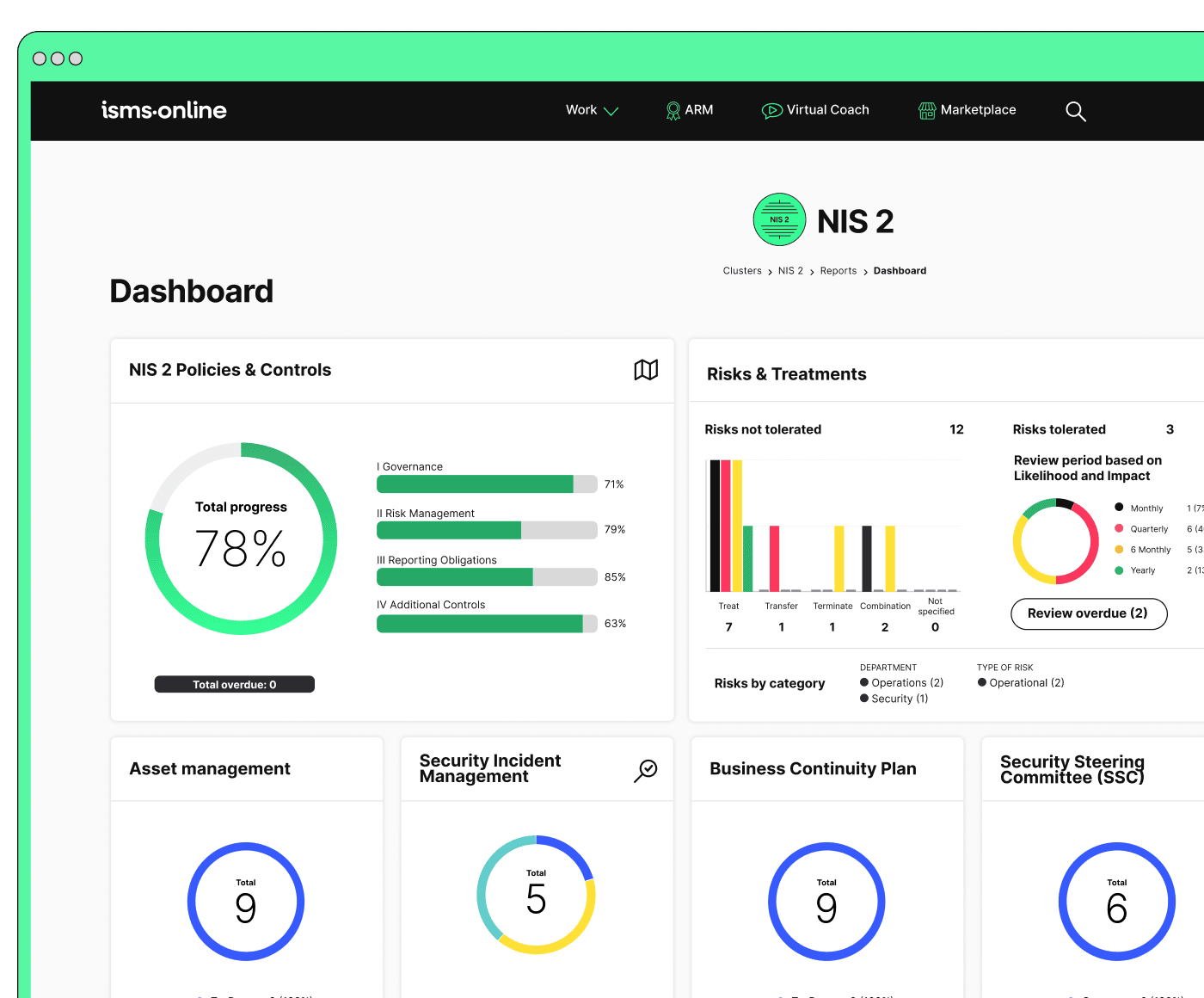
Be NIS 2-ready from day one
Launch with a proven workspace and templates – just tailor, assign, and go.
ISO 27001 and NIS 2: Alignment (and Gaps) No One Explains
The gold standard for information security, ISO 27001, forms a strong baseline for sector compliance. But NIS 2 introduces requirements that ISO 27001 does not cover fully-especially around supply chain live risk mapping, board/leadership evidencing, and continuous documentation of incident escalations. Passing your certification audit no longer provides complete regulatory protection.
Passing your ISO 27001 audit is not enough-regulators want to see controls live-mapped to risk events and board decisions.
High-performing waste operators centralise all critical evidence-risk updates, supplier events, board sign-offs, and incident records-within an integrated platform. This enables instant traceability for every regulator query, every customer questionnaire, every leadership decision.
Table 2: ISO/NIS 2 Traceability (Extended)
| Trigger | Risk Update | Control/SoA Link | Evidence Logged |
|---|---|---|---|
| Supplier breach | “3rd Party” risk | A.5.19, A.5.21 | Incident log, vendor escalation record |
| Director change | “Leadership” risk | Cl.5.2, A.5.2 | Board minutes, new sign-off record |
| Ransomware threat | “Malware” risk | A.8.7, A.8.8 | Patch logs, drill report, training logs |
| Policy update | “Policy” risk | Cl.6.1, A.5.1 | PolicyPack log, staff acknowledgements |
The regulatory theme: everything that impacts risk needs a time-stamped, attribution-proofed audit trail-always ready, always accessible.
Traceability: From Risks to Boardroom Accountability
Traceability is now the logic and language of compliance. NIS 2 expects every update across risk, incident, policy, and management review to be digitally linked to its origin, decision-maker, timestamp, and documented review.
Traceability defines sector leadership: only those who can instantaneously evidence every decision and escalation survive the new standards.
A static, unrefreshed policy or control will be treated as a sign of systemic neglect. Enforcement trends highlight the need for integrated digital “breadcrumb trails”-mapping every risk update, supplier incident, escalation, and management review in a manner that is instantly defensible.
Fast scenario:
- In the event of a supplier-side ransomware breach on a Friday afternoon, leading operators:
- Update the third-party risk register and explicitly map it to NIS 2 Article 21.
- Instantly trigger the incident escalation workflow and log all supplier communications.
- Review contractual incident notification obligations.
- Digitally log all board escalations and decisions in real time.
- Compile all evidence for an immediate, audit-ready pack.
This level of operational agility not only satisfies regulators but actively reassures boards, investors, and customers that you are not simply compliant, but resilient.
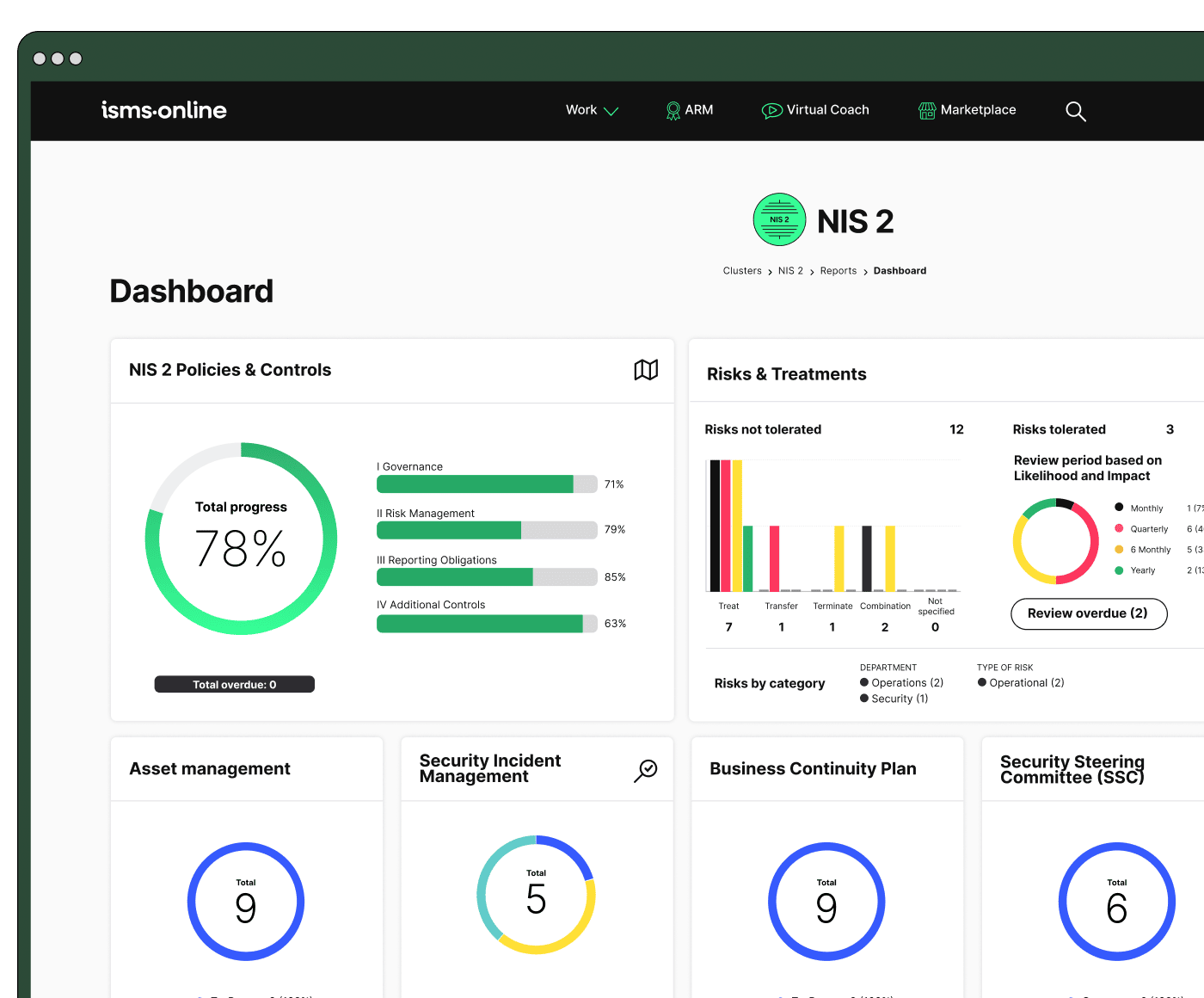
All your NIS 2, all in one place
From Articles 20–23 to audit plans – run and prove compliance, end-to-end.
Fines, Spot Inspections, and Board Exposure: How to Defend Your Organisation
The stakes for non-compliance have dramatically increased. NIS 2 empowers regulators to fine companies up to €7 million or 1.4% of global annual turnover-and the bar for “material breach” now includes failures to document decisions and risk management activities, not just systemwide breaches.
Too much documentation never appears in regulator findings-only the regret of being caught without it.
Spot inspections are a sector norm. Audit and supervisory authorities demand immediate, at-desk access to all evidence: not only incident logs and staff attestations, but every board or management sign-off, contract review, and drill event tying together the risk landscape.
Successful operators prepare by:
- Logging every board and management review in a compliance system (not email chains).
- Scheduling at least semi-annual drills, recording every activity, outcome, and action taken.
- Building a single, integrated evidence pack: risk updates, supplier escalations, incident logs, policy revisions, and board actions-ready to share any time.
In practise, the board’s confidence-and the company’s regulatory agility-rests on this continuous, evidence-first approach. Anything less will fail under scrutiny, eroding stakeholder trust and competitive positioning.
Lead With Confidence: Own NIS 2 Waste Management Compliance With ISMS.online
NIS 2 compliance in waste management is no longer a technical upgrade-it’s an operational and reputational imperative. The leaders in this sector unify risk management, supply chain assurance, staff engagement, and audit preparedness within platforms like ISMS.online. These systems transform evidence collection from a last-minute scramble into a daily, automated process-raising audit pass rates, reducing manual overhead, and letting teams focus on strategic outcomes instead of compliance catch-up.
Are you ready for the new normal? Boards and regulators now expect at-a-glance dashboards that can trace every significant risk, supplier escalation, and incident action-across the operation and up to the boardroom. Your ability to instantly assemble that evidence is now your defining asset.
True NIS 2 leadership is the ability to show, not tell-sector resilience means readiness is the visible asset boards, auditors, and regulators value most.
Make your NIS 2 compliance a competitive advantage. In the waste sector, leadership belongs to those whose evidence is always just a click away.
Frequently Asked Questions
What new cyber-security and incident reporting measures does NIS 2 require for waste management operators?
NIS 2 expects waste sector operators to prove cyber-security and incident readiness as a living, digital practise-maintaining dynamic risk registers, responsive supply chain controls, and management-driven actions you can show at any moment, not just during audits.
Today, compliance is measured not by policy folders, but by your ability to demonstrate:
- Dynamic risk mapping: -A continuously updated digital register, covering not just IT but OT (industrial and legacy SCADA), IoT endpoints, and supplier connections. Reviews are logged after any technology or process change, incident, or new threat warning, not just annually.
- Live incident response records: -Operators must log simulations and drills (with participants, outcomes, and remediation tracked to closure), as well as real incidents and lessons learned. Drills should include scenarios relevant to physical and digital waste flows and test continuity under supply chain pressure.
- Documented supply chain oversight: -Every contract must include cyber-security clauses, right-to-audit, and breach notification terms. Centralise logs of vendor audits, risk reviews, simulation results, and any non-compliance. Store these digitally for instant recall.
- Management and board engagement: -Supervisors expect signed, time-stamped minutes from risk reviews, escalation decisions, and resource allocations to cyber-security. The board’s active role must be traceable, not just delegated to IT.
- Comprehensive training records: -Electrically logged completion for all security and awareness training modules, covering even third parties with system access. Keep evidence up-to-date for staff, contractors, suppliers, and any temporary workforce.
Audits now chase proof of daily controls in action-not just once-a-year declarations.
Core Evidence Table
| NIS 2 Demand | Critical Evidence | ISO 27001 Reference |
|---|---|---|
| Risk assessment | Dynamic risk register, change/event log | Cl. 6.1 / 8.2 |
| Incident management | Drill/exercise records, after-action updates | A.5.24–26 |
| Supply chain security | Signed contracts, audit/remediation logs | A.5.19–21 |
| Executive engagement | Signed minutes, review history, approvals | Cl. 5.1, 9.3 |
| Training compliance | Completion logs, module history | A.6.3 |
For more:
Which waste sector operators qualify as “important entities” under NIS 2-and what triggers their obligations?
Your operation is an “important entity” if waste management (collection, transport, treatment, disposal) is your core business and you employ 50+ staff or have €10m+ turnover-regardless of whether you’re public, private, or PPP.
Categories and triggers:
- Public and private sector: Municipal services, private contractors, and joint ventures all qualify if their main activity revolves around waste handling and they exceed either threshold.
- Threshold clarifiers: Entities with fewer than 50 employees or less than €10 million turnover are usually exempt, unless regulators designate them as “critical” by sector or geography.
- Broad inclusion: Even if your waste management is part of a wider group (e.g., within a manufacturer), it must be separated out and only qualifies if waste activities themselves hit a threshold.
- Universal impact: Status means the full set of NIS 2 duties-including board oversight, risk management, incident disclosure, and supply chain checks-apply.
| Entity Type | Staff / Revenue | NIS 2 Status | What It Demands |
|---|---|---|---|
| National waste firm | 120 staff / €18m | Yes | Full NIS 2 compliance |
| Council-run division | 60 staff / €6m | Yes | All duties: risk, incident, supply chain |
| Small SME | 30 staff / €2m | No* | Not covered unless designated critical |
| Factory with minor waste operations | 200 staff total / waste = 5% revenue | No | Only applies if core business is waste |
*Unless local/national authority deems otherwise
What digital evidence and documentation must waste operators be ready to produce for supervisors?
Auditors demand live, accessible, digital evidence-not outdated binders-spanning:
- Risk register: Timestamped updates with entries for every reviewed threat, change, or new vulnerability; mitigation steps logged and signed by the responsible owner.
- Incident response logs: Records from each drill and simulation, real incidents (timeline, decisions, corrective actions, and subsequent risk review). All entries must note completion and who was involved.
- Vendor files and supply chain: Signed contracts (with cyber terms and notification rules), onboarding checklists, logs of supplier audits, remediation steps, and outcomes of breach simulations-annotated, dated, and centrally stored.
- Management and board oversight: Digitally signed minutes from risk and compliance reviews, logs of budget approvals or policy changes, and escalation actions for major risks or incidents.
- Staff and subcontractor training: Electronic proof for every user’s completed training, exceptions justified, with regular test results (e.g., phishing).
| Evidence Area | Required Format | “Living” Proof Indicator |
|---|---|---|
| Risk register | Exportable dashboard | Entry in past 90 days, sign-off |
| Incident drills | Scenario/action log | Dated, corrective action present |
| Vendor files | Contract/assessment pdf | Last audit/compliance review |
| Board oversight | Digitally signed files | Regular, dated review history |
Readiness is measured by digital recall and linked management action-not just paperwork.
How must waste operators change their supply chain management to comply with NIS 2?
Waste operators now must treat all major vendors-especially IT/OT suppliers and logistics partners-as extensions of their own cyber risk, not separate silos.
Required steps include:
- Cyber-Security clauses in every contract: Minimum controls, breach notifications, right to audit, and expectation for participation in drills/simulations.
- Joint drills & logging supplier engagement: Simulate cyber or operational breaches involving suppliers. Document who participated, scenario results, and remediation status for every vendor and subcontractor.
- Track every compliance issue: Maintain logs for non-conformance, delays, negotiations, and outcomes-even supplier refusals or postponed risk reviews must be recorded.
- Designate and log escalation contacts: Each provider should have a named contact for emergencies/audits, with up-to-date status on compliance and incident response.
| Vendor Name | Cyber Clause | Last Drill | Audit Status | Escalation Contact | Compliance State |
|---|---|---|---|---|---|
| SecureWaste | Yes | Feb 2024 | Passed | [email protected] | Full compliance |
| RecycleChain | Update due | Oct 2023 | Outstanding | [email protected] | Awaiting contract update |
If you can’t produce these records, or a supplier refuses to join in drills or audits, you risk both fines and non-compliance.
How can following ISO 27001 help waste operators, and which gaps remain for full NIS 2 alignment?
ISO 27001 forms a strong compliance base, but NIS 2 pushes for greater real-time proof and supply-chain depth:
ISO 27001 assists with:
- Risk, supplier, and incident policies: Clauses (Cl. 6.1, 8.2, A.5.19–21, A.5.24–26) correspond directly to NIS 2 requirements for live risk management, supplier due diligence, and incident logging.
- Audit readiness: If you keep digital audit trails, time-stamped updates, and signoffs, you’ll shorten response time to supervisors.
But NIS 2 requires:
- Board-level sign-off and digital evidence: No delegated compliance-senior management must personally sign reviews and strategic decisions, tracked in digital files.
- Continuous, logged supplier engagement: Simulations, remediation logs, contract amendments, and audit trail for every major vendor-not just policies.
- Strict incident response clock: Documentation of initial alert (within 24h), follow-up (72h), and all subsequent actions, with digital timestamps.
| NIS 2 Article | ISO 27001 Reference | NIS 2 Supplement | Example Evidence |
|---|---|---|---|
| Art. 21: Supply chain | A.5.21 | Drill, audit, remediation logs | Vendor drill report |
| Art. 20: Board review | Cl. 5.1, 9.3 | Digital signatures, escalation logs | Board minutes, approvals |
| Art. 23: Incident clock | A.5.24–26 | 24h/72h action tracking | Alert log, notification |
See: Bright Global-NIS2 & ISO 27001 Comparison
What NIS 2 penalties could waste operators face, and how do you survive real-time audits?
Sanctions include fines up to €7 million or 1.4% of turnover, board liability, public censure, and exclusion from contracts. Regulators can demand immediate digital evidence of compliance-at the desk, not just during pre-notified annual audits.
- Prepare for random audits: Regulators may visit (physically or remotely) and ask you to produce risk registers, incident logs, board minutes, and supplier drill records instantly.
- Demonstrate traceability and leadership: Every major event-new vendor, board risk decision, security incident-should be logged and linked to authenticated users.
- Maintain continuous, closed-loop records: Gaps or missing data are flagged as both operational weaknesses and compliance failures.
| Trigger | Logged Action | Clause / Control | Example Evidence |
|---|---|---|---|
| Vendor onboard | Update risk, contract | Annex A.5.21 | Digital contract, compliance log |
| Incident drill | Log scenario, actions | A.5.24–26 | Drill summary, lessons log |
| Board policy | Approve, sign minutes | Cl. 5.1, 9.3 | Digitally signed minutes, log |
Demonstrate resilience, don’t just claim it: compliance is the by-product of live, daily control, not an annual event.
Firms that embed digital audit-readiness set the pace, earning not only regulatory trust but reputational advantage with customers and partners.
ISO 27001-to-NIS 2 Bridge Table
| Audit Expectation | Operationalisation | Relevant Clause |
|---|---|---|
| Live risk tracking | Dynamic register, review log | Cl. 6.1, 8.2 |
| Incident exercises | Drill records, improvement logs | A.5.24–26 |
| Vendor management | Contract, audit, escalation logs | A.5.19–21 |
| Board decisions | Signed digital policies/minutes | Cl. 5.1, 9.3 |
Traceability Table
| Action Trigger | Event/Risk Update | Clause / SoA Link | Logged Evidence |
|---|---|---|---|
| New supplier | Register amended | Annex A.5.21 | Signed agreement, drill |
| Board approval | Policy minuted | Cl. 5.1, 9.3 | Digital sign-off, log |
| Incident | Notification sent | A.5.24–26 | Incident log, alert proof |
If you want to transform compliance from red-tape pain into operational confidence and sector leadership, start by ensuring every action, decision, and supplier touchpoint is digitally logged, auditable, and alive.






