





































Are You Ready for NIS 2? How Supply Chain Contracts Became the New Cyber Risk Battleground
As October 2024 approaches, NIS 2 isn’t just moving the goalposts on cyber-security-it’s redrawing the pitch. What once felt like distant supplier risk is now either a strategic strength or an exposed nerve for your entire organisation. The supply chain, long kept at the periphery of executive discussion, has suddenly become a direct audit target-and the quality and evidence of your supplier contracts are front and centre.
Even the most confident board meeting can unravel when an auditor maps operational risk clause by clause.
The days of “good faith” or “best effort” are over. Under NIS 2, auditors, regulators, and your own business partners will no longer tolerate woolly contract language or paper-only compliance. Instead, they’ll demand live proof that every obligation-whether it’s incident notification, audit rights, or supplier segmentation-has not only been documented, but embedded and exercised across your ecosystem (ENISA, 2024). Every supplier contract is now a living risk document, and the window for “wait and see” strategies is rapidly closing.
Your team is no longer judged on what’s written, but on what’s logged, mapped, and practised-every day. Ignore these trends, and you risk making tomorrow’s headlines for all the wrong reasons.
What Makes a NIS 2-Compliant Supply Chain Clause? Why “Legalese” No Longer Cuts It
It’s not enough to have contracts in place. In the age of NIS 2, regulators and auditors want ironclad commitments with named roles, strict timeframes, and workflows that can be proven in practise, not just promised in a file cabinet (Skadden, 2024). Acceptable “adequacy” now moves from the back office to your audit dashboard-presence is not enough; operationalisation and ongoing traceability are paramount.
An unsigned, untested contract triggers more auditor questions than it answers.
The Five Clauses That Separate Leaders from Laggards
An audit-ready, NIS 2-compliant supplier contract covers more than generalities. Auditors now expect to see:
- Security Assurance: Annual evidence, not just promises-logs and reports that map controls to current risks.
- Right to Audit: The ability for both you and your suppliers to perform scheduled/unannounced audits, with evidence of exercised rights.
- Incident Notification: Hard-coded timelines (24-hour early, 72-hour full), named notification roles, no ambiguity or “reasonable effort” loopholes.
- Vulnerability Cooperation: Mutual commitments for rapid disclosure and joint response to vulnerabilities-gaps here indicate silence is risk.
- Termination & Data Destruction: Demonstrated, not just declared-logs showing erasure, return, and sign-off that map back to platforms, not old emails.
When even one clause is missing, generic, or “pending review,” the audit spotlight finds you-and regulators now expect logs of periodic checks and live evidence drills (ENISA, 2024).
Don’t Stop at Tier-1 Suppliers: Auditing the Full Chain
Obligations “flow down” to all subcontractors. NIS 2 pushes your focus beyond immediate suppliers; auditors and regulators scrutinise evidence chains that cover every tier, not just those who send invoices (IAPP, 2024). If a breach originates in a fourth-tier vendor, your contract evidence will shoulder part of the blame.
Contracts as Live, Auditable Workflows
Legal teams can’t “set and forget” contracts anymore. They must partner with procurement and infosec to map, log, and rehearse every obligation. Modern ISMS platforms become a single source of truth-every service KPI, incident notification, and onboarding is mapped to a clause and drilled (Third Party Risk Institute, 2023).
A contract that gathers dust is a liability. An operational contract is a shield.

Master NIS 2 without spreadsheet chaos
Centralise risk, incidents, suppliers, and evidence in one clean platform.
What Does an Audit-Ready Supply Chain Clause Look Like? Red Flags and Best-in-Class Examples
The fastest way to lose an audit is with grey areas-“as soon as practicable” or “to the best of their knowledge” clauses. NIS 2 raises the evidentiary bar: timelines, process flows, notification recipients, and risk-tier-based segmentation (Quantum Cyber Analytics, 2024).
Precision Clauses: Why “Within 24 Hours” Is Now Mandatory
Incident notification is now a workflow, not just a policy. Both the 24-hour “early warning” and 72-hour full report must be locked into every critical contract clause. Ambiguity here is an immediate audit flag-auditors expect to see not only the clause, but logged timestamps for notifications (and even dry-run drills) (Lexology, 2024).
Contracts that don’t spell out how, when, and who foster invisible risk.
Data Return/Destruction: Don’t Stop at “Delete”-Prove it
Contractual data-handling obligations now include not just the act but the evidence-logfiles, deletion confirmations, chain of custody, request and fulfilment approvals (Pretesh Biswas, 2023). “Return upon request” is not enough. Prove you can erase and audit for verification.
Jurisdiction, Risk-Tiering, and Customization
Copy-paste legal templates or non-jurisdictional clauses often fail audits. NIS 2 expects contracts tuned to context-risk tier, geography, business process. Not all vendors are created equal; avoid “one-size-fits-none” exposure.
How Incident Reporting and Vulnerability Response Actually Flow Through Your Contracts
A contract isn’t just about onboarding. It’s your blueprint for crisis management and ongoing assurance. Under NIS 2, contracts must support real-time workflows, not just after-the-fact paperwork.
What Live Audit Evidence Looks Like
Auditors now require:
- Logs of real (or simulated) incident notifications-timestamped, recipient-specified, and contract-linked (ENISA, 2023).
- Drill logs showing rehearsals (24-/72-hour notification scenarios).
- Role-based action mapping: when a person changes job, audit logs show new assignments.
- Default notification cadence (even “no incidents” logging) to prove continuous operation.
- Live workflow evidence (not just “we sent the policy”) mapped to contract references.
If you can’t show a log for it, assume the auditor won’t count it.
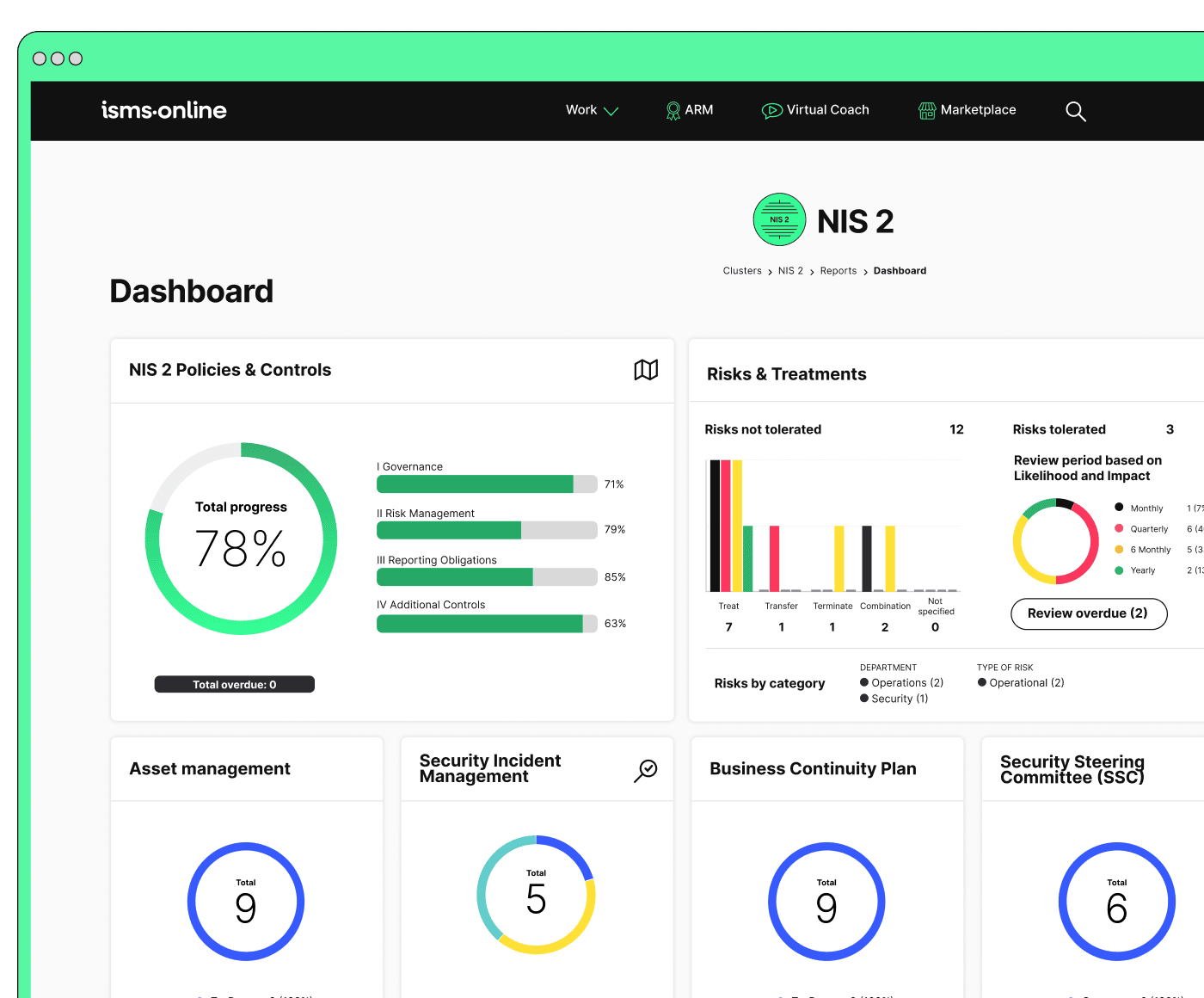
Be NIS 2-ready from day one
Launch with a proven workspace and templates – just tailor, assign, and go.
Clause, Control, Evidence: Traceability That Makes or Breaks Your Audit
Your compliance isn’t measured by policy-it’s measured by proof. The audit loop now runs from contract clause → ISMS platform control → logged evidence, not just email chains or SharePoint galleries (EY, 2024).
Clause–Control–Evidence Mini-Table
Every supply chain security clause must be operationalised by mapped controls and supporting evidence. Here’s how a sample traceability map might look:
| Clause Expectation | ISO 27001 Control/Process | Evidence Example |
|---|---|---|
| Incident notification | A.5.24, A.5.25, A.5.26 | 24/72h logs, alert acknowledgments |
| Right to Audit | A.5.19, A.5.20 | Audit schedule, procedure, sign-off |
| Data destruction | A.8.10, A.5.21 | Erasure confirmation, register updates |
| Vulnerability mgmt | A.8.8 | Drill reports, scan logs |
| Termination | A.5.21, A.5.20 | Offboarding protocol, proof-of-exit |
Trigger–Risk–Evidence Mini-Map
| Trigger | Risk Update | ISO 27001 Control | Evidence Logged |
|---|---|---|---|
| Supplier cyber incident | Risk register update | A.8.8 | Incident logs, alerts |
| New sub-processor onboarded | Due diligence log | A.5.19, A.5.20 | Contract, control logs |
| Contract amended | Contract/risk update | A.5.19 | Approval logs |
| Supplier audit completed | Risk log updated | A.5.19, A.5.20 | Audit report |
Remember: your logs are your audit defence. When in doubt, automate capture and mapping within a cloud ISMS platform.
Building Contract Clauses That Rise Above the Audit Line: Mapping, Accountability, Automation
A NIS 2-ready contract clearly assigns duties-by actor, role, and event-while the ISMS platform logs approvals, changes, and escalation paths. Evidence of segmented responsibilities and board-level sign-offs demonstrates real operational maturity.
Role- and Event-Based Mapping (Segmentation)
Contracts must map:
- Every critical event (onboarding, incident, termination) to specific roles, not generic “contact points.”
- High-risk suppliers to stricter monitoring and escalation steps.
- Duty handover and review cycles-never static or “fire-and-forget.”
Auditors validate these mappings with random checks; failures typically result from unassigned or out-of-date roles.
Automation and Audit Survivability
Manual tracking is no longer viable. Platforms that automate logging, evidence uploads, and notifications create daily defensibility-and let you scale compliance without perpetual scramble, even as frameworks evolve (Pinsent Masons, 2024).
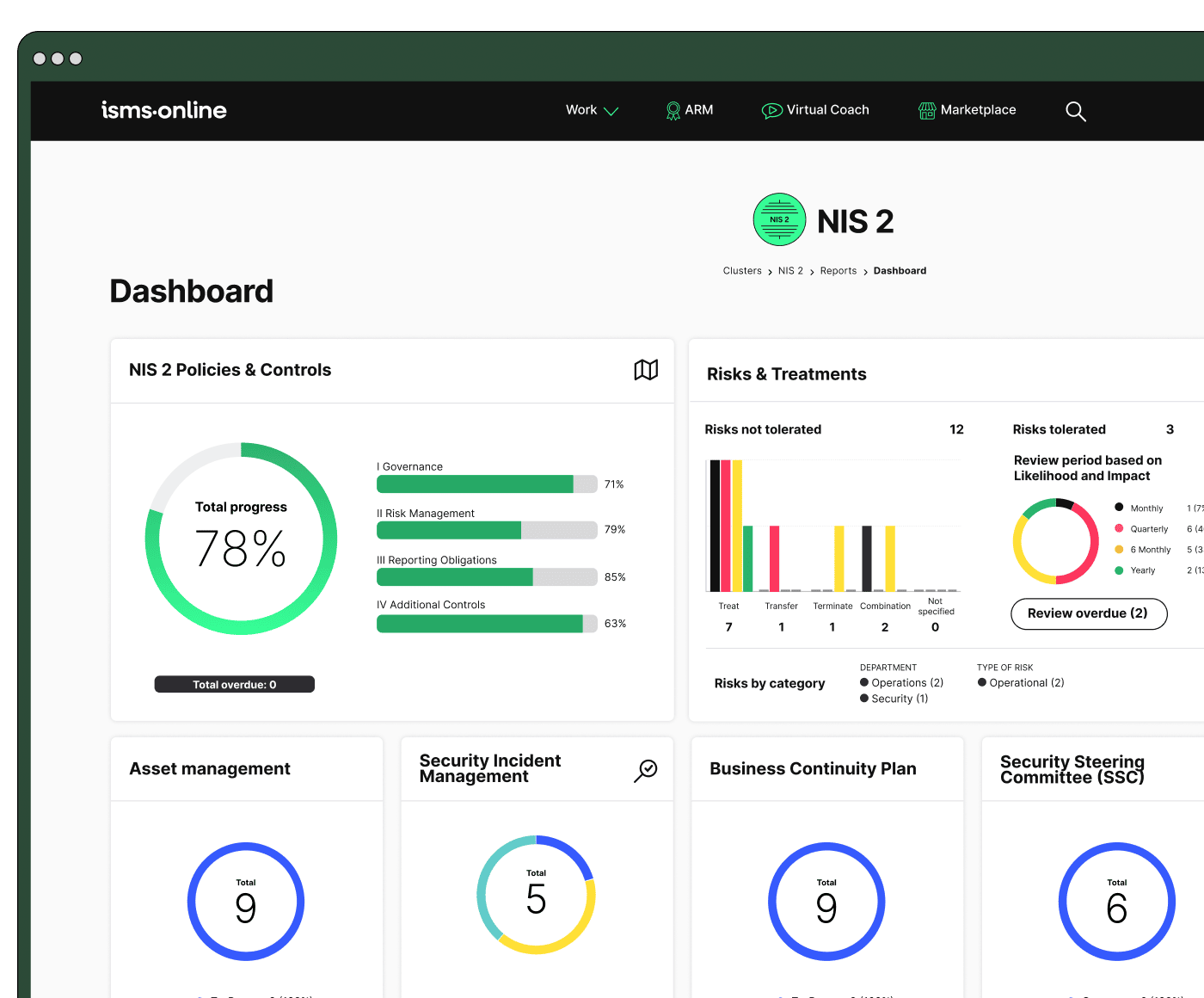
All your NIS 2, all in one place
From Articles 20–23 to audit plans – run and prove compliance, end-to-end.
Closing the Audit Loop: Assigning Ownership, Automating Evidence, Owning Outcomes
Who’s responsible for contract clauses, evidence collection, and workflow automation? NIS 2 requires named internal owners-never only external consultants or generic “compliance contacts.” Assign and log:
- CISO/Head of Security: Incident and vulnerability logs, supplier audits, breach escalations.
- DPO/Privacy Lead: Data flows, sub-processor controls, privacy reviews.
- Vendor Manager: Onboarding, contract updates, termination logs.
- Procurement Lead: Approval traceability, supplier segmentation, compliance notifications.
- Board/Risk Committee: Strategic sign-off, high-tier supplier oversight, audit cycle controls.
Evidence is only as strong as its owner-make assignments visible and keep them live.
Best practise: Use your ISMS platform to automate, monitor, and document. Replace annual-cadence reviews with persistent updating and scheduled drills. Ongoing compliance is not merely defensible, but truly sustainable.
Navigating Special Cases: Open Source, Cloud, and Non-EU Supplier Clauses
Supply chain security under NIS 2 includes complexities well beyond standard vendors. Open-source code, cloud hosting, and non-EU partners each require their own contract anatomy.
Open Source
Maintain an up-to-date software bill of materials (SBOM), require vulnerability patch logs, and rehearse code review acceptance.
Cloud Vendors & Data Location
Clauses must specify:
- Exact data location(s)
- Audit and inspection rights
- Incident response processes (including notifications that bridge jurisdictional boundaries)
- Clear offboarding/exit procedures
Non-EU Suppliers
Prove equivalence to EU standards, map data flows explicitly, and include choice-of-law clauses aligned with EU customer requirements (Skadden, 2024).
Complex supply chains demand bespoke clauses-a template from last year won’t cover new risk vectors.
Why Proactive Contract Health Checks and ISMS Automation Define NIS 2 Leaders
The most robust defence isn’t found in policy-it’s built in daily, traceable action. Centralise your supplier contract management, automate approvals and drills, and keep your evidence trail auditor-ready. A last-minute scramble is no longer survivable; leadership now means owning the audit before the audit period even starts.
If it’s not in the logs, it doesn’t exist-prove your compliance every day, not just during audits.
With ISMS.online, your platform becomes your contract control centre-every stakeholder gets one view, every clause can be mapped to workflow, and every incident becomes just another proof point on your audit journey (ENISA, 2024; ISMS.online).
Start by running a contract health check-map owners to every clause, rehearse notifications, and log every approval. Automate what you can, verify what can’t be automated, and treat compliance as an ongoing asset rather than a once-a-year scramble. Join those who lead through the NIS 2 transition, and let your evidence-not just your ambition-do the talking.
Frequently Asked Questions
What new contract clauses must supplier agreements contain for NIS 2 compliance?
To meet NIS 2, supplier contracts must advance well beyond vague assurances-each term must be enforceable, auditable, and directly mapped to both risk and regulatory standards. Your contracts should require:
- Security parity and audit rights: Mandate that suppliers fully align with, or exceed, your own security controls. Include explicit rights for both scheduled and surprise audits, extending to every sub-processor and affiliate down the chain.
- 24h/72h incident and vulnerability reporting: Require that all suppliers give initial notice of impactful cyber incidents or credible vulnerabilities within 24 hours of discovery, followed by a complete report inside 72 hours. Contracts must specify designated contacts and reporting protocols.
- Enforced remedial cooperation: Obligate suppliers to collaborate on incident resolution-joint action planning and remediation are contractually required, not simply notification.
- Data return, erasure, and certification: At contract end or offboarding, suppliers must delete or return your data, providing formal destruction certificates or logs as proof.
- Scheduled review and improvement cycles: Contracts must trigger at least annual reviews, and ad hoc updates whenever there are major regulatory, threat, or supplier changes-with documented approvals showing active oversight.
- Mandatory flow-down: All NIS 2 obligations must cascade contractually to every sub-contractor (including cloud, SaaS, OSS), with traceable, enforceable evidence for each tier.
- Live, auditable records: Real-time evidence-approval trails, version logs, notification simulations-must be produced, not just PDFs stored on a drive.
A contract that can’t generate auditable, real-time evidence is ignored by NIS 2-regulators now ask for living proof, not promises.
Table: Clause–Control–Evidence Mapping
| Clause | ISO 27001/Annex A Ref | Typical Audit Evidence |
|---|---|---|
| 24h/72h Notification | A.5.24, A.5.26 | Alert logs, notification trails |
| Audit Rights & Flow-down | A.5.19, A.5.20, A.5.21 | Audit logs, sub-contract docs |
| Data Erasure at Offboarding | A.8.10 | Deletion certs, destruction logs |
| Scheduled Review/Improvement | A.5.36 | Review logs, approval records |
How do NIS 2 incident and vulnerability notification requirements redefine timelines for suppliers?
NIS 2 abolishes ambiguous, “best effort” reporting-suppliers must deliver a two-step notification for any significant incident or vulnerability:
- Initial alert within 24 hours: to you (as the customer), the national CSIRT, or relevant authority, including preliminary facts plus likely impact;
- Full follow-up within 72 hours: with detailed findings, root cause, remedial steps, ongoing risks, and who did what.
Contracts alone aren’t enough-auditors will scrutinise operational reality. Suppliers must prove, with evidence, that teams know the process (training logs), can trigger notifications (drill simulations), and hit the timelines (timestamped log files).
If a notification is late, incomplete, or “lost,” regulators or loss adjusters won’t accept excuses. Auditable records-real or test case-must show contracts matched action, not just intentions.
The era of open-ended ‘soon’ is over; if you can’t show the 24/72 notification window was met or tested, the contract’s value is nil.
What specific operational evidence must be ready for NIS 2 supplier contract audits?
Regulators and external auditors will no longer accept verbal assurance or static certificates as proof. Instead, you must supply:
- Signed, version-controlled contracts showing mapped clauses: -each term should point to its regulatory driver and required controls.
- Change, approval, and renewal logs: -timestamped, governed by management or board, not just legal.
- Real and simulated incident/vulnerability notifications: -logs and workflow history showing alerts hit 24h/72h windows, tested at least annually.
- Training records: -onboarding and periodic training for staff and all suppliers, with records showing completion and comprehension.
- Third-party certifications: -proving operational coverage, mapped to your ISMS and contract clauses (not generic “certified” claims).
- Supplier/sub-processor traceability register: -mapping the full chain; showing dates, clause inheritance, and evidence for each link in the chain.
Traceability Table: Trigger to Evidence
| Trigger | Risk Register Update | ISO/Annex A Ref | Audit Evidence |
|---|---|---|---|
| Supplier incident | Supplier risk revised | A.8.8 | Alert log, risk entry |
| Contract renewal | Board approval recorded | A.5.36 | Change log, sign-off record |
| Notification drill | Response team logs event | A.5.24, A.5.26 | Simulation outcome, team feedback |
How should contracts adapt for cloud, open source, and non-EU suppliers under NIS 2?
For cloud suppliers, contracts must pinpoint where (jurisdiction) data lives, document all audit rights, force all notification deadlines (24/72h) onto the cloud provider and their subs, and require proof of mapped flow-down. Cloud partners must deliver live logs and evidence if queried.
For open-source (OSS) vendors or components, contracts should require a Software Bill of Materials (SBOM), patch/remediation timelines, and code audit permissions. If OSS risk is material, vulnerability exercises and licence reviews must also be evidenced.
Non-EU suppliers must be contractually bound to EU-standard notification and data requirements, even if local practise differs. The contract must specify EU law as governing, and you must attain attestation and mapped logs from the supplier and any sub-contractors-even if offshore.
Table: Supplier Adaptation Matrix
| Supplier Type | Key Contract Clause | Evidence Example |
|---|---|---|
| Cloud | Jurisdiction, audit, flow-down | Location proof, audit workflow, logs |
| Open Source | SBOM, patch SLA, audit rights | SBOM file, patch tickets, code audit |
| Non-EU | EU law, 24/72h standard, trace | Signed attestation, mapped logs |
Where do most companies fail NIS 2 supplier contract audits? What are key pitfalls?
Common, costly mistakes that trigger audit findings or outright failures include:
- Vague or weak language: Terms like “reasonable notice” or “industry best practises” satisfy neither the law nor the auditor-NIS 2 needs explicit, actionable commitments.
- Incomplete flow-down: If obligations aren’t carried by contract through every sub-supplier, cloud vendor, and OSS provider, the chain breaks. One missing flow-down = systemic risk.
- Evidence fragmentation: When logs, emails, approval trails, and notifications are scattered across personal inboxes and spreadsheets, evidence integrity is instantly doubted.
- No contract review discipline: Stale agreements-no formal review, no record of board or legal sign-off-constitute a known compliance gap.
- One-size-fits-all contracts: Failure to tailor supplier agreements by risk category-treating SaaS or data-hosting partners the same as janitorial services, for instance-neglects regulatory risk segmentation.
- Clauses not mapped to ISMS controls: If you cannot instantly show where a contract clause lives within your ISMS/Risk/SoA, and produce living evidence, it likely won’t pass audit.
Most organisations fail not by missing paperwork, but by lacking one clean, living thread from contract to control to evidence.
How can ISMS.online automate and centralise your NIS 2 supplier contract compliance?
ISMS.online transforms the pain of contract oversight and review into a continuous, digital system of record. Using one integrated platform, your team can:
- Centrally store each supplier contract and map every NIS 2 clause to relevant ISO 27001 controls, risks, and required evidence in live context.
- Automate and record all contract change reviews, board approvals, and incident notifications-each with a timestamped, role-assigned audit trail.
- Instantly run or log incident notification drills, ensuring those 24h/72h deadlines are hit and evidenced for every supplier and risk tier.
- Track supplier categories (cloud, OSS, non-EU) and force mapped flow-down evidence to partners, sub-contractors, or vendors beyond immediate control.
- Surface gaps-pending renewals, absent approvals, or missing logs-on one operational dashboard; no more spreadsheet sifting before an audit.
- Unite legal, procurement, and technical roles around the same, current supplier view-assuring board members, customers, and regulators.
Annex A Bridge Table – Key Contract Evidence Links
| Expectation | Operationalisation | ISO Ref |
|---|---|---|
| Incident notification 24/72h | Automated alerts and logs | A.5.24, A.5.26 |
| Audit right, flow-down mapped | Audit/renewal workflow, sub evidence | A.5.19–A.5.21 |
| Data return/destruction at exit | Deletion evidence, signed records | A.8.10 |
| Contract review and approval | Dated/role logs, board sign-off | A.5.36 |
Traceability Mini-Table
| Trigger | Risk Update/Action | Control/SoA Link | Evidence Logged |
|---|---|---|---|
| Cloud incident | Register/notification | A.5.21, A.8.8 | Incident, approval, review |
| Upgrade contract | Approval workflow launch | A.5.19, A.5.36 | Digital sign-off, version log |
To meet NIS 2, stop treating supplier contracts as static files. Automate your contract lifecycle, map every clause to operational controls, and ensure daily evidence is ready-so your next audit is defined by confidence, not scramble.






