





































Is Every Supplier Contract Now a Security Target Under NIS 2? (And What’s at Stake If You Get It Wrong?)
The world of supplier contracts is no longer defined by “nice to have” clauses or blanket fallback to industry standards. Under NIS 2, a missing or poorly-mapped security clause can risk more than a failed audit-it can expose revenue, operations, and executive reputations in ways supply chain owners rarely experienced before. Instead of asking, “Does every supplier contract need a NIS 2 clause?”, the question that boards, CISOs, compliance leads, and even project managers must urgently answer is, “How can we prove, line by line, that every high-risk contract stands up to the toughest audit and fastest regulatory deadline?”
A contract registry with missing clauses isn’t a small gap-it’s the most common root cause of audit pain, regulator questions, and executive anxiety.
For supply chain and contract managers, NIS 2 isn’t just law; it’s a lever to command material business outcomes. This guide delivers a roadmap for moving all your contracts-from the highest-impact cloud or logistics provider down to overlooked facilities or regional service links-out of the risk shadow, into a framework where evidence and confidence are built in.
Which Supplier Contracts Actually Fall in Scope, and Who Needs to Act?
The notion that every supplier agreement must suddenly feature NIS 2 schedule language is a myth. However, for any organisation operating as an “essential” or “important” entity-especially in regulated sectors or those underpinning business continuity-the majority of material supplier contracts absolutely require robust security and incident provisions. Failure to recognise these can force you into legal “fire-fights” just as quickly as a cyber incident.
Demystifying Entity Types
Essential entities-the backbone of regulated and critical sectors (banking, healthcare, energy, cloud infrastructure, transport)-must treat supplier contracts as regulatory assets. According to ENISA, these links must be “audit-ready” at all times, able to prove incident readiness, auditability, and security control mapping.
Important entities (key supply chains, digital services, high-value business operations) are not exempt. They must evidence that contracts critical to business outcomes have in-scope clauses, mapped, reviewed, and ready for inspection should an incident or inquiry hit.
A Stepwise Map: Risk, Sector, Service
To break the cycle of blanket policies and “policy copy-paste,” run your contracts through three simple tests:
- Risk Impact: Does the supplier underpin day-to-day regulated service? Would a failure require you to invoke NIS 2 notification?
- Sector Relevance: Is the supplier from a sector, or operating in a country, with NIS 2 (or more stringent “goldplated”) coverage? (e.g., logistics, SaaS, managed services, power)
- Service Criticality: If this supplier fails, are there incident, audit, or reporting ramifications under NIS 2 or national overlays?
Hidden Contracts = Hidden Risk
Most audit findings come not from IT services, but from non-obvious vendors: logistics, cleaning, managed maintenance, or niche cloud services. If a contract isn’t mapped-no evidence “on hand”-it’s not just a policy gap, but a liability flashpoint for next year’s audit, or worse, tomorrow’s regulator call.
National and Sector-Specific Overlays
Regulators are not bound to lowest-denominator enforcement. Some countries raise bars beyond the NIS 2 Directive (Belgium, Italy, Spain, etc.), triggering wider coverage or stricter supplier clause requirements. Every organisation must know, and show, which contracts are under what jurisdiction-and that their clauses match the hardest test, not the weakest peer practise.

Master NIS 2 without spreadsheet chaos
Centralise risk, incidents, suppliers, and evidence in one clean platform.
What Happens When Supplier Security Clauses Are Missing or Weak? (And Why It Costs More Than You Think)
Supplier contract flaws rarely announce themselves at contract signing; they become costly only when business is interrupted, audits go sideways, or regulators ask the difficult questions. The financial, reputational, and even operational consequences are real-and unequally distributed.
Regulators and auditors no longer accept ‘industry best practise’ or ‘template language’-they want clear traceability, mapped controls, and evidence your board has read and owned.
Penalty Scenarios: Fines, Findings, and Operational Setbacks
- Direct Fines: Auditors can enforce corrections, fines, and findings for misaligned or missing clauses-even in “minor” supplier contracts. For NIS 2 “essential” entities, these reach €10m or 2% of global turnover (ANSSI France).
- Reputational Damage: Customer or board trust is lost not only through breach, but through “invisible” process breakdown-delayed incident reporting, missed contract audits, or ambiguity in accountability (Data Protection Ireland).
- Operational Pain: Those who scramble to retrofit contract language after an incident lose precious weeks and mount up legal fees, project overruns, and management focus spent on appeals-not on delivery.
“Boilerplate” Is Not a Defence
The era of “off-the-shelf” security schedules is over. No matter how impressive a template sounds, auditors calibrate their review against your own contract register, cross-checking every NIS 2 trigger, national requirement, and cross-jurisdiction mapping for fit-for-purpose language and live evidence.
Case-in-Point: The Legacy Logistics Gap
A well-known EMEA manufacturer was targeted not by cybercriminals, but by an incident where a key logistics provider, not included in IT vendor reviews, suffered a ransomware breach. The missing incident reporting clause meant delayed notification, protracted regulatory investigation, and enforced addenda. The costs? Beyond fines: lost revenue, additional legal spend, overtime for compliance catch-up-plus months of trust rebuilding.
Essential vs Important Entity Actions: Mapping the Real Roadmap
Real compliance means acknowledging your classification and acting accordingly-not just once, but through ongoing, mapped milestones:
The first step: Know your status. The second: Lock in evidence that proves who owns which risk, contract, clause, and decision.
For Essential Entities
- Maintain a register of every supplier underpinning regulated operations, not just those with IT-facing contracts.
- Assign explicit ownership and update cycles for every contract; ensure incident notification and audit “window” clauses are current and linked directly to ISO 27001.
- Expect regular, proactive audits and high-stress incident drills from both internal and external reviewers. Missed or ad hoc schedules signal fragility and increase regulator scrutiny.
For Important Entities
- Target the “top five” suppliers: follow a risk/value hierarchy based on business continuity, revenue, or regulatory exposure.
- Map contract language for sector overlays and link every contract to the risk map in your ISMS.
- Prioritise clause updates by risk-not contract age or negotiation convenience.
Kill the “Grey Zone” With Tiered Risk Mapping
Every supplier, regardless of spend or perceived size, is mapped to a category: “critical,” “high,” or “routine.” Critical = must-have clauses now. High = next-in-line. Routine = monitored, may require attestation. Adopting this risk-based approach slashes the odds that hidden contracts slip through future audits.
Managing Multi-Framework Overlays
NIS 2 rarely operates alone. For many, DORA, the Cyber Resilience Act, and GDPR overlays require cross-mapped clauses and shared evidence logs (Clifford Chance, 2023). Delays in updating documentation mean lost executive trust, delayed product rollouts, and a protracted compliance clock.
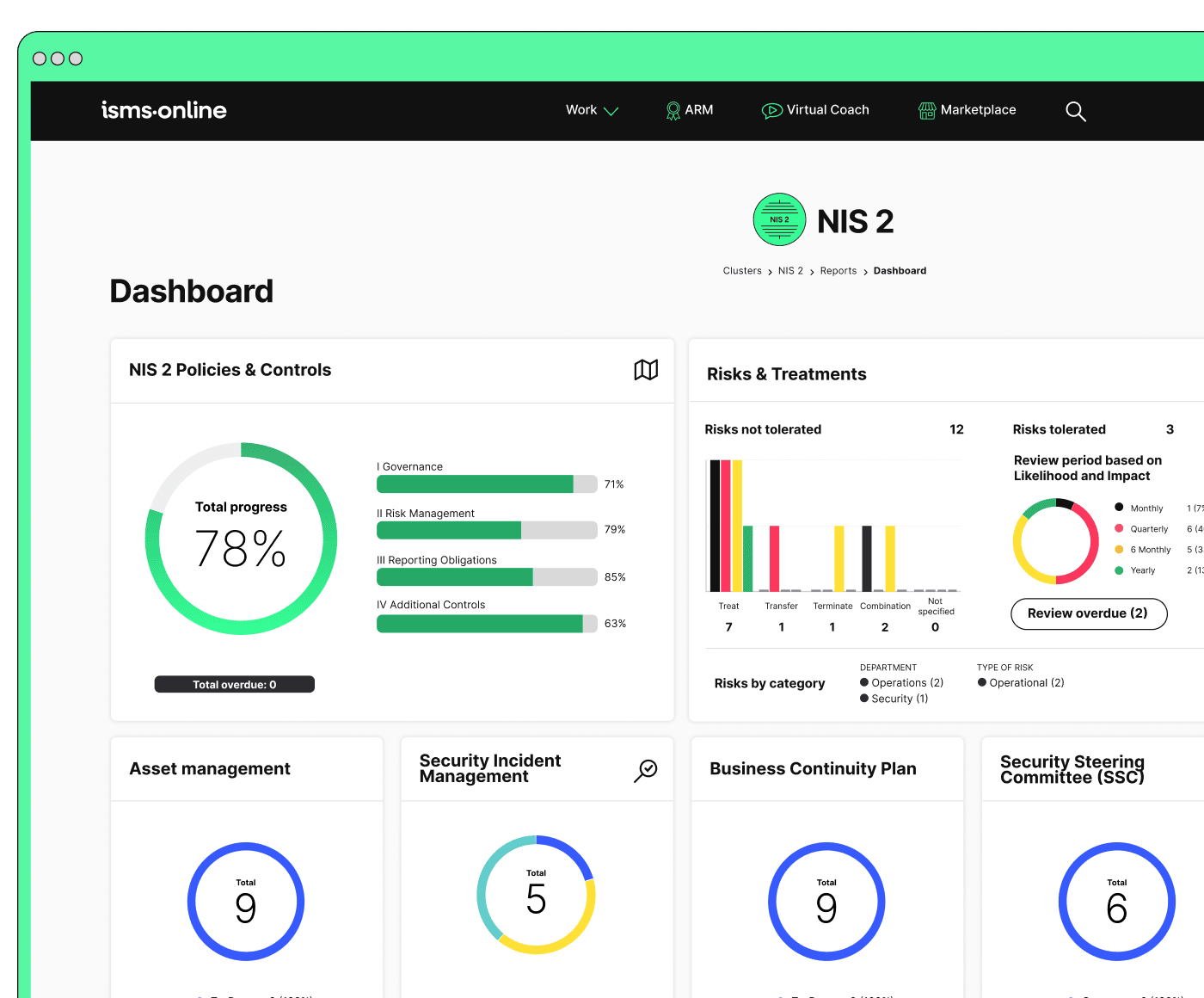
Be NIS 2-ready from day one
Launch with a proven workspace and templates – just tailor, assign, and go.
Country and Sector Goldplating: Why “Lowest Effort” Will Always Fail
Contract compliance must aim for the strictest test-the most demanding regulator or sector overlay where business operates. This principle shields organisations from the chaos of last-minute amendments and “double jeopardy” under varying national and sectoral implementations.
Your contract evidence only works if it passes in every country you operate-not just the most convenient one.
Practical Steps for Multi-Jurisdiction Contracting
- Map every supplier by home sector, law, and local overlays.: Contracts are not “one size fits Europe.”
- Draught addenda for the “strictest denominator”: across your current and forecast jurisdictions.
- Activate deadline-tracking and change-logging in your ISMS.: This ready evidence can buy board goodwill during audit cycles, and regulatory forbearance if changes are underway.
- Involve local counsel when ambiguity arises,: and keep their input logged alongside the clause map for every contract.
- Educate boards and stakeholder committees: with explicit overlays-no generic policy-speak.
ISMS platforms like ISMS.online now provide dashboard visibility into overlays, triggers, and live compliance state-what used to require an army of spreadsheets can now be a 5-minute system review followed by scheduled action.
The Legacy Contract Dilemma-And How to Transition to NIS 2 Compliance Now
Hidden, “pre-NIS 2” contracts are now risk prime. They are the leading root cause of “silent exposure”-undetected until audit or incident. Rapid, systematic transition is crucial for compliance.
Updating contracts isn’t optional. A robust contract lifecycle is the only difference between operational continuity and regulatory pain.
Build a Centralised Contract Register
Centralise all supplier contracts in a digital, searchable register that is kept current and actively tracked. For each contract, log:
- Link to regulated service(s)
- Clause update status and responsible owner
- Risk classification, mapped directly to your ISMS
- Scheduled review and amendment triggers
Leverage Phased Addenda for Critical Updates
Where negotiations are slow or supplier resistance is high, issue targeted addenda with pre-approved language, referencing NIS 2 and territory overlays. Keep amendment and communications logs as formal artefacts-these often count in your favour during audit and can mitigate regulator action if changes are underway (Clyde & Co, 2024).
Evidence Every Step-Even in Transition
If not every contract can be updated before your next audit, maintain a gap-closure log: communications, tracked attempts, and progress. “Credit” is awarded to organisations who show deliberate progress-while silence or omitted logs are penalised.
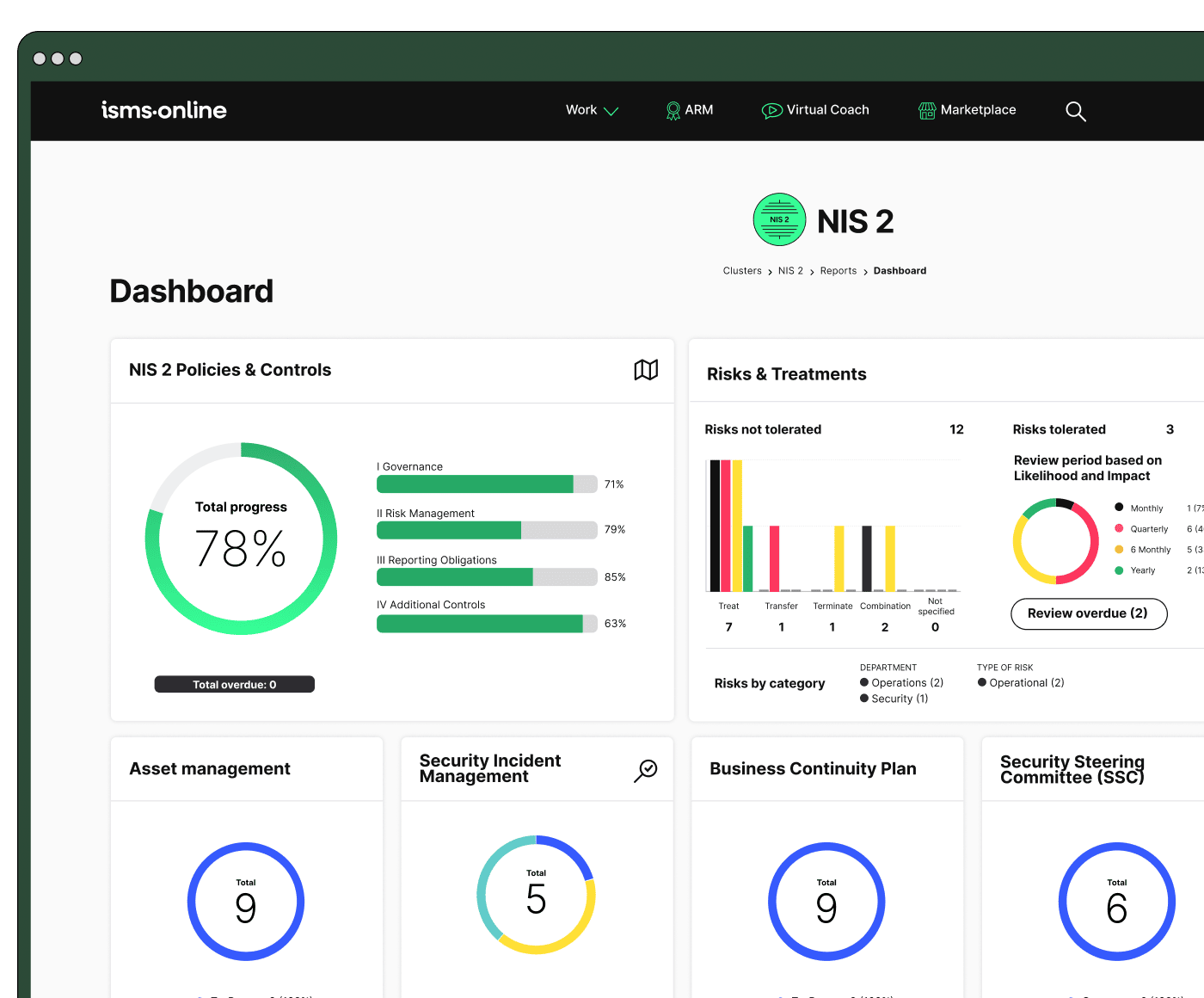
All your NIS 2, all in one place
From Articles 20–23 to audit plans – run and prove compliance, end-to-end.
Bulletproof NIS 2 Clauses: Bridging to ISO 27001:2022 (Table Included)
Not all contract language is created equal. Auditors, and increasingly, boards and legal, require clause schedules that are:
- Explicitly tied to ISO 27001:2022 and Annex A controls: (not just “best practise”).
- Trackable to related risk/action(s): in an ISMS or evidence dashboard.
Contract Policy Mapping Table
| Expectation | Operationalisation | ISO 27001:2022 / Annex A Reference |
|---|---|---|
| Suppliers pose risk | Clauses cover full supply chain and risk acceptance | A.5.19–A.5.22 |
| Incident reporting | Require notification in X hours/days, escalation to contract owner | A.5.19, A.5.21 |
| Right to audit | Grant audit data access and inspection rights (incl. sub-contractors) | A.5.20, A.5.22 |
| Security controls | Specify encryption, access, retention, training; explicit technical terms | A.5.19–A.5.22 |
Traceability in Practise (Mini-Table)
| Trigger | Risk update | Control / SoA link | Evidence logged |
|---|---|---|---|
| Supplier onboards | ISMS risk and control assessment | A.5.21 / SoA item 21 | Contract evidence logged |
| Law changes | Clause review and update scheduled | Board minutes, clause map | Addendum & approval logs |
| Auditor requests proof | Owner assigned, doc review triggered | Audit log/reference | Evidence in ISMS, sign-off |
ISMS.online Example
Every new supplier contract is logged in ISMS.online, against its supply chain control (A.5.21), immediately assigning an owner and evidence trail. Any legal or regulatory change flags contracts and schedules amendments, with communications and review status tracked in the dashboard-giving you an audit-ready trail and proof of “living” compliance at any time.
Traceable, Audit-Proof Compliance-How to Make It Reality
Genuine compliance isn’t static-or stuck in a file share. The only sustainable answer is live ownership, automated evidence cycles, and trackable change logs that reduce panic, not compound it.
Audit-ready is a point-in-time illusion-live ownership and active tracking create real resilience and board confidence.
How the Best Prepare (Persona Diagnostic)
- Every contract is centralised, mapped, and categorised by risk tier.
- ISMS & Annex A reference links plus evidence logs are musts.
- Ownership is assigned, automated reminders and review cycles in place.
- All change and communication logs are tracked, closing any gap between contract updates and audit reality.
- Teams operate through a shared, “single pane of glass” approach for procurement, legal, IT, and compliance.
Automating for Confidence
Failed audits and late evidence submission often boil down to missed reminders or “forgotten” contract tasks. Centralised, automated platforms like ISMS.online trigger renewal, amendment, and review cycles-so contract owners, managers, and execs alike can see their audit status in real time.
A resilient contract lifecycle turns what was once anxiety into an operational advantage and reduces audit cycles to routine milestones.
Proving Contract Compliance to Auditors, Boards, and Regulators
Assurance now means proving action-not merely intent-to every audience: from the line-of-business owner up to the board and out to the regulator.
An audit-proof contract lifecycle is earned, not asserted. If the evidence is centralised, mapped, and updated, audits, regulator visits, and board reviews become dry runs-not surprises.
What Scrutineers Want
- Sample supplier contracts cross-mapped to up-to-date NIS 2 & ISO 27001 controls, with digital logs.
- Evidence of ownership and status tracking-who is in step, who is not.
- Training and incident records confirming contract requirements are actioned, not ignored.
- Cross-jurisdiction overlays managed in one system, ready at speed for any inquiry.
Show Progress (and Earn Goodwill)
Auditors, regulators, and boards all reward clear evidence of ongoing contract health: amendment logs, supplier correspondence, and above all mapped improvement cycles-tracked end-to-end, with nothing left “off the books.”
Benchmarking Well Above Industry Average
Regulatory attention now falls hardest not on “bad actors” but on those who have failed to evolve above bare-minimum compliance. Firms who map their contracts to NIS 2, ISO 27001, and national overlays, then act systematically, have transformed board and audit committee attitudes from “compliance anxiety” to “competitive strength.”
Upgrade Your Contract Compliance-And Board Confidence-With ISMS.online
Your contracts don’t just protect assets-they become active evidence of maturity and trust when mapped, owned, and tracked. The combination of a live register, reminders, and mapped evidence makes every audit or incident an exercise in operational confidence, not a scramble.
With ISMS.online, you can:
- Create and maintain a live contract register for suppliers, mapped across all frameworks and overlays, tied to evidence and ownership.
- Automate contract addenda, renewal cycles, and evidence tracking-removing “fire drill” bottlenecks and boosting team morale.
- Map your policies directly to ISO 27001:2022, NIS 2, DORA, and all relevant laws, ensuring every contract is always ready for its hardest test.
- Transform audits and board briefings from anxiety events to clear demonstrations of diligence, readiness, and leadership.
- Give every compliance or procurement owner confidence that what matters is tracked, gaps are flagged, and evidence is always at your fingertips.
Ready to see how traceable, evidence-driven contract management can win trust, reduce risk, and streamline your next audit? Connect your stakeholders, close every compliance gap, and turn contracts into assets-not liabilities-with ISMS.online.
Frequently Asked Questions
Which supplier contracts actually require NIS 2 security clauses-and when do exceptions apply?
Supplier contracts only require NIS 2 security clauses if the supplier’s services are linked to your regulated “essential” or “important” functions, where their compromise could affect business continuity, operations, or the critical infrastructure obligations mandated by NIS 2 or your national regime. It’s not about universal coverage; it’s about materiality and risk transfer. If you’re relying on a core IT services provider, SaaS vendor hosting customer/regulated data, or any third party whose outage or breach would disrupt your regulatory obligations, your contract must specify NIS 2-aligned terms. Conversely, contracts with suppliers like office cleaning or basic facility management often sit outside scope-unless your national law has “goldplated” NIS 2, as seen in Belgium, the Netherlands, or Germany, where regulators can extend coverage to more categories or lower-tier vendors. Documentation and logic are your best defences: maintain a live register explaining why each vendor contract is in or out of scope, ready for board, auditor, or regulatory review.
Even for exempt suppliers, revisit decisions annually and after major operational changes-regulatory definitions and sector overlays can change quickly.
Contract Scope Table: NIS 2 Applicability
| Supplier Type | Country Example | Clause Mandated? |
|---|---|---|
| Core IT/MSP/Cloud | Germany | Yes-critical supplier |
| SaaS for customer data | Italy | Yes-if supporting key services |
| Office cleaning/facilities | Netherlands | Usually exempt, check overlay |
| Data centre (outsourced ops) | Belgium | Yes-subject to “goldplating” |
| Local catering | France | Generally exempt |
What specific clauses must a NIS 2-compliant contract contain to satisfy audits and regulators?
A NIS 2-compliant supplier contract goes far beyond generic security clauses. It should expressly stipulate:
- Implementable risk controls: -requirements for patch cadence, multi-factor authentication, incident detection, security awareness and regular risk review (Annex A.5.19–A.5.22 / ISO 27001).
- Incident notification: -precise timelines (24–72 hours) for reporting incidents that could affect your essential/important services, with escalation procedures that match or exceed your own notification obligations.
- On-demand audit rights: -the explicit, contractual right to request evidence, audit results, training/compliance logs at any point, not just annually.
- “Flow-down” clauses: -binding subcontractors at every tier, ensuring the entire supply chain is obligated to NIS 2 security expectations.
- Remediation and enforcement triggers: -clear remedies for non-compliance, including suspension, remediation windows, and-if needed-contract termination.
- Mapping to sector overlays or national law: -such as DORA for finance, the Cyber Resilience Act, or stricter national overlays in jurisdictions like Belgium or Germany.
- Supplier staff competence/training requirements: where relevant to risk.
These clauses must be more than formality; auditors now scan for both the substance of the language and evidence that you have activated your rights, issued reminders, and requested proof when prudent.
A contract’s effectiveness is measured by its ability to not just promise outcomes, but to enable action, verification, and enforcement-across the entire supply chain.
Key Contract Topics Table
| Topic | ISO 27001/Annex A Ref | NIS 2 Focus |
|---|---|---|
| Risk management | A.5.19–A.5.22 | Specific controls, real checks |
| Incident Notification | A.5.21 | Timelines, escalation pathways |
| Audit/Evidence rights | A.5.20, A.5.22 | On-demand & detailed |
| Flow-down obligations | A.5.21 | Coverage into subcontractors |
| Remediation / Termination | – | Triggers and clarity |
What risks and liabilities arise if you skip or under-specify NIS 2 terms in supplier contracts?
Treating NIS 2 as a “box-tick” or simply omitting key clauses can expose your organisation to:
- Regulatory fines and enforcement: Under NIS 2, penalties reach up to €10 million or 2% of global revenue for “essential entities,” with direct accountability if a supply chain failure impacts key services. Member States such as Germany and Belgium have made clear they will leverage these powers.
- Delayed incident response and cumulative damage: Without enforceable notification clauses, suppliers may delay informing you of a breach, denying your business-and your customers-valuable response time.
A slow supply chain response turns a containable incident into a career-defining crisis.
- Audit failure and legal risk: Audits now probe not just policy, but the digital contract register, negotiation chains, change logs, and active engagement. A detailed trail (even showing live work-in-progress) is defensible; inactivity is not. The lack of a “plausible rationale” for legacy/exempt contracts is itself a risk finding.
- Reputational harm: Gaps in supply chain governance have been at the heart of recent high-profile regulatory investigations-being unable to show a contract and evidence trail can accelerate business consequences.
Does referencing ISO 27001 in a contract satisfy NIS 2, or are further contract addenda required?
Mentioning ISO 27001 (especially Annex A.5.19–A.5.22) as the baseline is essential, but not sufficient for NIS 2. Regulators expect to see clear mapping to NIS 2-specific expectations, including sector overlays, national law enhancements, and granular evidence for reporting and audit.
Contracts often need schedules or reference documents that:
- Define notification protocols by criticality, service, and jurisdiction.
- Tie sector frameworks (e.g., DORA, CRA) to specific supplier roles and escalation paths.
- Show “living” Statement of Applicability (SoA) mapping between contract clauses and operational controls.
The gold standard is a contract addendum or mapping matrix bridging each supplier’s obligations to your ISMS controls, the NIS 2 articles that apply, and relevant sector overlays. With ISMS.online or similar platforms, these mappings can be generated, updated, and exported for audit or board review.
Contract–Control Traceability Table
| Trigger | Contract Mapping | SoA / Control Ref | Audit Evidence Example |
|---|---|---|---|
| Supplier change | Addendum + SoA update | A.5.21; NIS 2 | Signed log, updated SoA |
| Regulatory update | Dual mapping (DORA/NIS 2) | A.5.20; DORA; NIS 2 | PDF of policy, comms log |
| Board review | Full SoA cross-reference | SoA Register | Exported summary report |
How do you retrofit or “harden” legacy supplier contracts to align with NIS 2?
To upgrade legacy contracts-those written before 2024 or lacking full ISO 27001/NIS 2 terms-follow a risk-prioritised and evidence-rich process:
- Centralise all existing contracts: in a digital register by risk tier, service impact, and renewal cycle.
- Gap-analyse: each contract’s terms against the 2024 NIS 2 guidance, ISO 27001 controls, and national overlays; document which clauses are missing.
- Issue addenda or amendments: for high-risk suppliers first, sending communications and negotiating upgrades while logging all correspondence and outcomes.
- Automate reminders: for renewals and scheduled re-checks, maintaining a timeline of every update and negotiation.
- Maintain a living evidence track: -auditors seek documents under revision and repair as much as final, perfect contracts.
Auditors and regulators reward active management, transparent documentation, and “work in progress.” Absence of activity or vague, unsubstantiated exemptions increasingly trigger findings or fines.
Legacy Contract Hardening Checklist
- Inventory & risk-rank all existing contracts.
- Map each to current NIS 2/ISO requirements.
- Amend contracts in priority order; document every negotiation.
- Use automations (platform reminders) to prevent backsliding.
- Log and export changes for audit trail.
Which countries or sectors have stricter rules, and how should multinational organisations keep up?
Several EU countries (including Belgium, Germany, Italy, and the Netherlands) have “goldplated” NIS 2-expanding required contract clauses or broadening which suppliers are in-scope.
- Belgium: Applies rules across nearly all critical entities, not just “essential services” as defined by the core directive.
- Germany: Imposes personal liability on supplier errors and demands deeper board oversight.
- Italy & Netherlands: Broader contract scope, with compulsory updates on shorter timelines.
Within sectors, overlays like DORA (financial services) and the Cyber Resilience Act (manufacturing) introduce new clauses for audit rights, vulnerability documentation, and data flow tracking.
For multinationals: Safest strategy is to align all contracts to the most demanding applicable jurisdiction or regulatory regime affecting any one of your group entities. Harmonisation means fewer surprises in cross-border audits and streamlined supplier onboarding.
Goldplate Overlay Table
| Country | Affected Sector | Contracting Impact | Strategic Note |
|---|---|---|---|
| Belgium | All critical trade | More suppliers in scope | Don’t use EN thresholds alone |
| Germany | IT/Critical | Board/owner accountability | Document and assign ownership |
| Italy | Retail/cultural | Sector overlays, more tiers | Continual cycle of reviews |
| Netherlands | All sectors | Mandatory short reviews | Use platform for reminders |
How can you make your supplier contract register “audit-ready” and “board-ready” under NIS 2-both today and as requirements evolve?
Audit- and board-readiness starts with maintaining:
- A digital register mapping each supplier, tier, and contract owner, with clause-to-control cross-links.
- Automated schedules for clause review, contract update, and evidence capture-so nothing falls through the cracks when audit season or regulatory reviews hit.
- Complete, searchable logs of all amendments, negotiations, and active supplier communications-exportable at a click for internal (board) or external (audit/regulator) validation.
- Integrated workflows for procurement, compliance, and IT/security to collaborate in real time.
Centralising your system using an ISMS platform, such as ISMS.online, allows compliance to shift from an “audit fire-drill” to a steady, collaborative, and managed business process.
True confidence comes from visibility-when your team can instantly surface and export a contract’s compliance evidence, the next audit becomes an opportunity, not a risk.
What evidence do auditors, regulators, and boards require to prove your NIS 2 contract compliance?
Auditors, boards, and regulators now expect a granular evidence trail:
- Digital copies of contracts: , mapped directly to ISO/NIS 2 clauses, not just generic “we have a contract” assertions.
- Amendment and negotiation logs: -time-stamped, owner-tagged, showing responsive management (not “file and forget”).
- Active owner/lifecycle assignment: for every supplier contract.
- Supplier communications logs: -with risk notifications, evidence requests, and (where necessary) attestation or training proof for key suppliers.
- Overlay documentation: for multinational footprints-how sector frameworks (DORA, CRA), goldplating, or extra jurisdictional overlays are applied and mapped in contract language.
Platforms like ISMS.online make this evidence collection routine. Work in progress, amendment logs, and negotiation histories are all considered valid evidence-so long as your process is systematic, active, and transparent.
How does ISMS.online transform contract management for NIS 2 compliance, board visibility, and audit speed?
ISMS.online centralises and automates the entire contract lifecycle:
- Establish a digital, tiered register mapping contracts to NIS 2, ISO 27001, and local overlays, and assigning named owners.
- Track all communications, amendments, negotiations, and status changes-creating a living audit record.
- Automate reminders for reviews, clause updates, and evidence collection, so deadlines aren’t missed and ownership is never ambiguous.
- Enable all stakeholders-procurement, compliance, security, governance-to collaborate on contract oversight, with transparent workflows and single-source reporting.
- Rapidly export audit-ready evidence packs personalised to regulatory, auditor, or board requests.
The outcome: contracts are no longer unknown risk-they become managed assets, reinforcing trust with customers, board members, and regulators alike.
Board-ready and audit-ready mean evidence isn’t just stored-it’s owned, mapped, and always one step ahead of the next NIS 2 change.






