





































Is Compliance Fragmentation Hurting Your Cyber Resilience?
When most security and privacy leaders survey their operational landscape, it isn’t hackers who keep them up at night-it’s the labyrinth of disconnected requirements, siloed reporting, and the growing drag of administrative sprawl. Fragmentation is more than an inconvenience: it’s a silent risk multiplier, eroding your cyber resilience right as threats and regulatory fines escalate.
Every extra spreadsheet and redundant checklist is an open invitation for audit gaps and fatigue.
Contemporary European regulation is layered and fast-moving. In a single incident-such as a ransomware breach-your team might face three separate, overlapping reporting regimes: NIS 2, DORA, and GDPR. Each one has its own definition of a breach, its own trigger, its own clock, and sometimes, its own reporting channel. What begins as an IT security event quickly surges into a legal, reputational, and regulatory crisis. Cross-regulator confusion isn’t a theoretical concern: it is the new normal, and personal liability now travels upstream to your board, raising the stakes with each new directive.
Years ago, an ISO certificate might have sufficed in annual reviews to prove diligence. That era is over. Today, a disconnected ISMS exposes your gaps, not your strengths, as soon as you’re under investigation (isms.online). When your asset registers, incident logs, or supplier assessments sit in separate tools-or worse, require manual collation-the risks of audit failure, delayed breach response, or regulator sanction multiply.
Imagine: Instead of hunting through mismatched logs and email chains, your whole environment-suppliers, audits, contracts, role assignments-can be surfaced in a few clicks. The security leader becomes a resilience champion, ready for regulators or auditors at any moment. The alternative-status quo, with fragmented manual processes-erodes confidence and exposes your business to reputational and regulatory shocks.
The time for defensive, piecemeal compliance has passed. In a world where agility and evidence mean the difference between trust and liability, unifying your compliance approach is now the only credible strategy.
Does ISO 27001 Make You NIS 2-Ready, or Is More Required?
ISO 27001 remains foundational to any modern security programme, but relying on it alone to satisfy NIS 2, DORA, or GDPR will leave you with unaddressed gaps and weak spots-especially around notification, board accountability, and supplier management.
NIS 2, building on the foundation of the original NIS Directive, moves governance from “just IT” into the boardroom. It prescribes board-level accountability and adds teeth to enforcement with direct liability. It also mandates evidence-rich risk treatment processes and, most crucially, validation of your full supply chain’s security and resilience.
DORA dramatically tightens deadlines in financial services and critical digital infrastructure. If ISO 27001 imbues your organisation with structure and procedure, DORA bolts on demands for true “operational resilience”-requiring 4-hour incident notifications, robust supply chain controls, and relentless testing of your recovery protocols.
GDPR, meanwhile, makes privacy and subject rights enforcement a lived, organisational reflex, not a one-time project. Breach notification, lawful basis mapping, processor contracts-these must be traceable and instigated by live events, not routine reviews.
ISO 27001 remains the “skeleton”-encoding risk, policy, asset management, and control. But NIS 2, DORA, and GDPR build the muscle, nerve, and reflexes that move compliance from documentation to resilience in motion. Together, their expectations look like this:
| Framework | Core Focus | What’s Extra Compared to ISO 27001? |
|---|---|---|
| NIS 2 | Board accountability | Named board responsibility, explicit supplier testing |
| DORA | ICT resilience | Four-hour notification, third-party contracts, annual tests |
| GDPR | Privacy governance | SAR management, processor oversight, 72h notification |
Relying on ISO 27001 alone for ongoing compliance is like installing a steel door but forgetting the lock: the appearance of security is not the same as functional, audit-ready resilience.
Modern ISMS platforms allow your ISO controls to underpin a dynamic, cross-mapped compliance system: Changes in risk or supplier status automatically update your NIS 2 and DORA registers, and privacy controls stay linked to asset governance. That’s your future, and it’s audit– and regulator–ready by design.

Master NIS 2 without spreadsheet chaos
Centralise risk, incidents, suppliers, and evidence in one clean platform.
How Do Incident Notification Timelines and Triggers Differ Across NIS 2, DORA, GDPR, and ISO 27001?
Incident notification in a post-NIS 2 world is no longer a back-office routine. It’s a live, multi-channel performance-with severe consequences if you miss a cue.
Each framework sets a different reporting clock, a different trigger threshold, and assigns responsibility to different roles:
| Incident Expectation | Owner | Trigger | Reporting Deadline | Reference |
|---|---|---|---|---|
| DORA | Compliance/IT | Material ICT incident | 4 hours | DORA Arts. 17-21 |
| NIS 2 | Board/CISO | Significant cyber event | 24h alert, 72h update | NIS 2 Arts. 23-24 |
| GDPR | DPO | Personal data breach with harm | 72 hours | GDPR Arts. 33-34 |
| ISO 27001 | Risk/Control Owner | Any information security incident | Plan-defined | ISO 27001 A.5.24–A.5.28 |
Miss your notification window and risk isn’t limited to fines. Boards face personal scrutiny, and the company can incur legal and reputational damage. Regulatory action is coordinated; there may be parallel investigations across frameworks. In the worst cases, business operations are disrupted by auditor queries or loss of partner trust.
Regulators expect you to show, not just say, that the right incident triggered the right notification, handled by the right person-and mapped to live risk controls.
Suppose a ransomware event is detected at noon: By 16:00, your DORA notification is mandatory. But the GDPR 72h clock also started ticking, and NIS 2 requires both early warning and updates-plus evidence of board awareness. If your playbooks and ISMS aren’t cross-referenced and automated, even a best-in-class ISO certificate becomes window dressing.
High-maturity organisations now centralise incident triggers, responsibilities, and notification channels within living ISMS registers-surfacing the event, alerting relevant roles, and logging notifications by framework, automatically. This reduces silos, closes regulatory gaps, and transforms audit from “panic” into “routine proof”.
How Do You Move Third-Party and Supply Chain Security from Paper to Real-Time Assurance?
If you’re relying on annual supplier risk reviews or onboarding checklists, you’re already behind-modern frameworks have raised the bar to continuous oversight. Third parties and supply chain actors are now a primary path for regulatory scrutiny and actual cyber incidents ([NIS 2, Arts. 21, DORA Arts. 25-30, GDPR Arts. 28-29]).
| Supply Chain Requirement | Modern Action Steps | Framework Reference |
|---|---|---|
| NIS 2 | Live supplier tracking, risk scoring, incident linkages | Arts. 21.2(d-e), Recital 49 |
| DORA | Real-time monitoring, periodic board review, mandatory exit | Arts. 25-30 |
| ISO 27001 | Mapped onboarding/offboarding, risk-based contract review | A.5.19–A.5.22 |
| GDPR | Due diligence, up-to-date records, joint liability protocols | Arts. 28-29 |
The board now owns not just your controls, but those of your partners and their vendors-third- and even fourth-party risk is every bit as material as internal failure.
During any real incident (e.g., breach at your critical vendor), regulators now expect a full paper trail: supplier contracts, DPAs, third-party risk reviews, evidence of last audit/update, and incident linkage-all in minutes, not days.
Supervisory authorities insist on immediate proof of supplier due diligence, monitoring, and documented escalation points through the entire chain-of-control (EDPB Guidelines, 2024).
Modern ISMS like ISMS.online embed these requirements: They automate onboarding, pre-schedule due diligence, allow instant status updates, and directly tie every supplier to the relevant asset, risk control, and evidence chain (isms.online). For resilience leaders, every vendor record is traceable, live, and one incident away from immediate recall-no spreadsheets, no ambiguity.
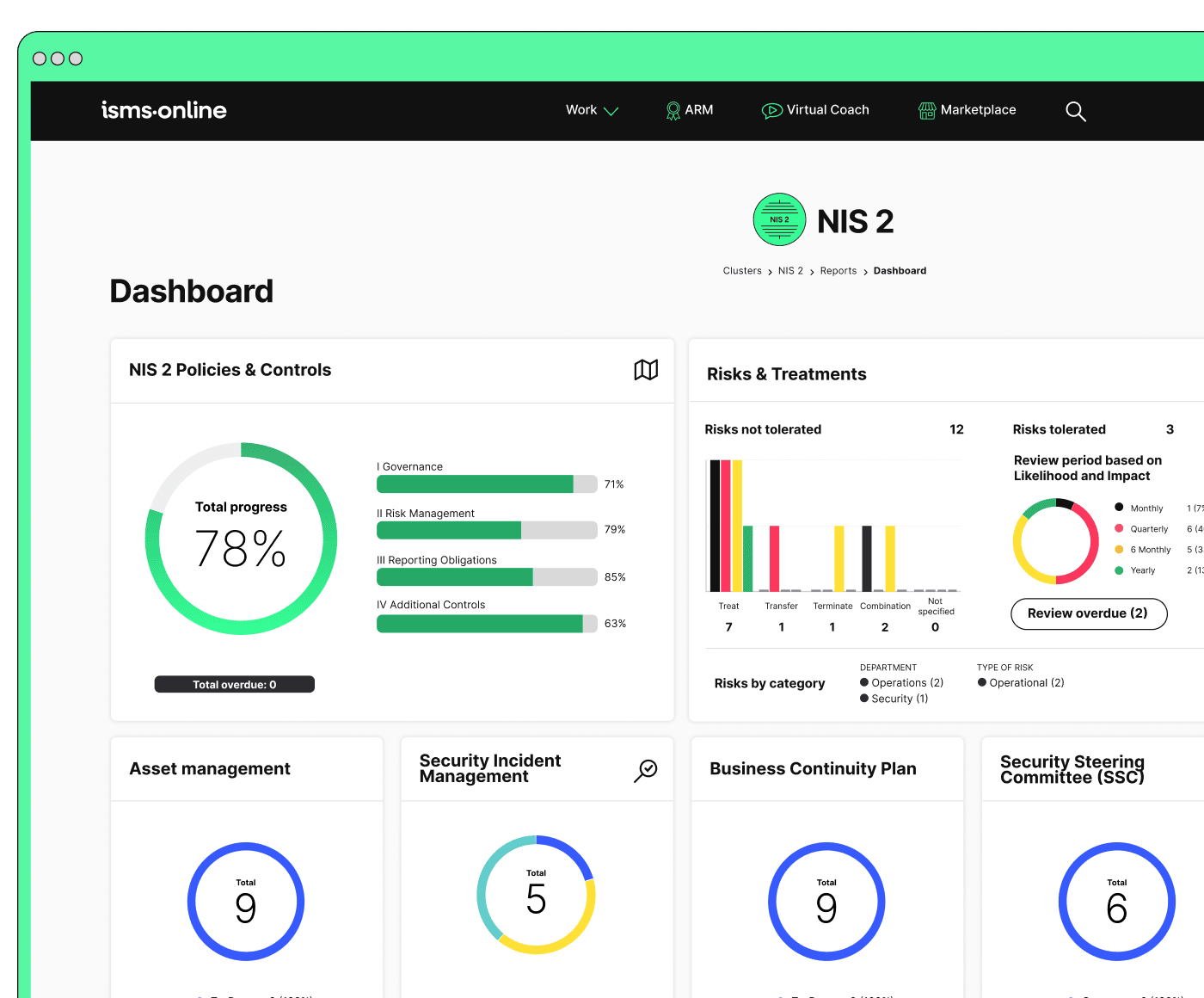
Be NIS 2-ready from day one
Launch with a proven workspace and templates – just tailor, assign, and go.
What Does Real Role Clarity and Board Accountability Now Require?
The era of ambiguous, “floating” responsibility is over. A named board member or officer must now stand visibly behind cyber risk, incident escalation, supplier oversight, and audit reviews. For privacy, DPO and CISO/IT security roles must be independent and regularly reviewed for conflicts ([GDPR Art.38, ISO 27701 Cl. 5.3.1, NIS 2 Art. 20, DORA Art. 5]).
| Role/Accountability | Proof & Processes | Framework Reference |
|---|---|---|
| Named board cyber role | Board minutes, risk dashboard, SoA sign-off | NIS 2 Art. 20; DORA Art. 5 |
| DPO/CISO separation | Org chart, conflict-of-interest (COI) logs | GDPR Art.38; ISO 27701 5.3.1 |
| Board risk review | Management review minutes, KPIs to board, audit log | ISO 27001 Cl. 9; NIS 2 Art. 21 |
If you’re still running with “shared” accountability-where one person covers three jobs, or roles drift over time-you’re building audit risk. Modern ISMS platforms enforce explicit assignments, enable annual role reviews, and ensure all accountability can be surfaced on demand. Role drift isn’t just bad practise under NIS 2 and DORA-it’s a documented, finable offence.
In resilient teams, the compliance leader isn’t a silent admin-it’s a named officer, hard-coded into the audit trail, with risk and supplier lines mapped unambiguously.
By using a living ISMS, board sign-off is tied to each policy, each incident, and every supplier onboarding, closing loops that manuals and spreadsheets cannot. This lifts compliance from box-ticking to true legal defensibility.
Where Do Cross-Framework Controls Overlap-And Where Do Gaps Still Expose Risk?
Cross-mapping of expectations is the battleground for modern audit-and where the savviest teams find both efficiency and risk.
| Audit Expectation | Operationalisation | ISO 27001/Annex Reference |
|---|---|---|
| Board governance | Board minutes, dashboards, signed SoA | Cl. 5, 9; A.5.1, A.5.2 |
| Supplier oversight | Supplier registry, onboarding, linkage | A.5.19–A.5.22 |
| Incident logging | Live incident register, notification | A.5.24–A.5.26 |
| Role independence | Mapped org chart, annual review | ISO 27701: 5.3.1; GDPR Art.38 |
| Evidence traceability | Risk-control-incident-supplier links | Cl. 7.5, 9.2, 9.3, A.5.35 |
Static control registers are audit-day mirages; living links between people, assets, risks, and suppliers are proof of real resilience.
Most organisations neglect one or more of these: they may have a polished SoA but lack board sign-off; robust supplier onboarding but no risk-linked incident trail; team assignments that haven’t been updated in years. This is where audit failure happens.
In a unified ISMS platform, every control, supplier, risk, and role can be seen live, mapped across frameworks, and kept up-to-date through automation-not annual review. That turns “maybe” compliance into routine, continuous audit readiness.
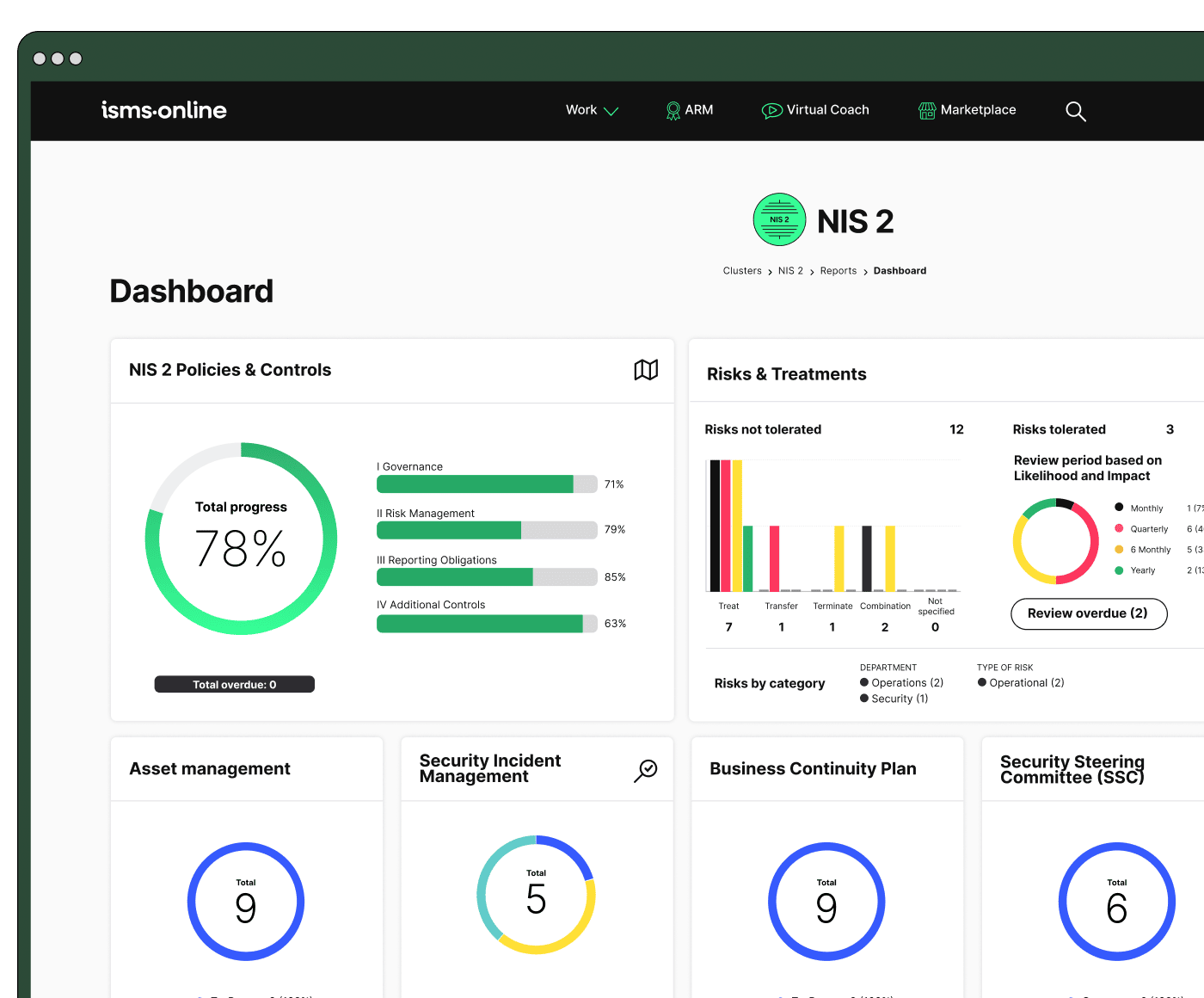
All your NIS 2, all in one place
From Articles 20–23 to audit plans – run and prove compliance, end-to-end.
What Does Unified, Audit-Ready Compliance Look Like in Practise?
What does audit resilience mean today? Not a flurry of last-minute emails and spreadsheet untangling-but living, always-on cross-links between controls, incidents, roles, suppliers, and evidence.
| Trigger | Risk Update | Control / SoA Link | Evidence Logged |
|---|---|---|---|
| Supplier onboarded | Automated supply chain risk review | A.5.19–A.5.21 | Vendor reg, contract, onboarding doc |
| Incident declared | Risk escalation, notification log | A.5.24–A.5.26 | Incident pack, management review |
| Policy updated | Tolerance and risk record refresh | Cl.5, 9.3 | SoA revision, board sign-off |
| Annual review | Full risk/control review | A.5.35, 9.2 | Mgmt review pack, updated KPIs |
In a high-maturity environment, these links update instantly and surface evidence (with time stamps, role signatures, and history) at a moment’s notice. If your board asks for proof, or a regulator inquires, it’s a matter of minutes-not days or weeks.
The real compliance champions aren’t spreadsheet warriors; they’re the teams with living, always-on audit links-earning trust through readiness, not just reports.
That’s the expectation ISMS.online delivers. All controls, risks, suppliers, roles, and proof are interconnected and always available, fundamentally abolishing the “last-minute scramble” for audit success.
How Do Proof, Traceability, and Evidence Now Determine Audit Outcomes?
Audit outcomes are no longer determined by who works hardest, but by which teams have a living system of compliance proof-traceable, up-to-date, and already board-endorsed. If your ISMS still relies on out-of-date exports or manual collation, you risk more than just a poor auditor review: fines, reputational risk, and executive liability can follow.
Static evidence collapses under stress; only living traceability supports evolving frameworks and real-time threats.
Unified ISMS frameworks like ISMS.online are designed around this principle: Every role, every risk, every action or update is assigned, linked, and surfaced on demand. Audit success becomes a routine affirmation, not a heroic rescue. Teams become trusted compliance heroes-confident, board-ready, and respected across the organisation.
This is your opportunity: to embed continuous trust by design, move beyond reactive compliance, and not only pass the next audit, but lead your industry in cyber resilience.
Start Confident, Stay Audit-Ready with ISMS.online
Hidden compliance costs-manual searches, year-end chases, opaque role assignments-are visible at every incident or audit. They slow your business, erode leadership trust, and make recovery harder when it matters most.
ISMS.online is designed to solve this. It unifies policies, controls, assets, risks, suppliers, contracts, and board assignments across frameworks (ISO 27001, NIS 2, DORA, GDPR), linking updates and evidence in real time. Compliance leaders become recognised for resilience-not firefighting-earning board trust, regulatory respect, and operational peace of mind.
Ready to become your organisation’s compliance hero? Audit-day confidence starts now.
Be known for seamless evidence, ready roles, and cross-framework proof-so your board, customers, and regulators believe you’re always one step ahead.
Frequently Asked Questions
How can you rapidly align NIS 2, ISO 27001, DORA, and GDPR controls without duplicating your efforts?
You can rapidly align NIS 2, ISO 27001, DORA, and GDPR controls by centralising your compliance operations and “mapping once, updating everywhere.” Rather than duplicating evidence or re-documenting the same process in silos, build your information security management process around a unified control framework-anchored in ISO 27001-and extend it out to capture the unique demands of NIS 2 (sector cyber resilience, board sign-off), DORA (financial ICT risk, hyper-rapid incident notifications), and GDPR (privacy and SAR management). This approach not only saves weeks of manual effort but also makes regulatory changes or business expansion far less disruptive, since updates in one area ripple through to all relevant standards.
Real compliance maturity isn’t a checklist; it’s a living system: when you map controls once and set evidence to auto-update across obligations, you outpace change, minimise audit fatigue, and protect reputation across every new law and customer audit.
Where do the controls converge, and where must you customise?
| Expectation | Operationalisation | ISO 27001 / Annex A Ref | Additional (NIS 2, DORA, GDPR) |
|---|---|---|---|
| Risk Management | Live register, board minutes, SoA | Cl. 6, 8, A.5–A.8 | Named approval, sector escalations |
| Supplier Oversight | Linked logs, onboarding, due-diligence | A.5.20–A.5.21 | Real-time checks, processor contracts |
| Incident Notification | Workflow mapping, notification logs | A.5.24–A.5.27 | 4/24/72 hour legal triggers |
| Privacy Obligations | Policies, training logs, SAR track | A.5.34, A.6.3 | DPO leads, SARs evidence, processor logs |
A cloud-based platform like ISMS.online automates the crosswalk, capturing every update, audit trail, or contract change, while flagging when new obligations (e.g. NIS 2 risk harmonisation, DORA incident clock) require a process tweak or secondary sign-off.
How do incident notification timelines and obligations actually differ between NIS 2, ISO 27001, DORA, and GDPR?
Incident notification rules create an intricate web-each framework launches its own clock, sometimes starting with the same trigger but running on vastly different deadlines and affected roles. DORA is the tightest: a major ICT or security incident must reach regulators within 4 hours if you’re in financial services. NIS 2 mandates an early warning in 24 hours, a status update by 72 hours, and a wrap-up report, covering critical infrastructure and “important” entities. GDPR requires notification for personal data breaches within 72 hours-to both authorities and potentially individuals. ISO 27001 lets you choose your organisation’s timeline, but you risk falling short if even one legal minimum is missed.
The same cyber event can ignite three or more legal deadlines-the only way to avoid cascading fines and reputational fallout is by mapping playbook triggers and responsibilities across all, rather than hoping one size fits all.
Obligations Matrix
| Framework | Responsible Role | What Counts | Deadline |
|---|---|---|---|
| DORA | Compliance Officer | Major ICT/security incident | 4 hours |
| NIS 2 | Board / CISO | Significant cyber incident | 24h warn/72h rpt |
| GDPR | DPO | Personal data breach | 72 hours |
| ISO 27001 | Control Owner | Info sec. incident | Policy defined* |
*Always ensure your internal ISMS rules never undercut the most stringent legal requirement.
Will ISO 27001 certification alone make us compliant with NIS 2, DORA, or GDPR?
No-while ISO 27001 is an indispensable backbone, evidencing your core risk, policy, and control management, it doesn’t fully satisfy NIS 2, DORA, or GDPR. Modern regulations expect explicit board accountability, rapid and role-specific incident reporting, processor oversight, and proof of privacy officer independence-requirements that go beyond ISO 27001’s more flexible, principle-based clauses. To close the gap, map each legal layer directly to your Statement of Applicability, update board review and sign-off logs, and automate linkages from every control to the new obligations these laws impose.
ISO 27001 proves you do compliance; NIS 2, DORA, and GDPR demand you name the accountable person, show rigorous speed, and defend rights in realtime.
Coverage Table
| Domain | What ISO 27001 Delivers | Where NIS 2/DORA/GDPR Stretch Further |
|---|---|---|
| Board Accountability | Management reviews | Named liability, signed SoA |
| Supplier Management | Supplier controls | Real-time due diligence, sector contract logs |
| Incident Notification | Custom deadline | 4/24/72hr legal clock, proof of action |
| Subject Rights & Privacy | Policy & training ref | SAR logs, DPO independence, audit evidence |
Staying ahead of law: formalise board signatures, automate privacy/due-diligence trails, and continuously update incident reporting flows.
What’s required to prove real-time supplier and third-party compliance, not just annual checks?
“Once-a-year” supplier reviews and spreadsheets are inadequate-supervisors and auditors now look for continuous, mapped evidence. Full compliance means:
- All vendors tied to asset registry and explicit contract owners.
- Automated logging of onboarding, offboarding, and contractual status changes.
- Every third-party incident cross-referenced to contracts, risks, and asset owners.
- Contract language updated for sector obligations (NIS 2 Art. 21, DORA Arts. 25–30, GDPR 28/29).
- Real-time dashboard flags lapsed or missing evidence, triggers for reviews and contract renewal.
Supplier risk management has become a living control-failure to evidence diligence, quick response, or map supply chain to risk and incident logs is now a finable gap.
Real-Time Compliance Checklist
- Vendors registered, mapped to assets and contract owners
- Onboarding/offboarding/contract changes logged
- Quarterly and trigger-based due diligence updates
- Processor and third-party incidents logged, linked to SOA
- Evidence exportable and review-ready at all times
How do you achieve full role clarity and legal board accountability under modern compliance laws?
Legal compliance goes beyond “management responsibility”-every critical asset, control, and incident must name a single accountable person, with proof of sign-off, independence, and annual review. NIS 2 and DORA demand signed evidence of board review and liability; GDPR mandates DPO independence and privileged communication; ISO 27001 expects management “commitment” but not proof by name/date. Your ISMS must track:
- Role assignments for each asset, control, and governance process
- Annual independence and re-authorization logs, especially for the DPO
- Board/CISO sign-off on each major risk, control, and incident log
Accountability isn’t an org chart-it’s in the log: Who signed, what, when, and did it meet legal tests of independence and timeliness?
Responsibility Mapping
| Role | Required Evidence | Mapping To Laws |
|---|---|---|
| Board | Signed SOA, review minutes, log | NIS 2 Art. 20, ISO 27001:2022 |
| CISO | Incident/control assignments, logs | NIS 2, DORA, ISO 27001:2022 |
| DPO | SAR privacy logs, independence proof | GDPR, ISO 27701, NIS 2 |
Track and export everything-your ISMS.online environment auto-links each proof for every audit or regulatory request.
What does “always-on,” evidence-driven, audit-ready compliance look like in practise?
“Always-on” compliance means every supplier, asset, incident, or policy update automatically triggers risk, control, and governance logs-linked directly to board review, with time-stamped evidence ready for any audit or regulator. This approach eliminates the last-minute scramble and builds trust both internally (board/leadership) and externally (customers/auditors), cementing your organisation’s reputation as resilient and trustworthy.
- Onboarding a new supplier instantly updates asset, risk, and contract maps
- Incident detection auto-assigns notifications, deadlines, and log trails
- Policy or control change logs responsible owner, timestamp, and triggers required board/CISO sign-off
Audit heroes aren’t lucky-they’re always-on: every process, role, and risk mapped and ready before the auditor even asks.
Live Traceability Example
| Trigger | Risk/Asset Update | Control/SoA Link | Evidence Log | Board/CISO Sign-off | Regulator Notified (if required) |
|---|---|---|---|---|---|
| New supplier onboarded | Yes | Yes | Yes | Yes | As law demands |
| Major incident detected | Yes | Yes | Yes | Yes | As law demands |
For organisations ready to step up, platforms like ISMS.online operationalise this model-making audit pass rates, regulatory peace of mind, and stakeholder trust a true asset you can show. Ready to move your compliance from reactive to reputation-building?






